Oldest written melody in history

January 17, 2011

There is the oldest known animated cartoon, 5,200 years old.  There is the oldest known musical instrument, between 7,000 and 9,000 years old.

Now, also, here is the oldest known written melody, too – from 1400 BCE.

Are we to assume that for at least 5,000 years, music was all improvised?  Would that make jazz the oldest musical form?

In the YouTube comments, there is what may be oldest known copyright dispute, too.

Michael Levy performs on the lyre in the video, and he’s the authority on ancient music who put the thing together.  His explanation and website offer a lot more that teachers of world history might use to bring these ancient arts to life.  He explained at YouTube:

This unique video, features my arrangement of the 3400 year old “Hurrian Hymn no.6”, which was discovered in Ugarit ,ancient northern Canaan (now modern Syria) in the early 1950s, and was preserved for 3400 years on a clay tablet, written in the Cuneiform text of the ancient Hurrian language – it is THE oldest written song yet known! Respect, to the amazing ancient culture of Syria…السلام عليكم

Although about 29 musical texts were discovered at Ugarit, only this text, (text H6), was in a sufficient state of preservation to allow for modern academic musical reconstruction.

In short, the Cuneiform text clearly indicated specific names for lyre strings, and their respective musical intervals — a sort of “Guitar tablature”, for lyre!

Although discovered in modern day Syria, the Hurrians were not Syrian — they came from modern day Anatolia. The Hurrian Hymn actually dates to the very end of the Hurrian civilisation (c.1400BCE) . The Hurrian civilization dates back to at least 3000 BCE. It is an incredible thought, that just maybe, the musical texts found at Ugarit, preserved precious sacred Hurrian music which may have already been thousands of years old, prior to their inscription for posterity, on the clay tablets found at Ugarit!

My arrangement here, is based on the original transcription of the melody, as interpreted by Prof. Richard Dumbrill. Here is a link to his book, “The Archeomusicology of the Ancient Near East”:
http://bit.ly/d3aovp

A photograph of the actual clay tablet on which the Hurrian Hymn was inscribed, can be seen here:

http://phoenicia.org/music.html

The melody is one of several academic interpretations, from the ambiguous Cuneiform text of the Hurrian language in which it was written. Although many of the meanings of the Hurrian language are now lost in the mists of time, it can be established that the fragmentary Hurrian Hymn which has been found on these precious clay tablets are dedicated to Nikkal; the wife of the moon god.

There are several such interpretations of this melody, but to me, the fabulous interpretation just somehow sounds the most “authentic”. Below is a link to the sheet music, as interpreted by Clint Goss:

http://www.flutekey.com/pdf/HurrianTa…

In my arrangement of the Hurrian Hymn, I have attempted to illustrate an interesting diversity of ancient lyre playing techniques, ranging from the use of “block and strum” improvisation at the end, glissando’s, trills & tremolos, and alternating between harp-like tones in the left hand produced by finger-plucked strings, and guitar-like tones in the right hand, produced by use of the plectrum.

I have arranged the melody in the style of a “Theme and Variations” – I first quote the unadorned melody in the first section, followed by the different lyre techniques described above in the repeat, & also featuring improvisatory passages at the end of the performance.

I am also playing the lyre horizontally – a much more authentic playing position, as depicted in ancient illustrations of Middle Eastern Lyre players:

http://www.hebrewhistory.info/factpap…

This also seems a much more stable playing position to me, and I find it much easier to improvise with string-blocking etc when the lyre is held in this manner.

My arrangement of the melody is much slower than the actual academic interpretation – I wanted the improvisations in the variations on the theme to stand out, and to better illustrate the use of lyre techniques by a more rubato approach to the melody.

All of my 9 albums of mystical, ancient lyre music are now available from iTunes . . .

1)”An Ancient Lyre”: http://bit.ly/dhCozi

2)”King David’s Lyre; Echoes of Ancient Israel”: http://bit.ly/9PCIua

3)”The Ancient Biblical Lyre”: http://bit.ly/9hTDje

4)”Lyre of the Levites”: http://bit.ly/9baWuM

5)”Apollo’s Lyre”: http://bit.ly/dhCozi

6)”Ancient Times — Music of The Ancient World”: http://bit.ly/aRF5PD

7)”The Ancient Greek Modes”: http://bit.ly/cZks0o

8)”The Ancient Greek Lyre”: http://bit.ly/bxO7Ra

9)”Ancient Visions — New Compositions for an Ancient Lyre”: http://bit.ly/dCPmRN

Physical CDs are also available anywhere in the world from CD Baby, for 3 of my best selling albums:

“An Ancient Lyre”: http://www.cdbaby.com/cd/mlevy4

“King David’s Lyre; Echoes of Ancient Israel”: http://www.cdbaby.com/cd/mlevy

“Lyre of the Levites”: http://www.cdbaby.com/cd/mlevy2

For full details about my albums of lyre music, and the fascinating ancient historical background, please visit my official website:

http://www.ancientlyre.com

Tip of the old scrub brush to Pharyngula, who used the video only in passing, oddly enough.


A real missed anniversary: Death of Hiram Walker, defendant in the case of Rose 2d of Aberlone

January 16, 2011

Another missed anniversary on January 12.

Detroit grocer Hiram Walker, founder of St. Mary's Church

Detroit grocer Hiram Walker, defendant in the case of Rose 2d of Aberlone, Sherwood v. Walker; it is one of the most famous contracts cases in American law. No photo of the cow was found.

Hiram Walker — yes, that Hiram Walker — died on January 12, 1899.  He was a Detroit grocer, and distiller, but dabbled in a lot of businesses.  Among those dabbles:  Land and cattle.

Every law student knows about Walkers dealing in one particular cow:  Rose 2d of Aberlone.

In addition to these notable accomplishments, Mr. Walker was also a cattle breeder and was party to a famous contracts case known as “The Pregnant-Cow Case.” (33 N.W. 919 (Mich. 1887).) According to the majority opinion, Walker agreed with Theodore Sherwood, a banker, to sell him a cow of distinguished ancestry known as “Rose 2d of Aberlone”. The price was $80, both parties believing Rose to be sterile. When Walker discovered that she was pregnant and worth between $750 and $1,000, he refused to deliver her. Sherwood sued and prevailed in the trial court, but lost on appeal. This case illustrates the contract law rules of rescission of contract by mutual mistake. Because both parties believed they were contracting for a sterile cow, there was a mutual mistake of fact, and therefore ground for rescission. However, the dissent in the case, written by Justice Sherwood, notes that Sherwood believed that Rose “might be made to breed” and purchased her on that chance.

Mutual mistake.  Rescission.  What law student doesn’t cram that case before the final?

Sherwood v. Walker 33 N.W. 919 (Mich. 1887).  The Pregnant Cow Case. (Short version here.  Is a full-text version available on-line for free?  History of the case from the Michigan Courts History site, here.) Fans of the Coen brothers’ True Grit may want to note it was a case in replevin.

No, the case did not settle the issues of replevin nor rescission.  We’re talking law, not the movies. “Thus and such is the law, except sometimes,” as our

When can a person get out of a contract?  When both parties are mistaken about key properties of the object of the contract, one party can back out.

The Michigan Supreme Court held that a party who has given apparent consent to a contract of sale may refuse to execute it, or may void it after it has been completed if the consent was founded, or the contract made, upon the mistake of a material fact—such as the subject matter of the sale, the price, or some collateral fact materially inducing the agreement—and this can be done when the mistake is mutual. Where the item actually delivered or received is different in substance from the thing bargained for and intended to be sold, there is no contract. However, if it is only a difference in some quality or accident, even though the mistake may have been the actuating motive to the purchaser or seller, or both, the contract remains binding. Where a cow was contracted to be sold upon the understanding of both parties that she was barren and useless for breeding purposes, and it appeared that such was not the case, the vendors had a right to rescind the contract, and refuse to deliver the property. The Cow Case has since received attention as, literally, a textbook example of contract law issues.  (Wallace D. Riley, President, Michigan Supreme Court Society)

Hiram Anderson, the defendant in Sherwood v. Walker, died 112 years ago, January 12.

The contract controversy rages on.

Comedians should be able to find many straight lines in that history.

More:


Typewriter of the moment: Daniel Patrick Moynihan’s policy machine and crystal ball

January 15, 2011

Daniel Patrick Moynihan at his typewriter - photo from the American Academy of Political and Social Science

Daniel Patrick Moynihan at his typewriter – photo from the American Academy of Political and Social Science

This photo adorns the page announcing and asking for nominations to the annual Daniel Patrick Moynihan Prize, at the site of the American Academy of Political and Social Sciences.

Moynihan was the always-opinionated, rarely un-informed social scientist who caused a firestorm of criticism to rain down on Richard Nixon when Moynihan, working for Nixon, suggested that civil rights might benefit from a period of  “benign neglect” by the President.  Later he caused another firestorm, and along period of reflection, when he worried in a paper about the potential bad effects of social welfare programs that would ease suffering, but fail to achieve all of their loftier goals — the workers compensation program that could not restore a worker to full service, the program to provide food and shelter to the children of out-of-work parents if the parents could not find new jobs, etc.  He worried about the ‘culture of poverty.’

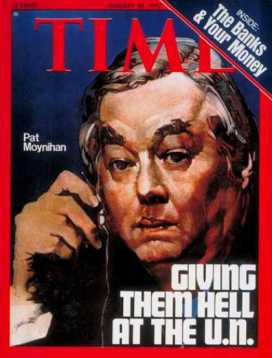
He raised hell as the U.S. Ambassador to the United Nations.

Time Magazine cover of UN Ambassador Daniel Patrick Moynihan

Time Magazine cover of UN Ambassador Daniel Patrick Moynihan

I knew him as the U.S. Senator from the State of New York, where he would shock his staff by showing up early on a Saturday morning to knock out a few letters to the editor, and op-ed pieces on his typewriter, without the bother of an in-session Senate to slow him down.  Later I worked for Checker Finn, who had worked with Moynihan when Moynihan was U.S. Ambassador to India.  Finn adopted many of his scholarly habits from Moynihan.  While working for Finn, nearly 25 years ago at the Department of Education, I got a taste of the world to come when Finn aggressively adopted e-mail messaging for himself and anyone of any executive influence under him, at the old Office of Educational Research and Improvement (OERI).  Aggressive adoption of new technologies can greatly improve organizations and organizational effectiveness.

Almost always with a bow tie.  Usually heavily editing his speeches, or writing his own op-ed pieces while other officials paid ghosts to do it for them.  Thinking thoughts Republicans would come to love, while a Democrat, but years before Republicans would come to love them.  Thinking thoughts Democrats would learn to love, but much later.

Few topics evaded his attention and careful thought.  He talked at length with David Gergen about the problem of Wikileaks, a dozen years before Wikileaks came to public attention (and years before Wikileaks even existed.)  He wrote books about international affairs, and education at home.  He pushed environmental laws to be better. Moynihan worried about the health of American families while James Dobson was still learning what a microphone and a family were.  In 1970, Moynihan warned the U.S. president that global warming is a problem.

Moynihan often appeared as the man who went everywhere, and did everything — after leaving Tulsa.  Moynihan studied everywhere.  He worked under New York Gov. Averell Harriman, and Presidents Kennedy, Johnson, Nixon and Ford, before serving a quarter century in the U.S. Senate (Is there some magic in that seat?  His predecessor was James Buckley; his successor was Hilary Rodham Clinton).   Here’s his brief Congressional biography:

MOYNIHAN, Daniel Patrick, a Senator from New York; born in Tulsa, Tulsa County, Okla., March 16, 1927; attended the public and parochial schools of New York City; attended City College of New York 1943; graduated, Tufts University, Medford, Mass., 1948; received graduate and law degrees from the Fletcher School of Law and Diplomacy 1949, 1961, 1968; studied as a Fulbright fellow, London School of Economics and Political Science 1950-1951; served in the United States Navy 1944-1947; Navy reserve 1947-1966; assistant and secretary to New York Governor W. Averell Harriman 1955-1958; member, New York State Tenure Commission 1959-1960; director, Syracuse University’s New York State Government Research Project 1959-1961; director, Joint Center for Urban Studies, Massachusetts Institute of Technology and Harvard University 1966-1969; author; held cabinet or sub-cabinet positions under Presidents John Kennedy, Lyndon Johnson, Richard Nixon, and Gerald Ford 1961-1976; Ambassador to India 1973-1975; United States Permanent Representative to the United Nations 1975-1976; elected as a Democrat to the United States Senate in 1976; reelected in 1982, 1988, and 1994 and served from January 3, 1977, to January 3, 2001; was not a candidate for reelection in 2000; chairman, Committee on the Environment and Public Works (One Hundred Second and One Hundred Third Congresses); Committee on Finance (One Hundred Third Congress); awarded the Presidential Medal of Freedom on August 9, 2000; professor at Syracuse University’s Maxwell School 2001; senior scholar, Woodrow Wilson International Center for Scholars 2001-2003; died of complications from a ruptured appendix on March 26, 2003; interment at Arlington National Cemetery.

Moynihan was a man ahead of his time.

In this photo, he’s making use of the technology of his time:  A typewriter (I think it’s an old Royal).  How much different would the world be had there been personal computers, and the internet, for Moynihan to toy with?

Moynihan was a writer, and the typewriter the chief tool of his trade.  How important was writing?  He gets his own page at Amazon.com.   Hendrik Hertzberg, in The New Yorker, last year:

Nevertheless, Pat Moynihan was, first, last, and always, a writer. “When I was five years old, I asked my mother, what does Dad do?” his daughter, Maura, recalls in a charming afterword to a splendid new book. “She replied, he’s a writer. And he was: he wrote every day—even at Christmas—articles, books, speeches, and, in great abundance, letters.” You might say he wrote his way to power. Without the writing, no foot-in-the-door job in John F. Kennedy’s Labor Department (and no influence once he was there), no high domestic-policy post in Richard Nixon’s White House, no ambassadorships to India and the United Nations, no twenty-four years in the Senate—and no Moynihan Station.

More, Resources:

Daniel Patrick Moynihan and typewriter, Harvard University

Daniel Patrick Moynihan and typewriter (Smith-Corona, I think) in his office at Harvard University – 1971. George Tames/The New York Times.


Sitting Bear, and the Millard Fillmore medal

January 13, 2011

Sitting Bear, Chief of the Arikaras, wearing a medal commemorating Millard Fillmore - Photo by Edward S. Curtis, Library of Congress image

Sitting Bear, Chief of the Arikaras, wearing a medal commemorating Millard Fillmore - Photo by Edward S. Curtis, Library of Congress image

In the 19th century, the U.S. Mint struck medals with the likeness of the sitting president, for use as gifts to foreign dignitaries.  Often these medals would be given to Native Americans as tokens of friendship between the government and the tribe, or as a ceremonial gift on the striking of a treaty.

Description from the Library of Congress:

Photograph shows Sitting Bear, an Arikara chief, in full regalia, with a medallion around his neck. The medallion appears to bear the image of Millard Fillmore and the words: … President of the United States, 1851(?).

Famous photographer of American Indians Edward S. Curtis took this photo.  The photo was copyrighted on November 19, 1908.

  • Reproduction Number: LC-USZ62-136605 (b&w film copy neg.)
  • Rights Advisory: No known restrictions on publication.
  • Call Number: LOT 12321-D [item] [P&P]
  • Other Number: H118592
  • Repository: Library of Congress Prints and Photographs Division Washington, D.C. 20540 USA
  • Notes:
    • H118592 U.S. Copyright Office.
    • Title from item.
    • Curtis no. 2894-08.
    • Forms part of: Edward S. Curtis Collection (Library of Congress).
    • Published in: The North American Indian / Edward S. Curtis. [Seattle, Wash.] : Edward S. Curtis, 1907-30, Suppl. v. 5, pl. 166.

Is the medal the 1851 Indian Peace Medal, perhaps?

Without medals, any plan of operations among the Indians, be it what it may, is essentially enfeebled. This comes of the high value which the Indians set upon these tokens of Friendship. They are, besides this indication of the Government Friendship, badges of power to them, and trophies of renown. They will not consent to part from this ancient right, as they esteem it; and according to the value they set upon medals is the importance to the Government in having them to bestow.

Thomas L. McKenney, head of the Indian Office, to the secretary of the War Department, 1829

And, by the way — isn’t that a grand photo of Sitting Bear?  Even knowing that Curtis might, on occasion, take some liberties in clothing Indians he photographed, it’s a great photo in a great setting of a great man.


Would Albuquerque and Santa Fe be part of Texas, but for Millard Fillmore?

January 9, 2011

Different take on Millard Fillmore here, at Duke City Fix (“Duke City” is a nickname for Albuquerque).

Republic of Texas, from Wikipedia

Republic of Texas, showing boundaries that would have inlcuded much of New Mexico in Texas - Wikipedia


A day that will live in obscurity

January 8, 2011

Except of course for you, Dear Reader, who knew that January 7 is the anniversary of the birth of Millard Fillmore, our 13th president.

But, did Brian Crane know that when he penned this Pickles strip for January 7?

Pickles cartoon strip, for January 7, 2011

Pickles cartoon strip, for January 7, 2011 - Brian Crane, Washington Post Writers Group

Could it really be just coincidence that Crane picked Fillmore for the punchline, on Fillmore’s birthday?  Or is it really that great an inside joke?


Millard Fillmore’s 211th

January 7, 2011

Millard Fillmore was born January 7, 1800. Had he lived, Millard Fillmore would be 211 years old today, very cranky, and looking for a good book to read.

Millard Fillmore clipart from University of South Florida

Millard Fillmore clipart from University of South Florida - Free! Click image to go to USF site.

Would you blame him for being cranky? He opened Japan to trade. He got from Mexico the land necessary to make Los Angeles a great world city and the Southern Pacific a great railroad, without firing a shot. Fillmore promoted economic development of the Mississippi River. He managed to keep a fractious nation together despite itself for another three years. Fillmore let end the practice of presidents using slaves to staff the White House, then called “the President’s Mansion,” eight years before the election of Abraham Lincoln.

Then in 1852 his own party refused to nominate him for a full term, making him the last Whig to be president. And to add insult to ignominy, H. L. Mencken falsely accused him of being known only for adding a bathtub to the White House, something he didn’t do.

As Antony said of Caesar, the good was interred with his bones — but Millard Fillmore doesn’t even get credit for whatever evil he might have done: Fillmore is remembered most for being the butt of a hoax gone awry, committed years after his death. Or worse, he’s misremembered for what the hoax alleged he did.

Even beneficiaries of his help promoting the Mississippi River have taken his name off their annual celebration of the event. Fillmore has been eclipsed, even in mediocrity (is there still a Millard Fillmore Society in Washington?).

Happy birthday, Millard Fillmore.

Millard Fillmore, free clipart from University of South Florida

Millard Fillmore, free clipart from University of South Florida

Millard Fillmore was a man of great civic spirit, a man who answered the call to serve even when most others couldn’t hear it at all. He was a successful lawyer, despite having had only six months of formal education (a tribute to non-high school graduates and lifelong learning). Unable to save the Union, he established the University of Buffalo and the Buffalo and Erie County Historical Society.  During the Civil War, he led the local militia in support of the war effort, many rungs down from his role of Commander-in-Chief.  And, it is said of him that Queen Victoria said he was the most handsome man she had ever met.

A guy like that deserves a toast, don’t you think?

Resources:


Annals of DDT: 1946 warning of the dangers of DDT

January 6, 2011

Warnings from this article in Popular Science in February 1946 are almost eerie in their accuracy.

Cover of Popular Science, February 1946; Google Books and Ebay image

Experiments in Ontario by the Dept. of Lands and Forests show what happens when DDT is used out of doors.  Damage to trees was limited to burning of leaf edges.  Carnivorous water beetles and some other aquatic animals were not greatly affected but died because the insects on which they fed were destroyed.  Other aquatic insects were killed directly.  Crayfish, which feed on insects and themselves serve as fish food, were very susceptible.  Minnows were killed by contact and trout died from eating poisoned insects.  Six kinds of frogs and two kinds of snakes were killed, either by contact or by eating poisoned insects.  Any DDT field spray is likely to destroy more than half of these amphibians.  (page 72)

There is an interesting reference to a case of several human deaths due to DDT — these reports of human deaths disappeared from research reports rather quickly, and today critics of environmental protection policies often say that no human ever died from DDT.  What happened to those reports, and are there others?

A further objection to the wide use of DDT in larvae control is the dangers of contaminating the water supply.  Fear of this led us to abandon plans to use DDT extensively at Bear Mountain Park.  Heavy rains might wash the DDT into reservoirs.  We were not fully aware of the deadly effects of the chemical then, but we received word from Okinawa later than several natives had died from eating DDT, and post-mortem examination revealed nerve lesions similar to those produced by strychnine.  (p. 72)

Brownfielders working against Rachel Carson sometimes claim she manufactured controversy about DDT with the publication of her book in 1962.  Go see this article from 16 years earlier, and see the warnings offered by the author, Dr. C. H. Curran, who was Associate Curator, Department of Insects and Spiders, at the American Museum of Natural History.

Rachel Carson was right, and still is.

More history:


University of Buffalo President Simpson to speak at Millard Fillmore’s 2010 birthday observance

January 5, 2011

Baird Point at University of Buffalo's North Campus

Baird Point at University of Buffalo's North Campus; tradition holds that the university was founded by Millard Fillmore, its first chancellor

John B. Simpson, President of the University of Buffalo

John B. Simpson, President of the University of Buffalo, will speak at a ceremony honoring President Millard Fillmore on the 211th anniversary of Fillmore's birth.

Press release from the University of Buffalo:

News Release

Simpson to Speak at Ceremony Commemorating 211th Birthday of Millard Fillmore

Release Date: January 4, 2011

BUFFALO, N.Y. — The 211th anniversary of the birth of Millard Fillmore, the University at Buffalo’s first chancellor and 13th president of the United States, will be celebrated at a ceremony to be held at 10 a.m. Jan. 7 at Fillmore’s gravesite in Buffalo’s Forest Lawn Cemetery.

UB President John B. Simpson will present the memorial address at the annual observance, which honors Fillmore, who played a major role in the founding of numerous cultural, civic and community organizations in Erie County.

Hosted by UB, the Forest Lawn Group and the Buffalo Club, the event will be free and open to the public, and each year draws a wide range of community supporters.

“The annual Millard Fillmore commemoration is a time-honored tradition that celebrates the life of a man who made considerable contributions to Buffalo and the United States,” said William J. Regan, director of special events at UB.”

Col. Jim S. McCready, vice wing commander of the 107th Airlift Wing of the New York Air National Guard based at Niagara Falls Air Reserve Station, will place a wreath from the White House at the gravesite.

Officials from the Buffalo Club, the Forest Lawn Group and UB will also be on hand to present wreaths.

The Rev. Joel Miller of the Unitarian Universalist Church of Buffalo will provide an invocation. The UB Police Color Guard will present the flags. To close the ceremony, West Richter, a UB undergraduate and a member of the UB Marching Band, will play taps.

A reception will follow immediately in the Forest Lawn Chapel.

Born on Jan. 7, 1800, Fillmore was instrumental in founding the Buffalo & Erie County Historical Society, the Buffalo Club and the Buffalo General Hospital. His activities also led to the creation of the Buffalo and Erie County Public Library, the Buffalo Fine Arts Academy and the Buffalo Society of Natural Sciences.

Some historians credit the former teacher, postmaster, lawyer and member of Congress with establishing the White House Library.

This year’s commemoration marks the 46th consecutive year UB has programmed the ceremony, a tradition that dates back to 1937.

From 1937 until 1965, the anniversary ceremonies were a cooperative staging by the City of Buffalo and the Buffalo Board of Education.

The events were administered by Irving R. Templeton, a 1909 graduate of UB, who scheduled two programs annually on or near Jan. 7, one in City Hall and one in Forest Lawn. Templeton was a partner in the law offices of Templeton, Turnabull & Templeton.

Following his death in 1965, responsibility for the event shifted to UB through an agreement between Chancellor Clifford C. Furnas and Alfred E. Kirchhofer, editor of The Buffalo Evening News. While UB participated in programming prior to Templeton’s death, the 1966 event marked the start of UB’s role as official steward of the annual community event.

The vice president for university relations and the Office of Public Affairs programmed the event from 1966-87, when the Office of Special Events began managing the program.

The University at Buffalo is a premier research-intensive public university, a flagship institution in the State University of New York system and its largest and most comprehensive campus. UB’s more than 28,000 students pursue their academic interests through more than 300 undergraduate, graduate and professional degree programs. Founded in 1846, the University at Buffalo is a member of the Association of American Universities.


Just how broken is the U.S. Senate?

January 3, 2011

Important question.

George Packer asked in back in August, in an article he wrote for The New Yorker, “The Empty Chamber.”

Illustration of U.S. Senators for New Yorker, August 2010

Illustration from The New Yorker. Caption from the magazine: “Sit and watch us for seven days,” one senator says of the deadlocked chamber. “You know what you’ll see happening? Nothing.” (Is there any Republican portrayed in this illustration?)

It’s troubling to me that back in August Packer could note a list of subjects critical to our nation that the Senate had been blocked from considering, and even after a “record setting” lame-duck session, all but one of those issues remain untouched.

Packer wrote:

On July 21st, President Obama signed the completed bill. The two lasting achievements of this Senate, financial regulation and health care, required a year and a half of legislative warfare that nearly destroyed the body. They depended on a set of circumstances—a large majority of Democrats, a charismatic President with an electoral mandate, and a national crisis—that will not last long or be repeated anytime soon. Two days after financial reform became law, Harry Reid announced that the Senate would not take up comprehensive energy-reform legislation for the rest of the year. And so climate change joined immigration, job creation, food safety, pilot training, veterans’ care, campaign finance, transportation security, labor law, mine safety, wildfire management, and scores of executive and judicial appointments on the list of matters that the world’s greatest deliberative body is incapable of addressing. Already, you can feel the Senate slipping back into stagnant waters.

Read more http://www.newyorker.com/reporting/2010/08/09/100809fa_fact_packer#ixzz19wpuFk4q

Only food safety got done, though a few judicial appointments squeaked through (less than two dozen).

December 31: Bright Idea Day, anniversary of Edison’s light bulb

December 31, 2010

100,000 people gather in Times Square, New York City, tonight, and millions more around the world, in festivities for the new year made possible by the work of Thomas Alva Edison.

Here it is, the invention that stole sleep from our grasp, made clubbing possible, and launched 50,000 cartoons about ideas:

The light bulb Thomas Edison demonstrated on December 31, 1879, at Menlo Park, New Jersey - Wikimedia image

The light bulb Thomas Edison demonstrated on December 31, 1879, at Menlo Park, New Jersey - Wikimedia image (GFDL)

The light bulb. It’s an incandescent bulb.

It wasn’t the first bulb. Edison a few months earlier devised a bulb that worked with a platinum filament. Platinum was too expensive for mass production, though — and Edison wanted mass production. So, with the cadre of great assistants at his Menlo Park laboratories, he struggled to find a good, inexpensive filament that would provide adequate life for the bulb. By late December 1879 they had settled on carbon filament.

Edison invited investors and the public to see the bulb demonstrated, on December 31, 1879.

Thomas Edison in 1878, the year before he demonstrated a workable electric light bulb.  Library of Congress image

Thomas Edison in 1878, the year before he demonstrated a workable electric light bulb. CREDIT: Thomas Edison, head-and-shoulders portrait, facing left, 1880. Prints and Photographs Division, Library of Congress. Reproduction number LC-USZ62-98067

Edison’s successful bulb indicated changes in science, technology, invention, intellectual property and finance well beyond its use of electricity. For example:

  • Edison’s Menlo Park, New Jersey, offices and laboratory were financed with earlier successful inventions. It was a hive of inventive activity aimed to make practical inventions from advances in science. Edison was all about selling inventions and rights to manufacture devices. He always had an eye on the profit potential. His improvements on the telegraph would found his laboratory he thought, and he expected to sell the device to Western Union for $5,000 to $7,000. Instead of offering it to them at a price, however, he asked Western Union to bid on it. They bid $10,000, which Edison gratefully accepted, along with the lesson that he might do better letting the marketplace establish the price for his inventions. Other inventive labs followed Edison’s example, such as the famous Bell Labs, but few equalled his success, or had as much fun doing it.  (Economics teachers:  Need an example of the marketplace in action?)
  • While Edison had some financial weight to invest in the quest for a workable electric light, he also got financial support, $30,000 worth, from some of the finance giants of the day, including J. P. Morgan and the Vanderbilts who established the Edison Light Company.
  • Edison didn’t invent the light bulb — but his improvements on it made it commercial. “In addressing the question ‘Who invented the incandescent lamp?’ historians Robert Friedel and Paul Israel list 22 inventors of incandescent lamps prior to Joseph Wilson Swan and Thomas Edison. They conclude that Edison’s version was able to outstrip the others because of a combination of three factors: an effective incandescent material, a higher vacuum than others were able to achieve (by use of the Sprengel pump) and a high resistance lamp that made power distribution from a centralized source economically viable.”
  • Edison’s financial and business leadership acumen is partly attested to by the continuance of his organizations, today — General Electric, one of the world’s most successful companies over the past 40 years, traces its origins to Edison.

Look around yourself this evening, and you can find a score of ways that Edison’s invention and its descendants affect your life. One of the more musing effects is in cartooning, however. Today a glowing lightbulb is universally accepted as a nonverbal symbol for ideas and inventions. (See Mark Parisi’s series of lightbulb cartoons, “Off the Mark.”)

Even with modern, electricity-saving bulbs, the cartoon shorthand hangs on, as in this Mitra Farmand cartoon.

Fusilli has an idea, Mitra Farmand, Fuffernutter

Brilliant cartoon from Mitra Farmand, Fuffernutter

Or see this wonderful animation, a video advertisement for United Airlines, by Joanna Quinn for Fallon — almost every frame has the symbolic lightbulb in it.

Other resources:

Patent drawing for Thomas Edison's successful electric lamp.  Library of Congress

Thomas Edison's electric lamp patent drawing and claim for the incandescent light bulb CREDIT: “New Jersey--The Wizard of Electricity--Thomas A. Edison's System of Electric Illumination,” 1880. Prints and Photographs Division, Library of Congress. Reproduction Number LC-USZ62-97960.

Yeah, this is mostly an encore post.


Make a creationist crazy: Celebrate Hubble “Looking Up” Day!

December 30, 2010

Here’s another way to drive creationists absolutely up the wall:  Lift a glass of champagne today in tribute to Edwin Hubble and his great discovery.

Ultraviolet image of the Andromeda Galaxy, first known to be a galaxy by Edwin Hubble on December 30, 1924 - Galaxy Evolution Explorer image courtesy NASA

Ultraviolet image of the Andromeda Galaxy, first known to be a galaxy by Edwin Hubble on December 30, 1924 - Galaxy Evolution Explorer image courtesy NASA

Today is a good day to celebrate the universe in all it’s glory – December 30.

On December 30, 1924, Edwin Hubble announced he’d discovered other galaxies in distant space. Though it may not have been so clear at the time, it meant that, as a galaxy, we are not alone in the universe (whether we are alone as intelligent life is a separate question). It also meant that the universe is much, much bigger than most people had dared to imagine.


Below, mostly an encore post.

In 2008  for Hubble Day, Wired picked up on the story (with a gracious link to 2007’s post here at the Bathtub). Wired includes several links to even more information, a good source of information. See Wired’s 2009 post here.

Hubble was the guy who showed us the universe is not only bigger than we imagined, it’s probably much bigger and much more fantastic than we can imagine. Hubble is the guy who opened our imaginations to the vastness of all creation.

How does one celebrate Hubble Day? Here are some suggestions:

  • Easier than Christmas cards: Send a thank-you note to your junior high school science teacher, or whoever it was who inspired your interest in science. Mrs. Hedburg, Mrs. Andrews, Elizabeth K. Driggs, Herbert Gilbert, Mr. Willis, and Stephen McNeal, thank you.
  • Rearrange your Christmas/Hanukkah/Eid/KWANZAA lights in the shape of the Andromeda Galaxy — or in the shape of any of the great photos from the Hubble Telescope (Andromeda Galaxy pictured above; Hubble images here)

    A few of the images from the Hubble Telescope

    A few of the images from the Hubble Telescope

  • Go visit your local science museum; take your kids along – borrow somebody else’s kids if you have to (take them along, too)
  • Spend two hours in your local library, just looking through the books on astronomy and the universe
  • Anybody got a good recipe for a cocktail called “The Hubble?” “The Andromeda?” Put it in the comments, please

The encore post, from 2007:

December 30, 1924, Edwin Hubble announced the results of his observations of distant objects in space.

PBS

Edwin Hubble - source: PBS

In 1924, he announced the discovery of a Cepheid, or variable star, in the Andromeda Nebulae. Since the work of Henrietta Leavitt had made it possible to calculate the distance to Cepheids, he calculated that this Cepheid was much further away than anyone had thought and that therefore the nebulae was not a gaseous cloud inside our galaxy, like so many nebulae, but in fact, a galaxy of stars just like the Milky Way. Only much further away. Until now, people believed that the only thing existing outside the Milky Way were the Magellanic Clouds. The Universe was much bigger than had been previously presumed.

Later Hubble noted that the universe demonstrates a “red-shift phenomenon.” The universe is expanding. This led to the idea of an initial expansion event, and the theory eventually known as Big Bang.

Hubble’s life offered several surprises, and firsts:

Hubble was a tall, elegant, athletic, man who at age 30 had an undergraduate degree in astronomy and mathematics, a legal degree as a Rhodes scholar, followed by a PhD in astronomy. He was an attorney in Kentucky (joined its bar in 1913), and had served in WWI, rising to the rank of major. He was bored with law and decided to go back to his studies in astronomy.

In 1919 he began to work at Mt. Wilson Observatory in California, where he would work for the rest of his life. . . .
Hubble wanted to classify the galaxies according to their content, distance, shape, and brightness patterns, and in his observations he made another momentous discovery: By observing redshifts in the light wavelengths emitted by the galaxies, he saw that galaxies were moving away from each other at a rate constant to the distance between them (Hubble’s Law). The further away they were, the faster they receded. This led to the calculation of the point where the expansion began, and confirmation of the big bang theory. Hubble calculated it to be about 2 billion years ago, but more recent estimates have revised that to 20 billion years ago.

An active anti-fascist, Hubble wanted to joined the armed forces again during World War II, but was convinced he could contribute more as a scientist on the homefront. When the 200-inch telescope was completed on Mt. Palomar, Hubble was given the honor of first use. He died in 1953.

“Equipped with his five senses, man explores the universe around him and calls the adventure Science.”

That news on December 30, 1924, didn’t make the first page of the New York Times. The Times carried a small note on February 25, 1925, that Hubble won a $1,000 prize from the American Academy for the Advancement of Science.

(Does anyone have a suitable citation for that video? Where did it come from? Who produced it? Is there more somewhere?)

Happy Hubble Day! Look up!

Resources:

Hubble Space Telescope - NASA image

Hubble Space Telescope, working homage to Edwin Hubble - NASA image


Feeling like you’re ready to fly? Not here, Comrade!

December 30, 2010

No Walking Off Roofs!  Photo by Chris Jeffries

No Walking Off Roofs! Photo by Chris Jeffries

Some warning signs really do need an explanation.

But, what if your name is Peter Pan? What if you have some Pixie Dust?

Photo by Chris Jeffries, taken at the Peter and Paul Fortress in St. Petersburg, Russia.

No, not that one; this Chris Jeffries.


Almost neglecting the “neglected anniversary” of Millard Fillmore’s Bathtub, H. L. Mencken’s hoax, and the lessons that lie therein

December 29, 2010

Could I get a longer title?  Here is our annual tribute to the hoax that gave its name and much inspiration to this blog.

Otherwise occupied — Kenny’s due to board an airplane in Beijing soon; tires for the cars; papers to correct, curriculum to correct; our wedding anniversary I cannot forget pending —  I nearly forgot: 93 years ago yesterday, on December 28, 1917, this column by H. L. Mencken was published in The New York Evening Mail:

A Neglected Anniversary

Mencken on April 7, 1933 - end of low-alcohol beer - Baltimore Sun Photo

H. L. Mencken at approximately 12:30 a.m., April 7, 1933, at the Rennert Hotel, corner of Saratoga and Liberty Streets, 17 years later, not neglecting a sudsy anniversary – Baltimore Sun photo

On December 20 there flitted past us, absolutely without public notice, one of the most important profane anniversaries in American history, to wit, the seventy-fifth anniversary of the introduction of the bathtub into These States. Not a plumber fired a salute or hung out a flag. Not a governor proclaimed a day of prayer. Not a newspaper called attention to the day.

True enough, it was not entirely forgotten. Eight or nine months ago one of the younger surgeons connected with the Public Health Service in Washington happened upon the facts while looking into the early history of public hygiene, and at his suggestion a committee was formed to celebrate the anniversary with a banquet. But before the plan was perfected Washington went dry (This was war-time Prohibition, preliminary to the main catastrophe. — HLM), and so the banquet had to be abandoned. As it was, the day passed wholly unmarked, even in the capital of the nation.

Bathtubs are so common today that it is almost impossible to imagine a world without them. They are familiar to nearly everyone in all incorporated towns; in most of the large cities it is unlawful to build a dwelling house without putting them in; even on the farm they have begun to come into use. And yet the first American bathtub was installed and dedicated so recently as December 20, 1842, and, for all I know to the contrary, it may still be in existence and in use.

Curiously enough, the scene of its setting up was Cincinnati, then a squalid frontier town, and even today surely no leader in culture. But Cincinnati, in those days as in these, contained many enterprising merchants, and one of them was a man named Adam Thompson, a dealer in cotton and grain. Thompson shipped his grain by steamboat down the Ohio and Mississippi to New Orleans, and from there sent it to England in sailing vessels. This trade frequently took him to England, and in that country, during the ’30s, he acquired the habit of bathing.

The bathtub was then still a novelty in England. It had been introduced in 1828 by Lord John Russell and its use was yet confined to a small class of enthusiasts. Moreover, the English bathtub, then as now, was a puny and inconvenient contrivance — little more, in fact, than a glorified dishpan — and filling and emptying it required the attendance of a servant. Taking a bath, indeed, was a rather heavy ceremony, and Lord John in 1835 was said to be the only man in England who had yet come to doing it every day.

Thompson, who was of inventive fancy — he later devised the machine that is still used for bagging hams and bacon — conceived the notion that the English bathtub would be much improved if it were made large enough to admit the whole body of an adult man, and if its supply of water, instead of being hauled to the scene by a maid, were admitted by pipes from a central reservoir and run off by the same means. Accordingly, early in 1842 he set about building the first modern bathroom in his Cincinnati home — a large house with Doric pillars, standing near what is now the corner of Monastery and Orleans streets.

There was then, of course, no city water supply, at least in that part of the city, but Thompson had a large well in his garden, and he installed a pump to lift its water to the house. This pump, which was operated by six Negroes, much like an old-time fire engine, was connected by a pipe with a cypress tank in the garret of the house, and here the water was stored until needed. From the tank two other pipes ran to the bathroom. One, carrying cold water, was a direct line. The other, designed to provide warm water, ran down the great chimney of the kitchen, and was coiled inside it like a giant spring.

The tub itself was of new design, and became the grandfather of all the bathtubs of today. Thompson had it made by James Cullness, the leading Cincinnati cabinetmaker of those days, and its material was Nicaragua mahogany. It was nearly seven feet long and fully four feet wide. To make it water-tight, the interior was lined with sheet lead, carefully soldered at the joints. The whole contraption weighed about 1,750 pounds, and the floor of the room in which it was placed had to be reinforced to support it. The exterior was elaborately polished.

In this luxurious tub Thompson took two baths on December 20, 1842 — a cold one at 8 a.m. and a warm one some time during the afternoon. The warm water, heated by the kitchen fire, reached a temperature of 105 degrees. On Christmas day, having a party of gentlemen to dinner, he exhibited the new marvel to them and gave an exhibition of its use, and four of them, including a French visitor, Col. Duchanel, risked plunges into it. The next day all Cincinnati — then a town of about 100,000 people — had heard of it, and the local newspapers described it at length and opened their columns to violent discussions of it.

The thing, in fact, became a public matter, and before long there was bitter and double- headed opposition to the new invention, which had been promptly imitated by several other wealthy Cincinnatians. On the one hand it was denounced as an epicurean and obnoxious toy from England, designed to corrupt the democratic simplicity of the Republic, and on the other hand it was attacked by the medical faculty as dangerous to health and a certain inviter of “phthisic, rheumatic fevers, inflammation of the lungs and the whole category of zymotic diseases.” (I quote from the Western Medical Repository of April 23, 1843.)

The noise of the controversy soon reached other cities, and in more than one place medical opposition reached such strength that it was reflected in legislation. Late in 1843, for example, the Philadelphia Common Council considered an ordinance prohibiting bathing between November 1 and March 15, and it failed of passage by but two votes. During the same year the legislature of Virginia laid a tax of $30 a year on all bathtubs that might be set up, and in Hartford, Providence, Charleston and Wilmington (Del.) special and very heavy water rates were levied upon those who had them. Boston, very early in 1845, made bathing unlawful except upon medical advice, but the ordinance was never enforced and in 1862 it was repealed.

This legislation, I suspect, had some class feeling in it, for the Thompson bathtub was plainly too expensive to be owned by any save the wealthy; indeed, the common price for installing one in New York in 1845 was $500. Thus the low caste politicians of the time made capital by fulminating against it, and there is even some suspicion of political bias in many of the early medical denunciations. But the invention of the common pine bathtub, lined with zinc, in 1847, cut off this line of attack, and thereafter the bathtub made steady progress.

The zinc tub was devised by John F. Simpson, a Brooklyn plumber, and his efforts to protect it by a patent occupied the courts until 1855. But the decisions were steadily against him, and after 1848 all the plumbers of New York were equipped for putting in bathtubs. According to a writer in the Christian Register for July 17, 1857, the first one in New York was opened for traffic on September 12, 1847, and by the beginning of 1850 there were already nearly 1,000 in use in the big town.

After this medical opposition began to collapse, and among other eminent physicians Dr. Oliver Wendell Holmes declared for the bathtub, and vigorously opposed the lingering movement against it in Boston. The American Medical Association held its annual meeting in Boston in 1849, and a poll of the members in attendance showed that nearly 55 per cent of them now regarded bathing as harmless, and that more than 20 per cent advocated it as beneficial. At its meeting in 1850 a resolution was formally passed giving the imprimatur of the faculty to the bathtub. The homeopaths followed with a like resolution in 1853.

But it was the example of President Millard Fillmore that, even more than the grudging medical approval, gave the bathtub recognition and respectability in the United States. While he was still Vice-President, in March, 1850, he visited Cincinnati on a stumping tour, and inspected the original Thompson tub. Thompson himself was now dead, but his bathroom was preserved by the gentlemen who had bought his house from the estate. Fillmore was entertained in this house and, according to Chamberlain, his biographer, took a bath in the tub. Experiencing no ill effects, he became an ardent advocate of the new invention, and on succeeding to the Presidency at Taylor’s death, July 9, 1850, he instructed his secretary of war, Gen. Charles M. Conrad, to invite tenders for the construction of a bathtub in the White House.

This action, for a moment, revived the old controversy, and its opponents made much of the fact that there was no bathtub at Mount Vernon, or at Monticello, and that all the Presidents and other magnificoes of the past had got along without any such monarchical luxuries. The elder Bennett, in the New York Herald, charged that Fillmore really aspired to buy and install in the White House a porphyry and alabaster bath that had been used by Louis Philippe at Versailles. But Conrad, disregarding all this clamor, duly called for bids, and the contract was presently awarded to Harper & Gillespie, a firm of Philadelphia engineers, who proposed to furnish a tub of thin cast iron, capable of floating the largest man.

This was installed early in 1851, and remained in service in the White House until the first Cleveland administration, when the present enameled tub was substituted. The example of the President soon broke down all that remained of the old opposition, and by 1860, according to the newspaper advertisements of the time, every hotel in New York had a bathtub, and some had two and even three. In 1862 bathing was introduced into the Army by Gen. McClellan, and in 1870 the first prison bathtub was set up at Moyamensing Prison, in Philadelphia.

So much for the history of the bathtub in America. One is astonished, on looking into it, to find that so little of it has been recorded. The literature, in fact, is almost nil. But perhaps this brief sketch will encourage other inquirers and so lay the foundation for an adequate celebration of the centennial in 1942.

(Text courtesy of Poor Mojo’s Almanac(k))

The entire history was a hoax composed by Mencken.

Even conservative wackoes appreciate the column.

Content with his private joke, Mencken remained silent about the hoax until a follow-up article, “Melancholy Reflections,” appeared in the Chicago Tribune on May 23, 1926, some eight years later. This was Mencken’s confession. It was also an appeal for reason to the American public.

His hoax was a joke gone bad. “A Neglected Anniversary” had been printed and reprinted hundreds of times in the intervening years. Mencken had been receiving letters of corroboration from some readers and requests for more details from others. His history of the bathtub had been cited repeatedly by other writers and was starting to find its way into reference works. As Mencken noted in “Melancholy Reflections,” his “facts” “began to be used by chiropractors and other such quacks as evidence of the stupidity of medical men. They began to be cited by medical men as proof of the progress of public hygiene.” And, because Fillmore’s presidency had been so uneventful, on the date of his birthday calendars often included the only interesting tidbit of information they could find: Fillmore had introduced the bathtub into the White House. (Even the later scholarly disclosure that Andrew Jackson had a bathtub installed there in 1834—years before Mencken claimed it was even invented—did not diminish America’s conviction that Fillmore was responsible.)

(No, dear reader, probably not correct; surely John Adams brought a bathtub with him when he moved into the White House, then called the President’s Mansion. Plumbing, hot water, and finally hot water to a bathtub in the president’s residence, were installed between 1830 and 1853, as best I can determine.)

Mencken wrote an introduction to the piece in a later book, A Mencken Chrestomathy (Alfred A. Knopf, 1949):

The success of this idle hoax, done in time of war, when more serious writing was impossible, vastly astonished me. It was taken gravely by a great many other newspapers, and presently made its way into medical literature and into standard reference books. It had, of course, no truth in it whatsoever, and I more than once confessed publicly that it was only a jocosity . . . Scarcely a month goes by that I do not find the substance of it reprinted, not as foolishness but as fact, and not only in newspapers but in official documents and other works of the highest pretensions.

There’s a moral to the story: Strive for accuracy!

So, Dear Reader, check for accuracy, and question authority.

Fact checks — what else might need to be corrected in this story?

Resources:


Antique, if not ancient, technology

December 28, 2010

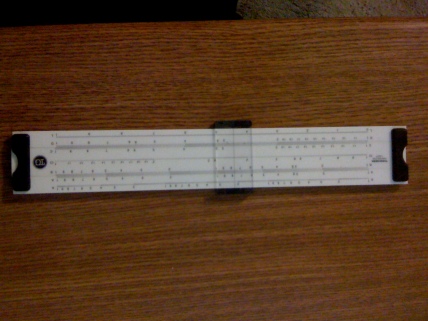
Slide rule, gifted to Art Hunt in December 2010 by his children - photo by Art Hunt

You could slide through the physics final with this device, at one time.

This is the device used to put humans on the Moon.

Have you ever used one?

It’s a slide ruleNice story about Art Hunt’s kids listening to tales from the olden days, and bringing back a little piece of the olden days for him.  He now claims to be ready for a power outage at his lab.

How does anyone understand a logarithmic scale anymore without a slide rule?  Does anyone make good slide rules anymore?