Millard Fillmore’s 1856 campaign poster, on the Native American Party ticket

December 31, 2009

Millard Fillmore 1856 campaign poster - Library of Congress

Notes from the Library of Congress:

MILLARD FILLMORE, AMERICAN CANDIDATE FOR PRESIDENT OF THE UNITED STATES.

CREATED/PUBLISHED
1856.

SUMMARY
A large woodcut proof for a campaign banner or poster for the Native American party’s 1856 presidential candidate. A bust portrait of Millard Fillmore appears in a roundel, flanked by allegorical figures of Justice (left) and Liberty (right). Both figures wear classical gowns and tiaras. Justice holds a large sword and scales, Liberty a staff and Phrygian cap and the Constitution. Atop the roundel perches an eagle, with American flags on either side. Below are a document “The Union” (left) and bundled fasces (right).

NOTES
Entered . . . 1856, by Baker & Godwin . . . New York.

The Library’s proof was deposited for copyright on July 10, 1856.

Published in: American political prints, 1766-1876 / Bernard F. Reilly. Boston : G.K. Hall, 1991, entry 1856-6.

Notice the striking resemblance to this 1860 campaign poster:

Poster for campaign of Abraham Lincoln for President, 1860 - Baker & Godwin, publisher; Library of Congress

Poster for campaign of Abraham Lincoln for President, 1860 - Baker & Godwin, publisher; Library of Congress

The Library of Congress notes:

SUMMARY: A print for a large campaign banner or poster for Republican presidential candidate Abraham Lincoln. It features a central roundel with a bust portrait of the candidate, flanked by standing deities Justice and Liberty. Justice (left) holds scales and a sword, while Liberty (right) holds the Constitution and a staff with Phrygian cap. An eagle with wings spread perches atop the roundel, behind which are several American flags on pointed staffs. Below the roundel a document “The Union” and a fasces lie on the ground. The image appears to have been printed from the same blocks (or a stereotype of them) as Baker & Godwin’s 1856 banner for Millard Fillmore (no. 1856-6). Only the central portrait has changed.

MEDIUM: 1 print on calendered paper : woodcut with letterpress ; image 39.3 x 55 cm.

CREATED/PUBLISHED: [New York] : Published and for sale by Baker & Godwin, Tribune Buildings, N.Y., c1860.

p


Climate change, and DDT: Monckton’s inconvenient and inaccurate history

December 31, 2009

Oh, Christopher Monckton raves on, and gullible or horribly ignorant journalists let him.  Maybe Michael Coren is both gullible and horribly ignorant.

Monckton’s grotesque errors of history suggest that he’s probably wrong on the science, too, considering that his studies were in the classics, and not science.  If he can’t get stuff right in his area of expertise, it’s almost impossible that he’d be right far afield.

I don’t know Coren’s other work, but the way he turned his microphone over to Monckton in the interview below is disturbing, with no challenge given to wild flights of imagination Monckton took, posed as history.  The Kennedy administration wasn’t that long ago; Rachel Carson’s book Silent Spring had a 40th anniversary edition that is still on the shelves.  Bald eagles, the national bird of the United States, climbed off the endangered species list just a few months ago with accompanying dozens of news stories that explained DDT had nearly wiped the species out.

Coren slept through all of that?  Monckton thought no one would remember the accurate history?

Monckton’s appearance on Michael Coren’s program on CTS (a Canadian network) obnoxiously slapped my browser.  You may recall I had checked out Monckton’s speech to an unquestioning group of students at a religious college in Minnesota.  At about the same time, he showed up on Coren’s program, saying much of the same things he’d said earlier in Minnesota.
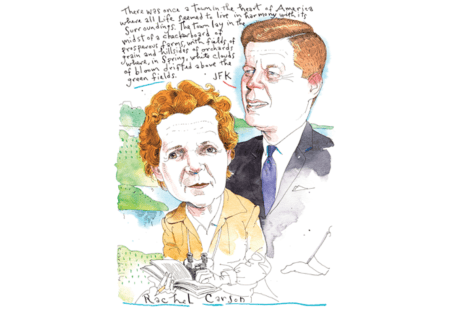
Rachel Carson persuaded President John Kennedy on her knowledge of oceans; it was the good science that hooked him. Illustration from Audubon Magazine: CARSON AND CAMELOT, Illustration by Joe Ciardiello

Rachel Carson persuaded President John Kennedy on her knowledge of oceans; it was the good science that hooked him. Illustration from Audubon Magazine: CARSON AND CAMELOT, Illustration by Joe Ciardiello

Have you ever interviewed a truly pathological liar?  Hoaxsters tell falsehoods, and the truly pathological ones keep exaggerating as they tell, testing the waters to see how much the audience will believe.  I think Monckton is one of those.

Consequently, the falsehoods grow grander as the hoaxster finds the audience gullibly lapping up the milk of human imagination.

Take this example, Monckton in part 5 of his interview comedy routine with Coren.  Coren doesn’t question any of the confabulations Monckton comes up with, apparently having been born after 1975 and never read much history of science or the enviornmental movement, and apparently having somehow missed the dozens of news stories in recent years on the recovery and removal from the Endangered Species List of the bald eagle and brown pelican, and recovery of osprey and peregrine falcons (does Canada have Google?  does Coren know how to use it?  does Coren have no producer, no fact checkers?)

Nor, apparently, does Monckton have any ability to control his ability to say patently offensive and absolutely impossible things to blame others.  Monckton blames Jackie Kennedy for killing 40 million kids with malaria; never mind that he’s wrong, he pushes on to call President Jack Kennedy “her foolish husband;” never mind that he’s got all his facts wrong, he proceeds to call William Ruckleshaus “an environmental nincompoop”:

[At 2:50 of the video]

LORD MONCKTON: I think it is particularly sad that what is essentially a scientific question has been politicized.  In Britain it’s different.  All parties have sort of gone along with the bedwetting theory.  They’ve all said, “Oh, yes!  We’re doomed!”

The Conservative Party — which is nominally the right-wing party, though now it’s kind of center-left, really — it has come out and said — in fact it has produced the stupidest document on climate change that I’ve ever seen, it’s even stupider than Al Gore’s film; it’s unbelievable how half-witted it is.  It isn’t universal that it’s right-left.

Certainly it is true to say that the left are more enthusiastic about this, worldwide, than anyone else.

But, you see, then, they’ve got it wrong before.  Let’s take the DDT example, where 41 years ago, Jackie Kennedy read Rachel Carson’s Silent Spring.  And the thesis of this book was that because of DDT and other chemicals we were pouring into the atmosphere, the world was going to be so grossly polluted that every species other than humankind would die, and then eventually we would die, too.  And it was all going to be terrible.

From where did Monckton get the idea that Jackie Kennedy read Carson’s book, and that she initiated action? Famously, President Kennedy took a question about DDT in one of his popular afternoon press conferences.  He said he had read the book, and that he was looking into it.

President Kennedy did in fact task his science advisers to check out the book.  The President’s Science Advisory Council (PSAC) reported on May 15, 1963.  They said Carson’s book was accurate, and that the government should act immediately to investigate harms from synthetic chemicals including DDT.

Carson didn’t write anything about ‘pouring chemicals into the atmosphere.’  One of the great concerns among wildlife biologists was the damage done in water — where, it turned out, DDT was quickly absorbed into all living things, which then multiplied the dosages of DDT several million times as it climbed up the trophic ladder (food chains).  The problem with DDT is that it doesn’t go into the air, or water, but is instead rapidly absorbed by living tissue.  DDT sprayed in an estuary is taken up by first-level producers, including zooplankton, phytoplankton and plants, as well as any other creature that happens by.  As these producers are consumed by creatures higher up the food chain, the dosage multiplies geometrically.

Carson didn’t whine as Monckton claims she did.  She coolly and calmly laid out the facts.  The facts were, and are, that DDT and its sister compounds pose serious dangers to living things.

And Jackie Kennedy read this, and shivered, and plucked at the sleeve of her husband — who was then President of the United States — and said:  “Look.  You’ve got to do something about this!  We’ve got to save the planet from DDT!”

Isn’t that a remarkable coincidence?  Jackie Kennedy’s husband was president of the United States! He always had such cute cuffs to tug on, too.  Monckton’s infantilizing the First Lady and President of the U.S. lacks the charm Monckton must think it adds.

Jackie Kennedy was a smart and capable woman, a journalist who went on to a long and successful career as an editor at a major publishing house.  Monckton’s disparaging of Mrs. Kennedy here is uncalled for, untoward, and ugly — and factually wrong.

I’m sure that if the president’s wife told him to look into an issue, he did.  She was not in the habit of being frivolous or silly.  There is film of President Kennedy at a press conference, being asked by a reporter if there is any official reaction on Carson’s book (hardly the pillow-side sleeve tug Monckton imagines); and anyone can check the presidential papers to see the report from the science advisors.  As we know now, Carson was right.  The Nobel winners  and others on the PSAC agreed.  Incidentally, they won their Nobels for hard research, not by writing letters to the editor of an publication from an organization that won a Nobel and then getting a sycophant to manufacture a replica Nobel, as Monckton claims with his dime-store “Nobel pin” (like a man whose mother refused to buy a deputy sheriff star for his cowboy games).

In his efforts to make the story entertainingly memorable, Monckton gives us the equivalent of passed gas in a crowded elevator.

But, Dear Reader — Dear God! — brace yourself:

And so Kennedy appointed a friend of his who was an environmental nincompoop, to take charge of the Environmental Protection Agency.

How can we know Monckton is lying? Well, John Kennedy died in November 1963.  The Environmental Protection Agency took form seven years later, in the administration of Richard Nixon, the man Kennedy defeated for the presidency in 1960.  John Kennedy was dead, and his younger brother suffered assassination, too.  Monckton’s English — U.S. history is not his forte.

So, EPA did not exist in John Kennedy’s life.  Unless Monckton claims Kennedy came back from the grave and wrested the pen from Nixon’s hand, it would have been impossible for Kennedy to appoint anyone to be in charge of the Environmental Protection Agency.

To whom is Monckton referring as director?  William Ruckelshaus, the old Republican political operator?  Monckton’s slip of the grip on history is so severe that it can’t be restored.  He’s so far out in fantasy land it’s difficult to tell.

But let’s take the next line:

Result:  Unfortunately; they banned DDT.

Ruckelshaus was Director of EPA when DDT was banned.  Ruckelshaus signed the documents.  Monckton could only be referring to Ruckelshaus.  To make his case for DDT, Monckton must bend time and all of politics.

And then, Monckton, of all people, refers to Ruckelshaus as a “nincompoop.” Um, Monck, this is one of the heroes of the Saturday Night Massacre, one of America’s better lawyers of that time or any time, a committed man of reason and solid environmental credentials.  If Ruckelshaus is an environmental nincompoop, Monckton is a lobotomized environmental pisant with a bad attitude.  (Regardless whatever he may be, Monckton has a bad attitude.)

We confront the reality here that Monckton is not engaging in any discussion about science, where simple facts of history got wrong can be subject to swift and gracious correction.  He’s off in Faux Propagandaland, making up nasty things to say as he bulldozes through the facts and truth, pushing them out of the way of his rant.  Facts, history and science be damned!, Monckton froths.  This is a crusade against the evils of socialism, and Monckton will carry on the war even when there are no socialists and no evil!  So what if they are not socialists!  Monckton will label them so and that will be that!

Oy.  Monckton’s so far out in left field at Wrigley that he’s in the bar across the street.

This was copied worldwide, because the left got going.  “Aha! We can show who’s boss!  We can ban DDT!”

Nope, sorry.  Sweden banned DDT, and then the U.S. banned DDT from use around babies, and then in 1972 the U.S. banned use of DDT in agriculture.  Most European nations eventually followed with tighter regulations.  History shows, however, that DDT was never banned in most of the world.  In the U.S., sadly, DDT manufacture for export continued until 1984 (to the day before the enactment of the Superfund bill), and DDT manufacture continues today in India and China.

Not only did the left not ban DDT around the world, no one did.

Not content to merely rape history and stuff its bloody body in a garbage can, Monckton then invents a whole new class of evil for environmentalists to do:

And of course a lot of them were in league with people who were producing chemicals other than DDT, which they wanted to replace, so they were making money out of it the usual — unfortunately the usual money-packed story, and inglorious story.

Got that?  He says Kennedy, though dead for nearly a decade, conspired to ban DDT so he could get kickbacks from companies who manufactured competing pesticides. And so did Ruckelshaus, one of the few men who stood up to Richard Nixon and refused to fire Archibald Cox.  Monckton says Ruckelshaus was crooked, and taking kickbacks from chemical companies.

So, they banned DDT.  Now, DDT is, in fact, safe enough you can eat it by the tablespoonful — I wouldn’t recommend that, but you can do that, it won’t hurt you if you do.  It’s completely harmless to humans.  It’s completely harmless to birdlife and animals.

In 1975 a committee of the House of Representatives asked for a history of EPA.  Among other topics, the DDT restrictions were discussed — here’s a 312-page document showing which harms were of greatest concern, and what was the science that backed the analysis of those harms.  It’s 312 pages that Monckton hopes you will never read.  He probably hopes it doesn’t even exist anymore.

By 1975 all the harms of DDT worried about by Rachel Carson 13 years before had been confirmed, with the slightly happy news that DDT is not a potent human carcinogen, but a weak one.

The only thing it’s harmful to is the anopheles mosquito, which is the vector that carries the falciparum parasite that causes malaria.  And to the aedes egyptii mosquito, which carries the yellow fever parasite.  It’s fatal — and really fatal — to both of them.

DDT acutely kills fish, birds and bats.  Had Monckton done his research, he’d have seen the plea from the U.S. Army to keep DDT available for poisoning bats in old, dilapidated barracks.  (EPA did not keep that use.)  DDT manufacturers bragged about how deadly the stuff was, in trying to make a case that it should be left on the market for unrestricted use.  40 years later, wild populations of bats are beginning to recover from collateral poisoning from DDT.  Bats fall into that branch of the animal kingdom known as mammals, where humans also fall.  Generally, if a poison is toxic to one mammal, it will be toxic to all others if dose is altered to consider body mass.  But also, if a substance is carcinogenic to one mammal, it will be cancer-causing to other mammals, too.

In mosquito control DDT is problematic.   It kills mosquitoes, but it also kills all other small creatures.  Especially, it kills those things that prey on mosquitoes — other insects, birds and arachnids, fish and small animals especially.  Since mosquitoes recover from DDT rather quickly, and predators take much longer to recover, this means an outdoor dose of DDT will result in a dramatic population explosion of malaria-carrying mosquitoes in a few weeks, as the mosquitoes recover more quickly than their predators do.

Monckton appears to think DDT is selective to mosquitoes.  DDT is a broad-scale killer, not selective in any way we know.

And the guy who invented it, who was German, got the Nobel Prize, because before DDT was introduced, a million people a year around the world, nearly all of them children, were dying of malaria.  It was one of the biggest killers.

Paul Muller won the Nobel in Medicine in 1948 for discovering that DDT kills insects.  But he was not the guy who invented the stuff more than 50 years earlier. Once again, where it’s easy to check facts, Monckton just doesn’t get the facts straight.

Before DDT was introduced, and for a long time thereafter, malaria killed about three million people annually.  When WHO conducted its eradication campaign, malaria deaths fell to about two million per year by the middle 1960s.  Once DDT use in that campaign was stopped, malaria death rates continued to fall to about a million a year today.  Malaria incidence and deaths rose in the 1980s when the malaria parasites themselves developed resistance to medicines used to treat and cure malaria in humans.

The chief barrier to lower malaria infection rates is education on barriers against mosquito exposure.  The chief barrier to lower malaria death totals is the development and delivery of pharmaceuticals to treat infected humans.  DDT is a panacea in neither theatre.

DDT came along and deaths fell to 50,000.

Monckton is flat out wrong.  He’s off by a factor of 20.  He’s making this stuff up.

We were on the point of wiping it out.

Flat out wrong again.  The World Health Organization (WHO) undertook a very ambitious program to eradicate malaria in the 1950s.  By the mid-1960s it was clear the program could not work:  In Africa, overuse of DDT (in agriculture) bred mosquitoes resistant to and immune to DDT.  Worse, in most of Subsaharan Africa, governments were not stable enough to have the discipline required to mount an effective campaign against the disease, knocking down the insect carriers briefly, then furiously treating humans with the disease so that when the mosquitoes returned there would be no pool of human infection from which to draw the disease.  This is all detailed in one of those fascinating New Yorker profiles of the legendary Fred Soper, by Macolm Gladwell.  For most of the world, we’ve never been to the point of wiping out malaria, and in those places where we’ve been successful in wiping out the disease, DDT was not the chief weapon.

When the left got in on the act — it’s exactly the same people:  the Environmental Defense Fund — you know — people who have got hundreds of millions of dollars in the bank!  Goodness knows where they get it from!  Foreign governments, possibly!  I don’t know!  I haven’t looked.  But it’s certainly an alarming question:  Are the environmental movements being backed by China or India so they won’t have to compete with us for natural resources because we will have shut our industry down.  It’s a question that the security services, I hope, are looking at, because it certainly worries me.

Monckton at his most scurrilous, and most distant from the facts.  Are environmental groups funded by China?  No.  In any case, the environmental groups don’t have nearly the funding of the pro-DDT groups, with their corporate funds. While we’re thinking about it, we should think about which side China would intervene on, were China to follow through on its historic reluctance to do anything about global warming.  Who is running around the world claiming we need to do nothing, and should do nothing?  Christopher Monckton.

If Monckton is worried about who is funding him, I’m sure the CIA and FBI would be happy to let him tell them about his well of money  he uses to frustrate the United Nations and treaty obligation of a hundred nations.  (Bill Dembski?  Are you still alive?  Why don’t you turn Monckton in — you’ve still got the number of Homeland Security, don’t you?)

Perhaps most egregious, or most funny, is this:  Environmental Defense has been a leader among all agencies, governmental and NGO, to urge the extremely limited use of DDT in indoor residual spraying – and yet, they are the one group Monckton complains about.

It’s a wonder to me that Monckton can figure out which part of his foot goes into his shoes first, in the mornings.  He has such a flair for getting the facts exactly wrong, and then getting into a dudgeon about his own error.  Monckton:  Not only wrong, but 180 degrees precisely wrong.

But there was the Environmental Defense Fund, and it came in and said, “Right, we’re going to press for a ban on DDT.” They succeeded.

The number of deaths went back up, from 50,000 a year to a million a year, and it stayed there for 40 years, while the likes of me were saying, “This is killing millions.  It ought to be stopped.  What on Earth is the World Health Organization doing?”

And eventually, just three years ago, on the 15th of September, 2006, Dr. Arata Kochi of the World Health Organization said, “Right.”  He said, “In this field, politics usually predominates.  Now we are going to take a stand on the science and the data.”  He ended the ban on DDT and declared that once again it would be the frontline of defense against the mosquito.

DDT has never been banned in most of the world — especially not in Africa.  WHO never banned DDT, they simply stopped using it when it ceased to be effective. Plus, you’ll recall from just a few paragraphs above, Environmental Defense (formerly EDF)  led the campaign to get DDT restored to use in IRS campaigns in Africa.

Monckton’s game is worse than blaming the messenger — he’s blaming the heroes.

COREN:  40 million people died . . .

MONCKTON:  Children!

COREN:   . . . because Jackie Kennedy read a silly book.

MONCKTON:  Yep.

COREN:   . . . and her foolish husband bought into it.

So, Coren’s bought Moncktons rude infantilizing of the Kennedys and all the false claims that went into it.  Anybody know how old Coren is?  Was he even alive in 1962?  If not, can he read?  Does he?  Carson’s book is out now in the 2002 40th anniversary edition, still available for anyone interested in the facts.

MONCKTON:  And then, the entire international left came in on the act.  And that was what did the damage.

And so the problem is that you have this political faction which likes to show who’s boss.  That’s the characteristic of the left.  They are instinctive interventionists.  And I know this is a little much of a political point, but it is unfortunately true that it was they who pushed the DDT ban.  And it was they who — to this day! — will say that David Suzuki and others who advocated this ban — and David Suzuki will tell you today that he regards this as one of the most successful campaigns he ever conducted.  That killed 40 million people, nearly all of them children. And it took 40 years before this decision could be reversed.  Why?  Because we had to wait until all the people responsible for the original decision had either retired or died, and were no longer in the way of doing the decent thing.

COREN:  Because they thought it was harmful to people, to animals . . .

MONCKTON:  They didn’t think any such thing.  It was purely to show who was boss.  There was never any scientific case for this.

Well, it’s in Canada, after all, so Monckton feels obligated to take a swipe at the most prominent local scientist who urges environmental protection.  David Suzuki was probably active in Canada on pesticide regulation, but of course he played only a tangential role in the U.S. action, which is what Monckton complains about here.  Suzuki was no personal confidante of the Kennedys.  Suzuki was 27 in 1963, probably completing graduate school.  Monckton’s swipe at Suzuki is almost completely gratuitous.

This is where the serious charges come.  Monckton accuses Carson, and all environmentalists, of ignoring human conditions.  He accuses us — he accuses you, since you were not active to stop the DDT ban — of being mass murderers, because, he claims, DDT would have been a safe and effective way to fight malaria, which has killed about a million people a year worldwide over the past 40 years.

Monckton is dead wrong.

First, malaria fighters stopped using DDT heavily in Africa in the early 1960s, years before any nation banned the substance.  There were three problems that contributed to the cessation of DDT use, as outlined by Malcolm Gladwell in his heavily researched and authoritative tribute to malaria fighter Fred Soper in The New Yorker:

  1. Many nations in Africa did have governments capable of conducting the regimented campaign necessary to successfully eradicate malaria — and in fact, most of the nations in Subsaharan Africa didn’t participate in the campaign at all.  Soper’s goal was to knock down mosquitoes for at least six months, and in that time cure malaria in every human.  When the mosquitoes came roaring back — as everyone in the program knew they would — there would be no pool of malaria in humans from which the mosquitoes could get infected.  The program was to break the chain of transmission required for the life cycles of the malaria parasites.  But that meant that governments had to have health care systems that could accurately diagnose malaria, and often which malaria parasite, and complete a cycle of treatment needed to flush the parasites out of the infected humans.  In the end, many entire nations simply did not participate.
  2. Malaria fighters were well aware of the race they were running:  Mosquitoes breed quickly, and consequently evolve quickly.  WHO’s malaria fighting teams understood it was a simply matter of time before mosquitoes became resistant or immune to DDT.  If that happened before malaria could be eradicated in a country or region, the game was over.  Resistance to DDT in mosquitoes started showing up as early as 1948 in Greece; by the 1960s several populations of mosquitoes were highly resistant.  (Today, every mosquito on Earth carries at least one of the two alleles that produces DDT immunity — and some carry as many as 60 copies of the two alleles, leaving them completely unaffected by DDT.)
  3. Industry didn’t get on board with the campaign.  Over-use of DDT out of doors by agricultural interests speeded the evolution of DDT-resistant mosquitoes.  Industrial use competed against, and ultimately frustrated, health care use of DDT.

Gladwell describes how WHO abandoned the eradication campaign with DDT as the key element, in the middle 1960s.  This was done not as a reaction to Carson’s book, but because the mosquitoes showed resistance.  Malaria fighters couldn’t build medical care in several nations at once while racing agriculture to use DDT.  WHO turned to other methods of fighting the parasites.

It’s important to note that WHO cannot dictate to nations what they do, nor did WHO ever “ban” DDT.  There are a lot of claims that there was pressure applied by environmentalists to get DDT use stopped, but the facts remain that DDT manufacture for export to Africa continued in the United States for more than a decade after DDT use was stopped in the U.S.  Manufacture of DDT moved to Africa and Asia — India and China make the stuff today.  Any African nation who wished to use DDT could have gotten it cheaply and in great quantity.

Second, there is no indication that DDT could have saved any more lives.  Simple mathematics tells the story:  The WHO eradication campaign reduced world-wide deaths from a high of 4 million annually, to about 2 million annually.  Each nation that eradicated malaria did so by raising incomes and improving the housing of poor people, making effective screening from mosquitoes the central part of the campaign.  Also, nations copied what the U.S. had done prior to the discovery that DDT killed insects:  They institute improved public health campaigns to educate people how to avoid being bitten, and to diagnose the disease and deliver knock-out pharmaceuticals quickly.

But, since heavy DDT use was stopped, the malaria rates continued to fall until recently.  Over the last decade, annual deaths numbered under a million, lower than when DDT use was at its greatest.  It’s impossible to square decreasing death rates with Monckton’s claim that DDT is a panacea against malaria, still.

Finally to this point of DDT and malaria, we have a conundrum:  Those nations who still use DDT, still have epidemic malaria.  If, as Monckton says, DDT is a miracle weapon against malaria, those nations that use DDT should be malaria-free.  If we think through the process, we see that malaria eradication is a much greater task that simply killing mosquitoes, and too complex to be cured simply by poisoning Africa and Africans.

Monckton ultimately tries to reduce the complex science, medical, geographical, political and education issues of malaria to a political question.  He accuses everyone who ever worked to reduce DDT use of being part of an out-of-control, monolithic and unthinking “left.”  It’s a popular idea among loud talkers from the right, including Monckton, Limbaugh, Rockwell, Hannity, the Hoover Institute, and most people who resist the science of global warming.  Monckton’s crude revisions of history away from accuracy might be justified as proper propaganda, if there were a noble political goal behind his work.  No noble goal can be discerned, latent or patent.

Many on the western left, in North America and Britain, urged tighter controls on DDT, especially once it became clear that the stuff was dangerous.  They got this from a long tradition of conservation in the U.S., for example, and not from any particular political orientation.  Fact is, the radical, socialist left who took over Russia and created the Soviet Union, who dominated Eastern Europe after World War II and who created the Peoples Republic of China, have always been unfriendly toward environmental protection, including the banning of DDT.  There was no ban on DDT use in the Soviet Union, nor in China.

Conservation, and the fight against pollution, is a product of western, capitalist nations.  It may be surprising news to a few, but the American conservation movement was led by people like John D. Rockefeller II, and Laurance Rockefeller, the Vanderbilts, and other people who were wealthy enough to have time to look around to see what was happening to America’s wild resources — or who appreciated the value of wilderness and conservation and the role it played in making America great.  Monckton is turning his back on one of the greater achievements of American capitalism, the strong desire to preserve the wild, and have clean air and clean water, for the health and benefit of all citizens.  Monckton completely shuns this great heritage of western civilization.  It’s quite astounding.

Ultimately, the decisions to reduce the use of, and now to phase out DDT (under 2001’s Persistent Organic Pesticides Treaty (POPs)) were scientific decisions.  In the U.S., the National Academy of Sciences wrote about DDT early on, noting (with an egregious typographical error) the great utility and benefit DDT provides to humans, but finally weighing the harmful effects and finding that they outweigh the benefits.  The number of assessments of DDT by august scientific and policy bodies is impressive, each deciding DDT had to go:  The 1958 U.S. Forest Service, the 1963 President’s Science Advisory Council, two federal courts in the U.S., the Food and Drug Administration in 1969, the U.S. Environmental Protection Agency in 1972, two more federal appellate courts ruling on the appropriateness and scientific soundness of EPA’s rule, the National Academy of Sciences, Congress under the Resource Conservation and Recovery Act (RCRA, the Superfund Act), and finally an international treaty between nearly 100 nations.  At each step science was the driving force.  At most steps, an absence of sound science would have made the ruling go the opposite way.

But all that is legal “mumbo-jumbo” to Monckton.  All that science is for naught, to Monckton’s classics trained mind.  What Monckton wants, Monckton should have, damn the facts, damn the courts, damn the scientists, damn history.

It’s really astonishing to add up the error Monckton piles on.

It’s the same with global warming.  There is no scientific case for this, either.  It’s the same people, trying to assert themselves in the same way.  They have succeeded, yet again, in getting the entire classe politique . . .

COREN:  I wish we had another hour.

So, with Monckton dead wrong or hallucinating on DDT, we should now trust him on global warming? No, we should not trust him on any issue.

Monckton will not understand those issues, either.  They are even more complex.

Update:  Monckton continues to smear the Kennedys in Australia, nearly two months later.

More:

Help others to remember history, so as not to be condemned to repeat it:

Add to FacebookAdd to NewsvineAdd to DiggAdd to Del.icio.usAdd to StumbleuponAdd to RedditAdd to BlinklistAdd to TwitterAdd to TechnoratiAdd to Furl


Let there be light: December 31, Bright Idea Day

December 31, 2009

Here it is, the invention that stole sleep from our grasp, made clubbing possible, and launched 50,000 cartoons about ideas:

The light bulb Thomas Edison demonstrated on December 31, 1879, at Menlo Park, New Jersey - Wikimedia image

The light bulb Thomas Edison demonstrated on December 31, 1879, at Menlo Park, New Jersey - Wikimedia image (GFDL)

The light bulb.  It’s an incandescent bulb.

It wasn’t the first bulb.  Edison a few months earlier devised a bulb that worked with a platinum filament.  Platinum was too expensive for mass production, though — and Edison wanted mass production.  So, with the cadre of great assistants at his Menlo Park laboratories, he struggled to find a good, inexpensive filament that would provide adequate life for the bulb.  By late December 1879 they had settled on carbon filament.

Edison invited investors and the public to see the bulb demonstrated, on December 31, 1879.

Thomas Edison in 1878, the year before he demonstrated a workable electric light bulb.  Library of Congress image

Thomas Edison in 1878, the year before he demonstrated a workable electric light bulb. CREDIT: Thomas Edison, head-and-shoulders portrait, facing left, 1880. Prints and Photographs Division, Library of Congress. Reproduction number LC-USZ62-98067

Edison’s successful bulb indicated changes in science, technology, invention, intellectual property and finance well beyond its use of electricity. For example:

  • Edison’s Menlo Park, New Jersey, offices and laboratory were financed with earlier successful inventions.  It was a hive of inventive activity aimed to make practical inventions from advances in science.  Edison was all about selling inventions and rights to manufacture devices.  He always had an eye on the profit potential.  His improvements on the telegraph would found his laboratory he thought, and he expected to sell the device to Western Union for $5,000 to $7,000.  Instead of offering it to them at a price, however, he asked Western Union to bid on it.  They bid $10,000, which Edison gratefully accepted, along with the lesson that he might do better letting the marketplace establish the price for his inventions.  Other inventive labs followed Edison’s example, such as the famous Bell Labs, but few equalled his success, or had as much fun doing it.
  • While Edison had some financial weight to invest in the quest for a workable electric light, he also got financial support, $30,000 worth, from some of the finance giants of the day, including J. P. Morgan and the Vanderbilts who established the Edison Light Company.
  • Edison didn’t invent the light bulb — but his improvements on it made it commercial.  “In addressing the question ‘Who invented the incandescent lamp?’ historians Robert Friedel and Paul Israel list 22 inventors of incandescent lamps prior to Joseph Wilson Swan and Thomas Edison. They conclude that Edison’s version was able to outstrip the others because of a combination of three factors: an effective incandescent material, a higher vacuum than others were able to achieve (by use of the Sprengel pump) and a high resistance lamp that made power distribution from a centralized source economically viable.”
  • Edison’s financial and business leadership acumen is partly attested to by the continuance of his organizations, today — General Electric, one of the world’s most successful companies over the past 40 years, traces its origins to Edison.

Look around yourself this evening, and you can find a score of ways that Edison’s invention and its descendants affect your life.  One of the more musing effects is in cartooning, however.  Today a glowing lightbulb is universally accepted as a nonverbal symbol for ideas and inventions.  (See Mark Parisi’s series of lightbulb cartoons, “Off the Mark.”)

Even with modern, electricity-saving bulbs, the cartoon shorthand hangs on, as in this Mitra Farmand cartoon.

Fusilli has an idea, Mitra Farmand, Fuffernutter

Brilliant cartoon from Mitra Farmand, Fuffernutter

Or see this wonderful animation, a video advertisement for United Airlines, by Joanna Quinn for Fallon — almost every frame has the symbolic lightbulb in it.

Other resources:

Patent drawing for Thomas Edison's successful electric lamp.  Library of Congress

Thomas Edison's electric lamp patent drawing and claim for the incandescent light bulb CREDIT: “New Jersey--The Wizard of Electricity--Thomas A. Edison's System of Electric Illumination,” 1880. Prints and Photographs Division, Library of Congress. Reproduction Number LC-USZ62-97960.


President Millard Fillmore, by John Sartain

December 31, 2009

John Sartain’s (1808-1897) engraving of Millard Fillmore as President, published by William Smith in Philadelphia, sometime between 1850 and 1853.  Image from the Library of Congress’s collection of portraits of the presidents.

President Millard Fillmore, by John Sartain - Library of Congress

President Millard Fillmore, engraving by John Sartain (1808-1897) - Library of Congress

January 7, 2009, is the 209th anniversary of the birth of Millard Fillmore.


Millard Fillmore in 1858

December 30, 2009

R. J. Compton lithograph of Millard Fillmore, published in 1858 - Library of Congress

Millard Fillmore lithograph, published March 14, 1858, by R. J. Compton - Library of Congress image

Millard Fillmore’s birthday will be celebrated on January 7.  He was born January 7, 1800, and was our 13th president.


Millard Fillmore’s birthday, January 7 – How will you celebrate in 2010?

December 30, 2009

In honor of Millard Fillmore’s birthday on January 7, I’ll post a collection of images of Fillmore and his administration that I’ve come across over the past year.  Though photography was invented in 1837, and though Fillmore was thought to be a handsome man, not many images of our 13th president survive on the internet.  For that matter, there is not a lot of good biographical information, either.

Many of these images come from the Library of Congress’s collections.

Millard Fillmore, Library of Congress Prints and Photographs Collection - Duval image

Millard Fillmore, undated lithograph, Library of Congress

The Library of Congress has one copy of a print of this image.  A note with the image says “Duval,” but little is known about it otherwise, at least to the Library of Congress.  No date is given.  Judging from the color of his hair, I think this may be an image done for his unsuccessful 1856 campaign.

Only a tiny handful of images of Fillmore show up regularly — this is not one of them.  I wonder whether my posting it here will have any effect in spreading its popularity.

Fillmore will perhaps always remain enigmatic, out of step with his own times in many ways, and forced to the edges of history by other events and people more in the mainstream.  Fillmore was born January 7, 1800, 24 days after the death of George Washington (d. December 14, 1799), and lived through the administration of Abraham Lincoln, and the Civil War.  Fillmore had some things in common with both of those great presidents, but no real dealings except for his opposition to Lincoln.

History uneasily deals with such men, who refuse to be put into pigeon holes.

Resources:


December 30 – Happy Hubble Day 2009!

December 30, 2009

Ultraviolet image of the Andromeda Galaxy, first known to be a galaxy by Edwin Hubble on December 30, 1924 - Galaxy Evolution Explorer image courtesy NASA

Ultraviolet image of the Andromeda Galaxy, first known to be a galaxy by Edwin Hubble on December 30, 1924 - Galaxy Evolution Explorer image courtesy NASA

Today is a good day to celebrate the universe in all it’s glory – December 30. This year, the International Year of Astronomy, makes it a double celebration.

On December 30, 1924, Edwin Hubble announced he’d discovered other galaxies in distant space.  Though it may not have been so clear at the time, it meant that, as a galaxy, we are not alone in the universe (whether we are alone as intelligent life is a separate question).  It also meant that the universe is much, much bigger than most people had dared to imagine.

Logo for International Year of Astronomy 2009 - Astronomy2009.org

Go to Astronomy2009.org

Below, mostly an encore post.

Last year for Hubble Day, Wired picked up on the story (with a gracious link to 2007’s post here at the Bathtub). Wired includes several links to even more information, a good source of information.  See Wired’s 2009 post here.

Hubble was the guy who showed us the universe is not only bigger than we imagined, it’s probably much bigger and much more fantastic than we can imagine. Hubble is the guy who opened our imaginations to the vastness of all creation.

How does one celebrate Hubble Day? Here are some suggestions:

  • Easier than Christmas cards: Send a thank-you note to your junior high school science teacher, or whoever it was who inspired your interest in science. Mrs. Hedburg, Mrs. Andrews, Elizabeth K. Driggs, Herbert Gilbert, Mr. Willis, and Stephen McNeal, thank you.
  • Rearrange your Christmas/Hanukkah/Eid/KWANZAA lights in the shape of the Andromeda Galaxy — or in the shape of any of the great photos from the Hubble Telescope (Andromeda Galaxy pictured above; Hubble images here)

    A few of the images from the Hubble Telescope

    A few of the images from the Hubble Telescope

  • Go visit your local science museum; take your kids along – borrow somebody else’s kids if you have to (take them along, too)
  • Spend two hours in your local library, just looking through the books on astronomy and the universe
  • Anybody got a good recipe for a cocktail called “The Hubble?” “The Andromeda?” Put it in the comments, please

The encore post, from 2007:

December 30, 1924, Edwin Hubble announced the results of his observations of distant objects in space.

PBS

Edwin Hubble - source: PBS

In 1924, he announced the discovery of a Cepheid, or variable star, in the Andromeda Nebulae. Since the work of Henrietta Leavitt had made it possible to calculate the distance to Cepheids, he calculated that this Cepheid was much further away than anyone had thought and that therefore the nebulae was not a gaseous cloud inside our galaxy, like so many nebulae, but in fact, a galaxy of stars just like the Milky Way. Only much further away. Until now, people believed that the only thing existing outside the Milky Way were the Magellanic Clouds. The Universe was much bigger than had been previously presumed.

Later Hubble noted that the universe demonstrates a “red-shift phenomenon.” The universe is expanding. This led to the idea of an initial expansion event, and the theory eventually known as Big Bang.

Hubble’s life offered several surprises, and firsts:

Hubble was a tall, elegant, athletic, man who at age 30 had an undergraduate degree in astronomy and mathematics, a legal degree as a Rhodes scholar, followed by a PhD in astronomy. He was an attorney in Kentucky (joined its bar in 1913), and had served in WWI, rising to the rank of major. He was bored with law and decided to go back to his studies in astronomy.

In 1919 he began to work at Mt. Wilson Observatory in California, where he would work for the rest of his life. . . .
Hubble wanted to classify the galaxies according to their content, distance, shape, and brightness patterns, and in his observations he made another momentous discovery: By observing redshifts in the light wavelengths emitted by the galaxies, he saw that galaxies were moving away from each other at a rate constant to the distance between them (Hubble’s Law). The further away they were, the faster they receded. This led to the calculation of the point where the expansion began, and confirmation of the big bang theory. Hubble calculated it to be about 2 billion years ago, but more recent estimates have revised that to 20 billion years ago.

An active anti-fascist, Hubble wanted to joined the armed forces again during World War II, but was convinced he could contribute more as a scientist on the homefront. When the 200-inch telescope was completed on Mt. Palomar, Hubble was given the honor of first use. He died in 1953.

“Equipped with his five senses, man explores the universe around him and calls the adventure Science.”

That news on December 30, 1924, didn’t make the first page of the New York Times. The Times carried a small note on February 25, 1925, that Hubble won a $1,000 prize from the American Academy for the Advancement of Science.

(Does anyone have a suitable citation for that video? Where did it come from? Who produced it? Is there more somewhere?)

Happy Hubble Day! Look up!

Resources:

Alert others to look up and toast Hubble:

Add to FacebookAdd to NewsvineAdd to DiggAdd to Del.icio.usAdd to StumbleuponAdd to RedditAdd to BlinklistAdd to TwitterAdd to TechnoratiAdd to Furl


Global warming politics: ‘Blame the teachers first’

December 29, 2009

Note to teachers: They hate you out there global warming denial land.

Watt’s Up denizens ramble in a state of confusion about how the planet can be warming while local records fall in cold weather.  [Note to Anthony Watts:  Have you explained to your readers that seasons are not governed by CO2 levels, but instead by the tilt of the Earth?]

How to clear up the confusion? Blame it on the teachers.  No kidding.  Here’s the comment from “r”:

r (08:12:32) : [about 62 comments down]

Forget the main stream media. The real roots of this movement, strangely enough, are in grade school and collage teachers.

College teachers are out of touch with the real world. They live in the insulated bubble of academia. They go to school for so long, all they know is school. They never get any experience in the real world of any industry. Therefore, they preach the socialist agenda because it sounds good on paper. The young people they teach do not protest because they don’t know any better yet. Their parents continue to give money to these colleges because they have no idea what their children are actually learning.

Grade school teachers despite having increased course work on classroom management are not required to take many classes in science. They cannot teach science because they don’t understand it themselves. Global warming was introduced to my children through Scholastic Magazine given out at school. The magazine is used as part of the curriculum. The teachers never questioned it. The children were frightened by it and peer pressure keeps anyone from dissenting. The parents are learning about global warming from their children as in 1984.

In fact it is harder for me to protest the fraud of global warming at my own school than it is to protest in the media. I run the risk of alienating myself and my children at school.

If anybody would like to send my schools a note telling them to stop teaching the global warming fraud with reasons why, I would be grateful.

Here are the principal’s emails: Vince.DiGrandi@WappingersSchools.org
Tom.Stella@wappingersschools.org

Perhaps I can do the same for someone else.

Thanks in advance.

Here’s what I recommend:  Send an e-mail to the two people listed above, and congratulate them for offering real science to their students.  Tell them you’ve heard that there is a national campaign to stop them from teaching good science, and that you support them and hope the campaign fails.

Anyone who lies to his kids about science, about the environmental issues we face, about life in general, will indeed alienate themselves from their children, if the children are lucky.  “r” wishes his kids to be taught voodoo science.  Shame on him.

I wonder what “r” thinks of his own teachers.


Baltimore ponders where to put bust of Frank Zappa, symbol of freedom

December 29, 2009

Ending the Cold War brought no end of benefits to the U.S., including Baltimore’s little civic problem:  Where should Baltimore put a bust of Frank Zappa, donated by Lithuanians to his birth city in honor of his standing for freedom?

Frank Zappa bust, donated by Lithuanians, to City of Baltimore - Baltimore Sun photo

Striking bust of Frank Zappa donated to the City of Baltimore by Lithuanians, in honor of Zappa's representing freedom to Lithuanians during the Cold War

More than a year ago, Baltimore accepted a bust of Baltimore native Frank Zappa. Valued at $50,000, the bust was a gift from a Lithuanian Zappa fan club.

Since then, officials have been debating where to put it.

Why Zappa?  Why Baltimore?

His family lived in the 4600 block of Park Heights Ave., then moved to Edgewood in Harford County. Zappa’s father, a chemist and mathematician, had a job nearby at Aberdeen Proving Ground. They moved to California when Frank was 10.

Until they met last night, some members of the Baltimore Public Art Commission, which voted unanimously to accept the gift of the bronze sculpture – valued at about $50,000 – were also unaware of Zappa’s connection to Charm City.

However, the donors of the bust, who come from much farther afield – in fact, from a nation Zappa never visited – are well aware of his background.

“We’re honored to have a chance to present this Frank Zappa monument to the city of Baltimore,” said Saulius Paukstys, 43, the president of one of the biggest and arguably most dedicated Frank Zappa fan clubs in, of all places, the Republic of Lithuania. “As an artist, and much more than that, he has meant a great deal to the Lithuanian people.”

If Zappa has been something of an unknown prophet in his own land, people like Paukstys, a photographer, have long held him in high regard as a symbol of free expression in the post-Cold War former Soviet bloc.

“Before 1990, you have to remember, [Lithuanians] could not criticize society,” Paukstys said through an interpreter. “Frank Zappa was a voice of freedom.”

After 1990, when Western music became available in their home country, Paukstys and friends like Saulius Pilinkus, an art historian, often gathered to listen to Zappa’s music. The fan club they started eventually numbered more than 300. Most were well-educated aesthetes who appreciated the fact that Zappa was more than a rock-and-roll star: He was a symphonic composer, a fact that appealed to a people whose love of classical music is part of their history.

Zappa’s followers number in the millions in the U.S.  People who don’t see eye-to-eye on much of anything else agree on Zappa’s genius.  Even old sobersides California Judge Ben Davidian is a Zappa fan.  (He was especially fond of Zappa’s deeply philosophical question about a Salt Lake City fan’s letter:  “Suzy Creamcheese, what’s gotten into you?”)

Zappa’s bust will be one more very good reason to visit Baltimore, in addition to crab cakes, Babe Ruth’s house, the C&O Museum and Sabatino’s.


A neglected, “Neglected Anniversary” – Mencken, Fillmore and the bathtub

December 29, 2009

Otherwise occupied, I nearly forgot:  92 years ago yesterday, on December 28, 1917, this column by H. L. Mencken was published in The New York Evening Mail:

A Neglected Anniversary

Mencken on April 7, 1933 - end of low-alcohol beer - Baltimore Sun Photo

H. L. Mencken at approximately 12:30 a.m., April 7, 1933, at the Rennert Hotel, corner of Saratoga and Liberty Streets, 17 years later, not neglecting a sudsy anniversary - Baltimore Sun photo

On December 20 there flitted past us, absolutely without public notice, one of the most important profane anniversaries in American history, to wit, the seventy-fifth anniversary of the introduction of the bathtub into These States. Not a plumber fired a salute or hung out a flag. Not a governor proclaimed a day of prayer. Not a newspaper called attention to the day.

True enough, it was not entirely forgotten. Eight or nine months ago one of the younger surgeons connected with the Public Health Service in Washington happened upon the facts while looking into the early history of public hygiene, and at his suggestion a committee was formed to celebrate the anniversary with a banquet. But before the plan was perfected Washington went dry (This was war-time Prohibition, preliminary to the main catastrophe. — HLM), and so the banquet had to be abandoned. As it was, the day passed wholly unmarked, even in the capital of the nation.

Bathtubs are so common today that it is almost impossible to imagine a world without them. They are familiar to nearly everyone in all incorporated towns; in most of the large cities it is unlawful to build a dwelling house without putting them in; even on the farm they have begun to come into use. And yet the first American bathtub was installed and dedicated so recently as December 20, 1842, and, for all I know to the contrary, it may still be in existence and in use.

Curiously enough, the scene of its setting up was Cincinnati, then a squalid frontier town, and even today surely no leader in culture. But Cincinnati, in those days as in these, contained many enterprising merchants, and one of them was a man named Adam Thompson, a dealer in cotton and grain. Thompson shipped his grain by steamboat down the Ohio and Mississippi to New Orleans, and from there sent it to England in sailing vessels. This trade frequently took him to England, and in that country, during the ’30s, he acquired the habit of bathing.

The bathtub was then still a novelty in England. It had been introduced in 1828 by Lord John Russell and its use was yet confined to a small class of enthusiasts. Moreover, the English bathtub, then as now, was a puny and inconvenient contrivance — little more, in fact, than a glorified dishpan — and filling and emptying it required the attendance of a servant. Taking a bath, indeed, was a rather heavy ceremony, and Lord John in 1835 was said to be the only man in England who had yet come to doing it every day.

Thompson, who was of inventive fancy — he later devised the machine that is still used for bagging hams and bacon — conceived the notion that the English bathtub would be much improved if it were made large enough to admit the whole body of an adult man, and if its supply of water, instead of being hauled to the scene by a maid, were admitted by pipes from a central reservoir and run off by the same means. Accordingly, early in 1842 he set about building the first modern bathroom in his Cincinnati home — a large house with Doric pillars, standing near what is now the corner of Monastery and Orleans streets.

There was then, of course, no city water supply, at least in that part of the city, but Thompson had a large well in his garden, and he installed a pump to lift its water to the house. This pump, which was operated by six Negroes, much like an old-time fire engine, was connected by a pipe with a cypress tank in the garret of the house, and here the water was stored until needed. From the tank two other pipes ran to the bathroom. One, carrying cold water, was a direct line. The other, designed to provide warm water, ran down the great chimney of the kitchen, and was coiled inside it like a giant spring.

The tub itself was of new design, and became the grandfather of all the bathtubs of today. Thompson had it made by James Cullness, the leading Cincinnati cabinetmaker of those days, and its material was Nicaragua mahogany. It was nearly seven feet long and fully four feet wide. To make it water-tight, the interior was lined with sheet lead, carefully soldered at the joints. The whole contraption weighed about 1,750 pounds, and the floor of the room in which it was placed had to be reinforced to support it. The exterior was elaborately polished.

In this luxurious tub Thompson took two baths on December 20, 1842 — a cold one at 8 a.m. and a warm one some time during the afternoon. The warm water, heated by the kitchen fire, reached a temperature of 105 degrees. On Christmas day, having a party of gentlemen to dinner, he exhibited the new marvel to them and gave an exhibition of its use, and four of them, including a French visitor, Col. Duchanel, risked plunges into it. The next day all Cincinnati — then a town of about 100,000 people — had heard of it, and the local newspapers described it at length and opened their columns to violent discussions of it.

The thing, in fact, became a public matter, and before long there was bitter and double- headed opposition to the new invention, which had been promptly imitated by several other wealthy Cincinnatians. On the one hand it was denounced as an epicurean and obnoxious toy from England, designed to corrupt the democratic simplicity of the Republic, and on the other hand it was attacked by the medical faculty as dangerous to health and a certain inviter of “phthisic, rheumatic fevers, inflammation of the lungs and the whole category of zymotic diseases.” (I quote from the Western Medical Repository of April 23, 1843.)

The noise of the controversy soon reached other cities, and in more than one place medical opposition reached such strength that it was reflected in legislation. Late in 1843, for example, the Philadelphia Common Council considered an ordinance prohibiting bathing between November 1 and March 15, and it failed of passage by but two votes. During the same year the legislature of Virginia laid a tax of $30 a year on all bathtubs that might be set up, and in Hartford, Providence, Charleston and Wilmington (Del.) special and very heavy water rates were levied upon those who had them. Boston, very early in 1845, made bathing unlawful except upon medical advice, but the ordinance was never enforced and in 1862 it was repealed.

This legislation, I suspect, had some class feeling in it, for the Thompson bathtub was plainly too expensive to be owned by any save the wealthy; indeed, the common price for installing one in New York in 1845 was $500. Thus the low caste politicians of the time made capital by fulminating against it, and there is even some suspicion of political bias in many of the early medical denunciations. But the invention of the common pine bathtub, lined with zinc, in 1847, cut off this line of attack, and thereafter the bathtub made steady progress.

The zinc tub was devised by John F. Simpson, a Brooklyn plumber, and his efforts to protect it by a patent occupied the courts until 1855. But the decisions were steadily against him, and after 1848 all the plumbers of New York were equipped for putting in bathtubs. According to a writer in the Christian Register for July 17, 1857, the first one in New York was opened for traffic on September 12, 1847, and by the beginning of 1850 there were already nearly 1,000 in use in the big town.

After this medical opposition began to collapse, and among other eminent physicians Dr. Oliver Wendell Holmes declared for the bathtub, and vigorously opposed the lingering movement against it in Boston. The American Medical Association held its annual meeting in Boston in 1849, and a poll of the members in attendance showed that nearly 55 per cent of them now regarded bathing as harmless, and that more than 20 per cent advocated it as beneficial. At its meeting in 1850 a resolution was formally passed giving the imprimatur of the faculty to the bathtub. The homeopaths followed with a like resolution in 1853.

But it was the example of President Millard Fillmore that, even more than the grudging medical approval, gave the bathtub recognition and respectability in the United States. While he was still Vice-President, in March, 1850, he visited Cincinnati on a stumping tour, and inspected the original Thompson tub. Thompson himself was now dead, but his bathroom was preserved by the gentlemen who had bought his house from the estate. Fillmore was entertained in this house and, according to Chamberlain, his biographer, took a bath in the tub. Experiencing no ill effects, he became an ardent advocate of the new invention, and on succeeding to the Presidency at Taylor’s death, July 9, 1850, he instructed his secretary of war, Gen. Charles M. Conrad, to invite tenders for the construction of a bathtub in the White House.

This action, for a moment, revived the old controversy, and its opponents made much of the fact that there was no bathtub at Mount Vernon, or at Monticello, and that all the Presidents and other magnificoes of the past had got along without any such monarchical luxuries. The elder Bennett, in the New York Herald, charged that Fillmore really aspired to buy and install in the White House a porphyry and alabaster bath that had been used by Louis Philippe at Versailles. But Conrad, disregarding all this clamor, duly called for bids, and the contract was presently awarded to Harper & Gillespie, a firm of Philadelphia engineers, who proposed to furnish a tub of thin cast iron, capable of floating the largest man.

This was installed early in 1851, and remained in service in the White House until the first Cleveland administration, when the present enameled tub was substituted. The example of the President soon broke down all that remained of the old opposition, and by 1860, according to the newspaper advertisements of the time, every hotel in New York had a bathtub, and some had two and even three. In 1862 bathing was introduced into the Army by Gen. McClellan, and in 1870 the first prison bathtub was set up at Moyamensing Prison, in Philadelphia.

So much for the history of the bathtub in America. One is astonished, on looking into it, to find that so little of it has been recorded. The literature, in fact, is almost nil. But perhaps this brief sketch will encourage other inquirers and so lay the foundation for an adequate celebration of the centennial in 1942.

(Text courtesy of Poor Mojo’s Almanac(k))

The entire history was a hoax composed by Mencken.

Even conservative wackoes appreciate the column.

Content with his private joke, Mencken remained silent about the hoax until a follow-up article, “Melancholy Reflections,” appeared in the Chicago Tribune on May 23, 1926, some eight years later. This was Mencken’s confession. It was also an appeal for reason to the American public.

His hoax was a joke gone bad. “A Neglected Anniversary” had been printed and reprinted hundreds of times in the intervening years. Mencken had been receiving letters of corroboration from some readers and requests for more details from others. His history of the bathtub had been cited repeatedly by other writers and was starting to find its way into reference works. As Mencken noted in “Melancholy Reflections,” his “facts” “began to be used by chiropractors and other such quacks as evidence of the stupidity of medical men. They began to be cited by medical men as proof of the progress of public hygiene.” And, because Fillmore’s presidency had been so uneventful, on the date of his birthday calendars often included the only interesting tidbit of information they could find: Fillmore had introduced the bathtub into the White House. (Even the later scholarly disclosure that Andrew Jackson had a bathtub installed there in 1834—years before Mencken claimed it was even invented—did not diminish America’s conviction that Fillmore was responsible.)

(No, dear reader, probably not correct; surely John Adams brought a bathtub with him when he moved into the White House, then called the President’s Mansion.  Plumbing, hot water, and finally hot water to a bathtub in the president’s residence, were installed between 1830 and 1853, as best I can determine.)

Mencken wrote an introduction to the piece in a later bookA Mencken Chrestomathy (Alfred A. Knopf, 1949):

The success of this idle hoax, done in time of war, when more serious writing was impossible, vastly astonished me. It was taken gravely by a great many other newspapers, and presently made its way into medical literature and into standard reference books. It had, of course, no truth in it whatsoever, and I more than once confessed publicly that it was only a jocosity . . .  Scarcely a month goes by that I do not find the substance of it reprinted, not as foolishness but as fact, and not only in newspapers but in official documents and other works of the highest pretensions.

There’s a moral to the story:  Strive for accuracy!

So, Dear Reader, check for accuracy, and question authority.

Resources:

Warn others of the hoax!

Add to FacebookAdd to NewsvineAdd to DiggAdd to Del.icio.usAdd to StumbleuponAdd to RedditAdd to BlinklistAdd to TwitterAdd to TechnoratiAdd to Furl


Ugly when they pretend to care

December 28, 2009

Kids dressing up as adults are cute.

Adults dressing up as things they are not can be entertaining at a masquerade.  It’s generally pretty ugly when they dress up as things they are not, for purposes of deception.

Joe Carter, the superstar blogger of evangelical Christians, posted at First Things, pretending to be upset that Democrats and others who work to control and ameliorate global warming, are missing the boat (so to speak) by not complaining about air pollution from ships, especially super-sized cargo ships.

(Even the title of the thing is offensive, either in or out of context:  “Sink a ship, save a planet.”  Ah, the humor of the conservative, reality- and humor-challenged.  I’m sure al Quaeda would be happy to oblige Carter and the headline writers.)

Carter thinks he’s caught environmentalists in some sort of hypocritical stance, worrying about global warming and urging clean air everywhere but from the ships that bring us oil:  ‘If you’re so gosh-darn concerned about global warming, why not worry about the pollution from ships, smarty-pants?’ Joe laments.

You’d think he’d have bothered to Google the issue first, before pretending he’s the only one who noticed.

Joe wrote:

Changing the emissions regulations on the shipping industry seems like a modest, commonsense step toward reducing air pollution. So why doesn’t it get more political attention? Why do hypothetical concerns about potential catastrophic problems always trump those that are causing massive deaths right now?

With all the focus on man-made global warming, its easy to overlook the fact that man-made pollution is already killing millions of people every year.

*   *   *   *   *   *   *   *

Imagine the effect we could have on pollution if we spent as much time, energy, and money on solutions that make a difference for other people’s lives rather than those that merely make us feel good about ourselves.

Imagine, indeed.  The gall of those environmentalists, warning about global warming but letting their friends in the shipping business get off scot-free, no?

Reality is that the liberal environmentalists and federal regulators were on the issue earlier, sponsoring legislation to deal with the issue — and President Obama’s Environmental Protection Agency got an agreement earlier this year to go at least part-way to resolving the problems.  EPA monitored air pollution from ships from long ago — at this 2001 EPA meeting in San Francisco, Fischbeck offered a .pdf PowerPoint summary of EPA’s work, the problems of air pollution from ships, the strategies to control the pollution and the benefits of such control.

Several Members of Congress introduced legislation to fix marine air pollution in the last Congress, and hearings were held on bills that didn’t quite make it into law.  These efforts were follow-on to an international treaty to control marine air pollution; according to the Congressional Research Service’s explanation of the bills and the issue:

In 1997, the United States and most countries signed an international agreement known as MARPOL Annex VI, setting extremely modest controls on air pollution from ships. The agreement did not enter into force until 2005, and the United States took until July 21, 2008, to enact legislation to implement it (P.L. 110-280). Negotiations to strengthen Annex VI accelerated in 2008, however, and discussions regarding GHG emissions have also begun. While awaiting congressional action and international agreement, the Environmental Protection Agency (EPA), port cities, and states have begun to act on their own. In the 110th Congress, legislation was introduced (S. 1499 / H.R. 2548) to require EPA to dramatically strengthen ship emission standards under the Clean Air Act. S. 1499 was reported, but no further action was taken.

I suppose it’s too much to expect hard-core rightists to pay attention to international news, but marine air pollution is a topic of international concern, obviously indicated by the MARPOL treaty, but with a lot of other indicators for anyone who chooses to look and study the issue.

Ships pour out great quantities of pollutants into the air in the form of sulphur and nitrogen oxides.

The emissions from ships engaged in international trade in the seas surrounding Europe – the Baltic, the North Sea, the north-eastern part of the Atlantic, the Mediterranean and the Black Sea – were estimated to have been 2.3 million tonnes of sulphur dioxide and 3.3 million tonnes of nitrogen oxides a year in 2000.

In contrast to the progress in reducing emissions from land-based sources, shipping emissions of sulphur and nitrogen oxides are expected to continue increasing by 40-50 per cent up to 2020. In both cases, by 2020 the emissions from international shipping around Europe will have surpassed the total from all land-based sources in the 27 EU member states combined.

Joe Carter is right that air pollution from ships should be of great concern.  He would be wise to listen to those like former U.S. Rep. Hilda Solis, who sponsored a bill in the 110th Congress to fight marine air pollution.

And, now that we’ve established that cleaning up marine air pollution is a good idea, and the liberals and environmentalists and Obama administration are already on the job, wouldn’t it also be great if the conservatives who  look at these issues, too, listen to these same people when they warn about the dangers of global warming, and of the dangers of failing to act soon to stop it?

Joe Carter identified a problem, and he’s discovered that the environmentalists and Democrats he wished to ding for not paying enough attention instead were there before him, and resolved much of the difficulty.

Anyone want to bet whether Carter will give credit to Obama, EPA and the Democrats in Congress for solving the problems?

Add to FacebookAdd to NewsvineAdd to DiggAdd to Del.icio.usAdd to StumbleuponAdd to RedditAdd to BlinklistAdd to TwitterAdd to TechnoratiAdd to Furl


Typewriter of the moment: Santa Claus, Indiana’s Post Office

December 27, 2009

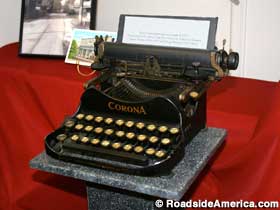
maybe a little late for Christmas:  Here’s the typewriter used to answer letters to Santa Claus, at the U.S. Post Office of Santa Claus, Indiana:

Typewriter used to answer letters to Santa Claus, from the U.S. Post Office in Santa Claus, Indiana - Roadside America photo

Typewriter used to answer letters to Santa Claus, from the U.S. Post Office in Santa Claus, Indiana - Roadside America photo

For 30 years, kids letters to Santa Claus were answered, with the responses typed on this Corona at the Post Office.  The machine rests on display at the Santa Claus Museum in Kris Kringle Plaza in Santa Claus, Indiana, about 40 miles east northeast from Evansville (south of Interstate 64).

Answers to letters to Santa Claus are answered from the museum today.

You can see the typewriter; Roadside America’s website says the museum is open 9:00 a.m. to 5:00 p.m. daily — but you may want to call ahead to confirm:

Santa Claus Museum

Address:
41 N. Kringle Place, Santa Claus, IN
Directions:
On the north side of Hwy 162/Christmas Blvd just west of Holiday World. In Kringle Plaza. Look for the Holiday Foods and the Post Office.
Admission:
Donations.
Hours:
9 am-5 pm daily. (Call to verify)
Phone:
812-937-2687

Spread Santa’s cheer!

Add to FacebookAdd to NewsvineAdd to DiggAdd to Del.icio.usAdd to StumbleuponAdd to RedditAdd to BlinklistAdd to TwitterAdd to TechnoratiAdd to Furl


Merry Christmas, to the “right” people (not you, Mr. President)

December 25, 2009

You can’t make this stuff up.

Here’s a generally mean-spirited post trying to make hay from the general disinformation about about Obama’s faith and otherwise trying to stir hatred.  (Here’s more of the flap on the ornaments on the White House’s Blue Room tree, and I’ve got a response in comments at this post.)

Followed by this “glowing” cross.

Merry Christmas.  “We dare you,” the Right Perspective says.

Make the right wing extremely angry today:  Have a good and merry Christmas.  Be tolerant.  Think.  Smile.  Act kindly.  It’ll make ’em crazy.

Also:


Santa’s ride updated – GE’s high-tech sleigh

December 24, 2009

GE labs suggest some improvements to the Santa Claus Sleigh.  A good way to introduce research, I think.

GE's improvements to Santa's Sleight, 2009

Click here for GE's interactive feature

Among improvements:

Companies hitching a star to Santa’s sleigh is nothing new.  It may be difficult to separate out the Coca-Cola from the Santa myth at this late date, and who remembers that “Rudolph, the Red-Nosed Reindeer” originally came from a project for departed department store Montgomery Ward.  GE at least shows good humor.

Here at Bathtub Manor we switched to LEDs on the Christmas tree this year.  The blue lights are a bit intense (more yellow and red in the mix, please, string assemblers).  Travel home, shopping, recipe-finding, and most other parts of our family’s Christmas preparations are laced with cell phones, computers, internet and digital photography, and microprocessors performing music — not to mention the yearly infusions of new technology under the tree.

We live in fascinating times.

Check out the update of Santa’s headgear, too.

Santa's old sleigh, as last configured - HowStuffWorks.com

Bye-bye tradition? Santa's old sleigh, as last configured - HowStuffWorks.com

Tell your friends about Santa’s high-tech ride:

Add to FacebookAdd to NewsvineAdd to DiggAdd to Del.icio.usAdd to StumbleuponAdd to RedditAdd to BlinklistAdd to TwitterAdd to TechnoratiAdd to Furl


Newspaper history: “Yes, Virginia,” the most popular editorial ever vouches for Santa Claus

December 20, 2009

“Papa says, ‘If you see it in the Sun, it’s so.'”

Do we stand as witnesses to the end of newspapers in America?

It’s been a grand history.  Newspapering gave us great leaders like Benjamin Franklin.  Newspapering gave us wars, like the Spanish-American War.  Newspapering gave us Charlie Brown, Ann Landers, the Yellow Kid, Jim Murray, Red Smith, Thomas Nast (and Santa Claus), the Federalist Papers, and coupons to save money on laundry soap.

It’s been a curious history, too.  An 1897 editorial vouching for Santa Claus rates as the most popular editorial of all time, according to the Newseum in Washington, D.C.

Francis Pharcellus Church, New York Sun writer who wrote "Yes Virginia, there is a Santa Claus" - Newseum

The man who saved Christmas, at least for Virginia O'Hanlon: Francis Pharcellus Church - Newseum image

In autumn, 1897, 8-year-old Virginia O’Hanlon of 115 West 59th Street in New York, wrote to the New York Sun with this simple question:

“Please tell me the truth; is there a Santa Claus?”

In the age of Yellow Journalism, the fiercely competitive Sun‘s editors turned the letter to Francis Pharcellus.  He responded to little Virginia on September 21, 1897:

“Yes, Virginia, there is a Santa Claus.”

Church’s brother, William Conant Church, owned and published the newspaper.  Both had followed their father into the news business.  They co-founded The Army-Navy Journal in 1863, and went on to a series of journalistic collaborations.  Francis was 58 years old when he answered Virginia’s letter. (He died at age 67, in 1906.)

The New York Sun held down the conservative corner in New York journalism at the time, versus the New York Times and the New York Herald-Tribune.  But it also had an interesting history, to a blogger intrigued by hoaxes.  In 1835 the paper published a series of six newspaper stories falsely attributed to Sir John Herschel, a well-known astronomer, claiming to describe a civilization on the Moon — the Great Moon Hoax.  The discovery was credited to a new, very powerful telescope.

In 1844 the paper published a hoax written by Edgar Allen Poe, the Balloon Hoax.  Under a pseudonym, Poe wrote that a gas balloon had crossed the Atlantic in three days.

The Sun also featured outstanding reporting.  A 1947 and 1948  series about crime on the docks of New York City won a Pulitzer Prize for writer Malcolm Johnson.  That series inspired Elia Kazan’s 1954 movie On the Waterfront starring Marlon Brando, Rod Steiger, Eva Marie Saint, Karl Malden and Lee J. Cobb.

The New York Sun ceased publication in 1950.

For all of its history, the Sun and the Churches are most remembered for that defense of belief in Santa Claus.
Virginia O’Hanlon grew up, graduated from Hunter College, got a masters at Columbia, and earned a Ph.D. from Fordham.  She taught in the New York City Public School system, from which she retired in 1959.  She died in 1971.

Birth of tradition

Columbia University was Church’s alma mater, as well as O’Hanlon’s.  Her letter and his response get a reading each year at the Yule Log Ceremony at Columbia College, along with the poem “A Visit from St. Nicholas.”  Animated, live-acting, and other television productions have been mounted in 1974, 1991, and 2009.


Is there a Santa Claus?  Did Church write a credible defense? The text of the letter and answer, below the fold.

Add to FacebookAdd to NewsvineAdd to DiggAdd to Del.icio.usAdd to StumbleuponAdd to RedditAdd to BlinklistAdd to TwitterAdd to TechnoratiAdd to Furl

Read the rest of this entry »