May 6, 2008
Living through the Watergate scandals and the Constitutional crises they produced — and spending part of that time in Washington, D.C., working for the Senate — I got a wonderful view of how constitutional government works, why it is important that good people step up to make it work, and a glimpse of what happens when good people lay back and let the hooligans run amock.
Over the last three months it occurs to me that we may be living in a similar time, when great but latent threats to our Constitution and the rule of law may be halted or rolled back by one John Dean-like character who will stand up before a group of elected officials, swear to tell the truth, and then, in fact, tell the whole truth.
Teachers, are you taking advantages of these lessons in civics that come into our newspapers every day?
We live in interesting times, exciting times — we live in educational times.
You should be clipping news stories on these events, and you should be using them in your classrooms today, and saving them for the fall elections, for the January inauguration, for the new Congress . . . and for your future classes.
What other opportunities for great civics lessons come to our doorsteps every day?
Spread the word; friends don't allow friends to repeat history.
 Leave a Comment » |
  Accuracy, Checks and Balances, Government, Heroes, Journalism, Justice, Law, Leadership, Lessons of history, Scandals, U.S. Constitution, U.S. House of Representatives, Watergate scandal | Tagged: Checks and Balances, civics, Constitution, Current Events, Government, Newspapers, Politics, Teaching, U.S. Congress |
  Permalink
 Posted by Ed Darrell
April 15, 2008
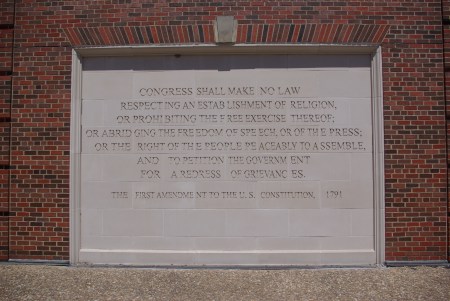
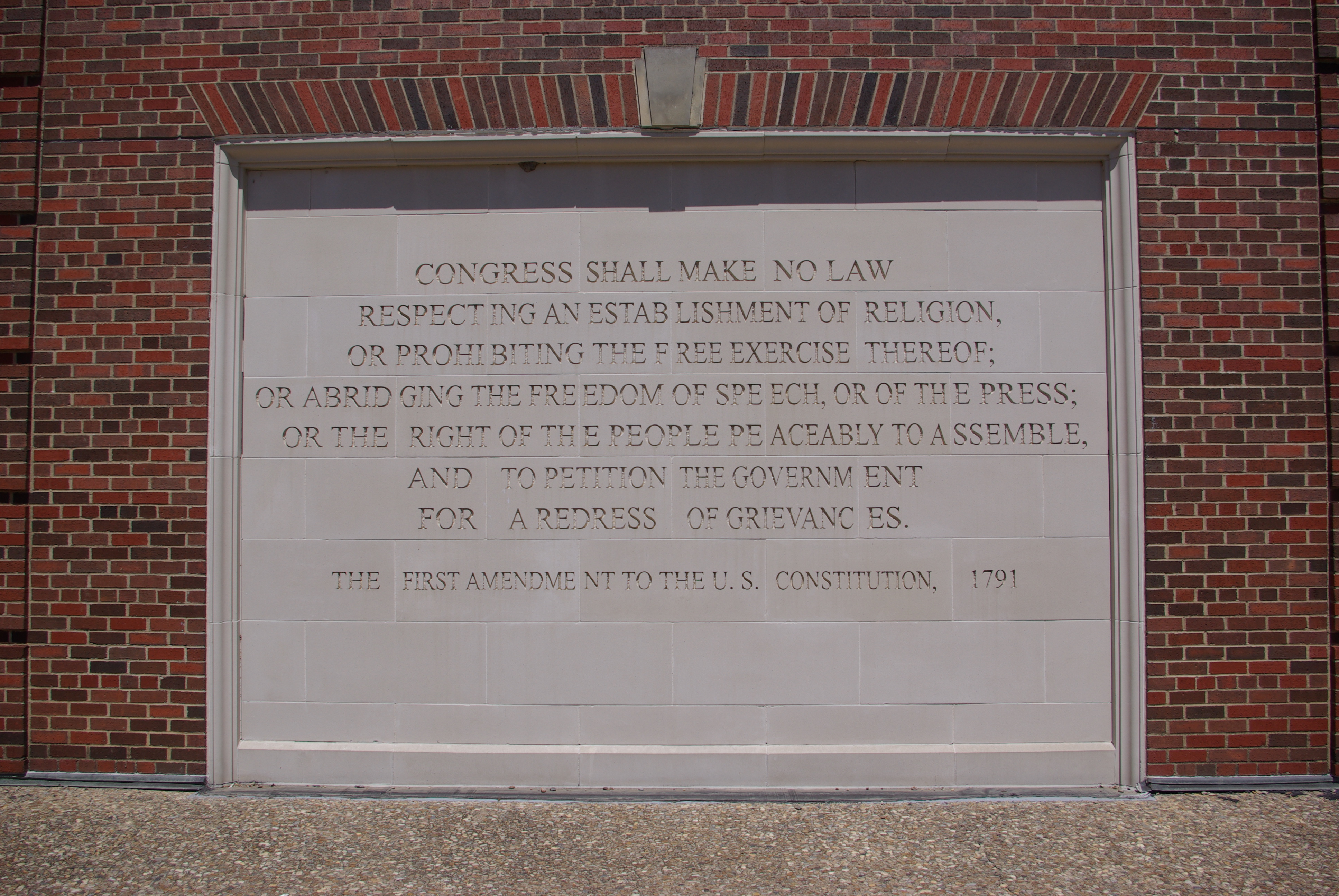
In a discussion about teaching evolution in biology classes a few years ago, I had carefully explained how and why the First Amendment does not require creationism to be taught in biology classes, and in fact is the reason that creationism isn’t taught, in the Establishment Clause. My explanation irritated the tarnation out of a creationist woman who exclaimed, “Well, it’s not like the First Amendment is engraved in stone!”
Heh. Guess what I found at Southern Methodist University Saturday. There, outside the main door of the Umphrey Lee Center, which houses the Department of Economics and the Division of Journalism of the Meadows School for the Arts:
Spread the word; friends don't allow friends to repeat history.
2 Comments | Creationism, History, Politics | Tagged: Constitution, First Amendment, Humor, Law, Politics, Southern Methodist University | Permalink
Posted by Ed Darrell
December 12, 2007
Our friends and benefactors at the Bill of Rights Institute put up a great branch of their site, Founders Online. A grant from the Shelby Cullom Davis Foundation made the project possible.

Check it out:
John Adams | Samuel Adams | Alexander Hamilton | Patrick Henry
Thomas Jefferson | James Madison | GeorgeMason | Gouverneur Morris
James Otis | Thomas Paine | George Washington | John Witherspoon
This page should be a first stop for your students doing biographies on any of these people, and it should be a test review feature for your classes that they can do on the internet at home, or in class if you’re lucky enough to have access in your classroom.
Good on-line sources are still too rare. This is stuff you can trust to be accurate and appropriate for your students. Send a note of thanks to the Bill of Rights Institute, and send your students to the site.
Just in time for Bill of Rights Day, December 15 . . .
Spread the word; friends don't allow friends to repeat history.
Leave a Comment » | 1787, 1789, Accuracy, Ben Franklin, Civil Rights, Classroom technology, Declaration of Independence, Education, Famous quotes, Freedom - Economic, Freedom - Political, George Washington, Heroes, Historic documents, History, James Madison, John Adams, On-line education, On-line learning, Student projects, Technology in the classroom, Thomas Jefferson, U.S. Constitution | Tagged: Bill of Rights, Constitution, Education, founders, History, Lesson plans, Politics | Permalink
Posted by Ed Darrell
November 8, 2007
Kathy Dopp’s project keeps turning up reasons to watch out for electronic voting machines, and other tampering with elections.
Below the fold I copy a recent e-mail from Dopp’s group. If true, the allegations here paint a sad picture of the U.S. as a nation plunging to third-world status in important areas, such as democratic elections.
I wish it were different, but for myself, I have little confidence that either the 2000 or 2004 election was straight up. Was it crooked enough to skew results? Let me know what you think in comments.
Dopp’s e-mail follows: Read the rest of this entry »
Spread the word; friends don't allow friends to repeat history.
Leave a Comment » | Civil Rights, Elections, Government, Law, Lessons of history, Voting Rights Act | Tagged: 2004, Constitution, Elections, fraud, Ohio, Voting Rights Act | Permalink
Posted by Ed Darrell
October 17, 2007
Every Member of Congress needs someone to read the Federal Register daily, the Congressional Record each day, and the Constitution regularly.
The Federal Register records agency actions, many of them quite obscure, but all of the agency actions that affect a member’s state or district. Sometimes an agency will try to sneak something past a member, and sometimes they’ll simply fail to notify the member of something that really deserves a lot of attention. The Congressional Record does the same thing for Congress. It’s a difficult read, but someone who knows it well can tell when conditions are ripe to get action on some measure.
Al Kamen at The Washington Post gives an object lesson on why knowledge of the Constitution is important. In this case, Senate Majority Leader Harry Reid’s Constitution experts invoked the clause that prevents a president from making recess appointments.
This may be inside baseball to most people. Kamen’s story demonstrates why a party will elect someone like Reid as their leader. He may not be as suave and funny as Jack Kennedy on camera, but he knows where the buttons are that open and close the automatic doors of power.
The detente the two sides reached over the Senate’s August break — which saw the Senate approve dozens of nominees in exchange for a no-recess-appointment pledge — is over.
That deal was reached in part because Senate Majority Leader Harry Reid (D-Nev.) dusted off an old weapon — the pro forma session — which would mean theoretically that the Senate would never be in recess. When both sides negotiate anew, that weapon looms large.
Turns out the pro forma session originally had nothing to do with recess appointments. It comes from Article I, Section 5 of the Constitution, which says neither the House nor Senate may be out for more than three days while the other body is in session, without the consent of that other body.
But neither chamber wanted to seek “permission” from the other one for anything. Bad form and all that.
Did you know what was in Article I, Section 5?
Perhaps more important, this was covered by the much-maligned-in-blogdom “Main Stream Media” (MSM). Can you find a blogger who broke this story before Kamen? I’ll wager you can’t.
Spread the word; friends don't allow friends to repeat history.
Leave a Comment » | Government, Law, U.S. Constitution, U.S. Senate | Tagged: Constitution, hardball politics, recess appointments, Sen. Harry Reid, Senate procedure | Permalink
Posted by Ed Darrell
September 30, 2007
 Trial simulations put students into the middle of tough topics in government, economics and history — or can do, depending on how well the simulations work. In the middle of the fight is a great place to learn.
Scholastic.com features a series of lesson plans suitable for government and civics. Looking for Constitution Day lesson plans I stumbled into a trial-by-jury simulation, with the mock trial script all prepared for you, for grades 5 through 8.
It looks to me to be a good way to study the jury system (see Amendments 6 and 7 of the Constitution). The lesson plans and materials were designed, and their dissemination supported by the American Board of Trial Advocates. Yes, that’s a group with a view; no, the bias doesn’t show up in the classroom materials, really.
Here’s a graphic on amending the Constitution, from the same site. This could be reproduced for student journals, printed for small posters, or, check with your high school drafting classes to see whether they won’t print this out for you in a poster size, in color. Scholastic.com features nine graphic pages like that one.
Trial by jury provides the foundation for some of our greatest drama: On television with Perry Mason, Matlock, Law & Order, Boston Legal, or L.A. Law; on the stage with Inherit the Wind and Ayn Rand’s The Night of January 16th; in opera with Gilbert and Sullivan’s Trial by Jury (okay, in operetta). This is the sort of thing students enjoy, and probably will remember.
How and why to show up for jury duty is one of the most important understandings our students can take away.

Spread the word; friends don't allow friends to repeat history.
Leave a Comment » | 6th Amendment, 7th Amendment, Bill of Rights, Government, Jurisprudence, Justice, Law, Lesson plans, U.S. Constitution | Tagged: 6th Amendment, Bill of Rights, Constitution, Lesson plans, Trial by jury | Permalink
Posted by Ed Darrell
June 15, 2007
1968 propelled history in dramatic fashion, much of it tragic. History teachers might await the 40th anniversary stories of 1968’s events, knowing that the newspapers and television specials will provide much richer material than any textbook could hope for.
Was 1967 less momentous? Perhaps. But an anniversary this week only serves to highlight how the entire decade was a series of turning points for the United States. This week marks the 40th anniversary of the Supreme Court’s issuing the decision in Loving v. Virginia. The Lovings had been arrested, convicted and exiled from the state of Virginia for the crime of — brace yourself — getting married.

Photo of Richard and Mildred Loving from Bettman-Corbis Archive.
You see, Virginia in those days prohibited marriage between a black person and a white person. So did 15 other states. In language that is quaint and archaic to all but Biblical literalist creationists, the trial judge said:
“Almighty God created the races white, black, yellow, malay and red, and he placed them on separate continents. And but for the interference with his arrangement there would be no cause for such marriages. The fact that he separated the races shows that he did not intend for the races to mix.”
The Lovings appealed their conviction. They appealed to the U.S. Supreme Court. And on June 12, 1967, the Supreme Court of the United States struck down laws that prohibit a person of one “race” from marrying a person of another. (I put “race” in quotes because, as we have since learned from DNA studies, there is just one race among us, the human race. Science verifies that the Supreme Court got it right, as did the Americans before them who wrote the laws upon which the Supreme Court’s decision was based.)
From 1958 to 1967 — nine years the case wended through the courts. Oral argument was had on April 10 — the decision coming down in just two months seems dramatically quick by today’s standards. This was one of the cases that angered so many Americans against the Court presided over by Chief Justice Earl Warren.
Ed Brayton at Dispatches from Culture Wars points to a statement from Mildred Loving on this anniversary. The statement is below the fold. Read the rest of this entry »
Spread the word; friends don't allow friends to repeat history.
8 Comments | 1968, Citizenship, Civil Rights, Fourteenth Amendment, Freedom - Political, Heroes, History, Human Rights, Jurisprudence, Justice, U.S. Constitution | Tagged: 1967, Civil Rights, Constitution, Loving v Virginia, marriage, Miscegination, Supreme Court | Permalink
Posted by Ed Darrell
February 20, 2007
That kid in New Jersey whose town turned on him, on the town’s internet bulletin board, after he ratted out the history teacher who was preaching instead of teaching? He’s still under attack.
The teacher took some time out to defend his odd views in the local paper. His letter is several weeks old, and it’s been fisked by others, but I want my licks. I fisk the letter below the fold. Read the rest of this entry »
Spread the word; friends don't allow friends to repeat history.
12 Comments | Adam Smith, America's founding, Bad Quotes, Ben Franklin, Bogus history, First Amendment, George Washington, Public education, Religious Freedom, Thomas Jefferson | Tagged: Adam Smith, Ben Franklin, Constitution, Education, First Amendment, George Washington, Kearney, New Jersey, Religion, Separation of church and state | Permalink
Posted by Ed Darrell




 Millard Fillmore's Bathtub