A neglected, “Neglected Anniversary” – Mencken, Fillmore and the bathtub

December 29, 2009

Otherwise occupied, I nearly forgot:  92 years ago yesterday, on December 28, 1917, this column by H. L. Mencken was published in The New York Evening Mail:

A Neglected Anniversary

Mencken on April 7, 1933 - end of low-alcohol beer - Baltimore Sun Photo

H. L. Mencken at approximately 12:30 a.m., April 7, 1933, at the Rennert Hotel, corner of Saratoga and Liberty Streets, 17 years later, not neglecting a sudsy anniversary - Baltimore Sun photo

On December 20 there flitted past us, absolutely without public notice, one of the most important profane anniversaries in American history, to wit, the seventy-fifth anniversary of the introduction of the bathtub into These States. Not a plumber fired a salute or hung out a flag. Not a governor proclaimed a day of prayer. Not a newspaper called attention to the day.

True enough, it was not entirely forgotten. Eight or nine months ago one of the younger surgeons connected with the Public Health Service in Washington happened upon the facts while looking into the early history of public hygiene, and at his suggestion a committee was formed to celebrate the anniversary with a banquet. But before the plan was perfected Washington went dry (This was war-time Prohibition, preliminary to the main catastrophe. — HLM), and so the banquet had to be abandoned. As it was, the day passed wholly unmarked, even in the capital of the nation.

Bathtubs are so common today that it is almost impossible to imagine a world without them. They are familiar to nearly everyone in all incorporated towns; in most of the large cities it is unlawful to build a dwelling house without putting them in; even on the farm they have begun to come into use. And yet the first American bathtub was installed and dedicated so recently as December 20, 1842, and, for all I know to the contrary, it may still be in existence and in use.

Curiously enough, the scene of its setting up was Cincinnati, then a squalid frontier town, and even today surely no leader in culture. But Cincinnati, in those days as in these, contained many enterprising merchants, and one of them was a man named Adam Thompson, a dealer in cotton and grain. Thompson shipped his grain by steamboat down the Ohio and Mississippi to New Orleans, and from there sent it to England in sailing vessels. This trade frequently took him to England, and in that country, during the ’30s, he acquired the habit of bathing.

The bathtub was then still a novelty in England. It had been introduced in 1828 by Lord John Russell and its use was yet confined to a small class of enthusiasts. Moreover, the English bathtub, then as now, was a puny and inconvenient contrivance — little more, in fact, than a glorified dishpan — and filling and emptying it required the attendance of a servant. Taking a bath, indeed, was a rather heavy ceremony, and Lord John in 1835 was said to be the only man in England who had yet come to doing it every day.

Thompson, who was of inventive fancy — he later devised the machine that is still used for bagging hams and bacon — conceived the notion that the English bathtub would be much improved if it were made large enough to admit the whole body of an adult man, and if its supply of water, instead of being hauled to the scene by a maid, were admitted by pipes from a central reservoir and run off by the same means. Accordingly, early in 1842 he set about building the first modern bathroom in his Cincinnati home — a large house with Doric pillars, standing near what is now the corner of Monastery and Orleans streets.

There was then, of course, no city water supply, at least in that part of the city, but Thompson had a large well in his garden, and he installed a pump to lift its water to the house. This pump, which was operated by six Negroes, much like an old-time fire engine, was connected by a pipe with a cypress tank in the garret of the house, and here the water was stored until needed. From the tank two other pipes ran to the bathroom. One, carrying cold water, was a direct line. The other, designed to provide warm water, ran down the great chimney of the kitchen, and was coiled inside it like a giant spring.

The tub itself was of new design, and became the grandfather of all the bathtubs of today. Thompson had it made by James Cullness, the leading Cincinnati cabinetmaker of those days, and its material was Nicaragua mahogany. It was nearly seven feet long and fully four feet wide. To make it water-tight, the interior was lined with sheet lead, carefully soldered at the joints. The whole contraption weighed about 1,750 pounds, and the floor of the room in which it was placed had to be reinforced to support it. The exterior was elaborately polished.

In this luxurious tub Thompson took two baths on December 20, 1842 — a cold one at 8 a.m. and a warm one some time during the afternoon. The warm water, heated by the kitchen fire, reached a temperature of 105 degrees. On Christmas day, having a party of gentlemen to dinner, he exhibited the new marvel to them and gave an exhibition of its use, and four of them, including a French visitor, Col. Duchanel, risked plunges into it. The next day all Cincinnati — then a town of about 100,000 people — had heard of it, and the local newspapers described it at length and opened their columns to violent discussions of it.

The thing, in fact, became a public matter, and before long there was bitter and double- headed opposition to the new invention, which had been promptly imitated by several other wealthy Cincinnatians. On the one hand it was denounced as an epicurean and obnoxious toy from England, designed to corrupt the democratic simplicity of the Republic, and on the other hand it was attacked by the medical faculty as dangerous to health and a certain inviter of “phthisic, rheumatic fevers, inflammation of the lungs and the whole category of zymotic diseases.” (I quote from the Western Medical Repository of April 23, 1843.)

The noise of the controversy soon reached other cities, and in more than one place medical opposition reached such strength that it was reflected in legislation. Late in 1843, for example, the Philadelphia Common Council considered an ordinance prohibiting bathing between November 1 and March 15, and it failed of passage by but two votes. During the same year the legislature of Virginia laid a tax of $30 a year on all bathtubs that might be set up, and in Hartford, Providence, Charleston and Wilmington (Del.) special and very heavy water rates were levied upon those who had them. Boston, very early in 1845, made bathing unlawful except upon medical advice, but the ordinance was never enforced and in 1862 it was repealed.

This legislation, I suspect, had some class feeling in it, for the Thompson bathtub was plainly too expensive to be owned by any save the wealthy; indeed, the common price for installing one in New York in 1845 was $500. Thus the low caste politicians of the time made capital by fulminating against it, and there is even some suspicion of political bias in many of the early medical denunciations. But the invention of the common pine bathtub, lined with zinc, in 1847, cut off this line of attack, and thereafter the bathtub made steady progress.

The zinc tub was devised by John F. Simpson, a Brooklyn plumber, and his efforts to protect it by a patent occupied the courts until 1855. But the decisions were steadily against him, and after 1848 all the plumbers of New York were equipped for putting in bathtubs. According to a writer in the Christian Register for July 17, 1857, the first one in New York was opened for traffic on September 12, 1847, and by the beginning of 1850 there were already nearly 1,000 in use in the big town.

After this medical opposition began to collapse, and among other eminent physicians Dr. Oliver Wendell Holmes declared for the bathtub, and vigorously opposed the lingering movement against it in Boston. The American Medical Association held its annual meeting in Boston in 1849, and a poll of the members in attendance showed that nearly 55 per cent of them now regarded bathing as harmless, and that more than 20 per cent advocated it as beneficial. At its meeting in 1850 a resolution was formally passed giving the imprimatur of the faculty to the bathtub. The homeopaths followed with a like resolution in 1853.

But it was the example of President Millard Fillmore that, even more than the grudging medical approval, gave the bathtub recognition and respectability in the United States. While he was still Vice-President, in March, 1850, he visited Cincinnati on a stumping tour, and inspected the original Thompson tub. Thompson himself was now dead, but his bathroom was preserved by the gentlemen who had bought his house from the estate. Fillmore was entertained in this house and, according to Chamberlain, his biographer, took a bath in the tub. Experiencing no ill effects, he became an ardent advocate of the new invention, and on succeeding to the Presidency at Taylor’s death, July 9, 1850, he instructed his secretary of war, Gen. Charles M. Conrad, to invite tenders for the construction of a bathtub in the White House.

This action, for a moment, revived the old controversy, and its opponents made much of the fact that there was no bathtub at Mount Vernon, or at Monticello, and that all the Presidents and other magnificoes of the past had got along without any such monarchical luxuries. The elder Bennett, in the New York Herald, charged that Fillmore really aspired to buy and install in the White House a porphyry and alabaster bath that had been used by Louis Philippe at Versailles. But Conrad, disregarding all this clamor, duly called for bids, and the contract was presently awarded to Harper & Gillespie, a firm of Philadelphia engineers, who proposed to furnish a tub of thin cast iron, capable of floating the largest man.

This was installed early in 1851, and remained in service in the White House until the first Cleveland administration, when the present enameled tub was substituted. The example of the President soon broke down all that remained of the old opposition, and by 1860, according to the newspaper advertisements of the time, every hotel in New York had a bathtub, and some had two and even three. In 1862 bathing was introduced into the Army by Gen. McClellan, and in 1870 the first prison bathtub was set up at Moyamensing Prison, in Philadelphia.

So much for the history of the bathtub in America. One is astonished, on looking into it, to find that so little of it has been recorded. The literature, in fact, is almost nil. But perhaps this brief sketch will encourage other inquirers and so lay the foundation for an adequate celebration of the centennial in 1942.

(Text courtesy of Poor Mojo’s Almanac(k))

The entire history was a hoax composed by Mencken.

Even conservative wackoes appreciate the column.

Content with his private joke, Mencken remained silent about the hoax until a follow-up article, “Melancholy Reflections,” appeared in the Chicago Tribune on May 23, 1926, some eight years later. This was Mencken’s confession. It was also an appeal for reason to the American public.

His hoax was a joke gone bad. “A Neglected Anniversary” had been printed and reprinted hundreds of times in the intervening years. Mencken had been receiving letters of corroboration from some readers and requests for more details from others. His history of the bathtub had been cited repeatedly by other writers and was starting to find its way into reference works. As Mencken noted in “Melancholy Reflections,” his “facts” “began to be used by chiropractors and other such quacks as evidence of the stupidity of medical men. They began to be cited by medical men as proof of the progress of public hygiene.” And, because Fillmore’s presidency had been so uneventful, on the date of his birthday calendars often included the only interesting tidbit of information they could find: Fillmore had introduced the bathtub into the White House. (Even the later scholarly disclosure that Andrew Jackson had a bathtub installed there in 1834—years before Mencken claimed it was even invented—did not diminish America’s conviction that Fillmore was responsible.)

(No, dear reader, probably not correct; surely John Adams brought a bathtub with him when he moved into the White House, then called the President’s Mansion.  Plumbing, hot water, and finally hot water to a bathtub in the president’s residence, were installed between 1830 and 1853, as best I can determine.)

Mencken wrote an introduction to the piece in a later bookA Mencken Chrestomathy (Alfred A. Knopf, 1949):

The success of this idle hoax, done in time of war, when more serious writing was impossible, vastly astonished me. It was taken gravely by a great many other newspapers, and presently made its way into medical literature and into standard reference books. It had, of course, no truth in it whatsoever, and I more than once confessed publicly that it was only a jocosity . . .  Scarcely a month goes by that I do not find the substance of it reprinted, not as foolishness but as fact, and not only in newspapers but in official documents and other works of the highest pretensions.

There’s a moral to the story:  Strive for accuracy!

So, Dear Reader, check for accuracy, and question authority.

Resources:

Warn others of the hoax!

Add to FacebookAdd to NewsvineAdd to DiggAdd to Del.icio.usAdd to StumbleuponAdd to RedditAdd to BlinklistAdd to TwitterAdd to TechnoratiAdd to Furl


Ugly when they pretend to care

December 28, 2009

Kids dressing up as adults are cute.

Adults dressing up as things they are not can be entertaining at a masquerade.  It’s generally pretty ugly when they dress up as things they are not, for purposes of deception.

Joe Carter, the superstar blogger of evangelical Christians, posted at First Things, pretending to be upset that Democrats and others who work to control and ameliorate global warming, are missing the boat (so to speak) by not complaining about air pollution from ships, especially super-sized cargo ships.

(Even the title of the thing is offensive, either in or out of context:  “Sink a ship, save a planet.”  Ah, the humor of the conservative, reality- and humor-challenged.  I’m sure al Quaeda would be happy to oblige Carter and the headline writers.)

Carter thinks he’s caught environmentalists in some sort of hypocritical stance, worrying about global warming and urging clean air everywhere but from the ships that bring us oil:  ‘If you’re so gosh-darn concerned about global warming, why not worry about the pollution from ships, smarty-pants?’ Joe laments.

You’d think he’d have bothered to Google the issue first, before pretending he’s the only one who noticed.

Joe wrote:

Changing the emissions regulations on the shipping industry seems like a modest, commonsense step toward reducing air pollution. So why doesn’t it get more political attention? Why do hypothetical concerns about potential catastrophic problems always trump those that are causing massive deaths right now?

With all the focus on man-made global warming, its easy to overlook the fact that man-made pollution is already killing millions of people every year.

*   *   *   *   *   *   *   *

Imagine the effect we could have on pollution if we spent as much time, energy, and money on solutions that make a difference for other people’s lives rather than those that merely make us feel good about ourselves.

Imagine, indeed.  The gall of those environmentalists, warning about global warming but letting their friends in the shipping business get off scot-free, no?

Reality is that the liberal environmentalists and federal regulators were on the issue earlier, sponsoring legislation to deal with the issue — and President Obama’s Environmental Protection Agency got an agreement earlier this year to go at least part-way to resolving the problems.  EPA monitored air pollution from ships from long ago — at this 2001 EPA meeting in San Francisco, Fischbeck offered a .pdf PowerPoint summary of EPA’s work, the problems of air pollution from ships, the strategies to control the pollution and the benefits of such control.

Several Members of Congress introduced legislation to fix marine air pollution in the last Congress, and hearings were held on bills that didn’t quite make it into law.  These efforts were follow-on to an international treaty to control marine air pollution; according to the Congressional Research Service’s explanation of the bills and the issue:

In 1997, the United States and most countries signed an international agreement known as MARPOL Annex VI, setting extremely modest controls on air pollution from ships. The agreement did not enter into force until 2005, and the United States took until July 21, 2008, to enact legislation to implement it (P.L. 110-280). Negotiations to strengthen Annex VI accelerated in 2008, however, and discussions regarding GHG emissions have also begun. While awaiting congressional action and international agreement, the Environmental Protection Agency (EPA), port cities, and states have begun to act on their own. In the 110th Congress, legislation was introduced (S. 1499 / H.R. 2548) to require EPA to dramatically strengthen ship emission standards under the Clean Air Act. S. 1499 was reported, but no further action was taken.

I suppose it’s too much to expect hard-core rightists to pay attention to international news, but marine air pollution is a topic of international concern, obviously indicated by the MARPOL treaty, but with a lot of other indicators for anyone who chooses to look and study the issue.

Ships pour out great quantities of pollutants into the air in the form of sulphur and nitrogen oxides.

The emissions from ships engaged in international trade in the seas surrounding Europe – the Baltic, the North Sea, the north-eastern part of the Atlantic, the Mediterranean and the Black Sea – were estimated to have been 2.3 million tonnes of sulphur dioxide and 3.3 million tonnes of nitrogen oxides a year in 2000.

In contrast to the progress in reducing emissions from land-based sources, shipping emissions of sulphur and nitrogen oxides are expected to continue increasing by 40-50 per cent up to 2020. In both cases, by 2020 the emissions from international shipping around Europe will have surpassed the total from all land-based sources in the 27 EU member states combined.

Joe Carter is right that air pollution from ships should be of great concern.  He would be wise to listen to those like former U.S. Rep. Hilda Solis, who sponsored a bill in the 110th Congress to fight marine air pollution.

And, now that we’ve established that cleaning up marine air pollution is a good idea, and the liberals and environmentalists and Obama administration are already on the job, wouldn’t it also be great if the conservatives who  look at these issues, too, listen to these same people when they warn about the dangers of global warming, and of the dangers of failing to act soon to stop it?

Joe Carter identified a problem, and he’s discovered that the environmentalists and Democrats he wished to ding for not paying enough attention instead were there before him, and resolved much of the difficulty.

Anyone want to bet whether Carter will give credit to Obama, EPA and the Democrats in Congress for solving the problems?

Add to FacebookAdd to NewsvineAdd to DiggAdd to Del.icio.usAdd to StumbleuponAdd to RedditAdd to BlinklistAdd to TwitterAdd to TechnoratiAdd to Furl


Merry Christmas, to the “right” people (not you, Mr. President)

December 25, 2009

You can’t make this stuff up.

Here’s a generally mean-spirited post trying to make hay from the general disinformation about about Obama’s faith and otherwise trying to stir hatred.  (Here’s more of the flap on the ornaments on the White House’s Blue Room tree, and I’ve got a response in comments at this post.)

Followed by this “glowing” cross.

Merry Christmas.  “We dare you,” the Right Perspective says.

Make the right wing extremely angry today:  Have a good and merry Christmas.  Be tolerant.  Think.  Smile.  Act kindly.  It’ll make ’em crazy.

Also:


Santa’s ride updated – GE’s high-tech sleigh

December 24, 2009

GE labs suggest some improvements to the Santa Claus Sleigh.  A good way to introduce research, I think.

GE's improvements to Santa's Sleight, 2009

Click here for GE's interactive feature

Among improvements:

Companies hitching a star to Santa’s sleigh is nothing new.  It may be difficult to separate out the Coca-Cola from the Santa myth at this late date, and who remembers that “Rudolph, the Red-Nosed Reindeer” originally came from a project for departed department store Montgomery Ward.  GE at least shows good humor.

Here at Bathtub Manor we switched to LEDs on the Christmas tree this year.  The blue lights are a bit intense (more yellow and red in the mix, please, string assemblers).  Travel home, shopping, recipe-finding, and most other parts of our family’s Christmas preparations are laced with cell phones, computers, internet and digital photography, and microprocessors performing music — not to mention the yearly infusions of new technology under the tree.

We live in fascinating times.

Check out the update of Santa’s headgear, too.

Santa's old sleigh, as last configured - HowStuffWorks.com

Bye-bye tradition? Santa's old sleigh, as last configured - HowStuffWorks.com

Tell your friends about Santa’s high-tech ride:

Add to FacebookAdd to NewsvineAdd to DiggAdd to Del.icio.usAdd to StumbleuponAdd to RedditAdd to BlinklistAdd to TwitterAdd to TechnoratiAdd to Furl


Newspaper history: “Yes, Virginia,” the most popular editorial ever vouches for Santa Claus

December 20, 2009

“Papa says, ‘If you see it in the Sun, it’s so.'”

Do we stand as witnesses to the end of newspapers in America?

It’s been a grand history.  Newspapering gave us great leaders like Benjamin Franklin.  Newspapering gave us wars, like the Spanish-American War.  Newspapering gave us Charlie Brown, Ann Landers, the Yellow Kid, Jim Murray, Red Smith, Thomas Nast (and Santa Claus), the Federalist Papers, and coupons to save money on laundry soap.

It’s been a curious history, too.  An 1897 editorial vouching for Santa Claus rates as the most popular editorial of all time, according to the Newseum in Washington, D.C.

Francis Pharcellus Church, New York Sun writer who wrote "Yes Virginia, there is a Santa Claus" - Newseum

The man who saved Christmas, at least for Virginia O'Hanlon: Francis Pharcellus Church - Newseum image

In autumn, 1897, 8-year-old Virginia O’Hanlon of 115 West 59th Street in New York, wrote to the New York Sun with this simple question:

“Please tell me the truth; is there a Santa Claus?”

In the age of Yellow Journalism, the fiercely competitive Sun‘s editors turned the letter to Francis Pharcellus.  He responded to little Virginia on September 21, 1897:

“Yes, Virginia, there is a Santa Claus.”

Church’s brother, William Conant Church, owned and published the newspaper.  Both had followed their father into the news business.  They co-founded The Army-Navy Journal in 1863, and went on to a series of journalistic collaborations.  Francis was 58 years old when he answered Virginia’s letter. (He died at age 67, in 1906.)

The New York Sun held down the conservative corner in New York journalism at the time, versus the New York Times and the New York Herald-Tribune.  But it also had an interesting history, to a blogger intrigued by hoaxes.  In 1835 the paper published a series of six newspaper stories falsely attributed to Sir John Herschel, a well-known astronomer, claiming to describe a civilization on the Moon — the Great Moon Hoax.  The discovery was credited to a new, very powerful telescope.

In 1844 the paper published a hoax written by Edgar Allen Poe, the Balloon Hoax.  Under a pseudonym, Poe wrote that a gas balloon had crossed the Atlantic in three days.

The Sun also featured outstanding reporting.  A 1947 and 1948  series about crime on the docks of New York City won a Pulitzer Prize for writer Malcolm Johnson.  That series inspired Elia Kazan’s 1954 movie On the Waterfront starring Marlon Brando, Rod Steiger, Eva Marie Saint, Karl Malden and Lee J. Cobb.

The New York Sun ceased publication in 1950.

For all of its history, the Sun and the Churches are most remembered for that defense of belief in Santa Claus.
Virginia O’Hanlon grew up, graduated from Hunter College, got a masters at Columbia, and earned a Ph.D. from Fordham.  She taught in the New York City Public School system, from which she retired in 1959.  She died in 1971.

Birth of tradition

Columbia University was Church’s alma mater, as well as O’Hanlon’s.  Her letter and his response get a reading each year at the Yule Log Ceremony at Columbia College, along with the poem “A Visit from St. Nicholas.”  Animated, live-acting, and other television productions have been mounted in 1974, 1991, and 2009.


Is there a Santa Claus?  Did Church write a credible defense? The text of the letter and answer, below the fold.

Add to FacebookAdd to NewsvineAdd to DiggAdd to Del.icio.usAdd to StumbleuponAdd to RedditAdd to BlinklistAdd to TwitterAdd to TechnoratiAdd to Furl

Read the rest of this entry »


Stand up for good history in Texas

December 17, 2009

Here’s an education and Texas issue I’ve not done justice to:  The Texas State Board of Education is working to gut social studies curricula in Texas, with a special vent on history, which they appear to think is not fundamentalist Christian enough, and economics, where they think “capitalism” is, somehow, a dirty word.

Do I exaggerate?   Very little, if at all.  Really.

There’s a lot to say.  I may have another post on it this week.  In the meantime, the indefatigable Texas Freedom Network works to organize for the hearing on the issue in January.  SBOE hopes it will be a quiet, non-confrontational meeting, and they will do whatever they can to prevent Texans from telling them to have good history standards that make great students.  So it’s important that you speak up — especially if you’re a Texan.  Here’s what TFN said in an e-mail alert:

Make Your Voice Heard at January Public Hearing

The process of revising social studies curriculum standards for Texas public schools is moving into a critical stage. And a public hearing the board has scheduled for January may be the only opportunity for you to speak out against the far right’s efforts to corrupt standards for history, government and other social studies classes.

The final drafts of the proposed standards prepared by writing teams made up of teachers, academics and other community members are reflective of mainstream academic scholarship in the various subject areas. It is clear that members of these writing teams largely resisted intense political pressure from far right, rejecting attempts to remove key civil rights figures and make other politically motivated revisions. (See the Background section at the bottom of this e-mail for a more detailed account of the politicization of this curriculum process.)

But as with science and language arts, far-right SBOE members are already plotting to undo the work of the writing teams of social studies.

Take Action

The State Board of Education so far has scheduled only one public hearing on the proposed standards. That hearing is likely to occur either on January 13 or January 14 in Austin.

If you are interested in speaking at the hearing, please click here. TFN will help you register to speak before the board and be an effective voice against efforts to politicize our children’s classrooms.

This may be the only opportunity the board provides for Texans to speak out on the proposed standards. If we are to prevent far-right SBOE members from turning social studies classrooms into tools for promoting political agendas, then it’s critical that the board hears from people like you! Click here to sign up for more information on how to testify in January.

___________________________________________________

Background on Social Studies Review Process to Date

Earlier this year, TFN exposed and derailed several attempts by the far right to hijack the social studies curriculum revision process. Members of the state board – or their appointees to review panels and writing teams – tried at various times to:

  • Remove civil rights champions like César Chávez and Thurgood Marshall from the standards, calling them poor examples of citizenship
  • Turn Joseph McCarthy – who discredited himself and dishonored Congress with his infamous Red-baiting smear campaign in the 1950s – into an American hero
  • Rewrite history and portray America’s Founders as intending to establish a Christian nation with laws based on a fundamentalist reading of the Bible

Members of the writing teams largely rejected these fringe ideas in the final drafts of the standards they submitted to the board. Chávez and Marshall remain in the curriculum. The American history standards do not whitewash the damaging history of McCarthyism. And under the proposed standards students would still learn that the Founders created a nation in which all people are free to worship – or not – as they choose without coercion or interference by government.

We must ensure that the board adopts curriculum standards that reflect mainstream academic scholarship in social studies. This is vitally important because the results of this decision will be reflected in the next generation of social studies textbooks around the country.

Click here to let TFN know you are willing to testify at the state board.

Spread the word even farther — help save history, in Texas:

Add to FacebookAdd to NewsvineAdd to DiggAdd to Del.icio.usAdd to StumbleuponAdd to RedditAdd to BlinklistAdd to TwitterAdd to TechnoratiAdd to Furl


If only hysteric, misplaced paranoia could reduce greenhouse gases . . .

December 10, 2009

“I got this idea for a movie!”

“Not another vampire who sucks the sap of only endangered species plants, please, Bob.”

“No, really, you gotta hear this!  Heck, it might even be real.”

“Whaddya mean by that, Bob?”

“I mean this whole Copenhagen thing!  World leaders getting together in secret to plot the destruction of world industry!”

“Copenhagen’s meetings are wide open, Bob.  It’s on the news everywhere.  And did you ever notice that most of the world leaders there are capitalists, and that they owe their election to other capitalists, frequently of the oil-drilling and coal-mining sort?”

“That’s what they want you to think!”

“Well, I think that way whether they want me to or not, Bob.  Money, you know?  I love it.  I follow it.  There’s no money in controlling climate change.  If there were, I’d be Copenhagen right now.”

“You’re missing the point!  These guys are meeting to take the money away from guys like you.”

“Pierre, here at the restaurant, does a pretty good job of taking money from guys like me, in return for a good arugula salad and a chunk of rare roast beef.”

“That’s not what I mean!”

“I think you’ve got another crazy idea that won’t make a good movie.  I’ll let you talk through the arugula, Bob.  When the roast beef comes, I don’t want stupid plots that won’t sell on the table — so it better be good, or we’ll change the topic.”

“Okay, here goes:  Mad climate scientists create a scare about global warming, and everybody gives them their money, and they the rest of the movie is about the chase to catch them before they get to a secret beach in the Maldives or Marshall Islands where they’ll hide forever in their secret lair.”

“I’m not impressed yet, Bob.  Why would anyone think a climate scientist would be so power hungry?

“They meet in Al Gore’s mansion.  Al Gore’s the power-hungry villain!”

“Al Gore?  He lost an election to George F. Bush, for cryin’ out loud.  Nobody would believe that.”

“You mean W — ‘George W. Bush.'”

“Have you seen what the stock market’s been like lately, Bob?  No, of course not.  You don’t own stocks in regular companies — gun makers and gold dealers only — but after what happened to my portfolio, I mean F.  He’s George F. Bush to me.”

“C’mon, it’s ripped from the headlines!”

“It’s about as exciting as the crossword puzzle, Bob.  That’s not a movie — it’s a new sleep drug.  I couldn’t sell it to a religious group trying to make a movie about Charles Darwin, even if we dressed Gore up as Darwin.  Even they’d see through the plot, Bob.”

“Archie!  It’s a great movie!  Think of the special effects!”

“Think of the NoDoz concession.  Theatres don’t have ’em.  Climate scientists taking over the world is like the Joffrey Ballet as the perps on the St. Valentine’s Day Massacre.  It’d be like getting toe-shoed to death.”

Oh, c’mon, Arch.  I got half the screenplay already done!”

“Well you need more research.”

“What?”

MaldivesMarshall Islands.  They’re the poster islands for climate change.  They’re the first nations to go as the sea rises.  All the geeks will know that, and so they’ll laugh at your movie.  Geeks laughing at you isn’t good box office.”

“We can do it like Superman!  You know a Fortress of Solitude somewhere in the ice.”

“No ice would kinda make that plot device not work, wouldn’t it, Bob?”

“Oh, c’mon.  No one really thinks the ice is disappearing!”

“Bob — remember our agreement?”

“What?”

“Beef’s here.  Shuttup.”

“Huh?  Oh, yeah.  Oh.  Yeah.”

“Okay, Archie.  How about this:  There really are gods, and hysteria makes them happy.”

“Hysteria.  Yeah.  There’s value in that.”

“No, I mean it.  Hysteria makes the gods happy, and so then they do good things for people.”

“Like what?”

“Well . . . like . . . like cleaning up global warming.  Yeah, that’s it!  Blind hysteria makes global warming go away!”

“Nobody’ll believe that, either, Bob.  If that worked, global warming would have been gone ten years ago.  Shuttup and eat your beef.”


The Curse of “Not Evil, Just Wrong” — still evil and wrong

December 10, 2009

At the first post on this material, the thread got a little long — not loading well in some browsers, I hear.

So the comments are closed there, and open here.

In fashion we wish were different but seems all too typical, so-called skeptics of global warming defend their position with invective and insult.  But they are vigorous about it.  What do you think?  What information can you contribute?

Here’s the post that set off the denialists, anti-science types and DDT sniffers, and a tiny few genuinely concerned but under-informed citizens:

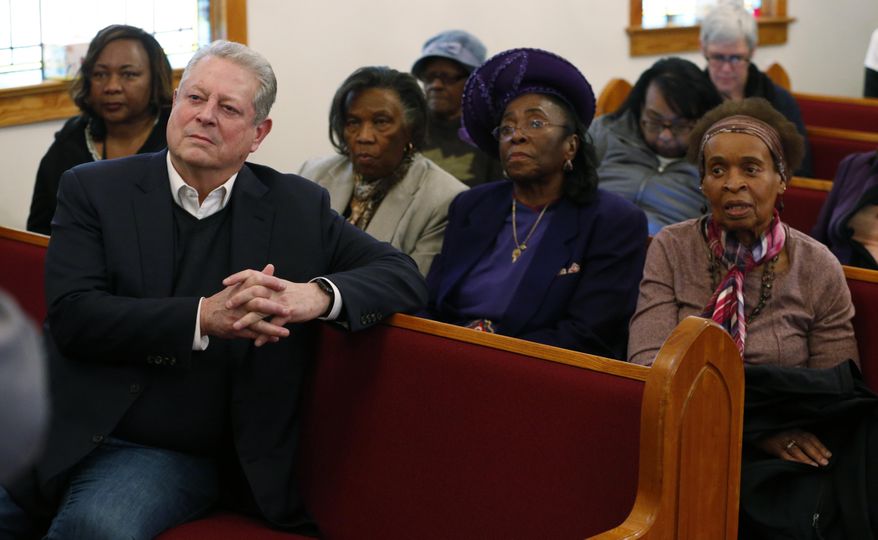
AP caption: Former Vice President Al Gore, left, listens to speakers during a meeting at the Grove Missionary Baptist Church in Buckingham, Va., Tuesday, Feb. 19, 2019. Gore visited the area that is the proposed site for a compressor station for the Atlantic Coast Pipeline. (AP Photo/Steve Helber)
Should be obviously silly for anyone to argue former divinity student Al Gore is evil, as this film implies despite the demurrer. It should also be obviously that it’s evil to call Gore wrong on these issues; but that doesn’t stop brown Earther critics of scientists and Al Gore.

I warned you about it earlier. Crank science sites across the internet feature news of another cheap hit on Rachel Carson and science in movie form.

“Not Evil, Just Wrong” is slated for release on October 18. This is the film that tried to intrude on the Rachel Carson film earlier this year, but managed to to get booked only at an elementary school in Seattle, Washington — Rachel Carson Elementary, a green school where the kids showed more sense than the film makers by voting to name the school after the famous scientist-author.

The film is both evil and wrong.

Errors just in the trailer:

  1. Claims that Al Gore said sea levels will rise catastrophically, “in the very near future.” Not in his movie, not in his writings or speeches. Not true. That’s a simple misstatement of what Gore said, and Gore had the science right.
  2. ” . . . [I]t wouldn’t be a bad thing for this Earth to warm up. In fact, ice is the enemy of life.” “Bad” in this case is a value judgment — global warming isn’t bad if you’re a weed, a zebra mussel, one of the malaria parasites, a pine bark beetle, any other tropical disease, or a sadist. But significant warming as climatologists, physicists and others project, would be disastrous to agriculture, major cities in many parts of the world, sea coasts, and most people who don’t live in the Taklamakan or Sahara, and much of the life in the ocean. Annual weather cycles within long-established ranges, is required for life much as we know it. “No ice” is also an enemy of life.
  3. “They want to raise our taxes.” No, that’s pure, uncomposted bovine excrement.
  4. “They want to close our factories.” That’s more effluent from the anus of male bovines.
  5. The trailer notes the usual claim made by Gore opponents that industry cannot exist if it is clean, that industry requires that we poison the planet. Were that true, we’d have a need to halt industry now, lest we become like the yeast in the beer vat, or the champagne bottle, manufacturing alcohol until the alcohol kills the yeast. Our experience with Rivers and Harbors Act of 1899, the Clean Air Acts and the Clean Water Act is that cleaning the environment produces economic growth, not the other way around. A city choked in pollution dies. Los Angeles didn’t suffer when the air got cleaner. Pittsburgh’s clean air became a way to attract new industries to the city, before the steel industry there collapsed. Cleaning Lake Erie didn’t hurt industry. The claim made by the film is fatuous, alarmist, and morally corrupt.

    When the human health, human welfare, and environmental effects which could be expressed in dollar terms were added up for the entire 20-year period, the total benefits of Clean Air Act programs were estimated to range from about $6 trillion to about $50 trillion, with a mean estimate of about $22 trillion. These estimated benefits represent the estimated value Americans place on avoiding the dire air quality conditions and dramatic increases in illness and premature death which would have prevailed without the 1970 and 1977 Clean Air Act and its associated state and local programs. By comparison, the actual costs of achieving the pollution reductions observed over the 20 year period were $523 billion, a small fraction of the estimated monetary benefits.

  6. “Some of the environmental activists have not come to accept that the human is also part of the environment.” Fatuous claim. Environmentalists note that humans uniquely possess the ability to change climate on a global scale, intentionally, for the good or bad; environmentalists choose to advocate for actions that reduce diseases like malaria, cholera and asthma. We don’t have to sacrifice a million people a year to malaria, in order to be industrial and productive. We don’t have to kill 700,000 kids with malaria every year just to keep cars.
  7. “They want to go back to the Dark Ages and the Black Plague.” No, that would be the film makers. Environmentalists advocate reducing filth and ignorance both. Ignorance and lack of ability to read, coupled with religious fanaticism, caused the strife known as “the Dark Ages.” It’s not environmentalists who advocate an end to cheap public schools.
  8. The trailer shows a kid playing in the surf on a beach. Of course, without the Clean Water Act and other attempts to keep the oceans clean, such play would be impossible. That we can play again on American beaches is a tribute to the environmental movement, and reason enough to grant credence to claims of smart people like Al Gore and the scientists whose work he promotes.
  9. “I cannot believe that Al Gore has great regard for people, real people.” So, this is a film promoting the views of crabby, misanthropic anal orifices who don’t know Al Gore at all? Shame on them. And, why should anyone want to see such a film? If I want to see senseless acts of stupidity, I can rent a film by Quentin Tarantino and get some art with the stupidity. [Update, November 23, 2009: This may be one of the most egregiously false charges of the film. Gore, you recall, is the guy who put his political career and presidential ambitions on hold indefinitely when his son was seriously injured in an auto-pedestrian accident; Gore was willing to sacrifice all his political capital in order to get his son healed. My first dealings directly with Gore came on the Organ Transplant bill. Gore didn’t need a transplant, didn’t have need for one in his family, and had absolutely nothing to gain from advocacy for the life-saving procedure. It was opposed by the chairman of his committee, by a majority of members of his own party in both Houses of Congress, by many in the medical establishment, by many in the pharmaceutical industry, and by President Reagan, who didn’t drop his threat to veto the bill until he signed it, as I recall. Gore is a man of deep, human-centered principles. Saying “I can’t believe Al Gore has great regard for real people” only demonstrates the vast ignorance and perhaps crippling animus of the speaker.]

That’s a whopper about every 15 seconds in the trailer — the film itself may make heads spin if it comes close to that pace of error.

Where have we seen this before? Producers of the film claim as “contributors” some of the people they try to lampoon — people like Ed Begley, Jr., and NASA’s James E. Hansen, people who don’t agree in any way with the hysterical claims of the film, and people who, I wager, would be surprised to be listed as “contributors.”

It’s easy to suppose these producers used the same ambush-the-scientist technique used earlier by the producers of the anti-science, anti-Darwin film “Expelled!

Here, see the hysteria, error and alarmism for yourself:

Ann McElhinney is one of the film’s producers. Her past work includes other films against protecting environment and films for mining companies. She appears to be affiliated with junk science purveyors at the Competitive Enterprise Institute, an astro-turf organization in Washington, D.C., for whom she flacked earlier this year (video from Desmogblog):

Remember, too, that this film is already known to have gross inaccuracies about Rachel Carson and DDT, stuff that high school kids could get right easily.

Anyone have details on McElhinney and her colleague, Phelim McAlee?

More:

Related posts, at Millard Fillmore’s Bathtub:


Who invented Santa Claus? Who really wrote the “Night Before Christmas?”

December 7, 2009

An encore post from 2007

Thomas Nast invented Santa Claus? Clement C. Moore didn’t write the famous poem that starts out, “‘Twas the night before Christmas, and all through the house . . . ?”

The murky waters of history from Millard Fillmore’s Bathtub soak even our most cherished ideas and traditions.

But isn’t that part of the fun of history?

Santa Claus delivers to Union soldiers, "Santa Claus in Camp" - Thomas Nast, Harper's Weekly, Jan 3, 1863
Thomas Nast’s first published drawing featuring Santa Claus; for Harper’s Weekly, “A Journal of Civilization,” January 3, 1863 Nast portrayed the elf distributing packages to Union troops: “Santa Claus in camp.” Nast (1840-1904) was 23 when he drew this image.

Yes, Virginia (and California, too)! Thomas Nast created the image of Santa Claus most of us in the U.S. know today. Perhaps even more significant than his campaign against the graft of Boss Tweed, Nast’s popularization of a fat, jolly elf who delivers good things to people for Christmas makes one of the great stories in commercial illustration. Nast’s cartoons, mostly for the popular news publication Harper’s Weekly, created many of the conventions of modern political cartooning and modeled the way in which an illustrator could campaign for good, with his campaign against the graft of Tammany Hall and Tweed. But Nast’s popular vision of Santa Claus can be said to be the foundation for the modern mercantile flurry around Christmas.

Nast is probably ensconced in a cartoonists’ hall of fame. Perhaps he should be in a business or sales hall of fame, too.  [See also Bill Casselman’s page, “The Man Who Designed Santa Claus.]

Nast’s drawings probably drew some inspiration from the poem, “Account of a Visit from St. Nicholas,” traditionally attributed to Clement C. Moore, a New York City lawyer, published in 1822. The poem is among the earliest to describe the elf dressed in fur, and magically coming down a chimney to leave toys for children; the poem invented the reindeer-pulled sleigh.

Modern analysis suggests the poem was not the work of Moore, and many critics and historians now attribute it to Major Henry Livingston, Jr. (1748-1828) following sleuthing by Vassar College Prof. Don Foster in 2000. Fortunately for us, we do not need to be partisans in such a query to enjoy the poem (a complete copy of which is below the fold).

The Library of Congress still gives Moore the credit. When disputes arise over who wrote about the night before Christmas, is it any wonder more controversial topics produce bigger and louder disputes among historians?

Moore was not known for being a poet. The popular story is that he wrote it on the spur of the moment:

Moore is thought to have composed the tale, now popularly known as “The Night Before Christmas,” on December 24, 1822, while traveling home from Greenwich Village, where he had bought a turkey for his family’s Christmas dinner.

Inspired by the plump, bearded Dutchman who took him by sleigh on his errand through the snow-covered streets of New York City, Moore penned A Visit from St. Nicholas for the amusement of his six children, with whom he shared the poem that evening. His vision of St. Nicholas draws upon Dutch-American and Norwegian traditions of a magical, gift-giving figure who appears at Christmas time, as well as the German legend of a visitor who enters homes through chimneys.

Again from the Library of Congress, we get information that suggests that Moore was a minor celebrity from a well-known family with historical ties that would make a good “connections” exercise in a high school history class, perhaps (”the link from Aaron Burr’s treason to Santa Claus?”): (read more, below the fold)

Clement Moore was born in 1779 into a prominent New York family. His father, Benjamin Moore, president of Columbia University, in his role as Episcopal Bishop of New York participated in the inauguration of George Washington as the nation’s first president. The elder Moore also administered last rites to Alexander Hamilton after he was mortally wounded in a tragic duel with Aaron Burr.

A graduate of Columbia, Clement Moore was a scholar of Hebrew and a professor of Oriental and Greek literature at the General Theological Seminary in Manhattan. [See comment from Pam Bumsted below for more on Moore.] He is said to have been embarrassed by the light-hearted verse, which was made public without his knowledge in December 1823. Moore did not publish it under his name until 1844.

Tonight, American children will be tucked in under their blankets and quilts and read this beloved poem as a last “sugarplum” before slipping into dreamland. Before they drift off, treat them to a message from Santa, recorded by the Thomas Edison Company in 1922.

Santa Claus Hides in Your Phonograph
By Arthur A. Penn, Performed by Harry E. Humphrey.
Edison, 1922.
Coupling date: 6/20/1922. Cutout date: 10/31/1929.
Inventing Entertainment: The Motion Pictures and Sound Recordings of the Edison Companies

Listen to this recording (RealAudio Format)

Listen to this recording (wav Format, 8,471 Kb)

But Henry Livingston was no less noble or historic. He hailed from the Livingtons of the Hudson Valley (one of whose farms is now occupied by Camp Rising Sun of the Louis August Jonas Foundation, a place where I spent four amazing summers teaching swimming and lifesaving). Livingston’s biography at the University of Toronto site offers another path for a connections exercise (”What connects the Declaration of Independence, the American invasion of Canada, the famous poem about a visit from St. Nick, and George W. Bush?”):

Henry Livingston Jr. was born in Poughkeepsie, New York, on Oct. 13, 1748. The Livingston family was one of the important colonial and revolutionary families of New York. The Poughkeepsie branch, descended from Gilbert, the youngest son of Robert Livingston, 1st Lord of Livingston Manor, was not as well off as the more well-known branches, descended from sons Robert and Philip. Two other descendants of Gilbert Livingston, President George Walker Herbert Bush and his son, President-Elect George W. Bush, though, have done their share to bring attention to this line. Henry’s brother, Rev. John Henry Livingston, entered Yale at the age of 12, and was able to unite the Dutch and American branches of the Dutch Reformed Church. At the time of his death, Rev. Livingston was president of Rutgers University. Henry’s father and brother Gilbert were involved in New York politics, and Henry’s granduncle was New York’s first Lt. Governor. But the law was the natural home for many of Henry’s family. His brother-in-law, Judge Jonas Platt, was an unsuccessful candidate for governor, as was his daughter Elizabeth’s husband, U.S. Supreme Court Justice Smith Thompson. Henry’s grandson, Sidney Breese, was Chief Justice of the Illinois Supreme Court.

Known for his encyclopedic knowledge and his love of literature, Henry Livingston was a farmer, surveyor and Justice of the Peace, a judicial position dealing with financially limited criminal and civil cases. One of the first New Yorkers to enlist in the Revolutionary Army in 1775, Major Henry Livingston accompanied his cousin’s husband, General Montgomery, in his campaign up the Hudson River to invade Canada, leaving behind his new wife, Sarah Welles, and their week-old baby, on his Poughkeepsie property, Locust Grove. Baby Catherine was the subject of the first poem currently known by Major Livingston. Following this campaign, Livingston was involved in the War as a Commissioner of Sequestration, appropriating lands owned by British loyalists and selling them for the revolutionary cause. It was in the period following Sarah’s early death in 1783, that Major Livingston published most of his poems and prose, anonymously or under the pseudonym of R. Ten years after the death of Sarah, Henry married Jane Patterson, the daughter of a Dutchess County politician and sister of his next-door neighbor. Between both wives, Henry fathered twelve children. He published his good-natured, often occasional verse from 1787 in many journals, including Political Barometer, Poughkeepsie Journal, and New-York Magazine. His most famous poem, “Account of a Visit from St. Nicholas,” was until 2000 thought to have been the work of Clement Clarke Moore (1779-1863), who published it with his collected poems in 1844. Livingston died Feb. 29, 1828.

More on Henry Livingston and his authorship of the Christmas poem here.

Thomas Nast, Merry Old Santa Claus, Harper's Weekly, Jan 1, 1881

Our views of Santa Claus owe a great deal also to the Coca-Cola advertising campaign. Coca-Cola first noted Santa’s use of the drink in a 1922 campaign to suggest Coke was a year-round drink (100 years after the publication of Livingston’s poem). The company’s on-line archives gives details:

In 1930, artist Fred Mizen painted a department store Santa in a crowd drinking a bottle of Coke. The ad featured the world’s largest soda fountain, which was located in the department store of Famous Barr Co. in St. Louis, Mo. Mizen’s painting was used in print ads that Christmas season, appearing in The Saturday Evening Post in December 1930.

1936 Coca-Cola Santa cardboard store display

  • 1936 Coca-Cola Santa cardboard store display

Archie Lee, the D’Arcy Advertising Agency executive working with The Coca-Cola Company, wanted the next campaign to show a wholesome Santa as both realistic and symbolic. In 1931, The Coca-Cola Company commissioned Michigan-born illustrator Haddon Sundblom to develop advertising images using Santa Claus — showing Santa himself, not a man dressed as Santa, as Mizen’s work had portrayed him.
1942 original oil painting - 'They Remembered Me'

  • 1942 original oil painting – ‘They Remembered Me’

For inspiration, Sundblom turned to Clement Clark Moore’s 1822 poem “A Visit From St. Nicholas” (commonly called “‘Twas the Night Before Christmas”). Moore’s description of St. Nick led to an image of Santa that was warm, friendly, pleasantly plump and human. For the next 33 years, Sundblom painted portraits of Santa that helped to create the modern image of Santa — an interpretation that today lives on in the minds of people of all ages, all over the world.

Santa Claus is a controversial figure. Debates still rage among parents about the wisdom of allowing the elf into the family’s home, and under what conditions. Theologians worry that the celebration of Christmas is diluted by the imagery. Other faiths worry that the secular, cultural impact of Santa Claus damages their own faiths (few other faiths have such a popular figure, and even atheists generally give gifts and participate in Christmas rituals such as putting up a decorated tree).

For over 100 years, Santa Claus has been a popular part of commercial, cultural and religious life in America. Has any other icon endured so long, or so well?

________________________
Below:
From the University of Toronto Library’s Representative Poetry Online

Major Henry Livingston, Jr. (1748-1828)

Account of a Visit from St. Nicholas

1 ‘Twas the night before Christmas, when all thro’ the house,
2 Not a creature was stirring, not even a mouse;
3 The stockings were hung by the chimney with care,
4 In hopes that St. Nicholas soon would be there;
5 The children were nestled all snug in their beds,
6 While visions of sugar plums danc’d in their heads,
7 And Mama in her ‘kerchief, and I in my cap,
8 Had just settled our brains for a long winter’s nap –
9 When out on the lawn there arose such a clatter,
10 I sprang from the bed to see what was the matter.
11 Away to the window I flew like a flash,
12 Tore open the shutters, and threw up the sash.
13 The moon on the breast of the new fallen snow,
14 Gave the lustre of mid-day to objects below;
15 When, what to my wondering eyes should appear,
16 But a miniature sleigh, and eight tiny rein-deer,
17 With a little old driver, so lively and quick,
18 I knew in a moment it must be St. Nick.
19 More rapid than eagles his coursers they came,
20 And he whistled, and shouted, and call’d them by name:
21 “Now! Dasher, now! Dancer, now! Prancer, and Vixen,
22 “On! Comet, on! Cupid, on! Dunder and Blixem;
23 “To the top of the porch! to the top of the wall!
24 “Now dash away! dash away! dash away all!”
25 As dry leaves before the wild hurricane fly,
26 When they meet with an obstacle, mount to the sky;
27 So up to the house-top the coursers they flew,
28 With the sleigh full of Toys — and St. Nicholas too:
29 And then in a twinkling, I heard on the roof
30 The prancing and pawing of each little hoof.
31 As I drew in my head, and was turning around,
32 Down the chimney St. Nicholas came with a bound:
33 He was dress’d all in fur, from his head to his foot,
34 And his clothes were all tarnish’d with ashes and soot;
35 A bundle of toys was flung on his back,
36 And he look’d like a peddler just opening his pack:
37 His eyes — how they twinkled! his dimples how merry,
38 His cheeks were like roses, his nose like a cherry;
39 His droll little mouth was drawn up like a bow.
40 And the beard of his chin was as white as the snow;
41 The stump of a pipe he held tight in his teeth,
42 And the smoke it encircled his head like a wreath.
43 He had a broad face, and a little round belly
44 That shook when he laugh’d, like a bowl full of jelly:
45 He was chubby and plump, a right jolly old elf,
46 And I laugh’d when I saw him in spite of myself;
47 A wink of his eye and a twist of his head
48 Soon gave me to know I had nothing to dread.
49 He spoke not a word, but went straight to his work,
50 And fill’d all the stockings; then turn’d with a jerk,
51 And laying his finger aside of his nose
52 And giving a nod, up the chimney he rose.
53 He sprung to his sleigh, to his team gave a whistle,
54 And away they all flew, like the down of a thistle:
55 But I heard him exclaim, ere he drove out of sight –
56 Happy Christmas to all, and to all a good night.

Online text copyright © 2005, Ian Lancashire for the Department of English, University of Toronto. Published by the Web Development Group, Information Technology Services, University of Toronto Libraries. Be sure to visit this site for more information on this poem, on Maj. Livingston, and on poetry in general.


Geography quiz: In space, who will accept your teeming masses?

December 3, 2009

Lady Liberty from space, European Space Agency photo

What is this famous landmark?

This could be an interesting geography or history bell ringer.  What are these famous sites pictured above?

Answer below the fold.

Read the rest of this entry »


Encore post: Rosa Parks, December 1, 1955

December 1, 2009

Rosa Parks being fingerprinted, Library of Congress

Rosa Parks: “Why do you push us around?”

Officer: “I don’t know but the law is the law and you’re under arrest.”

From Rosa Parks with Gregory J. Reed, Quiet Strength
(Grand Rapids, MI: Zondervan Pub. House, 1994), page 23.

Photo: Mrs. Parks being fingerprinted in Montgomery, Alabama; photo from New York World-Telegram & Sun Collection, Library of Congress

Today in History at the Library of Congress states the simple facts:

On the evening of December 1, 1955, Rosa Parks, an African American, was arrested for disobeying an Alabama law requiring black passengers to relinquish seats to white passengers when the bus was full. Blacks were also required to sit at the back of the bus. Her arrest sparked a 381-day boycott of the Montgomery bus system and led to a 1956 Supreme Court decision banning segregation on public transportation.

Rosa Parks made a nearly perfect subject for a protest on racism. College-educated, trained in peaceful protest at the famous Highlander Folk School, Parks was known as a peaceful and respected person. The sight of such a proper woman being arrested and jailed would provide a schocking image to most Americans. Americans jolted awake.

Often lost in the retelling of the story are the threads that tie together the events of the civil rights movement through the 1940s, 1950s and 1960s. As noted, Parks was a trained civil rights activist. Such training in peaceful and nonviolent protest provided a moral power to the movement probably unattainable any other way. Parks’ arrest was not planned, however. Parks wrote that as she sat on the bus, she was thinking of the tragedy of Emmet Till, the young African American man from Chicago, brutally murdered in Mississippi early in 1955. She was thinking that someone had to take a stand for civil rights, at about the time the bus driver told her to move to allow a white man to take her seat. To take a stand, she remained seated. [More below the fold]

Read the rest of this entry »


Good excuse to get to Houston: QWERTY, a typewriter exhibt at the Museum of Printing History

November 28, 2009

Well, yeah, its that kind of quirky museum you love — one topic, so you know the kind of history you’re going to get.

And this particular subtopic?  Just right square in the middle of the road — that is, up my alley!

QWERTY Exhibit at the Museum of Printing History, Houston

QWERTY Exhibit at the Museum of Printing History, Houston

QWERTY: A Typewriter Retrospective

October 8, 2009– March 20, 2010 Typewriters inhabit a special place in the American psyche. No longer in widespread use, typewriters have been outsourced by the desktop computer, although they maintain a special air of nostalgia. Americans remember their junior high typing class, while many of today’s youngsters have never set eyes on such a machine. Tucked away in closets and in office corners, many typewriters are still occasionally put to good use. In addition to being beautiful specimens of design, who can forget the characteristic music of taps and bells created by a manual typewriter? From the collection of the Museum of Printing History.

More details on the Museum:

The Museum of Printing History
1324 W. Clay Street
Houston, Texas 77019
Hours:
10 a.m. – 5 p.m.
Tuesday – Saturday
713-522-4652
Free admission for self-guided tours


Sources: Triangle Shirtwaist Fire, and Trial

November 28, 2009

More than just as tribute to the victims, more than just a disaster story, the Triangle Shirtwaist Co. fire, and the following events including the trial of the company owners, lay out issues students can see clearly.  I think the event is extremely well documented and adapted for student projects.  In general classroom use, however, the event lays a foundation for student understanding.

A couple of good websites crossed my browser recently, and I hope you know of them.

Cartoon about 1911 Triangle Shirtwaist Fire, New York Evening Journal, March 31

Cartoon about 1911 Triangle Shirtwaist Fire, New York Evening Journal, March 31, 1911

Events around the fire illuminate so much of American history, and of government (which Texas students take in their senior year):

  • Labor issues are obvious to us; the incident provides a dramatic backdrop for the explanation of what unions sought, why workers joined unions, and a sterling example of a company’s clumsy and destructive resistance to resolving the workers’ issues.
  • How many Progressive Era principles were advanced as a result of the aftermath of the fire, and the trial?
  • Effective municipal government, responsive to voters and public opinion, can be discerned in the actions of the City of New York in new fire codes, and action of other governments is clear in the changes to labor laws that resulted.
  • The case provides a dramatic introduction to the workings and, sometimes, misfirings of the justice system.
  • With the writings from the Cornell site, students can climb into the events and put themselves on the site, in the courtroom, and in the minds of the people involved.
  • Newspaper clippings from the period demonstrate the lurid nature of stories, used to sell newspapers — a working example of yellow journalism.
  • Newspapers also provide a glimpse into the workings of the Muckrakers, in the editorial calls for reform.
  • Overall, the stories, the photos, the cartoons, demonstrate the workings of the mass culture mechanisms of the time.

Use the sites in good education, and good health.


Obama’s well-qualified cabinet: Conservatives hoaxed by “J. P. Morgan” chart that verifies prejudices

November 26, 2009

Barack Obama’s cabinet is highly qualified on almost every score.  It’s the first cabinet to feature someone who has already received a Nobel prize in the field (Teddy Roosevelt as head of his own cabinet excepted).  Obama pulled highly qualified people from a lot of important positions, from both major parties, and from across the nation.

Conservatives, religiously believing Obama’s administration cannot be allowed to succeed, erupted in bluster this past week when a chart mysteriously cited to an unfound (by me) “J. P. Morgan study” claimed Obama’s cabinet has less that 10% who have private sector experience[See updates at bottom of post.]

“No business people!” the bloggers splutter.  “However can the government function?”

Chart claiming to be from J. P. Morgan, hoaxing experience of Obama cabinet, underestimating by 7 times

Chart claimed by American Enterprise Institute to be from J. P. Morgan, hoaxing experience data of Obama cabinet, underestimating by 700%

Gullibles rarely ask good questions, so we don’t need to bother with an answer to the question, if it’s a stupid question.  And in order to determine whether it’s a stupid question, we ought to ask whether the chart has any resemblance to reality.

According to the White House website:

The Cabinet includes the Vice President and the heads of 15 executive departments — the Secretaries of Agriculture, Commerce, Defense, Education, Energy, Health and Human Services, Homeland Security, Housing and Urban Development, Interior, Labor, State, Transportation, Treasury, and Veterans Affairs, as well as the Attorney General.

Six others have “cabinet-rank” status:  White House Chief of Staff Rahm Emanuel, EPA Administrator Lisa Jackson, OMB Director Peter Orzag, U.S. Trade Representative Ronald Kirk, U.S. Ambassador to the United Nations Susan Rice, and Council of Economic Advisors Chair Christina Romer.

Vice President, plus 15 executive department heads, plus six others:  22 people.

If only 10% had private sector experience, that would be 2.2 of them.  Each of the 22 people comprises about 4.5% of the cabinet.  Two of them with private experience would be 9% of the cabinet.  Three with private experience would reveal the chart to be in error.  Would it be possible to create a cabinet of 22 people and have only two of them with private experience?

The bullshit detectors in the bloggers’ minds should have been clanging like crazy when they saw that chart.

No one has cited any methodology for the chart, so I figure it was created on a napkin by interns for the American Enterprise Institute at lunch, and it took off before anyone could check the claims made for accuracy.  I’m a bit reluctant to blame it on J. P. Morgan, but maybe AEI can provide the interpleader to pin the blame on that private sector organization — which would be one more demonstration that private sector experience may not be all that AEI tries to crack it up to be.  Before counting, I guessed that Obama’s cabinet has more like 50% with private sector experience; it turns out to be more like 80%.  So the question now becomes, how and why did the chart originator discount real private-sector experience?

The “J. P. Morgan” chart from AEI is a hoax.  Here’s the cabinet, listed in succession order, with their private sector experience; members were listed from the White House website; biographical data were taken from Wikipedia, supplemented by official departmental biographies:

  • Vice President Joe Biden – Private experience:  Yes.  4.5% of the cabinet.  Biden’s father worked in the private sector his entire life — unsuccessfully for a critical period.  Biden attended a private university’s law school (Syracuse), and operated a successful-because-of-property-management law practice for three years before winning election to the U.S. Senate.  (I regard a campaign as a private business, too — and Biden’s first campaign was masterful entrepreneurship.)
  • Secretary of State Hillary Rodham Clinton – Private experience:  Yes, significant.  9% of the cabinet.  Extremely successful private practice lawyer in Arkansas for the Rose Law Firm, one of the “Top 100 Lawyers” in a classically dog-eat-dog business.
  • Secretary of Treasury Tim Geithner – Private experience:  Yes, significant.  13.6% of the cabinet (The chart’s error is established in the first three people checked — surely no one bothered to make a serious count of the cabinet in compiling the chart.) Geithner traveled with world with his Ford Foundation-employed father.  He graduated from private universities, with an A.B. from Dartmouth and an M.A. in economics from Johns Hopkins.  Starting his career, he worked three years in the private sector with Kissinger Associates.  After significant positions at Treasury and State Departments, he again ventured into the private sector with the Council on Foreign Relations; from there he moved to the Federal Reserve Bank of New York — in what is at worst a semi-public organization.  Running a Federal Reserve Branch is among the most intensive jobs one can have in private sector economics and management.   If an analyst at a bank named after J. P. Morgan didn’t understand that, one wonders just what the person does understand.
  • Secretary of Defense Robert Gates – Private sector experience:  Yes, at high levels.  18% of the cabinet.  Bob Gates spent a career with the Central Intelligence Agency, finally as Director of Central Intelligence, an executive level position with no equal in private enterprise.  He retired in 1993, and then worked in a variety of university positions, and joined several different corporate boards; in 1999 he was appointed interim Dean of the George W. Bush School of Government and Public Service at Texas A&M, and was appointed President of Texas A&M in 2002, where he served until his appointment as Secretary of Defense in 2006.
  • Attorney General Eric H. Holder, Jr – Private sector experience:  Yes, significant.  23% of the cabinet, total.  After a sterling career in the Justice Department, as a Ronald Reagan appointment to be a federal judge, as a U.S. Attorney, and again at the Justice Department, Holder spent eight years representing high profile private clients at Covington  &  Burling in Washington, D.C.  His clients included the National Football League, the giant pharmaceutical company Merck, and Chiquita Brands, a U.S. company with extensive international business.
  • Secretary of Interior Kenneth L. Salazar – Private sector experience: Yes.  27% of Obama cabinet.  Besides a distinguished career in government, as advisor and Cabinet Member with Colorado Gov. Roy Romer, Salazar was a successful private-practice attorney from 1981 to 1985, and then again from 1994 to 1998 when he won election as Colorado’s Attorney General.  As Senator, Salazar maintained a good voting record for a Republican business-supporting senator; Salazar is a Democrat.  Salazar’s family is in ranching, and he is usually listed as a “rancher from Colorado,” with life experience in the ranching business at least equal to that of former Supreme Court Justice Sandra Day O’Conner.
  • Secretary of Agriculture Thomas J. Vilsack – Private sector experience:  Yes, significant.  32% of Obama cabinet.  Vilsack spent 23 years in private practice as an attorney, 1975 to 1998, while holding not-full-time elective offices such as mayor and state representative.  He joined government as Governor of Iowa in 1998, and except for two years, has been in employed in government since then.
  • Secretary of Commerce Gary F. Locke – Private sector experience:  Yes, significant.  36% of Obama cabinet.  As near as I can determine, Locke was in private law practice from 1975 through his election as Executive in King County in 1993 (is that a full-time position?).  He was elected Governor of Washington in 1996.  After leaving office in 2005, he again worked in private practice with Davis Wright Tremaine, LLP, until 2009.  22 years in private practice, three years as Executive of King County, eight years as Governor of Washington.
  • Secretary of Labor Hilda L. Solis – Private sector experience:  Yes, but I consider it insignificant.  36% of Obama cabinet with private sector experience, 4.5% without.  Solis’s father was a Teamster and union organizer who contracted lead poisoning on the job; her mother was an assembly line worker for Mattel Toys.  She overachieved in high school and ignored her counselor’s advice to avoid college, and earned degrees from Cal Poly-Pomona and USC.  She held a variety of posts in federal government before returning to California to work for education and win election to the California House and California Senate, and then to Congress.
  • Secretary of  Health and Human Services Kathleen Sebelius – Private sector experience:  Yes, significant.  41% of Obama cabinet with private sector experience, 4.5% without.  Former Kansas Governor Kathleen Sebelius worked in the private sector for 12 years, at least nine years as director and lobbyist for the Kansas Association for Justice (then Kansas Trial Lawyers Association).  One might understand why the American Enterprise Institute would not count as “business experience” a career built on reining in insurance companies, as Sebelius did as a lobbyist and then elected Kansas Insurance Commissioner.
  • Secretary of  Housing and Urban Development Shaun L.S. Donovan – Private sector experience:  Yes, only 4 years, but significant because it bugs AEI analysts so much.  45% of cabinet with private sector experience, 4.5% without.  With multiple degrees from Harvard University in architecture and public administration, Donovan was Deputy Assistant Secretary of HUD for Multifamily Housing during the Clinton Administration; and he was Commissioner of the New York City Department of Housing Preservation and Development (HPD).  In the private sector, he worked for the Community Preservation Corporation, a non-profit in New York City, and he worked for a while finding sources to lend to people to buy “affordable housing” in the city, a task perhaps equal to wringing blood from a block of granite.
  • Secretary of  Transportation Raymond L. LaHood – Private sector experience:  No (not significant); school teacher at Holy Family School in Peoria, Illinois.  [As a teacher, I’m not sure that teaching should count as government experience, but it’s not really private sector stuff, either.  Education isn’t as wasteful as for-profit groups.]  45% of cabinet with private sector experience, 9% without.  Ironically, it is the Republican former Representative who pulls down the private sector experience percentage in the Obama cabinet.
  • Secretary of Energy Steven Chu – Private sector experience:  Yes, extremely significant.  50% of cabinet with private sector experience, 9% without.  Chu worked at Bell Labs, where he and his several co-workers carried out his Nobel Prize-winning laser cooling work, from 1978 to 1987.  Having won a Nobel for private sector work, I think we can count his private sector experience as important.  Chu also headed the Lawrence Livermore National Laboratory, which is seeded by a government contract to a university but must operate as a very highly-regulated business.  (I’ll wager Chu is counted as “no private sector experience,” which demonstrates the poverty of methodology of the so-called “J. P. Morgan” study AEI claims.)
  • Secretary of Education Arne Duncan – Private sector experience:  Yes, significant.  55% of cabinet with private sector experience, 9% without.  Duncan earned Academic All-American honors in basketball at Harvard.  His private sector is among the more unusual of any cabinet member’s, and more competitive.  Duncan played professional basketball: “From 1987 to 1991, Duncan played professional basketball in Australia with the Eastside Spectres of the [Australian] National Basketball League, and while there, worked with children who were wards of the state. He also played with the Rhode Island Gulls and tried out for the New Jersey Jammers.”  Since leaving basketball he’s worked in education, about four years in a private company aiming to improve education.
  • Secretary of Veterans Affairs Eric K. Shinseki – Private sector experience:  Yes, but to give AEI and “Morgan” a chance, we won’t count it.  55% of cabinet with private sector experience, 13.6% without.  Shinseki is a retired, four-star general in the army, a former Chief of the Joint Chiefs of Staff.  While Shinseki served on the boards of a half-dozen corporations, all of that service was in the six years between his official retirement and his appointment as Secretary of Veterans Affairs.
  • Secretary of Homeland Security Janet A. Napolitano – Private sector experience:  Yes, significant.  59% of cabinet with private sector experience, 13.6% without.  After a brilliant turn in law school at the University of Virginia, and a clerking appointment with a federal judge, Napolitano joined the distinguished Phoenix firm Lewis & Roca, where she practiced privately for nine years before Bill Clinton appointed her U.S. Attorney for Arizona.  AEI probably doesn’t want to count her private sector experience because, among other irritations to them, she was the attorney-advisor to Prof. Anita Hill during her questioning by the Senate Judiciary Committee on the issue of Clarence Thomas’s nomination to be Associate Justice of the Supreme Court.
  • White House Chief of Staff Rahm I. Emanuel – Private sector experience:  Yes, significant.  64% of cabinet with private sector experience, 13.6% without.  Emanuel’s major private sector experience is short, but spectacular.  “After serving as an advisor to Bill Clinton, in 1998 Emanuel resigned from his position in the Clinton administration and became an investment banker at Wasserstein Perella (now Dresdner Kleinwort), where he worked until 2002. In 1999, he became a managing director at the firm’s Chicago office. Emanuel made $16.2 million in his two-and-a-half-year stint as a banker, according to Congressional disclosures. At Wasserstein Perella, he worked on eight deals, including the acquisition by Commonwealth Edison of Peco Energy and the purchase by GTCR Golder Rauner of the SecurityLink home security unit from SBC Communications.”  J. P. Morgan and AEI wish that Emanuel had not had such smashing success is such a short time.
  • Environmental Protection Agency Administrator Lisa P. Jackson – Private sector experience:  No, significant.  64% of cabinet with private sector experience, 18% without.  Despite a brilliant career cleaning up environmental messes, with EPA and the New Jersey State government, Jackson has negligible private sector experience.  She was a brilliant student, valedictorian in high school and honors graduate in chemical engineering.
  • Office of Management & Budget Director Peter R. Orszag – Private sector experience:  Yes, short but significant.  68% of cabinet with private sector experience, 18% without.  Orszag is the youngest member of the cabinet, but he had a brilliant academic career (Princeton, London School for Economics) and a series of tough assignments in the Clinton Administration.  During the Bush years he founded an economic consulting firm, and sold it, and worked with McKinsey and Company, mostly on health care financing (he’s a member of the National Institute of Medicine in the National Academies of Science).
  • U.S. Trade Representative Ambassador Ronald Kirk – Private sector experience:  Yes, long and significant.  73% of cabinet with private sector experience, 18% without.  Son of a postal worker, Ron Kirk used academic achievement to get through law school.  He practiced privately for 13 years, interspersed with a bit of political work, before being appointed Texas Secretary of State in 1994 — the office that most businesses have most of their state regulatory action with.  About a year later he ran for and won election as Mayor of Dallas, considered a major business post in Texas.  Re-elected by a huge margin in 1999, he resigned to run for the U.S. Senate in 2002.  After losing (to John Cornyn), Price took positions with Dallas and then Houston law firms representing big businesses, especially in government arenas.
  • U.S. Ambassador to the United Nations Ambassador Susan Rice – Private sector experience:  Yes.  77% of cabinet with private sector experience, 18% without.  Rice was a consultant with McKinsey and Co., sort of the ne plus ultra of private sectorness, for a while before beginning her climb to U.N Ambassador.
  • Council of Economic Advisors Chair Christina Romer – Private sector experience:  Yes, but academic.  We won’t count it to make AEI out to be less of a sucker.  77% of cabinet with private sector experience, 23% without significant private sector experience.  Dr. Romer’s chief appointments have been academic, and at a public university, though her education was entirely private.  A specialist in the Great Depression and economic data gathering, she’s highly considered by her colleagues, and is a past-president of the American Economic Association.

All totaled, Obama’s cabinet is one of the certifiably most brainy, most successful and most decorated of any president at any time.  His cabinet brings extensive and extremely successful private sector experience coupled with outstanding and considerable successful experience in government and elective politics.

AEI’s claim that the cabinet lacks private sector experience is astoundingly in error, with 77% of the 22 members showing private sector experience — according to the bizarre chart, putting Obama’s cabinet in the premiere levels of private sector experience.  The chart looks more and more like a hoax that AEI fell sucker to — and so did others (von Mises Institute, Wall Street Blips, League of Ordinary Gentlemen, Volokh Conspiracy, Econlib).

Others bitten by Barnum’s Law:

  • Coyote Blog — stepped right into the punch:  “Ever get that feeling like the Obama White House doesn’t have a clue as to what it takes to actually run a business, make investments, hire people, sell a product, etc?”
  • Say Anthing
  • [Update — when did this guy erupt?] The Daily Mush, mushing the name of the author here, among nearly almost everything else.

Important update:  Thanks to the comment of Jake, below, I found this article in Forbes, by J. P. Morgan Michael Cembalest, chief investment officer for J. P. Morgan. In notes to the article Cembalest reports on his methodology:

A variety of sources were consulted for this analysis, including the Miller Center of Public Affairs at the University of Virginia. In the rankings, I did not include prior private-sector experience for the following positions: Postmaster General; Navy; War; Health, Education & Welfare; Veterans Affairs; and Homeland Security. In the rankings, private-sector experience at a law firm counts for a 33% score, which I think is very generous. My wife strongly suggested raising this to 50%, but I refused.

Cembalest doesn’t reveal much.  Does he include all cabinet-level posts outside the few he excluded?  Why did he exclude Navy and War, but not Defense?  Why would he exclude Homeland Security, with such obvious and extensive hits on private enterprise (think airlines and rail and ships)?  If no Homeland Security, why not exclude Transportation, too?

I’m particularly perturbed by his exclusion of lawyers.  If lawyers are excluded, why not investment bankers?  Lawyers are more directly engages in day-to-day competitive enterprise — and certainly most lawyers have more experience in hiring, firing, and as a commenter notes, “product placement” and advertising, than investment bankers.

In the end, Cembalest doesn’t provide enough details of his methdology, but we can see it’s a quick-and-very-dirty count, not much different from a SWAG.  I’m dying to see how Cembalest dealt with Energy Secretary Chu’s winning a Nobel from his work at Bell Labs, a bastion and symbol of private enterprise power and strength — or rather, how I suspect it was discounted in Cembalest’s counting.  And I wonder how his method dealt with the academic careers of George P. Shultz and Henry Kissinger, and the law career of James P. Baker III.  [end of update]

Update #2, March 16, 2010: I failed to post this last fall, for which I owe an apology to you, Dear Reader, and to Michael Cembalest.

About a week after I posted this I got a late afternoon call from Michael Cembalest.  It was a courtesy call.  He said he was striking the chart and the post from his website and recalling the newsletter.  We had a pleasant discussion, he explaining that it was originally, as he had said in Forbes, a Thanksgiving dinner table conversation.  He wrote about it on a slow investment week, meant to be a humorous barb to thought.  The experience and outlook of cabinet secretaries is indeed a good topic of conversation (how different would history have been had Herbert Hoover had anyone other than the filthy rich Andrew Mellon as his Secretary of Treasury, someone who hurt with the Depression and might not have had the personal wealth to survive any downturn no matter how long).  Mr. Cembalest explained that he had intended to count only those secretaries with a dog in the jobs fight — so Sec. of State Clinton wouldn’t count, for example — but he agreed that any methodology should be more clear than he indicated, and not so dodgy as it had become in internet discussions.

At that point, he felt, any serious point was irretrievable.  So he took the post down.

I’ve left this one up because I think it had spread too far by that time to call it back.  See the stories of Mencken’s hoax about putting a bathtub in the White House, and you may understand my reasoning.

Astounding update, July 23, 2010: Neil Boortz spread the hoax on his blog this morning. There is no end to a hoax, once, it’s out of the bag.

Help the truth catch up to the hoax:

Add to FacebookAdd to NewsvineAdd to DiggAdd to Del.icio.usAdd to StumbleuponAdd to RedditAdd to BlinklistAdd to TwitterAdd to TechnoratiAdd to Furl

Save


Mau-mauing the gullibles: Sirkin on DDT (again)

November 26, 2009

The hard core uneducables who make of the hard knot at the center of the anti-science and anti-environmental movement just refuses to jettison their adored myths about science, regardless how many times those myths are shown to be false.

It’s a religious exercise with them, and their faith in error and bad applications of science won’t be shaken.

Have you ever read Tom Wolfe’s Radical Chic & Mau-mauing the Flak Catchers? Claiming Ruckelshaus an enemy of Africans and Rachel Carson a mass murderer is the new Radical Chic, and constant writing about it the new Mau-mauing.

Natalie Sirkin writes screeds for newspapers in Connecticut, I understand from an odd blog that collects these misdeeds, Don Pesci’s Connecticut Commentary:  Red Notes from a Blue State.

(Pesci has a particular fetish for DDT myths, and Sirkin’s been there, too.  He’s hard-core — no amount of information can sway him.)

Sirkin’s latest screed is “Myths for Fun and Profit,” and includes as one of the myths DDT’s ban in the U.S.  Her complaint is badly worded, but from the brief and grossly wrong explanation, we can see she thinks that DDT shouldn’t have been banned, and that map and calendar challenged, she thinks the ban on using DDT on cotton in the U.S. in 1972 somehow led to a rise in malaria in Africa in the 1980s. (Mosquitoes don’t travel that far, generally, either across the ocean from the U.S. to Africa, nor in time, from 1972 to 1980, nor the other way around.)

Sirkin wrote:

8….DDT, the most wonderful chemical ever. “It is estimated that in little more than two decades, DDT has prevented 500 million deaths that would otherwise have been inevitable,” concluded the National Academy of Sciences in 1971, the year before EPA head William Ruckelshaus banned it. Thanks to Ruckelshaus, Rachel Carson, environmentalist extremists, and the WHO, millions of Africans including children are dying or disabled today.

Why, these irrational policy errors?

So I responded:

Banning DDT from agricultural use was an extremely rational act, as vouched for by the summary judgment against the DDT manufacturers in both of the cases brought against EPA for the ban, and as vouched for by the removal of the bald eagle and brown pelican from the Endangered Species List.

Sirkin wrote:  “DDT, the most wonderful chemical ever. ‘It is estimated that in little more than two decades, DDT has prevented 500 million deaths that would otherwise have been inevitable,’ concluded the National Academy of Sciences in 1971, the year before EPA head William Ruckelshaus banned it.”

EPA relabeled DDT in 1972, not 1971, effectively banning the use of DDT on cotton.  Under that rule, DDT could be available to fight malaria in the U.S., and DDT was manufactured in the U.S. for export to anyone who wished to use it.  There has never been a ban on using DDT to fight malaria.

But DDT ceased to work well against malaria-carrying mosquitoes in the 1960s.  Africans are not stupid.  Had DDT been a panacea, I’m sure they would have used it.

But while I worry about your implicit denigration of Africans and Asians in suggesting they are somehow incapable of deciding for themselves to use an effective weapon against disease, I am more concerned at your erroneous characterization of DDT’s value.  The National Academy of Sciences made an editing error, so part of your error is understandable.  DDT was never credited with saving 500 million lives.  During the entire time DDT has been available to fight malaria, from 1946 to today, the death rate worldwide from malaria has never exceeded 4 million a year, and since the 1960s the death rate has been about a million year.  At 4 million deaths per year, to save 500 million lives, DDT would have had to have been used for 125 years prior to now.  Insecticidal properties of the stuff were discovered only in 1939, 70 years ago.

At about a million deaths per year, to save 500 million lives, DDT would have had to have been used for 500 years.

Clearly there was an error in math, or confusion in citations.  About 500 million people are afflicted with malaria annually, noted earlier in that NAS book, which is where I think the 500 million figure came from.

But let’s leave that aside for a moment.  That 1970 publication by the National Academy of Sciences was an evaluation of chemicals in the environment.  That sentence crediting DDT with saving so many lives, erroneous as it was, was in a call to ban DDT as quickly as possible, and to increase research to find alternatives to DDT in order to get DDT use completely stopped.

NAS recognized the value of DDT, but said it was too dangerous to keep using.

Don’t cite NAS’s credit to DDT without noting they said we must stop using it, because its dangers outweigh the benefits.

You can find a more thorough discussion of the NAS report at this blog. [You should go see, Dear Reader — neither Sirkin nor Pesci will likely ever bother.]

Sirkin wrote:
“Thanks to Ruckelshaus, Rachel Carson, environmentalist extremists, and the WHO, millions of Africans including children are dying or disabled today.”

With the great assistance of the Bill and Melinda Gates Foundation, and continued efforts of the World Health Organization, several African nations have cut malaria rates by 50% to 85% with the use of bednets and “integrated vector management” (IVM), usually known as integrated pest management (IPM) in the U.S.

Anyone who reads Carson’s astoundingly accurate book knows that she did not call for a ban on DDT, but instead called for the use of an integrated program of pest management.  Had we listened to Rachel Carson in 1962, we could have saved several million children from death, in Africa, from malaria alone.  It is scurrilous, calumnous, and inaccurate to the point of sin to blame Rachel Carson for deaths caused by failure to listen to her and heed her words.

Ruckelshaus acted with full knowledge of the National Academy of Science’s calling for an end to DDT use due to its harms, known and then unknown.  It is foolish to blame people for acting with hard evidence and careful, rational thought.  It’s particularly ungraceful to then accuse them of acting irrationally.

I doubt that either Pesci or Sirkin will ever change their tune.  They’d have to concede that science works, that scientists are not all evil, and that sometimes environmentalists, and even liberals, get things right.  More importantly, they’d have to concede they erred — and that would be like Baum’s Wicked Witch of the West taking a shower.