If it’s an election year, it must be Bogus Quote Time! Patrick Henry on the Constitution

August 14, 2012

Keep your collections of Jefferson, Madison, Lincoln, and “the founders” close to you, and right next to your Bartlett’s or Yale.  It’s an election year, and that means people are pulling out all the stops to get you to act against your interests and common sense, including making up stuff that they claim famous people said.

This quote falsely attributed to Patrick Henry piqued my interest last night:

“The Constitution is not an instrument for the government to restrain the people, it is an instrument for the people to restrain the government.”  ~ Patrick Henry

Patrick Henry before the House of Burgesses, painting by Peter F. Rothermel

As the painter imagined it, Patrick Henry before the House of Burgesses, by Peter F. Rothermel. The painting was done in 1851, 52 years after Henry’s death. It commemorates his famous speech against the Stamp Act of 1775, “If this be treason, make the most of it.”  Henry was both fiery in oration and stubborn in policy; it is unlikely that he would have abandoned his staunch opposition to the U.S. Constitution, to praise its defenses of individual rights, the very thing he criticized it for failing to do.

How do we know Patrick Henry did not say it?

Recall, you students of history, that Patrick Henry bitterly opposed the Constitution and its ratification.  He considered it too much government, too much intrusions of a centralized, federal government over the states and the citizens of Virginia in particular.

Henry refused to serve when elected delegate to the convention in Philadelphia in 1787.  Henry made it clear that he opposed any new charter of government that set up a real, workable, national government. Henry held considerable sway in Virginia — he was serving one of his six terms as governor, and he had the legislature wrapped around his finger, doing his bidding.  Because of that, James Madison devised a plan for ratification that excluded governors and state legislatures, but instead asked for ratification by the people of each state, in specially-called conventions.

Henry tried to stack the Virginia convention against ratification.  He did his best scuttle Madison’s attending.  Henry thundered against the Constitution from the floor of the convention, claiming that it would forever trample the rights of citizens.  Partly as a result, and partly to get the document approved, Madison pledged that he would create a bill of rights to clarify protections of citizens.  Madison thought that rights were already protected, but he conceded for political reasons.

Madison won in the convention, and Virginia voted to ratify the Constitution.  Henry was livid.

To prevent Madison from creating a bill of rights, Henry fixed the election of the new senators in the state legislature, excluding Madison.  If Madison were to carry out his promise, he’d have to get elected to the House of Representatives — but as a popular man in his home county, that should not have been a problem.  Henry persuaded the only man in the county more popular than Madison, James Monroe, to run against Madison.  It’s a great story, but for another time — Madison eked out the win.

Henry opposed ratification of any of the twelve amendments Madison proposed, which Congress approved.  Eventually ten of the amendments won ratification; we call those ten our Bill of Rights.

President-elect George Washington asked Henry to serve in the new government, perhaps in the president’s cabinet as Secretary of State.  Henry refused.  Supreme Court?  Henry refused.

Get the picture yet?  Patrick Henry was not a fan of the U.S. Constitution.  He complained that it fettered citizens of the states, and that it fettered the states.

How likely is it that he would then turn around and praise the document as a tool for restraining the state against the citizen?  Henry was a stubborn man.  It is not likely.

On history alone, then, we should regard that quote attributed to Henry as bogus.  It’s a fake, a sham, a blot on Henry’s legacy and a warping of history.  Heck, it covers up great stories about Henry fighting the Constitution — it’s not much fun, either.

The words offered most likely never crossed Patrick Henry’s mind, let alone his lips.  Of course, this quote shows up at many so-called patriotic sites — none with good attribution.  I was interested to find this very statement at Wikiquotes, listed under quotes misattributed to Henry:

The Constitution is not an instrument for the government to restrain the people, it is an instrument for the people to restrain the government — lest it come to dominate our lives and interests.

More and Related Material:

Save


May 7: Anniversary of the 27th Amendment to the Constitution

May 8, 2011

Oops.  I forgot this anniversary yesterday.

September 25, 1789, Congress had approved and enrolled the proposals, and sent twelve proposed amendments to the Constitution to the states for ratification.  Ten of the twelve amendments were approved, rather quickly, and by 1791 the were attached to the Constitution.  These ten we now call the Bill of Rights.

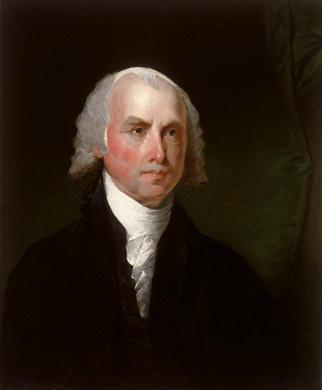
James Madison before he was president

James Madison proposed the first 10 Amendments to the Constitution, and the 27th Amendment; the 203 years it took to ratify the 27th Amendment is the longest legislative process in the history of the U.S., and probably the world.

The two proposals that failed to earn the required approval of three-fourths of the 13 states fell into a special limbo for Constitutional amendments that became clear only in the late 1970s when Congress discussed how long to wait for states to approve the Equal Rights Amendment (this is a much-simplified explanation, I know).  Congress put deadlines on the ratification process in the late 20th century, but the first twelve proposals had no deadlines, nor did any other proposal before the Equal Rights Amendment proposal.  In the 1980s, Congress passed a law that said any amendments floating around, unapproved, would be considered dead after a date certain.  There were six amendments in that category.

Before that date certain passed, more states took a look at one of James Madison’s 1789 proposals.  They liked it, and they ratified it — 34 states total.

That amendment became the 27th Amendment to the Constitution, on May 7, 1992, 203 years after it was proposed:

No law, varying the compensation for the services of the Senators and Representatives, shall take effect, until an election of Representatives shall have intervened.

This is the longest legislative procedure in U.S. history, perhaps the longest ever — it lasted much longer than many nations.  By that ratification in 1992, James Madison became the person who proposed both the first, and last amendments to the Constitution.

Madison’s reaching out from the grave 156 years after his death — he died on June 28, 1836 — is one of the greatest legislative coups in history, too.


How will you celebrate James Madison’s birthday? What happened to James Madison Week at JMU

March 14, 2010

James Madison joined the world on March 16, 1751.  Tuesday is the 259th anniversary of his birth.

James Madison University, appropriately, made hoopla during the whole week in 2009.  What about this year?

Exhibit: Creating the United States”James Madison, David Edwin engraving after Thomas Sully Portrait - Library of Congress

David Edwin (1776–1841). James Madison, President of the United States. Engraving after painting by Thomas Sully. Philadelphia: W.H. Morgan, ca.1809–1817. Prints and Photographs Division, Library of Congress (107.01.00)

The Culpepper, Virginia, Star-Exponent, said there will be celebrations at Montpelier, Madison’s mountaintop home a short distance from Charlottesville.

James Madison’s Orange County home offers free admission all day Tuesday in honor of the fourth president’s 259th birthday.

Born 1751 at Port Conway in King George while on a visit to his grandmother, Madison was raised at Montpelier, the oldest of 12 children. He is buried on the grounds of his lifelong home in the family cemetery, site of a special ceremony in honor of his birthday March 16 at 1:30 p.m.

Former Deputy Secretary of Education Eugene Hickock will deliver remarks at the cemetery along with Quantico Marine Corps Base Chief of Staff Col. Thompson Gerke, who will lay a wreath on the fourth president’s grave on behalf of President Barack Obama. Numerous other groups will also honor Madison by placing wreaths on his grave Tuesday.

The U.S. Marine Corps has a long-standing tradition of attending the annual birthday ceremony because of Madison’s connection to the naval force’s founding. As Secretary of State under Thomas Jefferson, Madison recommended sending a squadron of naval ships to fight pirates off the coast of Africa, ultimately leading to their demise by 1805.

As president, Madison again called on the Marines to lead the nation during the War of 1812.

Nice of the Marines to show.  Nice of President Obama to send a wreath.  Maybe we can understand why Republicans wish to avoid any celebration of Madison.

Resources:


James Madison, Father of the Constitution, March 16

March 16, 2009

Col. James Madison of the Virginia Militia, Citizen Soldier – National Guard image

Col. James Madison of the Virginia Militia, Citizen Soldier – National Guard image

James Madison was born on March 16, 1751 — date depending on which calendar you use.

Madison was one of our nation’s top two legislating presidents, on a par with Lyndon Johnson.  The essential ally for the creation of America, he is known as the Father of the Constitution for his work to shepherd that compact into existence.  A great ally of George Mason, Thomas Jefferson, George Washington, Alexander Hamilton, James Monroe, and sometimes nemesis of some of these men, Madison campaigned for freedom of religion, freedom of speech and freedom of the press his entire life.

Madison was delegate to the Virginia assembly, and wrote freedom of religion into the Virginia Bill of Rights.  He wrote the Memorial and Remonstrance defending religious freedom and opposing re-establishment of religion in Virgina, led the assembly to pass instead Thomas Jefferson’s Virginia Statute for Religious Freedom, helped settle the dispute over fishing and navigation in the Chesapeake, between Virginia and Maryland.  In league with George Washington, he convinced the Continental Congress to try to fix the Articles of Confederation with a convention in Philadelphia in 1787, then he hijacked the convention to write a new charter instead.  He wrote most of the Federalist Papers, with Alexander Hamilton, after John Jay was attacked and beaten by a mob.  He campaigned and won a seat in the First Congress, defeating the popular James Monroe who then became his fast friend.  Madison proposed and was chief sponsor of the 12 amendments to the Constitution that we now know as the Bill of Rights — two of the amendments did not win approval in 1791, but one of those did win approval in 1992 — so Madison wrote the first ten and the twenty-seventh amendments to the Constitution.

Electratig has a fine commentary on Madison and his birthday here, explaining the calendar shenanigans.

Go read the First Amendment, read a newspaper, and watch some news; say a prayer, and thank the stars and God for James Madison.


Dirty play on PUMA blogs, and election history (1800)

September 1, 2008

Oh, it’s only a little dirty, sure.  With but with Democrats like the PUMAs, sometimes you wonder why we need Karl Rove.  With Hillary supporters like a few of the PUMAs, who needs Monica Lewinsky?

At the Confluence, anything that displeases the board moderators gets edited to say something completely trivial and, the board’s moderators appear to hope, embarrassing.  Even compliments from people they don’t like get edited.  So much for robust discussion and debate.  So much for fairness.

The Ghost of Goebbels smiles.  The Ghost of Alexander Hamilton paces nervously. Hamilton, you recall, paid editors and writers to put all sorts of scandal and calumny against Thomas Jefferson into their newspapers, in 1796 and 1800.  Dumas Malone wrote in his Pulitzer Prize-winning biography of Jefferson that fully half the American electorate was convinced that Jefferson was an atheist who hated religious freedom by election day, 1800.  Still, Americans voted overwhelmingly for the Jefferson/Burr ticket.  So Hamilton’s skullduggery didn’t pay off.

Alas, prior to the 12th Amendment, electors in the electoral college all had two votes, and the rule was that the winner became president, the 2nd place person became vice president.  The electors of the Democratic Republican Party (the modern-day Democrats) each cast a vote for Jefferson for President, and a vote for Burr.  In electoral votes, there was a tie for the presidency.  The election went to the House of Representatives (see the Constitution, Article II, Section 1, Clause 3).

The new Congress had not been sworn in yet, so the old, Federalist-controlled Congress got to make the decision between the two top electoral college vote getters (same as today — the old congress decides).  A history site at the City University of New York gives the short version:

Uneasy about both men, the Federalists in the House of Representatives took five days and 35 ballots to choose Jefferson over Burr. The deadlocked election between the two allies spawned the Twelfth Amendment to the U.S. Constitution in 1804, which led to separate Electoral College ballots for president and vice-president. Jefferson called the election the “Revolution of 1800.”

35 ballots in the House of Representatives, before Jefferson was chosen on the 36th! When an election goes to the House, each state gets one vote; the Representatives and Senators must decide how to cast that state’s vote.  34 times that ballot came up inconclusive between Jefferson and Burr, both men despised by the Federalists due to the poisoned waters from the campaign.

Alexander Hamilton knew both men well.  Hamilton and Jefferson both served in Washington’s cabinet.  He had been a friend of Jefferson and guest at Jefferson’s table for the great compromise that gave us the first U.S. bank and put the capital on the Potomac.   Hamilton had worked closely with James Madison on policy and speeches in the Washington administration, an on the conspiracy to get the Constitution before that — Madison was Jefferson’s “campaign manager” in the election.  Hamilton also had crossed paths with Aaron Burr in New York, where both men practiced law.  Eventually, Hamilton persuaded a few Federalists to vote for Jefferson over Burr, and persuaded a few others to abstain from voting in their state delegations, throwing those delegations to Jefferson, too.  Jefferson was thus elected president, and Burr became vice president. Alexander Hamilton had to eat crow to keep his worst enemy, Burr, from becoming president.

Hamilton’s agonies did not end there.  After engineering Burr’s defeat in New York’s gubernatorial election in 1804, Burr claimed Hamilton had insulted Burr’s reputation.  A string of letters failed to resolve the situation, and Burr challenged Hamilton to a duel.  On July 11, 1804, Burr mortally wounded Hamilton in a dawn duel at Weehawken, New Jersey (dueling being illegal in New York).

Alexander Hamilton, hero of the American Revolution, created much of the financial underpinnings of our modern economic system, with a central bank and a view looking toward promoting trade to benefit the citizens of the nation.  He worked with Madison and Washington to created the Constitution, and worked with Jay and Madison to compose what became the Federalist Papers, originally a set of essays to persuade New Yorkers to ratify the Constitution, now a legal and history backgrounder in what the Constitution is and how it is supposed to work. Few important events in international or domestic affairs did not feature work by Hamilton, from Washington’s inauguration in 1789 to Hamilton’s death in 1804.  When his country called, Hamilton responded.

Hamilton’s death creates one of the greatest “what if” questions in American history:  What if Hamilton had lived, perhaps to serve as president himself? Opportunities lost do not knock again.

Resources:

Alexander Hamiltons gravestone, in the courtyard of Trinity Church, close to the location of the former towers of the World Trade Center, New York. AmericanRevolution.com

Alexander Hamilton’s gravestone, in the courtyard of Trinity Church, close to the location of the former towers of the World Trade Center, New York. AmericanRevolution.com

Another version of the same photo, Alexander Hamilton’s grave.


James Madison’s birthday, March 16

March 15, 2008

James Madison, portrait from Whitehouse.gov, and Wikimedia

Freedom of Conscience Day?

James Madison’s birth day is March 16, Sunday. He was born in 1751, in Conway, King George County, Virginia.

Father of the Constitution, fourth President of the U.S., Great Collaborator, and life-long champion for religious freedom and freedom of speech, press and thought: How should we mark his birthday?


Tagged by Myers to do history! Meet James Madison

March 1, 2008

One of those memes. I’ve got a couple of them hanging fire still, I really do badly at this stuff.

So I have to start chipping away at them. Latest first.

P. Z. Myers at Pharyngula tagged me. As he describes it, it’s a meme of history; here’s what I’m to do:

  1. Link to the person who tagged you.
  2. List 7 random/weird things about your favorite historical figure.
  3. Tag seven more people at the end of your blog and link to theirs.
  4. Let the person know they have been tagged by leaving a note on their blog.

Okay, #1 is out of the way.

Now the trouble. A favorite “historical” figure? Maybe for Myers, a biologist, that’s easy. But I teach history. I like teaching the quirky stuff. The universe of possibilities is so enormous! Whom to choose? How to choose? Which seven little snippets?

Here are some of the possibilities — you may as well share in my misery.

I could designate Douglas Stringfellow. You’ve never heard of him, most likely. He was known most famously as a congressman from Utah’s 1st District in the 1950s. Stringfellow rose to prominence on the strength of his stories of behind-enemy-lines work, kidnapping physicist Otto Hahn, losing the other 29 members of his squad, escaping to France and losing the use of his legs from a land mine there. He was elected to Congress, joined the anti-Communist faction, and was zooming on the way to re-election when one of his old Army buddies got off the train in Salt Lake City, read the story, and blew the whistle. Stringfellow spent the war in the U.S. He wasn’t a spy, not a hero. His wounds were not from combat. Stringfellow resigned his candidacy at the insistence of the Mormon Church and Utah Republicans (perhaps the last time an organized religion and the Republicans acted nobly, together). It’s a story that should be made into a movie. There’s a good account published by the Taft Institute of Public Policy at the University of Utah, but it’s difficult to get (funding f0r the Taft Institute ran out, I hear, and it was replaced by the Huntsman Seminars on Politics — but that may be erroneous information, too).

Or I could talk about Richard Feynman, an inspiration to me, and to our two sons, both of whom fully enjoyed his books, and one of whom seems destined to follow Feynman into physics (the other works to understand neuroscience, still inspired by Feynman to do science). Everybody knows the story of Feynman, though.

Millard Fillmore is already covered pretty well here; adding more would be gilding the lily, or covering tracks, or something. I could write about one of my modern heroes of history, Mike Mansfield, one of the best bosses I ever had — but trying to find seven items that could be explained quickly might be difficult. I could write chapters about one of my other bosses, too, Orrin Hatch. Or I could write about Jefferson.

I’ll try to go right down the middle on this one: James Madison it is.

Seven items about James Madison, our fourth president, and “the Father of the Constitution”:

  1. See that scar on his nose? It’s from frostbite. When Gov. Patrick Henry blocked Madison’s appointment to the U.S. Senate, in order to fulfill his commitment to James Madison create a bill of rights, Madison had to run for election to the U.S. House of Representatives. Henry thought he could block that, too, by picking James Monroe to run against Madison, and getting lots of support for Monroe. In the last debate, a good buggy ride away from their homes, the two men decided to share the fare. Monroe said Madison won the debate handily; Madison wasn’t sure. On the buggy ride back to their homes, at night on a very cold winter, the two got involved in a long discussion about the new government, the new nation, and their hopes and dreams about the future. Discussion was so engrossing that Madison failed to notice his nose was freezing. Fast friends ever after, Madison won the election; Madison introduced Monroe to Jefferson. Patrick Henry’s plan to frustrate the Constitution and the new government was thwarted. And Madison bore the scar the rest of his life.

  2. Good government as religion — Long before the concept of an American secular religion, Madison attended the College of New Jersey (later to become Princeton), aiming for a career in the clergy. College President John Witherspoon, a Presbyterian minister, urged Madison to take not just any calling, but the highest calling. Madison went into politics and government. Religionists try to paint Madison as a secularist; early on, his drive for religious freedom was fueled by his faith. It’s an example more church people should follow.
  3. Egalitarian trends — On his trip to New York for the inauguration and opening of the 1st Congress, Madison stopped off at Mt. Vernon. (See notes about ghosting below — it was an eventful trip.) One of the topics of conversation was what form of address to use for the chief executive. Two camps were forming, one favoring “Your Highness,” the other favoring “Your Excellency.” Asked for his opinion, Madison suggested “Mr. President.” Some tried to make a more formal, more stuffy title official later in the year, but we still call our chief executive today by the unroyal sobriquet Madison suggested, “Mr. President.”
  4. Romance with George and Martha as cupids — Madison’s bachelorhood was a challenge to George and Martha Washington. Once the government got underway in Philadelphia, and after Aaron Burr introduced Madison to the woman, George and Martha worked to match up Madison with a vivacious widow, successfully. James Madison and Dolley Payne Todd were married in 1794.
  5. Great Madison’s Ghost! — Madison played ghost writer for George Washington, and others. On his way to the first inauguration, at his courtesy stop at Mt. Vernon, Madison was asked to draft a speech suitable for a president at inauguration. He happily complied. With some irony, whether it was known or not, once Washington delivered the address, Congress designated Madison to write Congress’s reply. Madison’s writing shows up under many other names, including that of “Publius,” in the Federalist Papers. Madison also contributed major parts of the farewell essay Washington planned to use in 1792; Madison and Washington were not on such good terms when Washington actually bid farewell in 1796. Alexander Hamilton got the last crack at ghosting the piece, and added some barbs aimed at Thomas Jefferson. Madison’s own ghosting had come back to haunt him, and John Adams won the election of 1796. (Madison got revenge, if you can call it that, in 1800, when Jefferson won the rematch, but not until the House of Representatives had to break a tie between Jefferson and his vice presidential slate-mate, Aaron Burr; it was Hamilton who finally had to eat some crow and urge the Federalists in the House to go for Jefferson over Hamilton’s more bitter enemy, Burr.)
  6. Offending the great man — Madison was off getting married when Washington and Hamilton headed the army and put down the Whiskey Rebellion. Madison suggested to Washington that alternative resolutions would have been possible. Washington took offense. It is unclear whether they ever spoke to each other after that, but that event breached the once-warm and cordial relationship that had produced the Constitution and got the new government off to a fine start, not to mention got Madison into a good marriage.  It’s fascinating Washington would show such pique, and fascinating that Madison stood for it.
  7. America’s greatest collaborator? Madison got to the Virginia Assembly late in the Virginia Bill of Rights process, but collaborated with George Mason to add a clause on religious freedom, helping to secure George Mason’s reputation. He collaborated with Thomas Jefferson, pushing Jefferson’s legislative ideas while Jefferson was in France, getting immortality for Jefferson with the Virginia Statute for Religious Freedom. He collaborated with Washington to resolve the Chesapeake dispute between Maryland, Virginia and Pennsylvania; he collaborated with Washington and Alexander Hamilton to get the Continental Congress to call the Philadelphia convention. He collaborated with Ben Franklin to convince Washington to attend the convention, and to get Washington elected president of the convention. When John Jay was physically beaten badly at a demonstration for ratification, Madison stepped in to collaborate with Hamilton on what we now call the Federalist Papers. He collaborated with Washington on the formation of the new government; collaborated with Jefferson on a bill of rights and foreign affairs. In an era when one did not run for office one’s self, Madison got Jefferson on the ballots in 1796 and 1800, essentially managing the campaigns that put Jefferson into office. He was with Jefferson on the butt-kicking they got from John Marshall on the Marbury v. Madison decision. At the end of their lives, and especially after Jefferson’s death, Madison followed through on the establishment of the University of Virginia, Jefferson’s prize project. In each case, Madison’s collaboration improved the project, and in several cases, the projects would have failed but for Madison’s work. Madison may take the title of the most successful legislator ever in U.S. history (competing perhaps with LBJ), but he definitely takes the crown as the best collaborator for the public good. Had Madison not been the collaborator on these things, would they have happened? In all of these projects, the people with whom he collaborated achieved their highest aims. Who wouldn’t want to collaborate with Madison?

Let’s get some good stuff in here in the tagging. Let’s tag some diverse blogs and bloggers who write a fair amount. I tag Pam at Grassroots Science, Bug Girl, Miguel at Around the Corner, Ron at Route 66 News, Curious Expeditions, Dorigo at Quantum Diaries Survivor, and Barry Weber at The First Morning.

Whew!  There’s good reading at those places even if they don’t do anything new.

Thanks, P.Z., for the kick in the rear to think about Madison, and to think about seven (out of dozens) of good blogs to refer people to.