Flag House in 1936, where Mary Pickersgill sewed the garrison-sized, 15-star flag that flew over Fort McHenry at the Battle of Baltimore in 1814; one of the sites where the U.S. flag may be flown 24 hours. The house is at 844 East Pratt & Albemarle Streets (Baltimore, Independent City, Maryland). Cropped image courtesy of the federal HABS—Historic American Buildings Survey of Maryland.
January is loaded with flag flying dates, when we add in statehood days, dates those states are invited to fly their U.S. flags.
In January, the U.S. Flag Code urges citizens to fly flags on these dates:
New Year’s Day, January 1, a federal holiday
Martin Luther King’s Birthday, a federal holiday on the third Monday of January; that date is January 18, in 2014; King’s actual birthday is January 19, and you may fly your flag then, too
Inauguration Day, January 20, the year after election years (next one in 2017)
January 2, Georgia Statehood Day
January 3, Alaska Statehood Day
January 4, Utah Statehood Day
January 6, New Mexico Statehood Day
January 9, Connecticut Statehood Day
January 26, Michigan Statehood Day
January 29, Kansas Statehood Day
You may fly your flag any other day you wish, too; flags should not be flown after sundown unless they are specially lighted, or at one of the few places designated by Congress or Presidential Proclamation for 24-hour flag flying. According to Wikipedia’s listing, those sites include:
Fort McHenry, Baltimore, Maryland (Presidential Proclamation No. 2795, July 2, 1948).
Flag House Square, Albemarle and Pratt Streets, Baltimore, Maryland (Public Law 83-319, approved March 26, 1954).
December 25 is Christmas Day, a federal holiday, and one of the score of dates designated in the Flag Code.
Other dates?
Several states attained statehood in December, so people in those states should fly their flags (and you may join them):
Illinois, December 3 (1818, 21st state)
Delaware, December 7 (1787, 1st state)
Mississippi, December 10 (1817, 20th state)
Indiana, December 11 (1816, 19th state)
Pennsylvania, December 12 (1787, 2nd state)
Alabama, December 14 (1819, 22nd state)
New Jersey, December 18 (1787, 3rd state)
Iowa, December 28 (1846, 29th state)
Texas, December 29 (1845, 28th state)
December 15 is Bill of Rights Day, marking the day in 1791 when the Bill of Rights was declared ratified; but though this event generally gets a presidential proclamation, there is no law or executive action that requires flags to fly on that date, for that occasion.
Eleven flag-flying dates in December. Does any other month have as many flag flying opportunities?
Have I missed any December flag-flying dates?
Flags at the Washington Monument, looking down the Capital Mall towards the U.S. Capitol.
Spread the word; friends don't allow friends to repeat history.
Star-spangled Banner and the War of 1812 – The original Star-Spangled Banner, the flag that inspired Francis Scott Key to write the song that would become our national anthem, is among the most treasured artifacts in the collections of the Smithsonian’s National Museum of American History in Washington, D.C.
Every school kid learns the story of the “Star-Spangled Banner,” or should.
During the War of 1812, Georgetown lawyer Francis Scott Key, stood aboard a British ship in Baltimore Harbor to negotiate the release of his friend, Dr. William Beanes, who had been taken prisoner while the British stormed through Bladensburg, Maryland, after burning Washington, D.C. Key witnessed the British shelling of Fort McHenry, the guardian of Baltimore’s harbor. Inspired when he saw the U.S. flag still waving at dawn after a night of constant shelling, Key wrote a poem.
Key published the poem, suggested it might be put to the tune of “Anachreon in Heaven” (a tavern tune popular at the time) — and the popularity of the song grew until Congress designated it the national anthem in 1931. In telling the story of the latest restoration of that garrison flag now housed at the Smithsonian Museum of American History,Smithsonian Magazine repeated the story in the July 2000 issue: “Our Flag Was Still There.”
It’s a wonderful history with lots of splendid, interesting details (Dolley Madison fleeing the Executive Mansion clutching the Gilbert Stuart portrait of George Washington, the guy who had introduced Dolley to James Madison and then snubbed them after they were married; the British troops eating the White House dinner the Madisons left in their haste; the gigantic, 42 by 30 foot flag sewn by Mary Pickersgill, a Baltimore widow trying to support her family; the rag-tag Baltimore militia stopping cold “Wellington’s Invicibles;” the British massing of 50 boats and gunships; and much more).
It’s a grand and glorious history that stirs the patriotic embers of the most cynical Americans.
And it’s all true.
So it doesn’t deserve the voodoo history version, the bogus history created by some person preaching in a church (I gather from the “amens”) that is making the rounds of the internet, stripped of attribution so we can hunt down the fool who is at fault.
We got this in an e-mail yesterday; patriots save us, there must be a hundred repetitions that turn up on Google, not one correcting this horrible distortion of American history.
Horrible distortion of American history
(The full version is a mind-numbing 11 minutes plus. Some people have put it on other sites. )
There was no ultimatum to to Baltimore, nor to the U.S., as this fellow describes it.
Key negotiated for the release of one man, Dr. Beanes. There was no brig full of U.S. prisoners.
It’s Fort McHenry, not “Henry.” The fort was named after James McHenry, a physician who was one of the foreign-born signers of the Constitution, who had assisted Generals Washington and Lafayette during the American Revolution, and who had served as Secretary of War to Presidents Washington and Adams.
Fort McHenry was a military institution, a fort defending Baltimore Harbor. It was not a refuge for women and children.
The nation would not have reverted to British rule had Fort McHenry fallen.
The battle was not over the flag; the British were trying to take Baltimore, one of America’s great ports. At this point, they rather needed to since the Baltimore militia had stunned and stopped the ground troops east of the city. There’s enough American bravery and pluck in this part of the story to merit no exaggerations.
To the best of our knowledge, the British did not specifically target the flag.
There were about 25 American casualties. Bodies of the dead were not used to hold up the flag pole — a 42 by 30 foot flag has to be on a well-anchored pole, not held up by a few dead bodies stacked around it.
You can probably find even more inaccuracies (please note them in comments if you do).
The entire enterprise is voodoo history. The name of Francis Scott Key is right; the flag is right; almost everything else is wrong.
Please help: Can you find who wrote this piece of crap? Can you learn who the narrator is, and where it was recorded?
I keep finding troubling notes with this on the internet: ‘My school kids are going to see this to get the real story.’ ‘Why are the libs suppressing the truth?’ ‘I didn’t know this true story before, and now I wonder why my teachers wouldn’t tell it.’
If Peter Marshall and David Barton gave a gosh darn about American history, they would muster their mighty “ministries” to correct the inaccuracies in this piece. But they are silent.
It’s just a photo from World War II, the U.S. flag, flying against some California mountains.
It’s from Manzanar, the camp where Japanese Americans were detained during the war.
What words would be appropriate?
Dorothea Lange photo of the U.S. flag, flying at Manzanar, July 3, 1942. Via Wikimedia. “Scene of barrack homes at this War Relocation Authority Center for evacuees of Japanese ancestry. A hot windstorm brings dust from the surrounding desert.” Public domain.
Many more than a thousand words there.
Spread the word; friends don't allow friends to repeat history.
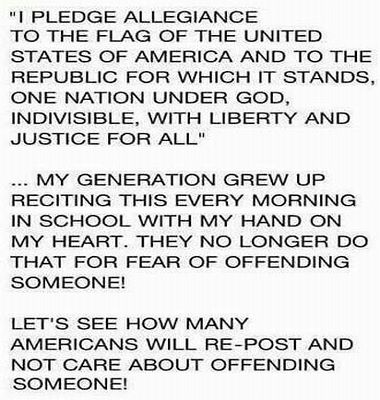
None of the five states previously required the Pledge, and then stopped.
None of the five states claim to not require the pledge in order to avoid offending anyone. Oklahoma would be happy to offend people on such issues, most of the time.
Reposting historically inaccurate claims, without fear of offending anyone, is no virtue. It’s just silly.
The creator of that poster is probably well under the age of 50, and may have grown up with the hand-over-heart salute used after World War II. That was not the original salute, and I’d imagine the author is wholly ignorant of the original and why it was changed.
Wikipedia image and caption: Students pledging to the flag, 1899, 8th Division, Washington, D.C. Part of the Frances Benjamin Johnston 1890 – 1900 Washington, D.C., school survey.
Wikipedia gives a concise history of the salute:
Swearing of the Pledge is accompanied by a salute. An early version of the salute, adopted in 1892, was known as the Bellamy salute. It started with the hand outstretched toward the flag, palm down, and ended with the palm up. Because of the similarity between the Bellamy salute and the Nazi salute, developed later, the United States Congress instituted the hand-over-the-heart gesture as the salute to be rendered by civilians during the Pledge of Allegiance and the national anthem in the United States, instead of the Bellamy salute. Removal of the Bellamy salute occurred on December 22, 1942, when Congress amended the Flag Code language first passed into law on June 22, 1942.
Students in an unnamed school in 1941, offering the Bellamy Salute for the Pledge of Allegiance. Wikipedia image.
One might understand why the Bellamy Salute was changed, during war with Nazi Germany.
Arrogance and ignorance combine to form many different kinds of prejudices, all of them ugly. The arrogant assumption that only “our generation” learned patriotism and that whatever goes on in schools today is not as good as it was “in our day,” regardless how many decades it’s been since the speaker was in a public school, compounds the ignorance of the fact that since 1980, forced patriotic exercises in schools have increased, not decreased.
In 1943, the Supreme Court determined that the Free Speech Clause of the First Amendment protects the right of a student to NOT recite the Pledge of Allegiance; Jehovah’s Witnesses students had been reprimanded in West Virginia, but they protested that the Pledge is exactly the sort of oath their religion claims to be against God. The case is West Virginia vs. Barnette 319 U.S. 625 (1943). Explanation of the case here; full text and more history of the case here, at Oyez; in irony the maker of the poster above will miss, Justice Jackson pointed out that the First Amendment especially protects Americans against the tyranny of forced thought
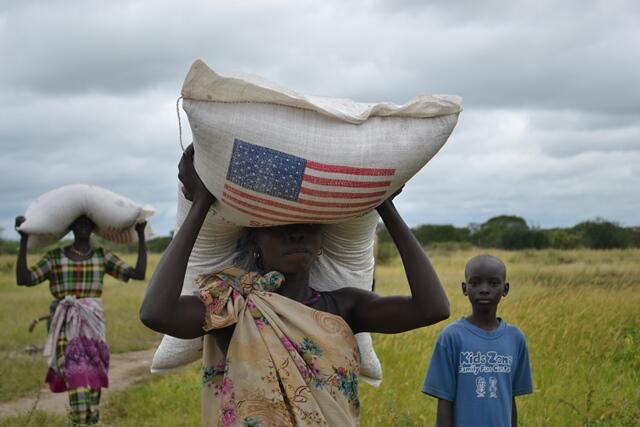
IDP means “internally displaced person,” or a refugee from war, natural disaster, or economic crisis, driven from their home, but still in their nation of residence; there are millions
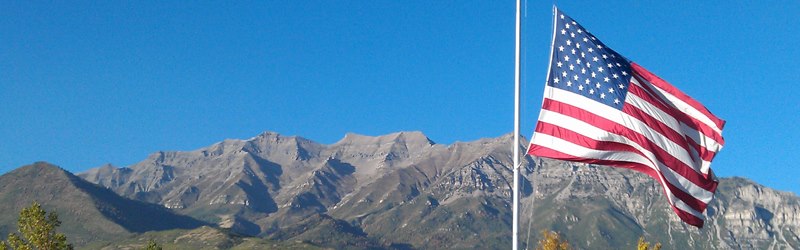
Mt. Timpanogos and the U.S. flag. Photo by Bob Walker of Orem, Utah; from Orem, circa September 2012. That’s Mt. Baldy on the left. This site is about six miles from our old home in Pleasant Grove, Utah.
Presidential Proclamation — Honoring the Victims of the Attack in Benghazi, Libya
HONORING THE VICTIMS OF THE ATTACK IN BENGHAZI, LIBYA
– – – – – – –
BY THE PRESIDENT OF THE UNITED STATES OF AMERICA
A PROCLAMATION
As a mark of respect for the memory of John Christopher Stevens, United States Ambassador to Libya, and American personnel killed in the senseless attack on our diplomatic facility in Benghazi, by the authority vested in me as President of the United States by the Constitution and the laws of the United States of America, I hereby order that the flag of the United States shall be flown at half-staff at the White House and upon all public buildings and grounds, at all military posts and naval stations, and on all naval vessels of the Federal Government in the District of Columbia and throughout the United States and its Territories and possessions until sunset, September 16, 2012. I also direct that the flag shall be flown at half-staff for the same length of time at all United States embassies, legations, consular offices, and other facilities abroad, including all military facilities and naval vessels and stations.
IN WITNESS WHEREOF, I have hereunto set my hand this twelfth day of September, in the year of our Lord two thousand twelve, and of the Independence of the United States of America the two hundred and thirty-seventh.
BARACK OBAMA
Spread the word; friends don't allow friends to repeat history.
On Jan. 3, 1959, President Dwight Eisenhower signed a proclamation admitting Alaska to the Union as the 49th state. The New York Times noted that the signing included the unveiling of the new 49-star American flag.
The land that became Alaska came into U.S. possession in 1867, when William Seward, secretary of state under President Andrew Johnson, negotiated a deal to buy the 586,000-square-mile area from Russia for $7.2 million, less than 2 cents per acre. Seward’s decision was ridiculed in the American press, who saw no potential in the vast, inhospitable and sparsely populated area.
For decades after its purchase, Alaska was derided as “Seward’s folly” or “Seward’s icebox.” This opinion changed in 1896 with the discovery of gold in the neighboring Yukon Territory, which spurred tens of thousands of people to head to Alaska in search of gold. The gold rush also brought about a boom in mining, fishing and trapping.
Though the first statehood bill had been presented to Congress in 1916, there was little desire in either Alaska or Washington for Alaskan statehood until after World War II. During the war, the U.S. established multiple military bases to resist Japan’s attacks on Alaska’s Aleutian Islands and prevent a potential invasion of the mainland. The military activity, along with the completion of a major highway from Montana, led to a large population growth.
In 1946, Alaskans voted in favor of statehood in a referendum and Alaskan delegates began to lobby Congress for statehood. After years of debate, Congress voted in June 1958 to admit Alaska.
Eight months after Alaska’s admission, on Aug. 21, 1957 [should be 1959, no?], Hawaii became the 50th state. The 49-star remained in place until the following July 4, when it was replaced by the now-familiar 50-star flag.
49-star flags were produced only until August 1959, so there are few of them around. I love this photo of the unveiling of the flag with President Eisenhower:
“Quartermaster General MG Andrew T. McNamara and President Eisenhower examine new 49 star flag” – image and caption from the Quartermaster Foundation. (Who are the other two people? The guy on the right looks to me a bit like is Pennsylvania’s Sen. Hugh Scott.)
How did the nation survive for 170 years without firm, decisive and conclusive orders on what the flag should look like? Isn’t it a great story that we went so long without law setting the requirements?
Alaska’s flag was designed by 13-year-old Benny Benson
Armed Forces Day honors those Americans who are, today, protecting our freedom, under arms, in the U.S. military services.
Veterans Day honors those who protected us in the past. Memorial Day honors those who died in our nation’s service, and those veterans who have passed on. Armed Forces Day honors and celebrates living Americans, to whom we owe immediate thanks.
Fly your flag today in their honor. Today is Armed Forces Day 2011.
The slogan on this year’s poster: Our Troops, and Those Supporting Them Back Home, Are United in Strength.
This flag needs to be retired. Will some patriot step up to the job?
Leaving Corpus Christi can be a trial. It’s at least a 15 mile drive from the American Banking Center to Interstate 37, if you go by the Starbucks on Staples to get coffee for the drive back to Dallas. (It’s a 100-yard drive otherwise.)
Tourist that I am I drove Staples all the way back, to see the nitty-gritty of the town.
Must it be this gritty?
The flag above, if it can still be considered a flag, struggles to honor our nation at the corner of Staples and Craig Streets. Clearly this is not a flag that is retired at sundown, as the U.S. flag code urges. It looks as though it has been flying there for at least a year. Perhaps it has flown since September 11, 2001. Perhaps it has flown since the War of 1812.
The flag, when it is in such condition that it is no longer a fitting emblem for display, should be destroyed in a dignified way, preferably by burning.* The act is silent on procedures for burning a flag. It would seem that any procedure which is in good taste and shows no disrespect to the flag would be appropriate. The Flag Protection Act of 1989,38 struck down albeit on grounds unrelated to this specific point,39 prohibited inter alia “knowingly” burning of a flag of the United States, but excepted from prohibition “any conduct consisting of disposal of a flag when it has become worn or soiled.”
Do we have any readers in Corpus Christi? Could you drop by the shop where this flag is flown sometime through the week, and ask them to retire the flag, as an act of honor for our nation?
Thank you.
Spread the word; friends don't allow friends to repeat history.
Or, until that account is unsuspended by the forces supporting Donald Trump: Follow @FillmoreWhite, the account of the Millard Fillmore White House Library
We've been soaking in the Bathtub for several months, long enough that some of the links we've used have gone to the Great Internet in the Sky.
If you find a dead link, please leave a comment to that post, and tell us what link has expired.
Thanks!
Retired teacher of law, economics, history, AP government, psychology and science. Former speechwriter, press guy and legislative aide in U.S. Senate. Former Department of Education. Former airline real estate, telecom towers, Big 6 (that old!) consultant. Lab and field research in air pollution control.
My blog, Millard Fillmore's Bathtub, is a continuing experiment to test how to use blogs to improve and speed up learning processes for students, perhaps by making some of the courses actually interesting. It is a blog for teachers, to see if we can use blogs. It is for people interested in social studies and social studies education, to see if we can learn to get it right. It's a blog for science fans, to promote good science and good science policy. It's a blog for people interested in good government and how to achieve it.
BS in Mass Communication, University of Utah
Graduate study in Rhetoric and Speech Communication, University of Arizona
JD from the National Law Center, George Washington University


 Posted by Ed Darrell