Can “Pepper-spraying cop” use copyright to stop the use of his image?

November 22, 2011

Just looking at a few of the dozens of parodies that make use of the photographic image of the cop at UC-Davis with the pepper spray can.

What if he, or UC-Davis, wanted to slow down the parodies, to catch their breath?  Could he, or the university, copyright the image and enforce copyright?  Do such over-the-top and often abusive parodies fall within the parody rules?

What say you, legal beagles?  What say you, anyone?

Pepper Spray Cop and Edvard Munch's "The Scream"

One of the least offensive parodies using the cop's image.


Obama unchained oil and gas exploration in the U.S.?

November 22, 2011

Anyone who votes Democrat regularly gets the “told you so” e-mails from Republicans making claims about how bad things are under President Obama.

One favorite, hoax meme is the claim that Obama hurt energy exploration in the U.S.  One friend e-mails me at least once a month with a claim that Obama has done something to frustrate drilling for oil in the U.S., usually accompanied with a political pitch that all we need to do is drill the hell out of Alaska, kill the caribou, and allow pollution of the Gulf of Mexico, and we’ll be independent of Middle Eastern oil forever.

Here’s the ugly secret they don’t want to tell you — heck, they probably don’t know:  Total oil rig count is way up under Obama from when he took office, increasing at a rate about double that of the previous Bush administration.

Under President Obama, oil and gas exploration in the U.S. is greatly increased.

Here’s the most recent rig count report from WTRG Economics, highlighting added:

North American Rotary Rig Counts

The U.S. rotary rig count was down 15 rigs at 2,001 for the week of November 18, 2011. It is 324 rigs (19.6%) higher than last year. 

The number of rotary rigs drilling for oil decreased 8 to 1,125. There are 394 more rigs targeting oil than last year. Rigs drilling for oil represent 56.2% percent of all drilling activity. 

Rigs directed toward natural gas were down 6 at 871. The number of rigs currently drilling for gas is 65 lower than last year’s level of 936.

Year-over-year oil exploration in the U.S. is up 53.9 percent. Gas exploration is down 6.9 percent. The weekly average of crude oil spot prices is 20.8 percent higher than last year and natural gas spot prices are 16.8 percent lower.

Tuesday a week ago I joined the high school economics teachers dining at the Dallas Federal Reserve Bank, the annual “Night at the Fed” event.  The bank brought in Keith Phillips, a Senior Economist and Advisor from the San Antonio Branch to talk about “Where Will Your Students Find Jobs?”

One of his charts showed drill rig counts since 2000, on a slide, “Drilling Rig Count has Surged to High Levels.”  Among other things, that partly explains why Texas was not so severely hit with the recession as the rest of the nation (though jobless counts in the past couple of months suggest Texas may catch up).

Sitting at the front table I could not help but be impressed with the rig count line.  In 2000, when Bush came to office, there were about 300 active drilling rigs in the country, in oil and gas.  Over seven years that count rose to about 1,000, then plunged in Bush’s last year in the economic downturn.

Obama came into office with a drill rig count just slightly higher than Bush had two terms previously.  In three years, drill rig counts have climbed to near the height of the Bush administration’s best year, just under 1,000 (if I’m reading the chart correctly — and the piece above suggests I am).

Here’s the chart from Baker-Hughes — showing about the same rig count Dr. Phillips showed:

Baker-Hughes Drill Rig Count, November 2011 (back to 2000)

Baker-Hughes Drill Rig Count, November 2011 (back to 2000) - click the image to go to WTRG Economics site and current chart

Here’s a more colorful, more clear version from EnergyDigger.com:

Drill Rig Count history from Energy Digger.com, November 18, 2011

Drill Rig Count history from Energy Digger.com, November 18, 2011

In other words, drill rigs have increased in the three years of the Obama administration at about double the rate of increase of the Bush administration.

When does Obama get credit for the increase in oil and gas exploration in the U.S. in his administration?

More, Resources: 


Joy of pollination, according to Louie Schwartzberg

November 21, 2011

It’s a TEDS Talk, of course

Birds do it, bees do it, even educated fleas do it.  Plants do it, too, but often with the help of animals.

Here are some of the most glorious pictures of sex you’ll ever see, filmed by Louie Schwartzberg.  Anyone who has ever tried to take a good photograph should marvel at these shots, and the skill and artistry and luck it took to get them:

What will we do if the bees vanish?

The lowdown:

http://www.ted.com Pollination: it’s vital to life on Earth, but largely unseen by the human eye. Filmmaker Louie Schwartzberg [of Moving Art] shows us the intricate world of pollen and pollinators with gorgeous high-speed images from his film “Wings of Life,” inspired by the vanishing of one of nature’s primary pollinators, the honeybee.


Bernie Sanders’ righteous anger at deficits caused by “two wars, unpaid for”

November 21, 2011

Slightly more complete story at Raw Story:

Sen. Bernie Sanders (I-VT) on Thursday urged the congressional debt committee not to propose any cuts to Social Security, Medicare or Medicaid.

“This country does in fact have a serious deficit problem,” he said to about 200 people packed in the Senate Budget Committee room.

“But the reality is that the deficit was caused by two wars — unpaid for. It was caused by huge tax breaks for the wealthiest people in this country. It was caused by a recession as result of the greed, recklessness and illegal behavior on Wall Street. And if those are the causes of the deficit, I will be damned if we’re going to balance the budget on backs of the elderly, the sick, the children, and the poor. That’s wrong.”

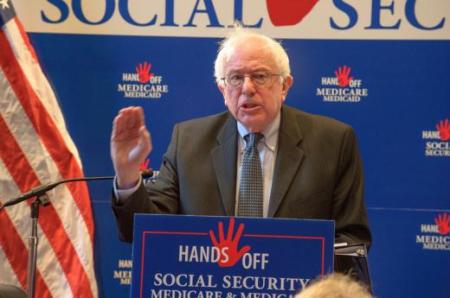
Sen. Bernie Sanders (I-Vt.) speaks to 200+ attending the Hands Off Social Security, Medicare and Medicaid Summit on Nov. 15th in Washington DC.

Sen. Bernie Sanders (I-Vt.) speaks to 200+ attending the Hands Off Social Security, Medicare and Medicaid Summit on Nov. 15th in Washington DC.


Hope for history to repeat itself in 2012 – Berryman cartoon on Congress

November 21, 2011

Caption from the National Archives, where this cartoon resides:

Clifford Berryman cartoon from 1912, "Congress will come to order!"  National Archives

Clifford Berryman cartoon from 1912, "Congress will come to order!" National Archives

“Congress Will Come To Order!”
by Clifford K. Berryman
Washington Evening Star, December 2, 1912
From the US Senate Collection, Center for Legislative Archives

The ultimate prize of a congressional election is control over the two houses of Congress: the U.S. House of Representatives and the U.S. Senate. This cartoon shows Congress following the pivotal 1912 elections when the Democrats swept into power and captured majorities both houses.

Some might hope that this history repeats.


Thoughts on top ten search phrases

November 21, 2011

Of course there are many others, but these are the top ten search phrases that hit on this blog today:

  1. famous long poems about life
  2. build a prairie
  3. natural lakes in texas
  4. only the dead have seen the end of war
  5. political cartoons
  6. texas
  7. texas map
  8. how to deal with dementia
  9. ddt
  10. japanese american internment camp original dorothea lange

“How to deal with dementia?”  Do you suppose those queries hit on how well I deal with demented commenters, or the fact that I deal with them at all?


Rhodes Scholars for 2012

November 21, 2011

On November 19, 2011, the Rhodes Trust announced the 32 winners of Rhodes Scholarships for the United States for 2012.

These young people are among the smartest and most accomplished people of their generation.  Under the will of Cecil Rhodes, the developer of African railroads and colonist, Rhodes Scholars must demonstrate leadership and service, and they must be well-rounded, which usually means they are accomplished athletes in one area in addition to their academic acumen.

One of this year’s winners will have to bail out on the second year of his Teach for America commitment — one hopes TFA will understand.  Joshua Carpenter, a 2010 graduate of the University of Alabama-Birmingham, taught writing, math and economics in Marion, Alabama.

Past American Rhodes Scholarship winners include former Sen. Bill Bradley of New Jersey, the late Sen. J. William Fulbright of Arkansas, musician and actor Kris Kristofferson, MSNBC host Rachel Maddow, former President Bill Clinton, late Secretary of State Dean Rusk, Sen. Richard Lugar of Indiana, physician and Pulitzer-winning author Siddhartha Mukherjee, U.S. Ambassador to the UN Susan Rice, and author Naomi Wolf.  Here’s the press release from the Trust:

WASHINGTON, DC/November 19, 2011 – Elliot F. Gerson, American Secretary of the Rhodes Trust, today announced the names of the thirty-two American men and women chosen as Rhodes Scholars representing the United States. Rhodes Scholarships provide all expenses for two or three years of study at the University of Oxford in England, and may allow funding in some instances for four years. Mr. Gerson called the Rhodes Scholarships,” the oldest and best known award for international study, and arguably the most famous academic award available to American college graduates.” They were created in 1902 by the Will of Cecil Rhodes, British philanthropist and African colonial pioneer. The first class of American Rhodes Scholars entered Oxford in 1904; those elected today will enter Oxford in October 2012.

Rhodes Scholars are chosen in a two-stage process. First, candidates must be endorsed by their college or university. This year over 2000 students sought their institution’s endorsement; 830 were endorsed by 299 different colleges and universities.

Committees of Selection in each of 16 U.S. districts then invite the strongest applicants to appear before them for interview. Gerson said, “applicants are chosen on the basis of the criteria set down in the Will of Cecil Rhodes. These criteria are high academic achievement, integrity of character, a spirit of unselfishness, respect for others, potential for leadership, and physical vigor. These basic characteristics are directed at fulfilling Mr. Rhodes’s hopes that the Rhodes Scholars would make an effective and positive contribution throughout the world. In Rhodes’ words, his Scholars should ‘esteem the performance of public duties as their highest aim.'”

Applicants in the United States may apply either through the state where they are legally resident or where they have attended college for at least two years. The district committees met separately, on Friday and Saturday, November 18 and 19, in cities across the country.  Each district committee made a final selection of two Rhodes Scholars from the candidates of the state or states within the district. Two-hundred ten applicants from 99 different colleges and universities reached the final stage of the competition, including 15 that had never before had a student win a Rhodes Scholarship. Gerson also reported, “in most years, we elect a winner from a college that had never before had a Rhodes Scholar, even after more than a century. This year we are pleased to announce first-time winners from Bard College and from California State University, Long Beach.”

The thirty-two Rhodes Scholars chosen from the United States will join an international group of Scholars chosen from fourteen other jurisdictions around the world. In addition to the thirty-two Americans, Scholars are also selected from Australia, Bermuda, Canada, the nations of the Commonwealth Caribbean, Germany, Hong Kong, India, Jamaica, Kenya, New Zealand, Pakistan, Southern Africa (South Africa, plus Botswana, Lesotho, Malawi, Namibia and Swaziland), Zambia, and Zimbabwe. Approximately 80 Scholars are selected worldwide each year, usually including several who have attended American colleges and universities but who ae not U.S. citizens and who have applied through their home country.

With the elections announced today, 3,260 Americans have won Rhodes Scholarships, representing 314 colleges and universities. Since 1976, women have been eligible to apply and 458 American women have now won the coveted scholarship. And for the fourth time since 1976, more women (17) than men (15) were elected. Men constituted 58% of the applicant pool and 60% of those who reached the final stage of the competition. More than 1,800 American Rhodes Scholars are living in all parts of the U.S. and abroad.

The value of the Rhodes Scholarship varies depending on the academic field and the degree (B.A., master’s, doctoral) chosen. The Rhodes Trust pays all college and university fees, provides a stipend to cover necessary expenses while in residence in Oxford as well as during vacations, and transportation to and from England. Mr. Gerson estimates that the total value of the Scholarship averages approximately US$50,000 per year, and up to as much as US$200,000 for Scholars who remain at Oxford for four years in certain departments.

The full list of the newly elected United States Rhodes Scholars, with the states from which they were chosen, their home addresses, and their American colleges or universities, follows. Brief profiles follow the list.

Selectees are listed here first by the state from which they competed, and then by the college they attended — note that the college may not be in the state from which the candidate competed.

American Rhodes Scholars-elect for 2012
(Subject to ratification by the Rhodes Trustees after acceptance by one of the colleges of Oxford University)

District 1

New Hampshire, Yale University
Ms. Helen E. Jack
Hanover, New Hampshire

Rhode Island Brown University
Ms. Emma F. LeBlanc
Manchester, New Hampshire

District 2

Massachusetts, Princeton University
Ms. Elizabeth W. Butterworth
Auburn, Massachusetts

Massachusetts, Brown University
Mr. David S. Poritz
Amherst, Massachusetts

District 3

New York, Princeton University
Ms. Miriam Rosenbaum
Bronx, New York

New York, Harvard College
Ms. Brett A. Rosenberg
Chappaqua, New York

District 4

Pennsylvania, Bryn Mawr College
Ms. Nina R.W. Cohen
Newton, Massachusetts

Pennsylvania, University of Pittsburgh
Mr. Cory J. Rodgers
Somerset, Pennsylvania

District 5 

Rhodes Scholar Brandon Turner, of Fontana, California, Wake Forest University

Rhodes Scholar Brandon Turner, of Fontana, California, Wake Forest University


Maryland/DC, Yale Law School and Bard College
Mr. Ronan S. Farrow
Washington, D.C.

North Carolina, Wake Forest University
Mr. Brandon E. Turner
Winston-Salem, North Carolina

District 6

Georgia, Stanford University
Mr. Ishan Nath
Atlanta, Georgia

Virginia, Brown University
Mr. Nabeel N. Gillani
Glen Allen, Virginia

District 7

Alabama, University of Alabama at Birmingham
Mr. Joshua D. Carpenter
Florence, Alabama

Tennessee, Sewanee: The University of the South
Ms. Carrie H. Ryan
Sewanee, Tennessee

District 8

Texas, Stanford University
Ms. Aysha N. Bagchi
Austin, Texas

Texas, Stanford University
Mr. Anand R. Habib
Houston, Texas

District 9

Indiana, Princeton University
Mr. Mohit Agrawal
West Lafayette, Indiana

Rhodes Scholar Victor Yang, of Lexington, Kentucky (Harvard University)

Victor Yang, from Lexington, Kentucky (Harvard University)

Kentucky, Harvard College
Mr. Victor Yang
Lexington, Kentucky

District 10

Rhodes Scholar Sarah Smierciak, Northwestern University - Chicago Tribune photo

Chicago Tribune photo - Northwestern University student and new Rhodes Scholar Sarah Smierciak speaks with the media on the Northwestern University campus in Evanston today. (StaceyWescott / Chicago Tribune / November 20, 2011)

Illinois, Northwestern University
Ms. Sarah N. Smierciak
Lemont, Illinois

Michigan, Harvard College
Mr. Spencer B.L. Lenfield
Paw Paw, Michigan

District 11

New Rhodes Scholar Alexis Brown, University of Wisconsin

New Rhodes Scholar Alexis Brown, University of Wisconsin

Wisconsin, University of Wisconsin-Madison
Ms. Alexis K. Brown
Madison, Wisconsin

Wisconsin, Princeton University
Ms. Astrid E. M. L. Stuth
Hubertus, Wisconsin

District 12

Kansas, University of Kansas
Ms. Kelsey R. Murrell
Kearney, Missouri

South Carolina, Stanford University
Ms. Katherine Niehaus
Columbia, South Carolina

District 13

Colorado, United States Air Force Academy
Mr. Zachary A. Crippen
Bala Cynwyd, Pennsylvania

USAFA Rhodes Scholar Zachary Crippen at Aspen Institute with Brent Scowcroft and others - USAFA photo

Aspen Institute Left to right; Cadet 1st Class Zachary Crippen (Rhodes Scholar), Cadet Squadron 12; retired Lt. Gen. Brent Scowcroft, co-chairman of the Aspen Strategy Group; Dr. Schuyler Foerster, the Academy’s Brent Scowcroft professor for national security studies; Cadet 1st Class Peter Lind, CS15; and Cadet 1st Class Nathan Betcher, CS25, pose for a photo at the Aspen Institute Saturday (date not designated) (U.S. Air Force Photo)

Colorado, Harvard College
Mr. Samuel M. Galler
Boulder, Colorado

District 14

Washington, University of Washington
Mr. Byron D. Gray
Post Falls, Idaho

Washington, University of Washington
Mr. Cameron W. Turtle
Pullman, Washington

District 15

California, Brown University
Ms. Brianna R. Doherty
Carmichael, California

California, Stanford University
Ms. Tenzin Seldon
Albany, California

District 16

California, California State University, Long Beach
Ms. Stephanie Bryson
San Diego, California

California, Massachusetts Institute of Technology
Ms. Stephanie Lin
Irvine, California

More details may be available at the Rhodes Trust website for the American group.

Profiles of Rhodes 2012 winners below the fold.

News coverage:

Why isn’t this a bigger deal in American news outlets?

Read the rest of this entry »


Gettysburg Address – again, “No casino, please”

November 21, 2011

Yet another version of readings of the Gettysburg Address — this time by actors, historians, and a winner of the Medal of Honor, in a campaign to prevent the construction of a casino next door to the battlefield monuments:


Springfield, Illinois area residents recite Lincoln’s Gettysburg Address

November 20, 2011

A short feature put together by the Springfield State Journal-Register:


Documentary film worth seeing: “The Other ‘F’ Word” at the Texas Theatre

November 20, 2011

Here’s the trailer:

Kathryn and I caught it last night at the renovated, historic Texas Theatre on Jefferson Avenue in Oak Cliff (formerly an independent town, now a sprawling neighborhood of Dallas).  The audience enthusiasm didn’t overpower the movie — the audience was much smaller than the film deserves.

It’s showing again this afternoon and Wednesday night at the Texas.

Advantages of seeing this at the Texas:

  1. Parking is easy and free after 4:00 p.m. on Jefferson Avenue.
  2. The bar has Mothership beer on tap (and a variety of other good libations).
  3. Popcorn is cheaper than at most megaplexes, plus it doesn’t taste as if made from petroleum by-product (which is not to say it is healthy, but that it may be less unhealthy).
  4. History point 1:  This is a near-Art Deco theatre built originally by Howard Hughes.
  5. History point 2:  This is the theatre in which Lee Harvey Oswald was captured in his flight from the scene of the assassination of President John F. Kennedy.
  6. It’s a great film.
  7. It’s a great theatre to view great films in.

Punk never made a great impression on me.  But at length, years later, I think I understand part of the angst and noise of the punkers, thanks to this film.  The description at the YouTube trailer:

THE OTHER F WORD
directed by Andrea Blaugrund Nevins
produced by Cristan Reilly and Andrea Blaugrund Nevins

IN THEATERS NOVEMBER 2ND, 2011
http://www.theotherfwordmovie.com/

This revealing and touching film asks what happens when a generation’s ultimate anti-authoritarians — punk rockers — become society’s ultimate authorities — dads. With a large chorus of punk rock’s leading men – Blink-182’s Mark Hoppus, Red Hot Chili Peppers’ Flea, Rise Against’s Tim McIlrath – THE OTHER F WORD follows Jim Lindberg, a 20-year veteran of the skate punk band Pennywise, on his hysterical and moving journey from belting his band’s anthem “F–k Authority,” to embracing his ultimately authoritarian role in mid-life: fatherhood.

Other dads featured in the film include skater Tony Hawk, Art Alexakis (Everclear), Mark Mothersbaugh (Devo), Tony Adolescent (The Adolescents), Fat Mike (NOFX), Lars Frederiksen (Rancid), and many others.

These are Tea Partiers with a cause and a brain, and a sense of social responsibility.  Lindberg said, near the end of the movie:

That’s what I want to hold on to, is that feeling that we can make a change out there.  Maybe the way we change the world is by raising better kids.

Readers of this blog may note the great irony in one of the chief profiles of the film being of Ron Reyes, a member of early West Coast punk band Black Flag, who quit the band in the middle of a set to protest the violence that afflicted the Los Angeles punk scene, and moved to Vancouver, British Columbia, to raise his kids well.

Heck, it’s probably a great film to see even if you can’t see it at the Texas.

(You know, I’ve got some shots of our tour of the Texas Theatre in August . . . hmm . . . where are those pictures?  Other computer?)


November 20, 1942: Alaska Highway opened

November 20, 2011

Widening the Alcan Highway, 1942 - Wikipedia image from Library of Congress

Widening the Alcan Highway, 1942 - Wikipedia image from Library of Congress

Thinking of Alaska today — a good day to ponder the Last Frontier.

Alaskan Frontier?  It’s been 52 years since Alaska became a state.  My students’ grandparents may remember the time, but the students don’t.  Alaska has not even been in the news much in the lifetimes of current high school students.  Construction on the Alaska Pipeline finished in 1977; the Exxon-Valdez Disaster rocked us in March 1989.  Juniors in a Texas U.S. history class were born circa 1994.  Alaska Gov. Sarah Palin’s nomination for vice president in 2008 prompted a bit of interest in people in Alaska, but not much more, for our students.  The earlier “bridge to nowhere” issue was just one more Washington, D.C. scandal to them.  Alaska holds no thrall over most U.S. high school students today.

In autumn, especially in Texas where winters mildly bluster most of the time, my thoughts turn to colder climes and earlier times.  I think of Alaska “back then.”

Much to study, much to know.  Alaska winds through American history in odd, mostly ignored ways — Alaska was the gateway to the Americas for those migrants who came in through Beringia in the Upper Paleolithic period, 12,000 years and longer ago; for nearly 150 years Alaska was the Russian Czar’s colonial presence in America, based partly on the exploration of the area by Vitus Bering, after whom both the Bering Sea and Bering Strait take their names (but just try to find that in the Texas text books); the U.S.-Russian treaty of 1824 rarely gets a mention anywhere, though it is the source of the line drawn at 54° 40′ North latitude which gave specificity to the jingo-ist slogan, “Fifty-four forty or fight!”  The administration of President James K. Polk resolved that crisis — with Britain — at 49° North, but Polk’s popularity maintained.  Alaska became Seward’s Folly in 1867 when Secretary of State William H. Seward negotiated the purchase of Alaska from Russia, for about $7 million.  This is one more indication of the power and genius in Abraham Lincoln’s cabinet, that such deals could occur even two years after Lincoln’s death (see the story in Doris Kearns Goodwin’s book).

Then there were the gold rushes, the Klondike Gold Rush of 1896-99, and the Nome Gold Rush of 1899-1909.

In World War II Japan attacked and occupied two islands in the Aleutian chain; Alaska became a point of defense against Japanese attacks on the mainland.  In partnership with Canada, the AlCan Highway took form to supply troops and troop supplies to Alaska — now called the Alaska Highway.

November 20, 1942, marked the formal opening of the road, the Alaska Highway.  Even today, it’s not a paved road.  Those who drive the road need to be prepared for hundreds of miles of graded, but unpaved road, with all the hazards such driving should imply but most Americans are wholly unfamiliar with.

The Alaskan Frontier

Mt. McKinley
Mt. McKinley and the Alaska Range, Mt. McKinley National Park, Alaska, 1958.
Taking the Long View: Panoramic Photographs, 1851-1991

Mt McKinley and the Alaska Range panoramic, LOC - 6a00286r

(click the thumbnail image for a larger version; even larger versions available at Library of Congress American Memory site)

On November 20, 1942, U.S. Army engineers, working closely with partners in U.S. civilian agencies and Canada officially opened the Alaska Highway. This overland military supply route, originally known as the Alcan Highway, passed through the Yukon, running from the prairies of British Columbia to the Territory of Alaska. The roadway was over 1,500-miles long and connected Dawson Creek, British Columbia, to Fairbanks, Alaska. It provided Americans and Canadians on the Pacific coast new avenues for the transportation of goods, and an increased sense of security after the Japanese attack on Pearl Harbor, and escalating hostility in the Pacific. This first phase of construction was completed in less than eight months.

In the 1780s, Russian fur traders became the first European settlers of the land across the Bering Strait from Siberia. Russian influence on native Alaskans is explored in the Library of Congress exhibition In the Beginning Was the Word: The Russian Church and Native Alaskan Cultures. The Library’s collaborative digital project with Russian libraries, Meeting Of Frontiers: Siberia, Alaska, and the American West, explores the comparative history of the Russian expansion across Siberia to the Russian Far East and the Pacific, the American expansion westward, and the meeting of the Russian-America frontier in Alaska and the Pacific Northwest.

The Russian-American Company administered Alaska from 1799 until 1867, when Secretary of State William H. Seward negotiated the purchase of Alaska for the United States. Congress established The Territory of Alaska in 1912, prompted by the significant gold discoveries of the 1880s and 1890s.

Building near the base of a mountain.
Independence Mine, Palmer Vicinity, Matanuska-Susitna Borough, Alaska
Jet Lowe, photographer, May 1981.
Built in America: Historic Buildings Survey/Historic American Engineering Record, 1933-Present

There is a wealth of material on Alaska in American Memory collections.

More sources:

Of the many posts on Alaska at Millard Fillmore’s Bathtub, you should see at least these:

1895 Rand McNally map of Alaska - Wikipedia

1895 Rand McNally map of Alaska - Wikipedia image

Map of the Alaska Highway, from Milepost.com

Map of the Alaska Highway, from Milepost.com


Constitutional right to be stupid: Birthers at it again

November 19, 2011

Where are the Republicans to stop this waste of time and money?

I get e-mail, from the Obama bunch; can you believe it?:

2012 Ed —

It’s no surprise that professional conspiracy theorists are still on the birth-certificate warpath — but now elected officials are getting their backs.

Yesterday, four Republicans in the New Hampshire State House supported a hearing requested by a group of birthers who want President Obama officially removed from the state’s primary ballot.

It’s not clear whether all this is a smokescreen or whether these dead-enders actually believe this stuff. But they aren’t letting the facts get in their way — one group in Arizona has even demanded that the President “release the microfiche” of his birth certificate.

Sadly, I don’t have any microfiches on hand, but we have the next best thing: In honor of birthers everywhere, we’re re-releasing the campaign’s limited-edition “Made in the USA” mugs.

Donate $20 or more today and we’ll send you one — complete with a reprint of the President’s birth certificate on the side for everyone to see.

Get your limited-edition mug

Here’s what one of the state representatives backing the effort had to say about yesterday’s hearing: “I’m not the sharpest knife in the drawer, but even I could take [the long-form birth certificate] apart and see that it was fraudulent.”

Well, I won’t argue with one part of that statement.

There’s clearly nothing we can do to satisfy this crowd — or anyone else who insists on wasting time and energy on nonsense like this.

But when it starts to make your head hurt, I’ve found the best remedy is to have some tea in my “Made in the USA” mug.

Works like a charm. I recommend Earl Grey:

https://donate.barackobama.com/Birth-Certificate-Mug

Thanks,

Julianna

Julianna Smoot
Deputy Campaign Manager
Obama for America

More:


November 19th, 1863: Mr. Lincoln at Gettysburg

November 19, 2011

A mostly encore post about today’s anniversary of Lincoln’s speech at Gettysburg.

Prior to 2007, this was the only known photo of Lincoln at Gettysburg, on the day of his address - Library of Congress

148 years ago today, Abraham Lincoln redefined the Declaration of Independence and the goals of the American Civil War, in a less-than-two-minute speech dedicating part of the battlefield at Gettysburg, Pennsylvania, as a cemetery and final resting place for soldiers who died in the fierce battle fought there the previous July 1 through 3.

Now in 2011, we’re in the “150th anniversary” years of the Civil War.  Maybe some will look back to the time our nation worked hard to tear itself asunder, and learn lessons that might help us keep from doing that in the 21st century.  Some might find inspiration, or aspiration, in Lincoln’s words at Gettysburg.

Interesting news for 2007: More photos from the Library of Congress collection may contain images of Lincoln. The photo above, detail from a much larger photo, had been thought for years to be the only image of Lincoln from that day. The lore is that photographers, taking a break from former Massachusetts Sen. Edward Everett’ s more than two-hour oration, had expected Lincoln to go on for at least an hour. His short speech caught them totally off-guard, focusing their cameras or taking a break. Lincoln finished before any photographer got a lens open to capture images.

Images of people in these photos are very small, and difficult to identify. Lincoln was not identified at all until 1952:

The plate lay unidentified in the Archives for some fifty-five years until in 1952, Josephine Cobb, Chief of the Still Pictures Branch, recognized Lincoln in the center of the detail, head bared and probably seated. To the immediate left (Lincoln’s right) is Lincoln’s bodyguard, Ward Hill Lamon, and to the far right (beyond the limits of the detail) is Governor Andrew G. Curtin of Pennsylvania. Cobb estimated that the photograph was taken about noontime, just after Lincoln arrived at the site and before Edward Everett’s arrival, and some three hours before Lincoln gave his now famous address.

On-line, the Abraham Lincoln Blog covered the discovery that two more photographic plates from the 1863 speech at Gettysburg may contain images of Lincoln in his trademark stove-pipe hat. Wander over to the story at the USA Today site, and you can see just how tiny are these detail images in relation to the photographs themselves. These images are tiny parts of photos of the crowd at Gettysburg. (The story ran in USA Today last Thursday or Friday — you may be able to find a copy of that paper buried in the returns pile at your local Kwikee Mart.) Digital technologies, and these suspected finds of Lincoln, should prompt a review of every image from Gettysburg that day.

To the complaints of students, I have required my junior U.S. history students to memorize the Gettysburg Address (though, not yet in this school year). In Irving I found a couple of students who had memorized it for an elementary teacher years earlier, and who still could recite it. Others protested, until they learned the speech. This little act of memorization appears to me to instill confidence in the students that they can master history, once they get it done.

To that end, I discovered a good, ten-minute piece on the address in Ken Burns’ “Civil War” (in Episode 5). On DVD, it’s a good piece for classroom use, short enough for a bell ringer or warm-up, detailed enough for a deeper study, and well done, including the full text of the address itself performed by Sam Waterson.

Embedded video from CNN VideoIn 1863 Edward Everett, the former Massachusetts senator and U.S. secretary of state, was regarded as the greatest orator of the time. A man of infinite grace, and a historian with some sense of events and what the nation was going through, Everett wrote to Lincoln the next day after their speeches:

“I should be glad, if I could flatter myself that I came as near the central idea of the occasion in two hours, as you did in two minutes.”

Interesting note: P. Z. Myers at Pharyngula notes that the Gettysburg Address was delivered “seven score and four years ago.” Of course, that will never happen again. I’ll wager he was the first to notice that odd juxtaposition on the opening line.

Do you have a favorite performance of this address you’d commend for internet bloggers?  Let us know where to find it, in comments.

Tip of the old scrub brush to Chamblee54 for reminding us about the anniversary, today.

Resources for students and teachers:


Kids Bill of Rights

November 18, 2011

Kids write and sing about the Bill of Rights — captured on video by the folks at EmergentOrder.com (the producers of the second Keynes/Hayek video).

How close to right are they?  Can you use this in class?

Can your kids improve on this, or do something like it?


More Keynes v. Hayek rap: Fight of the Century, Round II

November 18, 2011

Oddly, Black Flag actually tracked down the follow up to the Keynes/Hayek video.

What do you think?