Cinco de Mayo explained

May 5, 2009

You thought Cinco de Mayo was Independence Day for Mexico?

No, it’s not.

History.com has a nice explanation, with a nice little video.

Perhaps the U.S. should celebrate the day, too, at least in those states who were not in the old Confederacy.  On May 5, 1862, Mexicans under the command of 33 year old Commander General Ignacio Zaragoza Seguín stopped the quick advance of superior French forces trying to invade Mexico to take it over, at the Battle of Puebla.  While France did eventually defeat Mexican forces (after getting 30,000 men in reinforcements), the spirit of May 5 inspired Mexicans to continue to fight for freedom.  And ultimately, Mexican forces overpowered and captured the French forces and Emperor Maximilian, who was executed.

Thus ended a great hope for the Confederacy, that French-supported Mexican Army would lend aid to the Confederates in their struggle to secede from the Union.

It is one of the great what-ifs of history:  What if France had kept Mexico, and what if French-led Mexican forces backed up the Confederate Army?

One thing is rather sure:  Had that happened, and had the Confederacy been successful, we wouldn’t be celbrating Cinco de Mayo in Texas today.

Also in Texas, on May 5, 2009, AP Spanish tests.  Good luck, kids!

Battle of Puebla, Wikimedia (artist?)

Battle of Puebla, Wikimedia (artist?)

Mexican Independence Day is September 16.


Arc of history under the St. Louis Arch

November 7, 2008

This is just so, so, so delicious.

Look at this photo.  It’s a shot of the crowd gathered in St. Louis on October 19 to see and hear Barack Obama — about 100,000 people.  Study the buildings in the photo.

Supporters of Barack Obama rally in St. Louis, Missouri, on October 19, 2008

Supporters of Barack Obama rally in St. Louis, Missouri, on October 19, 2008

See the building with the green dome?  Recognize it?

Elizabeth Kaeton wrote at Telling Secrets:

If you look in the distance there, you can see a building with a greenish-copper dome. That’s the Old St. Louis Courthouse. For years and years, slaves were auctioned on the steps of that courthouse.

The Old Courthouse used to be called the St. Louis State and Federal Courthouse.

Back in 1850, two escaped slaves named Dred and Harriett Scott had their petition for freedom overturned in a case there. Montgomery Blair took the case to the US Supreme Court on Scott’s behalf and had Chief Justice Roger Taney throw it out because, as he wrote, the Scotts were ‘beings of an inferior order, and altogether unfit to associate with the white race, either in social or political relations, and so far inferior that they had no rights which the white man was bound to respect.’

Hard to imagine, isn’t it?

What is rather uplifting is that, 158 years later, the man who will most likely be the first black US President was able to stand outside this very same courthouse and gather that crowd. Today, America looked back on one of the darkest moments in its history, and resoundingly told Judge Taney to go to hell.

That case is the first one I thought of when Sarah Palin got caught by Katie Couric unable to explain Supreme Court decisions with which she might have disagreed.  In re Dred Scott is right at the top of my list, and generally on the tip of my tongue.  We fought a great and bloody war to overturn that decision, amended the Constitution, bore another 100 years of atrocities, then passed the Civil Rights Act of 1964 and the Voting Rights Act of 1965, all to blot out the dreadful decision those conservative, activist judges wrought on the nation.

Kaeton posted the photo and comments last Saturday, before Freedom Tuesday when we voted as nation to clean up even more of the mess of the Dred Scott case.

History teachers:  I’ll wager that’s a photo you can get cheap, to blow up to poster size for your classrooms.  You ought to do it.  Students should not only understand history, they ought also be able to take delight in watching it unfold, especially when justice comes out of the unfolding.

Found the photo and post, with a tip of the old scrub brush to Blue Oregon, while looking at the astounding number of literary and history allusions in Obama’s unique victory speech, in which he talked about Americans trying to “bend the arc of history.”  I knew I’d heard that line before.  It’s from Martin Luther King, who saidm “The arc of history is long, but it bends toward justice.”  (Where did he say that?  When?)

Those allusions, and the speech, may be a topic for another post.

Resources:


Can Texas split itself into five states? Is West Virginia legal?

September 15, 2008

Elektratig has found a legal scholar with a wild bent who has penned a couple of scholarly articles designed to give heart to conspiracy nuts, anarchists and radical libertarians.

One article [by Michael Stokes Paulsen], “Let’s Mess With Texas,” actually was published in the Texas Law Review in 2004, arguing the case that the odd treaty negotiations/statehood legislation that led to Texas becoming part of the U.S. in 1845 included a clause that would allow Texas to split itself into as many as five states.  The authors speculate as to chaos this would cause in U.S. politics.  The article is available in a free download from SSRN.

The other, “Is West Virginia Unconstitutional” was published in the California Law Review. It offers a good history of the creation of West Virginia from the northwestern territory of Virginia in 1863, when the pro-Union counties of the northwest part of the state declared a government in exile and consented to the Union’s partition of Virginia.

Both stories pose interesting questions for government classes, U.S. history classes (especially with regard to the Civil War), and possibly for Texas history classes, though the discussions may not seem germane to the 7th grade minds it would need to entertain.

Both articles breezily discuss history in a wry, humorous way.  A lot more history for high school students should be written this way.

I can’t find it at the moment, but it seems to me that most authorities determined Texas’s right to self-partition expired when the state tried to secede in 1861, and, in any case, did not survive the readmission process subsequent to the end of the war and reconstruction. Although Texas U.S. Rep. John Nance Garner (future vice president under FDR) threatened to exercise the clause in 1930 to fight a tariff he didn’t like, it’s unlikely Texans would consent to lose their bragging rights to being bigger than anybody else in the Lower 48.  The issue is generally considered dead to Texans, if not in law.

Plus, there isn’t enough hair in the Lone Star State for four more Rick Perrys.

If you think history can’t be fun, you haven’t read this stuff.  Go check it out.

Resources:


But, did Lee really say it?

September 9, 2008

Kevin Levin at A Civil War Memory checks out an almost-Sherman-like quote attributed to Gen. Robert E. Lee. “It is good that war is so terrible,” Lee is reputed to have started out . . .

Levin shows again why so many regard him as a very good historian.


“Network of the Lincoln Bicentennial”

June 10, 2008

You’ve got to love C-SPAN. Commercial television networks spend billions purchasing rights to be the sole broadcaster of sporting events, the Superbowl, the World Series, the NBA championships, the NCAA basketball championships, the Olympics.

What’s a money poor, creativity- and content-rich public affairs cable channel to do? Well, gee, there’s the bicentennial of Abraham Lincoln’s birth coming up in February 2009 . . .:

Meet C-SPAN, “the network of the Lincoln Bicentennial.”

Note the site, set your video recorders (digital or not — just capture the stuff). C-SPAN plans monthly broadcasts on Lincoln and the times, plus special broadcasts on certain events — November 19, the 145th anniversary of the Gettysburg Address, for example.

Of particular value to students and teachers, C-SPAN offers a long menu of links to sites about Lincoln, and to original speeches and documents (DBQ material anyone?).


War with Mexico

House Divided

Lincoln-Douglas Debates

·1st Debate: Transcript | Video

·2nd Debate: Transcript | Video

·3rd Debate: Transcript | Video

·4th Debate: Transcript | Video

·5th Debate: Transcript | Video

·6th Debate: Transcript | Video

·7th Debate: Transcript | Video

Cooper Union Speech

Farewell Address

First Inaugural

Second Inaugural

Gettysburg Address

Last Address

Good on ’em. C-SPAN leads the way again.

Teachers, bookmark that site. Are you out for the summer? U.S. history teachers have a couple of months to mine those resources, watch the broadcasts, and watch and capture the archived videos, to prepare for bell-ringers, warm-ups, and lesson plans.

What will your classes do for the Lincoln Bicentennial? Will that collide with your plans for the Darwin bicentennial?


What if you had commanded the South at Gettysburg?

January 31, 2008

Can you snatch victory from the jaws of historic defeat?

Military.com features this quick-play, script simulation of the Battle of Gettysburg. I played it, and the South won.

Can you figure out how to use this game to stimulate interest in history, in your classroom? Please tell about it.


Gettysburg Address, November 19, 1863

November 19, 2007


144 years ago today, Abraham Lincoln redefined the Declaration of Independence and the goals of the American Civil War, in a less-than-two-minute speech dedicating part of the battlefield at Gettysburg, Pennsylvania, as a cemetery and final resting place for soldiers who died in the fierce battle fought there the previous July 1 through 3.

Interesting news for 2007: More photos from the Library of Congress collection may contain images of Lincoln. The photo above, detail from a much larger photo, had been thought for years to be the only image of Lincoln from that day. The lore is that photographers, taking a break from former Massachusetts Sen. Edward Everett’ s more than two-hour oration, had expected Lincoln to go on for at least an hour. His short speech caught them totally off-guard, focusing their cameras or taking a break. Lincoln finished before any photographer got a lens open to capture images.

Images of people in these photos are very small, and difficult to identify. Lincoln was not identified at all until 1952:

The plate lay unidentified in the Archives for some fifty-five years until in 1952, Josephine Cobb, Chief of the Still Pictures Branch, recognized Lincoln in the center of the detail, head bared and probably seated. To the immediate left (Lincoln’s right) is Lincoln’s bodyguard, Ward Hill Lamon, and to the far right (beyond the limits of the detail) is Governor Andrew G. Curtin of Pennsylvania. Cobb estimated that the photograph was taken about noontime, just after Lincoln arrived at the site and before Edward Everett’s arrival, and some three hours before Lincoln gave his now famous address.

On-line, the Abraham Lincoln Blog covered the discovery that two more photographic plates from the 1863 speech at Gettysburg may contain images of Lincoln in his trademark stove-pipe hat. Wander over to the story at the USA Today site, and you can see just how tiny are these detail images in relation to the photographs themselves. These images are tiny parts of photos of the crowd at Gettysburg. (The story ran in USA Today last Thursday or Friday — you may be able to find a copy of that paper buried in the returns pile at your local Kwikee Mart.) Digital technologies, and these suspected finds of Lincoln, should prompt a review of every image from Gettysburg that day.

To the complaints of students, I have required my junior U.S. history students to memorize the Gettysburg Address. In Irving I found a couple of students who had memorized it for a an elementary teacher years earlier, and who still could recite it. Others protested, until they learned the speech. This little act of memorization appears to me to instill confidence in the students that they can master history, once they get it done.

To that end, I discovered a good, ten-minute piece on the address in Ken Burns’ “Civil War” (in Episode 5). On DVD, it’s a good piece for classroom use, short enough for a bell ringer or warm-up, detailed enough for a deeper study, and well done, including the full text of the address itself performed by Sam Waterson.

Edward Everett, the former Massachusetts senator and secretary of state, was regarded as the greatest orator of the time. A man of infinite grace, and a historian with some sense of events and what the nation was going through, Everett wrote to Lincoln the next day after their speeches:

“I should be glad, if I could flatter myself that I came as near the central idea of the occasion in two hours, as you did in two minutes.”

Interesting note: P. Z. Myers at Pharyngula notes that the Gettysburg Address was delivered “seven score and four years ago.” Of course, that will never happen again. I’ll wager he was the first to notice that odd juxtaposition on the opening line.

Resources for students and teachers:


Military history carnival

August 18, 2007

American Presidents, which is a great blog for history and economics teachers and students anyway, hosts the Military History Carnival.

Got a lot of carnival catch up to do. This one should help you focus on polishing lesson plans and getting ideas for student projets.

Tenth century soap opera? It’s a true story. Great background — is this the sort of story that might interest women more?

Waterberg – the first genocide of the 20th century. “Trail of bones.” Largely forgotten — or unknown — history of war in Africa in 1904. I’ll wager you didn’t know about it. It’s not in your world history book.

What do you know about African troops fighting in Europe in World War I? This post, “Forgotten soldiers of the Great War,” is guaranteed to make World War I more relevant to your African-related students.

Are you really prepared to explain the significance of the Battle of Shiloh?

◊ The school’s network went down and took your PowerPoint presentation on the Spanish Armada. What to do? Here’s some help — the PowerPoint slides you’re missing, perhaps.

◊ History is Elementary is represented by a great post about camouflage in war, particularly World War I. This is a wonderful foundation for a lesson plan that deals with non-electronic technology — and as a sidelight, this is the sort of topic where the hunters among your students will be able to provide five or six examples of modern versions, with detailed explanations about the best places to use them. (You should read the post even if it’s out of your area; it’s a fascinating mashup of art, modern art, botany, zoology, psychology and war.)

There is a magnanimous link to the Bathtub’s post on panoramic photos of World War II sites.

And a lot more. Go see.


Shortest term on the Supreme Court, and an unexpected controversy

August 5, 2007

Real history has enough mystery and controversy in it that one need not make up fictions.

I posed a question about who served the shortest term on the Supreme Court.

I had stumbled across the fact, and found it interesting: Edwin McMasters Stanton was a Supreme Court Associate Justice for one day in 1869.

Edwin M. Stanton, Lincoln's Sec. of War, Or was he? In the comments to my previous post, Ray from Anything Goes Discussions Edutechation (or Education Technology, more formally) pointed out that the official list of members from the Supreme Court Historical Association denies that Stanton took the oath of office, and so does not list him as a Member of the Court. What are the facts?

One source I have said Stanton took the oath of office on his deathbed, and died within hours. (Wikipedia agrees, but on such an issue, without reference, one should not trust it unconditionally.) The list from the Supreme Court specifically mentions the need to take the oath of office to be a Member, and leaves Stanton off the list, suggesting that he did not take the oath. What’s the truth in this matter? I do not know.

Read the rest of this entry »


Odd historical fact: Shortest term on the Supreme Court

August 4, 2007

Who served the shortest term as a justice on the U.S. Supreme Court?

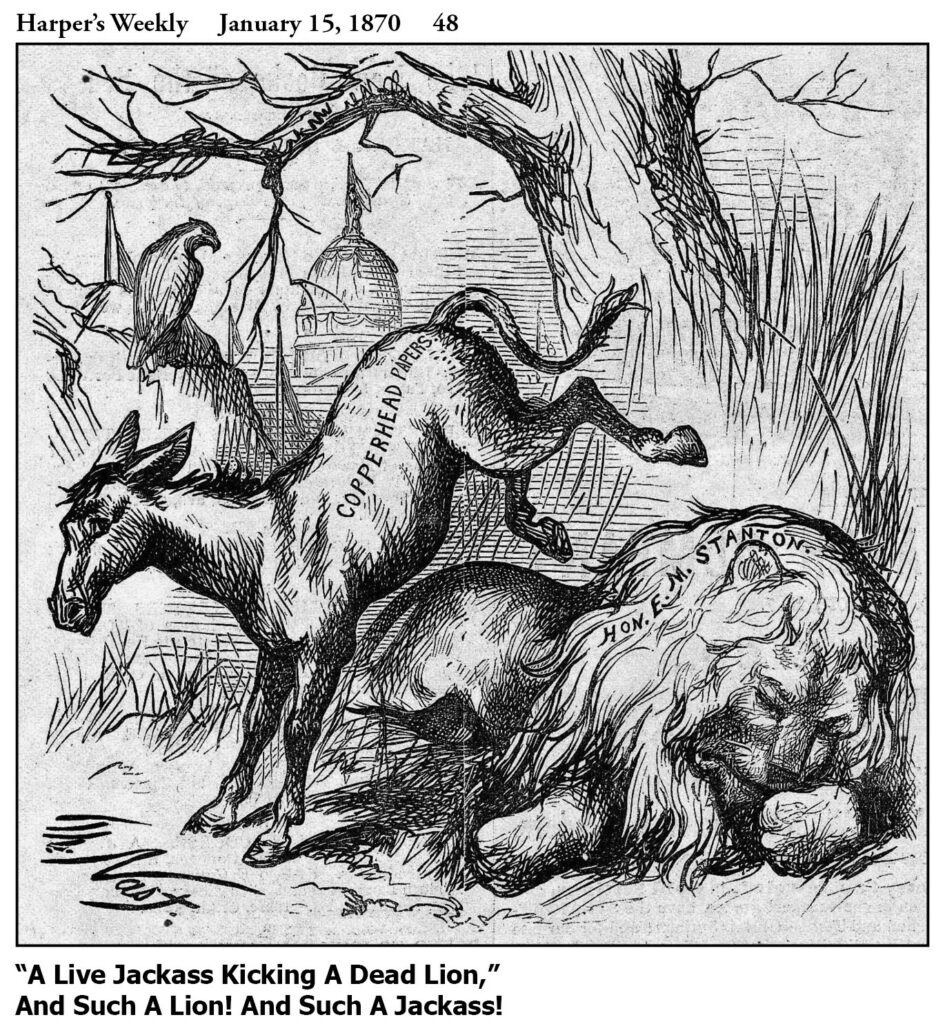
There is a clue in this famous cartoon by Thomas Nast (okay — the cartoon really gives it away, doesn’t it?):

Thomas Nast, Live Jackass kicking a Dead Lion,Harper's Bazaar, January 15, 1870

Cartoon depicting Democrats Thomas Nast, Live Jackass kicking a Dead Lion. Edwin Stanton was fired as Secretary of War by President Andrew Johnson, contrary to the Tenure of Office Act, and that action brought on the impeachment and trial of Johnson (who was acquitted by one vote). Later, President U. S. Grant appointed the financially and health ailing Stanton to the Supreme Court. Stanton was confirmed, but went home and died that night, December 24. Stanton’s opponents continued to try to smear him. Nast’s cartoon was the result. Harper’s Bazaar, January 15, 1870

Watch for the answer in a future post.

Image: Thomas Nast cartoon from Harper’s Weekly, January 15, 1870. Nast’s use in cartoons greatly popularized the use of a donkey as a symbol of the Democratic Party, whose official animal mascot is a rooster. Image in public domain, this one from the Thomas Nast Portfolio of The Ohio State University.

Also, note the explanation by Ray in comments, for historical accuracy.