Atomic history

November 15, 2006

I spent a decade of my life chasing compensation for the downwind victims of fallout from the U.S. government’s testing of atomic devices at the Nevada Test Site — I was working for a Utah politician, and many of the victims were Utah citizens unfortunate enough to live in small towns where, some idiot calculated, the damage from the fallout would be minimized and possible to deny.

Over at Axis of Evel Kneivel, where the Carnival of History 43 is hosted this week, I found this post on the November 5 anniversary of a 1951 atomic bomb test that involved moving hundreds of innocent soldiers to be exposed to radiation in order to test whether they could fight after an atomic exchange.

If Santayana was right, if learning history will help us to prevent the bad parts from recurring, it is urgent that you go read that post, and that you vow to prevent the recurrence of things such as a calculated sacrifice of innocent U.S. citizens.

Go see.


Texas Republicans urging Marxism be taught?

October 19, 2006

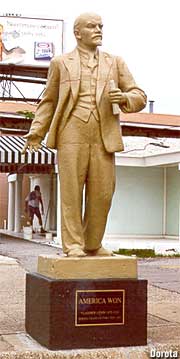
Lenin at Goff's Hamburgers, Dallas (2003)

Lenin does Dallas

No rational person would believe Texas Republicans would call for Marxist economics to be taught in Texas high schools, not even as a part of a “teach the controversy” movement.

The one-semester economics class does not lend itself to giving students backgrounds in economic models that compete with the consensus, free-market view, and even if it did, Marxism would be way down the list of what most Texans would think appropriate to teach. For illustration, consider that when the Soviet Union broke up, a Soviet-produced statute of Lenin was purchased by a Dallas hamburger magnate, placed outside one of his outlets with a plaque commemorating the Cold War, and noting: “America won.” (Alas, Goff’s is gone, as is the statue.)

So, either the Texas Republicans have gone non-rational, or they just were not thinking when they put in their party platform a requirement that alternative theories and their controversies be taught, in social studies.

Confused yet? Tony Whitson at Tony’s Curricublog explains:

But why is this provision regarding social studies tucked into the platform point on “Theories of Origins”? Apparently it reflects an agenda that includes teaching from a creationist standpoint not only in science, but in social studies and other subjects as well.

Someone who’s familiar with curriculum conflicts over recent years will recognize the entire education section of the platform as coming chapter and verse from Phyllis Schlafly’s Eagle Forum. The agenda they are pushing here is not something home-grown in Texas, but an agenda that we can expect to see being advanced all over the United States.

Well, Texas politics being what it is, the likelihood that a plank from any party’s platform could make it into law is a bit remote right now. And it seems clear that the intent was to go after science and evolution, not economics. Udall’s Law of Unintended Consequences says such efforts will produce unexpected and undesired results, and here we have a good case in point.

People are gearing up for fights on history and biology texts in Texas — economics, too? Ouch.


A fine, patriotic hoax — the U.S.S. Pueblo

October 8, 2006

Commander Lloyd Bucher

Cmdr. Lloyd Bucher and the Pueblo on the cover of Time Magazine, February 2, 1968 (substituted for the official portrait of Bucher, which is no longer available)

A good hoax? It could happen, right?

It did happen.

A U.S. spy ship, the U.S.S. Pueblo, under the command of Cmdr. Lloyd Bucher, was captured by North Korea on January 28, 1968 — the beginning of a very bad year in the U.S. that included Viet Cong’s Tet Offensive that revealed victory for the U.S. in Vietnam to be a long way off, the assassination of the Rev. Martin Luther King, Jr., the assassination of presidential candidate Sen. Robert F. Kennedy, riots during the Democratic National Convention in Chicago, a bitter election — and a wonderful television broadcast from astronauts orbiting the Moon on Christmas Eve.

North Korea held the crew of the Pueblo for eleven months. While holding the crew hostage — there was never any serious thought that the ship had in fact strayed into North Korean territorial waters, which might have lent some legitimacy to the seizure of the ship — North Korea (DPRK) tried to milk the event for all the publicity and propaganda possible. Such use of prisoners is generally and specifically prohibited by several international conventions. Nations make a calculated gamble when they stray from international law and general fairness.

To their credit, the crew resisted these propaganda efforts in ways that were particularly embarrassing to the North Koreans. DPRK threatened to torture the Americans, and did beat them — but then would hope to get photographs of the Americans “enjoying” a game of basketball, to show that the Americans were treated well. The crew discovered that the North Koreans were naive about American culture, especially profanity and insults. When posing for photos, the Americans showed what they told DPRK was the “Hawaiian good luck sign” — raised middle fingers. The photos were printed in newspapers around the world, except the United States, where they were considered profane. The indications were clear — the crew was dutifully resisting their captors. When the hoax was discovered, the Americans were beaten for a period of two weeks. Read the rest of this entry »


Query: Capt. Bucher’s confession?

September 28, 2006

I’m looking for a good copy of the full text of the “confession” of Capt. Lloyd Bucher of the U.S.S. Pueblo, the spy ship captured by North Korea in 1968.  I have a couple of versions that are alleged to be excerpts — I am particularly interested in what I recall that I have not found:  Navigation instructions that would have put the ship off the coast of Alaska, and a reference to the definition of rape in the Uniforme code of Military Justice (UCMJ).

If you know of a source, especially on-line, please let me know.


Cold War hero Günter Schabowski

September 24, 2006

Do you remember Günter Schabowski? I didn’t.

This snapshot of his role in the unwinding of the Berlin Wall story is the sort of thing we need to preserve, as historians, I think. It shows how large organizations tend to foul things up. And it shows how one person can influence history, even with error. It demonstrates how history does not consist of foregone conclusions, but is instead a long string of serendipitous events.

It’s just the sort of story I like, over at Earthling Concerned.


Dan Valentine — where are you?

September 6, 2006

Readers of the Salt Lake Tribune in the 1950s, 1960s and 1970s probably recall the work of Dan Valentine in his daily “Nothing Serious” column. Don’t they?

A friend recently sent an old piece of schmaltz from Valentine, “I trust you’ll treat her well,” about sending a daughter off to the first day of school. It was misattributed to Victor Buono (now you start to see my interest).

Valentine’s column was a rambling collection of not-serious observations about people the newspaper covered and events in Utah and the Intermountain states. Occasionally he would write about some event in a memorable fashion — the first day of school for his daughter, the first day of school for his son — and occasionally he’d do a tribute to some underappreciated profession, like truckers, waiters and waitresses, young mothers, secretaries. In those tributes, there was almost always a line like, ‘She’s America’s [future (teachers), heart (nurses), breakfast-tomorrow-morning (truckers)] with a smile on her face!’

Old columns appeared in paperback print collections sold in every truck stop and diner in the west — at least, that’s what it seemed like when the University of Utah debate squad travelled, and found the things everywhere we stopped. Standard breakfast behavior was for someone to grab the sample and perform one of the columns, for sport, to irritate the other debaters — but often enough to the appreciation of other breakfasters who found Valentine’s columns appropriate and touching, rather than out of place and out of time in the Vietnam era, especially at breakfast.

Dan Valentine passed, and his son, Dan Valentine, Jr., took over the column briefly. Valentine joined our writing team with Orrin Hatch for a brief time, too, later.

Query — Does anyone know: Are those collections of Dan Valentine’s old columns still available anywhere? (I don’t find them on Amazon as currently published.) Does anyone know where Dan Valentine, Jr., is these days? If any reader knows, please put a note in the comments. Read the rest of this entry »


Sutherland’s “Americana” cartoons

August 13, 2006

I stumbled across Bibi’s Box, a blog that appears to be devoted to finding videos available on the internet. Bibi wrote about John Sutherland, a producer for Walt Disney who struck out on his own in 1944. He became famous, or infamous, for doing cartoons for hire that capitalist enterprises wanted to make available for schools.

Some of us Baby Boomers will recognize almost every one of these films. Film distribution was always problematic back then, before Federal Express or UPS and overnight air delivery to almost anywhere in the world, and back when 16-mm film projectors were often old, cranky monsters that defied the most tech-savvy teachers to make a film dance on a screen. Consequently, to increase the circulation, many of these films also ended up in the afternoon cartoon fests that local television stations ran for “kiddies.”

The images are rich. There are time-bound charicatures of middle-class Americans, and full use of other American iconography. In a 1948 film, “Make Mine Freedom,” Sutherland’s film shows a Member of Congress dressed as a southern politician (though without an accent), the labor representative in denim overalls, the capitalist factory boss with a cigar and morning coat with striped pants, and the farmer in stereotypical straw hat. In a later scene, some of the characters parade in a “Spirit of ’76” fashion, with drum, fife and flag, across the Lincoln Memorial.

Some of the images are corny, but they are rich mines for classroom use, where the images form powerful mnemonic devices for kids who don’t know the history of that era. I have used chunks of “Schoolhouse Rock” for individual study on specific areas — last year I required high school history students to memorize the Preamble to the Constitution, and the “Schoolhouse Rock” version helped enormously. Sutherland’s films could be as useful, in certain topics.

In any case, Bibi has links to more than a dozen of Sutherland’s cartoon films.

If you find a good use for one, please let me know.


Berlin Wall’s 45th

August 13, 2006

August 13, 2006, is the 45th “anniversary” of the erection of the Berlin Wall, the totem of the Cold War that came down in 1989, pushing the end of the Cold War. Residents of Berlin awoke on this day in 1961 to find the communist government of East Germany erecting what would become a 96-mile wall around the “western quarters” of the city — not so much to lay siege to the westerners (that had been tried in 1948, frustrated by the Berlin Airlift) as to keep easterners from “defecting” to the West. The Brandenburg Gate was closed on August 14, and all crossing points were closed on August 26.

From 1961 through 1991 1989, teachers could use the Berlin wall as a simple and clear symbol for the differences between the communist Eastern Bloc, the Soviet Union and her satellite states, and the free West, which included most of the land mass of Germany, England, France, Italy, the United States and other free-market nations — the North Atlantic Treaty Organization (NATO) countries. I suspect most high school kids today know very little about the Wall, why it was there, and what its destruction meant, politically.

This era of history is generally neglected in high school. Many courses fail to go past World War II; in many courses the Cold War is in the curriculum sequenced after the ACT, SAT and state graduation examinations, so students and teachers have tuned out.

But the Wall certain had a sense of drama to it that should make for good lessons. When I visited the wall, in early 1988, late at night, there were eight fresh wreaths honoring eight people who had died trying to cross the Wall in the previous few weeks (in some places it was really a series of walls with space in between to make it easier for the East German guards to shoot people trying to escape) — it’s an image I never forget. Within a year after that, East Germans could travel through Hungary to visit the West, and many “forgot” to return. Within 18 months the wall itself was breached.

The Wall was a great backdrop for speeches, too — President John F. Kennedy visited Berlin in June 1963, and expressed his solidarity with the walled-in people of both West and East Berlin, with the memorable phrase, “Ich bin ein Berliner, which produced astounding cheers from the tens of thousands who came to hear him. There are a few German-to-English translators who argue that some of the reaction was due to the fact that “Berliner” is also an idiomatic phrase in Berlin for a bakery confection like a jelly doughnut — so Kennedy’s words were a double entendre that could mean either “I am a citizen of Berlin,” or “I am a jelly doughnut.”  [Be sure to see the comments below, from Vince Treacy (9/28/2010).]  Ronald Reagan went to the same place Kennedy spoke to the Berlin Wall, too, to the Brandenburg Gate, in his famous June 1987 speech which included a plea to the Soviet Union’s Premier Mikhail Gorbachev: “Mr. Gorbachev, tear down this wall!”
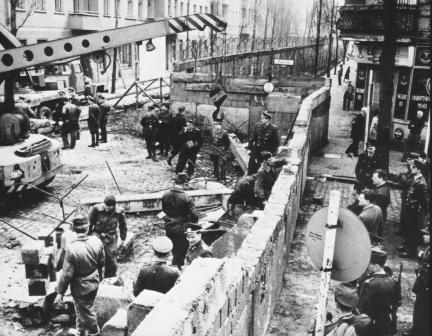
Construction of the Berlin Wall, photol collected by Corey S. Hatch

Construction of the Berlin Wall in August 1961 –photo from University of Utah, by Corey Hatch.

Update March 9, 2007: Berlin Airlift information and lesson plans are available from the Truman Library, here, here and here.

Update November 9, 2009: Notes on the 20th anniversary of the fall of the Wall

Please share this post:

Add to FacebookAdd to NewsvineAdd to DiggAdd to Del.icio.usAdd to StumbleuponAdd to RedditAdd to BlinklistAdd to TwitterAdd to TechnoratiAdd to Furl