Kern County, California, is ground zero for West Nile virus trouble in 2007. It’s a still-partly rural area, with many farms, around Bakersfield. California so far this year has more than 200 cases of human infection from West Nile reported, and 115 of those cases are in Kern County. Eight people died from the infections, all of them elderly.
So, were DDT the answer to West Nile virus problems, Kern County would be the first place from which we would expect to hear a plea for DDT.
Not so.
Kern County officials hope they’ve turned a corner. There were only eight new cases reported last week, and officials think that their spraying program may have contributed a lot.
Yes, you read that correctly: The spraying program in Kern County is credited with reducing West Nile virus infections in humans.
Occasional readers of this outlet might well ask: What are they spraying with, if not DDT?
Despite the Snake-oil Salesmen™ claim that the U.S. needs to poison itself with DDT in order to fight West Nile, officials in public health use other substances to fight mosquitoes directly, when there is an outbreak of West Nile virus-related disease in humans, or sometimes just in birds.
[Notice: Original reporting ahead]
The Kern County Department of Public Health Services actively fights West Nile, with public education, help to medical care professionals, and information to decision makers on what steps need to be taken. People at the agency were anxious to talk about their work against West Nile.
What do they use to spray for mosquitoes? Not DDT.
I checked with two other mosquito abatement groups, including Dallas County’s. They were anxious to talk about their work, though not for attribution without approval of their PR managers, who have so far not returned calls (public relations is impossible when you don’t relate to the public, guys).
Those who do the spraying emphasize that spraying is rather a last resort, and done only after significant research shows it is necessary. Spraying kills more than the mosquitoes, including a lot of creatures that would normally eat the mosquitoes and keep them in check. So spraying is done only when the mosquitoes seem to have an unnatural tipping of the balance in their favor.
Public health departments set traps for mosquitoes. These traps are checked regularly, and the mosquitoes are sorted by species. This is vitally important, because West Nile virus is carried only by certain species of mosquito, and different species require different abatement plans, and different insecticides.
Once sorted by species, the mosquitoes are sampled to see which are carrying pathogens, if any. In addition, most public health agencies also monitor birds, by reports of bird carcasses (almost always a sign of disease or poisoning), and by captive populations of chickens, whose blood is sampled to see whether viruses are present.
After the species are identified, the viruses are identified, and it is determined that there is virus activity, a decision is made on whether to spray.
For West Nile, the chief vector is a species of Culex. Culex mosquitoes are generally controlled by larvacides, not spraying for adults. If spraying for adults is determined necessary, most health departments are using synthetic pyrethroids, synthetic versions of insecticides plants manufacture. While they are not as environmentally friendly as natural pyrethrins, they are much less dangerous than DDT.
The sprayers I spoke with also made this point: The old model of DDT spraying of entire neighborhoods is outdated. “It is not a good use of the product,” as one gently put it.
For West Nile virus control, here’s what you need to tell Henry I. Miller, up in the ivory towers at the Hoover Institute promoting voodoo science:
1. No one thinks West Nile virus is out of control (but it’s a problem).
2. Health official thinks current, non-DDT methods of mosquito control are adequate to control for West Nile virus.
3. Even when spraying is required, DDT is the wrong stuff to use — Culex is generally controlled with a larvacide, and DDT spraying would be much less effective, and much more destructive.
I asked the abatement people if they were concerned about killing birds with spraying, or killing other things that eat mosquitoes. Basically, they said it’s not their job, but the chemicals they use are much gentler on birds and other mosquito predators than DDT is. One fellow said about collateral bird deaths: “I have bigger finch to fry.”
Spread the word; friends don't allow friends to repeat history.


 Posted by Ed Darrell
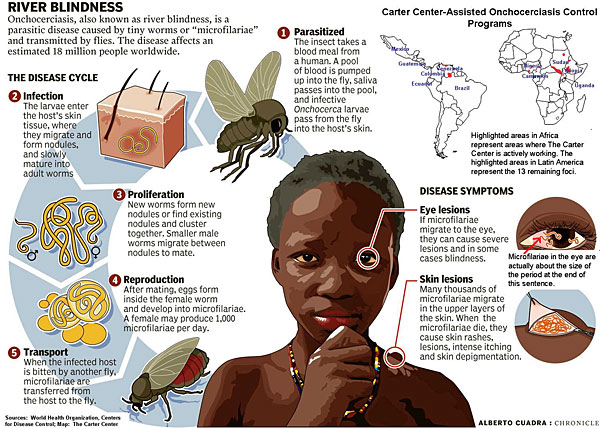 Click on thumbnail image for a chart showing the life cycle of river blindness





 Millard Fillmore's Bathtub