Richard Feynman, at a hearing of the Rogers Commission, demonstrates with a glass of ice water and a piece of O-ring material, how cold makes the O-rings inflexible; photo credit unknown
For a successful technology, reality must take precedence over public relations, for nature cannot be fooled.
A wax likeness of Millard Fillmore’s head, appearing to be for sale for $950.00 back in 2007. Did anyone ever buy it? Yes, it does bear an unusual resemblance to Tom Peters.
March 8, 2013, is the 139th anniversary of Millard Fillmore’s death. Famous lore claims Fillmore’s last words were, “The nourishment is palatable.”
Buffalo, N.Y., March 8 — 12 o’clock, midnight. — Ex-President Millard Fillmore died at his residence in this city at 11:10 to-night. He was conscious up to the time. At 8 o’clock, in reply to a question by his physician, he said the nourishment was palatable; these were his last words. His death was painless.
First, I wonder how the devil the writer could possibly know whether Fillmore’s death was painless?
And second, accuracy obsessed as I am, I wonder whether this is the source of the often-attributed to Fillmore quote, “The nourishment is palatable.” Several sources that one might hope would be more careful attribute the quote to Fillmore as accurate — none with any citation that I can find. Thinkexist charges ahead full speed; Brainyquote removed the quote after I complained in 2007. Wikipedia lists it. Snopes.com says the quote is “alleged,” in a discussion thread.
I’ll wager no one can offer a citation for the quote. I’ll wager Fillmore didn’t say it.
Let’s be more stolid: The quote alleged to be Fillmore’s last words, isn’t. No one says “palatable” when they’re dying, not even the man about whom it is claimed that Queen Victoria pronounced him the hansomest man she ever met (just try tracking that one down), and whose strongest legacy is a hoax about a bathtub, started 43 years after he died. No one calls soup “sustenance.”
The alleged quote, the misquote, the distortion of history, was stolen from the obituary in the New York Times. Millard Fillmore did not say, “The sustenance is palatable.”
March 5, 2013, is the 67th anniversary of Winston Churchill’s speech in Fulton, Missouri. He called the speech “Sinews of Peace,” but it is better known as the speech in which Churchill first used the phrase Iron Curtain to describe events in Eastern Europe after World War II.
Winston Churchill delivering the “Iron Curtain” speech, Westminster College, Fulton, Missouri, March 5, 1946 – Photo by George Skadding
“From Stettin in the Baltic to Trieste in the Adriatic, an iron curtain has descended across the Continent. Behind that line lie all the capitals of the ancient states of Central and Eastern Europe. Warsaw, Berlin, Prague, Vienna, Budapest, Belgrade, Bucharest and Sofia, all these famous cities and the populations around them lie in what I must call the Soviet sphere, and all are subject in one form or another, not only to Soviet influence but to a very high and, in many cases, increasing measure of control from Moscow.”
Last June son James and I stopped off in Fulton, on the way back from James’s graduation from Lawrence University in Appleton, Wisconsin. We were treated royally by the people at the Churchill Centre, and got a chance to spend time in what is really a first rate museum. More people should make Fulton a destination, or pause in their summer travels, for the sake of the kids.
This is an encore post; with a bit of time free, I may post more photographs of our trip.
Oh, why not: Below the fold is the speech in its entirety, from the transcript at the Churchill Centre. Read the rest of this entry »
Spread the word; friends don't allow friends to repeat history.
You do something all day long, don’t you? Every one does. If you get up at seven o’clock and go to bed at eleven, you have put in sixteen good hours, and it is certain with most men, that they have been doing something all the time. They have been either walking, or reading, or writing, or thinking. The only trouble is that they do it about a great many things and I do it about one. If they took the time in question and applied it in one direction, to one object, they would succeed. Success is sure to follow such application. The trouble lies in the fact that people do not have an object, one thing, to which they stick, letting all else go. Success is the product of the severest kind of mental and physical application.
Maria Popova’s post at BrainPickings explores Thomas Edison’s unusual preoccupation with sleep. I’ve usually considered him a model for some behaviors — he kept cots in his office for naps — but it becomes clear he was probably chronically sleep-deprived. With the knowledge we have now on how sleep deprivation hampers daily activities, Edison’s accomplishments become all the more fantastic. Imagine what he could have accomplished, had he had enough sleep!
Edison was born February 11, 1847, when Charles Darwin and Abraham Lincoln were both 38 years old, Darwin working in experiments with animals to disprove the evolution operations he had observed (he didn’t disprove them), and Lincoln in the middle of his sole term as a U.S. Congressman, during the Mexican-American War. (Both Darwin and Lincoln were born February 12, 1809.) In 1847 Brigham Young was leading Mormons across what Lewis and Clark had called “the Great American Desert,” the Great Plains, into the Valley of the Great Salt Lake (more desert than Lewis and Clark could have imagined). Famously, the main body of the Mormon emigration wagon flotilla would enter Salt Lake Valley on July 24, 1847.
Edison would probably agree: Overnight success takes years of preparation and practice.
Herbert Hoover, 88, attended the opening of the Hoover Library in West Branch, Iowa, on August 10, 1962, 30 years after his speech in Des Moines defending actions to shore up the credit of the U.S. At this 1962 event, former President Harry Truman came to pay respects, mensch that he was; Truman is walking ahead of Hoover here. Photo from Travel Iowa blog, and probably from the Hoover Library and Museum
Let me remind you that credit is the lifeblood of business, the lifeblood of prices and jobs.
Herbert Hoover, address at Des Moines, Iowa, October 4, 1932. — The Public Papers of the Presidents of the United States: Herbert Hoover, 1932–1933, p. 467. (courtesy of Wikiquote)
_____________
Just a month before he would be crushed at the polls by Franklin Roosevelt, President Herbert Hoover returned to Iowa, his proud home state, to deliver this speech in Des Moines, detailing actions his administration had taken over the previous 18 months to save the U.S. and world economies. Much of this action had been out of the glare of popular press. Hoover hoped that by explaining the difficult battles his administration fought behind the huge oak doors of boardrooms and international diplomacy, Americans might appreciate more what he had accomplished, and not focus so much on the fact that the Great Depression still ravaged millions of Americans.
In today’s anti-credit political environment, it is interesting to see one of our most ardent businessman presidents defend credit. In an irony unappreciated in today’s political discussions, much of the discussion in 1932 between Hoover and Roosevelt was over which one could better manage to get to and keep a balanced budget.
The full speech is available at The American Presidency Project housed at the University of California – Santa Barbara. Politics wonks, history fans, and economists will want to look at the full speech this line is ripped from, contextually bereft. Context, in this case, does not change the meaning, but deepens the complexity of the issues and time. Hoover bragged about keeping the U.S. on the gold standard, because so many contracts and mortgages were written to be payable in gold, and not currency. So leaving the gold standard could have enormous disrupting influence on credit.
The first of these perils was the steady strangulation of credit through the removal of $3 billions of gold and currency by foreign drains and by the hoarding of our own citizens from the channels of our commerce and business. And let me remind you that credit is the lifeblood of business, the lifeblood of prices and of jobs.
Much of the rest of the speech defended Hoover’s use of government in ways that would cause apoplexy among Tea Partiers and a blizzard of critical press releases from Republicans, today:
Hoover addresses a large crowd in his 1932 campaign. (Photo credit: Wikipedia)
Now, we have fought an unending war against the effect of these calamities upon our people in America. This is no time to recount the battles on a thousand fronts. We have fought the fight to protect our people in a thousand cities from hunger and cold.
We have carried on an unceasing campaign to protect the Nation from those unhealing class bitternesses which arise from strikes and lockouts and industrial conflict. We have accomplished this through the willing agreement of employer and labor which placed humanity before money through the sacrifice of profits and dividends before wages.
We have defended millions from the tragic result of droughts. We have mobilized a vast expansion of public construction to make work for the unemployed. We fought the battle to balance the budget. We have defended the country from being forced off the gold standard, with its crushing effect upon all who might be in debt. We have battled to provide a supply of credits to merchants and farmers and industries. We have fought to retard falling prices. We have struggled to save homes and farms from foreclosure of mortgages, battled to save millions of depositors and borrowers from the ruin caused by the failure of banks, fought to assure the safety of millions of policyholders from failure of their insurance companies, and fought to save commerce and employment from the failure of railways.
We have fought to secure the disarmament and to maintain the peace of the world. We have fought for stability in other countries whose failure would inevitably injure us. And, above all, we have fought to preserve the safety, the principles, and the ideals of American life. We have builded the foundations of recovery.
Now, all these battles, related and unrelated, have had a single strategy and a single purpose. That was to protect your living, your comfort, and the safety of your fireside. They have been waged and have succeeded in protecting you from infinitely greater harm that might have come to you.
Thousands of our people in their bitter distress and losses today are saying that “things could not be worse.” No person who has any remote understanding of the forces which confronted this country during these last 18 months ever utters that remark. Had it not been for the immediate and unprecedented actions of our Government things would be infinitely worse today.
Instead of moving forward we would be degenerating for years to come, even if we had not gone clear over the precipice, with the total destruction of every ideal we hold dear.
Let no man tell you that it could not be worse. It could be so much worse that these days now, distressing as they are, would look like veritable prosperity.
In all these great efforts there has been a constant difficulty of translating the daily action into terms of public understanding. The forces in motion have been so gigantic, so complex in character, the instrumentalities and actions that we must undertake to deal with them have been so involved, the figures we must use are so astronomical as to seem to have but little relation to the family in the apartment or the cottage or on the farm.
Five months after Hoover’s Des Moines speech, Franklin Delano Roosevelt and Herbert Hoover in convertible automobile on way to U.S. Capitol for Roosevelt’s inauguration, March 4, 1933 (Photo credit: Wikipedia)
If Hoover made that speech today, every fellow at the Hoover Institution would sign a petition demanding his impeachment, never mind that he’s not president any more.
____________
A few notes about the photograph at the top: This photo shows two former presidents, Herbert Hoover and Harry S Truman, walking through a crowd at the dedication of the Hoover Presidential Library and Museum, in West Branch, Iowa, in 1962. One might pay careful attention to how lax security was, generally — the crowd is allowed within an arm’s length of the two former presidents — and this was after an assassination attempt had been made on Truman, in Washington, years before. Insignia on the uniforms of the police are difficult to discern, but from the uniforms it looks as if there was a combination of local police, possibly a county sheriff’s staff, and Iowa state highway patrol troopers. I found it interesting to note that several of the younger men appear to be Explorer Scouts, BSA — one wearing what appears to be an Eagle Scout neckerchief. Cameras were special event tools, but generally not of the quality that could get a decent photograph at an event like this, except for professionals with professional cameras. Still, visible are double-lens reflex cameras held up in hope of a proper aim, small Kodaks, one man winding film in a 35-mm single-lens reflex, and a tiny handful of home movie cameras (with three lenses on the front — wide angle, normal and modest telephoto). Click on the photo for an expanded view, and see what else you may. If by chance you know anything about this photo, Dear Reader, please tell, in comments.
Presidents Harry Truman and Herbert Hoover at the dedication of the Herbert Hoover Presidential Library and Museum on August 10, 1962 (Photo credit: Wikipedia)
Spread the word; friends don't allow friends to repeat history.
It seems we need to keep reminding people of this.
The frequently quotable Oliver Wendell Holmes, Jr., circa 1930. Edited photograph from the Library of Congress Prints and Photographs Division. Original photo by Harris & Ewing. LC-USZ62-47817. Copyright expired.
I like paying taxes. With them I buy civilization.
Justice Oliver Wendell Holmes, Jr., attributed. (see Felix Frankfurter, Mr. Justice Holmes and the Supreme Court, Harvard University Press, 1961, page 71.)
I found reference to the quote in a book about eminent economists, through Google Scholar:
Eminent Economists: Their Life Philosophies
By Michael Szenberg
Published by Cambridge University Press, 1993
320 pages
On page 201, Szenberg refers Holmes’s view of “taxation as the price of liberty.” In a footnote, he points to Justice Frankfurter’s book. The quote is dolled up a little. According to Szenberg’s footnote:
More precisely, he rebuked a secretary’s query of “Don’t you hate to pay taxes?” with “No, young fellow, I like paying taxes, with them I buy civilization.”
Frankfurter is a reliable source. It’s likely Holmes said something very close to the words Friedman used.
Since the decay of the feudal system, by which the public defense was provided for chiefly at the expense of individuals, the system of loans has been introduced, and as no nation can raise within the year by taxes sufficient sums for its defense and military operations in time of war the sums loaned and debts contracted have necessarily become the subjects of what have been called funding systems. The consequences arising from the continual accumulation of public debts in other countries ought to admonish us to be careful to prevent their growth in our own. The national defense must be provided for as well as the support of Government; but both should be accomplished as much as possible by immediate taxes, and as little as possible by loans.
Taxes over loans. Who would have guessed that?
In contrast to some of the things circulating around the internet today attributed to John Adams, he actually wrote this in his message to Congress.
Spread the word; friends don't allow friends to repeat history.
Playwright Peter Stone wrote the witticism attributed to John Adams. Theatrical Rights image
We should more accurately attribute it to the play’s book’s author, Peter Stone.
What John Adams did not say about Congress, Peter Stone wrote. Such wit deserves proper attribution.
Mention of “law firms” gives away the origin’s being much later than Adams’s — Adams died, as you know, on July 4, 1826, the 50th anniversary of the Declaration of Independence. “Law firms” is 20th century language.
A day after Fulbright & Jaworski LLC announced a merger with Norton Rose, one might almost wish that law firms would be just three people. Norton Rose Fulbright starts out with 3,800 lawyers in 55 offices around the world. [Conflict of interest note: My spouse works at Fulbright & Jaworski.] The distaste with lawyers in the Stone quote also doesn’t ring to the times of the American Revolution. Good lawyer jokes probably existed then, but they didn’t really rise until the lawyerly pettifogging of the 19th century — see Dickens’ Mr. Bumble in Chapter 51 of Oliver Twist, or the entire text of Bleak House, for examples. Twain joked about Congress, but a joke about both Congress and lawyers probably was rare before 1910. (I am willing to be disabused of this idea, if I am wrong . . . comments are open.)
Stone died in 2003, much underappreciated if you ask me. Stone might be said to be among the greatest ghost speechwriters in history based on 1776! alone, creating lines for John Adams, Ben Franklin and Thomas Jefferson — three of the greatest authors and (sometimes reluctant) speakers of their day, and of all history. Stone’s plays include Titanic and Two by Two, his screenplays include Charade, Arabesque, Mirage, The Taking of Pelham 123, and Father Goose.
Introduction to Blast Off : Rockets, Robots, Ray Guns, and Rarities from the Golden Age of Space Toys (2001) by S. Mark Young, Steve Duin, Mike Richardson, p. 6; the quote on hydrogen and stupidity is said to have originated with an essay of his in the 1960s, and is often misattributed to Frank Zappa, who made similar remarks in The Real Frank Zappa Book (1989): “Some scientists claim that hydrogen, because it is so plentiful, is the basic building block of the universe. I dispute that. I say there is more stupidity than hydrogen, and that is the basic building block of the universe.”
For years I’ve found this quote attributed to Albert Einstein, occasionally to Frank Zappa, sometimes to Wolfgang Pauli, once to Richard Feynman, and to several other nuclear or particle physicists or cosmologists or astronomers. I’ve tried to track it down without success that I considered close enough to wager on. Recently someone mentioned that he thought he recalled it being said first by Harlan Ellison, and of course, that checks out.
How many other nuggets of Ellison’s wisdom and insightful humor get attributed to other sources?
Zappa probably read Ellison. Einstein would have wished he’d said it, as would Feynman (who probably also read Ellison); but please remember to attribute it to Ellison next time you use it. Please be sure to quote him accurately, with “elements,” and not “things.”
You may have plenty of cause to use that quote in the next few weeks.
Hidalgo himself was captured by the Spanish in 1811, and executed.
Statue of Father Hidalgo in Dolores, Mexico.
It’s a great story. It’s a good speech, what little we have of it (Hidalgo used no text, and we work from remembered versions). It’s important to Texas history, too — it’s difficult to imagine Tejians getting independence from Spain in quite the same way they won it from Mexico.
Why isn’t there a good 10- to 15-minute video on the thing for classroom use? Get a good actor to do the speech, it could be a hit. Where is the video when we need it?
Update from 2008: Glimmerings of hope on the video front: Amateur videos on YouTube provide some of the sense of what goes on in modern celebrations.
The Grito de Dolores (“Cry of/from Dolores”) was the battle cry of the Mexican War of Independence, uttered on September 16, 1810, by Miguel Hidalgo y Costilla, a Roman Catholic priest from the small town of Dolores, near Guanajuato, Mexico.
“My Children, a new dispensation comes to us today…Will you free yourselves? Will you recover the lands stolen 300 years ago from your forefathers by the hated Spaniards? We must act at once.”
Although many mistakenly attribute the Cinco de Mayo holiday as the celebration of Mexican independence, Sept. 16 was the day the enthusiastic Indian and mestizo congregation of Hidalgo’s small Dolores parish church took up arms and began their fight for freedom against Spain.
Portals to the World contains selective links providing authoritative, in-depth information about the nations and other areas of the world. Resources on Mexico include information on the country’s history, religion, culture and society to name a few.
September is also a notable month for Hispanic culture with the celebration of Hispanic Heritage Month Sept 15 – Oct. 15. Sept. 15 is significant because it is the anniversary of independence for Latin American countries Costa Rica, El Salvador, Guatemala, Honduras and Nicaragua. In addition to Mexico’s independence day on Sept. 16, Chile recognizes its independence day Sept.18. Also, Columbus Day or Día de la Raza, which is Oct. 12, falls within this 30-day period.
The theme for the 2009 Hispanic Heritage Month was “Embracing the Fierce Urgency of Now!” To coincide with the celebration, the Library and several partners present a website honoring Hispanic culture and people. [Nice idea, calling it “Heritage Month” instead of “History Month;” maybe we can change February to “Black Heritage Month,” and study Hispanic and black history every day.]
Specifically on the Grito de Dolores, see the Library of Congress’s American Memory Project:
Cry of Dolores
My Children, a new dispensation comes to us today…Will you free yourselves? Will you recover the lands stolen three hundred years ago from your forefathers by the hated Spaniards? We must act at once.Cry of Dolores, attributed to Father Miguel Hidalgo y Costilla, September 16, 1810.
Early on the morning of September 16, 1810, Father Miguel Hidalgo y Costilla summoned the largely Indian and mestizo congregation of his small Dolores parish church and urged them to take up arms and fight for Mexico’s independence from Spain. His El Grito de Dolores, or Cry of Dolores, which was spoken—not written—is commemorated on September 16 as Mexican Independence Day.
Father Hidalgo was born into a moderately wealthy family in the city of Guanajuato, northwest of Mexico City, in 1753. He attended the Jesuit College of San Francisco Javier, received a bachelor’s degree from the University of Mexico in 1774, and was ordained into the priesthood in 1778. He soon earned the enmity of the authorities, however, by openly challenging both church doctrine and aspects of Spanish rule by developing Mexican agriculture and industry.
In 1803, Hidalgo accepted the curacy of the small parish of Dolores, not far from his native city of Guanajuato. Between 1803 and 1810, he directed most of his energy to improving the economic prospects of his parishioners. He also joined the Academia Literaria, a committee seeking Mexico’s independence from Spain.
In September 1810, Spanish authorities learned of the group’s plot to incite a rebellion. On September 13, they searched the home of Emeterio González in the city of Queretaro where they found a large supply of weapons and ammunition. Warned of his impending arrest, Hidalgo preempted authorities by issuing the ElGrito de Dolores on the morning of September 16. Attracting enthusiastic support from the Indian and mestizo population, he and his band of supporters moved toward the town of San Miguel.
The rebel army encountered its first serious resistance at Guanajuato. After a fierce battle that took the lives of more than 500 Spaniards and 2,200 Indians, the rebels won the city. By October, the rebel army, now 80,000 strong, was close to taking Mexico City. Hidalgo, fearful of unleashing the army on the capital city, hesitated, then retreated to the north. He was captured in Texas, then still a part of the Spanish empire, and executed by firing squad on July 31, 1811. After ten more years of fighting, a weakened and divided Mexico finally won independence from Spain with the signing of the Treaty of Córdoba on August 24, 1821.
Learn more about Mexico:
View the Huexotzinco Codex, one of the Top Treasures in the Library of Congress’ American Treasures online exhibition. The codex is an eight-sheet document on amatl,a pre-European paper made from tree bark in Mesoamerica. It is part of the testimony in a legal case against representatives of Spain’s colonial government in Mexico and dates to 1531, ten years after Mexico’s defeat.
Read the Today in History feature on the Mexican holiday Cinco de Mayo, which celebrates Mexico’s defeat of French troops at the town of Puebla in 1862. This event is also widely celebrated by Latinos in the U.S.
Hispanic Heritage Month.gov, from the Library of Congress, National Gallery of Art, National Endowment for the Humanities and several other federal agencies and institutions
To locate resources for the study of Mexico and its history, search the Handbook of Latin American Studies, an online bibliography of works selected and annotated by scholars of Latin American history and culture, or visit the Hispanic Reading Room, which also offers a portal for online information on Mexico.
John F. Kennedy at Rice University, Houston, Texas, Sept 12, 1962 – photo from NASA
There is no strife, no prejudice, no national conflict in outer space as yet. Its hazards are hostile to us all. Its conquest deserves the best of all mankind, and its opportunity for peaceful cooperation many never come again. But why, some say, the moon? Why choose this as our goal? And they may well ask why climb the highest mountain? Why, 35 years ago, fly the Atlantic? Why does Rice play Texas?
We choose to go to the moon. We choose to go to the moon in this decade and do the other things, not because they are easy, but because they are hard, because that goal will serve to organize and measure the best of our energies and skills, because that challenge is one that we are willing to accept, one we are unwilling to postpone, and one which we intend to win, and the others, too.
Why this speech in Houston? There’s more here than just a speech in a football stadium. Kennedy was working to save the space initiative, and to make America more secure.
In this quest, Kennedy lays out the reasons we need strong science research programs funded by our federal government, and strong science educational achievement in all of our schools.
President John F. Kennedy (1961-1963) awoke on April 12, 1961, to the news that the Soviet Union had won the race to put a man into space. Kennedy immediately met with Vice President Lyndon Johnson in the White House to discuss the embarrassment of the Soviets beating America again. “Can we put a man on the moon before them?” Kennedy asked. A few weeks later, Kennedy challenged the nation to “commit itself to achieving the goal, before this decade is out, of landing a man on the moon and returning him safely to earth.”
Kennedy challenged Congress and the imaginations of all Americans a few weeks later, when on May 25, in a special Joint Session of Congress, he proposed a Moon exploration program. In a speech outlining defense and foreign policy needs to make the U.S. secure and safe against threats from Soviet communism, or any other nation or faction, Kennedy spoke openly about the space race that had been waged since October 4, 1957, when the Soviet Union became the first nation on Earth to orbit an artificial satellite, Sputnik.
Finally, if we are to win the battle that is now going on around the world between freedom and tyranny, the dramatic achievements in space which occurred in recent weeks should have made clear to us all, as did the Sputnik in 1957, the impact of this adventure on the minds of men everywhere, who are attempting to make a determination of which road they should take. Since early in my term, our efforts in space have been under review. With the advice of the Vice President, who is Chairman of the National Space Council, we have examined where we are strong and where we are not, where we may succeed and where we may not. Now it is time to take longer strides–time for a great new American enterprise–time for this nation to take a clearly leading role in space achievement, which in many ways may hold the key to our future on earth.
I believe we possess all the resources and talents necessary. But the facts of the matter are that we have never made the national decisions or marshalled the national resources required for such leadership. We have never specified long-range goals on an urgent time schedule, or managed our resources and our time so as to insure their fulfillment.
Recognizing the head start obtained by the Soviets with their large rocket engines, which gives them many months of leadtime, and recognizing the likelihood that they will exploit this lead for some time to come in still more impressive successes, we nevertheless are required to make new efforts on our own. For while we cannot guarantee that we shall one day be first, we can guarantee that any failure to make this effort will make us last. We take an additional risk by making it in full view of the world, but as shown by the feat of astronaut Shepard, this very risk enhances our stature when we are successful. But this is not merely a race. Space is open to us now; and our eagerness to share its meaning is not governed by the efforts of others. We go into space because whatever mankind must undertake, free men must fully share.
I therefore ask the Congress, above and beyond the increases I have earlier requested for space activities, to provide the funds which are needed to meet the following national goals:
First, I believe that this nation should commit itself to achieving the goal, before this decade is out, of landing a man on the moon and returning him safely to the earth. No single space project in this period will be more impressive to mankind, or more important for the long-range exploration of space; and none will be so difficult or expensive to accomplish. We propose to accelerate the development of the appropriate lunar space craft. We propose to develop alternate liquid and solid fuel boosters, much larger than any now being developed, until certain which is superior. We propose additional funds for other engine development and for unmanned explorations–explorations which are particularly important for one purpose which this nation will never overlook: the survival of the man who first makes this daring flight. But in a very real sense, it will not be one man going to the moon–if we make this judgment affirmatively, it will be an entire nation. For all of us must work to put him there.
The race was on. The Soviet Union’s massive rocket engines gave them a decided advantage. Kennedy’s challenge captured the imagination of Americans and America. Necessary money flowed from Congress, but not in a completely free flow. Some opposed the nation’s efforts in space exploration because they thought spending on space exploration detracted from the nation’s defense efforts. Kennedy continued to stress the connection between space exploration and defense. He was backed by successes — Navy Commander Alan Shepard, Jr., had successfully launched into space and returned safely; and on February 20, 1962, pilot Marine Capt. John Glenn orbited the Earth three times, catching the U.S. up almost to where the Soviet Union was in manned space exploration.
Kennedy understood that constant attention, constant selling of the space program would be necessary. So in September 1962 he found himself in Houston, the newly-designated home of the manned space program, and he took the opportunity to cast the American goals in the space race as peaceful, good for all mankind, and definitely worth the massive costs.
Notice in how he casts putting a human on the Moon in league with other great achievements of civilization. Kennedy was truly shooting for the stars.
Notice also how he relates space exploration to practical applications then in existence, such as communication, navigation of ships at sea, and weather forecasting. This was years before geosynchronus satellites were used for everyday telephone conversations, years before quantum theory was harnessed for Global Positioning Systems (GPS) and digital personal, handheld telephones, and before the newly-invented printed circuits were miniaturized to make computer calculating a possibility in space — the Moon landing was done with slide rules and hand calculations.
Just over 14 months later Kennedy would die in Texas, in Dallas, on November 22, 1963. On July 20, 1969, Neil Armstrong and Buzz Aldrin landed the Eagle Lunar Module on the Moon, at the Sea of Tranquility. A few hours later, on July 21, they stepped out on the Moon. From Kennedy’s speech to Congress, the task had taken 8 years, one month and 26 days.
Buzz Aldrin on the Moon, with Neil Armstrong, the U.S. flag, and the Eagle Lunar Module reflected in his helmet visor, July 21, 1969 – NASA photo via Wikimedia
Please share.
Spread the word; friends don't allow friends to repeat history.
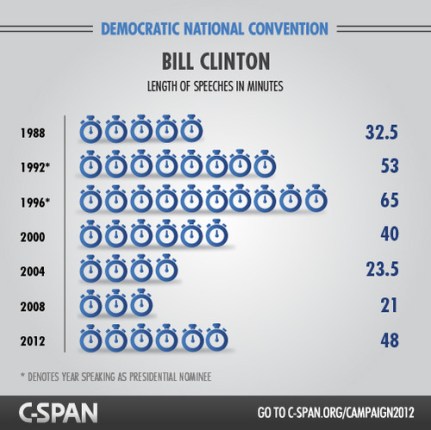
Especially when one recalls that in 1988, pundits said Bill Clinton‘s 32-minute speech was way too long, too dull, and the end of his political career, this chart is interesting:
Infographic: Bill Clinton’s Length of #DNC Speeches in Minutes Since 1988 #cspanDNC
Abraham Lincoln as working man, woodcut by Charles Turzak circa 1933 – Abraham Lincoln Presidential Library & Museum; caption on this image at the Lincoln Library site notes that Turzak portrayed Lincoln as the working man Lincoln himself never aspired to be, though he well respected those who did labor.
Labor is prior to and independent of capital. Capital is only the fruit of labor, and could never have existed if labor had not first existed.
Labor is the superior of capital, and deserves much the higher consideration.
◊ President Abraham Lincoln, Annual Message to Congress, December 3, 1861 (the “State of the Union”)
Abraham Lincoln took great inspiration from Americans and their striving to move up in the world. He admired inventions and inventors, he admired working people and their drive to become their own managers and proprietors of their own businesses. Lincoln had been there himself.
By the time he stopped at the Wisconsin State Fair in 1859 — a full year before his campaign for the presidency — Lincoln was a relatively wealthy lawyer, a good trial lawyer whose better-paying clients included the largest industrial companies of the day, railroads. Lincoln grew up on hard-scrabble farms, though, and he had been a shopkeeper and laborer before he studied law and opened his practice. Lincoln also owned a patent — a device to float cargo boats higher in the Sangamon River that served Sangamon County where he lived, the better to make the entire area a figurative river of free enterprise.
Lincoln was invited to comment on “labor,” at an exhibit showing new machines to mechanize America’s farms. At the Wisconsin fair Lincoln complimented farmers, inventors, inventions, and all laborers. Just over 24 months later, excerpts from that speech showed up at the close of his State of the Union declaration, his December 3 remarks delivered to Congress as the Constitution required. Lincoln probably did not deliver the remarks as as a speech, but they appear in the Congressional Record as a speech, and it is often cited that way. He spoke something like these words in Wisconsin, and they were his views at the end of the first year of the Civil War, expressing yet again his hope that the union would survive, and continue to prosper, for all working people.
Below is a more complete quoting of Lincoln’s remarks from the Message to Congress.
It continues to develop that the insurrection is largely, if not exclusively, a war upon the first principle of popular government– the rights of the people. Conclusive evidence of this is found in the most grave and maturely considered public documents, as well as in the general tone of the insurgents. In those documents we find the abridgment of the existing right of suffrage and the denial to the people of all right to participate in the selection of public officers except the legislative boldly advocated, with labored arguments to prove that large control of the people in government is the source of all political evil. Monarchy itself is sometimes hinted at as a possible refuge from the power of the people.
In my present position I could scarcely be justified were I to omit raising a warning voice against this approach of returning despotism. It is not needed nor fitting here that a general argument should be made in favor of popular institutions, but there is one point, with its connections, not so hackneyed as most others, to which I ask a brief attention. It is the effort to place capital on an equal footing with, if not above, labor in the structure of government. It is assumed that labor is available only in connection with capital; that nobody labors unless somebody else, owning capital, somehow by the use of it induces him to labor. This assumed, it is next considered whether it is best that capital shall hire laborers, and thus induce them to work by their own consent, or buy them and drive them to it without their consent. Having proceeded so far, it is naturally concluded that all laborers are either hired laborers or what we call slaves. And further, it is assumed that whoever is once a hired laborer is fixed in that condition for life.
Now there is no such relation between capital and labor as assumed, nor is there any such thing as a free man being fixed for life in the condition of a hired laborer. Both these assumptions are false, and all inferences from them are groundless.
Labor is prior to and independent of capital. Capital is only the fruit of labor, and could never have existed if labor had not first existed.
Labor is the superior of capital, and deserves much the higher consideration. Capital has its rights, which are as worthy of protection as any other rights. Nor is it denied that there is, and probably always will be, a relation between labor and capital producing mutual benefits. The error is in assuming that the whole labor of community exists within that relation. A few men own capital, and that few avoid labor themselves, and with their capital hire or buy another few to labor for them. A large majority belong to neither class–neither work for others nor have others working for them. In most of the Southern States a majority of the whole people of all colors are neither slaves nor masters, while in the Northern a large majority are neither hirers nor hired. Men, with their families–wives, sons, and daughters,–work for themselves on their farms, in their houses, and in their shops, taking the whole product to themselves, and asking no favors of capital on the one hand nor of hired laborers or slaves on the other. It is not forgotten that a considerable number of persons mingle their own labor with capital; that is, they labor with their own hands and also buy or hire others to labor for them; but this is only a mixed and not a distinct class. No principle stated is disturbed by the existence of this mixed class.
Again, as has already been said, there is not of necessity any such thing as the free hired laborer being fixed to that condition for life. Many independent men everywhere in these States a few years back in their lives were hired laborers. The prudent, penniless beginner in the world labors for wages awhile, saves a surplus with which to buy tools or land for himself, then labors on his own account another while, and at length hires another new beginner to help him. This is the just and generous and prosperous system which opens the way to all, gives hope to all, and consequent energy and progress and improvement of condition to all. No men living are more worthy to be trusted than those who toil up from poverty; none less inclined to take or touch aught which they have not honestly earned. Let them beware of surrendering a political power which they already possess, and which if surrendered will surely be used to close the door of advancement against such as they and to fix new disabilities and burdens upon them till all of liberty shall be lost.
From the first taking of our national census to the last are seventy years, and we find our population at the end of the period eight times as great as it was at the beginning. The increase of those other things which men deem desirable has been even greater. We thus have at one view what the popular principle, applied to government through the machinery of the States and the Union, has produced in a given time, and also what if firmly maintained it promises for the future. There are already among us those who if the Union be preserved will live to see it contain 200,000,000. The struggle of to-day is not altogether for to-day; it is for a vast future also. With a reliance on Providence all the more firm and earnest, let us proceed in the great task which events have devolved upon us.
Yes, I should have reposted this yesterday, for Labor Day. Lincoln’s words are good 365 days a year, 366 days in leap years. Keeping the thought with us is what counts. (This was originally posted in February 2012.)
First they came for the communists, and I did not speak out—because I was not a communist;
Then they came for the trade unionists, and I did not speak out—because I was not a trade unionist;
Then they came for the Jews, and I did not speak out—because I was not a Jew;
Then they came for me—and there was no one left to speak out for me.
German theologian and Lutheran Pastor Martin Niemöller on a postage stamp, painted by Gerd Aretz in 1992 – Wikipedia
Some time this year school curricula turn to the Holocaust, in English, in world history, and in U.S. history.
Martin Niemöller’s poem registers powerfully for most people — often people do not remember exactly who said it. I have seen it attributed to Deitrich Bonhoeffer (who worked with Niemöller in opposing some Nazi programs), Albert Einstein, Reinhold Niebuhr, Albert Schweitzer, Elie Wiesel, and an “anonymous inmate in a concentration camp.”
Niemöller and his actions generate controversy — did he ever act forcefully enough? Did his actions atone for his earlier inactions? Could anything ever atone for not having seen through Hitler and opposing Naziism from the start? For those discussion reasons, I think it’s important to keep the poem attributed to Niemöller. The facts of his life, his times, and his creation of this poem, go beyond anything anyone could make up. The real story sheds light.
Bust of Jefferson in the Great Hall, Library of Congress (Jefferson Building) – photo by Carol Highsmith. The plaster bust of Thomas Jefferson (1743–1826) is a copy of a work by the French sculptor Jean-Antoine Houdon (1741–1828).
In a republican nation, whose citizens are to be led by reason and persuasion, and not by force, the art of reasoning becomes of first importance.
Thomas Jefferson in a letter to David Harding, from Monticello, April 20, 1824; found in The Quotable Jefferson, collected and edited by John P. Kaminski, Princeton University Press 2006, p. 162.
I worry that perhaps we have as a people, abandoned the ideal of being ruled by reason and persuasion.
What’s your mileage?
Great Hall of the Library of Congress viewed from the second floor, Thomas Jefferson Building – Carol Highsmith photo. Note bust of Jefferson, opposite
Spread the word; friends don't allow friends to repeat history.
Or, until that account is unsuspended by the forces supporting Donald Trump: Follow @FillmoreWhite, the account of the Millard Fillmore White House Library
We've been soaking in the Bathtub for several months, long enough that some of the links we've used have gone to the Great Internet in the Sky.
If you find a dead link, please leave a comment to that post, and tell us what link has expired.
Thanks!
Retired teacher of law, economics, history, AP government, psychology and science. Former speechwriter, press guy and legislative aide in U.S. Senate. Former Department of Education. Former airline real estate, telecom towers, Big 6 (that old!) consultant. Lab and field research in air pollution control.
My blog, Millard Fillmore's Bathtub, is a continuing experiment to test how to use blogs to improve and speed up learning processes for students, perhaps by making some of the courses actually interesting. It is a blog for teachers, to see if we can use blogs. It is for people interested in social studies and social studies education, to see if we can learn to get it right. It's a blog for science fans, to promote good science and good science policy. It's a blog for people interested in good government and how to achieve it.
BS in Mass Communication, University of Utah
Graduate study in Rhetoric and Speech Communication, University of Arizona
JD from the National Law Center, George Washington University


 Posted by Ed Darrell


![Viva la república! Viva el Cura Hidalgo! Una página de Gloria, TITLE TRANSLATION: Long live the republic! Long live Father Hidalgo! A page of glory. Between 1890 and 1913. Prints and Photographs Division. Reproduction Information: Reproduction Nos.: LC-USZ62-98851 (b&w film copy neg.), LC-DIG-ppmsc-04595 (digital file from original, recto), LC-DIG-ppmsc-04596 (digital file from original, verso); Call No.: PGA - Vanegas, no. 123 (C size) [P&P] Catalog Record: http://hdl.loc.gov/loc.pnp/ppmsc.04595](http://www.loc.gov/wiseguide/sept09/images/Mexican_A.jpg)
![A street in Guanajuato, Mexico. Between 1880 and 1897. Prints and Photographs Division. Reproduction Information: Reproduction No.: LC-D418-8481 (b&w glass neg.); Call No.: LC-D418-8481 <P&P>[P&P] Catalog Record: http://hdl.loc.gov/loc.pnp/det.4a27131](http://www.loc.gov/wiseguide/sept09/images/Mexican_B.jpg)







 Millard Fillmore's Bathtub