Flag Day 2016 – Fly your flag June 14! Oh, and sing!

June 14, 2016

Our traditional Flag Day post.

Of course, you’re ready to fly your Stars and Stripes on Tuesday, June 14, right?

Flag Day 2014 celebrates the U.S. flag, now over 200 years since the night (in September) the British invaded Baltimore — the Battle of Baltimore, and the Battle of Baltimore Harbor, during the War of 1812.  On that night, Georgetown, D.C., lawyer Francis Scott Key negotiated the release of a physician the British captured during their raid on Washington, D.C.  But British officers didn’t want Key to be able to reveal what he might have learned about their next target, Baltimore.  So they put Key on a boat to watch as they invaded Baltimore, trying to capture the fort that guarded the harbor, Fort McHenry.

Yes, THAT battle.  Key saw the flag at the fort flying, under extreme bombardment, at sunset.  The bombardment continued through night.  At dawn, on September 14, 1814, Key saw that the massive flag at Fort McHenry still flew, meaning the British invasion failed.

He was inspired to write poem, “The Defense of Fort McHenry.”  You know the opening line:

“O! Say can you see by the dawn’s early light, what so proudly we hailed at the twilight’s last gleaming?”

History by Zim has a more detailed account — and this photo, noted as probably the first photograph of that same flag.

From History by Zim:

From History by Zim: “This is the first known photograph of the American flag taken on June 21, 1873 by George Henry Preble. The flag was flown over Fort McHenry in Baltimore, Maryland during an infamous battle between the British and the United States during the War of 1812. Photo Credit: National Star-Spangled Banner Centennial, Baltimore, Maryland, September 6 to 13, 1914.”

Flag Day, June 14th, marks the anniversary of the resolution passed by the Second Continental Congress in 1777, adopting the Stars and Stripes as the national flag.

Fly your flag today. This is one of the score of dates upon which Congress suggests we fly our U.S. flags.

Flag Day 1916, parade in Washington, D.C. - employees of National Geographic Society march - photo by Gilbert Grosvenor

Flag Day 1916, parade in Washington, D.C. – employees of National Geographic Society march – photo by Gilbert Grosvenor

The photo above drips with history, 100 years ago today. Here’s the description from the National Geographic Society site:

One hundred and fifty National Geographic Society employees march in the Preparedness Parade on Flag Day, June 14, in 1916. With WWI underway in Europe and increasing tensions along the Mexican border, President Woodrow Wilson marched alongside 60,000 participants in the parade, just one event of many around the country intended to rededicate the American people to the ideals of the nation.

Not only the anniversary of the day the flag was adopted by Congress, Flag Day is also the anniversary of President Dwight Eisenhower’s controversial addition of the words “under God” to the Pledge of Allegiance in 1954.

(Text adapted from “:Culture: Allegiance to the Pledge?” June 2006, National Geographic magazine)

The first presidential declaration of Flag Day was 1916, by President Woodrow Wilson. Wilson won re-election the following November with his pledge to keep America out of World War I, but by April of 1917 he would ask for a declaration of war after Germany resumed torpedoing of U.S. ships. The photo shows an America dedicated to peace but closer to war than anyone imagined. Because the suffragettes supported Wilson so strongly, he returned the favor, supporting an amendment to the Constitution to grant women a Constitutional right to vote. The amendment passed Congress with Wilson’s support and was ratified by the states.

The flags of 1916 should have carried 48 stars. New Mexico and Arizona were the 47th and 48th states, Arizona joining the union in 1913. No new states would be added until Alaska and Hawaii in 1959. That 46-year period marked the longest time the U.S. had gone without adding states, until today. No new states have been added since Hawaii, more than 57 years ago. (U.S. history students: Have ever heard of an essay, “Manifest destiny fulfilled?”)

150 employees of the National Geographic Society marched in that parade in 1916, and as the proud CEO of any organization, Society founder Gilbert H. Grosvenor wanted a photo of his organization’s contribution to the parade. Notice that Grosvenor himself is the photographer.

I wonder if Woodrow Wilson took any photos that day, and where they might be hidden.

History of Flag Day from a larger perspective, from the Library of Congress:

Since 1916, when President Woodrow Wilson issued a presidential proclamation establishing a national Flag Day on June 14, Americans have commemorated the adoption of the Stars and Stripes by celebrating June 14 as Flag Day. Prior to 1916, many localities and a few states had been celebrating the day for years. Congressional legislation designating that date as the national Flag Day was signed into law by President Harry Truman in 1949; the legislation also called upon the president to issue a flag day proclamation every year.

According to legend, in 1776, George Washington commissioned Philadelphia seamstress Betsy Ross to create a flag for the new nation. Scholars debate this legend, but agree that Mrs. Ross most likely knew Washington and sewed flags. To date, there have been twenty-seven official versions of the flag, but the arrangement of the stars varied according to the flag-makers’ preferences until 1912 when President Taft standardized the then-new flag’s forty-eight stars into six rows of eight. The forty-nine-star flag (1959-60), as well as the fifty-star flag, also have standardized star patterns. The current version of the flag dates to July 4, 1960, after Hawaii became the fiftieth state on August 21, 1959.

Fly your flag with pride today.

Elmhurst Flag Day 1939, DuPage County Centennial - Posters From the WPA

Elmhurst flag day, June 18, 1939, Du Page County centennial / Beauparlant.
Chicago, Ill.: WPA Federal Art Project, 1939.
By the People, For the People: Posters from the WPA, 1936-1943

This is an encore post, from June 14, 2009, and other previous Flag Days.

More, and Other Voices:


June 1, 2016: Fly your flags today in Kentucky and Tennessee for Statehood Day

June 1, 2016

Our laws on respecting and flying Old Glory encourage citizens to fly U.S. flags on specific dates, and on the date of statehood of the state in which a citizen lives.

Kentucky joined the union on June 1, 1792, the 15th state.  Tennessee joined four years later, on June 1, 1796, becoming the 16th state.

Fly your flags today in Kentucky and Tennessee — or wherever Kentuckians or Tennesseeans may be — in honor of statehood.

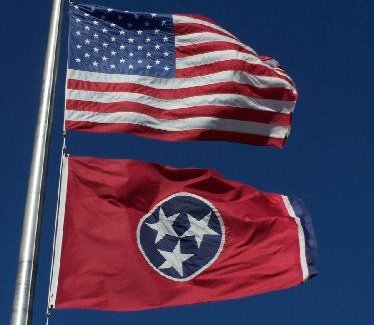
U.S. and Tennessee flags flying together on one staff. Photo by J. Stephen Conn

U.S. and Tennessee flags flying together on one staff. Photo by J. Stephen Conn

Kentucky's state flag, by Gage Skidmore

Kentucky’s state flag features a Native American and European colonist standing together, and the state motto, “United We Stand, Divided We Fall.” Photo by Gage Skidmore

Kentucky’s admission to the union pushed the U.S. flag to 15 stars and 15 stripes.   President George Washington signed the law that authorized the U.S. flag be expanded to 15 stripes in early 1794.  I’ve not pinned down the history of what happened next.  So far as I know there was no law expanding the flag to 16 stripes, and in 1818, Congress said the flag would be 13 stripes, with stars equal to the number of states (the law specified no specific pattern for the stars).

A 15-striped Star-spangled Banner that flew over Fort McHenry in Baltimore Harbor in 1814 and inspired Francis Scott Key to write the poem that is now the lyric to our national anthem.  President James Monroe signed the 13-stripe law four years later, in 1818.

What happened in between?  I suspect there are a lot of 15-stripe flags, but it wouldn’t surprise me to find a 16-stripe flag somewhere.  A variety of stars-and-stripes flags cropped up, which the 1818 law was intended to squelch.

Residents of the Bluegrass State and the Volunteer State should fly their flags today, in honor of their state’s having joined the union on June 1.

More:

https://twitter.com/gordonbelt/status/738001021708992512


http://twitter.com/hoyosplacido3/status/604008354571259904


Yes, this is mostly an encore post. Fighting ignorance requires patience.

Yes, this is mostly an encore post. Fighting ignorance requires patience. And repetition.


Memorial Day 2016 – Fly your flag today

May 30, 2016

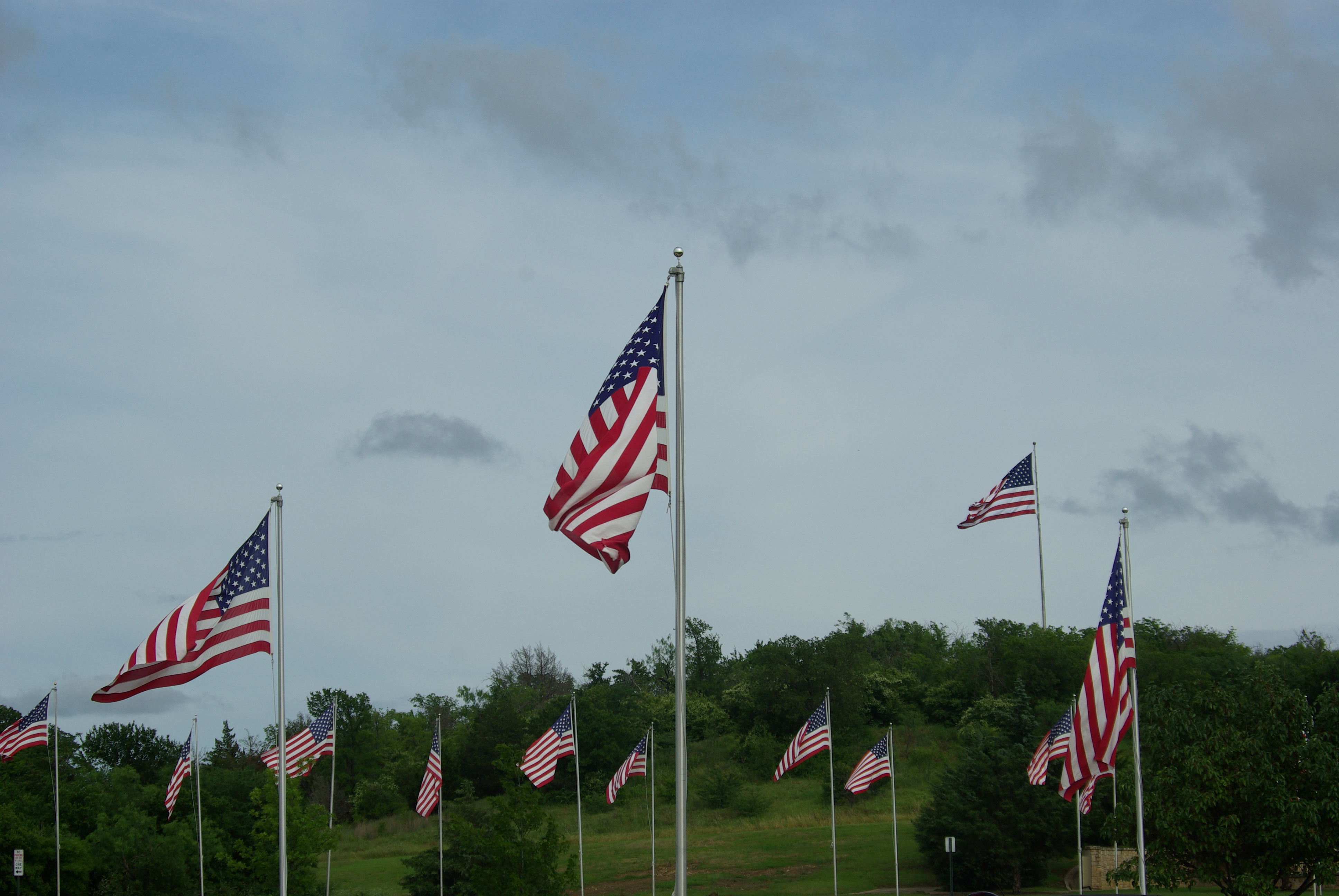
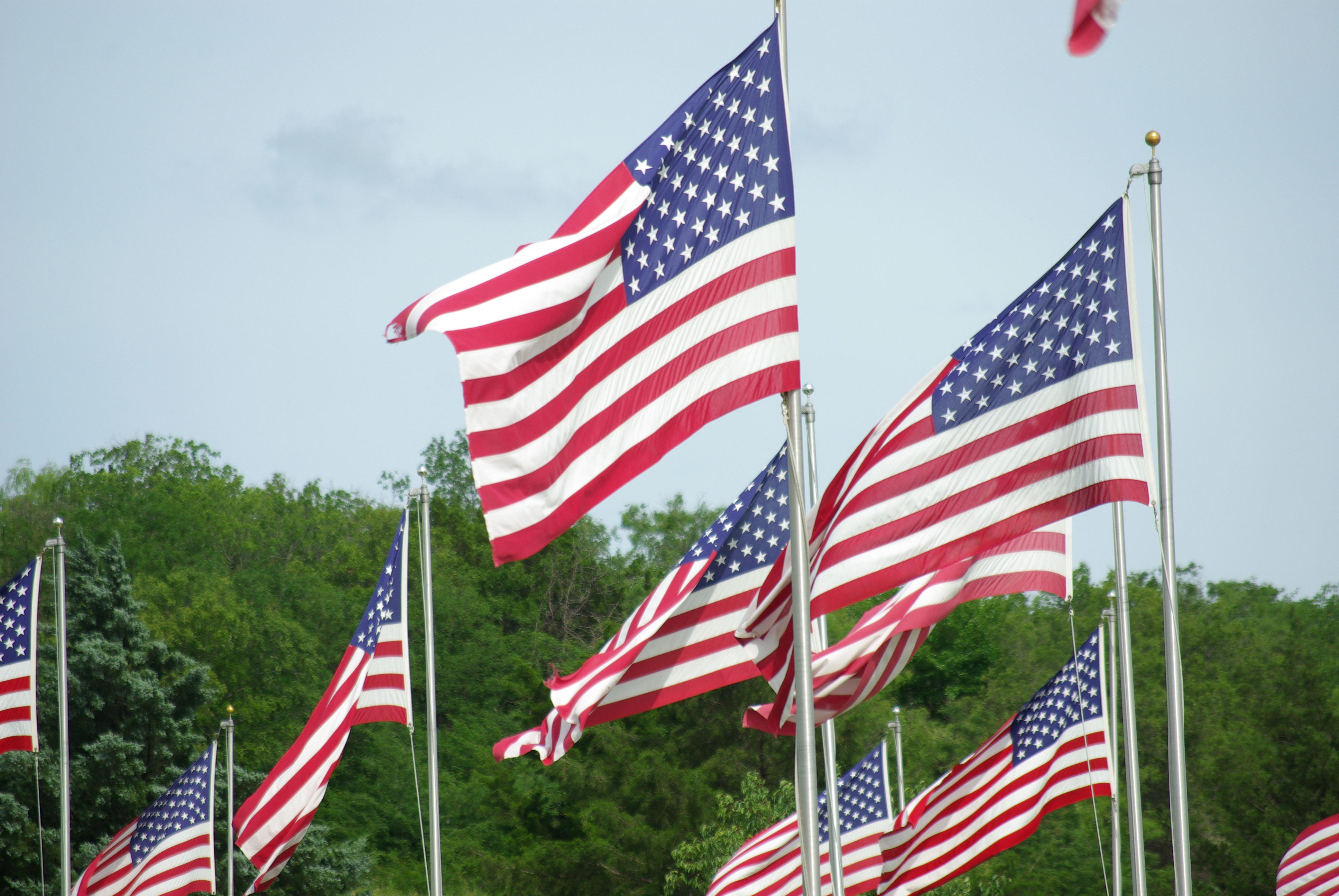
U.S. flags flying at the Dallas-Fort Worth National Cemetery, for Memorial Day 2015. Photo by Ed Darrell. Please use.

U.S. flags flying at the Dallas-Fort Worth National Cemetery, for Memorial Day 2015. Photo by Ed Darrell. Please use.

Fly your flag today for Memorial Day.

On Memorial Day, flags should be flown at half-staff until noon, then raised to full staff (and retired at sunset).

Just a reminder: When posting a flag to half-staff, it should be raised with gusto to full staff, then slowly lowered to the half-staff position.  On Memorial Day, when changing the flag’s position at noon, simply raise the flag briskly to full staff.  At retirement, the flag should be lowered in a stately fashion.

U.S. flags flying at the Dallas Fort Worth National Cemetery, for Memorial Day 2015. You may use this photo.

U.S. flags flying at the Dallas Fort Worth National Cemetery, for Memorial Day 2015. You may use this photo.


May 2016, flag-flying dates

May 4, 2016

Childe Hassam,

Childe Hassam, “Victory Day, May 1919,” 1919, oil on canvas, 36 x 21 3/4 inches (91.4 x 55.2 cm), American Academy of Arts and Letters, NY. There were at least twenty-three paintings in Hassam’s series of flag paintings. This Victory Day celebration no longer occurs, though there are several other May days to fly the colors.

May has three days designated for flying the U.S. flag out of the specific days mentioned in the U.S. Flag Code, three days designated in other federal laws,  and three statehood days, when residents of those states should fly their flags.

Interestingly, the three designated days all float, from year to year:

  • Mother’s Day, second Sunday in May (May 8, in 2016)
  • Armed Forces Day, third Saturday in May (May 21)
  • Memorial Day, the last Monday in May (May 30)

Residents of these states celebrate statehood; South Carolina and Wisconsin share May 23:

  • Minnesota, May 11 (1858, the 32nd state)
  • South Carolina, May 23 (1788, the 8th state)
  • Wisconsin, May 23 (1848, the 30th state)
  • Rhode Island, May 29 (1790, the last of the 13 original colonies to ratify the Constitution)

This year President Obama issued a proclamation calling on citizens to fly the flag on May 1, Law Day (I missed that one). It’s also Loyalty Day, which got a proclamation from President Obama calling for flag flying in 2016 (missed that one, too).

May 8 marks the 70th anniversary of Victory in Europe Day, the day the Axis Powers in Europe surrendered at the end of World War II.  Some years that day is marked by a proclamation calling for flag flying.  (You may fly your flag then even if Congress and the President do nothing.)

In recent years President Obama has proclaimed May 15 as Peace Officers Memorial Day, with flags to fly at half-staff. We might expect another such declaration in 2016.

May 22 is National Maritime Day, under a Joint Resolution from Congress from 1933. President Obama may be expected to proclaim that day as a day to fly the flag, too.

Gee, twelve events on fourteen days to fly the U.S. flag.  May could be quite busy for flag fliers.

  1. Law Day, May 1, AND
  2. Loyalty Day, May 1
  3. Victory in Europe Day, May 8, AND
  4. Mothers Day, May 8
  5. Minnesota Statehood, May 11
  6. Peace Officers Memorial Day, May 15 (half-staff flags; the law for Police Week calls for flags to be half-staff the entire week in which May 15 occurs, May 15-20 in 2016)
  7. Armed Forces Day, May 21
  8. National Maritime Day, May 22
  9. South Carolina Statehood, May 23, AND
  10. Wisconsin Statehood, May 23
  11. Memorial Day, May 30
  12. Rhode Island Statehood, May 29
Yes, this is mostly an encore post. Fighting ignorance requires patience.

Yes, this is mostly an encore post. Fighting ignorance requires patience, and repetition.

Save


Presidents’ Day 2016: Fly your flag today

February 15, 2016

It’s Presidents’ Day on most calendars, though the official U.S. holiday is “Washington’s Birthday.”

Presidents’ Day, or Washington’s Birthday, is celebrated on the third Monday in February. In 2016 this will overlap the period of mourning for Supreme Court Associate Justice Antonin Scalia.  President Barack Obama ordered flags to be flown half staff to honor Justice Scalia; if your flag pole allows, you should fly your flag at half staff, even on Washington’s Birthday.

You’re already flying your flag today, right?  Let’s recapitulate from last year.

Dr. Bumsted reminds us we need to emphasize that the federal holiday is Washington’s Birthday, not a day to honor presidents generically.  See the explanation from the U.S. National Archives.

Presidents Day is February 15, 2016 — fly your U.S. flag today.

National Park Service photo, Lincoln Memorial through flags at Washington Monument

The Lincoln Memorial, seen through flags posted at the Washington Monument, Washington, D.C.; National Park Service Photo via About.com

Oddly enough, some controversy arises from time to time over how to honor President Washington and President Lincoln, and other presidents.  Sometimes the controversy simmers over how to honor great Americans — if Lincoln deserves a day, why not FDR?  Why not Jefferson? — and sometimes the controversy covers more mundane ground — should the federal government give workers a day off?  Should it be on a Monday or Friday to create a three-day weekend to boost tourism?  About.com explains the history of the controversy:

Presidents’ Day is intended (for some) to honor all the American presidents, but most significantly George Washington and Abraham Lincoln. According to the Gregorian or “New Style” calendar that is most commonly used today, George Washington was born on February 22, 1732. But according to the Julian or “Old Style” calendar that was used in England until 1752, his birth date was February 11th. Back in the 1790s, Americans were split – some celebrated his birthday on February 11th and some on February 22nd.

When Abraham Lincoln became president and helped reshape our country, it was believed he, too, should have a special day of recognition. Tricky thing was that Lincoln’s birthday fell on February 12th. Prior to 1968, having two presidential birthdays so close together didn’t seem to bother anyone. February 22nd was observed as a federal public holiday to honor the birthday of George Washington and February 12th was observed as a public holiday to honor Abraham Lincoln’s birthday.

In 1968, things changed when the 90th Congress was determined to create a uniform system of federal Monday holidays. They voted to shift three existing holidays (including Washington’s Birthday) to Mondays. The law took effect in 1971, and as a result, Washington’s Birthday holiday was changed to the third Monday in February. But not all Americans were happy with the new law. There was some concern that Washington’s identity would be lost since the third Monday in February would never fall on his actual birthday. There was also an attempt to rename the public holiday “Presidents’ Day”, but the idea didn’t go anywhere since some believed not all presidents deserved a special recognition. [Take THAT you Franklin Pierce and Millard Fillmore fans!]

Even though Congress had created a uniform federal holiday law, there was not a uniform holiday title agreement among the individual states. Some states, like California, Idaho, Tennessee and Texas chose not to retain the federal holiday title and renamed their state holiday “President’s Day.” From that point forward, the term “Presidents’ Day” became a marketing phenomenon, as advertisers sought to capitalize on the opportunity for three-day or week-long sales.

In 1999, bills were introduced in both the U.S. House (HR-1363) and Senate (S-978) to specify that the legal public holiday once referred to as Washington’s Birthday be “officially” called by that name once again. Both bills died in committees.

Today, President’s Day is well accepted and celebrated. Some communities still observe the original holidays of Washington and Lincoln, and many parks actually stage reenactments and pageants in their honor. The National Park Service also features a number of historic sites and memorials to honor the lives of these two presidents, as well as other important leaders.

Fly your flag, read some history, enjoy the day.

More, Resources, and Related Articles:

English: Air Force One, the typical air transp...

President’s airplane, Air Force 1, flying over Mount Rushmore National Monument, in South Dakota – Image via Wikipedia; notice, contrary to Tea Party fears, the bust of Obama is not yet up on Rushmore (and also note there remains no room for another bust).

Yes, this is mostly an encore post.  This event occurs every year.


Flags at half-staff to honor Justice Antonin Scalia

February 15, 2016

U.S. Flag flew at half staff outside the Supreme Court on Sunday, February 14, 2016, in honor of Associate Justice Antonin Scalia, who died February 13.

U.S. Flag flew at half staff outside the Supreme Court on Sunday, February 14, 2016, in honor of Associate Justice Antonin Scalia, who died February 13. VOA image.

President Barack Obama ordered flags to be flown half-staff to honor Justice Antonin Scalia, who died February 13.  The half staff honor continues through the end of the day on which Justice Scalia is interred.

The order from the White House:

Presidential Proclamation: Death of Antonin Scalia

As a mark of respect for Antonin Scalia, Associate Justice of the United States, I hereby order, by the authority vested in me by the Constitution and laws of the United States of America, including section 7 of title 4, United States Code, that the flag of the United States shall be flown at half-staff at the White House and on all public buildings and grounds, at all military posts and naval stations, and on all naval vessels of the Federal Government in the District of Columbia and throughout the United States and its Territories and possessions until sunset, on the day of interment.  I also direct that the flag shall be flown at half-staff for the same period at all United States embassies, legations, consular offices, and other facilities abroad, including all military facilities and naval vessels and stations.

IN WITNESS WHEREOF, I have hereunto set my hand this thirteenth day of February, in the year of our Lord two thousand sixteen, and of the Independence of the United States of America the two hundred and fortieth.

BARACK OBAMA

# # #

The mourning period in which flags are to be flown half staff probably will include Presidents Day, February 15. Flags flown in honor of Presidents Day 2016 should be flown half staff. Where flags cannot be lowered, fly the flag as it is normally displayed.


February 6, Massachusetts Statehood Day

February 6, 2016

Flag etiquette guides and the U.S. Flag Code urge residents of Massachusetts to fly U.S. flags today, to honor Massachusetts’s joining the Union.

U.S. flag flies at Quincy Market in Boston (a 4th of July celebration is pictured) - WHDH Channel 7 image

U.S. flag flies at Quincy Market in Boston (a 4th of July celebration is pictured) – WHDH Channel 7 image

Massachusetts’s statehood is figured as the date the colony ratified the U.S. Constitution. A convention ratified the document on February 6, 1788. Massachusetts was the 6th colony to ratify.

The next flag-flying date is February 12, in honor of Lincoln’s birthday.


Fly your flag January 18, 2016, to honor Martin Luther King, Jr.

January 18, 2016

As on every federal holiday, citizens and residents of the U.S. should fly their U.S. flags today, on the holiday marking the birth of the Rev. Dr. Martin Luther King, Jr.

Rev. King, and the U.S. flag

Rev. King and the U.S. flag. (No information on place or time of photo; please feel free to lend light and facts.)

Fly the U.S. flag today for the holiday for the birthday of Martin Luther King, Jr.  The holiday is celebrated on the third Monday in January.

Many Americans will celebrate with a day of service.

More:

Yes, this is mostly an encore post. Fighting ignorance requires patience.

Yes, this is mostly an encore post for an annual event. Fighting ignorance requires patience.


Connecticut flies U.S. flags for statehood, January 9

January 9, 2016

Technically, states didn’t exist at all, yet.

But on January 9, 1788, Connecticut became the fifth of the 13 colonies to ratify the proposed Constitution for the United States of America, and by that action set the date we count as Connecticut’s entery into the union.

Within 12 months, four more colonies ratified the document, totaling nine ratifications required to put the Constitution into effect.  When the government of the new nation started functioning in 1789, Connecticut was counted as the fifth state.

Connecticut capitol building, Hartford

Capitol building for Connecticut in Hartford; this photo is from the rear of the building, so the U.S. flag is flying correctly on its own right. The building was completed in 1878. The dome is covered in gold. Image from Wikimedia Commons

To avoid political scheming by anti-federalist colony governors, especially Patrick Henry in Virginia, in September 1787 James Madison proposed that the draft constitution be ratified not by legislatures in the colonies, but instead by a specially-called convention of the people of the colony.  Connecticut’s convention met first on January 3, 1788. With six days of discussion and debate, the convention passed a resolution of ratification on January 9.

So by tradition, January 9 is Connecticut’s statehood anniversary.  According to U.S. law, the Flag Code and tradition, citizens and residents of a state fly their flags on statehood anniversaries.

Happy birthday Connecticut, 228 years old.

Next date to fly the U.S. flag is January 18, 2016, to honor the birth of the Rev. Dr. Martin Luther King, Jr. January 18 is the official holiday; January 19 is the actual birthday. You may fly your colors on both dates.

More:

Carol Highsmith photo of Connecticut's Hall of Flags

Hall of Flags in the Connecticut State Capitol Building; photo by the great photo-historian Carol Highsmith, from the Library of Congress collection; the statue is Connecticut’s Civil War Governor, William A. Buckingham (1804-1875), honored for his personal contributions to the equipping of Connecticut’s men fighting in the Civil War;.


Utah at 120: Fly colors for Utah statehood, January 4, 1896

January 4, 2016

Utah Capitol, with flags

South entrance (main) to the Utah State Capitol, with U.S. and Utah flags flying on the single flag poll, and the snow-dusted Wasatch Mountains in the background. Utah State Law Library photo.

Utah joined the Union on January 4, 1896.  It had been a 49-year slog to statehood for Deseret, the Mormon settlement in the Desert.  The size had been pared down, so it would not be the biggest state, incorporating parts of what is now Nevada, Arizona, Oregon, Idaho, Colorado and New Mexico.  New capitals had been tried and cast aside (Fillmore, Utah).  Democratic Party rule was broken when LDS church authorities went door-to-door, calling every other family to the Republican Party, and party parity.  The Mormon Church abandoned polygamy, and adopted a state constitution that gave the vote to women.

Finally, Utah became the 45th state.

You may fly your U.S. flag today for Utah statehood, especially if you’re in Utah.

Happy birthday, Utah!  120 years old today.

Next federal flag-flying date: January 6, in honor of New Mexico’s statehood.

More:

U.S. flag in Capitol Reef NP

U.S. flag flying at Capitol Reef National Park, in Utah. Photo by longyang0369, via Flickr

Much of this material appeared here before; this is an annual event, after all.


Georgians fly flags on January 2, celebrating statehood

January 2, 2016

Or not.

I haven’t found any commemoration in Georgia of Georgia Statehood Day.

Which rather moots Luther McKinnon’s question about which Georgia flag to fly on the date. (Head over there anyway, just to see the photos.)

In any case, January 2 is Georgia Statehood day. U.S. law urges residents of states to fly the U.S. flag on the anniversary of statehood.  Georgia was the fourth state to ratify the U.S. Constitution, in a unanimous vote in a convention called solely to consider the document, on January 2, 1788.  Georgia is considered the fourth state.

U.S. and Georgia flags fly at the Georgia Capitol. (Flags pictured flew half-staff on December 8, 2012.)

U.S. and Georgia flags fly at the Georgia Capitol. (Flags pictured flew half-staff on December 8, 2012.)

While patriots urge flying the flag often, and “with gusto,” one should be careful to avoid errors in etiquette, or other oopsies, like this one in April 2014:

Via Buzzfeed: Braves Spokesperson Beth Marshall told 11Alive News it happened because of new pyrotechnics. For the first time, they put pyrotechnics on Braves Vision (that’s the large HD screen). One of the pyrotechnics flew at the flag and lit it on fire. Marshall said the material of the flag is flame retardant, so it went out on its own.

Via Buzzfeed: Braves Spokesperson Beth Marshall told 11Alive News it happened because of new pyrotechnics. For the first time, they put pyrotechnics on Braves Vision (that’s the large HD screen). One of the pyrotechnics flew at the flag and lit it on fire. Marshall said the material of the flag is flame retardant, so it went out on its own.

Happy birthday, Georgia!  Fly your flags today.


Will you fly your U.S. flags in January 2016?

January 2, 2016

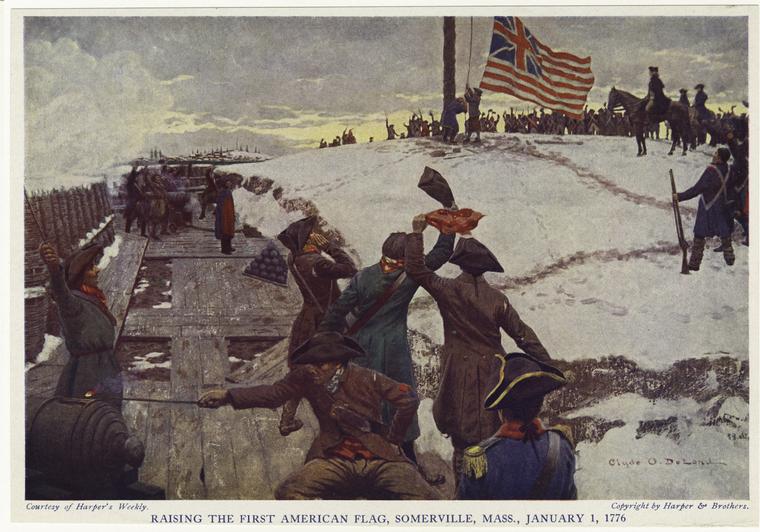
“Raising the first American flag, Somerville, Mass., January 1, 1776.” Harper’s Weekly painting by Clyde Osmer DeLand, 1897. From the digital collections of the New York Public Library

January is loaded with flag flying dates, when we add in statehood days, dates those states are invited to fly their U.S. flags.

In January 2016, the U.S. Flag Code urges citizens to fly flags on these dates, listed chronologically:

  • New Year’s Day, January 1, a federal holiday
  • January 2, Georgia Statehood Day
  • January 3, Alaska Statehood Day
  • January 4, Utah Statehood Day
  • January 6, New Mexico Statehood Day
  • January 9, Connecticut Statehood Day
  • Martin Luther King’s Birthday, a federal holiday on the third Monday of January; that date is January 18, in 2016; King’s actual birthday is January 15, and you may fly your flag then, too
  • Inauguration Day, January 20, the year after election years (next one in 2017)
  • January 26, Michigan Statehood Day
  • January 29, Kansas Statehood Day

You may fly your flag any other day you wish, too; flags should not be flown after sundown unless they are specially lighted, or at one of the few places designated by Congress or Presidential Proclamation for 24-hour flag flying.  According to Wikipedia’s listing, those sites include:

  • Fort McHenry, Baltimore, Maryland (Presidential Proclamation No. 2795, July 2, 1948).
  • Flag House Square, Albemarle and Pratt Streets, Baltimore, Maryland (Public Law 83-319, approved March 26, 1954).
  • Marine Corps War Memorial (Iwo Jima Memorial), Arlington, Virginia (Presidential Proclamation No. 3418, June 12, 1961).
  • Lexington Battle Green, Lexington, Massachusetts (Public Law 89-335, approved November 8, 1965).
  • White House, Washington, D.C. (Presidential Proclamation No. 4000, September 4, 1970).
  • Washington Monument, Washington, D.C. (Presidential Proclamation No. 4064, July 6, 1971, effective July 4, 1971).
  • Any port of entry to the United States which is continuously open (Presidential Proclamation No. 413 1, May 5, 1972).
  • Grounds of the National Memorial Arch in Valley Forge State Park, Valley Forge, Pennsylvania (Public Law 94-53, approved July 4, 1975).
Flag House in 1936, 844 East Pratt & Albemarle Streets (Baltimore, Independent City, Maryland) (cropped). Image courtesy of the federal HABS—Historic American Buildings Survey of Maryland.

Flag House in 1936, where Mary Pickersgill sewed the garrison-sized, 15-star flag that flew over Fort McHenry at the Battle of Baltimore in 1814; one of the sites where the U.S. flag may be flown 24 hours. The house is at 844 East Pratt & Albemarle Streets (Baltimore, Independent City, Maryland). Cropped image courtesy of the federal HABS—Historic American Buildings Survey of Maryland.


Happy birthday as a state, Texas! – 170 years old

December 29, 2015

It’s Texas Statehood day, the 170th anniversary of Texas joining the Union — or as some Texans prefer, the anniversary of Texas’s making America great.

According to the U.S. flag code, people should fly their U.S. flags on their state’s statehood day.

Not many Texans are, if any. Can you find someone honoring statehood day?

texas our texas

U.S. and Texas flags at the Texas Capitol – photo: jmtimages

170 years ago today: Rub your pet armadillo’s belly, slaughter the fatted longhorn, crank up the barbecue pit with the mesquite wood, put Willie Nelson and Bob Wills on the mp3 player, put the “Giant” DVD on the television, and raise your glass of Big Red, Dr. Pepper, or Lone Star Beer (or Pearl, or Shiner Bock, Sir Williams English Brown Ale, or Llano Wine).

U.S. Flag Code rules urge flying the U.S. flag on the anniversary of a state’s joining the Union — even as much as that will frost the tiny band of desperate Texas secessionists.  (Will the secessionists fly the Texas flag at half-staff?)

Texas was admitted to the union of the United States of America on December 29, 1845.

President Polk's authorization to affix Great Seal of the U.S. to Texas Statehood documents

President Polk’s Authorization to affix the Great Seal to Texas Statehood documents – Texas Memorial Museum, University of Texas at Austin

The text of Polk’s message:

I hereby authorize and direct the Secretary of State to affix the Seal of the United States to an authenticated copy of “an act to extend the laws of the United States over the State of Texas and for other purposes” approved Dec. 29, 1845 dated this day, and signed by me and for so doing this shall be his warrant.

James K. Polk
Washington, Dec. 29, 1845

Seal of the U.S. affixed to Texas Statehood Proclamation

Great Seal of the United States of America, affixed to the Texas Statehood Proclamation – image from State Archives Division, Texas State Library

Resources:

More:

The Texas Ranger Museum took note of the day (no, not the baseball Rangers):

Yes, this is mostly an encore post. Fighting ignorance requires patience.

Yes, this is mostly an encore post. It is an annual event, after all. And, fighting ignorance requires patience and persistence.


December 7, 2015: Fly your flags for Pearl Harbor Remembrance, for Delaware statehood — and at half staff

December 7, 2015

Flag flies at half-staff over the USS Utah, in Pearl Harbor (2004 photo – Pearl Harbor, Hawaii (May 31, 2004) – Sailors assigned to ships based at Pearl Harbor bring the flag to half-mast over the USS Utah Memorial on Ford Island in honor of Memorial Day May 31, 2004. U.S. Navy photo)

Flag flies at half-staff over the USS Utah, in Pearl Harbor (2004 photo – Pearl Harbor, Hawaii (May 31, 2004) – Sailors assigned to ships based at Pearl Harbor bring the flag to half-mast over the USS Utah Memorial on Ford Island in honor of Memorial Day May 31, 2004. U.S. Navy photo)

December 7 is a two-fer flag-flying day.

By public law, December 7 is Pearl Harbor Remembrance Day, and Americans fly the U.S. flag in memory of those who lost their lives at Pearl Harbor on December 7, 1941. U.S. flags should be flown at half-staff.

Under the U.S. Flag Code, residents of the relevant state should fly their U.S. flag on the date the state joined the union.

And in 2015, flags at all public buildings fly half-staff through December 7 in respect to the victims of the shootings at San Bernardino, California, on December 2. If you can fly your flag at half-staff, you should; if you cannot, fly the flag anyway.

In 1787 Delaware quickly and promptly elected delegates to the former colony’s convention to ratify the Constitution proposed at the Philadelphia convention just over three months earlier. The ratification of the Constitution won opposition from strong factions in almost every state. Pols anticipated tough fights in New York, Virginia, and other states with large populations. They also expected other states would wait to see what the bigger states did.

Delaware didn’t wait.  On December 7 Delaware became the first of the former British colonies to ratify the Constitution. Perhaps by doing so, it guaranteed other states would act more favorably on ratification.

Because Delaware was first, it is traditionally granted first position in certain ceremonies, such as the parades honoring newly-inaugurated presidents. Delaware’s nickname is “The First State.”

In Delaware and the rest of the nation, fly your flags on December 7, 2015.

The most famous portrayal of a U.S. flag flying in Delaware is in the painting by Emanuel Leutze (American, 1816–1868).

The most famous portrayal of a U.S. flag flying in Delaware is in the painting by Emanuel Leutze (American, 1816–1868). “Washington Crossing the Delaware,” 1851. The Metropolitan Museum of Art, New York, Gift of John Stewart Kennedy, 1897 (97.34) Among other problems with this portrayal: The flag depicted had not been designated on the date of the crossing, Christmas 1776.


December 2015, flag-flying days

November 28, 2015

Mural of Alexander Henson planting the American flag at North Pole, by Austin Mecklem, at the Recorder of Deeds building, built in 1943. 515 D St., NW, Washington, D.C. Library of Congress image

Mural of Alexander Henson planting the American flag at North Pole, by Austin Mecklem, at the Recorder of Deeds building, built in 1943. 515 D St., NW, Washington, D.C. Library of Congress image. Santa Claus may have been out of town when Henson was there.

November offers several flag flying days, especially in years when there is an election.

But December may be the month with the most flag-flying dates, when we include statehood days.

December 7 is Pearl Harbor Remembrance Day.  It’s not in the Flag Code, but public law (P.L. 103-308) urges that the president should issue a proclamation asking Americans to fly flags.

December 25 is Christmas Day, a federal holiday, and one of the score of dates designated in the Flag Code. If you watch your neighborhood closely, you’ll note even some of the most ardent flag wavers miss posting the colors on this day, as they do on Thanksgiving and New Years.

Other dates?

Nine states attained statehood in December, so people in those states should fly their flags (and you may join them).  Included in this group is Delaware, traditionally the “First State,” as it was the first colony to ratify the U.S. Constitution:

  • Illinois, December 3 (1818, 21st state)
  • Delaware, December 7 (1787, 1st state)
  • Mississippi, December 10 (1817, 20th state)
  • Indiana, December 11 (1816, 19th state)
  • Pennsylvania, December 12 (1787, 2nd state)
  • Alabama, December 14 (1819, 22nd state)
  • New Jersey, December 18 (1787, 3rd state)
  • Iowa, December 28 (1846, 29th state)
  • Texas, December 29 (1845, 28th state)

December 15 is Bill of Rights Day, marking the day in 1791 when the Bill of Rights was declared ratified; but though this event generally gets a presidential proclamation, there is no law or executive action that requires flags to fly on that date, for that occasion.

Eleven flag-flying dates in December.  Does any other month have as many flag flying opportunities?

Have I missed any December flag-flying dates?  11 events on 10 days (Delaware’s statehood falls on the anniversary of the Pearl Harbor attack).

Here’s a list of the days to fly the flag, under national law, in chronological order:

  1. Illinois, December 3 (1818, 21st state)
  2. Pearl Harbor Remembrance Day, December 7
  3. Delaware, December 7 (1787, 1st state) (shared with Pearl Harbor Remembrance Day)
  4. Mississippi, December 10 (1817, 20th state)
  5. Indiana, December 11 (1816, 19th state)
  6. Pennsylvania, December 12 (1787, 2nd state)
  7. Alabama, December 14 (1819, 22nd state)
  8. New Jersey, December 18 (1787, 3rd state)
  9. Christmas Day, December 25
  10. Iowa, December 28 (1846, 29th state)
  11. Texas, December 29 (1845, 28th state)

Fly your flag with respect to the flag, for the republic it represents, and for all those who sacrificed that it may wave on your residence.

Appropriate to a snowy December.

Appropriate to a snowy December. “The Barn on Grayson-New Hope Road. This barn with its old truck and ever-present American flag, is often the subject of photographs and paintings by the locals.” Photo and copyright by Melinda Anderson