SLC Mayor Rocky Anderson rebuts Bush

September 1, 2006

One of the more interesting rebuttals to the remarks of President Bush and Defense Secretary Rumsfeld was made by Salt Lake City Mayor Rocky Anderson.  It may be an internet flash-in-the-pan, but you should read it, here.  And read about it here.

Tip o’ the old scrub brush to Dr. David Raskin and Marga Raskin.


History repeating: Chamberlain, or Churchill?

August 31, 2006

Santayana’s warning to the ill-educated rests, sometimes uneasily, at the opening of this blog — a warning to get history, and get history right.

Presidents in sticky situations have occasionally suggested their domestic critics were less than patriotic.  Some claim the current administration has made this a standard claim against almost all criticism of foreign policy.  In speeches to the American Legion meeting in Salt Lake City, Utah, both Secretary of Defense Donald Rumsfeld and President George Bush criticized their critics.  (Here’s the transcript of Rumsfeld’s remarks, from Stars & Stripes; here is the transcript of Bush’s remarks from Salt Lake City’s Deseret News.)

Here are Rumsfeld’s words that sent so many to their history books; Rumsfeld said:

It was a time when a certain amount of cynicism and moral confusion set in among Western democracies. When those who warned about a coming crisis, the rise of fascism and nazism, they were ridiculed or ignored. Indeed, in the decades before World War II, a great many argued that the fascist threat was exaggerated or that it was someone else’s problem. Some nations tried to negotiate a separate peace, even as the enemy made its deadly ambitions crystal clear. It was, as Winston Churchill observed, a bit like feeding a crocodile, hoping it would eat you last.

There was a strange innocence about the world. Someone recently recalled one U.S. senator’s reaction in September of 1939 upon hearing that Hitler had invaded Poland to start World War II. He exclaimed:

“Lord, if only I had talked to Hitler, all of this might have been avoided!”

I recount that history because once again we face similar challenges in efforts to confront the rising threat of a new type of fascism. Today — another enemy, a different kind of enemy — has made clear its intentions with attacks in places like New York and Washington, D.C., Bali, London, Madrid, Moscow and so many other places. But some seem not to have learned history’s lessons.

(Someone has already wondered whether Rumsfeld got the quote right, and to what senator it might be blamed; Idaho’s Sen. William Borah is the likely candidate, according to The American Prospect.)

Rumsfeld’s example should get your blood heated up, if not boiling.  Problem is, according to Keith Olberman, part of the example should cut against Rumsfeld:  It was Neville Chamberlain’s government who criticized Winston Churchill as being in error.  Had the government only listened to the dissenters, many lives might have been saved, the war shortened, etc., etc.  Olberman’s opinion is worth reading through to the end, and it’s available at Crooks and Liars.

Sometimes it’s necessary to know more than the history; it’s necessary to know literature, too.  “Oh, what a tangled web we weave, when first we practice to deceive!” wrote Sir Walter Scott.

Tip o’ the old scrub brush to Pharyngula.


Madison on education

August 3, 2006

August 4 is the 184th anniversary of Madison’s letter to William T. Barry, with a discussion of the value of education to a free, democratic republic. Parts of the letter are among the most popular of Madison quotations.

A popular Government, without popular information, or the means of acquiring it, is but a Prologue to a Farce or a Tragedy; or, perhaps both. Knowledge will forever govern ignorance: And a people who mean to be their own Governors, must arm themselves with the power which knowledge gives.

James Madison, letter to William T. Barry, August 4, 1822

Madison Building inscription

Photo of inscription to the left (north) of the main entrance on Independence Ave., of the James Madison Building, Library of Congress, Washington, D.C.

Read the rest of this entry »


History is bunk – oops!

August 1, 2006

In a blog post which I assume was designed to provoke comment, The theory of “Intelligent Design” is neither intelligent nor a design,” The Opinionator at CapeCodToday takes on Florida’s new law dictating that only the “facts” of history be taught — I noted the law earlier, here. It’s an entertaining post.

He closes his post:

Some law makers are saying that their history is the best history. They fail to understand that history, like the law, changes and evolves over the decades. If they loved history more, they would understand this. Perhaps they don’t love or even understand history. Perhaps they agree with the American cultural giant Henry Ford, whose 143rd birthday we celebrate today. He once said, “History is bunk.”

Oops. Ford said something like that, but not quite that. According to Bartlett’s Familiar Quotations Sixteenth Edition, Ford gave an interview to Charles N. Wheeler, published in the Chicago Tribune on May 25, 1916. In that interview, Ford said, “History is more or less bunk.”

Nit-picky, yes. Let’s strive for accuracy.


Jefferson on religious freedom

August 1, 2006

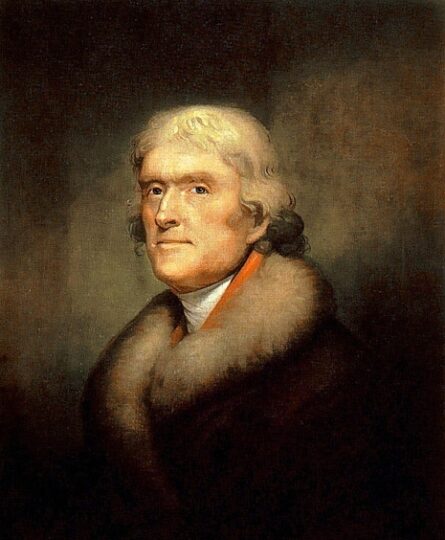
Thomas Jefferson *

In his Autobiography Jefferson recounted the 1786 passage of the law he proposed in 1779 to secure religious freedom in Virginia, the Statute for Religious Freedom:

The bill for establishing religious freedom, the principles of which had, to a certain degree, been enacted before, I had drawn in all the latitude of reason and right. It still met with opposition; but, with some mutilations in the preamble, it was finally passed; and a singular proposition proved that its protection of opinion was meant to be universal. Where the preamble declares, that coercion is a departure from the plan of the holy author of our religion, an amendment was proposed, by inserting the word “Jesus Christ,” so that it should read, “a departure from the plan of Jesus Christ, the holy author of our religion;” the insertion was rejected by a great majority, in proof that they meant to comprehend, within the mantle of its protection, the Jew and the Gentile, the Christian and the Mahometan, the Hindoo, and the Infidel of every denomination.

Life and Selected Writings of Thomas Jefferson, Modern Library 1993 edition, pp. 45 and 46.

* Image is a photo of detail from a painting of Jefferson by Rembrandt Peale, courtesy of the New York Historical Society by way of the Library of Congress.


History of Resisting Technology

July 6, 2006

techdirt has this wonderful short compilation of bad predictions about new technologies ruining entertainment industries — print the page and put it in your copy of Christopher Cerf’s and Victor Navasky’s The Experts Speak.

I attended a presentation of education guru Harry Wong two weeks ago. He had probably a dozen slides featuring quotations from the experts from this book and other sources, and each comment was met with “oohs” and “ahhs.” My first use of these wrongway predictions was in 1988 and 1989 in the “Committing to Leadership” program at AMR (American Airlines). It’s amazing to me that they still seem new to so many — but they are funny, and thought provoking, even if they are not new.