Original Documents: Long history of DDT trouble, from U.S. Fish and Wildlife Service, 1945 and later

August 12, 2007

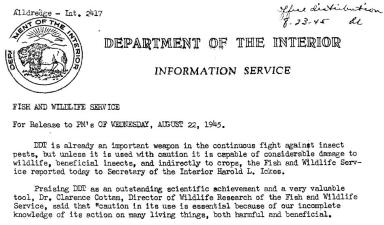
Header of FWS press release, Aug 22 1945

Archives of the U.S. Fish and Wildlife Service (FWS) reveal a long history of trouble with DDT, almost from the first uses of the chemical as an insecticide during World War II. You’ll find extensive links to historic press releases from FWS below the fold.

Critics of the various restrictions on DDT use often claim that DDT is a God-sent chemical that nearly eradicated malaria from the world (absolutely untrue) and which was banned only because of hysteria caused by Rachel Carson’s 1962 book, Silent Spring (untrue at both ends, hysteria and the power of Carson’s book). This is history revisionism at its worst, it is bogus history.

A careful study of the history of the use of DDT shows that scientists were concerned about its dangers from the first uses as a pesticide. The U.S. Fish and Wildlife Service reported dangers in a press release on August 22, 1945, just a week after the surrender of Japan ended World War II (VJ Day was August 15 in Tokyo, August 14 in Washington). In that release FWS noted the beneficial uses of DDT to fight insect and lice infestations that threatened troops and civilians with typhus and other diseases, but cautioned that such use should not become common, that more study was needed: Read the rest of this entry »


Hiroshima: August 6, 1945

August 6, 2007

Today, August 6, 2007, is the 62nd anniversary of the first use of atomic weapons in war, when the United States dropped an atomic bomb on Hiroshima, Japan. August 9 marks the anniversary of the bombing of Nagasaki.

Please see my post of last year — the links all still work, and they provide significant resources for teachers and students to understand the events.

Performance of Texas students on questions about the end of the war in the Pacific, in the TAKS exit exams in 2007 showed minor improvements.

Other sources teachers may want to use:


WSJ on oral histories: A hoax in the family line

August 6, 2007

Jay Gould told everybody he knew about his work recording the memories from the working people of Manhattan, real history. In 1942 he told The New Yorker of his work, and the phrase “oral history” leapt out of the story.

It was a great idea. But Gould made up everything about his work. At his death, friends discovered he left no oral histories behind.

It’s still a good idea, though, and it makes for good student project. Barry Weiss wrote a quick history of oral history for the Wall Street Journal last week. You can pull it off of JSTOR and use it as an introduction to the projects you assign to students.

You’ve never heard of him, but Robert Rush may be a modern-day Herodotus. Mr. Rush, who jokes that “he got his B.A. from the back of a Humvee,” is an oral historian with the U.S. Army. A retired command sergeant major who spent 30 years on active duty before getting his doctorate in history, Mr. Rush believes that recorded testimonies “can flesh out details that aren’t present in the paper histories.” In 2006, he was stationed in Iraq, where he spent seven months interviewing everyone from “engineers to bricklayers to military officers,” all with his handheld Olympus.

A century ago, historians might have laughed at Mr. Rush’s desire to spend time talking to construction workers. Today, the populist impulse is everywhere in the study of history.

Veteran interviews need to be done quickly for any veterans left from World War I, and for the few remaining veterans from World War II and Korea. There is a crying need for interviews of the women who performed the “Rosie the Riveter” work building airplanes, tanks, bombs, and other manufactured items, especially interviews of those women who worked in heavy industries and then went home to raise families when the men returned from foreign fronts. Rush got the soldiers while they were in Iraq — many of them are home now, and provide a source of oral history.

Veterans of Gulf War I, and Vietnam, have stories that need to be told and recorded. There is much to be done.

These stories would be perfect for podcasts, by the way.

Today, digital technology has allowed for every fisherman and every member of Parliament to immortalize their stories. With folks from all walks of life now making autobiographical podcasts, historians in the future will be presented with the issue of how to separate the wheat from the chaff.

Storycorps, an ambitious national oral- history project whose results can occasionally be heard on NPR, does some of this sorting, providing a more structured opportunity for such recordings than YouTube. In soundbooths across the country, Americans can come in and record their stories for 40 minutes, which then get archived in the Library of Congress. David Isay, the founder of Storycorps, describes the act of listening to the voice as “an adrenaline shot to the heart.” The physical experience of hearing another’s words can bring an understanding that reading those words on a page simply cannot.

If you go to the Library of Congress Web site you can listen to Lloyd Brown, the last U.S. Navy veteran of World War I, who died earlier this year. On the 71-minute recording, which he made at age 103, Mr. Brown offers a confession for posterity. “I lied about my age; I told them I was 18,” he recalls in a Southern drawl. At 16, he couldn’t wait two years to join the Navy. “It was a matter of patriotism.” So says the voice from history.

Weiss’s story, in the on-line version, briefly linked to this blog last week, bringing in at least two readers. Alas for the blog, but good for readers, the links at the bottom of the page change. Follow what’s there, see what you find.


Cool tool: Tag clouds of presidents’ thoughts

August 5, 2007

Only Crook pointed this out in a comment — and it’s neat enough to raise to a headline:

 . . . have you seen the U.S. Presidential Speeches Tag Cloud http://chir.ag/phernalia/preztags/ I happened upon a speech by Millard Fillmore, so naturally I thought of this blog. I can’t link you directly to the speech I looked at, which was his 1850 State of the Union Address, (you have to use the slider to get there) but these were the most common words in that speech according to the tag cloud:

appropriations california constitution negotiation pacific ports revenue territory treasury treaty war

Go try it out.   It’s a very interesting tool for the visual portrayal of information — visual portrayals that I don’t know how to copy for display here.

For example, notice the arrival of the word “California” in presidential speeches, circa 1848.  Note how the word grows over the next few years, but then disappears just prior to the Civil War — what might that suggest to students about events in California, compared to events in the rest of the U.S.?  Or, track the word “Constitution” from the earliest speeches/writings listed to the latest.  Or track the use of the word “Iraq” in President Bush’s speeches, between 2000 and 2007.

The tool is ahead of its time, a fun device now.  The key question is, how should we be using such information?

Chirag Mehta created the program. Browsing his site will give teachers good ideas about what can be done by a decent programmer.  Does any school have a programmer to make such things for the classroom?  And we’re supposed to be using technology?  (Mehta’s stuff may be as good as it looks — see this article about the tag cloud device, in the Wall Street Journal, no less.)


Leo Rosten on Adam Smith

July 29, 2007

Leo Rosten writes clearly, concisely, and often with great humor. Consequently, his essays make good fodder for classroom use.

British bank note featuring Adam Smith

Rosten is probably most famous for the introduction he once gave to the comedian W. C. Fields, a spur-of-the-moment bon mots that so exactly described Fields comedian persona that it is often listed as a line Fields himself wrote: “Any man who hates dogs and children can’t be all bad.”

That story also tells us that Rosten looks at Adam Smith coolly, through no rose-colored glass.

The Adam Smith Institute carries Rosten’s essay on Smith in its entirety. Go read it:

It is a clumsy, sprawling, elephantine book. The facts are suffocating, the digressions interminable, the pace as maddening as the title is uninviting: An Inquiry into the Nature and Causes of the Wealth of Nations. But it is one of the towering achievements of the human mind: a masterwork of observation and analysis, of ingenious correlations, inspired theorizings, and the most persistent and powerful cerebration. Delightful ironies break through its stodgy surface:

“The late resolution of the Quakers [to free] their Negro slaves may satisfy us that their number cannot be very great …”

“The chief enjoyment of riches consists in the parade of riches.”

“To found a great empire for the sole purpose of raising customers [is] unfit for a nation of shopkeepers, but extremely fit for a nation whose government is influenced by shopkeepers.”

So comprehensive is its range, so perceptive its probings, that it can dance, within one conceptual scheme, from the diamond mines of Golconda to the price of Chinese silver in Peru; from the fisheries of Holland to the plight of Irish prostitutes in London. It links a thousand apparently unrelated oddities into unexpected chains of consequence. And the brilliance of its intelligence “lights up the mosaic of detail,” says Schumpeter, “heating the facts until they glow.” Sometimes.

Adam Smith published The Wealth of Nations in 1776 – not as a textbook, but as a polemical cannon aimed at governments that were subsidizing and protecting their merchants, their farmers, their manufacturers, against “unfair” competition, at home or from imports. Smith set out to demolish the mercantilist theory from which those politics flowed. He challenged the powerful interests who were profiting from unfree markets, collusive prices, tariffs and subsidies, and obsolete ways of producing things.

[More at the site of the Adam Smith Institute, including the continuation of this essay.]

Leo Rosten, publicity shot

Leo Rosten


Constitutional limitations on regal fantasies of presidents

July 24, 2007

Some people still defend the Madisonian view of the Constitution and its limits on the powers of the president (Adam Cohen in the New York Times):

The Constitution cannot enforce itself. It is, as the constitutional scholar Edwin Corwin famously observed, an “invitation to struggle” among the branches, but the founders wisely bequeathed to Congress some powerful tools for engaging in the struggle. It is no surprise that the current debate over a deeply unpopular war is arising in the context of a Congressional spending bill. That is precisely what the founders intended.

Members of Congress should not be intimidated into thinking that they are overstepping their constitutional bounds. If the founders were looking on now, it is not Harry Reid and Nancy Pelosi who would strike them as out of line, but George W. Bush, who would seem less like a president than a king.


Even more on Odessa Bible class case

July 20, 2007

Oh, and, there’s more.

Also see Ed Brayton’s posts here:

Here’s the press release from the Liberty Legal Institute:

The ACLU put their initial complaint on-line, and may follow with more documents as the case progresses:

The Texas Freedom Network has sponsored high-level criticism of Bible study class curricula; their critiques forced changes in the curriculum used in Odessa, but the modified curriculum does not pass Constitutional, academic or Bible study muster, according to a careful report from Southern Methodist University (in Dallas) Bible study professor Mark Chancey. TFN has several reports and press releases on the general issue:

And from the local newspaper, the daily Odessa American:


Odessa Bible class case

July 20, 2007

In the continuing religious freedom/education drama in Texas, the school district in Odessa, Texas, approved a Bible study course using a curriculum indicted by the Texas Freedom Network’s expert-in-Bible-studies advisors as religious indoctrination rather than academically rigorous study. Citizens in Odessa sued the district to have that action declared unconstitutional.

The case is being readied for trial, with motions from plaintiffs and defendants flying back and forth. I should be watching it carefully, and I probably should be offering close coverage here for teachers, parents and administrators in Texas.

But I haven’t been able to dig into the stuff yet. In the interim, Ed Brayton at Dispatches from the Culture Wars has been following the case closely, and providing timely blog updates. He’s made connections with the legal teams on both sides and has access to the legal documents filed so far.

Don’t wait: Get on over to Dispatches from the Culture Wars and get updated on the case.

This would be a good topic for a civics class project, too, it seems to me. You may want to capture documents as they come out for DBQ exercises in the coming school year.


Lewis & Clark: Enrichment sources for teachers and students

July 17, 2007

David Horsey of Seattle P-I, on the Lewis and Clark expedition

David Horsey is an editorial writer and cartoonist for the Seattle Post-Intelligencer — he won the Pulitzer Prize for editorial cartoons.  In 2005, the 200th anniversary of the Lewis and Clark Expedition, he retraced the path of the explorers from the Continental Divide to the Pacific.  Horsey photographed his journey, wrote about it, and made drawings.

This is a rich resource for anyone studying the opening of the West, and especially the Lewis and Clark Expedition, exploring the territory included in 1803’s Louisiana Purchase. Let’s hope the Seattle Post-Intelligencer keeps the site available for teachers and students.

Illustration by David Horsey, Seattle Post-Intelligencer.


The story is the thing; tell the story in history

July 15, 2007

Son James and I spent July 4 in Taos, New Mexico, where we were working with Habitat for Humanity building homes (a project of the youth group at the church we attend, First Christian Church (Disciples of Christ) of Duncanville, Texas). We took that day off, saw Transformers, looked at the sights in Taos, and drove to Eagle Nest Lake to see fireworks.

Lincoln reading to son, Tad; LOC photo

At some point through the week I was discussing with others the stories that make history memorable, in my view, and we discovered that few others on the trip knew the story of the deaths of both John Adams and Thomas Jefferson on July 4, 1826, the 50th anniversary of the signing of the Declaration of Independence. It’s a story that is generally glossed over in U.S. history texts, but one that I make room for in U.S. history courses. My experience is that once kids get the story, that these two great men from such radically different backgrounds became great friends, then in presidential politics, great enemies, and then were reconciled, and then died on the exactly the same day which commemorated the event that both made them famous and that they made famous, kids don’t forget the story.

The story of their friendship is powerful and can be accompanied by readings from their letters in their later life (DBQ opportunity, teachers!). Generally, the story gets told in response to a question from a student. If I do it well, there will be sniffles from the class when we get to the part about Jefferson’s near-coma, awakening to ask whether it is the 4th of July, and then dying, and Adams’ death a few hours later, saying in error that “Jefferson still survives” (which is good that some students choke up, because it always gets me).

The story offers several mnemonic opportunities: 1826, the 50th year after the Declaration (1776); the presidencies of Adams and Jefferson, following one another; the fact that Adams and Jefferson were on the committee to write the Declaration, and that Adams nominated Jefferson as the better writer; the order of the terms of the presidency; the bitter politics at the end of Washington’s presidency (kids get interested in conflict, and the founding seems more vital to them when the controversies rear up); the reverence for law; Adams’ and Jefferson’s service as foreign ambassadors; and so on.

Once I’d told the story, others got the point. The story illustrates Mark Twain’s point about how much more difficult it is to write fiction. Fiction must stick with possibilities, Twain noted, while reality isn’t so constrained. If you wrote a screenplay with two heroes like Adams and Jefferson, and then had them die on the same day within a few hours of each other, hundreds of miles apart, you’d be criticized for being unrealistic. But it happened in history. It’s a true story, better than any lipsticked version Parson Weems could ever invent.

Study of history should never be a drudging trudge to memorize dates. The stories are what count, they are the things people remember. The stories tell people why history is important, and what mistakes to avoid, to satisfy Santayana’s ghost.

Such stories, especially about the founding of America, make history come alive and, often, grab students by the throat and make it memorable for them.  History is Elementary carries a nice story with the same message, though using Washington’s surprise attack on the Hessians from Trenton.  Teachers in need of such stories might do well to pick up a copy of David McCullough’s 1776, or Joseph Ellis’s Founding Brothers.

What other stories are there?  Well, the story about the scar on James Madison’s nose, and how it led to the cementing of the American Revolution (James Monroe, by the way, also died on July 4 — but in 1831).  The story of Lincoln’s trip to New Orleans; the story of Teddy Roosevelt’s capture of Mike Finnegan and two other outlaws, in the Dakotas; the story of Calvin Coolidge’s son’s death; the story of Robert Lincoln’s brushes with presidential assassinations; the story of the Civil War beginning in one man’s back-40 acres, and ending in his parlor; the story as Stephen Ambrose tells it of three men pinned down on a beach in Normandy on D-Day, and deciding the best course of action was to move forward to win the war; American history is rife with bizarre coincidences and seemingly minor events that go on to have great consequences.

I love to hear the story, especially told well.  Well told stories help students learn and retain history, and, I’ll wager, they boost the scores on standardized tests.


History Carnival catch up

July 11, 2007

How far behind am I on noting the Carnival of History?
History Carnival logo

Number 54 is at Historianess.

Number 53 is at American Presidents Blog.

History teachers, “off” for the summer, can use these assemblages for inspiration for lesson plans in world history, U.S. history, and state history courses, at a minimum. Serious readers will note deep themes suitable for summer consideration at the beach before we get back to the serious business of improving the world, in the fall, perhaps before Gen. Petraeus makes his report.

It’s summer. History is still serious.


Quote of the moment: Jefferson on the 4th of July

July 4, 2007

Thomas Jefferson to Roger Weightman, declining to attend the 50th anniversary of the Declaration of Independence in the District of Columbia. This was the last letter written by Jefferson, who died 10 days later, on July 4, 1826. –LB

Monticello, June 24, 1826

Respected Sir –

The kind invitation I receive from you, on the part of the citizens of the city of Washington, to be present with them at their celebration of the fiftieth anniversary of American Independence, as one of the surviving signers of an instrument pregnant with our own, and the fate of the world, is most flattering to myself, and heightened by the honorable accompaniment proposed for the comfort of such a journey. It adds sensibly to the sufferings of sickness, to be deprived by it of a personal participation in the rejoicings of that day. But acquiescence is a duty, under circumstances not placed among those we are permitted to control. I should, indeed, with peculiar delight, have met and exch anged there congratulations personally with the small band, the remnant of that host of worthies, who joined with us on that day, in the bold and doubtful election we were to make for our country, between submission or the sword; and to have enjoyed with them the consolatory fact, that our fellow citizens, after half a century of experience and prosperity, continue to approve the choice we made. May it be to the world, what I believe it will be, (to some parts sooner, to others later, but finally to all,) the signal of arousing men to burst the chains under which monkish ignorance and superstition had persuaded them to bind themselves, and to assume the blessings and security of self-government. That form which we have substituted, restores the free right to the unbounded exercise of reason and freedom of opinion. All eyes are opened, or opening, to the rights of man.

The general spread of the light of science has already laid open to every view the palpable truth, that the mass of mankind has not been born with saddles on their backs, nor a favored few booted and spurred, ready to ride them legitimately, by the grace of God. These are grounds of hope for others. For ourselves, let the annual return of this day forever refresh our recollections of these rights, and an undiminished devotion to them.

I will ask permission here to express the pleasure with which I should have met my ancient neighbors of the city of Washington and its vicinities, with whom I passed so many years of a pleasing social intercourse; an intercourse which so much relieved the anxieties of the public cares, and left impressions so deeply engraved in my affections, as never to be forgotten. With my regret that ill health forbids me the gratification of an acceptance, be pleased to receive for yourself, and those for whom you write, the assurance of my highest respect and friendly attachments.

Th. Jefferson

Cribbed entirely from Counterpunch. Tip of the old scrub brush to Bernarda, in comments on the previous post.

Read the Declaration of Independence today.


Japanese-American internment: Statesman-Journal web special

June 29, 2007

Looking for good sources on Japanese internment?

Editor & Publisher highlights the web version of a special series on Japanese internment during World War II, put together by the Statesman-Journal in Salem, Oregon. The series is featured in “Pauline’s Picks,” a feature by Pauline Millard showing off the best use of the web by old-line print publications.

Beyond Barbed Wire, photo by Salem Statesman-Journal

The Statesman-Journal’s web piece is “Beyond Barbed Wire,” featuring timelines, maps of the Tule Lake internment facility (closest to Oregon), stories about Japanese Americans in Oregon, especially in Salem, photos, video interviews, and a significant collection of original documents perfectly suited for document-based studies.

Texas kids test particularly badly in this part of U.S. history. Several districts ask U.S. history teachers and other social studies groups to shore up student knowledge in the area to overcome gaps pointed out in testing in the past three years, on the Texas Assessment of Knowledge and Skills (TAKS). In teacher training, I’ve noted a lot of Texas social studies teachers are a bit shaky on the history.

The Korematsu decision was drummed into my conscious working on civil rights issues at the Senate Labor and Human Resources Committee, and complemented by Constitutional Law (thank you, Mary Cheh) and other courses I was taking at the same time at George Washington University. It helped that Utah has a significant Japanese population and had “hosted” one of the internment camps; one of my tasks was to be sure committee Chairman Orrin Hatch was up on issues and concerns when he met with Japanese descendants in his constituencies in Utah. Hatch was a cosponsor of the bills to study the internment, and then to apologize to Japanese Americans affected, and pay reparations.
The internment was also a sore spot with my father, G. Paul Darrell, who witnessed the rounding up of American citizens in California. Many of those arrested were his friends, business associates and acquaintances. Those events formed a standard against which he measured almost all other claims of civil rights violations.

Because children were imprisoned with their parents, because a lot of teenagers were imprisoned, this chunk of American history strikes particular sympathetic chords with students of any conscience.  Dorothea Lange’s having photographed some of the events and places, as well as Ansel Adams and others, also leaves a rich pictorial history.

(I found this thanks to the RSS feed of headlines from Editor & Publisher at the Scholars & Rogues site.)


Hey, Britain! Duck! It’s another armada!

June 28, 2007

Gordon Brown may face a situation Tony Blair didn’t imagine: An invasion of ducks.

Plastic cuck similar to floating armada members - Times of London photo

Plastic ducks. An armada of ducks.

Quack! Quack!

Or, maybe more appropriately, “Rubber Ducky, you’re the one!”

Geography fans everywhere are salivating. History fans already recognize the ducks bear no resemblance to the Spanish Armada, but may be interested anyway.

Plastic duck toys, survivors from an original lot of about 30,000 knocked off a container ship in the north Pacific in 1992, could be drifting onto the shores of the British Isles this summer. A reward is offered for the first one found and reported to a scientist who has tracked the ducks from their accident, through currents in four of the world’s five oceans, to landfalls in North America, South America, Southeast Asia, Indonesia — and through the Arctic.

The Times of London carried a story today: Read the rest of this entry »