Buddy Guy’s Legends will move: Will Mount Bluesmore move, too?

February 11, 2010

Chicago blues legend Buddy Guy is moving his club, Buddy Guy’s Legends.  Guy’s club announced the move last September.

Buddy Guy's Legends, Today's Chicago Blues image

Buddy Guy's Legends, image from Today's Chicago Blues

We visited the club four years ago during the giant Midwest Clinic, where Duncanville’s Wind Ensemble debuted a tribute to Rosa Parks just a few days after her death (Samuel R. Hazo’s “Today Is the Gift”) and *spent a memorable evening going slightly deaf to the Kinsey Report.

Following federal law on how blues club should be, the walls tell stories of blues past, blues well-remembered, good blues players who visited, and stories of blues in general.  A neophyte can get a good education just looking at the walls in a good club.  One wall wore a painting of what could have been Mount Rushmore, which piqued my history radar — but in place of Washington, Jefferson, Teddy Roosevelt and Lincoln, it had Chicago blues legends:  Muddy Waters, Sonny Boy Williamson, Little Walter, and Howlin’ Wolf.

Who knows the history of the image?  Did Buddy Guy hire it done?  Did someone do it as a serious tribute?  Was it an image done for a show in the distant past, just pasted onto the wall?

When I heard the club was moving, I feared for the thing, especially since I was not digital at the time and didn’t get a photo of it.  To my shock, I couldn’t find any images on the internet.

Then a couple of days ago I ran across a version of the the image, at Today’s Chicago Blues.  It’s appropriately called “Mount Bluesmore.”

But the same question remains:  Will it be saved with the new venue?

Mount Bluesmore, at Buddy Guy's Legends, Chicago - image from Today's Chicago Blues

Mount Bluesmore, at Buddy Guy's Legends, Chicago - image from Today's Chicago Blues

Tip of the old scrub brush to Today’s Chicago Blues — go buy the book.

The Kinsey Report:

*  This isn’t blues, below, but it’s worth a listen; I believe it may even be Duncanville’s premiere of Hazo’s tribute to Rosa Parks — alas, without video of the band, and lacking a little on the bass end but otherwise showing off the Wind Ensemble’s performance flair:


Typewriter of the moment: L. Frank Baum, in 1899

February 7, 2010

L. Frank Baum, the author of The Wizard of Oz and other stories, at work at his typewriter in 1899, the year before his first Oz book was published.

L. Frank Baum at his typewriter in 1899

L. Frank Baum at his typewriter in 1899. Where?

Bonus: I found the photograph illustrating an essay by Kennesaw State University historian David B. Parker in the Bluegrass Express, a reprint of his 1994 article in The Journal of the Georgia Association of Historians, on the claim that The Wizard of Oz was written as a populist parable.

Every history teacher ought to read that article.

http://thebluegrassspecial.com/archive/2009/october2009/ozpoppycockoct09.php


Look at the past: A class project?

January 30, 2010

Look at this stuff, at Pillar Post.  Could your students do something like this for your town?

image by Bu Yourself, at Pillar Post

image by Bu Yourself, at Pillar Post

Students would have to find the old photos at the library, or at your local historical association or museum.  Most of your students already have the electronic photo equipment though . . .

Just an idea.

Resources, and more:


Happy birthday, Wolfie!

January 27, 2010

Wolfgang Amadeus Mozart came into the world on January 27, 1756 — younger than Franklin, younger than Madison barely.  I try to keep his life chronology in relation to U.S. history.  Mozart died on December 5, 1791, the day the Bill of Rights was ratified.

Our local classical station, WRR-101.1 FM promises appropriate playing of his music, even taking requests with that modern device, the internet:

Listen to WRR, Classical 101.1 as WRR plays works exclusively by Mozart, born Jan. 27, 1756. All your favorite symphonies, concertos, opera overtures and chamber works by this musical titan will be spotlighted.

Something from Mozart you’d like to hear? Share it with us at facebook.com/wrr101 and we may add it to the birthday celebration!

Personally, I hope someone plays one of Mozart’s two works for glass harmonica.  Dr. Franklin’s musical invention has a small repertoire, but a solid one, considering Mozart’s contribution.

Mozart’s stock rose in the 1990s with the production of the play and movie Amadeus! I like to think it rose at least partly because people like his music, too, as this essay suggested way back then:

Turn your channel to PBS, where Hugh Downs or Peter Ustinov is narrating a Mozart special. Turn to one of the commercial channels, and Mozart’s Piano Concerto K. 466 and “Little” G Minor Symphony K. 183/173dB are selling MacIntosh computers, Don Giovanni gives class to Cheer laundry detergent, The Marriage of Figaro hawks the Sirocco automobile, the Requiem’s Lacrymosa seemingly sanctifies Lee Jeans, and another piano concerto (K. 482) perks Maxwell House coffee. The recovery of a Mozart symphony, even if juvenilia, receives front-page coverage from The New York Times. Dealers and collectors will go to any extreme for a piece of the action; Mozart autographs sell at the same prices as fine paintings, and dealers in one case dismembered the “Andretter” Serenade K. 185, retailing it piecemeal for greater profit. The Marriage of Figaro and Don Giovanni now rival the box-office receipts of La Boheme and Madame Butterfly.

So, what will you do to celebrate?

In a chldren's play, every one but his sister has forgotten Mozart's birthday.  Photo by Chalemie

In a chldren's play, everyone but his sister has forgotten Mozart's birthday. Photo by Chalemie

Invite others to celebrate, too!

Add to FacebookAdd to NewsvineAdd to DiggAdd to Del.icio.usAdd to StumbleuponAdd to RedditAdd to BlinklistAdd to TwitterAdd to TechnoratiAdd to Furl


Who invented Santa Claus? Who really wrote the “Night Before Christmas?”

December 7, 2009

An encore post from 2007

Thomas Nast invented Santa Claus? Clement C. Moore didn’t write the famous poem that starts out, “‘Twas the night before Christmas, and all through the house . . . ?”

The murky waters of history from Millard Fillmore’s Bathtub soak even our most cherished ideas and traditions.

But isn’t that part of the fun of history?

Santa Claus delivers to Union soldiers, "Santa Claus in Camp" - Thomas Nast, Harper's Weekly, Jan 3, 1863
Thomas Nast’s first published drawing featuring Santa Claus; for Harper’s Weekly, “A Journal of Civilization,” January 3, 1863 Nast portrayed the elf distributing packages to Union troops: “Santa Claus in camp.” Nast (1840-1904) was 23 when he drew this image.

Yes, Virginia (and California, too)! Thomas Nast created the image of Santa Claus most of us in the U.S. know today. Perhaps even more significant than his campaign against the graft of Boss Tweed, Nast’s popularization of a fat, jolly elf who delivers good things to people for Christmas makes one of the great stories in commercial illustration. Nast’s cartoons, mostly for the popular news publication Harper’s Weekly, created many of the conventions of modern political cartooning and modeled the way in which an illustrator could campaign for good, with his campaign against the graft of Tammany Hall and Tweed. But Nast’s popular vision of Santa Claus can be said to be the foundation for the modern mercantile flurry around Christmas.

Nast is probably ensconced in a cartoonists’ hall of fame. Perhaps he should be in a business or sales hall of fame, too.  [See also Bill Casselman’s page, “The Man Who Designed Santa Claus.]

Nast’s drawings probably drew some inspiration from the poem, “Account of a Visit from St. Nicholas,” traditionally attributed to Clement C. Moore, a New York City lawyer, published in 1822. The poem is among the earliest to describe the elf dressed in fur, and magically coming down a chimney to leave toys for children; the poem invented the reindeer-pulled sleigh.

Modern analysis suggests the poem was not the work of Moore, and many critics and historians now attribute it to Major Henry Livingston, Jr. (1748-1828) following sleuthing by Vassar College Prof. Don Foster in 2000. Fortunately for us, we do not need to be partisans in such a query to enjoy the poem (a complete copy of which is below the fold).

The Library of Congress still gives Moore the credit. When disputes arise over who wrote about the night before Christmas, is it any wonder more controversial topics produce bigger and louder disputes among historians?

Moore was not known for being a poet. The popular story is that he wrote it on the spur of the moment:

Moore is thought to have composed the tale, now popularly known as “The Night Before Christmas,” on December 24, 1822, while traveling home from Greenwich Village, where he had bought a turkey for his family’s Christmas dinner.

Inspired by the plump, bearded Dutchman who took him by sleigh on his errand through the snow-covered streets of New York City, Moore penned A Visit from St. Nicholas for the amusement of his six children, with whom he shared the poem that evening. His vision of St. Nicholas draws upon Dutch-American and Norwegian traditions of a magical, gift-giving figure who appears at Christmas time, as well as the German legend of a visitor who enters homes through chimneys.

Again from the Library of Congress, we get information that suggests that Moore was a minor celebrity from a well-known family with historical ties that would make a good “connections” exercise in a high school history class, perhaps (”the link from Aaron Burr’s treason to Santa Claus?”): (read more, below the fold)

Clement Moore was born in 1779 into a prominent New York family. His father, Benjamin Moore, president of Columbia University, in his role as Episcopal Bishop of New York participated in the inauguration of George Washington as the nation’s first president. The elder Moore also administered last rites to Alexander Hamilton after he was mortally wounded in a tragic duel with Aaron Burr.

A graduate of Columbia, Clement Moore was a scholar of Hebrew and a professor of Oriental and Greek literature at the General Theological Seminary in Manhattan. [See comment from Pam Bumsted below for more on Moore.] He is said to have been embarrassed by the light-hearted verse, which was made public without his knowledge in December 1823. Moore did not publish it under his name until 1844.

Tonight, American children will be tucked in under their blankets and quilts and read this beloved poem as a last “sugarplum” before slipping into dreamland. Before they drift off, treat them to a message from Santa, recorded by the Thomas Edison Company in 1922.

Santa Claus Hides in Your Phonograph
By Arthur A. Penn, Performed by Harry E. Humphrey.
Edison, 1922.
Coupling date: 6/20/1922. Cutout date: 10/31/1929.
Inventing Entertainment: The Motion Pictures and Sound Recordings of the Edison Companies

Listen to this recording (RealAudio Format)

Listen to this recording (wav Format, 8,471 Kb)

But Henry Livingston was no less noble or historic. He hailed from the Livingtons of the Hudson Valley (one of whose farms is now occupied by Camp Rising Sun of the Louis August Jonas Foundation, a place where I spent four amazing summers teaching swimming and lifesaving). Livingston’s biography at the University of Toronto site offers another path for a connections exercise (”What connects the Declaration of Independence, the American invasion of Canada, the famous poem about a visit from St. Nick, and George W. Bush?”):

Henry Livingston Jr. was born in Poughkeepsie, New York, on Oct. 13, 1748. The Livingston family was one of the important colonial and revolutionary families of New York. The Poughkeepsie branch, descended from Gilbert, the youngest son of Robert Livingston, 1st Lord of Livingston Manor, was not as well off as the more well-known branches, descended from sons Robert and Philip. Two other descendants of Gilbert Livingston, President George Walker Herbert Bush and his son, President-Elect George W. Bush, though, have done their share to bring attention to this line. Henry’s brother, Rev. John Henry Livingston, entered Yale at the age of 12, and was able to unite the Dutch and American branches of the Dutch Reformed Church. At the time of his death, Rev. Livingston was president of Rutgers University. Henry’s father and brother Gilbert were involved in New York politics, and Henry’s granduncle was New York’s first Lt. Governor. But the law was the natural home for many of Henry’s family. His brother-in-law, Judge Jonas Platt, was an unsuccessful candidate for governor, as was his daughter Elizabeth’s husband, U.S. Supreme Court Justice Smith Thompson. Henry’s grandson, Sidney Breese, was Chief Justice of the Illinois Supreme Court.

Known for his encyclopedic knowledge and his love of literature, Henry Livingston was a farmer, surveyor and Justice of the Peace, a judicial position dealing with financially limited criminal and civil cases. One of the first New Yorkers to enlist in the Revolutionary Army in 1775, Major Henry Livingston accompanied his cousin’s husband, General Montgomery, in his campaign up the Hudson River to invade Canada, leaving behind his new wife, Sarah Welles, and their week-old baby, on his Poughkeepsie property, Locust Grove. Baby Catherine was the subject of the first poem currently known by Major Livingston. Following this campaign, Livingston was involved in the War as a Commissioner of Sequestration, appropriating lands owned by British loyalists and selling them for the revolutionary cause. It was in the period following Sarah’s early death in 1783, that Major Livingston published most of his poems and prose, anonymously or under the pseudonym of R. Ten years after the death of Sarah, Henry married Jane Patterson, the daughter of a Dutchess County politician and sister of his next-door neighbor. Between both wives, Henry fathered twelve children. He published his good-natured, often occasional verse from 1787 in many journals, including Political Barometer, Poughkeepsie Journal, and New-York Magazine. His most famous poem, “Account of a Visit from St. Nicholas,” was until 2000 thought to have been the work of Clement Clarke Moore (1779-1863), who published it with his collected poems in 1844. Livingston died Feb. 29, 1828.

More on Henry Livingston and his authorship of the Christmas poem here.

Thomas Nast, Merry Old Santa Claus, Harper's Weekly, Jan 1, 1881

Our views of Santa Claus owe a great deal also to the Coca-Cola advertising campaign. Coca-Cola first noted Santa’s use of the drink in a 1922 campaign to suggest Coke was a year-round drink (100 years after the publication of Livingston’s poem). The company’s on-line archives gives details:

In 1930, artist Fred Mizen painted a department store Santa in a crowd drinking a bottle of Coke. The ad featured the world’s largest soda fountain, which was located in the department store of Famous Barr Co. in St. Louis, Mo. Mizen’s painting was used in print ads that Christmas season, appearing in The Saturday Evening Post in December 1930.

1936 Coca-Cola Santa cardboard store display

  • 1936 Coca-Cola Santa cardboard store display

Archie Lee, the D’Arcy Advertising Agency executive working with The Coca-Cola Company, wanted the next campaign to show a wholesome Santa as both realistic and symbolic. In 1931, The Coca-Cola Company commissioned Michigan-born illustrator Haddon Sundblom to develop advertising images using Santa Claus — showing Santa himself, not a man dressed as Santa, as Mizen’s work had portrayed him.
1942 original oil painting - 'They Remembered Me'

  • 1942 original oil painting – ‘They Remembered Me’

For inspiration, Sundblom turned to Clement Clark Moore’s 1822 poem “A Visit From St. Nicholas” (commonly called “‘Twas the Night Before Christmas”). Moore’s description of St. Nick led to an image of Santa that was warm, friendly, pleasantly plump and human. For the next 33 years, Sundblom painted portraits of Santa that helped to create the modern image of Santa — an interpretation that today lives on in the minds of people of all ages, all over the world.

Santa Claus is a controversial figure. Debates still rage among parents about the wisdom of allowing the elf into the family’s home, and under what conditions. Theologians worry that the celebration of Christmas is diluted by the imagery. Other faiths worry that the secular, cultural impact of Santa Claus damages their own faiths (few other faiths have such a popular figure, and even atheists generally give gifts and participate in Christmas rituals such as putting up a decorated tree).

For over 100 years, Santa Claus has been a popular part of commercial, cultural and religious life in America. Has any other icon endured so long, or so well?

________________________
Below:
From the University of Toronto Library’s Representative Poetry Online

Major Henry Livingston, Jr. (1748-1828)

Account of a Visit from St. Nicholas

1 ‘Twas the night before Christmas, when all thro’ the house,
2 Not a creature was stirring, not even a mouse;
3 The stockings were hung by the chimney with care,
4 In hopes that St. Nicholas soon would be there;
5 The children were nestled all snug in their beds,
6 While visions of sugar plums danc’d in their heads,
7 And Mama in her ‘kerchief, and I in my cap,
8 Had just settled our brains for a long winter’s nap –
9 When out on the lawn there arose such a clatter,
10 I sprang from the bed to see what was the matter.
11 Away to the window I flew like a flash,
12 Tore open the shutters, and threw up the sash.
13 The moon on the breast of the new fallen snow,
14 Gave the lustre of mid-day to objects below;
15 When, what to my wondering eyes should appear,
16 But a miniature sleigh, and eight tiny rein-deer,
17 With a little old driver, so lively and quick,
18 I knew in a moment it must be St. Nick.
19 More rapid than eagles his coursers they came,
20 And he whistled, and shouted, and call’d them by name:
21 “Now! Dasher, now! Dancer, now! Prancer, and Vixen,
22 “On! Comet, on! Cupid, on! Dunder and Blixem;
23 “To the top of the porch! to the top of the wall!
24 “Now dash away! dash away! dash away all!”
25 As dry leaves before the wild hurricane fly,
26 When they meet with an obstacle, mount to the sky;
27 So up to the house-top the coursers they flew,
28 With the sleigh full of Toys — and St. Nicholas too:
29 And then in a twinkling, I heard on the roof
30 The prancing and pawing of each little hoof.
31 As I drew in my head, and was turning around,
32 Down the chimney St. Nicholas came with a bound:
33 He was dress’d all in fur, from his head to his foot,
34 And his clothes were all tarnish’d with ashes and soot;
35 A bundle of toys was flung on his back,
36 And he look’d like a peddler just opening his pack:
37 His eyes — how they twinkled! his dimples how merry,
38 His cheeks were like roses, his nose like a cherry;
39 His droll little mouth was drawn up like a bow.
40 And the beard of his chin was as white as the snow;
41 The stump of a pipe he held tight in his teeth,
42 And the smoke it encircled his head like a wreath.
43 He had a broad face, and a little round belly
44 That shook when he laugh’d, like a bowl full of jelly:
45 He was chubby and plump, a right jolly old elf,
46 And I laugh’d when I saw him in spite of myself;
47 A wink of his eye and a twist of his head
48 Soon gave me to know I had nothing to dread.
49 He spoke not a word, but went straight to his work,
50 And fill’d all the stockings; then turn’d with a jerk,
51 And laying his finger aside of his nose
52 And giving a nod, up the chimney he rose.
53 He sprung to his sleigh, to his team gave a whistle,
54 And away they all flew, like the down of a thistle:
55 But I heard him exclaim, ere he drove out of sight –
56 Happy Christmas to all, and to all a good night.

Online text copyright © 2005, Ian Lancashire for the Department of English, University of Toronto. Published by the Web Development Group, Information Technology Services, University of Toronto Libraries. Be sure to visit this site for more information on this poem, on Maj. Livingston, and on poetry in general.


Rap at the White House: Alexander Hamilton

November 22, 2009

An Obama guest, Lin-Manuel Miranda, pushes the envelope on gangsta rap, and history teaching:

You can’t use that in the classroom, teachers?  Why not?

More:

Wikipedia notes of Miranda:

He is working on a hip-hop album based upon the life of Alexander Hamilton, entitled The Hamilton Mixtape.[5] He recently performed “The Hamilton Mixtape” at the White House Evening of Poetry, Music, and the Spoken Word on May 12, 2009. Accompanied by Alex Lacamoire. [12]

Tip of the old scrub brush to Slashdot.


Add to FacebookAdd to NewsvineAdd to DiggAdd to Del.icio.usAdd to StumbleuponAdd to RedditAdd to BlinklistAdd to TwitterAdd to TechnoratiAdd to Furl


50 U.S. Senators missing — can you help find them?

November 13, 2009

No, not current senators — don’t get your ignoble hopes up.

With more than 40,000 photographs and other images, the Senate Historical Office has images of almost all people who have served as members of the U.S. Senate.  5o members are completely absent from the Senate collection, however.

Got any idea where to find images of these guys?  This comes from the Senate Historical Office:

Senators Not Represented in Senate Historical Office Photo Collection

The Senate Historical Office maintains a collection of more than 40,000 still pictures, slides, and negatives. The collection includes photographs and illustrations of most former senators, but to date no photo or other illustration of about fifty members has been found. Below is a list (by state) of U.S. Senators for whom we have no image in our collection. If you have an image, or information that may lead us to an image, please contact the Senate’s photo historian.

__________________________

Alabama: – 2
William Kelly, 1822-1825
John Williams Walker, 1819-1822

Connecticut: – 2
Thaddeus  Betts, 1839-1840
Perry Smith, 1837-1843

Delaware: – 1
Outerbridge Horsey, 1810-1821

Georgia: – 5
William Bellinger Bulloch, 1813-1813
Thomas Willis Cobb, 1824-1828
Alfred Cuthbert, 1835-1843
James Gunn, 1789-1801
Josiah Tattnall, 1796-1799

Kentucky – 1
George Walker, 1814-1814

Louisiana – 3
Eligius Fromentin, 1813-1819
Allan Bowie Magruder, 1812-1813
Robert Carter Nicholas, 1836-1841

Massachusetts – 1
Eli Porter Ashmun, 1816-1818

Maryland – 6
John Henry, 1789-1797
Robert Henry Goldsborough, 1813-1819, 1835-1836
James Lloyd, 1797-1800
William Dunhurst Merrick, 1838-1845
John Selby Spence, 1836-1840
David Stewart, 1849-1850

Mississippi – 4
Robert Huntington Adams, 1830-1830
John Black, 1832-1838
Joseph Williams Chalmers, 1845-1847

New Hampshire – 2
Charles Cutts, 1810-1813
Nahum Parker, 1807-1810

New Jersey: – 3
Jonathan Elmer, 1789-1791
Aaron Kitchell, 1805-1809
James Jefferson Wilson, 1815-1821

New York – 1
Obadiah German, 1809-1815

North Carolina – 4
Timothy Bloodworth, 1795-1801
Jesse Franklin, 1799-1805, 1807-1813
Francis Locke, 1814-1815
James Turner, 1805-1816

Ohio – 3
Stanley Griswold, 1809-1809
Joseph Kerr, 1814-1815
John Smith, 1803-1808

Pennsylvania – 1
Samuel Maclay, 1803-1809

Rhode Island – 7
Nathan Dixon, Sr., 1839-1842
Benjamin Howland, 1804-1809
Henry Frederick Lippitt, 1911-1917
Francis Malbone, 1809-1809
Samuel John Potter, 1803-1804
Joseph Stanton, Jr., 1790-1793
William Sprague, 1842-1844

South Carolina – 1
John Hunter, 1796-1798

Tennessee – 3
Daniel Smith, 1798-1799, 1805-1809
Jesse Wharton, 1814-1815
Jenkin Whiteside, 1809-1811

Vermont – 4
Dudley Chase, 1813-1817, 1825-1831
Nathaniel Chipman, 1797-1803
Jonathan Robinson, 1807-1815
Israel Smith, 1803-1807

_________________________

You just know that somewhere out there, a local museum has a painting of one of these guys.  Or, someone has a painting or drawing of an old-timey guy hanging over a fireplace, a family heirloom that features one of these guys.  I mean, how could a guy like Outerbridge Horsey fail to inspire an artist somewhere?

Do you know of one?  Contact the Senate Historical Office, and let us know here, too.


Typewriter of the moment: Alan Lomax, folk music historian, 1942

October 18, 2009

Alan Lomax at the typewriter, 1942 - Library of Congress photo

Alan Lomax at the typewriter, 1942, using the "hunt and peck method" of typing - Library of Congress photo

Who was Alan Lomax?  Have you really never heard of him before?

Lomax collected folk music, on wire recorders, on tape recorders, in written form, and any other way he could, on farms, at festivals, in jails, at concerts, in churches, on street corners — anywhere people make music.  He did it his entire life.  He collected music in the United States, across the Caribbean, in Britain, Scotland, Ireland, Spain and Italy.

Alan Lomax, Woody Guthrie, Lillie Mae Ledford and an obscured Sonny Terry, New York, 1944 (Library of Congress Collection - photographer unknown)

Alan Lomax, Woody Guthrie, Lillie Mae Ledford and an obscured Sonny Terry, New York, 1944 (Library of Congress Collection - photographer unknown)

Almost all of that collection is in the Library of Congress’s unsurpassed American Folklife collection, from which dozens of recordings have been issued.

Born in 1915, Alan Lomax began collecting folk music for the Library of Congress with his father [John Lomax] at the age of 18. He continued his whole life in the pursuit of recording traditional cultures, believing that all cultures should be recorded and presented to the public. His life’s work, represented by seventy years’ worth of documentation, will now be housed under one roof at the Library, a place for which the Lomax family has always had strong connections and great affection.

Were that all, it would be an outstanding record of accomplishment.  Lomax was much more central to the folk revivals in the both England and the U.S. in the 1950s and 19602, though, and in truth it seemed he had a hand in everything dealing with folk music in the English-speaking world and then some.  Carl Sagan used Lomax as a consultant to help choose the music to be placed on the disc sent into space with the exploring satellite Voyager, “the Voyager Golden Record.”

Have you listened to and loved Aaron Copland’s “Rodeo,” and the famous passage, “Hoedown?”  How about Miles Davis, with the Gil Evans-produced “Sketches of Spain?”  [Thank you, Avis Ortner.]  Then you know the work of Alan Lomax, as Wikipedia explains:

  • The famous “Hoedown” in Aaron Copland‘s 1942 ballet Rodeo was taken note for note from Ruth Crawford Seeger‘s piano transcription of the square-dance tune, “Bonypart” (“Bonaparte’s Retreat”), taken from a recording of W. M. Stepp’s fiddle version, originally recorded in Appalachia for the Library of Congress by Alan and Elizabeth Lomax in 1937. Seeger’s transcription was published in Our Singing Country (1941) by John A. and Alan Lomax and Ruth Crawford Seeger.
  • Miles Davis‘s 1959 Sketches of Spain album adapts the melodies “Alborada de vigo” and “Saeta” from Alan Lomax’s Columbia World Library album Spain.

Lomax died in 2002.

Other resources:


“To Hear Your Banjo Play” featuring Pete Seeger, written and produced by Alan Lomax.
Trailer for the PBS P.O.V. film, “The Song Hunter,” by Rogier Kappers

Vodpod videos no longer available.

more about “POV – Lomax the Songhunter | PBS“, posted with vodpod

Sing out!

Add to FacebookAdd to NewsvineAdd to DiggAdd to Del.icio.usAdd to StumbleuponAdd to RedditAdd to BlinklistAdd to TwitterAdd to TechnoratiAdd to Furl


St. Denis’s Day, and a missed chance at humor

October 10, 2009

Yesterday, October 9, was the Feast Day of St. Denis.

Who?  He’s the patron saint of Paris (and France, by some accounts), and possessed people.   Take a look at this statue, from the “left door” of the Cathedral of Notre Dame  in Paris (Cathédrale Notre-Dame de Paris: portail de gauche).  He was martyred by beheading, in about 250 C.E.

St. Denis, patron saint of Paris and possessed people, greets visitors to the Notre Dame Cathedral.  Wikimedia image, by Urban

St. Denis, patron saint of Paris and possessed people, greets visitors to the Notre Dame Cathedral. Wikimedia image, by Urban

Our trusty friend Wikipedia explains:

According to the Golden Legend, after his head was chopped off, Denis picked it up and walked two miles, preaching a sermon the entire way.[6] The site where he stopped preaching and actually died was made into a small shrine that developed into the Saint Denis Basilica, which became the burial place for the kings of France. Another account has his corpse being thrown in the Seine, but recovered and buried later that night by his converts.[2]

Clearly, he is the guy to pray to about Michelle Bachmann, Rush Limbaugh, intelligent design, and the Texas State Board of Education, no?  You catch my drift, you can use this factoid to some advantage, enlightenment, and perhaps humor.

As Rod Stewart sang, just “let your imagination run wild.”  Maybe St. Denis is listening.


Death of President William McKinley, September 14, 1901

September 15, 2009

On the Threshold, illustration from Harpers Weekly, September 14, 1901

"On the Threshold," illustration from Harper's Weekly, September 14, 1901

Teachers should be mining the “On This Day” feature at the New York Times, which usually features an historic cartoon or illustration from an antique Harper’s Weekly.  It is a favorite feature, to me.

Yesterday, it featured the illustration from Harper’s upon the death of President William McKinley, on September 14, 1901.

At the Threshold

Artist: William Allen Rogers

his post-dated cartoon was published as President William McKinley lay dying from an assassin’s bullet.  He had been shot on September 6, 1901, by anarchist Leon Czolgosz (pronounced chol-gosh) at the Pan-American Exposition in Buffalo, New York.  The president died on September 14.  Here, McKinley is led to the Hall of Martyrs by grief-stricken personifications of the North and South.  Between pillars topped by busts of the two previously slain presidents, Abraham Lincoln and James Garfield, the angel of death prepares to place a laurel wreath of honor upon McKinley’s head.  (Images related to Garfield’s assassination also showed a reconciled North and South.)

There is much more at the Times site.

Robert Lincoln, the son of Abraham Lincoln, was present when McKinley was shot.  Accounts I have read but not confirmed say that Robert Lincoln had been invited to attend Ford’s Theatre with his father and mother, the night his father was shot.  As a member of President James Garfield’s cabinet, Robert Lincoln had been awaiting Garfield’s arrival at Union Station in Washington, D.C., when Garfield was shot.

And as a visitor in Buffalo, Robert Lincoln had as a matter of respect lined up to shake President William McKinley’s hand.

Astounding if true.  Four U.S. presidents have been assassinated.  Robert Lincoln was present for two of them, and close to the first assassination.  Where can we confirm or deny that story?

McKinley’s death catapulted the do-gooder, Theodore Roosevelt, into the presidency, probably to the great chagrin of corrupt Republican politicians who had hoped that by getting him nominated to the vice presidency they could get him out of New York politics.

The rest is history.


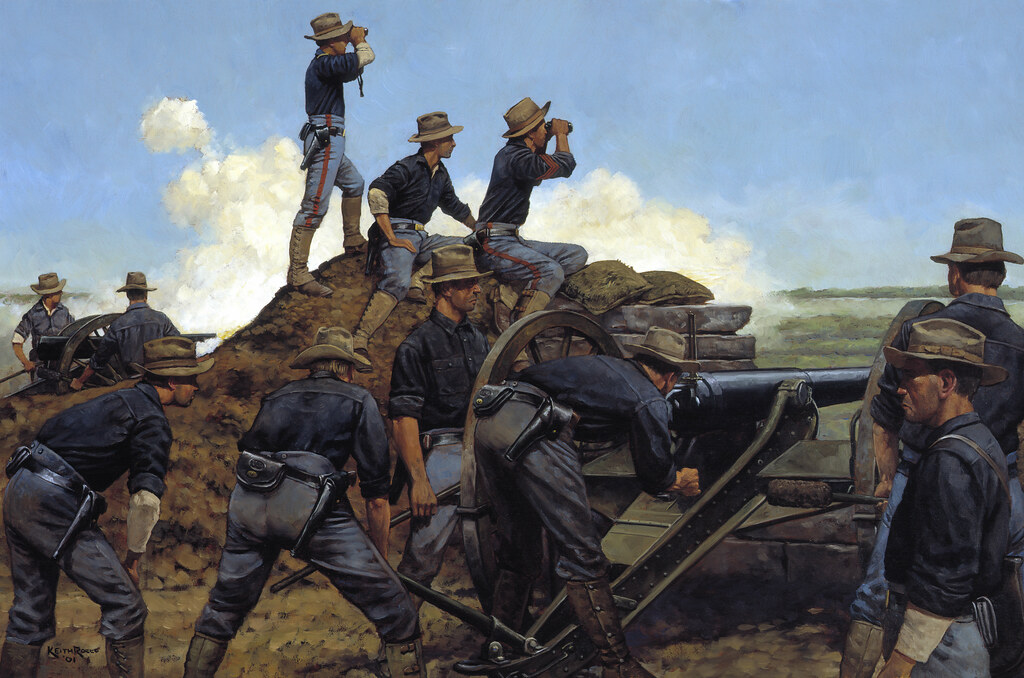
Utah Light Artillery in the Philippines, Spanish-American War

August 13, 2009

The Utah Light Artillery, painting by Keith Rocco -- August 13, 1898, Manila, Philippine Islands August 13, 1898, Manila, Philippine Islands  On April 6, 1898, Congress declared war on Spain and President William McKinley organized United States forces for the Splendid Little War. Of the tens of thousands of regular, volunteer and National Guard (Militia) troops who served, 343 Utah Guardsmen saw service in the Philippine Islands. On May 1st, after the Navys stunning victory at Manila Bay, McKinley authorized an invasion force to capture the Philippine archipelago from Spain. Organized into two batteries, the Utah Light Artillery mustered into federal service on May 9, 1898 at Fort Douglas, Utah. Shortly thereafter, at Camp Merritt near San Francisco, the Utah Artillery became part of Brig. Gen. Francis V. Greenes brigade of the U.S. VIII Corps under the command of Maj. Gen. Wesley Merritt.  Leaving San Francisco, Greenes brigade first raised the U.S. flag in Guam and then arrived on the island of Luzon on July 17, 1898. In the Philippines, 15,000 Americans not only faced 13,000 Spanish soldiers but a second army of some 12,000 Philippine rebels under Emilo Aguinaldo. The rebels had been fighting for national independence from Spain and hoping for American assistance. When Merritt ordered to keep the rebels out of the fight against Spain, the rebels became a second possible enemy.  On August 13th, the Utah Artillery supported Greenes brigade as it attacked towards the old city of Manila. The battle was predetermined to be a limited one in order to preserve Spanish honor and minimize casualties. The rebels, however, made this impossible. As American forces moved quickly against the Spanish defenses, a race to the old city center developed between the Americans and Aguinaldos rebels. The Utah batteries fired and re-deployed several times providing close and accurate support for the infantry attacks.  The Utah Light Artillery continued in federal service for another year and fought in the Philippine Insurrection until returning to Utah in August 1899. Todays 145th Field Artillery, Utah Army National Guard, carries on the history and traditions of the Utah Light Artillery.

Utah Light Artillery in the Spanish-American War – National Guard Heritage Gallery

On April 6, 1898, Congress declared war on Spain and President William McKinley organized United States forces for the “Splendid Little War.” Of the tens of thousands of regular, volunteer and National Guard (Militia) troops who served, 343 Utah Guardsmen saw service in the Philippine Islands. On May 1st, after the Navy’s stunning victory at Manila Bay, McKinley authorized an invasion force to capture the Philippine archipelago from Spain. Organized into two batteries, the Utah “Light” Artillery mustered into federal service on May 9, 1898 at Fort Douglas, Utah. Shortly thereafter, at Camp Merritt near San Francisco, the Utah Artillery became part of Brig. Gen. Francis V. Greene’s brigade of the U.S. VIII Corps under the command of Maj. Gen. Wesley Merritt.

Leaving San Francisco, Greene’s brigade first raised the U.S. flag in Guam and then arrived on the island of Luzon on July 17, 1898. In the Philippines, 15,000 Americans not only faced 13,000 Spanish soldiers but a second army of some 12,000 Philippine rebels under Emilo Aguinaldo. The rebels had been fighting for national independence from Spain and hoping for American assistance. When Merritt ordered to keep the rebels out of the fight against Spain, the rebels became a second possible enemy.

On August 13th, the Utah Artillery supported Greene’s brigade as it attacked towards the “old” city of Manila. The battle was predetermined to be a “limited” one in order to preserve Spanish honor and minimize casualties. The rebels, however, made this impossible. As American forces moved quickly against the Spanish defenses, a race to the old city center developed between the Americans and Aguinaldo’s rebels. The Utah batteries fired and re-deployed several times providing close and accurate support for the infantry attacks.

The Utah Light Artillery continued in federal service for another year and fought in the Philippine Insurrection until returning to Utah in August 1899. Today’s 145th Field Artillery, Utah Army National Guard, carries on the history and traditions of the Utah Light Artillery.

All text from the National Guard Heritage Gallery.


Bad guys of Baltimore

August 12, 2009

Or, “How a little study of history can make your visit to a city so much more entertaining and fun.”  At Clio Bluestocking Tales.

Why do visitors leave pennies at this gravesite?  Read the story at Clio Bluestocking Tales

Why do visitors leave pennies at this gravesite? Read the story at Clio Bluestocking Tales

For five weeks, I walked around the streets of Baltimore, or at least the distance between a certain major university known for its doctors, the Inner Harbor, and Fells Point — especially Fells Point — with some diversions elsewhere. As I walked, I began to notice landmarks of some very bad guys who have graced the streets of this interesting city.

Fans of “The Wire” will especially want to read it.  Did you catch the reason Clio is in Baltimore, for the full effect?

It’s not that history tells you how to live your life, or save it; it can make your life worth the living and saving.


Thoughts on Waterloo

August 6, 2009

Republicans and Sen. Jim Demint look forward to meeting Obama at Waterloo.

Obama Wellington at Waterloo, by Robert Alexander Hillingford

Obama Wellington at Waterloo, by Robert Alexander Hillingford

Napoleon looked forward to meeting Wellington at Waterloo, too.

It’s important to remember that at history’s great turning points, there are generally at least two sides.  The British don’t celebrate the Fourth of July, either.

Be careful what you hope for, Republicans.


2009 Poets Forum – October 15 – 17, in New York City

August 3, 2009

This sounds like fun, actually.  I wonder if they offer Continuing Education Units?

Shouldn’t schools make sure all English teachers get to make this pilgrimage at least once every four years?  Principals, are you listening?

Poets Forum Update:
New Events and More Participants Announced for 2009
Discounted passes available for a limited time at poets.org/poetsforum

Participants include Frank Bidart, Rita Dove, Lyn Hejinian,Edward Hirsch, Haryette Mullen, Sharon Olds, Ron Padgett, Carl Phillips, Robert Pinsky, Kay Ryan, Gerald Stern, Susan Stewart, Jean Valentine, Ellen Bryant Voigt, and many more.

The Academy of American Poets invites you to join us in New York City for the annual Poets Forum, a series of events exploring the landscape of contemporary poetry in America.

This year’s Poets Forum includes new talks and discussions with an array of distinguished poets, readings, publication parties, and an expanded selection of literary walking tours, led by poets, through Manhattan and Brooklyn.

“In only three years, the Poets Forum has become the poetry event of the fall, as poets (and fans of poetry) of all aesthetics celebrate and learn about what they all have in a common: a desire to give life itself a shape through language.”
– Carl Phillips

Poets Forum Reading
Thursday, October 15
7 p.m.
Join us for an unforgettable evening as some of the most acclaimed poets of our day come together on one stage to read from their latest work. Featured readers include Frank Bidart, Rita Dove, Lyn Hejinian, Edward Hirsch, Sharon Olds, Ron Padgett, Carl Phillips, Robert Pinsky, Kay Ryan, Gerald Stern, Susan Stewart, and Ellen Bryant Voigt.
The Times Center
242 West 41st Street

Poetry Walking Tours
Friday, October 16
10:30 a.m. & 2 p.m.
Take a trip down the same streets traversed by Walt Whitman, Marianne Moore, E. E. Cummings, Langston Hughes, George Oppen, and countless other poets. Walking tours will explore the literary history of Brooklyn, Harlem, the Museum of Modern Art, the West Village, and SoHo. Tour guides include poets Anselm Berrigan, Jordan Davis, Bob Holman, Katy Lederer, Greg Pardlo, Tom Thompson, and Mónica de la Torre.
Meeting locations throughout New York City.
TOURS ARE RESERVED FOR ALL-EVENTS PASS HOLDERS ONLY

NEW: Poets & Place Talk
Friday, October 16
2 p.m.
“Show Me Your Environment, and I Will Tell You Who You Are”:  Place, Pathos, and the Problems of Identity
David Baker discusses the relationship between poets and their environment.
Philoctetes Center
247 East 82nd Street
Co-sponsored by the Philoctetes Center
RESERVED FOR ALL-EVENTS PASS HOLDERS ONLY

Poets Awards Ceremony Friday, October 15 7 p.m. Celebrate contemporary poetry and recipients of the premier collection of awards for poetry in the United States. The night will include readings and presentations by Linda Gregg, Jennifer K. Sweeney, J. Michael Martinez, Harryette Mullen, James Richardson, Avi Sharon, Jean Valentine, and many others. A reception will follow.
Tishman Auditorium
The New School
66 West 12th Street
Co-sponsored by the New School Creative Writing Program

Poets Forum Discussions Saturday, October 17 10 a.m. – 4 p.m. 6 Sessions Examine the issues central to contemporary poetry as we present a day of engaging and intimate conversations with some of the most renowned poets of our time, including Frank Bidart, Rita Dove, Lyn Hejinian, Edward Hirsch, Harryette Mullen, Sharon Olds, Ron Padgett, Carl Phillips, Robert Pinsky, Kay Ryan, Gerald Stern, Susan Stewart, Jean Valentine, Ellen Bryant Voigt and other special guests.
Tishman Auditorium
The New School
66 West 12th Street
Co-sponsored by The New School Creative Writing Program

“This public forum on American Poetry is the first of its kind for our brave, wild world of poesy. We will leave no stone unturned to address all the voices and all the thoughts that beset, overwhelm, confuse, delight, and alarm us.”
– Gerald Stern

American Poet Publication Party
Saturday, October 17
7 p.m.
Reading and reception for the new fall issue of American Poet, the journal of the Academy of American Poets. Noelle Kocot, Robert Polito, and Brian Teare will read from their work. Ico Art and Music Gallery
606 West 26th Street (at 11th Avenue)
Co-sponsored by the Ico Gallery

Ticket Information
All-Events Pass: $85 before Sept 15 / $110 after
Saturday-Only Tickets: $60
Students (with current ID): Student rates are available by by phone.
Contact: Jennifer Kronovet, (212) 274-0343, ext.10.

Purchase tickets online at poets.org/poetsforum or by phone,(212) 274-0343, ext.10.

All times are subject to change. Contact Jennifer Kronovet at jkronovet@poets.org with further questions.
Academy of American Poets
584 Broadway, Suite 604
New York, NY 10012

212-274-0343


Folk Alley’s 100 essential folk songs

June 22, 2009

fp

First, the list.  Discussion and explanation later:

Folk Alley’s The 100 Essential Folk Songs

1. “This Land Is Your Land” – Woody Guthrie
2. “Blowin’ in the Wind” – Bob Dylan
3. “City of New Orleans” – Steve Goodman
4. “If I Had a Hammer” – Pete Seeger
5. “Where Have All the Flowers Gone” – The Kingston Trio
6. “Early Morning Rain” – Gordon Lightfoot
7. “Suzanne” – Leonard Cohen
8. “We Shall Overcome” – Pete Seeger
9. “Four Strong Winds” – Ian and Sylvia
10. “Last Thing on My Mind” – Tom Paxton
11. “The Circle Game” – Joni Mitchell
12. “Tom Dooley” – The Kingston Trio (Trad)
13. “Both Sides Now” – Joni Mitchell
14. “Who Knows Where the Time Goes” – Sandy Denny
15. “Goodnight Irene” – The Weavers (Trad)
16. “Universal Soldier” – Buffy Sainte-Marie
17. “Don’t Think Twice, It’s Alright” – Bob Dylan
18. “Diamonds and Rust” – Joan Baez
19. “Sounds of Silence” – Simon & Garfunkel
20. “The Wreck of the Edmund Fitzgerald” – Gordon Lightfoot
21. “Alice’s Restaurant” – Arlo Guthrie
22. “Turn, Turn, Turn!” – The Byrds (Pete Seeger)
23. “Puff the Magic Dragon” – Peter, Paul and Mary
24. “Thirsty Boots” – Eric Anderson
25. “There But for Fortune” – Phil Ochs
26. “Across the Great Divide” – Kate Wolf
27. “The Night They Drove Old Dixie Down” – The Band (Robbie Robertson)
28. “The Dutchman” – Steve Goodman
29. “Matty Groves” – Fairport Convention (Trad)
30. “Pastures of Plenty” – Woody Guthrie
31. “Canadian Railroad Trilogy” – Gordon Lightfoot
32. “Ramblin’ Boy” – Tom Paxton
33. “Hello in There” – John Prine
34. “The Mary Ellen Carter” – Stan Rogers
35. “Scarborough Fair” – Martin Carthy (Trad)
36. “Freight Train” – Elizabeth Cotton
37. “Like a Rolling Stone” – Bob Dylan
38. “Paradise” – John Prine
39. “Northwest Passage” – Stan Rogers
40. “And the Band Played Waltzing Matilda” – Eric Bogel
41. “Changes” – Phil Ochs
42. “Streets of London” – Ralph McTell
43. “Gentle on My Mind” – John Hartford
44. “Barbara Allen” – Shirley Collins (Trad)
45. “Little Boxes” – Malvina Reynolds
46. “The Water Is Wide” – Traditional
47. “Blue Moon of Kentucky” – Bill Monroe
48. “No Regrets” – Tom Rush
49. “Amazing Grace” – Odetta (Trad)
50. “Catch the Wind” – Donovan
51. “If I Were a Carpenter” – Tim Hardin
52. “Big Yellow Taxi” – Joni Mitchell
53. “House of the Rising Sun” – Doc & Richard Watson (Trad)
54. “Kisses Sweeter Than Wine” – The Weavers
55. “Tangled Up in Blue” – Bob Dylan
56. “The Boxer” – Simon and Garfunkel
57. “Someday Soon” – Ian and Sylvia
58. “[500?] Miles” – Peter, Paul and Mary
59. “Masters of War” – Bob Dylan
60. “Wildwood Flower” – Carter Family
61. “Can the Circle Be Unbroken” – Carter Family
62. “Can’t Help but Wonder Where I’m Bound” – Tom Paxton
63. “Teach Your Children” – Crosby, Stills Nash & Young
64. “Deportee” – Woody Guthrie
65. “Tecumseh Valley” – Townes Van Zandt
66. “Mr. Bojangles” – Jerry Jeff Walker
67. “Cold Missouri Waters” – James Keeleghan
68. “The Crucifixion” – Phil Ochs
69. “Angel from Montgomery” – John Prine
70. “Christmas in the Trenches” – John McCutcheon
71. “John Henry” – Traditional
72. “Pack Up Your Sorrows” – Richard and Mimi Farina
73. “Dirty Old Town” – Ewan MacColl
74. “Caledonia” – Dougie MacLean
75. “Gentle Arms of Eden” – Dave Carter
76. “My Back Pages” – Bob Dylan
77. “Arrow” – Cheryl Wheeler
78. “Hallelujah” – Leonard Cohen
79. “Eve of Destruction” – Barry McGuire
80. “Man of Constant Sorrow” – Ralph Stanley (Trad)
81. “Shady Grove” – Traditional
82. “Pancho and Lefty” – Townes Van Zandt
83. “Old Man” – Neil Young
84. “Mr. Tambourine Man” – Bob Dylan
85. “American Tune” – Paul Simon
86. “At Seventeen” – Janis Ian
87. “Bridge Over Troubled Water” – Simon & Garfunkel
88. “Road” – Nick Drake
89. “Tam Lin” – Fairport Convention (Trad)
90. “Ashokan Farewell” – Jay Ungar and Molly Mason
91. “Desolation Row” – Bob Dylan
92. “Love Is Our Cross to Bear” – John Gorka
93. “Hobo’s Lullaby” – Woody Guthrie
94. “Urge for Going” – Tom Rush
95. “Return of the Grievous Angel” – Gram Parsons
96. “Chilly Winds” – The Kingston Trio
97. “Fountain of Sorrow” – Jackson Browne
98. “The Times They Are A-Changin'” – Bob Dylan
99. “Our Town” – Iris Dement
100. “Leaving on a Jet Plane” – John Denver

Folk Alley is the name of an online stream from Kent State University’s WKSU, an NPR-affiliated station that offers several genres of music and public affairs programs. A 24-hour stream of folk music is rare, and the programmers probably are among the best qualified to assemble a list like this — even though it is popularly voted. NPR described it:

Folk Alley, the 24-hour online stream of Kent State University’s WKSU, has never hopped on or off any folk-music bandwagons. Which, in turn, makes it a perfect place to explore the genre’s many permutations, from bare-bones acoustic protest music to the many forms of electric roots music that followed. Folk Alley recently spent eight weeks polling its listeners in search of a master list of “The 100 Most Essential Folk Songs.” The results — found here in the form of a printable list and a continuous music mix, streamed in no particular order — are fodder for debate, discussion and discovery.

You can listen to the songs on the list from the WKSU feed, here.

If you are a fan of folk music, you probably have a few bones to pick with the list, no?

It is a modern list.  It is heavy on compositions since 1960 — admittedly a heyday for folk music, and a great time that produced a lot of material to write folk songs about.  I wonder and worry whether some of these songs are really so much in the folk tradition.  I love the Byrds version of Pete Seeger’s “Turn, Turn, Turn,” a song my band covered years ago and which makes me yearn to be back in the band with Leon Anderson shooting out the dissected chords from his electric 12-string guitar.  But it’s a rock and roll song.  It’s a modern composition.

Of course, it’s a modern composition from an ancient tune, Seeger says (“Twinkle, Twinkle, Little Star”) with lyrics adapted from one of the oldest folk traditions we have (Ecclesiastes in the Bible).  A fair reading notes there is a lot of gray area there, with no bright lines.

Still, I think there are notable omissions that really should be there.

For example, the Shaker song, “A Gift to be Simple,” is as much in the folk tradition as anything there.  But it also is the inspiration for a wonderful classical composition by Aaron Copeland.  Shouldn’t it be listed just for that reason alone, let alone its influence on other singers, writers and songs?

One can make  a similar argument for “Greensleeves,” which inspired entire collections of folk versions and classical compositions.

I think history is slighted, too. I can see why “Yankee Doodle” might be overlooked, it’s so ubiquitous.  But should it be overlooked?  How about the Civil War song, “John Brown’s Body.”  What summer camper won’t sing something based on that this year?  Heck, if we’re including Neil Young’s “Old Man,” why not some Irving Berlin?  “Over There” and “You’re in the Army Now, Mr. Jones,” have no less stature in history and folk music.

How about a Stephen Foster tune?  “Camptown Races” alone should outshine 40 or 50 songs on the list.

Jackson Browne’s “Fountain of Sorrow” as a folk song?  If we allow him in, why not the Rolling Stones’ “Salt of the Earth,” even if you have to list it as a Joan Baez performance?

I’m wondering about the list of “100 Great Folk Songs that Didn’t Make the List?”

I’m also looking at my collection, and wondering if I shouldn’t rush to the local CD shops and internet to supplement some of these great songs on the list that I don’t have.  Somebody borrowed my Phil Ochs — 20 years ago?

What great folk songs do you know that are missing from the list, that probably ought to be there?  List them in comments — let’s not let our heritage be reduced to an inadequate list!  (The people at WKSU are really super — check out their own comments list, with a lot of suggestions for tunes that should be there, and others that should not.)

More grist

Add to FacebookAdd to NewsvineAdd to DiggAdd to Del.icio.usAdd to StumbleuponAdd to RedditAdd to BlinklistAdd to TwitterAdd to TechnoratiAdd to Furl

Save