Sinclair Lewis on patriotism, the flag, and fascism

February 16, 2008

Oh, my.

Sun dog on US flag, Sinclair Lewis quote on fascism

When fascism comes to America, it will be wrapped in a flag and carrying a cross.

Sinclair Lewis

You can’t purchase the actual poster anywhere. It’s a photographic political cartoon. From our friends at Hot Dogs, Pretzels, and Perplexing Questions. (Bob, in Austin)

Did Lewis actually say that?  I’ve not sourced it yet.

Wave the flag for real:

Add to FacebookAdd to NewsvineAdd to DiggAdd to Del.icio.usAdd to StumbleuponAdd to RedditAdd to BlinklistAdd to TwitterAdd to TechnoratiAdd to Furl


National Statuary Hall’s newest residents

January 19, 2008

Po'pay, statue in the Capitol, photo from Architect of the Capital

Pictured at left is the statue of Po’pay, one of two statues of heroes from the history of New Mexico featured in the National Statuary Hall, a collection in the U.S. Capitol. Po’pay’s statue was added to the collection in 2005, one of the two latest additions.

Po’pay was a leader of the revolt against oppressive Spanish rule over New Mexico’s native inhabitants between 1675 and 1681, a century before the American Revolution.

In 1997, the New Mexico Legislature selected Po’pay as the subject of the state’s second statue for the National Statuary Hall Collection and created the New Mexico Statuary Hall Commission, whose members were appointed by Governor Gary Johnson. Four sculptors were selected to create maquettes, and Cliff Fragua was awarded the commission in December 1999. It will be the seventh statue of a Native American in the collection; the others are King Kamehameha I, Will Rogers (who had Cherokee ancestors), Sakakawea, Sequoyah, Washakie, and Sarah Winnemucca.

The seven-foot-high statue was carved from pink Tennessee marble (making it the only colored marble statue in the collection) and stands on a three-foot-high pedestal comprised of a steel frame clad in black granite. It is the first marble statue contributed to the collection since that of South Dakota’s Joseph Ward, which was given in 1963; the other statues given since that time have been bronze. Its acceptance marked the first time at which every state in the Union has been represented by two statues in the collection. In addition, Po’pay is historically the first person represented in the collection to be born on what would become American soil.

No image or written description of Po’pay is known to exist. Sculptor Cliff Fragua describes the statue thus:

In my rendition, he holds in his hands items that will determine the future existence of the Pueblo people. The knotted cord in his left hand was used to determine when the Revolt would begin. As to how many knots were used is debatable, but I feel that it must have taken many days to plan and notify most of the Pueblos. The bear fetish in his right hand symbolizes the center of the Pueblo world, the Pueblo religion. The pot behind him symbolizes the Pueblo culture, and the deerskin he wears is a humble symbol of his status as a provider. The necklace that he wears is a constant reminder of where life began, and his clothing consists of a loin cloth and moccasins in Pueblo fashion. His hair is cut in Pueblo tradition and bound in a chongo. On his back are the scars that remain from the whipping he received for his participation and faith in the Pueblo ceremonies and religion.

Fragua, an Indian from Jemez Pueblo, studied sculpture in Italy, California, and New Mexico; he created his first stone sculpture in 1974.

The other 2005 addition to the collection was Sarah Winnemucca, heroine from Nevada (pictured below, right).

Sarah Winnemucca, in the National Statuary Hall, Architect of the Capitol photo

Sarah Winnemucca
[facsimile of her signature, “Sarah Winnemucca Hopkins”]
1844–1891
Nevada
Defender of Human rights
Educator
Author of first book by a Native woman

Each state may have two statues in the collection.

My work on the Senate staff often required that I walk the Capitol, especially between the Senate and House Press Galleries. I often lamented that it was not available or accessible to students.  This collection of statues is one of the better unsung galleries of history in Washington, D.C. It is heavily influenced by politics and current fashion. Selections illustrate how state legislatures try to make their state’s reputation, and can be very quirky. For example, Pennsylvania’s statues include Robert Fulton, an inventor of the steamboat, and John Peter Gabriel Muhlenberg — but not Ben Franklin or William Penn.  Why?  There could be a paper done on the politics of the choices of each of the 50 states.

Read the rest of this entry »


On the night before Christmas: Untangling the history of a visit from St. Nick

December 24, 2007

Thomas Nast invented Santa Claus? Clement C. Moore didn’t write the famous poem that starts out, “‘Twas the night before Christmas, and all through the house . . . ?”

The murky waters of history from Millard Fillmore’s Bathtub soak even our most cherished ideas and traditions.

But isn’t that part of the fun of history?

  • Below: Thomas Nast’s first published drawing featuring Santa Claus; for Harper’s Weekly, “A Journal of Civilization,” January 3, 1863 Nast portrayed the elf distributing packages to Union troops: “Santa Claus in camp.” Nast (1840-1904) was 23 when he drew this image.

Santa Claus delivers to Union soldiers, "Santa Claus in Camp" - Thomas Nast, Harper's Weekly, Jan 3, 1863 Yes, Virginia (and California, too)! Thomas Nast created the image of Santa Claus most of us in the U.S. know today. Perhaps even more significant than his campaign against the graft of Boss Tweed, Nast’s popularization of a fat, jolly elf who delivers good things to people for Christmas makes one of the great stories in commercial illustration. Nast’s cartoons, mostly for the popular news publication Harper’s Weekly, created many of the conventions of modern political cartooning and modeled the way in which an illustrator could campaign for good, with his campaign against the graft of Tammany Hall and Tweed. But Nast’s popular vision of Santa Claus can be said to be the foundation for the modern mercantile flurry around Christmas.

Nast is probably ensconced in a cartoonists’ hall of fame. Perhaps he should be in a business or sales hall of fame, too.  [See also Bill Casselman’s page, “The Man Who Designed Santa Claus.]

Nast’s drawings probably drew some inspiration from the poem, “Account of a Visit from St. Nicholas,” traditionally attributed to Clement C. Moore, a New York City lawyer, published in 1822. The poem is among the earliest to describe the elf dressed in fur, and magically coming down a chimney to leave toys for children; the poem invented the reindeer-pulled sleigh.

Modern analysis suggests the poem was not the work of Moore, and many critics and historians now attribute it to Major Henry Livingston, Jr. (1748-1828) following sleuthing by Vassar College Prof. Don Foster in 2000. Fortunately for us, we do not need to be partisans in such a query to enjoy the poem (a complete copy of which is below the fold).

The Library of Congress still gives Moore the credit. When disputes arise over who wrote about the night before Christmas, is it any wonder more controversial topics produce bigger and louder disputes among historians?

Moore was not known for being a poet. The popular story is that he wrote it on the spur of the moment:

Moore is thought to have composed the tale, now popularly known as “The Night Before Christmas,” on December 24, 1822, while traveling home from Greenwich Village, where he had bought a turkey for his family’s Christmas dinner.

Inspired by the plump, bearded Dutchman who took him by sleigh on his errand through the snow-covered streets of New York City, Moore penned A Visit from St. Nicholas for the amusement of his six children, with whom he shared the poem that evening. His vision of St. Nicholas draws upon Dutch-American and Norwegian traditions of a magical, gift-giving figure who appears at Christmas time, as well as the German legend of a visitor who enters homes through chimneys.

Again from the Library of Congress, we get information that suggests that Moore was a minor celebrity from a well-known family with historical ties that would make a good “connections” exercise in a high school history class, perhaps (“the link from Aaron Burr’s treason to Santa Claus?”): (read more, below the fold)

Read the rest of this entry »


Beginning of the American experiment in freedom

December 23, 2007

On December 23, 1783, Commander of the Continental Army, Gen. George Washington resigned his commission, to the Continental Congress sitting in Annapolis, Maryland. Washington modeled his actions on the life of Roman general and patriot Cincinnattus. (See especially this site, the Society of the Cincinnati)

John Trumbull painting of Washington resigning his commission

Washington had been thought to be in a position to take over the government and declare himself king, if he chose. Instead, at some cost to himself he personally put down a rebellion of the officers of the army who proposed a coup d’etat against the Continental Congress, angered that they had not been paid. Washington quietly asked that the men act honorably and not sully the great victory they had won against Britain. Then Washington reviewed the army, wrapped up affairs, journeyed to Annapolis to resign, and returned to his farm and holdings at Mount Vernon, Virginia.

Because Washington could have turned into a tyrant, it is reported that King George III of England, upon hearing the news of Washington’s resignation, refused to believe it. If the report were true, George is reported to have said, Washington was the greatest man who ever lived.

Washington’s resignation set precedent: Civilian government controlled the military; Americans served, then went back to their private lives and private business; Americans would act nobly, sometimes when least expected.

Read the rest of this entry »


Typewriter and quote of the moment: David McCullough

December 17, 2007

I bought my Royal Standard typewriter in 1965. It was secondhand. I have written everything I’ve ever had published on it, and there is nothing wrong with it.

Giambarba photo of historian David McCullough and his typewriter

  • Pulitzer-winner David McCullough, defending his refusal to write on a computer during a Dallas book-signing.

(Found in Dallas Morning News, Alan Peppard, “Salutations, Year in Review, Local Celebrities,” December 17, 2007, page 1E, in graphic on page 4E)

More from McCullough on typing, and on writing, reading and understanding history, below the fold.

Read the rest of this entry »


Quote of the moment: Ted Williams (the conservationist)

December 8, 2007

It’s a long passage, but worth the read. Go to the Audubon site for the full essay; it’s longer, and worth more. (Photo: Bald eagle, from the US Fish and Wildlife Service)

Bald Eagle, USFWS photo

This is from an essay the great conservation curmudgeon Ted Williams published in Audubon in December 2004.

I envy young environmentalists of the 21st century, but I feel bad for them, too. They don’t know what it feels like to win big against seemingly impossible odds. When I started out, America and the world were environmentally lawless. There was no Endangered Species Act, no Convention on International Trade in Endangered Species, no Clean Water Act, no Clean Air Act, no National Environmental Policy Act, no National Forest Management Act. In 1970 I remember standing on the steps of the Massachusetts Division of Fisheries and Wildlife field headquarters and arguing with a colleague, Joe, about the banning of DDT. “It will never happen,” he told me. When DDT was banned two years later, he said, “It won’t make any difference.”

For a while it didn’t. The March 1976 Audubon reported “considerable gloomy speculation” about the plight of endangered bald eagles in the Lower 48—more birds dying than hatching, fewer than a thousand nesting pairs. Today there are an estimated 7,000 nesting pairs. The September 1975 Audubon reported that 300 brown pelicans transplanted from Florida to Louisiana—”the Pelican State”—had died from lethal doses of DDT and other chlorinated hydrocarbons. Today Louisiana has more than 13,000 nesting pairs. In 1972 I was assigned by the Massachusetts Division of Fisheries and Wildlife to write an article on the peregrine falcon in the East—a history piece, because the species had been extirpated from the region. By 1999 peregrines had fully recovered, and they were removed from the Endangered Species List.

The hopelessness I felt about DDT in 1970 was nothing compared with what Rachel Carson felt when she started her campaign against this World War II hero. Writing a book about DDT seemed impossible; she was a nature writer, not an investigative reporter. Barely had she taken pen to paper when she was assailed by arthritis, flu, intestinal virus, sinus infections, staph infections, ulcers, phlebitis, and breast cancer. She didn’t get discouraged; she got mad. Her ulcers, she told her editor, “might have waited till the book was done.” Radiation treatments were “a serious diversion of time.” She found the phlebitis that prevented her from walking “quite trying””not for herself but for “poor Roger,” her adopted son.

When Silent Spring appeared in 1962, Chemical World News condemned it as “science fiction.” Time magazine dismissed it as an “emotional and inaccurate outburst.” Reader’s Digest canceled a contract for a 20,000-word condensation and ran the Time piece instead. But only seven years later Time used a photo of Carson to illustrate its new Environment section. Silent Spring was not a prediction, as anti-environmentalists profess; it was a warning, full of hope. “No,” Carson wrote her friend Lois Crisler, “I myself never thought the ugly facts would dominate. . . . The beauty of the living world I was trying to save has always been uppermost in my mind.” If Rachel Carson could find hope in the face of what and who were closing in on her, no environmentalist has the right to feel discouraged in 2004.


Prehistory and art: Lesson plan material

October 7, 2007

Teachers looking for good interactive graphics on human migration in prehistoric times should take a look at the website of Australia’s Bradshaw Foundation. The map requires an Adobe Flash player, and I cannot embed it here — but go take a look, here. “The Journey of Man” seems tailor made for classroom use, if you have a live internet connection and a projector.

Ancient art is the chief focus of the foundation.

Ancient paintings, the Bradshaw paintings, at the Bradshaw Foundation Examples of some of the most famous cave and rock paintings populate the site, along with many lesser known creations — the eponymous paintings, the Bradshaw group, generally disappear from U.S. versions of world history texts. The Bradshaw Foundation website explains:

The Bradshaw Paintings are incredibly sophisticated, as you will see from the 32 pictures in the Paintings Section, yet they are not recent creations but originate from an unknown past period which some suggest could have been 50,000 years ago. This art form was first recorded by Joseph Bradshaw in 1891, when he was lost on an Kimberley expedition in the north west of Australia. Dr. Andreas Lommel stated on his expedition to the Kimberleys in 1955 that the rock art he referred to as the Bradshaw Paintings may well predate the present Australian Aborigines.

This ancient art carries a story that should intrigue even junior high school students, and it offers examples of archaeological techniques that are critical to determining the ages of undated art in the wild:

According to legend, they were made by birds. It was said that these birds pecked the rocks until their beaks bled, and then created these fine paintings by using a tail feather and their own blood. This art is of such antiquity that no pigment remains on the rock surface, it is impossible to use carbon dating technology. The composition of the original paints cant be determined, and whatever pigments were used have been locked into the rock itself as shades of Mulberry red, and have become impervious to the elements.

Fortuitously, in 1996 Grahame Walsh discovered a Bradshaw Painting partly covered by a fossilised Mud Wasp nest, which scientists have removed and analysed using a new technique of dating, determining it to be 17,000 + years old.

Texas history and geography teachers should note the Bradshaw Foundation’s work on prehistorica art in the Pecos River Valley: “Pecos Experience: Art and archeaology in the lower Pecos.” There is much more here than is found in most Texas history texts — material useful for student projects or good lesson plans.

Painting from Panther Cave, lower Pecos, Texas - Bradshaw Foundation


Historic maps: Florida and the Gulf of Mexico

September 21, 2007

Go to the University of Florida Smathers Library site, and admire the beauty of these old maps of Florida and the Gulf of Mexico. (While I think fair use would cover it, I’m holding back on posting an image until copyright permission comes through — you’re licensed to use them in the classroom, however.)

What else would you expect from a library named after Sen. George A. Smathers, who was part of that legendary 1950 Senate campaign in Florida?

The maps featured on the first page include Spanish, Dutch, English, Belgian, French and Italian maps of the early explorers, suitable certainly for Texas history courses, and also for Florida, Louisiana and U.S. history units on European exploration.

This site is quite Florida-centric, but it’s links also provide some interesting and valuable resources, such as the link to satellite imagery of the areas, like the NOAA map, below.

NOAA map of ocean water temperatures around Florida, satellite image

Tip of the old scrub brush to A Cracker Boy Looks at Florida


Update on Seeger: Critics dig deeper holes

September 12, 2007

It’s not exactly breaking news, but I probably should have caught it earlier — that Ron Radosh article in the New York Sun in which he noted Pete Seeger had condemned Stalin, ‘finally, after all these years?’ The article that made Instapundit exclaim it’s about time?

The New York Times noted that Seeger had made the confession in his book in 1993. Pete was probably too polite to embarrass his former banjo student, Radosh, with Radosh’s being at least a decade behind the times. But of course, the harpy right wing pundits can’t resist taking a swipe at Seeger anyway. I have to wonder whether earlier examples can be found.

Sour grapes articles were expectorated at NewsBusters, by P. J. Gladnick, Hard Country (which inexplicably extolls the virtue of Pete’s music and offers links to several videos of Pete’s performances), Andrew Sullivan (who even more inexplicably links to the NY Times article pointing out Seeger did it at least a decade ago), Dean’s World, Classically Liberal, Assistant Village Idiot (bucking for promotion?), Moonbattery, Mona Charen at NRO (who confesses to having it wrong in the 1970s, too), Dictators of the World, Jim-Rose.com, Synthstuff — whew! Here’s a pre-Radosh column sour grapes swipe from David Boaz in The Guardian.

See also The Philadelphia Inquirer, Walter Weiss, and the AP story in the Miami Herald. And this: The Peekskill riots?

To get the bad taste out of your mouth, see what Marketing Begins at Home has to say, and see the photos. And see this piece on the Highlander School.


Millard Fillmore at the National Portrait Gallery

September 11, 2007

Part of the Smithsonian Museums, the National Portrait Gallery remains one of my favorite museums in Washington. It is off the Mall, tucked away at Eighth and F Streets, NW, D.C., (above the Gallery Place-Chinatown Metrorail station – Red, Yellow and Green lines). Free admission, great art, but far enough out of the way to almost guarantee no crowds.

If you Google “National Portrait Gallery,” you also get the gallery of the same name in London, which is not part of the Smithsonian. Another great gallery, but don’t confuse the two.

My continuing search for images of Millard Fillmore turned up this one at the NPG:

Millard Fillmore at the NPG, unnamed artist, circa 1840

The artist is unknown. It’s oil on canvas, and rather a specialty of the NPG — it’s not the official White House portrait. Some of the portraits of presidents come with cheeky commentary or history, since they are not the official portraits usually approved by the president in question himself.

Fillmore’s portrait by an unidentified artist dates from about the time he retired from the House of Representatives in the early 1840s. In the years following, he devoted himself to reconciling the growing differences among fellow Whigs in his native New York State a task for which this hulking and amiable politician was well suited.

“Hulking?”

Check out the other president’s portraits for a usually different view (Lyndon Johnson hated the portrait the NPG has of him, and Richard Nixon never looked better, nor Thomas Jefferson younger); see what else is there that you might use in the classroom.

The NPG has the added advantage of being a short walk from Washington’s China Town, where we used to dine happily at a restaurant named Szechuan, when such cuisine was rather new in the U.S. Several eateries in the area feature dim sum on Sunday mornings, for those days one would rather commune with good friends over delectable tidbits and a good Sunday newspaper, instead of sitting in a pew. Debra Winstead, a former colleague from the University of Arizona, introduced me to the joy of dim sum in D.C. a few years ago.

Good art, good food, good friends. No wonder Washington is such a livable city these days.


The story is the thing; tell the story in history

July 15, 2007

Son James and I spent July 4 in Taos, New Mexico, where we were working with Habitat for Humanity building homes (a project of the youth group at the church we attend, First Christian Church (Disciples of Christ) of Duncanville, Texas). We took that day off, saw Transformers, looked at the sights in Taos, and drove to Eagle Nest Lake to see fireworks.

Lincoln reading to son, Tad; LOC photo

At some point through the week I was discussing with others the stories that make history memorable, in my view, and we discovered that few others on the trip knew the story of the deaths of both John Adams and Thomas Jefferson on July 4, 1826, the 50th anniversary of the signing of the Declaration of Independence. It’s a story that is generally glossed over in U.S. history texts, but one that I make room for in U.S. history courses. My experience is that once kids get the story, that these two great men from such radically different backgrounds became great friends, then in presidential politics, great enemies, and then were reconciled, and then died on the exactly the same day which commemorated the event that both made them famous and that they made famous, kids don’t forget the story.

The story of their friendship is powerful and can be accompanied by readings from their letters in their later life (DBQ opportunity, teachers!). Generally, the story gets told in response to a question from a student. If I do it well, there will be sniffles from the class when we get to the part about Jefferson’s near-coma, awakening to ask whether it is the 4th of July, and then dying, and Adams’ death a few hours later, saying in error that “Jefferson still survives” (which is good that some students choke up, because it always gets me).

The story offers several mnemonic opportunities: 1826, the 50th year after the Declaration (1776); the presidencies of Adams and Jefferson, following one another; the fact that Adams and Jefferson were on the committee to write the Declaration, and that Adams nominated Jefferson as the better writer; the order of the terms of the presidency; the bitter politics at the end of Washington’s presidency (kids get interested in conflict, and the founding seems more vital to them when the controversies rear up); the reverence for law; Adams’ and Jefferson’s service as foreign ambassadors; and so on.

Once I’d told the story, others got the point. The story illustrates Mark Twain’s point about how much more difficult it is to write fiction. Fiction must stick with possibilities, Twain noted, while reality isn’t so constrained. If you wrote a screenplay with two heroes like Adams and Jefferson, and then had them die on the same day within a few hours of each other, hundreds of miles apart, you’d be criticized for being unrealistic. But it happened in history. It’s a true story, better than any lipsticked version Parson Weems could ever invent.

Study of history should never be a drudging trudge to memorize dates. The stories are what count, they are the things people remember. The stories tell people why history is important, and what mistakes to avoid, to satisfy Santayana’s ghost.

Such stories, especially about the founding of America, make history come alive and, often, grab students by the throat and make it memorable for them.  History is Elementary carries a nice story with the same message, though using Washington’s surprise attack on the Hessians from Trenton.  Teachers in need of such stories might do well to pick up a copy of David McCullough’s 1776, or Joseph Ellis’s Founding Brothers.

What other stories are there?  Well, the story about the scar on James Madison’s nose, and how it led to the cementing of the American Revolution (James Monroe, by the way, also died on July 4 — but in 1831).  The story of Lincoln’s trip to New Orleans; the story of Teddy Roosevelt’s capture of Mike Finnegan and two other outlaws, in the Dakotas; the story of Calvin Coolidge’s son’s death; the story of Robert Lincoln’s brushes with presidential assassinations; the story of the Civil War beginning in one man’s back-40 acres, and ending in his parlor; the story as Stephen Ambrose tells it of three men pinned down on a beach in Normandy on D-Day, and deciding the best course of action was to move forward to win the war; American history is rife with bizarre coincidences and seemingly minor events that go on to have great consequences.

I love to hear the story, especially told well.  Well told stories help students learn and retain history, and, I’ll wager, they boost the scores on standardized tests.


Lady Bird Johnson, 94

July 12, 2007

Did I mention that we considered Lady Bird Johnson to be a family friend?

Ladybird Johnson among wildflowers

  • Ladybird Johnson in a field of Texas wildflowers, gaillardia and probably coriopsis, 2001; photo by Frank Wolfe, MacNeil/Lehrer Productions and KLRU-TV production, “Lady Bird”

We didn’t know her that well, really. But for the two years prior to our move to Texas, when I staffed the President’s Commission on Americans Outdoors, she was a solid presence. A passionate advocate of wildflowers, she was well aware of the possibilities that the commission might make recommendations regarding gardening and walking and hiking, and preserving natural beauty. She had already convered Tennessee Gov. Lamar Alexander to the cause — he issued an executive order that Tennessee should not cut down wildflowers along roadsides, saving the state a bunch of money on mowing and adding to the beauty of the state’s roads all at once. Alexander chaired the commission.

But she went to work on the vice chair, too — Gil Grosvenor, the president of the National Geographic Society. And she worked on the commission director, Victor Ashe, who had recently lost a U.S. Senate campaign to Al Gore and would go on to be mayor of Knoxville and chairman of the National Conference of Mayors. Lady Bird did not want to let any potential ally go unpersuaded. She had the phone numbers, and she made the calls, especially the late-in-the-day-catch-the-big-fish-without-a-secretary calls. Some of the people who go out of channels that way are very obnoxious. Lady Bird always produced smiles.

She persuaded them and the other commissioners to her cause, the commission staff, and probably anyone who ever bothered to read the reports of the commission or who attended any of the several public hearings where the joys and value of wildflowers was discussed.

And then we moved to Texas, and in the spring time we could see what Lady Bird’s passion was all about. It helped that Kathryn decided to chase her own passion for horticulture, and fell in with a great bunch of landscape designers and nursery people who emphasized Texas native plants. We joined the wildflower center Lady Bird set up in Austin, and actually met her on a couple of occasions. Kathryn and I both worked in the U.S. Senate, and we know stuffy people. Lady Bird was not stuffy, but always a woman of infinite charm and grace.

Most recently, when our son James earned his Eagle rank in Scouting, Lady Bird’s name was on the list of those public figures who would be gracious enough to drop a note of congratulations if asked. We know how to recognize the letters signed by machines, and we know how to recognize letters written by software that mimics handwriting. So it was a pleasant surprise to get a hand-addressed note from Austin, and see that the handwriting on the note matched the envelope. That’s the way a lady does it.

In Texas now, in the spring time there are bluebonnet watches, maps in newspapers showing a path to drive to see the best blooms, festivals, and trinkets galore. An entire industry of photographers revolves around getting families to sit among the flowers at the side of the road for a portrait. The flowers, other than the bluebonnets, show brilliantly to incoming airplanes. A flight from Houston or Austin to Dallas gives a passenger a floral sendoff and a floral welcome at the other end.

You can read the stories. Lady Bird was the financial manager of the Lyndon Johnson family fortune. She was also the peacemaker, the one who got LBJ calmed down from his frequent flights of passion, calm enough that he could be the best legislator our nation ever had, including James Madison, and a great legislative master even as president, as no president before or since.

Steel magnolias have nothing on Lady Bird Johnson, who understood the power of a blanket of flowers, the importance of roots and family, and how much grace can mean to those who get it.

Teachers in Texas should hit the newstands today and get the papers with the special features — the Dallas Morning News front page and front section are full of good stories. Teachers should get to the news websites and get the stories that will disappear in a week downloaded for later use. U.S. history teachers would do well to do the same, to get the information about the American environmental movement, and to pick up additional history on Lyndon Johnson, Vietnam, the successes of the civil rights movement, and the amazing decade of the 1960s.

America is better because of Lady Bird Johnson. She worked to be, and was, a family friend to the entire nation.

Here are sources you can check from contemporary news:

Dallas Morning News coverage


Former first lady dies at 94

LBJ trusted Lady Bird with his true self, warts and all

Lady Bird cultivated natural beauty from Western wilderness to inner cities

Journalist remembers her friend

Remembering Lady Bird

Editorial: She showed world grace, gentleness

Timeline: Her life and times

Services planned for Lady Bird Johnson

Statement from President George W. Bush

Statement from former President Bill Clinton and Sen. Hillary Clinton

Submit: Sign the online guestbook

Photos: The life of Lady Bird Johnson

Video:
Remembering Lady Bird Johnson (WFAA-TV)
Kay Bailey Hutchison on Lady Bird Johnson (WFAA-TV)
John Cornyn on Lady Bird Johnson (WFAA-TV)
Mrs. Johnson’s impact on Central Texas (KVUE-TV)
Lady Bird Johnson’s Legacy (KVUE-TV)
Family friend and spokesman Neal Spelce shares his memories of Mrs. Johnson (KVUE-TV)
Reaction from the LBJ Library and Museum staff (KVUE-TV)

Links
Lady Bird Johnson Final Tribute
Lady Bird Johnson Wildflower Center
Lady Bird Johnson biography
Lyndon Baines Johnson Library and Museum

Tip of the old scrub brush to O’Folks.


Four Stone Hearth 18

July 12, 2007

More catching up: 4 Stone Hearth 18 is up over at Clioaudio — a carnival of blog entries on “Archaeology, Biological Anthropology, Linguistics and Social Anthropology.” Some excellent entries, and even a reference back to the Caddoland map I noted a week or so ago.

4 Stone Hearth on iPod, by Beej Jorgensen

The entries on use of computers during class are useful. This one seems to have a lot of material for world geography and world history, but it’s stuff any social studies teacher should have available as a resource.

Don’t go blind, as Tom Boswell’s father told him when he turned Tom loose in the Library of Congress’ room on baseball.

Campfire Crowd image copyright by Beej Jorgensen.


History Carnival catch up

July 11, 2007

How far behind am I on noting the Carnival of History?
History Carnival logo

Number 54 is at Historianess.

Number 53 is at American Presidents Blog.

History teachers, “off” for the summer, can use these assemblages for inspiration for lesson plans in world history, U.S. history, and state history courses, at a minimum. Serious readers will note deep themes suitable for summer consideration at the beach before we get back to the serious business of improving the world, in the fall, perhaps before Gen. Petraeus makes his report.

It’s summer. History is still serious.


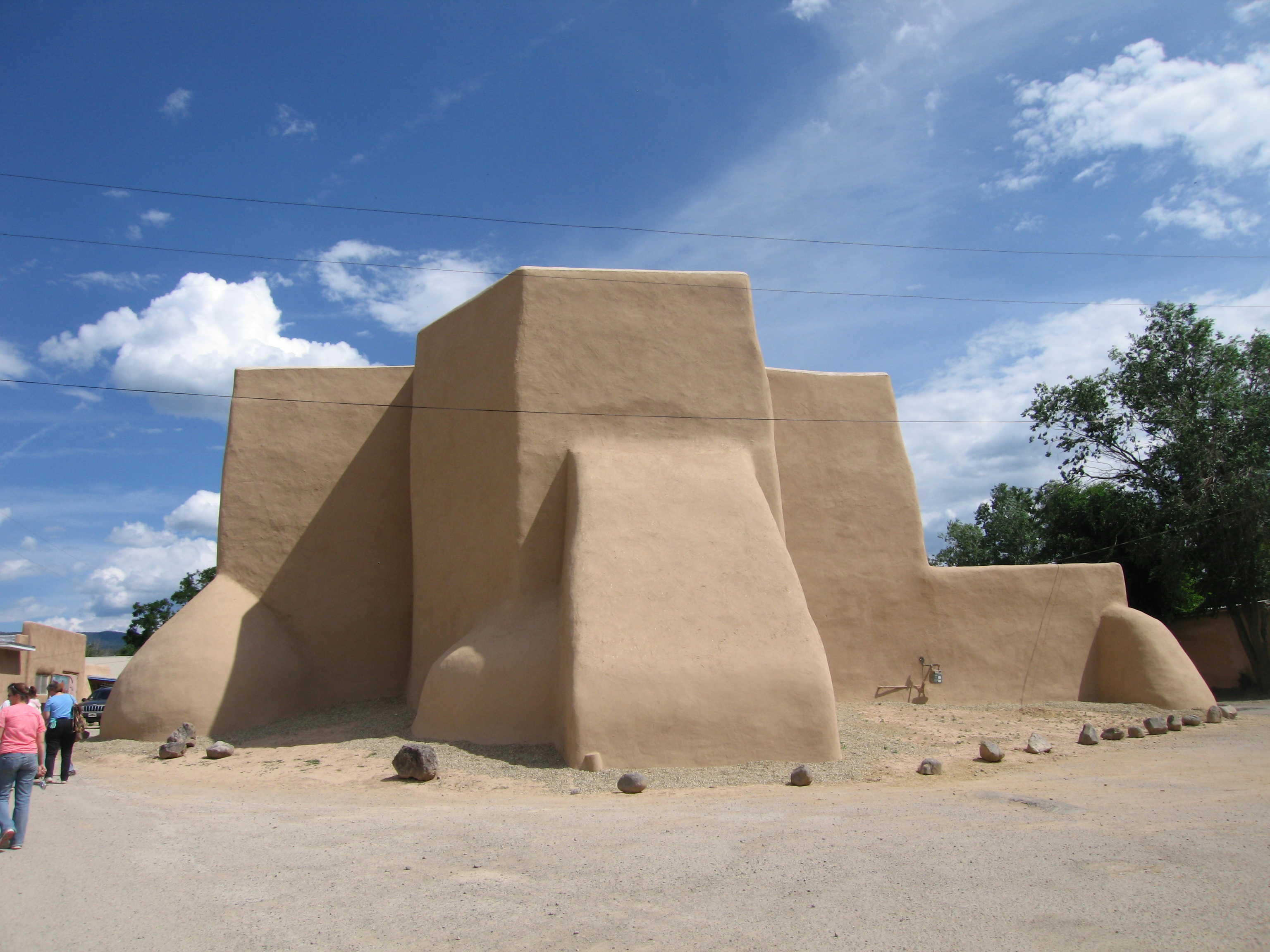
Image of the moment: San Francisco de Asis without Adams or O’Keefe

July 6, 2007

Neither Ansel Adams nor Georgia O’Keefe noted the power lines, or the gas meter.

They must be recent additions.

The essential beauty of the church remains.

1549-san-francisco-de-asis-church-in-taos-july-5-2007.jpg

The original adobe construction of the church was completed in 1772 — four years prior to the Declaration of Independence. It is built in the shape of a cross, but structural weaknesses required the addition of buttresses, shown in the photograph — also of adobe.

A bad photograph of the church is almost impossible.

The interior is cool on a hot afternoon. Adobe construction offers significant advantages, even in the 21st century. The church hosts an active congregation, without air conditioning.

Photo: Copyright 2007, Ed Darrell; you may reproduce for educational or non-profit use, so long as attribution is attached. Attribution must be attached.

Welcome, visitors!  Please leave a comment, at least tell why you visited, and where you’re from.  Thank you.