Another carnival of DDT

November 18, 2007

One of the clues that someone is financing a public relations campaign for DDT and against care for the environment is the way “news” keeps popping out about the benefits of DDT, though there is no natural process for making such news in back of the stories.

We old PR flacks recognize that without the push from an agent, these stories wouldn’t get written.

Just over a month ago there was a flurry of stories about how DDT was “effective” even after mosquitoes developed immunity to it, because it repels mosquitoes, too — even though that wasn’t what the researchers concluded, and that wasn’t the major thrust of the research article.

We also saw a Hoover Institute fellow call for DDT to be used to fight the spread of West Nile virus, though no public health official called for such action, though there is no particular need for such a drastic change in policy, and despite the fact that DDT spraying for the mosquitoes that carry West Nile is one of the least effective means of killing them (DDT is not a larvacide, and larvacides are called for to combat West Nile).

This month? No real news, but the American Enterprise Institute, which nominally is pitched at promoting business interests, issued a new report recycling all the old canards, calling for increased use of DDT in Africa to fight malaria, despite already expanded use, and despite a lack of call from health officials to spray more DDT.

Here’s how it looks on the internet:

November 5, 2007 – Wall Street Journal opinion piece by AEI’s Roger Bate, over the years one of the most ardent salesmen of DDT as the solution to nearly every problem, so long as it bashed environmentalists. WSJ notes the piece is a shorter version of the AEI report.

November 1, 2007 – TCS piece by AEI’s Roger Bate, complaining generally about environmentalists.

Random DDT stuff, some of which may turn into separate posts:


Sticking by the error

November 17, 2007

Neil Boortz has a bottomless well of venom. Boortz appears to be the chief source of the mean-spirited, cut-from-whole-cloth fables about Hillary Clinton being next to Marx.

Checking to see whether he had run a correction of those errors* (he did not), I found this little spittle of acid in that same post from October 8: Boortz wonders about former National Security Advisor Sandy Berger advising Hillary Clinton’s campaign, citing Berger’s admission that he took documents out of the National Archives as a basis for some conspiracy about a cover-up of Bill Clinton’s actions prior to September 11, 2001.

Berger pled to misdemeanor charges. He had the right to view the documents, especially since many of the documents he was reviewing were his own. NARA staff said he took copies of documents only. He was working to prepare a report to the 9-11 Commission at the time.

Neil, here are the facts: Berger was right about Osama bin Laden, years before you ever thought about it. Berger was the guy who was left standing at the White House door, ready to brief President George W. Bush on the need to continue chasing Osama bin Laden and the threat al Quaeda posed to America when Condoleeza Rice informed him that the Bush administration would not continue the chase. Berger was the guy who first got the news that Bush was letting al Quaeda off the hook.

There is great value in getting advice from people who seem to have an ability to see the future, or at least get the present right. Boortz can’t even bring himself to admit error for a silly quiz. We shouldn’t expect him to admit the larger error: Sandy Berger was right about Osama bin Laden and al Quaeda, and it was a nasty, damaging error for the Bush group to brush him off and ignore his warnings. Now we are involved in a great, perhaps misguided war that could have been avoided had Bush listened to Sandy Berger in January 2001.

It must be painful for Boortz to even imagine such things.

It’s a great idea for Berger to advise Clinton, or anyone else, because George W. Bush didn’t allow it, would not listen. Nearly 10,000 Americans are dead, 100,000 to more than a million Iraqis and Afghanis are dead, the U.S. has a multi-trillion-dollar debt, and the entire planet is a lot less safe because of Bush’s error. Let’s not compound the error.

(Boortz’s radio show is carried on a backwater AM station here in Dallas — oddly on KSL’s old clear channel frequency. I’ve never heard it. Is he this reckless with facts on all things? If the FCC were alive today, such inaccuracies might endanger a license, back when broadcasters had to broadcast in the public interest. Nostalgia is appropriate here. Too bad such broadcasters are not required to be licensed like history teachers; worse that Boortz doesn’t work for accuracy himself.)

* No, I don’t really believe Boortz simply erred; but it’s polite to pretend so, so that he may more gracefully make corrections.

Writing the history texts: What is history?

October 29, 2007

History textbook controversies abound, really. Just a list to pull some sources together:


History text accuracy: Okinawa mass suicides

October 25, 2007

Controversy surrounds history textbooks all over the world. Texans may be a bit more sensitive to the issues while the Texas Education Agency is revising curricula, but others are even more sensitive – such as Turkey, where controversy over the Armenian Genocide threatens to derail Turkey’s 40-year project to join the European Union; Japan, where citizens and other nations protest failures to mention harms done to people by the Japanese Imperial Army during World War II; and even Europe in general, where controversy surrounds efforts to find a unifying, Europe-wide culture.

History is important in our relations with other nations. With increasing globalization, it becomes ever more important that all citizens have basic understanding of their local history, their national history, and world history, if only to avoid the social faux pas in socializing with people from other nations.

The issue is hot in Japan right now. Okinawa, a formerly independent kingdom annexed by Japan in the 19th century (did you know that?), hosted the biggest protest demonstration the island prefecture has ever seen, earlier this month – a protest over the changing of a few words in Japanese school history texts, removing the responsibility for mass suicides on Okinawa from the Japanese Imperial Army.

A story in the New York Times describes the anguish felt by Okinawans:

Brainwashed by Japanese Imperial Army soldiers into believing that victorious American troops would rape all the local women and run over the men with their tanks, Mr. Kinjo and others in his village here in Okinawa thought that suicide was their only choice. A week before American troops landed and initiated the Battle of Okinawa in March 1945, Japanese soldiers stationed in his village gave the men two hand grenades each, with instructions to hurl one at the Americans and then to kill themselves with the other.

Most of the grenades failed to explode. After watching a former district chief break off a tree branch and use it to kill his wife and children, Mr. Kinjo and his older brother followed suit.

”My older brother and I struck to death the mother who had given birth to us,” Mr. Kinjo said in an interview at the Naha Central Church, where he is the senior minister. ”I was wailing of course. We also struck to death our younger brother and sister.”

Mr. Kinjo agreed to tell his story again because the Japanese government is now denying, in new high school textbooks, that Okinawans had been coerced by Imperial troops into committing mass suicide.

The proposed changes to the school textbooks — the deletion of a subject, the change to the passive voice — amounted to just a couple of words among hundreds of pages. But the seemingly minor grammatical alterations have led to swelling anger in the Okinawa islands in Japan, cresting recently in the biggest protest here in at least 35 years and stunning the Japanese government.

How should texts deal with such issues?

China and Korea also protested the rewrite. Hot button issues involve the Japanese invasion and taking of Nanking in 1937, generally known to western historians as “the rape of Nanking;” Japanese treatment of Prisoners of War (POWs), including the Bataan Death March in the Philippines, what amounted to slave labor using POWs in Japan, and Korean women impressed into service as prostitutes to the Japanese Army, at what are euphemistically called “comfort stations.”

Texas history standards writers may benefit from taking a look at some of these other controversies, in other places. These lessons can apply to Texas and U.S. history, where Anglo and European colonist treatment of aboriginal natives is certainly an issue, but also to subjects such as biology and the treatment of evolution, health and the treatment of preventing sexually-transmitted diseases, and environmental science, and the treatment of pollution and climate change issues.


Ardeatine Massacre: Bombers were soldiers, not terrorists

August 13, 2007

Our Italian physicist friend, Dorigo, at A Quantum Diaries Survivor reports that an Italian court ruled against a newspaper that started a campaign to deny the history of the Ardeatine Massacre.

Good news today. The supreme court of Cassazione in Italy has ruled that the press campaign labeling “terrorists” the GAP partisans who organized the bombing of Via Rasella in nazi-occupied Rome in 1944, launched by the national newspaper “Il Giornale”, was a striking example of manipulation of historic truth for political means. The newspaper is owned by Paolo Berlusconi (brother of Silvio, formerly premier of Italy in 1994 and 2001-2006), and was directed by Vittorio Feltri . . . a journalist who never hid his sympathy for the extreme right.

What was the Ardeatine Massacre?

Statue memorial to the victims of the Ardeatine Massacre, Italy Wikipedia:

The massacre of Fosse Ardeatine (Italian: Eccidio delle Fosse Ardeatine) took place in Rome, Italy during World War II. On 23 March 1944, 2 German soldiers, 31 Italian soldiers of Battaglione Bozen and a few Italian civilians passing along the road, were killed when members of the Italian Resistance set off a bomb close to a column of German soldiers who were marching on via Rasella[1]. This terrorist attack was led by the Gruppi di Azione Patriottica, of Rosario Bentivegna, Carla Capponi, Antonello Trombadori (Head of GAP in Roma) and the approval of Sandro Pertini (later President of Italian Republic), in order to provocate the reaction of SS troops.

Adolf Hitler is reported but never confirmed to have ordered that within 24 hours, one-hundred Italians were to be shot for each dead German. Commander Herbert Kappler in Rome concluded that ten Italians for each dead German would be sufficient and quickly compiled a list of 320 civilians who were to be killed. Kappler voluntarily added ten more names to the list when the 33rd German/Italian died after the Partisan attack. The total number of people murdered at the Fosse Ardeatine was 335, most Italians. The largest cohesive group among the murdered were the members of Bandiera Rossa, a Communist military Resistance group.

Why is there controversy 60 years later? Read the rest of this entry »


Original Documents: Long history of DDT trouble, from U.S. Fish and Wildlife Service, 1945 and later

August 12, 2007

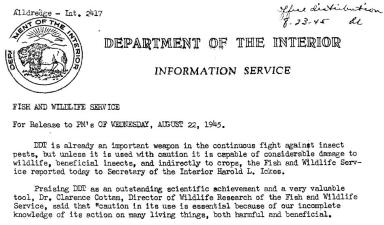
Header of FWS press release, Aug 22 1945

Archives of the U.S. Fish and Wildlife Service (FWS) reveal a long history of trouble with DDT, almost from the first uses of the chemical as an insecticide during World War II. You’ll find extensive links to historic press releases from FWS below the fold.

Critics of the various restrictions on DDT use often claim that DDT is a God-sent chemical that nearly eradicated malaria from the world (absolutely untrue) and which was banned only because of hysteria caused by Rachel Carson’s 1962 book, Silent Spring (untrue at both ends, hysteria and the power of Carson’s book). This is history revisionism at its worst, it is bogus history.

A careful study of the history of the use of DDT shows that scientists were concerned about its dangers from the first uses as a pesticide. The U.S. Fish and Wildlife Service reported dangers in a press release on August 22, 1945, just a week after the surrender of Japan ended World War II (VJ Day was August 15 in Tokyo, August 14 in Washington). In that release FWS noted the beneficial uses of DDT to fight insect and lice infestations that threatened troops and civilians with typhus and other diseases, but cautioned that such use should not become common, that more study was needed: Read the rest of this entry »


A religious bias against good education?

August 8, 2007

One might be too stunned to shake one’s head; this is a description for a high school calculus course:

CALCULUS
Students will examine the nature of God as they progress in their understanding of mathematics. Students will understand the absolute consistency of mathematical principles and know that God was the inventor of that consistency. Mathematical study will result in a greater appreciation of God and His works in creation. The students will understand the basic ideas of both differential and integral calculus and its importance and historical applications. The students will recognize that God created our minds to be able to see that the universe can be calculated by mental methods.

No, I’m not kidding. It’s from Castle Hills First Baptist School in San Antonio, Texas.

The scientist who sent me the link called it “God’s math.” Architect Mies van der Rohe once said, “God is in the details.” But he didn’t mean that math should be taught as anything other than mathematics. He didn’t mean that any religion should be inserted into math classes — and frankly, that’s a little worrying to me. I speak regularly with theologians who read the same text and come up with radically different descriptions of what it means, sometimes diametrically opposite descriptions.

The social studies curricula are more troubling. What is described is at best second-rate course work. One hopes that the teachers teach the material instead of these descriptions:

SOCIAL STUDIES/HISTORY

WORLD HISTORY I
NINTH GRADE
The students will examine the nature of God as revealed through the study of social studies. Students will develop convictions about God’s word as it relates to world history and will define their responses to it. Through the study of world history, students will develop an understanding of the economic, social, political and cultural developments of our world, as they compare countries and civilizations, Students will learn and acquire an appreciation for God’s relations throughout the timeline of world events. The integration of literature into studies of ancient civilizations will enhance and inspire their learning process. Students will develop attitudes, values, and skills as they discover their place in the world. Students will analyze, synthesize and evaluate social studies skills, including social relationships such as family and church.

WORLD HISTORY II
TENTH GRADE
The students will examine the nature of God as revealed through the study of social studies. Students will develop convictions about God’s word as it relates to world history and will define their responses to it. Through the study of world history, students will develop an understanding of the economic, social, political and cultural developments of our world, as they compare countries and civilizations since the Reformation. Students will learn and acquire an appreciation for God’s relations throughout the timeline of world events. The integration of literature into the studies of modern civilizations will enhance and inspire their learning process. Students will develop attitudes, values, and skills as they discover their place in the world. Students will analyze, synthesize and evaluate social studies skills, including social relationships such as family and church.


AMERICAN HISTORY
ELEVENTH GRADE
Students will evaluate the past and learn from its lessons (I Corinthians 10:11), and become effectual Christians who understand “the times” (I Chronicles 12:32). Students will study the history of our country beginning with the Civil War with a biblically integrated filter as they examine the political, social, and economic perspectives. An emphasis will be placed on the major wars, the industrial revolution, and the settlement of the frontier, requiring students to critically analyze the cause and effect relationships of events in history.

GOVERNMENT/CIVICS
TWELFTH GRADE
Students will evaluate the past and learn from its lessons (I Corinthians 10:11), and become effectual Christians who understand “the times” (I Chronicles 12:32). Students will study the foundational documents of our founding Fathers built upon as they formulated the ideals upon which our country was established. Such documents include: The Magna Carta, The English Bill of Rights of 1689, and the Mayflower Compact. Students are equipped with an understanding of the basic principles contained in these documents, and are able to identify their dependence upon biblical and Reformation principles, leading them to an understanding why the American system is meant for a religious people.

ECONOMICS/FREE ENTERPRISE
TWELFTH GRADE

Students will evaluate the past and learn from its lessons (I Corinthians 10:11), and become effectual Christians who understand “the times” (I Chronicles 12:32). Students will gain an understanding of the workings of economic systems, being able to identify the strengths and weaknesses inherent in capitalism (Deuteronomy 8, 15, 28, Leviticus 25), and the reasons for its superiority to the models of communism and socialism (Ezekiel 46:18).

The last description there, for economics, might lead one to understand this school ignores most of the lessons of Jesus, and especially the stories of the disciples in the immediate aftermath of the crucifixion as described in Acts 2. Not only are the courses described inadequate (we hope the teachers teach the state standards instead, at least), where scripture is specifically mentioned, they appear to be tortured to fit the agenda.

Then comes the choker:

SCIENCE

BIOLOGY

Students will study the physical life of God’s creation. They will continue to develop skills in the use of the scientific method. The students will learn methods and techniques of scientific study, general attributes of the cell and its processes, characteristics of the wide spectrum of living organisms, the classification, similarities and differences of the five kingdoms, evolutionary models and the creation model, the mechanics of inheritance, disease and disorders, and the workings of the human body. Students will gain experience in manipulating the conditions of a laboratory investigation and in evaluating the applications of biological principles in everyday life.

There is no “creation model” that is scientific, nor is there one that conflicts with evolution and is also Biblical. What, in God’s name, are they teaching?

CHFB School was established over 25 years ago, and claims to have more than 300 students enrolled, K-12. Surely there is a track record to look at.

Anybody know what the actual curricula look like at this school? Are there any measures to suggest the school teaches real subjects instead of what is described?

What was the Texas legislature thinking when they authorized Bible classes? Isn’t this bad enough as it is?

____________________

Update: See parent and student comments and ratings of the school, here.

____________________

Update, August 11:  Blogs4Brownback endorses the curriculum — if you do not fully realize the significance of that particular endorsement, study this post, and this one.  Parody?  I asked Brownback’s campaign about the site — they have not disowned it.  As Dave Barry often wrote, I could not make this stuff up.


Textbook critic Norma Gabler, 84

July 26, 2007

Appropriate to a discussion of textbook approvals and the Texas State Board of Education comes this news: Norma Gabler died in Phoenix, Sunday. She was 84.

Norma and her husband Mel started the practice of nit-picking textbooks during the approval process, always pushing to get a Christian view inserted into books, especially science and history books. Eventually they founded a non-profit group to criticize texts, Education Research Associates, based in Longview, Texas. Despite the deaths of both Gablers, the non-profit will continue.

Steven Schafersman of Texas Citizens for Science alerted me in an e-mail. The Longview News-Journal carried the news of Mrs. Gabler’s death:

The 84-year-old Longview resident died Sunday in Phoenix, Ariz., after serving for decades as the public face of an effort to bolster both accuracy and conservative beliefs in public school textbooks. She and her husband, Mel, who died in 2004, began their work in 1961 in Hawkins after finding errors in a textbook of one of their sons.

They became nationally famous, and a Rice University professor who was head of the Texas Council for Science Education in 1982 said the Gablers were “the most effective textbook censors in the country.”

They founded the Longview-based nonprofit organization Educational Research Analysts, which describes itself as a conservative Christian organization.

Educational Research Analysts is dedicated to finding factual errors in textbooks, as well as to pointing out “censorship of conservative political or social views,” said Neal Frey, president of the organization who worked with the Gablers since 1982. The group’s work will continue, he said.

The Gablers’ work, he said, had national impact because Texas is such a large buyer of textbooks; what is approved here is often repeated nationally by publishers.

Update, August 2, 2007: Afarensis points us to NPR, who seem to speak admiringly of the dead. Awfully polite of them to do so, unless it’s getting in the way of accuracy.


The scary truth about Powerline

July 16, 2007

Clearly somebody at Powerline proofs the copy — I imagine spelling errors that sneak into publication get corrected. But does anyone ever bother to check the boys’ work for reality?

Today Powerline appears to be complaining about Rep. Keith Ellison, Minnesota’s and America’s first Moslem congressman. After reciting the usual Powerline diatribes claiming Ellison is probably a Marxist, certainly out of touch with America, and probably responsible in an unsavory fashion for the designated hitter rule and the movie “Gigl,” the blog details Ellison’s sins (in the eyes of Powerline).

Do they need glasses? A refresher course in history? What’s scary is that Ellison’s criticisms of the Bush administration start sounding so rational — and for that, Powerline has no response.

Powerline warns us that Ellison spoke to a group of atheists in Edina, Minnesota, in towns that suggest disaster in the next film reel, copying from the Minneapolis Star-Tribune:

“You’ll always find this Muslim standing up for your right to be atheists all you want,” Ellison, the first Muslim to serve in Congress, said in a speech to more than 100 atheists at the Southdale Library in Edina. As Minnesota’s first black member of the U.S. House ends his first six months in office, Ellison did not disappoint a crowd that seemed energized the more pointed he made his opinions.

Oh, my! Ellison takes the Jeffersonian stand on the First Amendment. Are we swooning yet? What? Oh, yeah, well — Powerline prefers to think that parts of the Bill of Rights don’t exist, not in the rude company they keep, I guess.

The truly revelatory point there is that Edina has 100 atheists. If Powerline had any sense, they’d worry about how that might limit their market.

On impeaching Cheney, which the Minneapolis DFLer supports: “[It is] beneath his dignity in order for him to answer any questions from the citizens of the United States. That is the very definition of totalitarianism, authoritarianism and dictatorship.”

So, Powerline worries that Ellison thinks the administration should be answerable to the American people? That strikes me as a pretty good idea, actually. Bully for Ellison. Unsurprisingly, even Republicans say the same thing [see the last paragraph].

The Vice President should answer to and be held accountable to the citizens of the nation. That’s one of the key points of our Constitution — the founders wrote in formal occasions for the administration to make such presentations. Do the guys at Powerline know about the Constitution and its requirement for reports to Congress?

On calling the war in Iraq an “occupation”: “It’s not controversial to call it an occupation — it is an occupation.”

Ellison calls a shovel, a shovel. What was it Powerline wanted? What does Powerline call it?

While it is possible to hope for a better future, analysts and business consultants teach that people must recognize the reality of the situation they are in before making effective and executable plans to change things for the better in the future. Powerline has other plans in Iraq than success for America?

Here’s the money quote, the one that has caused a major kerfuffle of controversy today:

On comparing Sept. 11 to the burning of the Reichstag building in Nazi Germany: “It’s almost like the Reichstag fire, kind of reminds me of that. After the Reichstag was burned, they blamed the Communists for it and it put the leader of that country [Hitler] in a position where he could basically have authority to do whatever he wanted. The fact is that I’m not saying [Sept. 11] was a [U.S.] plan, or anything like that because, you know, that’s how they put you in the nut-ball box — dismiss you.”

Powerline comments:

In promoting the disgusting conspiracy myths of radical “truthers” and extremist Muslims, Ellison is simply working his latest hustle to the growing audience in the nut-ball box. It’s an audience that includes the Minneapolis atheists who fancy themselves too intelligent to believe in God.

Here’s the problem: The Bush administration did use the events of 9/11 as an the emergency event to get things done that they needed a contingency for. What was to become the PATRIOT Act, instituting a new system of spying on Americans, was already drafted by September 1, 2001; administration officials worried that it appeared too great an over-reach. Memos show that some officials suggested waiting for an event that might galvanize opinion in favor of such a move. That event occurred on September 11, and the PATRIOT Act was before Congress within a few days.

Powerline doesn’t deny that, of course. They can’t . All they can do is throw invective at Ellison, call him a Marxist, and suggest he’s out of touch.

Which, of course, is what the National Socialist Party did to their political rivals in Germany after February 27, 1933, the day after the Reichstag building burned. President Hindenberg issued the Reichstag Fire Decree, suspending many civil liberties in Germany.

Powerline says Ellison can’t accuse them of doing what they’re doing, after they call him “Marxist” for noting the historical parallels — just as the National Socialists called their enemies Marxists (several communists were arrested and tried for starting the fire; while most were acquitted, Marinus van der Lubbe was convicted and beheaded; a German court overturned his conviction in 1981).

If you don’t want to be accused of latter-day Reichstag political fixing, don’t do the crime. The rest of us may wish Ellison weren’t so scarily close with his historic comparisons. The solution is for the government to defend civil rights, and to stop calling people communists or worse for simply disagreeing about policy.

I think I hear Santayana’s ghost giggling a bit, between sighs. If our national future weren’t at stake, it would be really funny.


Encore post: Recognizing bogus history, 2

July 3, 2007

Editor’s Note:  I’m traveling this week, celebrating our independence 231 years on.  While mostly out of pocket, I’ll feature some encore posts, material that deserves another look to keep it from fading from memory.  This post, below, is the second of a two-part series from August 2006.

Recognizing bogus history, 2

Bogus history infects political discussions more than others, though there are some areas where bogus history strays into the realm of science (false claims that Darwin and Pasteur recanted, for example).

1. The author pitches the claim directly to the media or to organizations of non-historians, for pay.

Historians are detectives, and they like to share what they find. One historian working in the papers of one figure from history will find a letter from another figure, and pass that information on to the historian working on the second figure. Historians teach history, write it up for scholarly work, and often spin it in more fascinating tales for popular work. Most years there are several good works competing for the Pulitzer Prize in history. Academic historians, those tied to universities and other teaching institutions, join societies, attend meetings, and write their material in journals — all pitched to sharing what they have learned.

Bogus historians tend to show up at conferences of non-historians. Douglas Stringfellow’s tales of World War II derring do were pitched to civic clubs, places where other historians or anyone else likely to know better, generally would not appear (Stringfellow’s stories of action behind enemy lines in World War II won him several speaking awards, and based on his war record, he was nominated to a seat in Congress for Utah, in 1952, which he won; a soldier who knew Stringfellow during the war happened through Salt Lake City during the 1954 re-election campaign, and revealed that Stringfellow’s exploits were contrived; he was forced to resign the nomination). Case in point: David Barton speaks more often to gun collectors than to history groups.

2. The author says that a powerful establishment is trying to suppress his or her work.

Sen. Joseph McCarthy insisted that anyone who opposed his claims that communists dominated certain government agencies, or that any given person was a communist, was because those who challenged him were, themselves, part of the greater conspiracy, trying to silence him. Utah Sen. Arthur V. Watkins, who chaired the committee that recommended censure for Sen. McCarthy, lost his own re-election campaign in 1958 in part to the belief by Utah voters that such a conspiracy existed and had succeeded in suppressing McCarthy.

But there was no organized campaign against McCarthy.  Individual Americans, spurred by patriotism, the Boy Scout Law, or just a sense that truth is valuable, spoke up against him, time and again in many different forums.  Sen. Watkins powerfully opposed communism.  Later historians found any truth in McCarthy’s claims against the State Department and other government agencies, and his critics, got there accidentally, below the usual levels of coincidence.

3. The sources that verify the new interpretation of history are obscure; if they involve a famous person, the sources are not those usually relied on by historians.

Most internet hoaxes simply don’t list sources. Bogus quotes circulating that have been attributed to Madison, Jefferson, Washington, Lincoln, and others, often list a year, and nothing else. When I staffed the Senate, several times a year I’d get letters to work on with claims that the Supreme Court had ruled in 1892 that the U.S. is, officially, a “Christian nation.” Usually there there was no case name attached, but I came to understand that the case referred to was the Church of the Holy Trinity vs. U.S. 1892 was far enough back that it was a difficult case for people outside of a decent law library to get — and then, it is couched in 1892 legalese, which makes it difficult to understand. It is an obscure enough case that most of the time it won’t be checked out. If the case can be produced, rarely will it be among lawyers who can interpret what happened from the fog of the language of the decision. The case is not listed at the Cornell University Law School’s on-line Legal Information Institute, nor at Findlaw.com — the databases they rely on go back to 1893. There is a full text copy at the Justicia website. [This was written in 2007.]

The case involved a law that prohibited the importing of laborers, and the Court ruled that the law probably was not intended to apply to a white, white collar worker, a preacher from England (the law was probably aimed at Chinese workers, coming as it did in that time when immigration from China was prohibited). It appears from the case that the church had argued some First Amendment justification to be exempt, and the U.S. Solicitor General had argued in response that the First Amendment requires the courts to assume that the government is hostile to religion; Justice David Brewer wrote at length about how the nation had accommodated religion over the years, especially Christianity, in dismissing the Solicitor General’s argument (he did not accept the church’s argument, either). This sort of writing is called obiter dicta in legal studies — words of an opinion wholly unnecessary to the decision. The case is cited rarely, and never for its religious “ruling,” because that was not what was ruled, and the language was not applied as law then, nor has it been since.  The Supreme Court ruled that importing preachers from England was not covered by the law. The ruling makes no mention of religion.

A bit of reflection on what really happened in history should make this clear: Consider the effect of such a ruling by the Supreme Court on later cases involving textbooks, busing of parochial students, student prayer, Bible readings, etc. Had such a precedent existed, lawyers would have sniffed it out regardless its obscurity.

4. Evidence for the history is anecdotal.

America’s founders carefully wrote laws that assure religious freedom, largely by creating a separation of state and church. To those unhappy with such a separation, every utterance of a founder in which God is praised, or invoked in any way, becomes “proof” that the founders did not mean what they wrote in the laws. Anecdote trumps any other evidence, to these people.
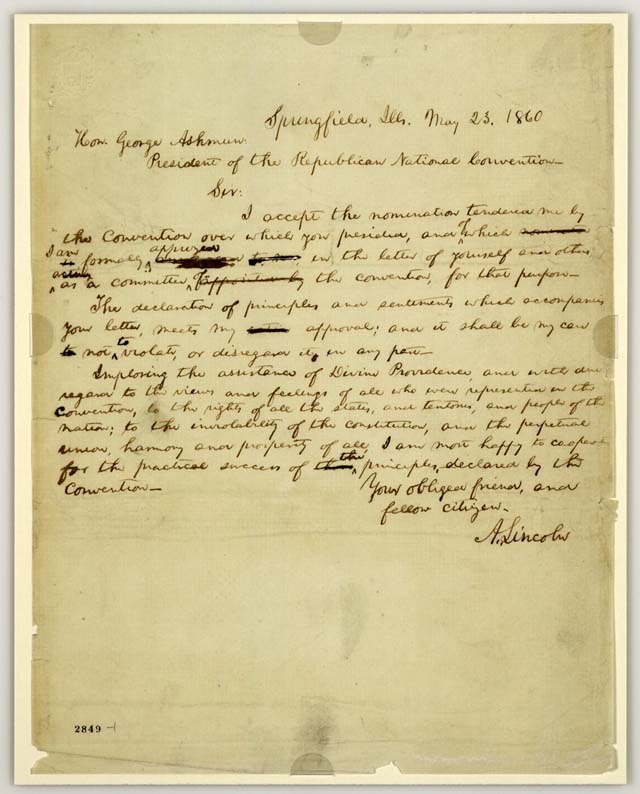
Abraham Lincoln's letter to the president of the Republican National Convention of 1860, accepting the convention's nomination for the presidency.

Abraham Lincoln’s letter to the president of the Republican National Convention of 1860, accepting the convention’s nomination for the presidency. It was written, you will note, from Springfield, Illinois, 200 miles away from Chicago where the convention was held.

To prove to me the piety of Abraham Lincoln, a fellow showed me photograph of a plaque on a church in Chicago, said to be the church where Abraham Lincoln said his prayers every morning during the Republican Convention of 1860, at which Lincoln got the nomination for president. Other records — newspapers, Lincoln’s letters and other documents, show that, as was the fashion in 1860, Lincoln did not attend the convention in Chicago, but as a candidate for president, stayed at home in Springfield, nearly 200 miles away.

Most real history can be read in documents, and does not need to rely on folk retellings exclusively.

5. The author says a belief is credible because it has endured for some time, or because many people believe it to be true.

Faced with the evidence that a dozen quotes he had attributed to figures such as James Madison, George Washington and Patrick Henry were whole cloth inventions, Texas quote-purveyor David Barton issued a statement urging people not to rely on them because they were “questionable.

A great example of belief triumphing over fact presents itself as the Cardiff Giant, now on display at the Farmers’ Museum in Cooperstown, New York (go visit when you visit the Baseball Hall of Fame). After an argument with a cleric over whether the Bible’s claim that giants once existed, a tobacconist named George Hull hired stonecarvers to carve a giant; then he hired a farmer to bury the carving on his farm, and claim to have struck it when planting. Once discovered the “petrified man” was put on display, for a fee. Hull got lucky: Syracuse businessmen offered to buy it from him for an enormous sum.

Paleontologist Othniel Marsh inspected it on display, and pronounced it a hoax. For some odd reason, that increased the popularity of the attraction. Carnival and side show entrepreneur P. T. Barnum offered $60,000 for the carving, but was refused. Barnum then had a plaster replica made and put on display. The owners of the original hoaxed carving sued, but the suit was thrown out because they could not demonstrate the “genuineness” of their own hoax.  Barnum made more money than the original.  A hoaxed hoax is even more popular than the truth.

A photo (staged?) of the 1869 unearthing of the Cardiff Giant (Cardiff, New York). Photograph courtesy Farmers Museum via Associated Press, and via National Geographic.

A photo (staged?) of the 1869 unearthing of the Cardiff Giant (Cardiff, New York). Photograph courtesy Farmers Museum (where the carving now rests, on display to museum visitors)  via Associated Press, and via National Geographic.

6. The author has worked in isolation.

Historians often help each other. Good historians put out queries to many sources, the better to assure accuracy. So, conversely, if there are only a few people who know anything about an account, that fact alone may cause suspicion. Clifford Irving’s hoax biography of Howard Hughes, while remarkably accurate in some regards, was unraveled when enough people familiar with Hughes called the bluff — including, of course, Hughes himself. The book got as far as it did with extreme secrecy on Irving’s part. Working alone makes error easier, and is essential for intentional frauds.

7. The author must propose a new interpretation of history to explain an observation.

Various conspiracy claims require that key people act counter to their known character. If Franklin Roosevelt had “allowed” Pearl Harbor to occur in order to get the U.S. into war, his actions over the previous six years to support Britain start to make little sense. Had Lyndon Johnson been part of a conspiracy to assassinate John Kennedy, his later carrying out the legislative plan of Kennedy runs contrary to all such motivations. If the founders of the U.S. actually intended to make Christianity the state religion, their efforts to disestablish the churches in all 13 colonies, efforts to write bills of rights for each state including freedom of religion, and efforts to create the First Amendment in the Bill of Rights seem like incredible, repeated errors.

Bogus history is much like the conjectured problems that result from time travel: Change one jot of history, and there is a cascading effect on later events. In many cases,were the bogus histories accurate, what follows could not be so, and we wouldn’t be here to discuss it.

Those are the seven warning signs of bogus history. Bogus, or voodoo history should be suspected if two or more of the signs are present — though it is quite possible for actual history to show more than two signs (perhaps actual history could show all seven signs — but I’d have to see an example before stating it’s so).

More:


Encore post: Recognizing bogus history, 1

July 3, 2007

While traveling this week, I’ll feature a few blasts from the past — posts that may merit new attention. This post comes from a two-part series in August 2006:

Recognizing bogus history, 1

Robert Park provides a short e-mail newsletter every Friday, covering news in the world of physics. It’s called “What’s New.” Park makes an art of smoking out bogus science and frauds people try to perpetrate in the name of science, or for money. He wrote an opinion column for the Chronicle of Higher Education published January 31, 2003, in which he listed the “7 warning signs of bogus science.”

Please go read Park’s entire essay, it’s good.

And it got me thinking about whether there are similar warning signs for bogus history? Are there clues that a biography of Howard Hughes is false that should pop out at any disinterested observer? Are there clues that the claimed quote from James Madison saying the U.S. government is founded on the Ten Commandments is pure buncombe? Should Oliver Stone have been able to to more readily separate fact from fantasy about the Kennedy assassination (assuming he wasn’t just going for the dramatic elements)? Can we generalize for such hoaxes, to inoculate ourselves and our history texts against error?

Perhaps some of the detection methods Park suggests would work for history. He wrote his opinion piece after the Supreme Court’s decision in Daubert v. Merrell Dow Pharmaceuticals, Inc., in which the Court laid out some rules lower courts should use to smoke out and eliminate false science. As Park described it, “The case involved Bendectin, the only morning-sickness medication ever approved by the Food and Drug Administration. It had been used by millions of women, and more than 30 published studies had found no evidence that it caused birth defects. Yet eight so-called experts were willing to testify, in exchange for a fee from the Daubert family, that Bendectin might indeed cause birth defects.” The Court said lower courts must act as gatekeepers against science buncombe — a difficult task for some judges who, in their training as attorneys, often spent little time studying science.

Some of the Daubert reasoning surfaced in another case recently, the opinion in Pennsylvania district federal court in which Federal District Judge John Jones struck down a school board’s order that intelligent design be introduced to high school biology students, Kitzmiller v. Dover Area School District.

Can we generalize to history, too? I’m going to try, below the fold.

Here are Park’s seven warning signs, boiled down:

Park wrote:

Justice Stephen G. Breyer encouraged trial judges to appoint independent experts to help them. He noted that courts can turn to scientific organizations, like the National Academy of Sciences and the American Association for the Advancement of Science, to identify neutral experts who could preview questionable scientific testimony and advise a judge on whether a jury should be exposed to it. Judges are still concerned about meeting their responsibilities under the Daubert decision, and a group of them asked me how to recognize questionable scientific claims. What are the warning signs?

I have identified seven indicators that a scientific claim lies well outside the bounds of rational scientific discourse. Of course, they are only warning signs — even a claim with several of the signs could be legitimate. [I have cut out the explanations. — E.D.]

  1. The discoverer pitches the claim directly to the media.
  2. The discoverer says that a powerful establishment is trying to suppress his or her work.
  3. The scientific effect involved is always at the very limit of detection.
  4. Evidence for a discovery is anecdotal.
  5. The discoverer says a belief is credible because it has endured for centuries.
  6. The discoverer has worked in isolation.
  7. The discoverer must propose new laws of nature to explain an observation.

Voodoo history

Here, with thanks to Robert Park, is what I propose for the warning signs for bogus history, for voodoo history:

  1. The author pitches the claim directly to the media or to organizations of non-historians, for pay.
  2. The author says that a powerful establishment is trying to suppress his or her work.
  3. The sources that verify the new interpretation of history are obscure; if they involve a famous person, the sources are not those usually relied on by historians.
  4. Evidence for the history is anecdotal.
  5. The author says a belief is credible because it has endured for some time, or because many people believe it to be true.
  6. The author has worked in isolation.
  7. The author must propose a new interpretation of history to explain an observation.

Any history account that shows one or more of those warning signs should be viewed skeptically.

In another post, I’ll flesh out the reasoning behind why they are warning signs.


Insanity spreads through Article II agencies

June 26, 2007

From the Chicago Tribune:

White House press secretary Tony Snow said the president and vice president are not executive “agencies” and are therefore not covered under the executive order, but he stopped short of placing Cheney exclusively in the legislative branch. Snow He said the vice president has served “in an executive capacity delegated to him by the president” and noted that, constitutionally “there are no specified executive activities for the vice president,” and that his role “is a wonderful academic question.”

Chicago Tribune, “Emanuel seeks to cut funding for Cheney’s office, home,” June 26, 2007

Constitution of the United States, Article II, Section 1:

The executive Power shall be vested in a President of the United States of America. He shall hold his Office during the Term of four Years, and, together with the Vice President, chosen for the same Term, be elected, as follows . . .


Whither history?

June 25, 2007

Very few high school students say they want to grow up to be historians. As a profession, we ignore history.

Still, a few do. More seriously, what happens in the high school class depends a lot on what is being done by professional historians. What is that?

Historian Keith Thomas wrote a long piece about where history is headed for The Times of London, in October 2006. It even has hints about it of how to make history more intrigueing in high school. Go see. Read the rest of this entry »


Bogus science palace puts blot on Memorial Day remembrances

May 27, 2007

There’s not much to add, beyond the three-quarters of a hundred entries in the one time Ken Ham’s Creation Museum blog carnival, hosted at Pharyngula by P. Z. Myers.

Those we honor on Memorial Day fought, and died, to preserve Ken Ham’s right to believe any fool thing he wants to believe.  That’s part of the ironic beauty of our Constitution and those who fight to defend it.

Having a right to believe any fool thing, and promoting fool ideas with $27 million given by people who expected one to tell the truth, are probably separate, different things.


Mining the Internet Archive: Tobacco, history and controversy

May 22, 2007

European Union rules require member states to do something about indoor air pollution. European states are banning smoking in public places. Gone soon will be days when we can joke about Britons and their Player’s cigarettes, or the French and their Galois habits.

Every once in a while as I recount the great Tobacco/Health Wars, my kids remind me that they never saw a cigarette commercial on television. Once, we caught a showing of past ads, and I was truck nostalgic by Fred Flintstone’s testimony for Winston cigarettes — the kids gasped: “Fred Flintstone used to smoke!”

Everybody smoked, once upon a time, it seemed. 1940s and 1950s magazines have ads in which doctors and athletes claim cigarette smoking is either unharmful, sheer pleasure, or even health promoting. Got a cigarette cough? Switch to menthol cigarettes! Mouth burns? Try a filter cigarette.

Today, kids wonder why Virginia did so well selling tobacco to Britain — who in their right mind would have smoked? they ask.

The Internet Archive has an abundance of film material on tobacco. The films come from the University of California – San Francisco: Read the rest of this entry »