Back to the Eisenhower era? It’d be a smash

November 9, 2010

Sen.-elect Rand Paul wants to take us back to the Eisenhower era?  Too much regulation, “strangling business,” he says?

See what the Eisenhower-era Chevrolet does versus the Obama-era Chevrolet — Insurance Institute for Highway Safety crash tests:

There.  Feel safer?

Tip of the old scrub brush to Mary Almanza.


Fatal flaw in American politico-economic system, that schools could fix, but won’t

November 7, 2010

. . . unless we change them soon, and in a fashion much different from what Arne Duncan wants.

John Quiggin, again:

Contrary to the cherished beliefs of most Americans, the United States has less social mobility than any other developed country. As Ron Haskins and Isabel Sawhill of the Brookings Institution have shown, 42 percent of American men with fathers in the bottom fifth of the income distribution remain there as compared to: Denmark, 25 percent; Sweden, 26 percent; Finland, 28 percent; Norway, 28 percent; and Britain, 30 percent. The American Dream is fast becoming a myth.

Tea Partiers, most of them, believe they have a vested interest in keeping things that way, to preserve their own modest economic achievement.  And those at the top?  They delight in a little bit of “Let’s You and Him Fight.”

Quiggin’s article at Foreign Policy introduces five of the ideas in his new book, Zombie Economics; well worth the read.


Veterans Day 2010 — why not volunteer to help veterans other days, too?

November 7, 2010

Video from the Veterans Administration:

More:


DDT: Zombie ideas of the right-winged and ill-informed

November 7, 2010

John Quiggin’s done with his book, Zombie Economics:  How Dead Ideas Still Walk Among Us.

Cover of John Quiggin's Zombie Economics

Cover of John Quiggin's Zombie Economics

Go buy a copy.  You will be happy you did.

Today, at Crooked Timber he’s looking at zombie ideas he was sure would eventually go away — like the bizarre, false idea that a lot more DDT should be used to fight malaria.

Is Quiggin ever wrong?


Badly-needed fable for our times

November 6, 2010

When you’re fed up with the hysteria that Glenn Beck offers instead of true history, when your neighbor complains about how government regulation should “get off my lawn,” point them to this story.

It’s truer than Beck, righter than Limbaugh, and it deserves a wider audience:

[YouTube=http://www.youtube.com/watch?v=sdhTumEUBN8&feature=player_embedded]

Tip of the old scrub brush to Crooks & Liars Video Cafe, John Gray in Cincinnati, Ohio (whoever he is), and to Thom Hartmann, the performer of the piece, who seems like a regular Joe on the level.

A transcript, below the fold:

Read the rest of this entry »


Conviction in Massachusetts church arson — hate crimes laws at work

November 4, 2010

Did you see this press release from the U.S. Department of Justice?  Prosecutors got a conviction in a 2008 arson of a church in Massachusetts.

Here’s the press release:

For Immediate Release
November 1, 2010

U.S. Department of Justice
Office of Public Affairs

Massachusetts Man Sentenced to Federal Prison for Burning African-American Church
WASHINGTON—Benjamin Haskell was sentenced by U.S. District Judge Michael A. Ponsor in Springfield, Massachusetts to nine years in prison and three years of supervised release for his role in the 2008 burning of the Macedonia Church of God in Christ, a predominately African-American Church, on the morning after President Barack Obama was elected as the first African-American president of the United States. In addition, Haskell will pay more than $1.7 million in restitution, including $123,570.25 to the Macedonia Church.

On June 16, 2010, Haskell, 24, of Springfield, pled guilty to conspiring to injure, oppress, threaten, and intimidate the mostly African-American parishioners of the Macedonia Church in the free exercise of the right to hold and use their new church building, which was under construction, and to damaging the parishioners’ new church building through arson and obstructing their free exercise of religion because of their race, color, and ethnic characteristics.

At the earlier plea hearing, a prosecutor told the court that had the case proceeded to trial, the government’s evidence would have proven that in the early morning hours of Nov. 5, 2008, within hours of President Barack Obama being elected, Haskell and his co-conspirators agreed to burn down, and did burn down, the Macedonia Church’s newly constructed building where religious services were to be held. The building was 75 percent completed at the time of the fire, which destroyed nearly the entire structure, leaving only the metal superstructure and a small portion of the front corner intact. Investigators determined that the fire was caused by arsonists who poured and ignited gasoline on the interior and exterior of the building.

Haskell confessed to the crime and admitted that prior to the presidential election, he and his co-conspirators used racial slurs against African-Americans and expressed anger at the possible election of Barack Obama as the first African-American president. Haskell admitted that after Obama was declared the winner of the election, he and his co-conspirators walked through the woods behind the Macedonia Church to scout out burning it down. Then, in the early morning hours of Nov. 5, 2008, Haskell and his co-conspirators went back to the church, poured gasoline inside and outside of the church, and ignited the gasoline.

“The freedom to practice the religion that we choose without discrimination or hateful acts is among our nation’s most cherished rights,” said Thomas E. Perez, Assistant Attorney General in charge of the Justice Department’s Civil Rights Division. “As seen here today, the Department will prosecute anyone who violates that right to the fullest extent of the law.”

“The burning of the Macedonia Church because of racial hatred and intolerance was a vicious attack on one of our most cherished freedoms—to worship in the religion of our choice safely and without fear of discrimination,” said U.S. Attorney for the District of Massachusetts Carmen Ortiz. “The successful investigation, prosecution, and punishment of those who committed this hateful act is a clear statement that law enforcement will do all in its power to protect our citizens’ civil rights.”

“While the Bureau of Alcohol, Tobacco and Firearms (ATF) is charged with investigating some of the most violent crimes, I consider the arson to be one of the most serious and dangerous offenses. Not only was this case about the burning of a house of worship, it cut to the very heart of our most valued rights, that of religious freedom. I want to acknowledge all of our partners who assisted in bringing the individuals responsible for this fire to justice,” said ATF Special Agent in Charge Guy Thomas.

“Today’s sentencing represents just one more step toward closure and healing, not only for the victims of this hate crime, but for the Springfield community as a whole. The FBI, along with its federal, state, and local law enforcement partners, remains committed to protecting each and every citizen’s civil rights, and will aggressively investigate any violation of those rights, bringing the perpetrators to justice,” said Richard DesLauriers, Special Agent in Charge of the FBI.

The case was prosecuted by Assistant U.S. Attorneys Paul H. Smyth and Kevin O’Regan of the U.S. Attorney’s Springfield Office, and Nicole Lee Ndumele, Trial Attorney in the Department of Justice’s Civil Rights Division.


You have a friend in the Bill of Rights Institute . . .

November 3, 2010

. . . or should have.

Bill of Rights Institute

Click here, "friend" the Bill of Rights Institute

Bill of Rights Institute does good work.  They’re looking for a few friends on Facebook — they want at least 2,010 friends by the end of 2010.

They’re over 1,100 now.  Go see if you can’t get them to their goal by the end of the week, eh?  If you’re on Facebook, go give them the thumbs up.


November 2: Remember to vote. Remember

November 2, 2010


Rick Perry is the new Corrupt Bargain

November 1, 2010

The fiercely independent Democratic Blog of Collin County compiled a series of Burnt Orange Report posts that make the case that Rick Perry should be retired from the governorship, at a bare minimum.

Will voters wake up before Tuesday, and do the right thing?

Rick Perry’s Cover-Up and Corruption

From the BOR:

Rick Perry’s Cover-Up and Corruption: Texas’ Dropout Crisis

Rick Perry’s Cover-Up and Corruption: Texas Forensic Science Commission

Rick Perry’s Cover-Up and Corruption: Ethics Complaints

Rick Perry’s Cover-Up and Corruption: Emerging Technology Fund

Rick Perry’s Cover-Up and Corruption: Political Appointees

Rick Perry’s Cover-Up and Corruption: Secret Schedules

Rick Perry’s Cover-Up and Corruption: The $500,000 Land Deal

Rick Perry’s Cover-Up and Corruption: Texas Youth Commission

Rick Perry’s Cover-Up and Corruption: Teacher Retirement System

Rick Perry to Launch National Book Tour, Won’t Commit to Full Term as Governor

Bonus points if you know off the top of your head where “corrupt bargain” plays in U.S. political history.


WWII veterans tell their stories – Central Florida WWII Museum

November 1, 2010

Part of the Veterans History Project, a museum in Florida interviews World War II veterans, and much of the material shows up on YouTube.

These interviews offer great resources for student projects, and are simply a grand way to capture history.

See this story about “Flying the Hump,” transporting war materiel over the Himalayas into China; it’s an interview with E. W. “Bill” Cutler, one of the fliers who survived:

This interview caught my attention for a personal reason.  My uncle, Bruce Davis, died flying the route.  His aircraft and remains were recovered more than 30 years later — someone stumbled on the wreckage accidentally.  When an aircraft went down for any reason (usually weather), the crews passed into a limbo that comprised a special hell for their families.  It was almost impossible that anyone would survive, as Cutler details.  But, with no wreckage and no remains, there were always questions.

Update: Brother Dwight informed me his father-in-law served at the last base before the airplanes went over the mountains.  We have more family Himalayan connections than I knew.

This interview has a mere 152 views as of this posting — pass it around, let’s bump the viewing total up, and get the story out.  At YouTube, the Central Florida WWII Museum has its own channel, listing several similar interviews.

I could see each student assigned to one interview, to tell the story of the interview to the class, to research the background of the theatre of war discussed, the battle, the incident, the armaments, the nations and people involved — to make a history narrative out of the interview, in other words.    What other uses do you see?

Here’s the rest of the story:  The museum has not yet been built.  This project, the video interviews, is a place-holder, a way to communicate while raising the money to build an edifice to honor the veterans more appropriately.  It’s a virtual museum — one your students may browse from the classroom.  How cool is that?


DDT or PCB?

November 1, 2010

One of the key hoax points of the pro-DDT crowd claims that most early studies on the harms of DDT — from 1945 into the 1970s — must be dismissed because chemists then could not distinguish DDT from PCBs.

Chemically, were that the case at any point, modern methods of spectrophotometry would allow the retesting of tissues, or egg shells, or anything sampled years ago.   Why not retest?

I stumbled into this interview with Art Cooley, one of the early activists with the Environmental Defense Fund (EDF) (now just “Environmental Defense”).  In it, Cooley said that EDF had been able to establish that DDT can be distinguished from PCBs.

Which case is he talking about, in Wisconsin?  What was its outcome?  Which research papers, where, discuss how to tell DDT from PCBs?  This appears to be one more point where the hoaxsters exploited a general lack of specific information about a case.  What will the record show?

Climate Action Can’t Rest: Q&A with Art Cooley

August 12, 2010 | Posted by Sam Parry in climate action report

Sam Cooley, a founder of EDF

Art Cooley, one of EDF's founders, offers his perspective on the climate fight and the road ahead.

With the Senate apparently giving up on its efforts to pass a strong climate and energy bill this year, we took some time to talk with several EDF experts to help provide a broader perspective and describe some of the other important ways we are fighting to cut global warming pollution.

We begin this series with Art Cooley, who helped found EDF in 1967 to campaign against the use of DDT. Art remains on EDF’s board as a founding trustee.

Question: You helped found EDF more than 40 years ago. Can you tell us a bit about the early years and what EDF’s mission has been since?

We originally got started because we were concerned about the decline of ospreys on Long Island. We started by looking at the science and the case we put together — the effect on brown pelicans and peregrine falcons and bald eagles and ospreys — was compelling. It was DDT.

In one of our first cases in Wisconsin they tried to confuse the debate and tell us that we couldn’t differentiate between DDT and PCBs. Well, we plotted out evidence and showed that in fact yes we could tell the difference, and so weren’t confusing the effects from DDT with other chemicals.

That focus on science has always been central to our work. And getting the science right remains at the core of our mission today, which is why we are all so concerned about climate change.


New paradigm for education

October 31, 2010

Not sure where this guy, Sir Ken Robinson,  is going — nor especially how it would relate to education in the U.S. (this group is from Britian — hear the accent?).

The animation is great — I’d love to have someone who could do this for quick history lessons to correspond with what we’re supposed to be doing on the curriculum calendar.

Plus, of course, he’s right.  We need less standardization, and more personalization.  Firing teachers frustrates both ends of that equation. He’s right — the schools are headed in the wrong direction.

I’ll wager Arne Duncan has never seen this.  Any of our old friends at Education know?  I’ll wager this speech and film drop into the abyss, regardless the credentials of Sir Ken Robinson and the good intentions of RSA.

RSA is the acronym for the clumsily-named Royal Society for the encouragement of Arts, Manufactures and Commerce.  “RSA” is a deft recovery from such a nomenclaturical handicap.

This RSA Animate thing has some potential — a lot like some of the animation schemes used by network news.

Resources:


Washington, by Ron Chernow – great scholarship, a good read, significant light

October 28, 2010

Welcome, Book Tourists!  This is the last stop on a virtual book tour for Ron Chernow’s biography, Washington.

Virtual cocktails afterward, I hope.  Then sit down and read the book.

In a piece of great fortune for me, six years ago I spent a week at Mount Vernon, George Washington’s home in Virginia, through the good graces of the Bill of Rights Institute and the National Endowment for the Humanities, studying George Washington’s role in the creation of the U.S. Constitution.

Cover of Ron Chernow's book, Washington

Washington, by Ron Chernow. Penguin Press, 2010; 906 pages, $40.00

My academic interest leaned more toward James Madison’s role.  I thought then, and I still think, that Madison deserves a good, popular biography to complement the great recent work of others on the American Revolution and post-revolutionary organization of the nation.  We’ve had recent books by Edmund Morris, Ron Chernow, David McCullough, Joseph Ellis, Walter Isaacs  and others on Franklin, Jefferson, Adams, the “founding brothers,” Hamilton and Washington.   But for Garry Wills’ short and crabby assessment of Madison’s presidency, I am unaware of a good, popularly-readable Madison book.    As a professional journalist, as a civil libertarian, as a lawyer and occasional investigator, my studies of the era favored Franklin, Jefferson and Madison.  George Washington took the center stage, in my conception of events, while those working around him and in the wings frantically worked to put on the production that made America and allowed Washington to play the role of a hero, the face of the “Father of His Country” role — while the truth was that such success really did have many fathers.

For most history purposes in elementary and secondary schools, for most of the past 200 years, Washington is the easy center of attention, and I suspected a different story.  Jefferson wrote better, and more thoughtfully, did he not?  Madison’s legislative work in Virginia alone shone above Washington’s.  Washington had military experience, and he managed to cling on through the revolution — but his role as president was often more as a referee between the great creative forces driven by Hamilton, Madison and Jefferson.

What I hoped to find at the Mount Vernon meetings were sources to reveal the true role of James Madison — maybe I could get the story together and write it myself.

Simply put, I was not prepared to confront the genius of Washington, nor did I appreciate the depth of his involvement in so many areas where our common understanding of history simply gave Washington the title of hero, but without telling much of the backstory.

I looked for the evidence of Madison’s genius.  What I found was the overwhelming evidence of Washington’s genius, too.

Washington’s economic genius now displays proudly at Mount Vernon, with the reconstruction of his 16-sided barn for wheat thrashing, and with the reconstruction of the distillery which made the man who put down the Whiskey Rebellion, ironically, the leading distiller of whiskey in America shortly before his death.  I learned that Washington got out of tobacco a decade before the revolution, because he didn’t like the economics of sending a crop to agents he did not fully trust in London, for sales in markets whose prices he could not track, for sales to purchasers he could not see.  Instead, he took his business into wheat, a commodity much in demand since most other farmers locally grew tobacco.  Washington became a leading wheat producer, and grew richer as a result of that and other similar decisions of clear-thinking economics.  By the end of his life, he was producing a surplus of wheat — which excited his Scotland-born farm foreman, who had a recipe for whiskey.

Washington was not merely the frontman for the convention in Philadelphia in 1787.  It became clear to me that he was a driving force, introducing Madison to Hamilton, and mentoring both in their work to get the convention approved, and then to get the Constitution written and ratified.   Washington had financial interests in seeing a great, united nation out of the 13 colonies:  He had land in the Ohio River Valley to sell, to get rich, if only there were an authority to made transportation into the valley hospitable to settlers, and transportation out to let those settler farmers get rich from their produce.   Washington’s vision, I learned, was much greater than I had understood.

Ron Chernow’s thick biography of Alexander Hamilton excited historians in 2004.  As studies of Jefferson lead to studies of Madison, and vice-versa, so do studies of Hamilton inevitably lead to studies of Washington.  We are fortunate that Chernow wrote the thick biography of Washington, the first great study of the man for the 21st century.

Chernow’s Washington, A Life (2010, Penguin Press, 906 pages) is every bit the great study of Washington we need and can use.  My bias as a teacher of high school students leans toward usefulness in the classroom — a higher standard than most imagine, since, for a high school classroom, a book must be eminently readable as well as accurate and clear.

Chernow had me at the Prelude.  In a brisk five pages he tells the story of Gilbert Stuart, an often-economically-bereft artist who saw fortune in Washington’s election.  Stuart arranged to get the great man to sit for a portrait — Washington did not like it — but Stuart never finished Washington’s commission in Washington’s life.  Instead, Stuart used the portrait to copy, for others.    Stuart’s fortune came not from Washington, but from the vast throng of Washington admirers who would pay handsomely for an image of the man.  It’s a well-told story, and a great introduction to the lionizing of Washington and his image, the reality of the man who sat for the portrait, and the way history has treated the man and the myth.  [Courtesy of the New York Times, you may read the Prelude, here.]

Readers of McCullough’s 1776 know of some of Washington’s genius at war, and some of his attention to details of making things work right — whether it be the way latrines were dug so an army could relieve itself and avoid disease, or the the exact tints of the color of green paint applied to the massive dining room he had added to the house at Mount Vernon.  McCullough’s book is a taste, a sampling of the work Chernow has.  One may compare Chernow’s story-telling ability to McCullough’s, and Chernow may suffer a bit.  For Washington, the drama is so often in the details, however — and details we have, galore.

Is it too much detail?  For the life of another, it may be.  Not for Washington.  Chernow is able to make readable even the details.  One may open this book at any page, start with a paragraph, and learn something about Washington — most often, learning something one did not know precisely before.  Chernow relied on the massive project at the University of Virginia to publish all the papers of Washington, collected from various sources.  Washington had not been quite so assiduous as Jefferson in making copies of everything he wrote for posterity, though much he was an assiduous diarist and taker of notes.  No biographer before had the advantage of the catalogueing done at Virginia, nor perhaps of the scope of the material there.

For this reason alone, this book should be read.

Chernow’s portrait is painstaking.  What emerges in the end is a George Washington whose vanity would be quirky and irksome in others, but necessary to the building of the image history graces to him, as the standard-bearer for the founders of the nation, truly the Father of His Country.  The vanities quickly become clear as careful consideration by a man who understood, especially as president, that each move he made would be a precedent for those who would follow, he hoped.   One example:  Washington’s work on the bank bill of 1791, made possible as we know by the dinner at Jefferson’s where Hamilton and Madison struck the bargain that sited the District of Columbia on the Potomac, and set up the finances that would make the nation successful in business and international relations over the next 200 years.

Though he had sat through every session of the Constitutional Convention, Washington did not pretend to expertise in constitutional nuances — he nce wrote that he had ‘had as little to do with lawyers as any man of my age” — and engaged in much hand-wringing over the bank bill.  He would be forced to issue a black and white opinion that would alienate some, gratify others, and irrevocably shape the future government.  He called in Madison, supremely well versed in the Constitution, for a series of quiet, confidential talks.  “The constitutionality of the nation bank was a question on which his mind was greatly perplexed,” Madison would recall, noting that Washington was already biased in favor of a national bank and “a liberal construction of the national powers.”  On the other hand, Washington was shaken by uncompromising verdicts from Randolph and Jefferson and asked Madison, as a precaution, to draft a veto message for the bank bill.

When Washington turned to Hamilton, he made plain that, unless he could vanquish the arguments of Randolph and Jefferson, he planned to veto the bank bill, telling him that he wished to “be fully possessed of the arguments for and against the measure before I express any opinion of my own.”  By this point Washington knew the vigor of Hamilton’s mind and his extraordinary knack for legal argument.  In little more than a week, Hamilton, in a superhuman burst of energy, produced more than thirteen thousand words that buried his opponents beneath an avalanche of arguments.  His exegesis of the “necessary and proper” clause not only made way for a central bank but would enable the federal government to respond to emergencies throughout American history.  Hamilton interpreted the “necessary and proper” clause to mean that “every power vested in a government is in its nature sovereign and includes, by force of the term, a right to employ all the means requisite and fairly applicable to the ends of such power.”  In other words, the Constitution gave the federal government not only the powers explicitly enumerated but also a series of unstated or “implied powers” indispensable to attain those ends.  (circa page 649)

Two paragraphs, easily read without seriously taxing the vocabulary of an SAT-studying high school junior.  They clearly detail Washington’s care in analyzing all sides of an issue.  They reveal Washington’s ability to harness the good work of men of greatly differing viewpoints, to the enlightenment of Washington and benefit of the nation — which benefit likely would not have occurred had another man been in Washington’s place (can you imagine anyone else mediating Madison and Hamilton — and keeping them both as friends?).  Chernow gracefully slips from telling a good story to providing scholarly details (I have omitted footnotes here), but not in an eye-glazing fashion — weaving the scholarship into a story fantastic enough that it would not sell for fiction, as Twain warned because it does not stick to the probabilities.

A few years ago a student offered what I considered a great insight.  We were comparing the American Revolution to the French Revolution; naturally, considering the Reign of Terror and the rise of the dictatorial Emperor Napoleon, students wondered where the French went wrong, and where the Americans got luck and went right.  Israel Pena summed it up neatly:  “The French didn’t have George Washington.  Americans came out of their revolution with George Washington; France came out of their revolution with Napoleon.”

Napoleon would have done well to have studied George Washington.

It is reported that when King George III learned that Gen. George Washington had, at the end of the American Revolution and the peace treaty negotiations, resigned his commission to the Continental Congress, the news was met with disbelief.  Washington improbably held together a ragamuffin mob of an army, disciplined them into a fighting force, and through evasion tactics, inspiration and sheer luck, and great aid from the King of France and the French Navy, defeated Great Britain in a war where no one, probably  including Washington had thought it possible to do so.  Many Europeans expected Washington would assume the crown of America and have himself declared king.

Instead, following the story of his Roman hero, Cincinnatus, Washington declined the power, deferring to civilian and more democratic rule, sublimating military might and prowess to the greater powers of reason.  (Washington, following Cincinnatus again, bowed out after two terms in the presidency — the power of story and early education over the fate of a nation.)

King George said he didn’t believe the news.  “But if it is true, [Washington] is the greatest man who ever lived.”

Without unnecessary shine, Ron Chernow has written more than 800 pages of the brief for the case proving King George’s judgment.  In these times, when people claim to wish to follow Washington and the Constitution, we would do well to study what Washington said, wrote and did, and how he came to create the Constitution and the nation it frames.

Note: My review copy did not include an index. The book, Washington covers the man as an encyclopedia.  For the sake of high school teachers and researchers, I hope an index comes with the published text.

More, and resources; other reviews:

Other stops on the virtual book tour:


Quote of the moment: Lewis Carroll on Republican politics, climate skeptics, DDT advocates and creationism

October 26, 2010

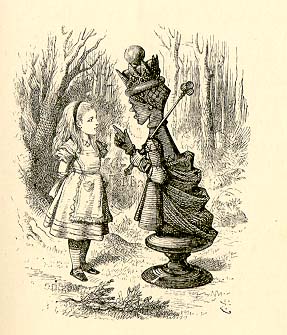
Alice and the Red Queen

Alice and the Red Queen – illustration by Sir John Tenniel

Alice laughed: “There’s no use trying,” she said; “one can’t believe impossible things.”

“I daresay you haven’t had much practice,” said the Queen. “When I was younger, I always did it for half an hour a day. Why, sometimes I’ve believed as many as six impossible things before breakfast.”

Charles Lutwidge Dodgson, writing under the name Lewis Carroll,
Alice in Wonderland, 1866

[Yes, the illustration is from Through the Looking Glass, 1871]


How to tell the textbook approval process is broken: Virginia’s voodoo history

October 25, 2010

4th graders in Virginia could learn from their history texts that thousands of African Americans formed battalions in the Confederate Army and fought to save the South, during the Civil War — entire battalions under Gen. Stonewall Jackson.

That’s what the book claims, anyway.  It’s fiction.  The author fell victim to a hoax.

Kevin Sieff exposed the book in The Washington Post last week.  Virginia education officials quickly moved to discourage teachers from teaching the erroneous passages.  Some education authorities pulled the books.  The incident exposes problems in the textbook approval processes popular in southern states.

If you had hoped textbook craziness was confined to Texas, you know better now.

More: