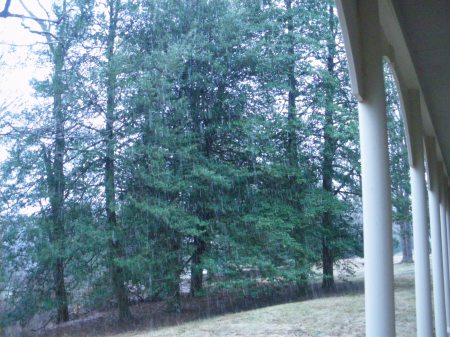
The photos don’t show the beauty, nor do they capture the wonderful quiet that accompanied it.
It snowed briefly and lightly at George Washington’s home at Mount Vernon Friday morning.
Snow at the Quarters, Mount Vernon, Virginia, March 13, 2009 - copyright Ed Darrell
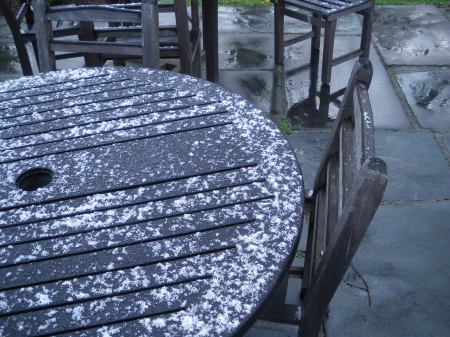
Al fresco dining would have been cool, and wet.
Snow on tables, The Quarters, Mount Vernon, Virginia - copyright 2009 by Ed Darrell
Inside, a few minutes later, the conversation was hot. We opened with a session the night before, and post-dinner meeting with William B. Allen, the editor of a recent collection of George Washington’s papers. Allen is suave, with a perfectly-modulated baritone voice. He doesn’t just speak in properly punctuated, grammatically correct paragraphs. He speaks in chapters that summarize volumes.
Among other telling gems, Allen noted that Washington, who is often regarded as an intellectual inferior to Jefferson, Madison, Franklin, Hamilton and others, because he “wrote so little,” has had his collected published papers now pass the 100 volume mark. Reading the letters in full, as we did much of at this meeting, reveals Gen. Washington as little else can.
A quick snippet of learning from my stay at Mount Vernon:
How many places are named after Washington? How many schools?
At the relatively new museum here I found a display that notes how Americans have honored our First President by naming things after him:
26 mountains
740 schools
155 places (the exhibit said “155 cities and counties,” but the map also showed the State of Washington)
(All of this comes without the aid of a George Washington Legacy Project to inflate his importance and the love of Americans for his work!)
George Washington can still lay claim to his friend Richard Lee’s eulogy, as “first in the hearts of his countrymen.”
I found the display on place names on the way out of the Education Center — a place designed to help visiting teachers learn about resources available for classroom use.
Of course the group works to help teachers who can’t visit at the moment, too. To that end they’ve published online a series of lesson plans developed by the George Washington Teachers’ Institute, a summer residency program that provides professional development.
[This is an Encore Post, from August 2007 — just as it appeared then. See especially the links on textbook selection processes, and “cargo cult” science, at the bottom.]
NOVA had a couple of good programs on Richard Feynman that I wish I had — it had never occurred to me to look at YouTube to see what people might have uploaded.
By then, of course, Feynman was one of my heroes. His stories are useful in dozens of situations — his story of joining the samba bands in Rio testify to the joy of living, and the need for doing new things. Brazil was also the place he confronted the dangers of rote learning, when students could work equations perfectly for examples in the book — which they had memorized — but they couldn’t understand real world applications, such as describing how the sunlight coming off the ocean at Ipanema was so beautiful.
Feynman wrote about creationism, and about the dangers of voodoo science, in his now-famous essay on “Cargo cult science” — it’s so famous one has difficulty tracking down the facts to confirm the story.
Feynman’s stories of his wife, and her illness, and his love for her, were also great inspirations. Romance always gets me.
I failed to track him closely enough. During the run of the President’s Commission on Americans Outdoors, we had the misfortune of having scheduled a hearing in Orlando on January 30 (or maybe 29), 1986. We had hoped that the coincidental launch of the Space Shuttle Challenger on January 28 might boost our press response. Of course, the Challenger exploded. Our hearing went on as planned (we had a tough schedule to meet). The disaster affected our staff a lot, those who were in Florida, and the rest of us in Washington where many of us had been on the phone to Florida when the disaster occurred.
Feynman’s appointment to the commission studying the disaster was a brilliant move, I thought. Our schedule, unfortunately, kept me tied up on almost every day the Challenger commission met. So I never did walk the three blocks down the street to meet Feynman, thinking there would be other opportunities. He was already fatally ill. He died on February 15, 1988. I missed a chance of a lifetime.
We still have Feynman’s writings. We read the book aloud to our kids when they were younger. James, our youngest and a senior this year, read Surely You’re Joking again this summer, sort of a warmup to AP physics and his search for a college. [2009 Update: James is studying physics in the wilds of Wisconsin, finals week at Lawrence University next week — study hard, and good luck, James!]
BBC made portions of The Pleasure of Finding Things Out available for free online. These interviews include a short video of his explaining how a scientist can perceive the beauty of a flower at many different levels, beyond the artist’s view — a testament to science as a way of knowing AND appreciating life.
Officials are shooting for an April 20 starting date for the long-awaited cleanup of the Moab, Utah, mill-tailings pile.
U.S. Energy Department officials last week opened a 3,800-foot section of rail track they will use as a staging area for shipments of mill tailings from the pile to a disposal site to the north, near Crescent Junction.
A gantry crane capable of lifting 50 tons will pluck tailings-laden containers from trucks and place them on railroad cars on a ledge above the pile, which sits near the entrance to Arches National Park.
Why is this relevant to anything?
This tailings pile has been targeted for cleanup for at least 30 years. The story doesn’t say precisely, calling it “cold war” — it is partly a remnant of the uranium boom of the 1950s. It may date back to the 1940s.
And, according to the story:
The Energy Department has a 2028 target date for completion of work moving the pile. The cost is estimated to run as high as $698 million.
2028? Ten years of usefulness for the mine, another 60 years to clean it up. Some boom. Some bust.
You load 16 million tons [of radioactive and poisonous tailings], and what do you get? A site cleaner in Moab from uranium milled a half-century ago, and a warning to those who push nuclear power for the future damn-the-cost. There are costs.
1600 Pennsylvania Avenue. It sounds like a number Fred Waring’s Glenn Miller’s band could shout out at the end of instrumental verses. It’s the street address of the White House, not so secretly, and to most fans or other followers of politics, it carries great symbolism.
So a professor at the University of Akron thought it would be a good name for a blog. It is. The blog is a very good compilation of sources and intriguing commentary.
This item caught my eye yesterday — the least tawdry dealing with this issue I’ve seen in a long time, though some of the portraits pointed to are more impressionistic than history. The listing alone reveals a lot. It’s incomplete, of course. This is the one post probably not suitable for 8th grade U.S. history; it’s already come up in my government classes this year.
Check out the stuff in the widgets — the link to the current WhiteHouse.gov feed is a good idea, cool, and by its mere existence, an indicator of the influence of technology on politics.
I’m curious to know how one might use this blog in the classroom. Got ideas?
Spread the word; friends don't allow friends to repeat history.
Last month science won a victory when members of the Texas State Board of Education (SBOE) agreed to strip creationist, anti-science language out of biology standards.
New Texas Science Standards Will Be Debated and Voted Upon March 26-27 in Austin by the Texas State Board of Education — Public Testimony is March 25
Radical Religious-Right and Creationist members of the State Board of Education will attempt to keep the unscientific amendments in the Texas science standards that will damage science instruction and textbooks.
THE TEXAS SCIENCE STANDARDS SHOULD BE ADOPTED UNCHANGED!
The Black Ships — Commodore Matthew C. Perry’s squadron in Japan, 1854 – CSSVirginia.org image from Gleason’s Pictorial Drawing Room Companion, Boston, May 15, 1852 (also, see BaxleyStamps.com); obviously the drawing was published prior to the expedition’s sailing.
Commodore Matthew C. Perry in 1852 photograph, Library of Congress via WikiMedia
Within 50 years Japan would come to dominate the seas of the the Western Pacific, and would become a major world power.
1854 japanese woodblock print of U.S. Navy Commodore Matthew C. Perry. Peabody Museum: “The characters located across the top read from right to left, ‘A North American Figure’ and ‘Portrait of Perry.’ According to the Peabody Essex Museum, ‘this print may be one of the first depictions of westerners in Japanese art, and exaggerates Perry’s western features (oblong face, down-turned eyes, bushy brown eyebrows, and large nose).'” But compare with photo above, right. Peabody Museum holding, image from Library of Congress via WikiMedia
Then, 20 years later, on March 8, 1874, Millard Fillmore died in Buffalo, New York.
The Perry expedition to Japan was the most famous, and perhaps the greatest recognized achievement of Fillmore’s presidency. Fillmore had started the U.S. on a course of imperialistic exploitation and exploration of the world, with other expeditions of much less success to Africa and South America, according to the story of his death in The New York Times:
The general policy of his Administration was wise and liberal, and he left the country at peace with all the world and enjoying a high degree of prosperity. His Administration was distinguished by the Lopez fillibustering expeditions to Cuba, which were discountenanced by the Government, and by several important expeditions to distant lands. The expedition to Japan under Commodore Perry resulted in a favorable treaty with that country, but that dispatched under Lieut. Lynch, in search of gold in the interior of Africa, failed of its object. Exploring expeditions were also sent to the Chinese seas, and to the Valley of the Amazon.
Here we are in 2013, 160 years after the end of Millard Fillmore’s presidency, 159 years after Commodore Perry’s success on the mission to Japan Fillmore sent him on, 139 years after Millard Fillmore’s death, and not yet have we come to grips with Fillmore’s real legacy in U.S. history. Most of that legacy, we don’t even acknowledge in public. Santayana’s Ghost paces nervously.
Spread the word; friends don't allow friends to repeat history.
The story of Saturday, May 26, 1838, a day which began an event the Cherokees would call Nu-No-Du-Na-Tlo-Hi-Lu, “The Trail Where They Cried,” will be told from a new perspective at the premiere of “Trail of Tears” at 7:30 p.m., Tuesday, March 10, in the Davidson Auditorium at the School of Management.
Production background information is available on the PBS We Shall Remainsite.
The third film in the five-part We Shall Remain series produced by PBS’ American Experience, “Trail of Tears” takes a new look at the United States government’s forced removal of thousands of Cherokees from their homes in the Southeastern United States, driving them toward Indian Territory in Eastern Oklahoma.
Admission is free; seating is first come, first served. The film premiere will be followed by a panel discussion with We Shall Remain executive producer Sharon Grimberg; Native American filmmaker Chris Eyre; and series adviser Dr. R. David Edmunds, the UT Dallas Anne and Chester Watson Professor in American History.
Especially for AP history students, this panel should provide a lot of grist for the thinking mills on questions about civil rights, genocidal actions, duties of citizens, and migration, immigration and settlement of the U.S.
North Texas high school teachers and students have great luck living in an area that includes the University of North Texas, Texas Christian University, Southern Methodist University, the University of Texas at Dallas, the University of Texas at Arlington, and the University of Dallas. This film premiere is one more piece of that luck.
University of Texas at Dallas history professor, Dr. R. David Edmunds will take part in a panel discussion following the premiere of Trail of Tears.
It’s a compelling story that is often mistold. According to UTD’s press office:
For years, the Cherokee had resisted removal from their land in every way they knew. Convinced that white America rejected Native Americans because they were “savages,” Cherokee leaders established a republic with a Euro-American style legislature and legal system.
Many Cherokees became Christians and adopted Westernized education for their children. Their visionary principal chief, John Ross, would even take the Cherokees’ case to the Supreme Court, where he won a crucial recognition of tribal sovereignty that still resonates.
Though in the end the Cherokees’ embrace of “civilization” and their landmark legal victory proved no match for white land hunger and military power, the Cherokee people were able to build a new life in Oklahoma, far from the land that had sustained them for generations.
Edmunds, who is of Cherokee descent, is proud to be a part of the We Shall Remain crew because the series breaks with typical portrayals of Native Americans.
“The thing that sets the We Shall Remain series apart is its ability to get away from two of the biggest stereotypes of Native Americans: the Indian as a warrior and the Indian as a victim,” said Edmunds. “The portrayal of warfare between Native Americans and whites is abandoned for a view of the very civilized, very adaptive ways of the Cherokees, as they try to assimilate to imported culture in order to remain on their lands.
“Additionally, when you see ‘Trail of Tears,’ you’ll see Native Americans as actors in their own destiny. You’ll see them make decisions, which sometimes work and sometimes don’t, but it’s all part of the American experience.”
Spread the word; friends don't allow friends to repeat history.
Instead of a vitamin a day, Pest Control Executive Robert Loibl and his wife Louise start breakfast with a 10-mg. capsule of DDT. After 93 days on DDT, the North Hollywood, Calif., couple figured they had ingested as much of the pesticide (some 300 times more than the average daily intake) as persons consuming food dusted with the chemical would get in 83 years. “We feel better than we used to,” crows Loibl. “In fact, I think my appetite has increased since I began taking DDT.”
The Loibls’ experiment is designed to prove that DDT, which they claim is the most maligned of pesticides, is “harmless.” They believe that the environment is better served with spraying. On the surface, their consumption of DDT appears to have caused them no harm. Blood tests and urinalysis conducted by Government physicians, says Loibl, “showed nothing out of the ordinary.” But while the Loibls seem safe enough now, they could become ill in the future. More important, even if DDT is not immediately harmful to man, it is destructive to many beneficial insects and to some fish and birds.
Whatever happened to these people? My internet searches have not turned up any significant further information on either of the Loibls. Does anyone know?
Associated Press caption, presumably to an AP photo: Robert Loibl and his wife, Louise, hold 10-milligram capsules of DDT which they took in front of witnesses for 93 days at lunch time, June 10, 1971. Loibl said their total dosage was more than the average person consumes in 83 years. He said his wife’s dandruff disappeared, their appetites perked up and they feel better. Loibl said they just wanted to call attention to the public that DDT was safe. Image via Gizmodo.
I believe they lived in or near San Diego, perhaps in retirement, and I believe he owned or operated a pest control company there as well as farther north. Can anyone tell us what happened to the intrepid DDT eaters, the Loibls?
(This is an uncontrolled experiment, and probably dangerous. Kids, do not try this at home.)
What do you think? Was this a good idea? Does anyone know what happened to them?
More:
Most people tend to forget DDT was NOT banned due to human health effects, but was instead banned because, under the 1958 amendments to the Federal Insecticide, Fungicide and Rodenticide Act (FIFRA), it was found to be an uncontrollable poison, which was (is) banned under the law. Since the 1970s, however, human health effects of DDT became much better known. Perhaps the best survey was composed at the Alma Conference at Alma College, Michigan, in 2009. Known as the Pine River Statement, it was submitted for peer review and published in Environmental Health Perspectives, “ The Pine River Statement: Human Health Consequences of DDT Use”
The film’s credits say it was done by Michael Seltzer — it’s rather obviously a student production, but there is also a Dr. Michael Seltzer active in environmental protection. Are they related?
Anthony Watts want to make a case that rising ocean levels aren’t connected to human activities, there’s nothing we can do about it, there’s nothing we should do about it, or something. Looking for a touchstone in history, Watts said:
In 2002, the BBC reported that a submerged city was found off the coast of India, 36 meters below sea level. This was long before the Hummer or coal fired power plant was invented. It is quite likely that low lying coastal areas will continue to get submerged, just as they have been for the last 20,000 years.
Submerged city? Hmm. Not in the textbooks published since 2002. What’s up with that?
NASA Earth Observatory photo of the Gujarat Gulfs, including the Gulf of Cambay (Khambhat), where a "lost city" was thought to have been found in 2001; later research indicates no city underwater.
Oh, this is what’s up: Watts links to a BBC news story, not a science journal — one of the warning signs of Bogus Science and Bogus History, both. The news story talks about preliminary findings in 2002 that did not hold up to scrutiny. Measurement error was part of the problem — the pattern of the scanning radar sweep was mistaken for structures found on the sea floor. Natural formations were mistaken for artificial formations. When the news announcement was made, archaeologists and other experts in dating such things had not be consulted (and it’s unclear when or whether they were ever brought in). The follow-up didn’t support the story, notes Bad Archaeology. Terrible archaeology to support pseudo climate science? Why not?
This doesn’t deny Watts’ general claims in his post, but it is too indicative of the type of “find anything to support the favored claim of denial” mindset that goes on among denialists. (There is evidence of a much lower waterline in the area during the last ice age; water levels have risen, according to physical evidence, but probably not inundating the what would be the oldest civilization on Earth.)
It will be interesting to watch what happens. Will Watts note an oopsie and apologize, or will the entire group circle their Radio Super wagons around the issue and call it a mainstream science plot against them? Will Watts correct his citation, or will they move on to cite the disappearance of Atlantis as evidence that warming can’t be stopped?
Anybody want to wager?
What sort of irony is there in a guy’s complaining about a scientific consensus held by thousands of scientists with hundreds of publications supporting their claims, and his using one news report almost totally without any scientific corroboration in rebuttal?
How can you tell I’m behind the scope and sequence?
I was just reminded today of how neat this site is: Imaging the French Revolution. Good stuff comes out of George Mason University from time to time. This site is part of that stuff.
11. Le plus Grand, des Despotes, Renversé par la Liberté (Place Vendôme). [Place Vendôme, The Greatest of Despots Overthrown by Freedom] Source: Museum of the French Revolution 88.170 Medium: Etching and colored wash Dimensions: 17.2 x 24.4 cm Commentary (numbers refer to pages in essays): General analysis – Day-Hickman, 5 Reasonable crowd – Day-Hickman, 2
The convention delegates actually gathered on March 1, 1836, a month after they were elected and sent to Washington, a growing town on the Brazos River less than 100 miles northwest of what now is Houston.
The convention within weeks would adopt a constitution amid a swift series of events. While they were meeting, Travis and his men were killed at the Alamo. And just over another month later, Gen. Sam Houston’s army would defeat the Mexicans in the famous Battle of San Jacinto.
Author Jim Bevill found the order issued on March 2, 1836, for the first copies of the Texas Declaration of Independence in a collection donated to the Southern Methodist University library. The order had long been missing from the state archives. Photo by Michael Paulsen, Houston Chronicle
Bevill was doing research for his upcoming book, The Paper Republic, a history of the Republic of Texas from the viewpoint of economics rather than the usual military perspective.
The new Texas government was desperately short of money. Investors in New Orleans refused to give the fledgling country a loan until Texas officially declared independence from Mexico.
The document Bevill found was an order sent to San Felipe to have printers make five handwritten copies and 1,000 printed copies of the declaration.
Hope you have a good Texas Independence Day. We have grades due.
Or, until that account is unsuspended by the forces supporting Donald Trump: Follow @FillmoreWhite, the account of the Millard Fillmore White House Library
We've been soaking in the Bathtub for several months, long enough that some of the links we've used have gone to the Great Internet in the Sky.
If you find a dead link, please leave a comment to that post, and tell us what link has expired.
Thanks!
Retired teacher of law, economics, history, AP government, psychology and science. Former speechwriter, press guy and legislative aide in U.S. Senate. Former Department of Education. Former airline real estate, telecom towers, Big 6 (that old!) consultant. Lab and field research in air pollution control.
My blog, Millard Fillmore's Bathtub, is a continuing experiment to test how to use blogs to improve and speed up learning processes for students, perhaps by making some of the courses actually interesting. It is a blog for teachers, to see if we can use blogs. It is for people interested in social studies and social studies education, to see if we can learn to get it right. It's a blog for science fans, to promote good science and good science policy. It's a blog for people interested in good government and how to achieve it.
BS in Mass Communication, University of Utah
Graduate study in Rhetoric and Speech Communication, University of Arizona
JD from the National Law Center, George Washington University


 Posted by Ed Darrell





