Time to raise the minimum wage

June 21, 2013

Illustration for Bloomberg News by Rand Renfrow: $15 Minimum Wage

Illustration for Bloomberg News by Rand Renfrow: $15 Minimum Wage

Robert Reich put it succinctly at his Facebook site [links added here]:

Nick Hanauer, one of the nation’s most successful businessmen, proposed yesterday that the minimum wage be raised to $15 an hour. But wouldn’t that cause employers not to hire workers who were “worth” less, and thereby lead to higher unemployment? No, says Hanauer. By putting more money into the hands of more people, it would stimulate more buying — which would generate more jobs than any jobs that might be lost. Hanauer understands that the basic reason the economy is still limping along is workers are consumers, and workers continue to get shafted, which means consumers lack the purchasing power to get the economy off the ground. A minimum wage of $15 an hour, combined with basic worker standards such as paid sick leave and a minimum of 3 weeks paid vacation per year, should all be in a national campaign for better jobs and a better economy in the 2014 election.

That’s the case, in brief.

Last March Reich said raising the minimum wage to $9/hour was a “no brainer.”

Alas, he didn’t account enough for the anti-brain lobby.

What do you think?

More:

Also good, an update:


Why are flags flying in West Virginia today? Statehood

June 20, 2013

On June 20, 1863, West Virginia joined the fractured union as the 35th state.

Yes, that was during the Civil War.  Yes, West Virginia had been the northwestern counties of Virginia.  No, I’m not sure of the history of how Congress decided Virginia had consented to be divided.

In any case, per the guidelines in the U.S. Flag Code, West Virginians should fly the U.S. flag today in honor of their statehood, 150 years ago.  Lots of celebrations, reenactments, and general festive events are planned in West Virginia this weekend.

West Virginia's State Capitol in Charleston, West Virginia, on December 11, 2011

West Virginia’s State Capitol in Charleston, West Virginia, on December 11, 2011 — built in 1931. From O Palsson’s Flickr collection: “As I was traveling through Charleston, the capital of West Virgina, during blue hour (my favorite time of day) a couple of days after Thanksgiving, I happened upon this beautiful sight of the State Capitol Building reflected in the Kanawha River flowing by in total stillness, so I just had to stop and capture the scene. I didn’t have a tripod handy, so this is not a long-exposure nightshot, just a regular hand-held shot accomplished by bumping up the ISO as much as I dared to get correct exposure at acceptable shutter speed (ended up being 1/40 sec) and doing my best to keep the camera steady.”

Kathryn and I have a few fond memories of Charleston.  Then-West Virginia Attorney General Charlie Brown was one of the few with enough wisdom to offer me a job, when I graduated from the National Law Center at George Washington University as an older student.  Brown promised to clean up West Virginia politics, and he had a lively, very young crew of attorneys fighting coal companies, oil companies, loggers, shady real estate people, and corrupt city, county and state officials.  One fellow in the office complained that he’d “had to argue eight cases” at the State Supreme Court that year, in his first year out of law school.

But the corrupt officials knew what they were doing.  Brown could only offer $25,000 a year, and in Charleston it was unlikely we’d be able to find any work for Kathryn.  Tough to attract crime fighters at less-than crime-fighting rates. It would have been a more than 75% cut in income.  We made a trip there to mull it over, baby on the way (pre-digital photographs buried here in the archives).  Brown got a special dispensation to offer $5,000 more.

Great tour of the Capitol, great interviews with the office lawyers.  Kathryn and I sat for a long while in the deserted West Virginia Supreme Court (sort of tucked into an attic of the Capitol) discussing how in the world we could afford to move the Charleston and take on the work.  We drove around the city, looking at houses for sale and rent; we gazed at the Kanawha River and discussed the future for the city.

We went to dinner in a tiny restaurant touted as Charleston’s finest, which was a long way from good eateries in D.C.  We discussed with our host the cultural pickings in Charleston.  We could give up the symphony but get back to fishing and practice fly fishing . . .

A few tables over, the maitre ‘d brought in a few extra chairs, and then seated Muhammed Ali and his party.  Our waiter asked that we not make a scene.

I don’t remember for what charitable purpose Ali was in Charleston, but the event was over and his hosts took him out to the good restaurant in Charleston, too.

Ali was a slower, sedate and gentle version of the fiery fighter he’d been.  Parkinson’s disease already had him in its grip.  His voice, soft as it could be at times, was still strong enough to carry across a table.  There was a young boy with the group, under five years old.  Ali had lost steps, but not spirit.  He produced a couple of balls from a pocket and proceeded to dazzle the kid with sleight-of-hand magic tricks.  He picked one of the balls from behind the kid’s ear, and the kid giggled wonderfully.  Balls appeared here, disappeared there — I remember thinking how much easier those tricks could be with hands that big; but Ali also had difficulty dealing with a knife and fork.  Working magic tricks pulled years away from Ali, and he seemed much younger, much more deft than he really was.  The little boy laughed and giggled through the meal.  It was a happy affair.

Our dinners finished about the same time.  As we got up, Ali looked over at us and said, “You wonder why I spend so much time with children?  They are the future.”

I turned down the offer from West Virginia.  A job I’d hoped for at American Airlines fell through, but a position opened up at the Office of Educational Research and Improvement (OERI) at Bill Bennett’s Department of Education.  A year or so later I saw small item in the Washington Post that Charlie Brown had been indicted on some charge.  Coal companies still have a lot of clout in West Virginia.

This is an anniversary day for Ali, too:  June 20, 1967, Muhammed Ali was convicted in Houston, Texas, of evading the draft.  That conviction was overturned by the U.S. Supreme Court.

Fly those flags in West Virginia.

More:

U.S. and West Virginia flags flying together.  Photo by Stephen-KarenConn

U.S. and West Virginia flags flying together. Photo by Stephen-KarenConn


Rachel Carson project won first at National History Day competition

June 19, 2013

News from the San Ramon (California) Express [links added here, except for reporter’s contact]:

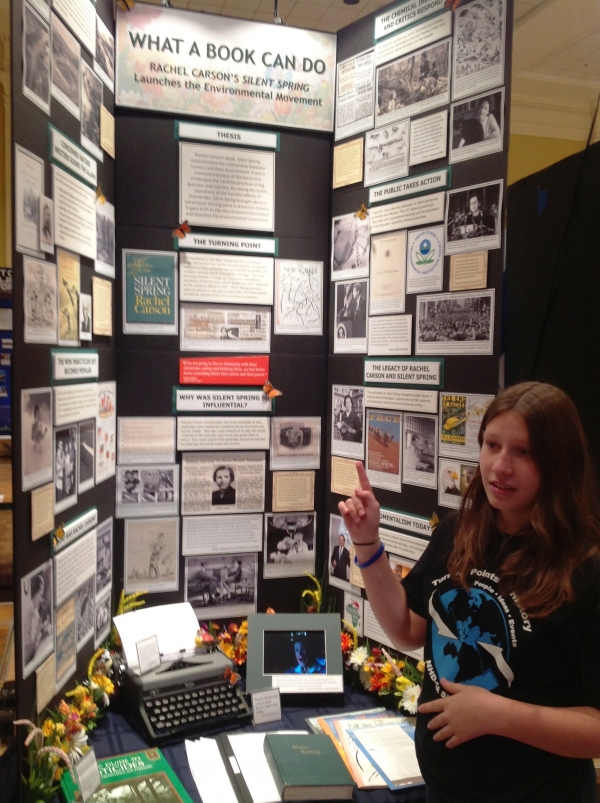
Julienne Sauer in front of her project,

Julienne Sauer in front of her project, “What a book can do — Rachel Carson‘s Silent Spring Launches the Environmental Movement.” (© 2013 San Ramon Express)

San Ramon student takes first at National History Day contest

by Jessica Lipsky

Windemere Ranch Middle School student was one of 30 recognized by the National Endowment for the Humanities (NEH) for their impressive use of historic newspapers in projects presented at National History Day.

Julienne Sauer, who graduated from eighth grade last week, took first place in NEH’s individual exhibit junior division for her project titled “What a book can do — Rachel Carson’s Silent Spring Launches the Environmental Movement.” This year’s National History Day theme was “Turning Points in History: People, Ideas, Events.”

Julienne was also named a National Endowment Humanities Scholar.

The annual event is the culmination of a year-long academic program in which students in middle and high school conduct original historical research for papers, exhibits, websites, documentaries and public performances. Each year more than 600,000 students compete in local, regional and state competitions for a chance to win a spot at the national finals.

This year was the first time NEH awarded prizes to students who incorporated into their projects research using Chronicling America, a free online database of 5 million pages of historic US newspapers dating from 1836 to 1922, digitized through a partnership between NEH and the Library of Congress.

Julienne won a national finalist award at the 2011 National History Day exhibit for her exhibit titled “The Cable Car Wars: A City Debates to Preserve its Character.”

Carson’s work was good enough that, even 49 years after her death, 51 years after the publication of Silent Spring, Carson and the book still inspire students to heights of excellence in study.

More:


June 15: Magna Carta anniversary, #798

June 15, 2013

In 2015 we’ll celebrate the 800th anniversary of the signing of the Magna Carta.  I predict that, beginning in late 2014, pseudo-historians will begin an assault on the history of the document, attempting to convince us that the document banned income taxes, banished the poor from hospitals and job finding agencies, and said children should have to work for their meals and never get food stamps. 

I hope I’m wrong.

Today, June 15, 2013, is the 798th anniversary of the signing of the Magna Carta.  The document laid a foundation for freedom, almost 800 years ago, upon which we stand today.

Runnymede, Magna Carta Isle, photo by Wyrdlight, Antony McCallum, 2008 (Wikimedia)

What event critical to western history and the development of the democratic republic in the U.S. happened here in 1215?

A teacher might use some of these photos explaining the steps to the Constitution, in English law and the heritage of U.S. laws. Other than the Magna Carta, all the events of Runnymede get overlooked in American studies of history. Antony McCallum, working under the name Wyrdlight, took these stunning shots of this historic meadow. (He photographs stuff for studies of history, it appears.)

Maybe it’s a geography story.

View of Runnymede Meadow from Engham Village -- Wyrdlight photo through Wikimedia

View of Runnymede Meadow from Engham Village — Wyrdlight photo through Wikimedia

Several monuments to different events of the past millennium populate the site. The American Bar Association dedicated a memorial to the Magna Carta there — a small thing open to the air, but with a beautiful ceiling that is probably worth the trip to see it once you get to England.

Wikipedia explains briefly, with a note that the ABA plans to meet there again in 2015, the 800th anniversary of the Great Charter:

Magna Carta Memorial


The Magna Carta Memorial & view towards the ‘medes’


Engraved stone recalling the 1985 ABA visit

Situated in a grassed enclosure on the lower slopes of Cooper’s Hill, this memorial is of a domed classical style, containing a pillar of English granite on which is inscribed “To commemorate Magna Carta, symbol of Freedom Under Law”. The memorial was created by the American Bar Association to a design by Sir Edward Maufe R.A., and was unveiled on 18 July 1957 at a ceremony attended by American and English lawyers.[5]

Since 1957 representatives of the ABA have visited and rededicated the Memorial renewing pledges to the Great Charter. In 1971 and 1985 commemorative stones were placed on the Memorial plinth. In July 2000 the ABA came:

to celebrate Magna Carta, foundation of the rule of law for ages past and for the new millennium.

In 2007 on its 50th anniversary the ABA again visited Runnymede and during the convention installed as President Charles Rhyne who devised Law Day which seeks in the USA an annual reaffirmation of faith in the forces of law for peace.

The ABA will be meeting at Runnymede in 2015 on the 800th anniversary of the sealing of the original charter.

The Magna Carta Memorial is administered by the Magna Carta Trust, which is chaired by the Master of the Rolls.[10]

In 2008, flood lights were installed to light the memorial at night, but due to vandalism they now lie smashed.

I’ll wager the lights get fixed before 2015.

Detail of the Magna Carta monument at Runnymed...

Detail of the Magna Carta monument at Runnymede. I took this photo some time in the early Eighties. (Photo credit: Wikipedia)

This is mostly an encore post.

More:


Flag Day poster from 1917, remembered 96 years later

June 14, 2013

140th US Flag Day poster. 1777-1917. The birthday of the stars and stripes, June 14th, 1917. 'Tis the Star Spangled Banner, oh, long may it wave, o'er the land of the free and the home of the brave!" Library of Congress description: "Poster showing a man raising the American flag, with a minuteman cheering and an eagle flying above." - Wikipedia

140th US Flag Day poster. 1777-1917. The birthday of the stars and stripes, June 14th, 1917. ‘Tis the Star Spangled Banner, oh, long may it wave, o’er the land of the free and the home of the brave!” Library of Congress description: “Poster showing a man raising the American flag, with a Minuteman cheering and an eagle flying above.” – Wikipedia

Details about the poster, from the Library of Congress:


1777-1917: The 140th flag day. The birthday of the stars and stripes, June 14th, 1917. The text continues: ‘Tis the Star Spangled Banner, oh, long may it wave, o’er the land of the free and the home of the brave! President Woodrow Wilson remarked, “this flag, which we honor and under which we serve, is the emblem of our unity, our power, our thought and purpose as a nation. Though silent, it speaks to us of the past, of the men and women who went before us, and of the records they wrote upon it.”

MEDIUM: 1 print (poster) : lithograph, color ; 101 x 65 cm.

CREATED/PUBLISHED: 1917.

NOTES: Forms part of: Willard and Dorothy Straight Collection.

Who was the artist?  Who ordered the printing, and for what specific purpose?  Anyone know? (Still looking for the history of this poster, which has become quite popular in the past two years.)

The Library of Congress sells copies of this poster.

Additional reading in 2013:


Flag Day 2013 – Fly your flag today!

June 14, 2013

Of course, you’re already flying your Stars and Stripes, right?

I’ve been on the road, mostly without internet access; I’m tardy in my reminder.

June 14th marks the anniversary of the resolution passed by the Second Continental Congress in 1777, adopting the Stars and Stripes as the national flag.

Fly your flag today. This is one of the score of dates upon which Congress suggests we fly our flags.

Flag Day 1916, parade in Washington, D.C. - employees of National Geographic Society march - photo by Gilbert Grosvenor

Flag Day 1916, parade in Washington, D.C. – employees of National Geographic Society march – photo by Gilbert Grosvenor

The photo above drips with history. Here’s the description from the National Geographic Society site:

One hundred and fifty National Geographic Society employees march in the Preparedness Parade on Flag Day, June 14, in 1916. With WWI underway in Europe and increasing tensions along the Mexican border, President Woodrow Wilson marched alongside 60,000 participants in the parade, just one event of many around the country intended to rededicate the American people to the ideals of the nation.

Not only the anniversary of the day the flag was adopted by Congress, Flag Day is also the anniversary of President Dwight Eisenhower’s controversial addition of the words “under God” to the Pledge of Allegiance in 1954.

(Text adapted from “:Culture: Allegiance to the Pledge?” June 2006, National Geographic magazine)

The first presidential declaration of Flag Day was 1916, by President Woodrow Wilson. Wilson won re-election the following November with his pledge to keep America out of World War I, but by April of 1917 he would ask for a declaration of war after Germany resumed torpedoing of U.S. ships. The photo shows an America dedicated to peace but closer to war than anyone imagined. Because the suffragettes supported Wilson so strongly, he returned the favor, supporting an amendment to the Constitution to grant women a Constitutional right to vote. The amendment passed Congress with Wilson’s support and was ratified by the states.

The flags of 1916 should have carried 48 stars. New Mexico and Arizona were the 47th and 48th states, Arizona joining the union in 1913. No new states would be added until Alaska and Hawaii in 1959. That 46-year period marked the longest time the U.S. had gone without adding states, until today. No new states have been added since Hawaii, more than 49 years ago. (U.S. history students: Have ever heard of an essay, “Manifest destiny fulfilled?”)

150 employees of the National Geographic Society marched, and as the proud CEO of any organization, Society founder Gilbert H. Grosvenor wanted a photo of his organization’s contribution to the parade. Notice that Grosvenor himself is the photographer.

I wonder if Woodrow Wilson took any photos that day, and where they might be hidden.

History of Flag Day from a larger perspective, from the Library of Congress:

Since 1916, when President Woodrow Wilson issued a presidential proclamation establishing a national Flag Day on June 14, Americans have commemorated the adoption of the Stars and Stripes by celebrating June 14 as Flag Day. Prior to 1916, many localities and a few states had been celebrating the day for years. Congressional legislation designating that date as the national Flag Day was signed into law by President Harry Truman in 1949; the legislation also called upon the president to issue a flag day proclamation every year.

According to legend, in 1776, George Washington commissioned Philadelphia seamstress Betsy Ross to create a flag for the new nation. Scholars debate this legend, but agree that Mrs. Ross most likely knew Washington and sewed flags. To date, there have been twenty-seven official versions of the flag, but the arrangement of the stars varied according to the flag-makers’ preferences until 1912 when President Taft standardized the then-new flag’s forty-eight stars into six rows of eight. The forty-nine-star flag (1959-60), as well as the fifty-star flag, also have standardized star patterns. The current version of the flag dates to July 4, 1960, after Hawaii became the fiftieth state on August 21, 1959.

Fly your flag with pride today.

Elmhurst Flag Day 1939, DuPage County Centennial - Posters From the WPA

Elmhurst flag day, June 18, 1939, Du Page County centennial / Beauparlant.
Chicago, Ill.: WPA Federal Art Project, 1939.
By the People, For the People: Posters from the WPA, 1936-1943

This is an encore post, from June 14, 2009, and other previous Flag Days.

More, and Other Voices:


Do Nothing GOP Congress

June 13, 2013

Poorly-attended hearing of Congressional Joint Economic Committee hearing on jobs, 2013

“Do Nothing Congress?” How about “Missing in Inaction Congress?” Photo and caption from National Journal: When the Joint Economic Committee’s hearing on fixing the nation’s long-term unemployment problem kicked off on April 24, only one lawmaker was in attendance: Sen. Amy Klobuchar, the committee’s vice chair who was holding the hearing. (Niraj Chokshi)

National Journal’s article fairly damns Congress and especially the House for doing very little this year about jobs.

Probably more damning is this little fact:  In a period of time that historically might see 50 or 100 laws passed, Congress has passed into law only 13 measures.  The “Do Nothing” 80th Congress Truman campaigned against passed nearly 900 laws.  The current Congress is on track to pass 52.  Most important, probably, are the authorization and appropriations bills for the different departments of the federal government, much more important than the non-binding budget resolutions conservatives whine about.  Republicans have successfully blocked almost all authorization and appropriations action.  Appropriations bills, of course, must originate in the GOP-shackled House of Representatives.

In the six months and four days since the 113th Congress began, it has passed 13 laws. And, despite lawmakers constantly beating the drum on boosting jobs, none of the new measures have been focused on employment. Here’s a list of what the 113th Congress has passed in its first six months:

  1. H.R.41: To temporarily increase the borrowing authority of the Federal Emergency Management Agency for carrying out the National Flood Insurance Program.
    Sponsor: Rep Garrett, Scott [NJ-5] (introduced 1/3/2013) Cosponsors (44)
  2. H.R.152: Disaster Relief Appropriations Act, 2013
    Sponsor: Rep Rogers, Harold [KY-5] (introduced 1/4/2013) Cosponsors (None)
  3. H.R.325: No Budget, No Pay Act of 2013
    Sponsor: Rep Camp, Dave [MI-4] (introduced 1/21/2013) Cosponsors (1)
  4. S.47: Violence Against Women Reauthorization Act of 2013
    Sponsor: Sen Leahy, Patrick J. [VT] (introduced 1/22/2013) Cosponsors (61)
  5. H.R.307: Pandemic and All-Hazards Preparedness Reauthorization Act of 2013
    Sponsor: Rep Rogers, Mike J. [MI-8] (introduced 1/18/2013) Cosponsors (5)
  6. H.R.933: Consolidated and Further Continuing Appropriations Act, 2013
    Sponsor: Rep Rogers, Harold [KY-5] (introduced 3/4/2013) Cosponsors (None)
  7. S.716: A bill to modify the requirements under the STOCK Act regarding online access to certain financial disclosure statements and related forms.
    Sponsor: Sen Reid, Harry [NV] (introduced 4/11/2013) Cosponsors (None)
  8. H.R.1246: District of Columbia Chief Financial Officer Vacancy Act
    Sponsor: Rep Norton, Eleanor Holmes [DC] (introduced 3/19/2013) Cosponsors (None)
  9. H.R.1765: Reducing Flight Delays Act of 2013
    Sponsor: Rep Latham, Tom [IA-3] (introduced 4/26/2013) Cosponsors (None)
  10. H.R.1071: To specify the size of the precious-metal blanks that will be used in the production of the National Baseball Hall of Fame commemorative coins.
    Sponsor: Rep Hanna, Richard L. [NY-22] (introduced 3/12/2013) Cosponsors (2)
  11. H.R.360: To award posthumously a Congressional Gold Medal to Addie Mae Collins, Denise McNair, Carole Robertson, and Cynthia Wesley to commemorate the lives they lost 50 years ago in the bombing of the Sixteenth Street Baptist Church, where these 4 little Black girls’ ultimate sacrifice served as a catalyst for the Civil Rights Movement.
    Sponsor: Rep Sewell, Terri A. [AL-7] (introduced 1/23/2013) Cosponsors (301)
  12. H.R.258: Stolen Valor Act of 2013
    Sponsor: Rep Heck, Joseph J. [NV-3] (introduced 1/15/2013) Cosponsors (127)
  13. S.982: Freedom to Fish Act
    Sponsor: Sen Alexander, Lamar [TN] (introduced 5/16/2013) Cosponsors (3)

Freedom to Fish Act?  No doubt it is important to someone.  But even that someone, or those somebodies, would benefit from a jobs bill, more than from the Freedom to Fish Act.

When I worked for Lamar Alexander, I found him to be among the more fair and forward thinking of elected politicians.  It’s good to see he can still move a bill.

It’s tragic he’s been unable to push the GOP to move on more important matters.

The “Do-Nothing Congress” Harry Truman successfully indicted in 1948 looks like Wilma Rudolph streaking over the finish line in the 1960 Rome Olympics, by comparison.

I recall sitting up to get the news out to Utah, and anyone else interested in the nation, when Congress would pass 13 laws in a night.  At no point did it occur to me to think “these are the good old days of America,” then.

More:

taken by yours truly during 2007 hof induction...

Baseball Hall of Fame on Induction Weekend, 2007, crowded with people who now need jobs.  Congress passed a bill dealing with the Baseball Hall of Fame.  Ironic, no? All inductees in Cooperstown got there by doing something, doing it with hustle, and doing a lot, a sharp contrast to the 2013-2014 U.S. Congress.  Wikipedia image


Exxon-Mobil’s Rex Tillerson urges Scouts to get on with the “main thing,” Scouting, after historic membership policy vote

June 11, 2013

Late last month the national board, the governing body of the Boy Scouts of America, voted to open Scouting again to Scouts who have determined they are homosexual.

Scout leaders voted to change a 22-year-old membership policy that effectively banned Boy Scouts from being homosexual, or acknowledging they are gay.  The policy was a haphazard outgrowth of a 1991 policy change, still in effect, that bans homosexuals from leadership positions.  Over the past decade the issue heated up, with a few boys having completed their work to earn Scouting’s highest rank, Eagle, and then being denied the rank when officials discovered they were homosexual.

No brief description does full justice to the issue, to the change in policy, nor to the difficulty of discussions surrounding the change.  Several national groups assailed BSA for even considering the change, including the Family Research Council and members of the Southern Baptist Convention.

Discussions in some quarters were as ugly as any I’ve seen on any issue anywhere — worse than union votes in non-union corporations, worse than votes to cut teacher pay in state legislatures, worse than civil rights votes, worse than abortion issues.

Bryan Wendall’s blog, Bryan on Scouting, is a semi-official mouthpiece for Scouting — he is the editor of Scouting magazine, the monthly publication to leaders of Boy Scouting.  At the blog, where serious discussions of the new policy unfolded since February, Bryan posted a video of immediate past President of Boy Scouting National Council, Rex Tillerson, talking about the next steps.  I’ve reproduced Bryan’s introduction, and the video.  Discussions at that blog have been rather intense (but not nearly so ugly as those at Family Research Council venues, and at WorldNet Daily).

One more piece of background:  In Scout leader training, two mantras rising over the past 15 years involve reminding leaders to stick to the main purposes of Scouting in any controversy, to help get through difficulties or crises in unit management or local organization issues:  “Remember, we do it for the boys, they are the main thing.”  And, “The main thing to remember is to keep the main thing, the main thing.”  Tillerson knows Scouting, and knows Scouters, when he makes his appeal.

Rex Tillerson at 2013 National Board meeting of BSA

Exxon-Mobil CEO Rex Tillerson exhorted Scouters to get on with ‘the main thing,’ making Scouting work for boys. Tillerson is a Distinguished Eagle Scout, and past national president of the organization; he remains active in his local Scouting organizations, in Circle 10 Council in Dallas, Texas, and surrounding counties. Photo by Michael Roytek/BSA

Rex Tillerson speaks out about change and ‘The Main Thing’

“So we’ve made the decision. We’re going to change,” says Rex Tillerson. ”Now what?”

Less than 24 hours after the volunteer delegates voted to change the BSA’s membership policy for youth, Tillerson addressed a large room full of Scouting volunteers and professionals at the closing general session of the BSA’s National Annual Meeting.

In a powerful, heartfelt speech, Tillerson made his message clear: Change is inevitable, but “The Main Thing,” which is to serve more youth in Scouting, hasn’t changed. With that in mind, he reasoned, it’s time for all of us unite toward this common goal.

Tillerson, immediate past president of the Boy Scouts of America and a 2010 Silver Buffalo recipient, knows something about making big decisions and dealing with change. When he’s not serving as a Scouting volunteer, he’s the chairman, president, and CEO of Exxon Mobil Corp., one of the world’s largest companies.

In 1999, Tillerson worked for Exxon when it merged with Mobil—definitely a big change for both companies.

Take 10 minutes to watch the video below and listen to Tillerson’s message. Then, share it with the members of your Scouting family.

Are you volunteering in any way in Scouting now?  You should.

More:


Flag day June 14? Heck! Fly it all week!

June 11, 2013

“The American Flag”, music by L.S.D. Rees and words by J.B. Dickson, 1862. Music Division, Library of Congress

President Barack Obama proclaimed the week of June 9 through 16 National Flag Week, in anticipation of Flag Day, June 14.

Boy Scouts from Troop 123 stand together during a Flag Day ceremony Thursday, June 14, 2012 at Veterans Memorial Park in Peru, Ill.

Boy Scouts from Troop 123 stand together during a Flag Day ceremony Thursday, June 14, 2012 at Veterans Memorial Park in Peru, Ill. Photo and caption from Reactions

Fly your U.S. flag all week!

Of course, you may fly your state and local flags, too.

June 14 commemorates the day the first resolution was passed designating the stars and stripes as the national flag of the united colonies, June 14, 1777. This is another event occurring even prior to the creation of the United States by the Constitution.

Here’s the proclamation from President Obama:

For Immediate Release

June 07, 2013

Presidential Proclamation — Flag Day and National Flag Week, 2013

FLAG DAY AND NATIONAL FLAG WEEK, 2013

– – – – – – –

BY THE PRESIDENT OF THE UNITED STATES OF AMERICA

A PROCLAMATION

Each June, our Nation lifts its sights to the flag that has watched over us since the days of our founding. In those broad stripes and bright stars, we see the arc of the American story — from a handful of colonies to 50 States, united and free.

When proud patriots took up the fight for independence, they came together under a standard that showed their common cause. When the wounds of civil war were still fresh and our country walked the long road to reconstruction, our people found hope in a banner that testified to the strength of our Union. Wherever our American journey has taken us, whether on that unending path to the mountaintop or high above into the reaches of space, Old Glory has followed, reminding us of the rights and responsibilities we share as citizens.

This week, we celebrate that legacy, and we honor the brave men and women who have secured it through centuries of service at home and abroad. Let us raise our flags high, from small-town storefronts to duty stations stretched around the globe, and let us look to them once more as we press on in the march toward a more perfect Union.

To commemorate the adoption of our flag, the Congress, by joint resolution approved August 3, 1949, as amended (63 Stat. 492), designated June 14 of each year as “Flag Day” and requested that the President issue an annual proclamation calling for its observance and for the display of the flag of the United States on all Federal Government buildings. The Congress also requested, by joint resolution approved June 9, 1966, as amended (80 Stat. 194), that the President annually issue a proclamation designating the week in which June 14 occurs as “National Flag Week” and call upon citizens of the United States to display the flag during that week.

NOW, THEREFORE, I, BARACK OBAMA, President of the United States of America, do hereby proclaim June 14, 2013, as Flag Day and the week beginning June 9, 2013, as National Flag Week. I direct the appropriate officials to display the flag on all Federal Government buildings during that week, and I urge all Americans to observe Flag Day and National Flag Week by displaying the flag. I also call upon the people of the United States to observe with pride and all due ceremony those days from Flag Day through Independence Day, also set aside by the Congress (89 Stat. 211), as a time to honor America, to celebrate our heritage in public gatherings and activities, and to publicly recite the Pledge of Allegiance to the Flag of the United States of America.

IN WITNESS WHEREOF, I have hereunto set my hand this seventh day of June, in the year of our Lord two thousand thirteen, and of the Independence of the United States of America the two hundred and thirty-seventh.

BARACK OBAMA

You may want to read further history of Flag Day and the Wisconsin-born dentist who created and promoted the campaign to commemorate it, Bernard J. CiGrand, at the National Flag Day Foundation site.


Flag Day cartoon  by Joel Mielke in the North Coast Journal, Humboldt, California

Joel Mielke cartoon in the North Coast Journal, Humboldt, California. Each of these flag uses is, technically, a violation of the flag code. Fly your flag on Flag Day; it’s a non-violative, non-offensive way to honor the flag, and our nation.

More:


War on Teachers and Education, Part 4: The fight gets a little weird

June 10, 2013

Prof. Diane Ravitch is a well-known education reformer, and lately a staunch defender of teachers and educators who struggle to educate kids while officials fiddle with ways to test kids to improve the case for firing more teachers.  Ben Austin is an experienced political organizer who settled in California and has emerged as the chief spokesman for the “shut the schools down and fire the teachers” faction, in his role as director of the heavily-funded Parent Revolution.

Ravitch criticized a campaign Austin’s group ran against an elementary school principal in Los Angeles.  Austin took offense, and took to HuffPo to let it be known.  Ravitch responded at her blog.

Then, late Sunday night, I got an e-mail from Ben Austin, who otherwise I don’t know from Adam’s off-ox.  How did he get my e-mail?  (It’s not difficult, if you’re looking for it . . .  but why was he looking for it?)

Here’s Austin’s email.  The preface is the key part here; the rest is a mostly a repeat of his letter to Ravitch at HuffPo:

A Kids First Dialogue

parentrevolution
Dear Sir/Madam,

Recently, Dr. Diane Ravitch – an education historian and author – used her blog to lodge multiple personal and quite nasty attacks on me and Parent Revolution, calling me “loathsome” and deeming that everyone who supports Parent Revolution deserves “a special place in hell.”

As noted by multiple education writers, and thinkers, this type of dialogue goes far beyond the bounds of reasonable debate.

Please take a few minutes to read my response below (or access it here).

As I wrote in my open letter to Dr. Ravitch, “We cannot purport to encourage tolerance and discourage bullying on the schoolyard if the adults in charge of the schoolyard can’t adhere to those same basic principles.”

Best,
Ben Austin

P.S. Please stay tuned for exciting news in the coming weeks, as parents in several California schools prepare for newly transformed schools under the state’s Parent Trigger law.

——————————————-
A Kids First Dialogue: Open Letter to Dr. Diane Ravitch

Ben Austin
Executive Director, Parent Revolution

Dear Professor Diane Ravitch:

Parents, educators, and education advocates have a lot in common when it comes to a kids-first first agenda. But we can never seize that common ground if those with whom we disagree are deemed to be “evil” and sentenced to Hell, as you did last week in your now infamous blog post.

If we can’t start from that basic premise, then we are no more mature than the children we endeavor to serve. We cannot purport to encourage tolerance and discourage bullying on the schoolyard if the adults in charge of the schoolyard can’t adhere to those same basic principles.

For the past year, the organization for which I serve as executive director – Parent Revolution – has been working with parents from the Watts neighborhood community school Weigand Avenue Elementary to help turnaround their failing school. Although there appear to be some areas of improvement at the school, Weigand is currently ranked 15th worst of nearly 500 elementary schools in the Los Angeles Unified School District (LAUSD), and has been on a continual overall downward slide for the past 3-4 years under its current school leadership.

Four years is a long time for parents to wait for improvements in a failing school, despite even the best of intentions from dedicated professionals like Weigand’s current principal. Unfortunately, the current principal was unable to make the progress needed to turnaround the school.

In 2011 many of these same parents petitioned along with Weigand’s teachers to oust their failed principal, but had no real power to force change, and the principal retained her job. Every teacher who signed that 2011 petition is now gone, and the school has gotten even worse since then.

Many of the kids have now “graduated” without having learned basic skills. Currently, more than half of kids at Weigand cannot read, write, or do math at grade level.

So this year, the parents organized again – but this time using California’s landmark Parent Trigger law, which gives parents trapped in a failing school the power to force leadership or staffing changes at the school, or convert it to a non-profit charter school.

After the parents submitted petitions representing a majority of parents at the school demanding a leadership change, the district complied with the law, verified the parents’ legal majority, and in August Weigand will open up as a newly transformed school with new leadership.

Recently, in a debate about whether these parents should have the power to demand a new principal for their failing public school, you labeled me “loathsome” for siding with the parents. You declared that everyone who supports these parents “deserves a special place in Hell.”

Let me tell you about Hell.

I grew up in Greenwich Village and Venice Beach, the son of two writers. My parents published a number of books, but our family struggled financially.

In many ways, I grew up lucky. I grew up with parents who valued education and loved me. They helped me get a scholarship to a private high school in Los Angeles. That scholarship may have saved my life.

My dad was an alcoholic. A few weeks before my junior year in high school, he committed suicide. I vividly remember going to the first day of school after my dad’s death, soon after his funeral. As a kid, my overriding emotion that day was embarrassment. I (wrongly) assumed that all the wealthy kids at my school had near perfect home lives, and I was embarrassed about mine. I didn’t want them to know about my dad, but it was such a small school that I knew that everyone would.

That’s what I remember as a boy. But looking back as an adult, I see that same day through a different lens. I can see the role that educators and others played to get me through this Hell.

I see how my teachers and my principal sat down with me that first day of school to talk. They told me they believed in me. They told me they would help me. Some even told me they loved me.

They told me I could make it. And I did. I graduated from high school, then Berkeley, then Georgetown Law School. I worked in the Clinton White House as well as on five Democratic presidential campaigns. I served as deputy mayor in Los Angeles, and sat as a member of the California State Board of Education.

I was lucky. But my younger brother wasn’t so lucky.

He went to a different school. His principal told him that he would never amount to anything. So he dropped out of school in 9th Grade. He fell down, and with no one at his school to help pick him up (and no dad), he lost a decade of his life.

Astonishingly, he did end up getting back up. Years later, he earned his GED, went to college, then business school and now is an awesome dad with a wonderful family. But his story is not the typical story of a 9th grade drop out.

When I see kids attending schools like Weigand, I see kids who are going through a whole lot more at home than I could have ever imagined as a boy, but who don’t have a safe place where somebody believes in them, supports them and loves them. Many kids drop out like my brother, but rarely share his happy ending.

So forgive me if I take it personally when parents trapped in a failing school ask for the same kind of support for their children that saved me as a child, and that I now expect from my daughters’ neighborhood public school as a father.

Your opposition to the Weigand parents is especially puzzling given the logic of your prior critique of Parent Trigger as a conspiracy to trick parents into converting their school into a charter school. The Weigand parents did not want a charter school, or new teachers, or even a new union contract. They wanted a change in leadership after 4 years of failure.

Weigand has exposed you as being opposed not just to charter schools, but to pure parent power.

To be clear, the reason that we have never personally attacked you, the principal, or any other opponent of parent power, is because our goal isn’t a political victory. It is a victory for our kids, and we can’t achieve that goal without ultimately working together.

Just last year, I wrote about you in the Huffington Post: “Diane Ravitch is a talented academic who has devoted her life to this issue. She clearly cares about kids and the future of public education in America.” I believed it then and still believe it now, despite your mean-spirited attacks against me and the committed parents and staff with whom I work. Instead of puerile name-calling and ugly personal attacks, let’s commit to a debate about a kids-first agenda and the future of public education that is worthy of our children.

Your intelligence and unique perspective have the potential to enrich this debate. But we must stipulate that this debate will not occur in Hell, Heaven, or in some imaginary world where one side has all the answers and holds all the moral authority.

Let us debate about the future of American public education on Planet Earth, where ideas and civility matter.

Sincerely,
Ben Austin

Executive Director
Parent Revolution

Dr. Ravitch picked a fight, not with Ben Austin, but with the entire 45 person group at the $5.5 million/year political organizing group. I’m not sure popcorn is appropriate. But do stay tuned.

This series, on the dustup between Prof. Diane Ravitch and Ben Austin in California:

More:


War on Teachers and Education, Part 3: Prof. Ravitch’s response

June 10, 2013

At her blog again, Diane Ravitch responded to Ben Austin’s open letter to her at the Huffington Post.

Earlier today, Ben Austin wrote an open letter to me on Huffington Post. He expressed dismay about my characterization of him and his group Parent Revolution. Read his letter here. Here is my reply.

My Reply to Ben Austin’s Open Letter to Me

Dear Ben Austin,

Thank you for your invitation to engage in dialogue in your letter posted on Huffington Post.

You probably know that I have been writing a daily blog for the past fourteen months and during that time, I have written over 4,000 posts. I can’t remember any time when I have lost my temper other than when I wrote about your successful effort to oust an elementary school principal in Los Angeles named Irma Cobian.

I apologize for calling you “loathsome,” though I do think your campaign against a hardworking, dedicated principal working in an inner-city school was indeed loathsome. And it was wrong of me to say that there was a special place in hell reserved for anyone “who administers and funds this revolting organization that destroys schools and fine educators like Irma Cobian.”

As I said, I lost my temper, and I have to explain why.

I don’t like bullies. When I saw this woman targeted by your powerful organization, it looked like bullying. Your organization is funded by many millions of dollars from the Walton Family Foundation, the Bill & Melinda Gates Foundation, and the Eli and Edythe Broad Foundation. You have a politically powerful organization, and you used your power to single out this one woman and get her fired.

Your organization sent in paid staff to collect signatures from parents. The teachers in the school were not permitted to express their opinion to parents about your efforts to fire their principal. When you succeeded in getting her fired, 21 of the 22 teachers on staff requested a transfer. That suggests that Cobian has the loyalty of her staff and is a good leader.

Who is this woman that you ousted?

All I know about her is what I read in this article in the Los Angeles Times.

It said: “More than two decades ago, Cobian walked away from a high-powered law firm to teach. The daughter of Mexican immigrants, she said she was inspired by a newspaper article about the low high school graduation rates of Latinos and wanted to make a difference.

“Her passion for social justice led her to Watts in 2009.”

Irma Cobain is now in her fourth year as principal of the school, and you decided that her time was up.

What did her teachers say about her?

“Third-grade teacher Kate Lewis said Irma Cobian is the best principal she’s had in nine years at Weigand Avenue Elementary School in Watts.

“Joseph Shamel called Cobian a “godsend” who has used her mastery of special education to show him how to craft effective learning plans for his students.”

“Fourth-grade teacher Hector Hernandez said Cobian is the first principal he’s had who frequently pops into classrooms to model good teaching herself. Recently, he said, she demonstrated how to teach about different literary genres by engaging students in lively exercises using characters from the “Avengers” comic book and film.”

When Cobian arrived at the Weigand Avenue Elementary school four years ago, she found a school with low test scores, low parent involvement, and divisiveness over a dual-language program. “All the students come from low-income families, more than half are not fluent in English and a quarter turn over every year,” the Los Angeles Times story said.

Cobian decided to focus on improving literacy and raising morale. She certainly won over the faculty.

The day after Cobian learned about the vote removing her, she went to a second-grade classroom to give prizes to children who had read 25 books this year. She cheered those who met the goal and encouraged those who were trying. But she could not hide her sadness.

“I need happiness today,” Cobian told the bright-eyed students. “What do I do when I’m sad?”

“Come here!” the students sang out.

For a moment, her sadness gave way to smiles. But later, she said: “I am crushed.”

Ben, how did you feel when you read that? I felt sad. I felt this was a caring and dedicated person who had been singled out unfairly.

Ben, I hope you noticed in the article that Dr. John Deasy, the superintendent of schools in Los Angeles, praised the plan that Cobian and her staff developed for improving the school. He called it a “well-organized program for accelerated student achievement.” He thanked Cobian for her commitment and hard work.” But you decided she should be fired.

Ironically, the parent who worked with you to fire Cobian said she preferred Weigand to her own neighborhood school where she had concerns about bullying. Even stranger, the parents at Cobian’s school voted to endorse her plan. Your parent spokesperson said she did not like the plan because it focused on reading and writing, but she told the reporter from the Los Angeles Times that she actually never read the plan.

I understand from your letter, Ben, that you somehow feel you are a victim because of what I wrote about you. But, Ben, you are not a victim. Irma Cobian is the victim here. She lost her job because of your campaign to get rid of her. She is the one who was humiliated and suffered loss of income and loss of reputation. You didn’t. You still have your organization, your staff, and the millions that the big foundations have given you.

I am sorry you had a tough childhood. We all have our stories about growing up. I am one of eight children. My father was a high-school dropout. My mother immigrated from Bessarabia and was very proud of her high school diploma from the Houston public schools. She was proud that she learned to speak English “like a real American.” My parents were grateful for the free public schools of Houston, where I too graduated from high school. We had our share of problems and setbacks but I won’t go on about myself or my siblings because my story and yours are really beside the point. What troubles me is what you are doing with the millions you raise. You use it to sow dissension, to set parents against parents, parents against teachers, parents against principals. I don’t see this as productive or helpful. Schools function best when there is collaboration among teachers, parents, administrators, and students. Schools have a better chance of success for the children when they have a strong community and culture of respect.

Your “parent trigger” destroys school communities. True to its name, the “trigger” blasts them apart. It causes deep wounds. It decimates the spirit of respect and comity that is necessary to build a strong community. Frankly, after the school shootings of recent years, your use of the metaphor of a “parent trigger” is itself offensive. We need fewer triggers pointed at schools and educators. Please find a different metaphor, one that does not suggest violence and bloodshed.

It must be very frustrating to you and your funders that–three years after passage of the “parent trigger” law– you can’t point to a single success story. I am aware that you persuaded the parents at the Desert Trails Elementary School in Adelanto, California, to turn their public school over to a privately operated charter. I recall that when parents at the school tried to remove their signatures from your petition, your organization went to court and won a ruling that they were not allowed to rescind their signatures. Ultimately only 53 parents in a school of more than 600 children chose the charter operator. Since the charter has not yet opened, it is too soon to call that battle a success for Parent Revolution. Only the year before, the Adelanto Charter Academy lost its charter because the operators were accused of financial self-dealing.

But, Ben, let me assure you that I bear you no personal ill will. I just don’t approve of what you are doing. I think it is wrong to organize parents to seize control of their public school so they can fire the staff or privatize it. If the principal is doing a bad job, it is Dr. Deasy’s job to remove her or him. I assume that veteran principals and teachers get some kind of due process, where charges are filed and there is a hearing. If Cobain was as incompetent as you say, why didn’t Dr. Deasy bring her up on charges and replace her?

I also have a problem with the idea that parents can sign a petition and hand their public school off to a private charter corporation. The school doesn’t belong to the parents whose children are enrolled this year. It belongs to the public whose taxes built it and maintains it. As the L.A. Times story pointed out, one-quarter of the children at Weigand Avenue Elementary School are gone every year. The parents who sign a petition this year may not even be parents in the school next year. Why should they have the power to privatize the school? Should the patrons of a public library have the power to sign a petition and privatize the management? Should the people using a public park have the right to take a vote and turn the park over to private management?

We both care about children. I care passionately about improving education for all children. I assume you do as well. You think that your organized raids on public schools and professionals will lead to improvement. I disagree. Schools need adequate resources to succeed. They also need experienced professionals, a climate of caring, and stability. I don’t see anything in the “trigger” concept that creates the conditions necessary for improvement. Our teachers and principals are already working under too much stress, given that schools have become targets for federal mandates and endless reforms.

I suggest that educators need respect and thanks for their daily work on behalf of children. If they do a bad job, the leadership of the school system is responsible to take action. What educators don’t need is to have a super-rich, super-powerful organization threatening to pull the trigger on their career and their good name.

Ben, thanks for the open letter and the chance to engage in dialogue. If you don’t mind, I want to apologize to Irma Cobain on your behalf. She was doing her best. She built a strong staff that believes in her. She wrote a turnaround plan that Dr. Deasy liked and the parents approved. Ms. Cobain, if you read this, I hope you can forgive Ben. Maybe next time, he will think twice, get better information, and consider the consequences before he decides to take down another principal.

Diane Ravitch

If Dr. Ravitch is correct in her claims, and her fears for future results, the biggest problem with this parent-trigger farce is that it costs a lot of money, and does only damage to schools, and to students, therefore.

Please continue to Part 4.

This series, on the dustup between Prof. Diane Ravitch and Ben Austin in California:

More:


War on Teachers and Education, Part 2: Ben Austin of Parent Revolution attacked Prof. Ravitch

June 10, 2013

Ben Austin is the head of Parent Revolution, the group trying to push teachers out of management of schools in California.  After Prof. Diane Ravitch noted problems with his group’s actions at Weigand Avenue Elementary in Los Angeles, on her blog, he responded with an “open-letter” carried by Huffington Post.

Other than the link to Dr. Ravitch’s post (“now infamous blog post,” as Austin calls it), all links are added here.

Dear Professor Diane Ravitch:

Parents, educators, and education advocates have a lot in common when it comes to a kids-first first agenda. But we can never seize that common ground if those with whom we disagree are deemed to be “evil” and sentenced to Hell, as you did last week in your now infamous blog post.

If we can’t start from that basic premise, then we are no more mature than the children we endeavor to serve. We cannot purport to encourage tolerance and discourage bullying on the schoolyard if the adults in charge of the schoolyard can’t adhere to those same basic principles.

For the past year, the organization for which I serve as executive director – Parent Revolution – has been working with parents from the Watts neighborhood community school Weigand Avenue Elementary to help turnaround their failing school. Although there appear to be some areas of improvement at the school, Weigand is currently ranked 15th worst of nearly 500 elementary schools in the Los Angeles Unified School District (LAUSD), and has been on a continual overall downward slide for the past 3-4 years under its current school leadership.

Four years is a long time for parents to wait for improvements in a failing school, despite even the best of intentions from dedicated professionals like Weigand’s current principal. Unfortunately, the current principal was unable to make the progress needed to turnaround the school.

In 2011 many of these same parents petitioned along with Weigand’s teachers to oust their failed principal, but had no real power to force change, and the principal retained her job. Every teacher who signed that 2011 petition is now gone, and the school has gotten even worse since then.

Many of the kids have now “graduated” without having learned basic skills. Currently, more than half of kids at Weigand cannot read, write, or do math at grade level.

So this year, the parents organized again – but this time using California’s landmark Parent Trigger law, which gives parents trapped in a failing school the power to force leadership or staffing changes at the school, or convert it to a non-profit charter school.

After the parents submitted petitions representing a majority of parents at the school demanding a leadership change, the district complied with the law, verified the parents’ legal majority, and in August Weigand will open up as a newly transformed school with new leadership.

Recently, in a debate about whether these parents should have the power to demand a new principal for their failing public school, you labeled me “loathsome” for siding with the parents. You declared that everyone who supports these parents “deserves a special place in Hell.”

Let me tell you about Hell.

I grew up in Greenwich Village and Venice Beach, the son of two writers. My parents published a number of books, but our family struggled financially.

In many ways, I grew up lucky. I grew up with parents who valued education and loved me. They helped me get a scholarship to a private high school in Los Angeles. That scholarship may have saved my life.

My dad was an alcoholic. A few weeks before my junior year in high school, he committed suicide. I vividly remember going to the first day of school after my dad’s death, soon after his funeral. As a kid, my overriding emotion that day was embarrassment. I (wrongly) assumed that all the wealthy kids at my school had near perfect home lives, and I was embarrassed about mine. I didn’t want them to know about my dad, but it was such a small school that I knew that everyone would.

That’s what I remember as a boy. But looking back as an adult, I see that same day through a different lens. I can see the role that educators and others played to get me through this Hell.

I see how my teachers and my principal sat down with me that first day of school to talk. They told me they believed in me. They told me they would help me. Some even told me they loved me.

They told me I could make it. And I did. I graduated from high school, then Berkeley, then Georgetown Law School. I worked in the Clinton White House as well as on five Democratic presidential campaigns. I served as deputy mayor in Los Angeles, and sat as a member of the California State Board of Education.

I was lucky. But my younger brother wasn’t so lucky.

He went to a different school. His principal told him that he would never amount to anything. So he dropped out of school in 9th Grade. He fell down, and with no one at his school to help pick him up (and no dad), he lost a decade of his life.

Astonishingly, he did end up getting back up. Years later, he earned his GED, went to college, then business school and now is an awesome dad with a wonderful family. But his story is not the typical story of a 9th grade drop out.

When I see kids attending schools like Weigand, I see kids who are going through a whole lot more at home than I could have ever imagined as a boy, but who don’t have a safe place where somebody believes in them, supports them and loves them. Many kids drop out like my brother, but rarely share his happy ending.

So forgive me if I take it personally when parents trapped in a failing school ask for the same kind of support for their children that saved me as a child, and that I now expect from my daughters’ neighborhood public school as a father.

Your opposition to the Weigand parents is especially puzzling given the logic of your prior critique of Parent Trigger as a conspiracy to trick parents into converting their school into a charter school. The Weigand parents did not want a charter school, or new teachers, or even a new union contract. They wanted a change in leadership after 4 years of failure.

Weigand has exposed you as being opposed not just to charter schools, but to pure parent power.

To be clear, the reason that we have never personally attacked you, the principal, or any other opponent of parent power, is because our goal isn’t a political victory. It is a victory for our kids, and we can’t achieve that goal without ultimately working together.

Just last year, I wrote about you in the Huffington Post: “Diane Ravitch is a talented academic who has devoted her life to this issue. She clearly cares about kids and the future of public education in America.” I believed it then and still believe it now, despite your mean-spirited attacks against me and the committed parents and staff with whom I work. Instead of puerile name-calling and ugly personal attacks, let’s commit to a debate about a kids-first agenda and the future of public education that is worthy of our children.

Your intelligence and unique perspective have the potential to enrich this debate. But we must stipulate that this debate will not occur in Hell, Heaven, or in some imaginary world where one side has all the answers and holds all the moral authority.

Let us debate about the future of American public education on Planet Earth, where ideas and civility matter.

Sincerely,

Ben Austin
Executive Director
Parent Revolution

Why didn’t he respond on Ravitch’s blog?  I don’t know for sure, but as deliverd on HuffPo, this letter is a poison-the-well tactic:  Austin didn’t respond to Ravitch’s criticism directly.  Instead, he attacked Ravitch’s tone, making Ravitch out to be a rude person — but he did so to a different audience, one that had no background in the controversy.  Had he responded at her blog, he wouldn’t have the chance to introduce the audience of not-closely-watching-this-issue people to his biases first.  So this letter increases my skepticism of the good faith claims of Parent Revolution and Ben Austin.

Ben Austin’s group, Parent Revolution’s website lists a string of successes.  Each of those successes is a political victory over teachers and educators.  So far, there is not a single school turnaround success Ben Austin’s group can point out for us.  They claim they worked for a year with parents to turn around Weigand Avenue elementary.  As a political organizer, education administrator, civics wonk and teacher, I wonder why Austin’s group didn’t work with the teachers, too or instead.  The work described was not to turn around Weigand, but rather to wrest control from people who, by all accounts I’ve seen, were making solid progress in a tough situation.  I have not found evidence of a working PTA, which suggests the parents could not and would not organize a toss-the-principal campaign on their own. (If you have information on a working PTA, please note it in comments.)

Austin’s group is no fly-by-night neighborhood parents’ group.  Austin has no children at Weigand, nor do any of the other full-time staffers on the group’s payroll.  The Hechinger Report notes:

Parent Revolution, whose backers include the Gates, Walton Family and Wasserman foundations, now has a budget that has climbed close to $5.5 million and a staff of about 45, including its California and national teams, Phelps said.

I’m mystified by Austin’s story of his family life.  It explains some of his drive, perhaps, but it’s totally at odds with his group’s continuing attacks on the teachers and principals who, he claims, were heroes in his own life.  He also calls out the principal of his brother’s school as a villain.  But he offers not a hint of any rational way to tell who are the heroes and who are the villains in these dramas.

Plus, he almost completely brushes off the concerns raised by Ravitch and the Los Angeles Times.  The woman fired by Austin’s outside agitator-style actions looks a heroine in every portrait I’ve seen. The Parent Revolution targeting of Irma Cobian is covered in a smokescreen for no apparent reason.  Austin managed to can the one person who could save the life of a kid like Ben Austin.

Is there an explanation?

Please continue to Part 3.

More:


War on Teachers and Education, Part 1: Prof. Ravitch’s emotion-touching call for a cease-fire on teachers

June 10, 2013

This is the first of five parts needed to document and lay the background for what unfortunately promises to be a pitched public relations battle, if not a serious battle to rescue a California school from being crushed by a corporation making a hostile takeover of a school using California’s “parent trigger” law.  Follow-ups may be needed.

Diane Ravitch in Dallas, April 28, 2010 - Copyright 2010 Ed Darrell (you may use freely, with attribution)

Diane Ravitch in Dallas, April 28, 2010 – Copyright 2010 Ed Darrell (you may use freely, with attribution)

If you’ve followed education issues, you know Dr. Diane Ravitch is a professor of education at Columbia, one of the most respected schools of education in the world.  Her work on education reform was popular with the Reagan administration in the period after the Report of the Commission on Excellence in Education in 1983, and particularly with education reformers at the time I was tapped to work at the Department of Education, in the old Office of Educational Research and Improvement.  Dr. Ravitch was appointed to head that arm of Education in the administration of George H. W. Bush, but after I had left government for the private sector.

More recently, Dr. Ravitch has looked hard to find evidence that the testing regimes imposed by the “No Child Left Behind” Act (NCLB) actually produce benefits to the education of students.

Finding no such evidence, Dr. Ravitch has called for an end to unproven methods of destruction of schools and school systems in pursuit of foggy, unattainable goals.

Recently, big-dollar guys have backed efforts to kick out teachers and trained educators from schools, and in particular with “parent-trigger” laws, which allow a group of parents to petition for the removal of professionals at a school, and for a group of parents to then take over the management of that school.

Oddly, the first places these laws have been applied is against teachers in schools where parental involvement has been historically abysmal.  A closer look shows that in these cases professional organizers, well-financed by businessmen who fancy themselves education reformers, did the load-carrying to get the petitions signed, and to get the educators ousted.

One of the schools where this process is moving is Weigand Avenue Elementary School in Watts, that troubled, poverty-ridden section of Los Angeles more famous for riots and gangs than educational attainment.

Dr. Ravitch wrote on her blog on May 25:

Parent Revolution Force Out Excellent Principal

The billionaire-funded Parent Revolution flexed its muscle and got enough parent signatures to force the resignation of a highly effective principal.

Please read the story.

This is the principal who was ousted by Parent Revolution:

“Third-grade teacher Kate Lewis said Irma Cobian is the best principal she’s had in nine years at Weigand Avenue Elementary School in Watts.

“Joseph Shamel called Cobian a “godsend” who has used her mastery of special education to show him how to craft effective learning plans for his students.

“Los Angeles Unified Supt. John Deasy praised a plan developed by Cobian and her team to turn around the struggling campus — where most students test below grade level in reading and math — calling it a “well-organized program for accelerated student achievement.” He thanked Cobian for her commitment and hard work.”

21 of the school’s 22 teachers have requested transfers because of Cobian’s ouster.

Parent Revolution is a malevolent organization funded by Walton, Gates, and Broad.

There is a special place in hell reserved for everyone who administers and funds this revolting organization that destroys schools and fine educators like Irma Cobian.

Dr. Ravitch has a good sense of justice, and injustice in my opinion.  This situation got her thinking, and she had more comments later.

Wondering About Ben Austin

Earlier today, I posted an article that appeared in the Los Angeles Times about Parent Revolution forcing the ouster of an excellent principal, Irma Cobian.

I keep thinking about it. I think about the way her staff admired and respected her, how 21 of 22 teachers requested a transfer when she was targeted by the phony Parent Revolution.

Ben Austin is loathsome. He ruined the life and career of a dedicated educator. She was devoted to the children, he is devoted to the equally culpable foundations that fund his Frankenstein organization–Walton, Gates, and Broad. His biggest funder is the reactionary Walton Family Foundation [line added here], which spends $160 million every year to advance privatization.

Ben Austin is Walton’s useful idiot. He prattles on about his liberal credentials, but actions speak louder than words.

Here is my lifelong wish for him.

Ben, every day when you wake up, you should think of Irma Cobian. When you look in the mirror, think Irma Cobian. Your last thought every night should be Irma Cobian.

Ben, you ruined the life of a good person for filthy lucre. Never forget her. She should be on your conscience–if you have one–forever.

W. Edwards Deming

W. Edwards Deming,Wikipedia image. Oddly, few, if any, education reform efforts work to incorporate any of Deming’s rules for running high-efficiency, highly-productive, championship-quality organizations; its as if there is a different agenda being pursued.

Ravitch makes a good point.  Organizational turnarounds rarely work when they start with mass firings.  It didn’t work in the French Revolution, it didn’t work in Russian in 1917.  Management experts like W. Edwards Deming, the most famous of the tough-reorganization management consultants in the drive for high quality organizations, bluntly warn that such efforts generally are destructive — the people fired are not the problem, nor do they have the authority to fix the problems, most often.  People on the front line know the problems better than anyone else, and can provide the leadership to turn organizations around, however — and for those reasons, you don’t get rid of them, if your goal is to effect an organizational turnaround.

Mr. Austin should have a framed photo of Mrs. Cobian on his desk so he must see her, every day.

Mr. Austin disagrees.

See part 2.

This series, on the dustup between Prof. Diane Ravitch and Ben Austin in California:

More, different views, and resources:


Typewriter of the moment: Alice Denham, circa 1956

June 8, 2013

One needs a typewriter to type out a story; but one needs a story to tell, first.

Alice Denham and her typewriter, 1956

Alice Denham, Playboy magazine’s Playmate of the Month in July 1956; photo undated, but probably about the same time; from 20th Century Man

I haven’t been able to identify the typewriter.  A short story she wrote appeared in the same issue of Playboy as her playmate layout.

Denham led an adventurous life in the New York literary scene, as an aspiring writer, and as a woman who liked sex.  Was she working on her book in this photo?  It was eventually published in 1967, My Darling from the Lions.

In 2006 she got attention for another book, a tell-much memoir of her life and romances and flings along the way, Sleeping With Bad Boys – A Juicy Tell-All of Literary New York in the Fifties and Sixties, good enough, or historically interesting enough, to get a review in the New York Times.

If typewriters could talk, you know?

More:


Mike Rowe: The value of Scouting, even for kids who don’t make Eagle

June 7, 2013

Distinguished Eagle Scout Award

Distinguished Eagle Scout Award Wikipedia image

Boy Scouts of America (BSA)  invited Mike Rowe to the 2012 Annual National Meeting.  They asked him to speak, but surprised him with a Distinguished Eagle Scout award.

Listen to his praise for the value of Scouting, for and from Scouts who don’t make Eagle (it’s at least ten minutes in, but this is entertaining).  Rowe has two brothers, neither of whom earned Eagle; his story involves the exploits of his younger brother, who was a Scout, and achieved the rank of Star.

It really is a Star Scout story.

More:

Ray Suarez receiving his Distinguished Eagle S...

PBS News Hour’s Ray Suarez receiving his Distinguished Eagle Scout Award. You find Eagles all over the place. Wikipedia image