What’s in a name? A Texas town by any other name . . . (redux)

February 7, 2013

. . . would still be a Texas town.

(This is an encore post of a piece that is five years old, and borrowed from a kid who has since graduated from Texas schools on gone on to Princeton; see bottom for additional, updated information.)

But Texas towns have some of the best names of towns in the U.S. Plus, there are a lot of Texas towns, plus 254 Texas counties.

Freckles Cassie at Political Teen Tidbits has a great list:

texas-road-map-tripinfodotcom.gif

Need to be cheered up?

Happy, Texas 79042
Pep, Texas 79353
Smiley, Texas 78159
Paradise, Texas 76073
Rainbow, Texas 76077
Sweet Home, Texas 77987
Comfort, Texas 78013
Friendship, Texas 76530

Go see the entire list — and maybe add a few of your favorites in the comments. An ambitious geography teacher could make a couple of great exercises out of those lists. “What’s the shortest distance one would have to drive to visit Paris, Italy, Athens and Santa Fe? How many could you visit in the shortest time?”

Texas counties, all 254 of 'em, from Geography.com

Texas counties, all 254 of ’em, from Geography.com

More, and updated information:

Read the rest of this entry »


Quote of the moment: Herbert Hoover, on credit, in Des Moines, Iowa, 1932

February 4, 2013

Herbert Hoover and crowd in West Branch, Iowa, 1932 - dedication of Hoover Library

Herbert Hoover, 88, attended the opening of the Hoover Library in West Branch, Iowa, on August 10, 1962, 30 years after his speech in Des Moines defending actions to shore up the credit of the U.S.  At this 1962 event, former President Harry Truman came to pay respects, mensch that he was; Truman is walking ahead of Hoover here.  Photo from Travel Iowa blog, and probably from the Hoover Library and Museum

Let me remind you that credit is the lifeblood of business, the lifeblood of prices and jobs.

  • Herbert Hoover, address at Des Moines, Iowa, October 4, 1932. — The Public Papers of the Presidents of the United States: Herbert Hoover, 1932–1933, p. 467.  (courtesy of Wikiquote)

_____________

Just a month before he would be crushed at the polls by Franklin Roosevelt, President Herbert Hoover returned to Iowa, his proud home state, to deliver this speech in Des Moines, detailing actions his administration had taken over the previous 18 months to save the U.S. and world economies.  Much of this action had been out of the glare of popular press.  Hoover hoped that by explaining the difficult battles his administration fought behind the huge oak doors of boardrooms and international diplomacy, Americans might appreciate more what he had accomplished, and not focus so much on the fact that the Great Depression still ravaged millions of Americans.

In today’s anti-credit political environment, it is interesting to see one of our most ardent businessman presidents defend credit. In an irony unappreciated in today’s political discussions, much of the discussion in 1932 between Hoover and Roosevelt was over which one could better manage to get to and keep a balanced budget.

The full speech is available at The American Presidency Project housed at the University of California – Santa Barbara. Politics wonks, history fans, and economists will want to look at the full speech this line is ripped from, contextually bereft. Context, in this case, does not change the meaning, but deepens the complexity of the issues and time.  Hoover bragged about keeping the U.S. on the gold standard, because so many contracts and mortgages were written to be payable in gold, and not currency.  So leaving the gold standard could have enormous disrupting influence on credit.

The first of these perils was the steady strangulation of credit through the removal of $3 billions of gold and currency by foreign drains and by the hoarding of our own citizens from the channels of our commerce and business. And let me remind you that credit is the lifeblood of business, the lifeblood of prices and of jobs.

Much of the rest of the speech defended Hoover’s use of government in ways that would cause apoplexy among Tea Partiers and a blizzard of critical press releases from Republicans, today:

Hoover addresses a large crowd in his 1932 cam...

Hoover addresses a large crowd in his 1932 campaign. (Photo credit: Wikipedia)

Now, we have fought an unending war against the effect of these calamities upon our people in America. This is no time to recount the battles on a thousand fronts. We have fought the fight to protect our people in a thousand cities from hunger and cold.

We have carried on an unceasing campaign to protect the Nation from those unhealing class bitternesses which arise from strikes and lockouts and industrial conflict. We have accomplished this through the willing agreement of employer and labor which placed humanity before money through the sacrifice of profits and dividends before wages.

We have defended millions from the tragic result of droughts. We have mobilized a vast expansion of public construction to make work for the unemployed. We fought the battle to balance the budget. We have defended the country from being forced off the gold standard, with its crushing effect upon all who might be in debt. We have battled to provide a supply of credits to merchants and farmers and industries. We have fought to retard falling prices. We have struggled to save homes and farms from foreclosure of mortgages, battled to save millions of depositors and borrowers from the ruin caused by the failure of banks, fought to assure the safety of millions of policyholders from failure of their insurance companies, and fought to save commerce and employment from the failure of railways.

We have fought to secure the disarmament and to maintain the peace of the world. We have fought for stability in other countries whose failure would inevitably injure us. And, above all, we have fought to preserve the safety, the principles, and the ideals of American life. We have builded the foundations of recovery.

Now, all these battles, related and unrelated, have had a single strategy and a single purpose. That was to protect your living, your comfort, and the safety of your fireside. They have been waged and have succeeded in protecting you from infinitely greater harm that might have come to you.

Thousands of our people in their bitter distress and losses today are saying that “things could not be worse.” No person who has any remote understanding of the forces which confronted this country during these last 18 months ever utters that remark. Had it not been for the immediate and unprecedented actions of our Government things would be infinitely worse today.

Instead of moving forward we would be degenerating for years to come, even if we had not gone clear over the precipice, with the total destruction of every ideal we hold dear.

Let no man tell you that it could not be worse. It could be so much worse that these days now, distressing as they are, would look like veritable prosperity.

In all these great efforts there has been a constant difficulty of translating the daily action into terms of public understanding. The forces in motion have been so gigantic, so complex in character, the instrumentalities and actions that we must undertake to deal with them have been so involved, the figures we must use are so astronomical as to seem to have but little relation to the family in the apartment or the cottage or on the farm.

English: Franklin Delano Roosevelt and Herbert...

Five months after Hoover’s Des Moines speech, Franklin Delano Roosevelt and Herbert Hoover in convertible automobile on way to U.S. Capitol for Roosevelt’s inauguration, March 4, 1933 (Photo credit: Wikipedia)

If Hoover made that speech today, every fellow at the Hoover Institution would sign a petition demanding his impeachment, never mind that he’s not president any more.

____________

A few notes about the photograph at the top:  This photo shows two former presidents, Herbert Hoover and Harry S Truman, walking through a crowd at the dedication of the Hoover Presidential Library and Museum, in West Branch, Iowa, in 1962.  One might pay careful attention to how lax security was, generally — the crowd is allowed within an arm’s length of the two former presidents — and this was after an assassination attempt had been made on Truman, in Washington, years before.  Insignia on the uniforms of the police are difficult to discern, but from the uniforms it looks as if there was a combination of local police, possibly a county sheriff’s staff, and Iowa state highway patrol troopers.  I found it interesting to note that several of the younger men appear to be Explorer Scouts, BSA — one wearing what appears to be an Eagle Scout neckerchief. Cameras were special event tools, but generally not of the quality that could get a decent photograph at an event like this, except for professionals with professional cameras.  Still, visible are double-lens reflex cameras held up in hope of a proper aim, small Kodaks, one man winding film in a 35-mm single-lens reflex, and a tiny handful of home movie cameras (with three lenses on the front — wide angle, normal and modest telephoto).  Click on the photo for an expanded view, and see what else you may.  If by chance you know anything about this photo, Dear Reader, please tell, in comments.

Tip of the old scrub brush to Henry Mowry at Mowryblog.

More, and resources:

Presidents Harry Truman and Herbert Hoover at the dedication of the Herbert Hoover Presidential Library and Museum on August 10, 1962 (Photo credit: Wikipedia)

Presidents Harry Truman and Herbert Hoover at the dedication of the Herbert Hoover Presidential Library and Museum on August 10, 1962 (Photo credit: Wikipedia)


Four freedoms really at risk in America?

February 1, 2013

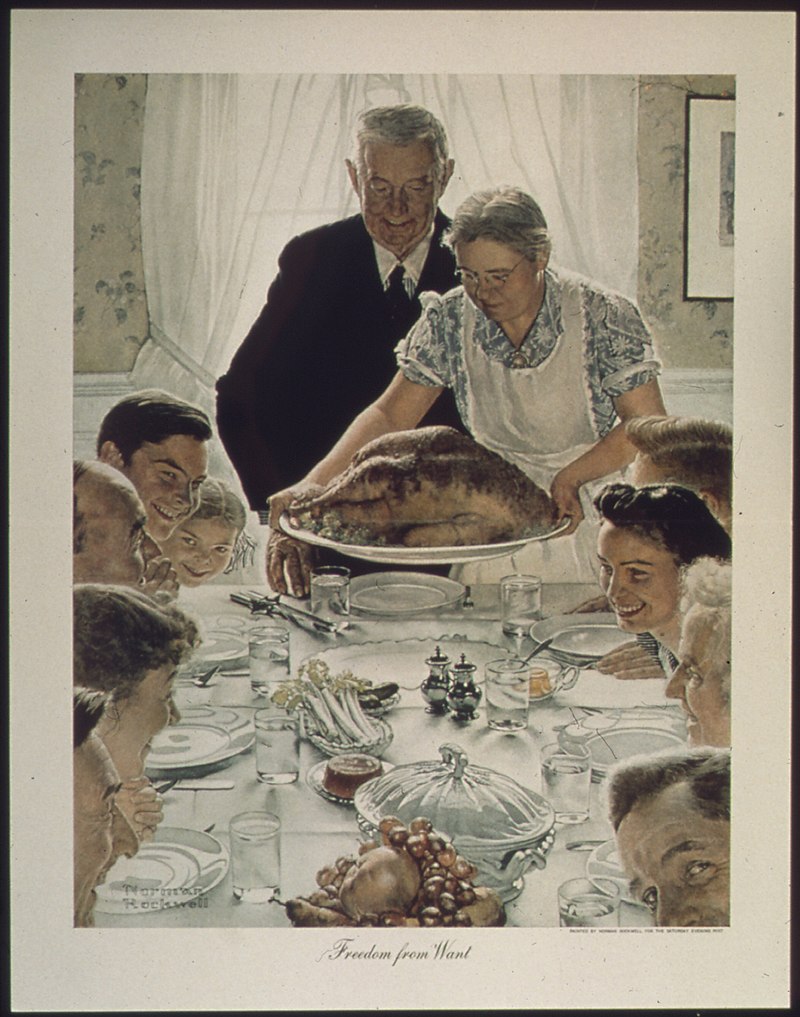
I found a photo that reminded me of Norman Rockwell‘s “Freedom from Want,” and wrote about it.

Then I ran into a tweet from Texas educator Bonnie Lesley:

That in turn led to an Alternet post, displayed at Reader Supported News (RSN), by a guy who claims that, compared to 1941 and the progress made on the Four Freedoms, all four of them are in danger, in America, today.

Could that be right?  In was in his State of the Union address in January 1941 that Roosevelt described the four freedoms he said the U.S. should work to secure around the world — this was clearly a philosophical foundation-laying for going to war on the side of Britain, and against Germany, in the World War that was already raging, but which the U.S. had managed to stay out of for five years in Asia and two years in Europe.

Near the end of the speech on January 6, 1941, Roosevelt explained why freedom needed to be fought for, what was important to us, as Americans in the freedom of others in other nations.

Here is an excerpt of the speech, the final few paragraphs:

I have called for personal sacrifice, and I am assured of the willingness of almost all Americans to respond to that call. A part of the sacrifice means the payment of more money in taxes. In my budget message I will recommend that a greater portion of this great defense program be paid for from taxation than we are paying for today. No person should try, or be allowed to get rich out of the program, and the principle of tax payments in accordance with ability to pay should be constantly before our eyes to guide our legislation.

If the Congress maintains these principles the voters, putting patriotism ahead of pocketbooks, will give you their applause.

In the future days, which we seek to make secure, we look forward to a world founded upon four essential human freedoms.

Norman Rockwell's

Norman Rockwell’s “Freedom from Fear,” 1943 painting based on FDR’s 1941 State of the Union address, “The Four Freedoms.” This painting was used on posters urging Americans to buy War Bonds.

The first is freedom of speech and expression — everywhere in the world.The second is freedom of every person to worship God in his own way everywhere in the world.

The third is freedom from want, which, translated into world terms, means economic under- standings which will secure to every nation a healthy peacetime life for its inhabitants — everywhere in the world.

The fourth is freedom from fear, which, translated into world terms, means a world-wide reduction of armaments to such a point and in such a thorough fashion that no nation will be in a position to commit an act of physical aggression against any neighbor — anywhere in the world.

That is no vision of a distant millennium. It is a definite basis for a kind of world attainable in our own time and generation. That kind of world is the very antithesis of the so-called “new order” of tyranny which the dictators seek to create with the crash of a bomb.
To that new order we oppose the greater conception — the moral order. A good society is able to face schemes of world domination and foreign revolutions alike without fear.

Since the beginning of our American history we have been engaged in change, in a perpetual, peaceful revolution, a revolution which goes on steadily, quietly, adjusting itself to changing conditions without the concentration camp or the quicklime in the ditch. The world order which we seek is the cooperation of free countries, working together in a friendly, civilized society.

This nation has placed its destiny in the hands and heads and hearts of its millions of free men and women, and its faith in freedom under the guidance of God. Freedom means the supremacy of human rights everywhere. Our support goes to those who struggle to gain those rights and keep them. Our strength is our unity of purpose.

To that high concept there can be no end save victory.

War Bonds poster showing all of Rockwell's

Posters showing all four of Rockwell’s paintings also were printed for the War Bonds Drive. Image from the digital collection of the libraries at the University of North Texas

This speech inspired Norman Rockwell to create a series of paintings in tribute to the four freedoms, which paintings were used as posters for War Bond drives.

Paul Bucheit argues we’re losing those four freedoms, which we as a nation fought to secure, in the Pacific, in the Atlantic, in Africa, Europe and Asia:

The 2013 version shows how our freedoms have been diminished, or corrupted into totally different forms.

  • Freedom from want? Poverty keeps getting worse. . .
  • Freedom from fear? The new Jim Crow. . .
  • Freedom of worship? Distorted by visions of the Rapture. . .
  • Freedom of speech? No, surveillance and harassment. . .

Mr. Bucheit offers longer explanations.  I don’t think I agree completely, but I’m interested in your opinion:  Are we losing the Four Freedoms we fought for?

Tip of the old scrub brush to Bonnie Lesley, @EdFocus on Twitter.

More:

Herblock cartoon, August 13, 1951, whatever happened to freedom from fear?

“Say, whatever happened to ‘Freedom from Fear?'” Herblock cartoon in the Washington Post, August 13, 1951, on McCarthyism and the hunt for communists in government jobs. CJR290 image; click image for more information.


Lunch at Woolworth’s, with a side of non-violence and civility: North Carolina, February 1, 1960

February 1, 2013

Today is the 53rd anniversary of the Greensboro sit-in. Be sure to read Howell Raines‘ criticism of news media coverage of civil rights issues in a 2010 article in the New York Times: “What I am suggesting is that the one thing the South should have learned in the past 50 years is that if we are going to hell in a handbasket, we should at least be together in a basket of common purpose.”

This is mostly an encore post; please holler quickly if you find a link that does not work.

Four young men turned a page of history on February 1, 1960, at a lunch counter in a Woolworth’s store in Greensboro, North Carolina.

Ezell A. Blair, Jr. (now Jibreel Khazan), Franklin E. McCain, Joseph A. McNeil, and David L. Richmond, sat down at the counter to order lunch. Because they were African Americans, they were refused service. Patiently, they stayed in their seats, awaiting justice.

On July 25, nearly six months later, Woolworth’s agreed to desegregate the lunch counter. One more victory for non-violent protest.

Ezell A. Blair, Jr. (now Jibreel Khazan), Franklin E. McCain, Joseph A. McNeil, and David L. Richmond leave the Woolworth store after the first sit-in on February 1, 1960. (Courtesy of Greensboro News and Record)

Caption from Smithsonian Museum of American History: Ezell A. Blair, Jr. (now Jibreel Khazan), Franklin E. McCain, Joseph A. McNeil, and David L. Richmond leave the Woolworth store after the first sit-in on February 1, 1960. (Courtesy of Greensboro News and Record)

News of the “sit-in” demonstration spread. Others joined in the non-violent protests from time to time, 28 students the second day, 300 the third day, and some days up to 1,000. The protests spread geographically, too, to 15 cities in 9 states.

On the second day of the Greensboro sit-in, Joseph A. McNeil and Franklin E. McCain are joined by William Smith and Clarence Henderson at the Woolworth lunch counter in Greensboro, North Carolina. (Courtesy of Greensboro News and Record)

Smithsonian caption: “On the second day of the Greensboro sit-in, Joseph A. McNeil and Franklin E. McCain are joined by William Smith and Clarence Henderson at the Woolworth lunch counter in Greensboro, North Carolina. (Courtesy of Greensboro News and Record)”

Part of the old lunch counter was salvaged, and today is on display at the Smithsonian Institution’s Museum of American History. The museum display was the site of celebratory parties during the week of the inauguration as president of Barack Obama.

Part of the lunchcounter from the Woolworths store in Greensboro, North Carolina, is now displayed at the Smithsonians Museum of American History, in Washington, D.C.

Part of the lunch counter from the Woolworth’s store in Greensboro, North Carolina, now displayed at the Smithsonian’s Museum of American History, in Washington, D.C.- photo from Ted Eytan, who wrote: [“Ever eaten at a lunch counter in a store?”] The words . . . were said by one of the staff at the newly re-opened National Museum of American History this morning to a young visitor. What she did, very effectively, for the visitor and myself (lunch counters in stores are even before my time) was relate yesterday’s inequalities to those of today, by explaining the importance of the lunch counter in the era before fast food. This is the Greensboro, North Carolina lunch counter, and it was donated to the Smithsonian by Woolworth’s in 1993.

Notes and resources:

Student video, American History Rules, We Were There – First person story related by Georgie N. and Greg H., with pictures:

Associated Press interview with Franklin E. McCain:

More, in 2013:


Odd juxtaposition of images — but it gives me some hope

January 29, 2013

A great photo from Pete Souza, the current White House photographer.  I’m hoping to track down I’ve tracked down even more details on this, because not all sources like to post all the credit information or other stuff a newspaper or blog should have . . .

Pete Souza photo, lunch in the White House, Obama, Boehner, Pelosi, Reid, McConnell

Photo of a lunch in an anteroom of the President’s office, with President Obama, House Speaker John Boehner, House Minority Leader Nancy Pelosi, Senate Majority Leader Harry Reid, and Senate Minority Leader Mitch McConnell.

Consolidated News published the photo for its clients with this information:

United States President Barack Obama has lunch with members of the Congressional Leadership in the Oval Office Private Dining Room, May 16, 2012. The President served hoagies from Taylor Gourmet, which he purchased after a small business roundtable earlier in the day. Seated, clockwise from the President, are: U.S. Senate Majority Leader Harry Reid (Democrat of Nevada), U.S. Senate Republican Leader Mitch McConnell (Republican of Kentucky), U.S. House Minority Leader Nancy Pelosi (Democrat of California), and U.S. House Speaker John Boehner (Republican of Ohio)..Mandatory Credit: Pete Souza – White House via CNP

At least we know where to get sandwiches like that, now. (Here’s the photo in the White House Flickr set.)

Senate Majority Leader Mike Mansfield

Senate Majority Leader Mike Mansfield; oil on canvas by Aaron Shikler, 1978;  photo of painting from Wikipedia

Way back in the Early Holocene, when I first interned with the U.S. Senate, Majority Leader Mike Mansfield, D-Montana, held a close friendship with Sen. George Aiken, R-Vermont.  Many mornings they breakfasted together in the staff carry-out in the basement of the Capitol; their wives were friends, too.  One morning we got a question on some hot political issue at the Democratic Policy Committee (where I shared the best office I ever had in the third floor of the Capitol); I was dispatched to find Mansfield at breakfast and get an answer.  I found him dining with Aiken.

I forget the issue, but it was highly politically charged, something about policy on Vietnam.  Republicans and Democrats were much at war on the issue.  Mansfield read the note, and showed it to Aiken.  They discussed the issue while Mansfield penned an answer and handed it to me.  No big deal — two senators dealing with an important issue, talking it over.

When I joined Senate staff in a permanent position, life was much different among the senators.  The easy camradery between Mansfield and Aiken couldn’t be found anywhere.  That was in the late 1970s.  Partisanship was much sharper and nastier than I had seen earlier.  Vietnam was over, and that was probably a good thing.  The divisiveness I found would not have lent itself to any resolution of Vietnam.

At the RARE II conference at the University of Montana, in 1978, I heard a presentation from a staffer to Montana’s Sen. Paul Hatfield, if I recall correctly, a guy who had staffed for Sen. Lee Metcalf before.  He described the difficulties in getting serious legislation done on public lands issues.  As he described it, especially before the installation of air conditioning in the Capitol, the Senate would recess for the insufferable summer heat.  Senators, who had developed working relationships, if not friendships, would visit each other in their home states, for hunting and sight-seeing, among other things.  A Montana senator might show his colleague from Vermont how different the Rocky Mountains are from the Appalachians.  A Louisana senator might show his colleagues from western states how different is flood control on the Mississippi than on the Colorado or Sacramento, or Columbia.  By the time the Senate got back to business in the fall, legislation had been worked out, key alliances formed to get things done for various states, and though opposition was expressed to many projects, it was genuine difference of opinion expressed to friends.

That’s gone.  In 2013, it’s rare a Member of Congress can develop those kinds of relationships with other Members, especially with the fund-raising requirements for re-election.  Members travel back to their states and districts as many weekends as they can; they get to know their staff on each end, but they don’t know the other senators, or members of Congress.

President Warren G. Harding doesn’t have a reputation as a great president; but his poker parties were famous.  Lyndon Johnson didn’t play poker a lot (though I understand he did on occasion), but his presidency’s record in photographs show that he invited Members of Congress individually for afternoon meetings, often punctuated with a drink, always slathered in business and the potential for favors or arm-twisting.  Those sessions are legendary for the legislation they greased into law.

When I saw that photo at the top, I was put in mind of another famous image.

Norman Rockwell's Freedom from Want

Norman Rockwell’s painting, “Freedom from Want,” part of a quartet based on the Four Freedoms State of the Union Speech of Franklin Roosevelt, in January 1941.

Did Souza have that Rockwell painting in mind when he framed that shot?

Rockwell’s work was more than just iconic, really.  In the simple history, from Wikipedia:

The Four Freedoms or Four Essential Human Freedoms is a series of oil paintings produced in 1943 by the American artist Norman Rockwell. The paintings are approximately equal in dimension with measurements of 45.75 inches (116.2 cm) × 35.5 inches (90 cm).[1] The series, now in the Norman Rockwell Museum, was made for reproduction in The Saturday Evening Post over the course of four consecutive weeks in 1943 alongside essays by prominent thinkers of the day. Later they were the highlight of a touring exhibition sponsored by the Saturday Evening Post and the United States Department of the Treasury. The touring exhibition and accompanying sales drives raised over US$132 million in the sale of war bonds.[2]

The Four Freedoms theme was derived from the 1941 State of the Union Address by United States President Franklin Roosevelt delivered to the 77th United States Congress on January 6, 1941.[3] During the speech he identified four essential human rights (Freedom of Speech, Freedom of Worship, Freedom From Want and Freedom From Fear) that should be universally protected and should serve as a reminder of the American motivation for fighting in World War II.[4]

The theme was incorporated into the Atlantic Charter,[5] and it became part of the charter of the United Nations.[6] Roosevelt’s message was as follows: “In the future days which we seek to make secure, we look forward to a world founded upon four essential human freedoms.”[3][7]

Torpedo sandwiches from Taylor’s don’t exactly make a Thanksgiving dinner, but that’s not the point.  Rockwell portrayed an American family — at Thanksgiving, perhaps — sitting down to enjoy dinner together, breaking bread together as a Christian preacher might put it in a sermon.  President Johnson famously invited, “Come, let us reason together.”  Around Obama’s smaller-than-Rockwell’s table, the smiles are not so evident.  But I still see hope.

I see some hope for friendship, for the relationships that might move legislation, for the legislation that might move the nation.  God and Norman Rockwell know we could use it.

We can hope, can’t we?

More, perhaps related:


GOP “no-budget” hoax

January 28, 2013

If you repeat some hoary old falsehood often enough, people will begin to assume it’s got some accuracy to it, right?

Paul Ryan and Eric Cantor are at it again, complaining that the Senate hasn’t passed a budget.

But that’s false.  In fact, no only did the Senate pass a budget, but so did the House — and then (perhaps stupidly), they made it a law instead of the budget resolution the Congressional Budgeting process calls for.

Then-Senate Budget Committee Chairman Kent Conrad, D-North Dakota, explained last April how this worked:

We’ve got a budget, by law — and it’s a disaster.

We don’t need a budget resolution nearly so badly as we need some Congressional leadership who understand supply and demand, and who are committed to good government and not the destruction of America (even if unintentional).

Oliphant cartoon on GOP leading nation over fiscal cliff

Cartoon by Pulitzer Prize winner Pat Oliphant, syndicated by Go Comics

More:

Text of Sen. Conrad’s remarks, below the fold.

Read the rest of this entry »


Eagles! We reduced DDT, and the eagles recovered

January 28, 2013

Love this photo, from the great folks at Yellowstone National Park:

Chris Daniel photo of a bald eagle in Yellowstone National Park, in the snow

From the Yellowstone NP Facebook site: An adult bald eagle perched along the Firehole River on New Year’s Day, near a trumpeter swan that it had either killed or was scavenging. Adult bald eagles usually remain in or near their nest territory throughout winter provided they have access to sufficient prey. Photo courtesy of Chris Daniel. (kd)

It’s a reminder of progress we’ve made in environmental protection.

While bald eagles may not have been the most endangered animal protected under the Endangered Species Act, or any other law, they became the most famous.  In the late 18th century Congress voted to designate the bald eagle as our national symbol.  At the time, the continent was still lousy with the creatures.  But from the arrival of Europeans after 1492, eagles had been hunted mercilessly.  By the early 20th century it was clear the animal was bound for extinction, like the great auk and other species (see here for technical information on the auk).

Ben Franklin complained the eagle was a dirty carrion eater, in a smart and funny polemic favoring the American turkey as the national bird.  Franklin couldn’t know how hunting and in-breeding would suck the nobility out of even wild turkeys over the next 200 years, until species protection laws and hunters pushed governments to invigorate stocks of wild turkeys again.  Compared to the eagle’s troubles, though, the turkey’s genetic torpor and limited habitat was almost nothing.

Americans tried to save the eagle.  After 1890, and during the run on great bird feathers that excited the fashion world and led to the senseless slaughter of millions of America’s most spectacular birds, we passed a federal law against hunting and shooting eagles for sport or no reason.  It was a toothless law, and the decline of eagle populations begun in the early 16th century continued unabated. Migratory bird treaties, providing more legal heft to bird protection, didn’t help the eagles either — not enough of them crossed borders, at least not that hunters and law enforcement could see.  The Bald Eagle Protection Act of 1940, kicking into action in 1941, provided teeth to eagle hunting restrictions, and hunters stopped shooting them so much.  Between 1940 and 1950, eagle populations stabilized, with a good bunch in Alaska, and a few nesting pairs spread from Oregon to Maine, Lake of the Woods to Florida Everglades.  There were so few eagles, and they were spread so far apart, that most Americans could not see one without major effort and travel.

Bird watchers noticed trouble in the 1950s.  Young eagles stopped showing up for the Audubon Christmas bird count, and at the Hawk Mountain migration counts.  Adults went through the motions, migrating, hunting, building nests, laying eggs for all anyone knew, and hatching young that had been seen, sometimes, to fledge — but then the young birds died.  Between leaving the nest, and returning to mate up and breed, the young birds simply disappeared.

Research showed deeper trouble.  On careful observation the birds were seen to be frustrated in hatching and raising chicks.  Sometimes the eggs wouldn’t hatch.  If they did hatch, the chicks died.  The few who lived to fly out, died soon after.

Rachel Carson called attention to the trouble in her 1962 claxon call on pesticide and chemical pollution, Silent Spring (50 years ago in 2012).

Doctor Science at Obsidian Wings wrote a paean to seeing bald eagles in the wild, with a brief and kind mention of this blog. You should go read it there.

Protecting birds?  The Steve Milloys, CEIs, AEIs, Heritage Foundations, CATO Institutes and other dens of smug cynicism and bad citizenship have it all wrong.  It’s not about power for environmentalists.  It’s nothing so cheap or mean.  Heck.  Often it’s not even about protecting the birds so much.

It’s about protecting our own dreams, and places we have to inspire those dreams.  Frederick Jackson Turner postulated that there is something mystical and magical in a frontier that helped form the American character and make us hard-working, smart, and noble.  He was right, of course.  Those frontiers are not simply frontiers of settlement in the wilderness anymore.  We have to work to find them, to declare Alaska the “Last Frontier,” or government reform and Cold War enterprise as the “New Frontier.”  But we still need frontiers.

Eagles still soar there.  Wherever eagles soar, in fact, we find those frontiers, those places to dream and inspire.  The Endangered Species Act isn’t about saving animals and plants.  It’s about saving our own souls.

More:


In 90 seconds, National Parks stuff you should see in Washington, D.C.

January 27, 2013

National Park Service video, and of course, featuring some stunning time-lapse photography.

696


Darrell’s corollaries of education + technology: No good work goes unpunished, most opportunities missed

January 27, 2013

Aristotle, and his pupil Alexander
Does this 19th century engraving show the perfect learning situation? Alexander had no iPhone, no laptop; Aristotle used no PowerPoint, no grading machines, not even a chalkboard. Have we come a long way, or is this a measure of how far we’ve fallen? “Aristotle and his pupil, Alexander (c. 340 BCE)” (original source?)

David Warlick‘s blog serves up a lot of stuff to make teachers think (cynically, I wonder whether education administrators can be shoved into thinking at all . . . but I digress).

David Warlick
David Warlick, formerly pictured in a taxi in Shanghai, probably off at some education conference or other, until that photo went away from the internet.

Recently he pondered his own son’s use of several different kinds of media at once.  In a longer discussion that would be worth your while, someone asked, “Has the nature of information influenced the emerging ‘appropriate technologies’ like the digital learning object called an iBook?”  David responded:

My knee-jerk response is, “Not nearly enough.” This current push toward digital textbooks, urged on by our Secretary of Education, concerns me. I worry that we’re engaged in a race to modernize schooling, rather than a sober and thoughtful imagining and designing of learning materials and practices that are more relevant to today’s learners (ourselves include), today’s information landscape and a future that has lost the comforts of certainty, but become rich with wondrous opportunities.

What I enjoyed, though, about my experience in publishing an iBook was learning to hack some features into the book that were not part of Apples general instructions for using their publishing tool. This is the ultimate opportunity of digital learning objects and environments, that they can be hacked into new and better learning experiences by information artisans who see what’s there and what it can become.

In a cynical mood, I commented on an earlier statement Warlick made, about how technology has changed the education landscape:

“… we live in a time of no unanswered questions.”

BUT:

1.  The internet and especially portable devices have exponentially increased the probability that difficult questions will be answered incorrectly.

2.  For teachers, no longer is it possible to ask a simple, factual question as a teaser to get students to search for the answer, and thereby learn something deeper along the way.  Portable computer devices present one more non-print medium in which education appears to be abdicating its duties, and the war.  (We missed radio, film, television, recorded television, and desk-top computing; now we’re missing portable devices.)

English: Cropped picture of Jaime Escalante
Legendary AP calculus teacher Jaime Escalante; pencil, paper, chalkboard and chalk, maybe a slide rule, made up his technology kit. Photo: Wikipedia

3.  No question goes unanswered, but what is really rare is a question that is worth answering; even more rare, that good question that can be answered well from free internet sources.

Darrell’s Education Technology Corollary:  When administrators and policy makers tell educators (especially teachers) they wish to utilize “new technology,” they mean they want new ways to figure out ways to fire teachers, because they don’t have a clue how technology can be used in education, nor have they thought broadly enough about what education is.

Darrell’s Education Technology Corollary Corollary: When a teacher effectively uses technology in a classroom, it will be at the teacher’s instigation, the teacher’s expense, and administrators will get revenge on the teacher for having done so.

I’ve wondered whether I wasn’t too cynical; David offered a solid response.

A couple of weeks later, my cynicism is growing.  I’m warning you, teachers, you adopt new technologies at your risk, often — especially in some school districts like Dallas ISD.

It’s a caution only.  Teachers, being teachers, will continue to push the envelopes, as Fionna Larcom related at Warlick’s blog.  Good on ’em.  One out of 500,000 will get accolades outside the education system, like Jaime Escalante did.  Many others will face reprimand.

But if education is to improve, this experimentation by teachers must continue.  So teachers slog on, under-appreciated and often opposed in their attempts to fix things.

Someday a school system will figure out how to unlock teachers’ creativity, knowledge and skills.  Not soon enough.

Teacher in primary school in northern Laos
Teacher in primary school in northern Laos.  Photo: Wikipedia

(Can someone explain to me how Warlick’s blog, with much better stuff than I do here, gets fewer hits?  Teachers, not enough of you are reading broadly enough.)

More, not necessarily the opinion of this blog:


Swearing-in stew: Inauguration week olla podrida – Where are the dung beetles when you need them?

January 25, 2013

In no particular order, nor in any particular ardor, stuff of interest and consequence we should be talking about instead of soaking in Millard Fillmore’s bathtub and admiring the plumbing:

More:


Lyndon Johnson as visionary: Great Society, speech at University of Michigan

January 25, 2013

President Lyndon B. Johnson during commencemen...

President Lyndon B. Johnson during commencement exercises at the University of Michigan on May 22, 1964 (Photo via Wikipedia, or LBJ Museum and Library in Austin, Texas)

May 22, 1964 — Lyndon Johnson laid out his vision of a much better America. At the University of Michigan Johnson discussed what a great nation in the 20th and 21st centuries should be, the Great Society speech.

This is the Lyndon Johnson speech Republicans wish had never been given, and which they hope to ignore as much as possible, laying out dreams for a better American they hope to frustrate.

More information from the LBJ Library in Austin:

Audio from President Johnson’s speech at the University of Michigan May 22, 1964, also called “the Great Society speech.” Audio is WHCA_83_2, photo is c387-8-wh64. Both are in the public domain. For more images of this speech, please see http://youtu.be/WqP037Pe5i0, which is B Roll of the same speech.

Full text of this speech at the University of Michigan is available at The American Presidency Project, at the site of the University of California – Santa Barbara (UCSB).

January 4, 1965 — Lyndon Johnson laid out the legislative plan for the Great Society.  Back then, even after crushing defeats in the 1964 elections, Republicans shared Johnson’s and the Democrats’ dreams for a better America.

Full text of this 1965 State of the Union speech can be found at The American Presidency Project at the UCSB.

From calls for international peace to a call for great expansion of federal support of education, to calls for aid for the sick and aged, is there a single area where the GOP agrees today?

How can we get the GOP to dream again?

More:


GPO Bookstore clearance sale! (Underground Railroad for kids)

January 24, 2013

One of my great joys in working in a Congressional office was the delivery of a lot of the publications that were available through the GPO, the General Printing Office. Not just Congressional hearings and dull reports, but some excellent volumes on a wide variety of topics — back when America was exceptional (before the Republicans started claiming God made America exceptional, and not hard work by Americans), most Congressional offices kept a list of people who wanted the annual Department of Agriculture farming bulletin.  It was a sort of compendium of state-of-the-art practices, predictions on soils conditions and weather, and an encyclopedia of what the government could do to help farmers out (mostly a list of county agriculture extension agents).

A lot of this activity reflected the Roosevelt-Truman-Eisenhower-Kennedy-Johnson view that government should serve the people, and good information was like diamonds.

Those days are gone

GPO still publishes some great stuff, though.

Got a note in e-mail that GPO is having a clearance/overstock sale.  As an example, this Junior Ranger workbook on the Underground Railroad — reduced to $3.00 from $6.00.  Ages 5 to 12, or kindergarten to 7th grade.

Need some supplements for your elementary or middle school classrooms?  Want just one to steal ideas from?

Discovering the Underground Railroad: Junior Ranger Activity Book

Publisher: Interior Dept., National Park Service, Southeast Region

Description: Provides activities for children ages 5-12 to learn about the history of the underground railroad and the Emancipation Proclamation. Children who finish the age-appropriate activities can send in to the National Underground Railroad Network to Freedom Program to receive a free Junior Ranger badge from the National Park Service. Gently covers topics including: the meaning of freedom and slavery; the hardships and daily life of slaves; the importance and travel routes of the “Underground Railroad;” safe refuge choices; key dates and laws relating to slavery and emancipation; and key figures including Harriet Tubman, Frederick Douglass and abolitionists Levi and Catharine Coffin, among others.

Year/Pages: 2011: 20 p.; ill.

Price: $6.00 $3.00

Of course there are a lot of other books on sale; go see.

(Oh, and a nasty little secret? The material on the Underground Railroad is in the public domain, and the booklet is available in a .pdf version, online, for free.)

Among books on sale you might find of interest:

More:


“Penetration however slight”: Remembering a good and noble hoax – the U.S.S. Pueblo

January 23, 2013

January 23 is the anniversary of the North Koreans‘ capture of the spy boat, U.S.S. Pueblo, in 1968 — a beginning of a momentous year for bad events.  The saga of the Pueblo and its crew, including especially Cmdr. Lloyd Bucher, is of special interest to me because it features a series of some of the grandest, best and most humorously American hoaxes ever perpetrated by imprisoned people against their captors and wardens.  This is one of the great Kilroy stories of American history.  It should not be forgotten.  Especially with the role North Korea plays in contemporary angst, the Pueblo episode should not be forgotten. This is an encore post, with new links added.

1968 brought one chunk of bad news after another to Americans. The year seemed to be one long, increasingly bad disaster. In several ways it was the mark of the times between the feel-good, post-war Eisenhower administration and the feel-good-despite-the-Cold-War Reagan administration. 1968 was depressing.

Lloyd M. Bucher

USN Cmdr. Lloyd M. Bucher (Photo credit: Wikipedia)

What was so bad? Vietnam manifested itself as a quagmire. Just when Washington politicians predicted an end in sight, Vietcong militia launched a nationwide attack in South Vietnam on the Vietnamese New Year holiday, Tet, at the end of January. Civil rights gains stalled, and civil rights leaders came out in opposition to the Vietnam war. President Johnson fared poorly in the New Hampshire primary election, and eventually dropped out of the race for the presidency (claiming he needed to devote time to making peace in Vietnam). Labor troubles roiled throughout the U.S., including a nasty strike by garbage collectors in Memphis. It didn’t help to settle the strike that the sanitation workers were almost 100% African American, the leadership of Memphis was almost 100% white, and race relations in the city were not so good as they might have been – the strike attracted the efforts of the Southern Christian Leadership Conference, and Martin Luther King, Jr. – who was assassinated there in early April. In response, riots broke out in 150 American cities.

More below the fold, including the key confession to “penetration.” Read the rest of this entry »


Carl Sagan explains how science works: Eratosthenes and the size of the planet

January 23, 2013

It’s not exactly a hoax.  It started out as just bad reporting of history.

In his search for an easier route from Spain to China, in which he stumbled into the Americas, Christopher Columbus knew with  certainty the Earth is a round ball.  The story that he proved the Earth round, or rather than he laid the foundations for Magellan to prove the Earth round, is only a story, mostly devoid of fact.  Sailors knew something was up just from their having watched things while sailing on the ocean.  One can deduce the ball shape of the planet by watching other ships as they sail away, and sink below the horizon.  Were sailors of a more scientific bent, they could have made much of the fact that the guy in the crow’s nest could see a ship moving away — or an island or a continent — for a time longer than those a few dozen feet below, on the deck of the ship.

Long before that a Greek librarian and polymath, Eratosthenes, figured out that the surface of the Earth is curved, deduced that the planet is basically a ball, and calculated very closely how big the ball is, merely by noting the different shadows cast by the sun at the Spring/Vernal Equinox.  Carl Sagan used this story way back in his famous PBS series, Cosmos.  It’s still interesting, informative and instructive today (surely Texas 9th grade geography teachers use this example all the time, no?  9th grade math teachers?  Say, what?).

You can find this and more Sagan videos at the Carl Sagan Portal on YouTube.

How did he do it?  Wikipedia — as usual — has a good, relatively lay explanation:

Visual representation of Eratosthenes's calculations of the size of the spherical Earth.

Bathtub Art Figure 1:  Eratosthenes’ measurement of the Earth’s circumference.

Eratosthenes calculated the circumference of the Earth without leaving Egypt. Eratosthenes knew that, on the summer solstice, at local noon in the Ancient Egyptian city of Swenet (known in Greek as Syene, and in the modern day as Aswan) on the Tropic of Cancer, the sun would appear at the zenith, directly overhead (he had been told that the shadow of someone looking down a deep well would block the reflection of the Sun at noon). Using a gnomon, he measured the sun’s angle of elevation at noon on the solstice in his hometown of Alexandria, and found it to be 1/50th of a circle (7°12′) south of the zenith. Assuming that the Earth was spherical (360°), and that Alexandria was due north of Syene, he concluded that the meridian arc distance from Alexandria to Syene must therefore be 1/50 = 7°12’/360°, and was therefore 1/50 of the total circumference of the Earth. His knowledge of the size of Egypt after many generations of surveying trips for the Pharaonic bookkeepers gave a distance between the cities of 5,000 stadia (about 500 geographical miles or 927.7 km). This distance was corroborated by inquiring about the time that it takes to travel from Syene to Alexandria by camel. He rounded the result to a final value of 700 stadia per degree, which implies a circumference of 252,000 stadia. The exact size of the stadion he used is frequently argued. The common Attic stadion was about 185 m,[9] which would imply a circumference of 46,620 km, which is off the actual circumference by 16.3%; too large an error to be considered as ‘accurate’. However, if we assume that Eratosthenes used the “Egyptian stadion”[10] of about 157.5 m, his measurement turns out to be 39,690 km, an error of less than 2%.[11]

Description of Bathtub Art Figure 1:

Syene (S) is located on the Tropic of Cancer, so that at summer solstice the sun appears at the zenith, directly overhead. In Alexandria (A) the sun is \varphi south of the zenith at the same time. So the circumference of earth can be calculated being \frac{360^\circ}{\varphi} times the distance \delta between A and S.

Erastothenes measured the angle \varphi to be 1/50 of a circle and his access to knowledge of the size of Egypt gave a north/south distance \delta between Alexandria and Syene of 5000 stadia. His circumference of the Earth was therefore 250 000 stadia. Certain accepted values of the length of the stadia in use at the time give an error of less than 6% for the true value for the polar circumference.

Tropic of Cancer sign in Western Sahara

Tropic of Cancer sign in Western Sahara, placed by trans-Sahara racers, in English and Hungarian Photo: Wikipedia

A fun little exercise, but a remarkable achievement for anyone about 240 years before the birth of of the Biblical Jesus.  Syene, now known as Aswan, is on what we now call the Tropic of Cancer (the “tropics” were named by the Greeks, but I am uncertain whether the line had that name in Eratosthenes’s time).  The date is probably not important, so much as the observation that the sun was vertical at noon on a given date — and then Eratosthenes’s experiment to see whether that were true in Alexandria, and then his understanding of what that might mean and his work to assemble the data to make the calculations.   High school students — heck, junior high school students — should be able to figure all that out today, if they had the basics down.  I suspect that knowing this story would be a spur to students to learn the elements of the mystery and how it was solved, and what it might mean for later navigators of the oceans, land and air, for astronomers, for farmers and for mathematics.

I also like this story because it presents a strange conundrum, a paradox about what people know, and what they may reason from the foundation of what they know.  Our friend and frequent commenter Morgan, whose blog he calls the House of Eratosthenes.  I suspect he thinks himself some latter-day Eratosthenian (“Latter-day Erats?”).  He says as much in his blog FAQ:

I’m just like Eratosthenes peeking into a well here, and I don’t know what it means yet.

It’s an entertaining read and more enlightening that one might think from his forays here, so you probably ought to go read the FAQ and the reasons Morgan misbelieves liberals miss out on Eratosthenes’s wisdom.  Morgan has an explanation of Eratosthenes and his discoveries which I find too brief to be accurate (and I’m not sure why Morgan finds the name “Beta” to be dubious; being a polymath was not a small thing then, or now; second best in everything means one is first in the All-Around, first in the academic centathlon or millathlon — no mean set of feats at all).  I find that funny because, while he makes a pretense and some effort to following Eratosthenes and scientific methods, to me he seems to find science and logic things to run away from, as in our recent discussion where he ends up defending Anthony Watts’s erroneous views because Watts’s critics didn’t link to Watts (see comments in “It’s raining crazy,” and see also Morgan’s own post, which defies explanation).  Eratosthenes would find that funny, too, I hope, but not a demonstration of Eratosthenian logic and calculation.

Does anyone doubt where Carl Sagan would be in the debate between the dozen serious scientists and hundreds of political wankers who deny climate change, and the thousands of scientists and good citizens who recognize that it occurs and think we should get on with saving the future?

(Did James Burke cover Eratosthenes in his brilliant series Connections?  Which episode?)

Tip of the old scrub brush to Fred Clark at Slacktivist, whose compilation posts often overflow with stuff you ought to know or see, and whose post today sent me to Joe at It’s Okay to Be Smart and “Top 10 Reasons We Know The Earth Is Round.”

More:


Fly your flag today: Martin Luther King, Jr., holiday (and President Obama’s 2nd Inauguration)

January 21, 2013

I hope your flag is already flying today — sun’s up in almost all the U.S.

U.S. Capitol before dawn, January 21, 2013 – flags for the Senate and House not up yet, but the historic five flags of the nation hang ready for the 2nd Inauguration of the 44th President, Barack Obama. Photo from near the Newseum (replacing earlier photo from roof of Newseum, gone into internet ether).


Newseum photo, U.S. Capitol at dawn in inauguration day, 2013

U.S. Capitol before dawn, January 21, 2013 — flags for the Senate and House not up yet, but the historic five flags of the nation hang ready for the 2nd Inauguration of the 44th President, Barack Obama. Photo from the roof of the Newseum.

Fly the U.S. flag today for the holiday for the birthday of Martin Luther King, Jr.  The holiday is celebrated on the third Monday in January.

Many Americans will celebrate with a day of service.

Today also celebrates the 2nd inauguration of President Barack Hussein Obama, the 57th inauguration of a president.

What a breathtaking intersection of history!


Miami Herald front page, January 21, 2013

Courtesy of the Newseum, the front page of the Miami Herald, today — featuring the Martin Luther King, Jr., monument, and the official inauguration of President Barack Obama.  40 years ago, who would have dared guess this front page in a southern newspaper?

More:

View from the National Capital Mall, 2nd Inauguration of Barack Obama

Photo by John Rudy, from the National Capital Mall, about 11:00 a.m., January 21, 2013. Flags a-flying there!