Utah’s legislature boosts education across the board

February 27, 2007

Gifted with a surplus of funds due to a good economy, the Utah legislature hiked education spending in almost every category, providing pay increases for teachers, more teachers, more schools, more books, more computers — adding more than $450 million, raising the total state education check to $2.6 billion for elementary and secondary schools.

Much of the increases will be consumed by rising enrollments.

Through much of the 20th century Utah led the nation in educational attainment, but fell in state rankings as population growth accelerated especially through the 1980s and 1990s. The Salt Lake Tribune’s story sardonically noted:

The budget package increases per-pupil spending by more than 8 percent. But because other states may also boost school funds this year, fiscal analysts can’t yet say whether the new money will move Utah out of last place in the nation in money spent per student.

Classroom size reduction is excluded from the increases, because the legislature thinks earlier appropriations for that purpose were misused, according to the Associated Press story in the Casper (Wyoming) Star-Tribune:

The extra $450 million will have little effect on reducing classroom size, however, because even as Utah hires more teachers, every year brings more students.

Lawmakers said they were withholding money for reducing classroom sizes until legislative auditors can investigate reports that districts misappropriated some of the $800 million dedicated for that purpose since 1992.

Every teacher and librarian should get a $2,500 pay raise and a $1,000, one-time “thank-you” bonus. Starting pay for teachers in Utah averages barely over $26,000 now.

Read the rest of this entry »


Crazies without comment

February 6, 2007

As the title notes, without comment:


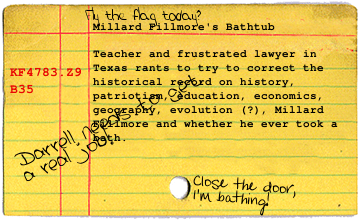
Odd things you find in library card catalogs

January 12, 2007

Like this:

faux-library-catalog-card.png

I went looking for mine when Myers at Pharyngula found one.

Here, you can find yours, too:  At blyberg.net.

My card must be older than P.Z.’s — it’s a lot yellower.  The call number seems just a bit off, don’t you think?  Is that right?


Death of books, and history on video

December 3, 2006

In the Eisenhower administration some wise person noted that through history, libraries have been essential to civilization. In that wisdom-tinged era, the federal government started a program to establish in every county in the U.S. a library which would contain practical information on farming, industry, health care, and government and philosophy, so that in the event a nuclear exchange wiped out great libraries in Chicago, New York, Philadelphia, Washington and Los Angeles, among other places, the knowledge and wisdom needed to rebuild America would be available to people easily, locally.

It was a good idea, I think, but chiefly because of the side effect of putting good information close to people, even without nuclear destruction. I wonder whether we have strayed.

Today, libraries abandon books in favor of electronic media, film and on-line applications at a prodigious rate. Million-book libraries, once the hallmark of a good university, now represent dated data and a backwater center of scholarship, to many.

Libraries missed the first video wave. Thinking they were about books and not television presentation of information, libraries missed the opportunity to attract customers for videos. Instead, here in the U.S. a company named Blockbuster did badly (by my estimation) the promulgation and protection of culture, for profit, that libraries should have done for free. Determined not to miss the next evolution or revolution in media, libraries now plan to adopt new media when possible, and store information in new electronic formats.

In the U.S., college libraries turn to coffee bars and advanced internet access to attract students to . . . where the stacks used to be. (audio story from NPR’s Saturday Edition)

In the Netherlands, libraries plan to archive local video productions and photographs, and to digitize the data to make it more widely available. Plans are to spend 173 million euro (more than $230 million U.S. at today’s exchange rate), to archive 285,000 hours of film, video and radio recordings, and nearly 3 million photos.

Will civilization survive?

Tip of the old scrub brush to If:book, from the Institute for the Future of the Book.


Free “classics” books for school libraries, from NEH

November 26, 2006

The National Endowment for the Humanities is prepared to give away collections of classic books to school libraries.

Here is the NEH press release, unedited by me:

National Endowment for the Humanities Offers Free Classic Books to Libraries Through the We The People Bookshelf Program

WASHINGTON (Sept. 18, 2006)–The National Endowment for the Humanities (NEH) today announced the fourth annual We the People Bookshelf, a program that offers sets of classic books to 2,000 community and school libraries throughout the United States. Recipients of the NEH awards program will receive a collection of 15 classics which were selected to illustrate this year’s theme, “The Pursuit of Happiness.”

The We the People Bookshelf is part of NEH’s We the People program designed to strengthen the teaching, study, and understanding of American history and culture. Again this year, NEH has partnered with the American Library Association (ALA) to distribute a set of books, posters, and educational CDs to 2,000 selected libraries that offer the best programs for young readers using the awarded materials.

“These classic books are rich in stories about individuals who embrace the ‘unalienable’ right of free people–the pursuit of happiness, a phrase written indelibly in the Declaration of Independence by Thomas Jefferson,” said NEH Chairman Bruce Cole. “Young readers will find in these books the spirit of hope that has contributed to the growth and strength of our great nation and its citizens for more than two hundred years.”

The We the People Bookshelf on “The Pursuit of Happiness” features the following books for 2007:

  • Grades K-3: Aesop’s Fables by Aesop; Stopping by Woods on a Snowy Evening by Robert Frost; Mike Mulligan and His Steam Shovel by Virginia Lee Burton (also in Spanish).
  •  
  • Grades 4-6: Tuck Everlasting by Natalie Babbitt; The Great Migration by Jacob Lawrence; These Happy Golden Years by Laura Ingalls Wilder; and Journal of Wong Ming-Chung (donated by Scholastic, Inc.) by Laurence Yep.
  •  
  • Grades 7-8: A Wrinkle in Time by Madeleine L’Engle; Esperanza Rising (donated by Scholastic, Inc.) by Pam Munoz Ryan, (also in Spanish); and Carry On, Mr. Bowditch by Jean Lee Latham.
  •  
  • Grades 9-12: Kindred by Octavia Butler; O Pioneers! by Willa Cather (also in Spanish); The Great Gatsby by F. Scott Fitzgerald; Leaves of Grass by Walt Whitman; and Common Sense by Thomas Paine.

As a bonus, each library receiving a We the People Bookshelf set will receive a music CD, Happy Land: Musical Tributes to Laura Ingalls Wilder.

Libraries wishing to participate in the We the People Bookshelf program can find more information and application instructions online at www.neh.gov. Applications can be submitted from Sept. 19, 2006, through Jan. 31, 2007.


Media Contact: Michele Soulé at 202-606-8454


Carnival of Education #86

September 30, 2006

Just go read it.  (It’s at Education Wonks.) It’ll make you mad, keep you busy, fill you with information, enough for a week at least.

I missed Banned Books Week this year?  Drat.

Bush political appointees pushing a political agenda against good education?  Not surprised, but concerned there is not more visible outrage anywhere.

Hmmm.  Must brew big pot of coffee today.  (In any case, I’m off for a service project by some Boy Scouts; at least I’ll be smiling when I get back to this stuff.)


Tantalizing partnership in Abilene, Texas

September 26, 2006

When I handed in my paper on the history of the Pleasant Grove Review to my journalism history professor, I lamented the lack of really good books and articles on Utah papers in general, and I noted how I had difficulty finding experts to cite, and so I had to spend hours in the backrooms of libraries and archives going through newspapers. He gave me a long deadpan look, and said, “You’re the expert — now.”

Actually, finding the stuff in those odd places was a good bit of fun.

Kids in Abilene, Texas, may have an easier go of such research in the future. A local consortium has funding to archive local history sources.

The Abilene Library Consortium has been awarded $2.2 million to begin a Digital Archives project. The Consortium members are Abilene Christian University, Abilene Public Library, Hardin-Simmons University, McMurry University, and Howard Payne University. The five-library group will build a digital repository to preserve and present historically significant materials that tell the stories of people within their communities. The repository will be available to the public and to each home institution. Staff will schedule workshops to assist individuals and agencies in preserving their historical records.

The Dodge Jones Foundation has awarded $2 million dollars and the Dian Graves Owen Foundation awarded $200 thousand dollars to begin the project and sustain it for the first three years. The grants include funding for equipment, staff, training and outsourced services.

I wonder whether high school teachers in Abilene are salivating at the chance to turn loose a small army of young historians, or are they instead suffering through one more meeting on how to boost TAKS scores?

Tip of the scrub brush to Library Technology in Texas.