Tom Lehrer collides with the periodic table of the elements on YouTube

August 20, 2007


Cover to the original vinyl record, "An Evening Wasted with Tom Lehrer," containing his performance of his song, "The Elements."

Cover to the original vinyl record, “An Evening Wasted with Tom Lehrer,” containing his performance of his song, “The Elements.”

Great song, great table, entertaining mashup probably worthy of a more serious production; there are a lot of pictures of boxes on the periodic table.

Tip of the old scrub brush to Homeschool Stuff.

(Lehrer is a math instructor — he intentionally stalled out before getting his Ph.D. — who wrote a series of parody songs in the late 1950s and 1960s. There are three albums of his work, still available last time I checked. One legend is he stopped writing parodies a couple of decades ago, saying that satire was no longer possible after Henry Kissinger won the Nobel Peace Prize in 1973. A collection of his works was assembled into a hit review, Tomfoolery! in 1980; it opened in London, moved to New York, and had a pleasant run in several other venues. Much of his work touches on the scientific, or dives right in.)

(You recognize the tune, of course. It’s from the Gilbert and Sullivan operetta Pirates of Penzance, “The Major-General’s Song.”)

Almost immediate update: Oooh! Here’s an even more ambitious animation of a live performance:


Good Vibrations

August 15, 2007

August 15 is Leon Theremin’s birthday (b. 1896).

Leon Theramin and his instrument, the Theramin Without Leon Theremin, musical scores to horror movies would be nearly impossible, at least for everyone except Henry Mancini and John Williams.

His life would make a great movie. He invented the Theremin in the midst of World War I in Russia; after the war he toured Europe, and then the U.S. He played Carnegie Hall, he collaborated with Albert Einstein, and he married a young African-American ballerina, Lavinia Williams. In 1938 he was kidnapped by the Soviet KGB and forced to return to Russia, in the Union of Soviet Socialist Republics (USSR).

Sent to a work camp, he worked alongside Andrei Tupelov and a host of other famous Soviet scientists. Theremin was “rehabilitated” in 1956. He returned to invention, and invented bugging devices, including the famous microphone that was placed in the Great Seal of the United States in the U.S. Embassy in Moscow. The bug had no moving or active parts, and no power supply, but could transmit when hit with a microwave transmission. The bug spied on U.S. diplomats from 1945 until its accidental discovery in 1952.

Later Theremin turned to inventions of devices to open doors, and to burglar alarms. He trained his niece, Lydia Kavina, on the Theremin — she is considered a virtuoso at the instrument today. In 1991 he returned to the U.S., reunited with some of the artists he’d worked with 50 years earlier for several concerts. He died in Russia in 1993, at the age of 97.

And if you’ve ever heard the Beach Boys’ recording of “Good Vibrations,” you know what a Theremin sounds like.


Evolution as one folksinger sings it

June 23, 2007

Chris Smither, about whom I know absolutely nothing, with a song that should make you smile, about Genesis and Darwin, with commentary.

Tip of the old scrub brush to Bruce Tomaso at DallasNews Religion.


Typewriter of the moment: Jack Kerouac

June 6, 2007

Jack Kerouac's typewriter, in Lowell, MA - Beat Museum on Wheels

Jack Kerouac’s typewriter, on display in Lowell, Massachusetts. Kerouac attended Lowell High School, and Lowell hosts an annual festival to Kerouac. Photo from the on-line photos of the Beat Museum on Wheels (image downloaded and linked on June 6, 2007)

Kerouac appears in almost all U.S. history texts for high schools, and is to cover the post-World War II poetry mentioned in the Texas Essential Knowledge and Skills (TEKS).

Poet and author Jack Kerouac was the “King of the Beats.” The Beats were a group of poets and authors who gave rise and verse to the “Beat Generation.” The word “beat” is short for “beatitude.” Not only do most high school kids struggle with this character from U.S. history — in what should be a very fun section — many high school teachers have only vague understanding of the whole Beat movement. Read the rest of this entry »


How it’s done right

June 1, 2007

If I need a lift, I go here. It’s how school should be — probably all the way through.

I don’t know the details of how or why this class is set up the way it is, but day after day they do things that other people use as textbook examples of what a good classroom ought to be doing, sometimes. And they do it day, after day, after day.

Carnival of Education, are you paying attention?

Wow.

I wager right now that these kids will be the top performers on the standardized tests for at least the next five years, in their classrooms and schools. The Living Classroom weblog is a valuable chronicle for how to provide quality education.

Somebody should step up with the money to track how these kids do, especially against their contemporaries. Alas, this is exactly the sort of information that will be lost, due to “lack of funding.” Fortunately, one of the women involved in the classroom made the chronicles, and shared them.

Side note: Looking at the photos, ask yourself, “Does our town offer these types of recreational facilities for use?” Washington has traditionally led the nation in setting aside land for public recreational use — this class has taken full advantage of being in a town that had the foresight to put up public art and public beaches, and other public parks and places. There is a lesson here for city planners, and for mayors and city councils who wonder how they might support their schools, run by other governmental entities.

Dandelion, class activitiy for The Living Classroom


Bluegrass good news: John Starling is back

May 1, 2007

Not only is John Starling back, he’s got his old colleagues from the original Seldom Scene with him, Mike Auldridge and Tom Gray (Ben Eldridge continues to hold down the fort with the new casts of players in the Scene).

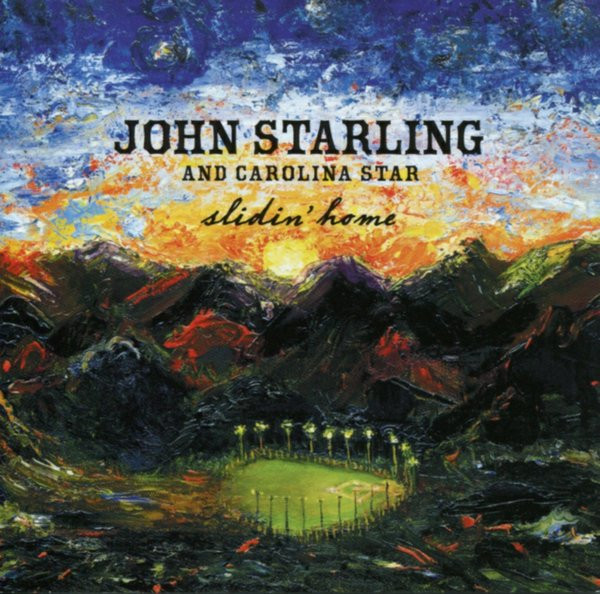
“Sliding Home,” 2007 album from John Starling and Carolina Star, featuring a lot of Starling’s friends as guests (and great musicians), including from Seldom Scene.

John Starling and Carolina Star have a new CD out, “Slidin’ Home.John Starling and Carolina Star, Slidin' Home (cover)

The seeds for this reunion were planted in 2005 at a benefit concert for Eddie Adcock in Washington D.C. “I knew they (Auldridge and Gray) were going to be there, and I called Ben, and he came, and Larry Stephenson was there,” Starling recalls. “We just went up there, Larry sang tenor and the other four of us were original members of Seldom Scene, just went up and did a show. We worked it up backstage, and next thing you know, we had so much fun, we decided to do another couple of shows.”

With encouragement from Massenburg and an attentive audience base, Starling, Auldridge and Gray decided to go into the studio and record a few songs to see how things went. “We liked it and decided to come back to Washington and put together a group that would go out and play it and decided to take a couple of Beltway bandits, Jimmy Gaudreau and Richie Simpkins, who also live in the Washington area and went back and finished the album with that group,” he says.

Rebel Records has a setup to allow listening to the album, at Rebel Records’ site.


Janis Joplin tour invites fans to Texas

April 24, 2007

Janis Joplin in concert

Good News Comes in Small Packages Division: This was the entirety of the article in the Dallas Morning News travel section Sunday:

Come on down for a Janis Joplin tour

Head down to Port Arthur – in a Mercedes Benz, if possible – for a new self-guided Janis Joplin driving tour. The 15 stops include her childhood home, churches, schools and the Museum of the Gulf Coast, which has an exhibit devoted to the rock and blues singer. For the tour brochure, call 1-800-235-7822.

Is there more? Sure — below the fold. Summertime’s a good time to make the tour — but so is spring, fall, and winter.

Read the rest of this entry »


Texan Ornette Coleman wins Pulitzer Prize

April 18, 2007

Quoting from the Pulitzer Prize website:Ornette Coleman by Jimmy Katz

For distinguished musical composition by an American that has had its first performance or recording in the United States during the year, Ten thousand dollars ($10,000).
Awarded to “Sound Grammar” by Ornette Coleman, recording released September 12, 2006.

Also nominated as finalists in this category were: “Grendel” by Elliot Goldenthal, premiered June 8, 2006 by the Los Angeles Opera at the Dorothy Chandler Pavilion, libretto by Julie Taymor and J.D. McClatchy, and “Astral Canticle” by Augusta Read Thomas, premiered June 1, 2006 by the Chicago Symphony Orchestra (G. Schirmer, Inc.).

Ornette Coleman does nothing without flair (look at the photo — catch the color of the horn, and don’t miss the jacket). Fort Worth native, Coleman won the Pulitzer Prize for composition, for a recording released in 2006. It was the first time that a recording was considered for the composition prize. The Pulitzer judge panel put Coleman in competition sua sponte — his composition was not nominated prior to the judges’ consideration.

So Coleman won for an improvisation, the composition was presented as a recording rather than on paper, and he won despite not being nominated in the first place.

NPR has one of the best stories on the prize, with excerpts from the recording you may listen to. Here is Coleman’s own website.

Coleman would make a fun Texas Music Monday in seventh grade Texas history, but it may be difficult to find tracks that are really listenable. His work is deep, and it often takes a lot for a listener to keep up.

But in a context of the diversity of Texas music, in a curriculum that has already included Van Cliburn, Bob Wills, conjunto, “The Yellow Rose of Texas,” Charley Pride, George Strait, Tex Ritter, Janis Joplin, Flaco Jimenez, Brave Combo, Robert Johnson and Blind Lemon Jefferson, Scott Joplin, et cetera ad infinitum — everything from classical to the purest country, with rock, German and Mexican polka, and everything else thrown in* — kids might find it of interest, especially if they’re from Fort Worth.

Ornette Coleman is one more great Texas Native. Tip of the old scrub brush to P. M. Summer, who called my attention to the Coleman award in the comments of my previous Pulitzer post.

* Yes, of course I left off three or four of your favorite artists. If you can’t name five good-to-great Texas musicians who are not on this list, you’re not breathin’.


Texas “million-air” songwriters

March 31, 2007

One of the large copyright license clearance organizations for music performances, Broadcast Music, Incorporated, (better known simply as BMI), keeps track of how many times a song is performed on radio. When a song passes a million performances, it is said to be a “million-air” tune.

Texas music license plateAccording to the governor’s Texas Music Office, a million plays of most popular tunes is equal to 50,000 broadcast hours, or about 5.7 years of continuous play.

Texas songwriters have quite a few tunes in that category, and a surprising number of them of recent vintage. More below the fold. Read the rest of this entry »


Best in bluegrass? Not Tenacious D, certainly

February 28, 2007

Tenacious D fans may find it satisfying, but the bluegrass-styled tribute to D’s work is far from the heights of bluegrass, or even the heights of the odd marriage of rock or blues and bluegrass.

Bluegrass is a uniquely American invention, probably not really well defined until Bill Monroe and the Louvin Brothers started recording it in the first half of the 20th century. Bluegrass is an instrument set as well as a style of music — it usually should include guitar, mandolin, and banjo and bass. Solid bluegrass also includes a Dobro. Fiddle is optional, drums often detract from the music but may be added. Autoharp is an occasional addition — the Carter Family used autoharp with good effect, though they were not exactly in the middle of the bluegrass path.

The late Dick Dabney wrote an article for The Washingtonian in the 1980s that I have been unable to track down, in which he well defined for us lay people what defines bluegrass: The song is a story with consequences. Bad things happen, and people are sorry for the occurrences. Good things happen, too, but that’s to be expected.

Putting bluegrass instrumentation to Tenacious D tunes just doesn’t measure up to Dabney’s criteria, I fear.

Bluegrass could have a role in history classes, selected carefully. Below the fold, I’ll suggest some things you may want to listen to.

Read the rest of this entry »


Grand music hoax: Plagiarist confesses

February 27, 2007

A fascinating, tragic hoax has unraveled in the classical music world. Dozens of performances by relatively unknown — but great — pianists were pirated, credited to a great pianist dying of cancer, and made internet hits.

The hoax that lives by the internet, dies by the internet, Jesus might have said. A music critic loaded one of the released discs into his iPod list on his computer, and it identified it as being performed by someone else.

Joyce Hatto had retired due to ovarian cancer in the 1970s, but started releasing recordings made at home in 1989. This was not unusual — her husband was a recording engineer. The quietly-released, small-label recordings got good reviews and a faithful audience. As time went on, the recordings became more ambitious, and the quality of the piano playing of the dying woman audibly increased.

Questions arose earlier this year.   Read the rest of this entry »