No, not here.
Clio Bluestocking has it up at her blog; Eliot and Picasso, together — go see. An interesting partnering of painting and poetry, for another National Poetry Month celebration.
No, not here.
Clio Bluestocking has it up at her blog; Eliot and Picasso, together — go see. An interesting partnering of painting and poetry, for another National Poetry Month celebration.
 1 Comment |
  Famous Battles, History, Patriotism, Peace, Quotes, War |
  Permalink
 Posted by Ed Darrell

Jefferson, Paul Jennewein bas relief in U.S. House chamber
Jefferson’s birthday sneaked up on me this year. There is the constant tension between doing the Things that Keep the Wolf from the Door and following all the things we should follow; wolves have been on my mind more lately (notice the drop off in posts).
So all I had was a warning post last week, and the post yesterday wishing Tom a happy natal anniversary day. Hey it’s not my job.
But what about the rest of you? What about the president, Congress, public officials, educators and others everywhere?
Here is what I found of celebrations of Jefferson’s birthday:
Architectural Record reported that the Thomas Jefferson Medal in Architecture was won by Zaha Hadid.
The Daily Progress of Charlottesville, Virginia, Jefferson’s home town, reported that Alan Greenspan won the first Thomas Jefferson Medal in Citizen Leadership.
In the last paragraph of the story about Greenspan, The Daily Progress also noted that the Thomas Jefferson Medal in Law was awarded to Anne-Marie Slaughter.
The Thomas Jefferson Center for the Protection of Free Expression issued 16 “Jefferson Muzzle” awards to people who damaged free expression. The story I found was from the UPI wire, UPI now being owned by the Unification Church and probably sort of a muzzle itself. The story listed only one of 16 awardees.
In Washington, D.C., Secretary of Commerce Carlos M. Gutierrez noted the 200th anniversary of the science agencies that became the National Oceanic and Atmospheric Administration (NOAA), in a speech at the Jefferson Memorial. Jefferson had created the first science agency, the Survey of the Coast, during his presidency, in 1807.
President Bush declared April 13 “Thomas Jefferson Day,” on April 11. If any news agency picked up that press release, I’ve not been able to find it.
That’s about it for celebration. That’s not a lot. It’s not enough.
We can and should do better than that. In The Philadelphia Inquirer, education scholar Peter Gibbon of Boston University suggests we can and should honor Jefferson more overtly, despite Jefferson’s own refusal of letting the citizens of Boston make his birthday a holiday:
Jefferson was more than an eloquent espouser of democratic ideology, more than a patient and realistic secretary of state, and more than a president who doubled the size of America with the Louisiana Purchase. He was a scientist who analyzed climate change, studied mastodon bones, and championed small-pox inoculation; a farmer who invented a moldboard plough and brought fruit trees and upland rice to America; a lawyer who helped make Virginia laws more humane; and an architect who designed Monticello and the University of Virginia.
Only education, Jefferson believed, could end tyranny and preserve democratic values. Thus, he advocated universal primary education, colleges open to merit, and curriculum separate from theology. His thousands of books eventually became the beginning of the Library of Congress. Devoted to reason, he loved beauty, playing his violin, and marveling at the flowers and fruits of the Virginia countryside. In love with knowledge, he placed a higher priority on virtue.
Jefferson cultivated friends, treasured his wife (who died after only 10 years of marriage), and watched after his children. In 1804, Maria, his 26-year-old daughter, died. Against a background of war, political combat, and personal suffering, Jefferson struggled to retain his optimism.
Our celebration of Jefferson’s birthday today is more complicated than the adoration of Boston citizens in 1803. Now, we acknowledge a guilty, conflicted slaveholder who did not transcend his time, a tough politician who orchestrated attacks on his opponents and carefully shaped his reputation for posterity. We see a second presidential term marred by a misconceived embargo that backfired and caused an economic crisis. Still, we might also see a sweet-tempered, affectionate human being – a diplomat, architect, and idealist who believed in religious tolerance, rebuked tyrants, promoted civil rights, and wrote the words that justify the creation of America.
Some Americans are unhappy with Jefferson’s legacy. As with all real humans who achieve some level of hero-worship, some people are unhappy to discover that others who do heroic things are not heroic in all aspects of their lives. They need to get over it.
We should do more to celebrate Thomas Jefferson and his legacy. April 13 is a good day for such celebrations.
This is not a call for a hero cult, nor especially a religious-style cult. Honoring Jefferson honors his better nature, his calls for freedom for everyone, his calls for ending slavery (even if he did not free his own slaves), his call for universal education in order to make a republic work well and righteously, his calls for intellectual freedom, his celebration of the Common Man as an ideal, his work for libraries and learning, his work for good and beautiful architecture, his love of science, etc., etc., etc.
Honoring Jefferson honors America, and calls us to do better ourselves in working for a higher good. We should do that.
Leave a Comment » | 1803, History, Leadership, Libraries, Patriotism, Politics, Presidents, Public education, Public libraries, Science, Science and faith, Thomas Jefferson | Permalink
Posted by Ed Darrell
Canadian history? Yeah, it’s important. You’ve never heard of the Battle for Vimy Ridge?
Start here: “The Easter Monday that Changed the World.”
Leave a Comment » | Famous Battles, History, Leadership, Lesson plans, Patriotism, World War I | Permalink
Posted by Ed Darrell
What’s the Constitution between friends?
–Timothy J. Campbell (1840-1904), Attributed, circa 1885
A little more below the fold? Certainly. Read the rest of this entry »
2 Comments | Bad Quotes, Famous quotes, Good Quotes, Patriotism, Politics, Presidents, Quotes, U.S. Constitution | Permalink
Posted by Ed Darrell
Here are some of the posts I’ve been thinking about over the past couple of days:
Iraq and Vietnam: Writings by Hudson has been reading about LBJ and Vietnam. Santayana’s ghost appreciates the exercise.
Camels in the Outback, camels in the dogfood: Would you believe a million camels are feral in the Australian Outback? And now, with a drought, it’s a problem. The Coffee House alerts us.
What if everybody in your organization came to you for help? The Drawing Room tells us why you’d be wise to work for such a thing.
U.S. soldiers protest the war: No, not the current war — African American soldiers protest the Filipino conflict. Forgotten soldiers, forgotten war — you’d do well to reacquaint yourself with this chapter of U.S. history at Vox ex Machina.
Leaks about the incident that got us into the war: No, not yet the Iraq war (see how you jump to conclusions?). POTUS reflects on LBJ and the Gulf of Tonkin Resolution, and the leaks and lack of intelligence that may have gotten us into a quagmire.
Earthquakes in Tornado Alley: Tennessee Guy points to an article that wonders about the New Madrid Fault, and whether it is tensing up for “the Big One” to shake West Tennessee (and the rest of the Midwest), or it is going to sleep for a millennium.
Science and racism: A collection of Darwin’s writings that touch on race and slavery, for your bookmark file.
Cool school libraries: We’re not talking about air conditioning.
1 Comment | Charles Darwin, Civil Rights, Dissent, Education, Elections, Evolution, History, History blogs, Leadership, Lessons of Vietnam, Patriotism, Politics, Presidents, Public libraries, Santayana's ghost, Theodore Roosevelt, Vietnam, War, Weblogs | Permalink
Posted by Ed Darrell
We’d better hope it’s a tongue-in-cheek title, but the Carnival of the Decline of Democracy 2.6 is up at Ken Goldstein’s Random Thoughts, Notes, and Incidents. It’s a short one — it would appear democracy’s decline is overstated.
And, how do they come up with the “2.6” count?
Leave a Comment » | Patriotism, Politics, Weblogs | Permalink
Posted by Ed Darrell

Congress voted to award the Congressional Gold Medal of Honor to the Tuskegee Airmen as a group. The ceremony is set for Washington, D.C., in the Capitol Rotunda, for March 29, 2007.
This is another great story of Americans, otherwise held down in their daily life, who rise to meet a monstrous challenge. They not only met the challenge but achieved a degree of triumph beyond what anyone had hoped. The story is a natural segue to the post World War II civil rights movement, and it fits nicely into studies of the war or studies of civil rights. News items around the time of the ceremony should update the history of the Tuskegee Airmen and provide good photos for classroom presentations.
“It’s sort of an open validation of the Tuskegee Airmen, that we fought stereotypes, overcame them and prevailed,” said Roscoe Brown, an 85-year-old Riverdale, N.Y., resident who graduated from the Tuskegee program in 1944. “This is the ultimate when your nation recognizes you.”
The gold medal, equivalent to the Presidential Medal of Freedom, is awarded to individuals or groups for singular acts of exceptional service and for lifetime achievement. The Tuskegee fliers will join a distinguished group of recipients that includes George Washington, Winston Churchill, Rosa Parks, the Wright brothers and former Secretary of State Colin Powell.
Rep. Charles Rangel, D-N.Y., and Sen. Carl Levin, D-Mich., introduced identical bills in the House of Representatives and the Senate in 2005 to give the airmen the congressional medal. The Senate bill passed in October 2005 and the House followed in February 2006. President Bush signed the bill into law last April.
It is also a story of racism and bureaucratic bungling delaying appropriate recognition to heroes for 60 years.
Lee Archer, 87, of New Rochelle, is America’s first black flying ace.
“It shows the country is trying to right an old wrong,” Archer said. “I never thought we would get it, but we would have done it without any recognition … . My family is very excited. I am, too.”
Of the 994 black aviators who got their training at the Tuskegee Institute in Alabama beginning in 1942, fewer than 385 are still alive. On March 4, Edgar L. Bolden, 85, who trained at Tuskegee and flew P-47s, died in Portland, Ore.
More information:
Leave a Comment » | Civil Rights, Current History, Curricula, Freedom - Political, Heroes, History, Leadership, Patriotism, War, World War II | Permalink
Posted by Ed Darrell
Lessons from Vietnam as applied to Afghanistan and Iraq:
#2. Honor veterans when they return; honor the soldiers while they serve. One of the great errors of Vietnam was the failure to hold parades for returning soldiers. Regardless one’s views of the war, or its justness, or its execution, the soldiers who served deserved thanks, kudos, and a warm welcome back. They also deserved top-notch medical care for their injuries, physical and mental — Bob Dole, John McCain, Daniel Inouye, John Kennedy and others stand as monuments to what returned veterans can do for the nation when welcomed back and given appropriate medical care.
Vietnam was just a repeat of the error, however — Korean War veterans also got no homecoming parades. The Korean conflict is in fact known to some as “the forgotten war.” So we have more than 50 years of bad habits to break in figuring out how to honor our soldiers and veterans. We as a nation have not gotten it right for a very long time.
Honoring the veterans does at least two beneficial things: It helps the veterans readjust to life, if only a little, knowing that people at home appreciate them as individuals, and that people appreciate the sacrifices they made to serve the nation even when those sacrifices are so great as to be beyond comprehension. Read the rest of this entry »
4 Comments | Current History, Iraq, Lessons of Vietnam, Patriotism, Vietnam, War | Permalink
Posted by Ed Darrell
For a decade of my life I was deeply involved in the fight to get compensation for downwind victims (most from Utah) of the fallout from U.S. atomic bomb tests at the Nevada Test Site. In the course of that time I saw a variety of amazing fibs told by the government — hoaxes that injured and killed people. I grew to respect those whistleblowers who had the guts and patriotism to cry foul on the hoaxes.
Leroy Lee died about a month ago in Santa, Idaho. He was a seasonal government worker, a timber stand examiner — a tree counter. As low guy on the totem pole, it was not his job to take the global view. Still, he noted that there were fewer growing trees in the forests than the U.S. Forest Service claimed, and much more cleared land, too, clearcut.
The Forest Service was lying to Congress about millions of dollars of harvests on public lands. Lee blew the whistle. Officials had hoaxed up on paper, forests that didn’t exist, in 15 of the west’s National Forests.
It wasn’t a big scandal as scandals go, but the Kootenai National Forest still works to straighten things out, mostly in litigation. Most hoaxes are exposed by honest, hard-working people like Leroy Lee. They are heroes of our republic. Many of them remain unsung, like Lee.
In his “day job,” Lee taught physics, chemistry and biology at St. Maries High School, St. Maries, Idaho.
More information:
Leave a Comment » | Business Ethics, Environmental protection, Ethics, Freedom - Political, Hoaxes, Natural history, Patriotism, Science, Teaching | Permalink
Posted by Ed Darrell

I think these are the last five of the states to have official state pledges for their state flags. If I have missed any, please let me know.
The pledge to the state flag (from Miss. Code Ann., Section 37-13-7(1972)) is:
- “I salute the flag of Mississippi and the sovereign state for which it stands with pride in her history and achievements and with confidence in her future under the guidance of Almighty God.”
“I salute the flag of the State of New Mexico and the Zia symbol of perfect friendship among united cultures.”

I salute the flag of the State of Oklahoma. Its symbols of peace unite all people.
House Concurrent Resolution No. 1034 was approved by the Oklahoma House of Representatives on April 22, by the Senate on May 18, and filed with the Secretary of State on May 19, 1982.
I pledge loyalty and support to the flag and State of South Dakota, land of sunshine, land of infinite variety.
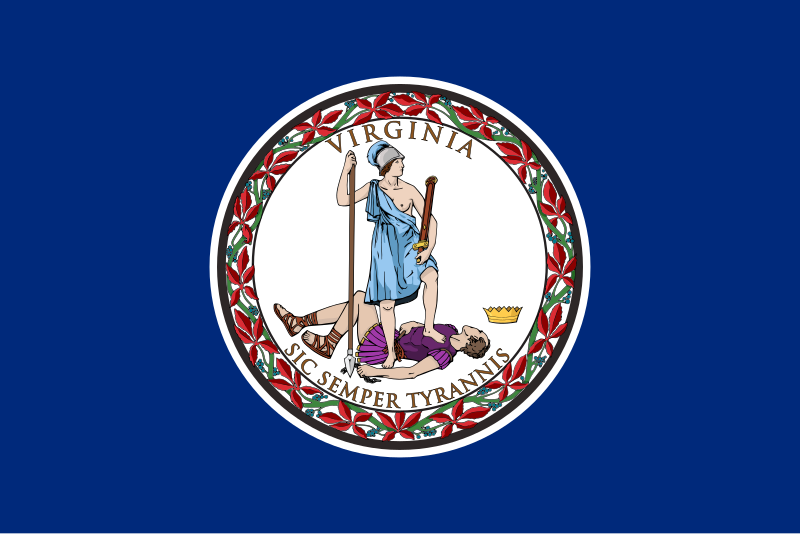
In 1954, the General Assembly adopted an official salute to the flag of Virginia which states:
“I salute the flag of Virginia, with reverence and patriotic devotion to the ‘Mother of States and Statesmen,’ which it represents—the ‘Old Dominion,’ where liberty and independence were born.”
See other related posts:
3 Comments | Flag etiquette, History, Patriotism, Pledge to the flag, State flag | Tagged: Flag etiquette, Mississippi, New Mexico, Oklahoma, Pledge to the flag, South Dakota, Virginia | Permalink
Posted by Ed Darrell

Sundown January 25 marks the end of the 30-day period of mourning for President Gerald Ford, during which flags in the United States are flown at half-staff.
Flags retired at sundown should be quickly hoisted to the peak of the staff, and then lowered soberly. If a flag is lighted or otherwise authorized for 24-hour display, it should be hoisted back to the peak of the staff at sundown.
Tomorrow, January 26, flags should be posted at full staff, as usual.
See also:
4 Comments | Flag etiquette, Gerald Ford, Patriotism | Permalink
Posted by Ed Darrell
A good guide to flag etiquette from the U.S. Congress is on-line now. Our Flag is a traditional publication Congress passes out in efforts to help education in history and patriotism (H.Doc 108-97).
Interest in proper etiquette for flag display increased recently — not enough by my calculation, but any increase is welcomed. Where is good information available?
This Congressionally-sponsored guide is basic and accurate. As a classroom resource or a piece of a Scout troop library, it’s a useful reference guide. It can be downloaded (it’s a .pdf), and printed out in color (56 pages).
The book includes many illustrations showing proper flag display. It also covers the history of the U.S. flag in good enough detail to get through most high school reports, and it features illustrations of flags of each of the states.
Congress in the past provided many publications on such topics for general public consumption and use in classrooms, but has cut back on free distribution of printed information since the early 1980s. One might be able to get a printed copy with a request to one’s local Member of the House of Representatives, or U.S. Senator.
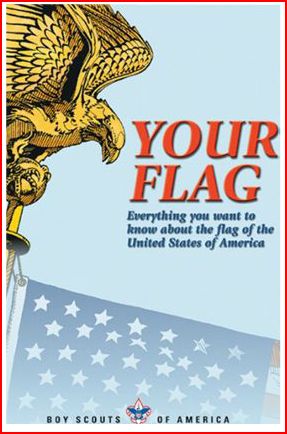
Boy Scouts of America version of the flag etiquette guide, Your Flag
Another book I’ve found very useful is an official Boys Scouts of America publication of the almost the same name, Your Flag. It’s a graphic-novel type of publication — cartoons for every point to be made. It features deeper information on proper flag display. The book can be purchased at any local Boy Scout Council supply shop, or any other shop that stocks Scout literature. It can also be ordered from BSA’s national catalog, or online at Scoutstuff.org, for $7.9910.99plus shipping. Every Scout troop should have one of these, and it is also very useful for classroom libraries, for history and civics.
In either publication, one learns that there are not many ways to display a flag properly from a vehicle — improper displays include decals on windows, bumper stickers, flying them from the radio antenna, or attaching them to a window pole to be battered in freeway-speed winds.
One might hope these books get much broader circulation.
22 Comments | Accuracy, Boy Scouts of America, Flag etiquette, Patriotism | Tagged: Accuracy, Boy Scouts of America, Flag etiquette, History, Patriotism, U.S. Flag | Permalink
Posted by Ed Darrell
I used to marvel at the irony of attending Republican conventions in states and counties across the nation, where ceremonies would open with the recitation of the Pledge of Allegiance to the U.S. flag, and the nation, ideals and government it stands for, and where speaker after speaker would then assault every aspect of that same nation and government. In the Vietnam era and a decade afterward, frequently these speeches would include rhetorical questions like, “Do we really need a First Amendment?” in reference to protestors, or the speech of anyone that the speaker found disagreeable.
This is a new height: The New York Times reports this morning that a top Pentagon official is bothered that lawyers defend prisoners in the U.S., especially prisoners at Guantanamo Bay — somehow forgetting that lawyers are obligated to do such things by their ethical canons, their state laws and state licensing rules, and by the Constitution. Then he urges corporations who use those same lawyers to stop paying them.
Is this a joke, or can someone who has sworn to uphold the Constitution actually be so clueless?
The senior Pentagon official in charge of military detainees suspected of terrorism said in an interview this week that he was dismayed that lawyers at many of the nation’s top firms were representing prisoners at Guantánamo Bay, Cuba, and that the firms’ corporate clients should consider ending their business ties.
The comments by Charles D. Stimson, the deputy assistant secretary of defense for detainee affairs, produced an instant torrent of anger from lawyers, legal ethics specialists and bar association officials, who said Friday that his comments were repellent and displayed an ignorance of the duties of lawyers to represent people in legal trouble.
The Wall Street Journal joined in the assault on the Constitution in an editorial, according to the news story.
Stanley Kubrick is dead, or I’d think that this was just a review of a Stanley Kubrick follow-up to Dr. Strangelove, or: How I Stopped Worrying and Learned to Love the Bomb.
Any corporation official who fires the company’s attorneys for representing Guantanamo Bay detainees should be fired himself — he’s acting contrary to the interests of his stockholders in getting rid of the best legal team he could hire.
How do such barbarians an anti-American people get to be officials in the Pentagon, and editorial writers at the Wall Street Journal?
More information:
Blog reactions:
2 Comments | Civil Rights, Current History, Democracy, Dissent, Ethics, Iraq, Jurisprudence, Justice, Law, Patriotism, U.S. Constitution | Permalink
Posted by Ed Darrell
Still looking for a comprehensive — and accurate — list of states that have official pledges. The search is occasionally illuminating (as are all genuine quests for knowledge).
For example, I knew Alaska’s flag was designed by a student, Benny Benson. I had not realized that it was adopted in the Coolidge administration, though, and not much closer to statehood in 1959.
More, Alaska has a song to its flag. I suspect the song is sung less often than Texas’s pledge is made (well, Texas requires school kids to say the pledge every day). But it’s a bit more poetic, isn’t it?

Alaska’s song to the flag is below the fold. A link to an MP3 recording of the song is available here. Read the rest of this entry »
18 Comments | Flag etiquette, History, Music education, Patriotism, Pledge to the flag | Tagged: Alaska flag, Alaska Flag Song, State flag | Permalink
Posted by Ed Darrell
Ralph Luker at Cliopatria (at History News Network) adds Alabama to the list of states with an official pledge to the state flag.
Alabama’s another one, Ed: “Flag of Alabama I salute thee. To thee I pledge my allegiance, my service, and my life.” And then I wash my mouth out with soap.
Yeah, that one’s a bit over the top, rather the shark-jumper of state flag pledges.
How many more are there? 
3 Comments | Flag etiquette, History, History blogs, Patriotism | Permalink
Posted by Ed Darrell
You are currently browsing the archives for the Patriotism category.


Ed Darrell on Texas's Colorado River


Come on in, the water's fine. Come often: Cleanliness is next to godliness.


 Millard Fillmore's Bathtub