Free market failure: Electricity deregulation

October 24, 2006

Free markets generally outperform regulated markets — except sometimes.

Deregulation of electricity offered hope of lower electric bills for consumers in the south during the summer, and consumers in the north in the winter. A handful of states pushed through legislation that allows companies to compete in electric rates in a fashion similar to telephone competition: Different services on the same wires.

But electricity deregulation also cut loose the power generating foundation of electrical supply from the customer delivery services. Consequently, customer demand has not played as large a role in the creation of new electrical generation as anyone would have hoped. Many markets in the U.S. today face massive shortages of electrical generating capacity, not because of environmental concerns, but because the finances of deregulation discouraged power plant construction.

David Cay Johnston’s article in the New York Times yesterday details some of the problems: Read the rest of this entry »


Texas Republicans urging Marxism be taught?

October 19, 2006

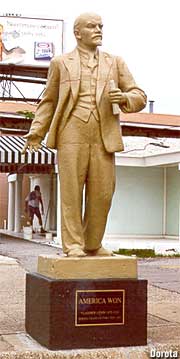
Lenin at Goff's Hamburgers, Dallas (2003)

Lenin does Dallas

No rational person would believe Texas Republicans would call for Marxist economics to be taught in Texas high schools, not even as a part of a “teach the controversy” movement.

The one-semester economics class does not lend itself to giving students backgrounds in economic models that compete with the consensus, free-market view, and even if it did, Marxism would be way down the list of what most Texans would think appropriate to teach. For illustration, consider that when the Soviet Union broke up, a Soviet-produced statute of Lenin was purchased by a Dallas hamburger magnate, placed outside one of his outlets with a plaque commemorating the Cold War, and noting: “America won.” (Alas, Goff’s is gone, as is the statue.)

So, either the Texas Republicans have gone non-rational, or they just were not thinking when they put in their party platform a requirement that alternative theories and their controversies be taught, in social studies.

Confused yet? Tony Whitson at Tony’s Curricublog explains:

But why is this provision regarding social studies tucked into the platform point on “Theories of Origins”? Apparently it reflects an agenda that includes teaching from a creationist standpoint not only in science, but in social studies and other subjects as well.

Someone who’s familiar with curriculum conflicts over recent years will recognize the entire education section of the platform as coming chapter and verse from Phyllis Schlafly’s Eagle Forum. The agenda they are pushing here is not something home-grown in Texas, but an agenda that we can expect to see being advanced all over the United States.

Well, Texas politics being what it is, the likelihood that a plank from any party’s platform could make it into law is a bit remote right now. And it seems clear that the intent was to go after science and evolution, not economics. Udall’s Law of Unintended Consequences says such efforts will produce unexpected and undesired results, and here we have a good case in point.

People are gearing up for fights on history and biology texts in Texas — economics, too? Ouch.


Wits, not bombs

October 10, 2006

When I posted the last piece on Cmdr. Lloyd Bucher and the U.S.S. Pueblo I was unaware of the news that North Korea (DPRK) had detonated its nuclear device.   In retrospect, the crisis around the Pueblo demonstrated that in dealing with officials in DPRK, we generally do best to use our wits, not bullets or threats of bombs.

Just an observation.


Point of personal pique: Mitch Rasansky, stay away from my kids

October 4, 2006

This morning’s Dallas Morning News carries a sad story. Dallas City Councilman Mitchell Rasansky’s campaign against an Eagle Scout project finally bore fruit for Rasansky — he persuaded the city’s parks department to remove three bat houses which had been installed in a city park.

Rasansky first complained last spring. Irrationally, against all evidence, he said he thought the bat houses were a menace. When a storm of public opinion overwhelmed him, he backed off. The 70,000 or so Scouts and Scouters of Circle 10 Council relaxed, happy to know that the Eagle’s project was at work, reducing mosquitoes and, thereby, reducing the risks of West Nile virus.

Is it unfair to suggest Rasansky hates Boy Scouts? Probably. Is it unfair to suggest he’s mean and doesn’t let rationality get in the way of good public policy? I doubt it. Consider: 11 North Texans have died from West Nile virus already this year 16 24 people have died across Texas — and Rasansky’s evidence of danger from the bats is a story of a rabid bat in Houston. One bat? One of the deaths from West Nile virus was an otherwise healthy young man who lived within a few hundred yards of my son at the University of Texas at Dallas. West Nile is not a minor problem around here.

Worse, Rasansky kept his actions secret this time. He got the bat houses removed without notice to the Scout who put them up, nor notice to anyone else concerned.
Some people told me Mitch Rasansky is really a nice guy, when this flap first arose last spring. I gave him the benefit of the doubt then. Not now.

Any man who favors West Nile virus over the public service project of an Eagle Scout has his priorities wrong at best, and is a menace to public health at worst. I don’t want a person running my town who can’t figure out that West Nile virus is a greater health hazard than bats.

Who is running against Rasansky? Arm that woman (or man) with some facts, and let the race begin, even though we’re months away from the election.

More information: See the Organization for Bat Conservation for more information about bats and their benefits.


Ann Richards, you warned us

September 14, 2006


Former Texas Gov. Ann Richards, and a sample of a Texas barbecue rib. Photo by Elecro-Fish Media (Austin, Texas)

Ann Richards died yesterday. It’s sad for me to think what might have been, had she been able to hold off one more charge by the Texas Republicans, had she defeated George Bush in her second campaign for governor of Texas.

Gov. Richards was a gracious and graceful woman who was simply fun to know — while quietly and forcefully inspiring others to do good deeds. In a former time, a candidate who defeated someone like Richards would have the good sense to keep her in government in some capacity, just for her wisdom and experience. It will be a tribute to Richards when civility is returned to politics.

Ann Richards was a public school teacher, clearly of the highest caliber. We can only hope there are more like her teaching in Texas schools today.

Update, September 17, 2006: Molly Ivins, perhaps America’s best political columnist, was a close friend of Ann Richards. Her column well reflects the special qualities of Richards, why we will miss her so badly, and why we should worry that there are so few like her around today.