Zajonc wasn’t a household name (I didn’t even know it rhymes with “science”), but his research was.
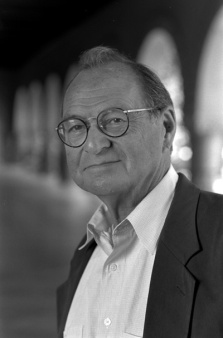
Psychologist Robert Zajonc, pioneer of social psychology
Plus, he led a stunning, dramatic and sometimes wonderful life, surviving horrors in the Holocaust and contributing great things to science.
Gorlick’ s memorial may be best read there, and I encourage you to click over there to read it.
Several of Zajonc’s articles are listed as “Classics” at Science Magazine, including his 1981 defense of research spending, in the first year of the Reagan administration.
I also urge you to consider what teachers might do with some of Zajonc’s findings, things that propagandists and dastardly politicians (and a few nice politicians) have already used:
Parental contact with older children can raise their IQs — well, parental contact does raise the IQs of older children, but having less time for younger children tends to keep the younger kids’ IQs from developing as much. (Did you read to your youngest kid last night?)
Challenging kids to tell why things work the way they claim makes them smarter. (This was the same research: The younger kids’ challenging the older kids made the older kids smarter. Heck, their challenging of the parents probably make the parents smarter, too. Do we make students defend their views to other students?)
Facial expression affects emotions (“Emotions and Facial Expression,” Zajonc, Science 8 November 1985: 608-687; DOI: 10.1126/science.230.4726.608-b)
People who perform tasks well, perform them even better in front of an audience.
People who perform an unknown task before an audience tend to make more mistakes than they would if they practiced it in private.
What Professor Zajonc found was that when performers have mastered a skill at a high level, they are helped by the presence of an audience. (Think of professional musicians or athletes.) But he also found that when a performer has mastered a skill only imperfectly, the existence of onlookers is a hindrance. (Think of Sunday duffers in any arena.)
Elsewhere in his work, Professor Zajonc explored the nexus between psychology and physiology. In one widely reported study, he found that smiling or frowning can alter blood flow to the brain as facial muscles relax or contract. This in turn affects the parts of the brain that regulate feelings, helping induce happy or sad emotional states.
And do you ever wonder about why old couples tend to resemble each other so much? Zajonc worked that out, too.
Why didn’t he get a Presidential Medal of Freedom?
One of the great mysteries of history is how an entire nation of people can follow a leader into tragedy — a stupid war, economic morass, cultural suicide, genocide, or other tragedy — without appearing to notice they were going against their national values, against reason, against morality.
I wonder if part of the answer can be found by studying the way our brains perceive things, in particular, the way our brains force us to see things that are not so.
Some things are just so unbelievable, our brains tell us we’re seeing something different, something more believable. Here are two examples, the Charlie Chaplin mask illusion, and the Einstein mask illusion.
Chaplin — you know it’s concave, but the nose sticks out every time:
Einstein — is Big Brother really watching you? What do your eyes say?
Here’s a nasty little kicker: Even when most people know that it’s an illusion, they can’t perceive the illusion-in-action; as Paul Simon wrote, “Still a man sees what he wants to see and he disregards the rest.” See Stephen Fry’s discussion about the illusion from BBC2:
Historical applications
CIA chief William Colby was involved in Operation Phoenix during the Vietnam War. When investigations revealed that the operation involved torture, many people refused to believe the U.S. would be involved in torture (good!). And even after he admitted to Congressional committees that he had personally authorized the torture, people had difficulty believing it. David Wise wrote an article about Operation Phoenix for the New York Times Magazine, July 1, 1973: “Not one of Colby’s friends or neighbors, or even his critics on the Hill, would, in their wildest imagination, conceive of Bill Colby attaching electric wires to a man’s genitals and personally turning the crank. “Not Bill Colby… He’s a Princeton man.'”
“[T]he Russians are finished. They have nothing left to throw against us,” a confident Adolf Hitler told Gen. Franz Halder in July 1941. Russia mired down the German army, making the phrase “the Eastern Front” a dreaded death sentence in German commands. In the end, it was the Soviet Army that first got to Berlin, and captured Hitler’s command bunker where der Führer had committed suicide a short time before. Adding to the historic irony, twice over: First, Stalin refused to believe his intelligence service reports that the Nazis were massing on the border of Russia, just two years after the Molotov-Ribbentrop Pact, which pledged neither nation would invade the other. Second, Hitler’s generals had studied Napoleon’s invasion of Russia in 1812, working to avoid all the mistakes Napoleon made. So sure were the Nazis of their superiority to Napoleon in every way, they invaded Russia on the anniversary of Napoleon’s invasion, June 22, 1941. Great shades of Santayana’s Ghost!
Richard Feynman discussed at length how scientists know their experimental results are accurate, and how to keep science honest. He pointed out that most of the time, errors creep in at the start, and some people just refuse to believe they exist. It is easiest to fool ourselves, Feynman said — and so a good scientist understands that, and protects against self-deception. If only other disciplines could adopt that philosophy, strategy and tactics!
Faith can get us through troubled times, but often gets us into troubled times in the first place.
Do you have other examples of self-delusion by illusionary means?
Academics have compiled a list of the most ancient gags and the oldest, harking back to 1900BC, is a Sumerian proverb from what is now southern Iraq.
“Something which has never occurred since time immemorial; a young woman did not fart in her husband’s lap,” goes the joke.
Perhaps it loses something in the translation from Sumerian. (The oldest animation comes in at 5,200 years, the oldest joke at about 3,900 years — cartoons lacked punch lines for more than 1,000 years?)
“Jokes have varied over the years, with some taking the question and answer format while others are witty proverbs or riddles,” said Dr Paul McDonald, who led the study by academics at the University of Wolverhampton.
“What they all share, however, is a willingness to deal with taboos and a degree of rebellion.”
My students complain my jokes are too dry as it is. Should I try to work these into the presentations?
As today, world leaders make good foils for ancient humour, particularly Egyptian pharaohs, as shown by this 1600BC joke:
“How do you entertain a bored pharaoh? Sail a boatload of young women dressed only in fishing nets down the Nile – and urge the pharaoh to go fishing.”
One Roman jape dating back to the 1st Century BC details the Emperor Augustus touring his realm and coming across a man who bears a striking resemblance to himself.
Intrigued, he asks the man: “Was your mother at one time in service at the palace?”
The man replies: “No your highness, but my father was.”
Full press release on the World’s Ten Oldest Jokes, from the University of Wolverhampton and the full list of the jokes from Dave TV, below the fold.
If your family has not been touched by a member with Alzheimer’s Disease, senile dementia, or some other form of memory-killing disease, you’re in a lucky minority.
A good friend told how her brother-in-law eased the pain of her mother’s slide into dementia, with little lies. The mother developed an invisible friend who had to accompany her on most outings. The problem was that the invisible friend was also invisible to the mother. The brother-in-law, frustrated at the mother’s refusal leave her room for an outing because the friend was not apparent to accompany them, finally told the mother that the friend was already in the car. Mom happily scooted to the car and forgot about the friend completely by the time they got to the car.
The friend was “already there” for much of the rest of the mother’s life. It was a lie, a falsehood, but it made things so much easier.
In Dorothy’s case, Garner found that while she [Dorothy] had no idea what she had done moments before, she automatically tried to make sense of her situation by matching it to past experiences. Dorothy had always enjoyed travelling, and so if she was asked to sit with other people for any length of time, she assumed she was in the Heathrow departure lounge. By not challenging this assumption, Garner found that her mother would sit peacefully for long periods. If she did wander off, Garner found she could encourage her to return by reminding her of her former skill as a bridge-player, telling her that the other players were waiting for her. “Given a properly set up bridge table, my mother would spend hours happily looking at her cards and waiting to play,” she says.
People with dementia are often exhausting to care for because they forget what they are doing during routine activities. Garner found that she could enable her mother to remain relatively independent by providing cues. “If while getting ready for bed, I noticed she had lost track of whether she was buttoning up the cardigan ready to go out or taking it off to go to bed, I would fiddle with my buttons alongside her and say ‘Oh good! No more travelling for us today! Glad we’ve got a bed for the night!’ I found that this simple cue was all she needed. Without it, she was inclined to get half-way through undressing and then start getting dressed again.”
We all look for such cues in everyday life, and we use them to remind us of what we are doing, where we are going, and why. Why not make it easier for victims of dementia?
Who is president of the United States? Half the time I’d prefer to forget it’s George W. Bush. Don’t quiz me on it. Ask me if it isn’t great that we’re electing someone to replace him, this fall.
How do you apply this information in your lesson plans?
Even babies chunk data for memorization. That is, even babies find it easier to remember things if the new items include chunks of already familiar information.
Which of these strings of letters is easier to remember: QKJITJGPI or BBCITVCNN?
Chances are, you chose the latter string, where the nine letters are the combined names of three television networks. This neatly illustrates a fundamental property of human memory – that we remember long strings of information more easily if we can break them down into bite-sized chunks. In this case, a nine-letter string can be divided into three lots of three letters. You probably use similar strategies for remembering telephone numbers, credit card details, or post codes.
Now, Lisa Feigenson and Justin Halberda from Johns Hopkins University have found that infants just 14 months old can use the same technique, delightfully known as “chunking” to increase the limited scope of their memories. Their work suggests that this technique isn’t something we learn through education or experience – it’s more likely to be a basic part of the way our minds process information.
Educators don’t know beans about motivation I think. I still see courses offered on “how to motivate” students to do X, or Y, or Z — or how to motivate faculty members to motivate students to do X. This view of motivation is all wrong, the industrial psychologists and experience say. A student must motivate herself. A teacher can remove barriers to motivation, or help a student find motivation. But motivation cannot be external to the person acting.
Frederick Herzberg wrote a classic article for The Harvard Business Reviewseveral years back: “One More Time: How Do You Motivate Employees?” Herzberg would get a group of managers together and ask them, “If I have six week-old puppy, and I want it to move, how do I get it to move?” Inevitably, one of the wizened managers of people would say, “Kick him in the ass!” Is that motivation? Herzberg would ask? Managers would nod yes.
Then, Herzberg would ask what about dealing with the pup six months later. To get the older pup to move, he’d offer a doggie yum, and the dog would come. “Is that motivation?” Herzberg would ask. Again, the managers would agree that it was motivation. (At AMR’s Committing to Leadership sessions, we tried this exercise several hundred times, with roughly the same results. PETA has changed sensitivities a bit, and managers are fearful of saying they want to kick puppies, but they say it in different words.)
Herzberg called this “Kick In The Ass” theory, or KITA, to avoid profanity and shorten the phrase.
Herzberg would then chastise the managers. Neither case was motivation. One was violence, a mugging; the other was a bribe. In neither case did the dog want to move, in neither case was the dog motivated. In both cases, it was the manager who was motivated to make the dog move.
Herzberg verified his theories with research involving several thousands of employees over a couple of decades. His pamphlet for HBR sold over a million copies.
Education is wholly ignorant of Herzberg’s work, so far as I can tell. How do I know?
The sad part about this is that I bet if a mere, ordinary teacher were to have made some similar statement, he or she would be treated more like the student rather than the principle.
Now imagine if some student at the school had said something along the same lines in a writing assignment. We would be hearing about zero tolerance all over the place. The student would be out of the regular classroom so fast it would make your head spin.
No charges will be brought against New Braunfels Middle School Principal John Burks for allegedly threatening to kill a group of science teachers if their students’ standardized test scores failed to improve, although all four teachers at the meeting told police investigators Burks made the statement.
Kick in the ass, knife in the back, knife in the heart — that ain’t motivation.
As God is my witness, you can’t make this stuff up. I’m not sure who deserves more disgust, the principal who made the threat and probably didn’t know anything else to do, or the teachers who didn’t see it as a joke, or treat it that way to save the principal’s dignity — or a system where such things are regarded as normal.
Spread the word; friends don't allow friends to repeat history.
From Think or Thwim, a TEDS Talk video of neurologist Jill Bolte Taylor, describing in that brief, TEDS way, the morning when she had a stroke on the left side of her brain. It’s a stirring talk, as she describes the loss of functions, the loss of the ability to hear, the loss of the ability to talk, and the great insights she got from the experience in her 30s — more than a decade later, after what must be described as a full recovery.
Caution to the skeptics — she veers into a bit of wooishness. It’s still worth the look. Caution to the squeamish: Yes, that’s a brain.
Psychology teachers: Can you use this in class? What a great piece in discussion of brain physiology.
If I had a perception problem or a new optical illusion for every class day in psychology, we’d start every day happy.
This is a great ad. It gently pokes your pride in your ability to see what’s going on — from a bicycle safety campaign in Britain urging motorists to look out for bicyclists:
Spread the word; friends don't allow friends to repeat history.
History Carnival 62 has been up for a couple of weeks at Spinning Clio. I just got there a couple of days ago — and you need to go see it, too. The History Guru has a series of podcasts on western civilization, the Western Intellectual History Lecture Series. Can you use this in your classes? Figure out how to use it in your classes. If you’re not making iPod recommendations for your students, you’re missing the boat and so are they. Go check it out at least. Such activities threaten to drag teaching into the last decade of the 20th century. There’s hope we can drag teaching into the 21st century sometime before 2090. The President of France proposes that each 10 year-old child in France memorize the history of one child deported from France during the Holocaust. Good idea or not? See the discussion here (yes, it’s in French; this is the internet, put on your grande fille culottes or pantalons adulte and deal with it). [Why is it that high school history texts never explain the origin of the name of the political movement in Paris, the sans-culottes? How could any kid fail to remember a movement known as “no-pants?” Do the book authors not know that kids would be interested?]
The History Carnival is particularly rich for high school teachers, I think; see these posts:
Dog and cat breeders, pigeon fanciers, racehorse breeders, and others whose livelihoods depend on their trying to do better than nature at the Darwinian game often offer anecdotes about breeding failures. They thought they might get a faster horse, but they got a skittish one instead; they thought they were getting a good bird dog, but the dog would panic at the shot of a gun.
Breeders know genetics carry a lot of traits, and trying to select for one is difficult. One may amplify a bad trait in addition to the desired trait.
In one classic paper that more critics of Darwin should read, researchers discovered that instead of getting better egg production, they got mean chickens that damaged production of the entire flock.
One of my favorite papers in evolutionary biology, which I have mentioned here before, is this:
Muir, W.M., and D.L. Liggett, 1995a. Group selection for adaptation to multiple-hen cages: selection program and responses. Poultry Sci. 74: s1:101
It outlines the group selection effects observed when trying to breed chickens for increased egg production in multiple-hen cage environments. In short, selecting individual chickens for increased productivity in a group environment didn’t select for increased productivity. Instead, it selected for mean chickens. The result was an overall reduction in productivity. Only by selecting at the group level was productivity increased.
The topic is a worthy one for discussion in economics courses, especially with regard to incentives for certain behaviors.
There is this caution: Adam notes that Enron annually fired the “bottom 10%” as a matter of policy, trying to encourage everyone else to work harder, trying to reward productive people, trying to prune deadwood from the corporate vine. At one point, some divisions of GE Corp. would purge the bottom 25%. That’s even more intensive selective pressures, for evil as well as good.
And when legislators try to purge education of bad teachers? Can they possibly hope to get anything but mean chickens? Economists indict our reliance on standardized tests of students.
Or, until that account is unsuspended by the forces supporting Donald Trump: Follow @FillmoreWhite, the account of the Millard Fillmore White House Library
We've been soaking in the Bathtub for several months, long enough that some of the links we've used have gone to the Great Internet in the Sky.
If you find a dead link, please leave a comment to that post, and tell us what link has expired.
Thanks!
Retired teacher of law, economics, history, AP government, psychology and science. Former speechwriter, press guy and legislative aide in U.S. Senate. Former Department of Education. Former airline real estate, telecom towers, Big 6 (that old!) consultant. Lab and field research in air pollution control.
My blog, Millard Fillmore's Bathtub, is a continuing experiment to test how to use blogs to improve and speed up learning processes for students, perhaps by making some of the courses actually interesting. It is a blog for teachers, to see if we can use blogs. It is for people interested in social studies and social studies education, to see if we can learn to get it right. It's a blog for science fans, to promote good science and good science policy. It's a blog for people interested in good government and how to achieve it.
BS in Mass Communication, University of Utah
Graduate study in Rhetoric and Speech Communication, University of Arizona
JD from the National Law Center, George Washington University


 Posted by Ed Darrell




 Millard Fillmore's Bathtub