Quote of the moment, encore: President asks the Senate Majority Leader for help on the debt ceiling issue, November 16, 1983

November 16, 2013

Ronald Reagan preparing for a video address from the Oval Office. (Photo is from 1989; this post is about a 1983 address.)  Wikipedia image

Ronald Reagan preparing for a video address from the Oval Office. (Photo is from 1989; this post is about a 1983 event.) Wikipedia image

In a letter to the Majority Leader of the U.S. Senate, the President wrote:

This letter is to ask for your help and support, and that of your colleagues, in the passage of an increase in the limit on the public debt.

As [the Treasury Secretary] has told you, the Treasury’s cash balances have reached a dangerously low point.  Henceforth the Treasury Department cannot guarantee that the Federal Government will have sufficient cash on any one day to meet all of its mandated expenses, and thus the United States could be forced to default on its obligations for the first time in history.

This country now possesses the strongest credit in the world.  The full consequences of a default — or even the serious prospect of default — by the United States are impossible to predict and awesome to contemplate.  Denigration of the full faith and credit of the United States would have substantial effects on the domestic financial markets and on the value of the dollar in exchange markets.  The Nation can ill afford to allow such a result.  The risks, the costs, the disruptions, and the incalculable damage lead me to but one conclusion:  the Senate must pass this legislation before the Congress adjourns.

I want to thank you for your immediate attention to this urgent problem, and for your assistance in passing an extension of the debt ceiling.

Sincerely,

         Ronald Reagan

True then.  Still true now.

Letter from President Ronald Reagan to Senate Majority Leader Sen. Howard Baker, R-Tennessee, November 16, 1983.  The Treasury Secretary at the time was Donald Regan.

Tip of the old scrub brush to mainstream media pillar, The Washington Post, where a .pdf of the letter is available.

More:

.


Quote of the Moment, October 29, 1941: Churchill, ‘never give in’

October 29, 2013

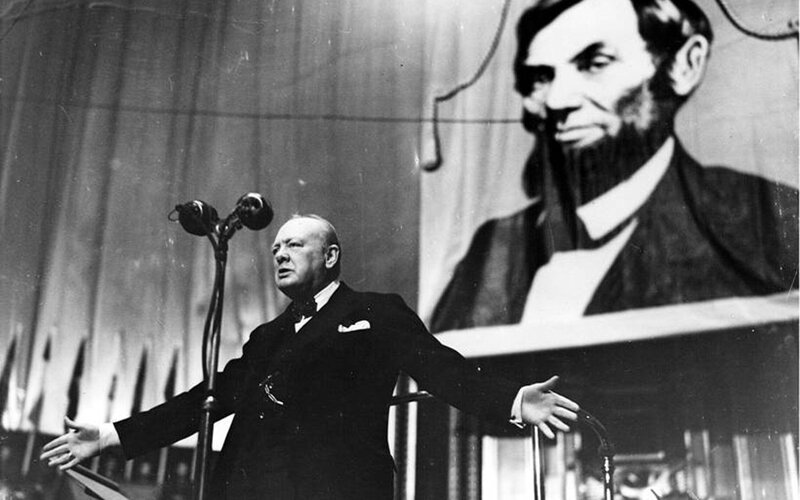
 Churchill speaking at the Albert Hall in London, 1944, at an American Thanksgiving Celebration.  Churchill Centre image

Churchill speaking at the Albert Hall in London, 1944, at an American Thanksgiving Celebration. Churchill Centre image

Never give in, never give in, never, never, never, never — in nothing, great or small, large or petty — never give in except to convictions of honour and good sense!

Winston S. Churchill, address to the boys of Harrow School, October 29, 1941.

More:

(This version may be a re-enactment of the vocal delivery.]

This is much an encore post, from 2007, with material added.


Sourcing Thomas Jefferson quotes: “A country with no border . . .” Jefferson didn’t say it

October 2, 2013

Way back in 2012 I wrote this:

A group calling itself “Patriotic Moms” claims to quote Thomas Jefferson:

Thomas Jefferson 3x4

Thomas Jefferson said a lot, and kept careful records of about 15,000 letters — but did he ever say a country without a border is not a country? (Photo credit: Wikipedia)

“A country with no Border is not a country.”

I can’t find that in Jefferson’s writings.  Anybody know if Jefferson said or wrote anything like that?  Got a citation?

Is this another fake Jefferson quote?

More, reference:

Here we are, over a year later, and this does not appear in any form that I think we can say Jefferson said it, or wrote it.  It’s not in any Jefferson collection I can find.

Perhaps even more telling, our old friend Higginbotham finds a solid attribution to former Congressman Mike Pence (now Governor of Indiana), introducing a bill in Congress in 2005.

The judges rule Jefferson did not say “A country with no border is not a country.”  Neither did he say “A nation with no border is not a nation.”  In his bogus quote, neither did he add “secure” before the last “country” or “nation.”

It’s a misattributed quote, a bogus quote, a distortion of history, whatever epithet you wish to impale it on.  But it’s not from the canon of Thomas Jefferson wisdom.  It’s been flying around the internet this past week, and my earlier post has increased activity. Perhaps immigration is about to heat up as an issue?   Time to put this canard down.

Here’s one thing that should make you very wary of any quote in any similar circumstance:  No one seems to know what the occasion was that Jefferson made the remark, nor the date, nor the format.  Jefferson’s writings are extensively indexed, and he kept copies himself of about 15,000 letters, for the sake of history.  If you can’ t find it quickly, he probably didn’t say it.

More, in 2013:


Quote of the moment: Useless men a Congress? Not John Adams, but Peter Stone who said it

October 1, 2013

It’s a great line, an almost-Mark Twain-ism that makes people of all political strips smile.  It’s attributed to John Adams:

I have come to the conclusion that one useless man is called a disgrace; that two are called a law firm; and that three or more become a Congress!

There’s a problem: John Adams didn’t say it.

It’s a line from the 1969 Broadway musical comedy 1776!

The character John Adams in the play said it.  It’s art in pursuit of history, but it’s not really history.

Playwright Peter Stone, Theatrical Rights image

Playwright Peter Stone wrote the witticism attributed to John Adams.  Theatrical Rights image

We should more accurately attribute it to the play’s book’s author, Peter Stone.  What John Adams did not say about Congress, Peter Stone wrote.  Such wit deserves proper attribution.

Especially on a day when the U.S. Congress appears to be not only a collection of useless people, men and women, but useless people bent on destruction of our national institutions.  Congress has fallen down on the job, failing to play its vital, Constitutional role of appropriating money to run the government.

Stone’s mention of “law firms” gives away the quote’s origins being much later than Adams — Adams died, as you know, on July 4, 1826, the 50th anniversary of the Declaration of Independence.   “Law firms” is 20th century language.

In an era of law firms so big the people in them cannot comprehend their size, such a statement might emerge.  The distaste with lawyers in the Stone quote also doesn’t ring to the times of the American Revolution.  Good lawyer jokes probably existed then, but they didn’t really rise until the lawyerly pettifogging of the 19th century — see Dickens’ Mr. Bumble in Chapter 51 of Oliver Twistor the entire text of Bleak House, for examples.  Law firms in 1776 simply did not exist as large corporations, but more often as an office of an individual lawyer, or two or three.  Mark Twain joked about Congress, but a joke about both Congress and lawyers probably was rare before 1910.  (I am willing to be disabused of this idea, if I am wrong . . . comments are open.)

Wikiquote’s rapid improvement provides us with a good check on whether Adams said it — Wikiquote points us clearly to Peter Stone instead.

Stone died in 2003, much underappreciated if you ask me.  Stone might be said to be among the greatest ghost speechwriters in history based on 1776! alone,  creating lines for John Adams, Ben Franklin and Thomas Jefferson — three of the greatest authors and (sometimes reluctant) speakers of their day, and of all history.  Stone’s plays include Titanic and Two by Two, his screenplays include Charade, Arabesque, Mirage, The Taking of Pelham 123, and Father Goose.  (The first two of those movies favorites of mine solely for the scores by Henry Mancini.)

1776! plays in revival in California’s Bay Area, at A.C.T. (see reviews from both the San Jose Mercury News and San Francisco Chronicle, linked below).  One might wish Congressmen today would see the play.  In 1776 the colonies in rebellion were unsure what to do next; the Declaration of Independence was not a foregone conclusion.  The amazing collection of men — unfortunately no women — who populated the Second Continental Congress were predisposed to find ways around their differences, to make wise policies, and to keep things functioning.  Rather than shut government down, they carefully instructed individual governments in the states to make preparations to operate without infusions of cash or policy direction from the Crown, even before deciding independence made sense.  In short, they were dedicated to making things work.

Ironic that so many remember Peter Stone’s slam of Congress as incompetent, when the rest of his play book demonstrates that particular congress of men took quite an opposite view of life, and created a model for leadership we marvel at today.

More:

This is an edited encore post, sadly made salient today by Congress’s inaction on required spending bills.

Photo from the San Francisco Chronicle: Jarrod Zimmerman, as Edward Rutledge, makes a passionate appeal to delegates of the Second Continental Congress in the Tony Award-winning musical

Useless men? Funny quip, but the Second Continental Congress was far from a group of useless men thrown together. Photo from the San Francisco Chronicle: Jarrod Zimmerman, as Edward Rutledge, makes a passionate appeal to delegates of the Second Continental Congress in the Tony Award-winning musical “1776,” coming to ACT. Photo: Juan Davila


Quote of the moment: Carl Sagan, on perspective on our own lives

September 14, 2013

You’ve heard the news by now: Voyager I has left the system.

What are we to think of that?

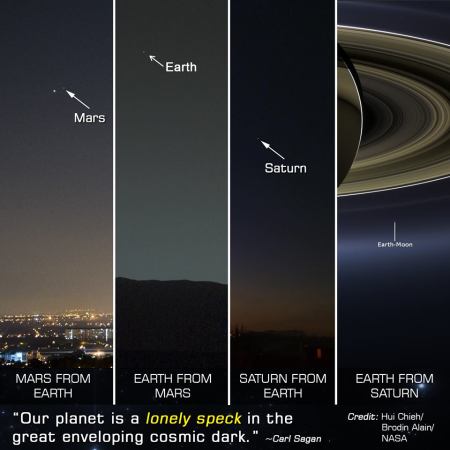
perspective-mars-earth-saturn

Earth, Moon, Mars, Jupiter – What you see depends on where you are, in reality as well as metaphorically. Images from NASA

” . . . astronomy is a humbling and character-building experience.”

Carl Sagan on how images of Earth from space change our perspective

Sagan’s words in the full passage impart a larger message, about caring for our planet and our neighbors on it.

From this distant vantage point, the Earth might not seem of any particular interest. But for us, it’s different. Consider again that dot. That’s here. That’s home. That’s us. On it everyone you love, everyone you know, everyone you ever heard of, every human being who ever was, lived out their lives. The aggregate of our joy and suffering, thousands of confident religions, ideologies, and economic doctrines, every hunter and forager, every hero and coward, every creator and destroyer of civilization, every king and peasant, every young couple in love, every mother and father, hopeful child, inventor and explorer, every teacher of morals, every corrupt politician, every “superstar,” every “supreme leader,” every saint and sinner in the history of our species lived there – on a mote of dust suspended in a sunbeam.

The Earth is a very small stage in a vast cosmic arena. Think of the rivers of blood spilled by all those generals and emperors so that in glory and triumph they could become the momentary masters of a fraction of a dot. Think of the endless cruelties visited by the inhabitants of one corner of this pixel on the scarcely distinguishable inhabitants of some other corner. How frequent their misunderstandings, how eager they are to kill one another, how fervent their hatreds. Our posturings, our imagined self-importance, the delusion that we have some privileged position in the universe, are challenged by this point of pale light. Our planet is a lonely speck in the great enveloping cosmic dark. In our obscurity – in all this vastness – there is no hint that help will come from elsewhere to save us from ourselves.

The Earth is the only world known, so far, to harbor life. There is nowhere else, at least in the near future, to which our species could migrate. Visit, yes. Settle, not yet. Like it or not, for the moment, the Earth is where we make our stand. It has been said that astronomy is a humbling and character-building experience. There is perhaps no better demonstration of the folly of human conceits than this distant image of our tiny world. To me, it underscores our responsibility to deal more kindly with one another and to preserve and cherish the pale blue dot, the only home we’ve ever known.

Carl SaganPale Blue Dot: A Vision of the Human Future in Space, 1997 reprint, pp. xv–xvi

In other words, we’re on our own.  What are we going to do about that?

Tip of the old scrub brush to Hashem Al-ghaili for making this image! https://www.facebook.com/ScienceNaturePage, and to All Science, All the Time.

It would be good to have better photo credits, including the genius who put together the montage.

More:

Voyager I photo of the Earth from outside Jupiter's orbit - the Pale Blue Dot photo

This is the photo that inspired Sagan’s reflection, as opposed to the photos in the poster mashup above. Via Wikipedia, with captions. ¶Seen from about 6 billion kilometers (3.7 billion miles), Earth appears as a tiny dot (the blueish-white speck approximately halfway down the brown band to the right) within the darkness of deep space. ¶This narrow-angle color image of the Earth, dubbed ‘Pale Blue Dot’, is a part of the first ever ‘portrait’ of the solar system taken by Voyager 1. The spacecraft acquired a total of 60 frames for a mosaic of the solar system from a distance of more than 4 billion miles from Earth and about 32 degrees above the ecliptic. From Voyager’s great distance Earth is a mere point of light, less than the size of a picture element even in the narrow-angle camera. Earth was a crescent only 0.12 pixel in size. Coincidentally, Earth lies right in the center of one of the scattered light rays resulting from taking the image so close to the sun. This blown-up image of the Earth was taken through three color filters – violet, blue and green – and recombined to produce the color image. The background features in the image are artifacts resulting from the magnification.

Save


Quiz answer: Who ratted out the Republicans like this, and when?

September 3, 2013

I said earlier that you may wish to file this under o tempora, o mores; or perhaps under plus ça change.  

These words seem oddly, perhaps astonishingly appropriate to political discussion today.  They come from the past, from more than a half-century ago, but they refer to issues that have not yet been solved, and to issues that were resolved, but have come undone, or just come around again.

GOP vs. Dems. Image from Addicting Information.

GOP vs. Dems. Image from Addicting Information, “15 differences between Democrats and Republicans.”

I posed this a quiz in a post a couple of days ago.

Does history repeat itself?  George Santayana said history repeats for those who forget what happened before.

Here’s a political speech given in Minnesota.  Without hitting Google, can you tell who said this, and when?

Democracy does not work that way. Democracy is a matter of faith–a faith in the soul of man–a faith in human rights. That is the kind of faith that moves mountains–that’s the kind of faith that hurled the Iron Range at the Axis and shook the world at Hiroshima.

Faith is much more than efficiency. Faith gives value to all things. Without faith, the people perish.

Today the forces of liberalism face a crisis. The people of the United States must make a choice between two ways of living–a decision, which will affect us the rest of our lives and our children and our grandchildren after us.

On the other side, there is the Wall Street way of life and politics. Trust the leader! Let big business take care of prices and profits! Measure all things by money! That is the philosophy of the masters of the Republican Party.

Well, I have been studying the Republican Party for over 12 years at close hand in the Capital of the United States. And by this time, I have discovered where the Republicans stand on most of the major issues.

Since they won’t tell you themselves, I am going to tell you.

They approve of the American farmer-but they are willing to help him go broke.

They stand four-square for the American home–but not for housing.

They are strong for labor–but they are stronger for restricting labor’s rights.

They favor a minimum wage–the smaller the minimum the better.

They indorse educational opportunity for all–but they won’t spend money for teachers or for schools.

They think modern medical care and hospitals are fine–for people who can afford them.

They approve of social security benefits-so much so that they took them away from almost a million people.

They believe in international trade–so much so that they crippled our reciprocal trade program, and killed our International Wheat Agreement.

They favor the admission of displaced persons–but only within shameful racial and religious limitations.

They consider electric power a great blessing-but only when the private power companies get their rake-off.

They say TVA is wonderful–but we ought never to try it again.

They condemn “cruelly high prices”–but fight to the death every effort to bring them down.

They think the American standard of living is a fine thing–so long as it doesn’t spread to all the people.

And they admire the Government of the United States so much that they would like to buy it.

Now, my friends, that is the Wall Street Republican way of life. But there is another way–there is another way–the Democratic way, the way of the Democratic Party.

Of course, the Democratic Party is not perfect. Nobody ever said it was. But the Democratic Party believes in the people. It believes in freedom and progress, and it is fighting for its beliefs right now.

In the Democratic Party, you won’t find the kind of unity where everybody thinks what the boss tells him to think, and nothing else.

But you will find an overriding purpose to work for the good of mankind. And you will find a program–a concrete, realistic, and practical program that is worth believing in and fighting for.

Now, I call on all liberals and progressives to stand up and be counted for democracy in this great battle. I call on the old Farmer-Labor Party, the old Wisconsin Progressives, the Non-Partisan Leaguers, and the New Dealers to stand up and be counted in this fight.

What clues does that passage contain that it wasn’t said in the past year?  Or was it?

I’ll post the answer in a day or so — take a guess in comments.

James said it was Harry Truman, and indeed it was.

President Harry S Truman, image from UCSB American Presidency Project

President Harry S Truman, image from UCSB American Presidency Project

Truman spoke to a crowd in Minnesota, in the St. Paul Municipal Auditorium, on October 13, 1948, about three weeks before the 1948 election in which he “upset” New York Gov. Thomas Dewey.  This was part of Truman’s famous Whistle Stop speaking tour of the U.S.

If the words look like they could have been said today, perhaps we should pay attention to them today, no?

Surely someone has a photograph of Truman speaking in St. Paul — but I haven’t found it yet.

More:


Who ratted out the Republicans like this, and when?

September 2, 2013

You may wish to file this under o tempora, o mores; or perhaps under plus ça change.  

GOP vs. Dems. Image from Addicting Information.

GOP vs. Dems. Image from Addicting Information, “15 differences between Democrats and Republicans.”


Does history repeat itself?  George Santayana said history repeats for those who forget what happened before.

Here’s a political speech given in Minnesota.  Without hitting Google, can you tell who said this, and when?

Democracy does not work that way. Democracy is a matter of faith–a faith in the soul of man–a faith in human rights. That is the kind of faith that moves mountains–that’s the kind of faith that hurled the Iron Range at the Axis and shook the world at Hiroshima.

Faith is much more than efficiency. Faith gives value to all things. Without faith, the people perish.

Today the forces of liberalism face a crisis. The people of the United States must make a choice between two ways of living–a decision, which will affect us the rest of our lives and our children and our grandchildren after us.

On the other side, there is the Wall Street way of life and politics. Trust the leader! Let big business take care of prices and profits! Measure all things by money! That is the philosophy of the masters of the Republican Party.

Well, I have been studying the Republican Party for over 12 years at close hand in the Capital of the United States. And by this time, I have discovered where the Republicans stand on most of the major issues.

Since they won’t tell you themselves, I am going to tell you.

They approve of the American farmer-but they are willing to help him go broke.

They stand four-square for the American home–but not for housing.

They are strong for labor–but they are stronger for restricting labor’s rights.

They favor a minimum wage–the smaller the minimum the better.

They indorse educational opportunity for all–but they won’t spend money for teachers or for schools.

They think modern medical care and hospitals are fine–for people who can afford them.

They approve of social security benefits-so much so that they took them away from almost a million people.

They believe in international trade–so much so that they crippled our reciprocal trade program, and killed our International Wheat Agreement.

They favor the admission of displaced persons–but only within shameful racial and religious limitations.

They consider electric power a great blessing-but only when the private power companies get their rake-off.

They say TVA is wonderful–but we ought never to try it again.

They condemn “cruelly high prices”–but fight to the death every effort to bring them down.

They think the American standard of living is a fine thing–so long as it doesn’t spread to all the people.

And they admire the Government of the United States so much that they would like to buy it.

Now, my friends, that is the Wall Street Republican way of life. But there is another way–there is another way–the Democratic way, the way of the Democratic Party.

Of course, the Democratic Party is not perfect. Nobody ever said it was. But the Democratic Party believes in the people. It believes in freedom and progress, and it is fighting for its beliefs right now.

In the Democratic Party, you won’t find the kind of unity where everybody thinks what the boss tells him to think, and nothing else.

But you will find an overriding purpose to work for the good of mankind. And you will find a program–a concrete, realistic, and practical program that is worth believing in and fighting for.

Now, I call on all liberals and progressives to stand up and be counted for democracy in this great battle. I call on the old Farmer-Labor Party, the old Wisconsin Progressives, the Non-Partisan Leaguers, and the New Dealers to stand up and be counted in this fight.

What clues does that passage contain that it wasn’t said in the past year?  Or was it?

I’ll post the answer in a day or so — take a guess in comments.


Quote of the moment: James Madison, education, or farce and tragedy

August 31, 2013

James Madison Building, Library of Congress -- the official Madison Memorial

James Madison Building of the Library of Congress, the official James Madison Memorial for the nation

A popular Government, without popular information, or the means of acquiring it,
is but a Prologue to a Farce or a Tragedy; or perhaps both.
Knowledge will forever govern ignorance.

And a people who mean to be their own governours,
must arm themselves with the power which knowledge gives.

— James Madison in a letter to W. T. Barry, August 4, 1822

This is an encore post, partly.

Photo of inscription to the left (north) of the main entrance on Independence Ave., of the James Madison Building, Library of Congress, Washington, D.C.

Photo of inscription to the left (north) of the main entrance on Independence Ave., of the James Madison Building, Library of Congress, Washington, D.C.

More:  


Edward Tufte channels Richard Feynman

August 6, 2013

Tufte writes at great length — well, writes and demonstrates — about yellow warning signs.  (Yes, that Edward Tufte.)

In one of his demonstrations, the art comes from the ideas and sayings of Richard Feynman.

Edward Tufte makes art out of Feynman's ideas.

Edward Tufte makes art out of Feynman’s ideas. Sorta. Edward Tufte, Nature Cannot Be Fooled, print on canvas, 78″ x 27 ½”, edition of 3

This guy makes money doing that? What kind of charmed life is that?

More:

Just how fitting is it that Tufte uses the words of Feynman, probably more famous for Feynman diagrams than the work that got him a Nobel?

English: Picture of a Feynman diagram, inscrib...

“Picture of a Feynman diagram, inscribed by Richard P. Feynman to me [who MFB has not identified], in my copy of Volume 3 of his Feynman Lectures on Physics (Quantum Mechanics). Picture taken by self. if you can’t read the symbols, they are \gamma_\mu to \gamma_\mu and 1/q^2 .” Wikipedia image

English: Edward Tufte giving a class and holdi...

Edward Tufte giving a class and holding a scanned copy of a first edition book by Galileo. Wikipedia image


Quote of the moment, still: John Adams, July 2 “the most memorable Epocha in the History of America”

July 2, 2013

“The Second Day of July 1776 will be the most memorable Epocha, in the History of America. . . . It ought to be solemnized with Pomp and Parade, with Shews, Games, Sports, Guns, Bells, Bonfires, and Illuminations from one End of this Continent to the other from this Time forward forever more.”
John Adams to Abigail Adams, July 3, 1776

1776 filled the calendar with dates deserving of remembrance and even celebration. John Adams, delegate from Massachusetts to the Second Continental Congress, wrote home to his wife Abigail that future generations would celebrate July 2, the date the Congress voted to approve Richard Henry Lee’s resolution declaring independence from Britain for 13 of the British colonies in America.

Continental congress DSC_0607

Scene of the crime — Independence Hall in Philadelphia, where the Second Continental congress approved the resolution to declare the colonies independent from Britain – (Photo credit: diablodale)

Two days later, that same Congress approved the wording of the document Thomas Jefferson had drafted to announce Lee’s resolution to the world.

Today, we celebrate the date of the document Jefferson wrote, and Richard Henry Lee is often a reduced to a footnote, if not erased from history altogether.

Who can predict the future?

(You know, of course, that Adams and Jefferson both died 50 years to the day after the Declaration of Independence, on July 4, 1826. In the 50 intervening years, Adams and Jefferson were comrades in arms and diplomacy in Europe, officers of the new government in America, opposing candidates for the presidency, President and Vice President, ex-President and President, bitter enemies, then long-distance friends writing almost daily about how to make a great new nation. Read David McCullough‘s version of the story, if you can find it.)

(Yes, this is mostly an encore post.)

More, and Related articles:

The Lee Resolution.

The Lee Resolution, passed by the Second Continental Congress on July 2, 1776 – Wikipedia image (Wait a minute: Are those numbers added correctly? What are they?)


Quote of the moment: Reorganization creates illusion of progress, and demoralization – Charlton Ogburn

May 31, 2013

Historian and birder Charlton Ogburn, right.

Historian and birder Charlton Ogburn, right.

We trained hard, but it seemed that every time we were beginning to form up into teams we would be reorganized. Presumably the plans for our employment were being changed. I was to learn later in life that, perhaps because we are so good at organizing, we tend as a nation to meet any new situation by reorganizing; and a wonderful method it can be for creating the illusion of progress while producing confusion, inefficiency, and demoralization.

This quotation is often misattributed to one Greek philosopher or another, or to the Roman Petronius.

Cover of "The Marauders"

Cover of The Marauders

Ogburn’s magazine article became the basis for his book, The Marauders. In turn, that was the basis for a movie, Merrill’s Marauders.  In the book, the quote is different:

As a result, I suppose, of high-level changes of mind about how we were to be used, we went though several reorganizations. Perhaps because Americans as a nation have a gift for organizing, we tend to meet any new situation by reorganization, and a wonderful method it is for creating the illusion of progress at the mere cost of confusion, inefficiency and demoralization.

  • The Marauders (1959), chapter 2, page 60 (attributed)

My old friend Frank Hewlett had been a correspondent in the South Pacific and Southeast Asia, including Burma, during World War II.  Frank told me that he had been the first to call the American group “Merrill’s Marauders” in a war news dispatch on the progress the group made.  He did not get any credit for the book or movie title, but he said it was great that any group of soldiers that worked that well got popular attention for their work.  I’ve never found Hewlett’s dispatches from that period, but I’ve never found anything else he told me to be inaccurate.

In serious corporate reorganizations, or in corporate culture change operations, this quote is usually trotted out in opposition to whatever the proposed change may be.  Generally reorganizers will dismiss the thing as fictional, in at least one case claiming that renegade corporate leader Bob Townsend made it up.

In our work at Committing to Leadership at American Airlines, CEO Bob Crandall actually read the full quote (misattributed at the time), and observed that it was probably true — but not a good reason to stop a needed reorganization.  Crandall pointed to the last sentence, and said that a good manager’s job is to make sure that reorganization creates real success, not just an illusion of action, and that any good manager will recognize that reorganizations offer the danger of demoralization and confusion.  Those are problems to be managed, Crandall said, not fates that cannot be avoided.

Do you find Ogburn’s snippet of wisdom to be true? So what?

More:

Merrill's Marauders (film)

Advertising poster for Merrill’s Marauders; Wikipedia image


Remedial economics, remedial U.S. history

May 20, 2013

I should set a threshold — five e-mails, or a dozen Facebook posts, and a response will be given.

But then some idiot would work to make the threshold.

You’ve seen this, of course:

5 misleading truths

“5 Truths You CANNOT Disagree With”

It was past the threshold, so I responded:

More truths:

  1. You cannot legislate poverty away by laws that send all the wealth generated by the working poor, to the rich.
  2. What one person receives without working for in capital gains, or productivity increases, another person worked for, without receiving. It is unjust to give the benefits of the sweat of one woman, to another man.
  3. Government subsidies create wealth in nations; most great enterprises have found their roots in government funding, from irrigation in Babylon, to farming along the Yellow River, through Columbus’s voyage of (accidental) discovery, the Transcontinental Railroad, and settlement of America.
  4. When opportunities exist for the poor, hard work makes much wealth. A society is wealthy, and an economy is sound, when the poor spend money. Rich guys spending money doesn’t work — there are not enough rich guys.
  5. When the rich tiny percentage of the people get the idea that they do not have to work, but that the work of others is ALSO their property and the poor will take care of them, then we have conditions for financial collapse (see the Panic of 1908, or 1837, or the Great Depression — or any other); those conditions often lead to revolution, sometimes violent (see Russia in 1917, Germany in 1922, Shay’s Rebellion, the French Revolution — when the rich get the rewards the hard-working man created, it is the beginning of the end of any nation. Some smart nations fix those problems when they occur.

When hard work no longer gets you ahead, and when hard work no longer will feed, clothe and educate your family, you may get angry.

“Those who make peaceful revolution impossible, make violent revolution inevitable,” John Kennedy said. He was pretty smart for a young, rich guy.

(Links added above, other than the YouTube video; I hope the JFK Library has video of Kennedy actually saying that.)

People who post these “5 truths” without irony must have slept through ALL of economics in high school, and forgotten everything they may have ever learned about American history in the 20th century.  Income distribution is a serious issue — maldistribution and misdistribution of wealth leads to trouble, either economic calamity, or violent revolution, or both.

It’s fun to say that no person should get ahead on the earnings of another person; it’s more realistic when we understand that a system rigged to give financial players yachts, and working people debt, is the unfairness that those worriers should worry about.

John F. Kennedy waves to a crowd in front of Cobo Hall, in Detroit

Presidential candidate John F. Kennedy waves to a crowd in front of Cobo Hall, in Detroit, during the 1960 American Legion Convention. Image from Walter Reuther Library

More:


Nope, Patrick Henry didn’t say that

April 8, 2013

More misquoting of “the Founders”:

For America misquotes Patrick Henry

For America’s poster featuring a quote falsely claimed to be from Patrick Henry.  The racial right wingers won’t tell you, but the painting is a portrait by George Bagby Matthews c. 1891, after an original by Thomas Sully.

It’s baseball season.  I love a pitch into the wheelhouse.

The radical right-wing political group For America — a sort of latter-day Redneck Panther group — invented this one, and pasted it up on their Facebook site this morning.

You know where this is going, of course.  Patrick Henry didn’t say that.  The poster is a hoax.

Your Hemingway [Excrement] Detector probably clanged as soon as you pulled the poster up.  Patrick Henry was a powerful opponent to the Constitution.

Opposed to the Constitution?  Oh, yes.  It helps to know a bit of history.

Henry was at best suspicious of the drive to get a working, central government after the Treaty of Paris ended the American Revolution. While George Washington needed an interstate authority, at least to resolve disputes between the states, in order to create a commercial entity to build a path into the Ohio Valley, Henry was opposed.  To be sure, Washington was scheming a bit, with his dreaming:  Washington held title to more than 15,000 acres of land in the Ohio Valley, his fee for having surveyed the land for Lord Fairfax many years earlier.  Washington stood to get wealthy from the sale of the land — if a path into and out of the Ohio could be devised.  Washington struggled for years to get a canal through — seen today in the remains of the Chesapeake and Ohio Canal from Washington, D.C., up along the Potomac River.

Henry was so opposed to the states’ working together that he refused to notify Virginia’s commissioners appointed to a commission to settle the fishing and title dispute to the Chesapeake Bay, between Maryland and Virginia especially, and including Delaware.  When Maryland’s commissioners showed up in Fairfax for the first round of negotiations, they could not find the Virginia commissioners at all.  So they called on Gen. Washington at his Mt. Vernon estate (as about a thousand people a year did in those years).  Washington recognized immediately how this collaboration could aid getting a path through Maryland to the Ohio.

Perplexed at the abject failure of Virginia’s government, Washington dispatched messages to the Virginia commissioners, including a young man Washington did not know, James Madison.  Washington was shocked and disappointed to learn the Virginians did not know they had been appointed.  He suggested the Marylanders return home, and immediately began working with Madison to make the commission work.  When this group settled the Chesapeake Bay boundaries and fishing issues, and Washington’s war aide Alexander Hamilton was entangled in a separate but similar dispute between New York and New Jersey over New York Harbor, Washington introduced Hamilton and Madison to each other, and suggested they broaden their work.  Ultimately this effort produced the Annapolis Convention among five colonies, which called for a convention to amend the Articles of Confederation.  The Second Continental Congress agreed to the proposal.

When the delegates met at Philadelphia, they determined the Articles of Confederation irreparably flawed.  Instead, they wrote what we now know as the Constitution.

Patrick Henry opposed each step.  Appointed delegate to the Philadelphia Convention in 1787, he refused to serve.  Instead, he was elected Governor of Virginia, and proceeded to organize opposition to ratification of the Constitution.  Madison’s unique ratification process, sending the Constitution to conventions of the people in each state, instead of to the state legislatures, was designed to get around Henry’s having locked up opposition to ratification in the Virginia Assembly.

Henry led opposition to ratification at the Virginia convention.  Outflanked by Madison, Henry was enraged by Virginia’s ratification.  Virginia had called for the addition of a bill of rights to the document, and the ratification campaign was carried partly on Madison’s promise that he would propose a bill of rights as amendments, as soon as the new federal government got up and running.  Henry sought to thwart Madison, blocking Madison’s appointment as U.S. senator, in the state legislature.  When Madison fell back to run for the House of Representatives, Henry found the best candidate to oppose Madison in the Tidewater area and threw all his support behind that candidate. (James Monroe was that candidate; in one of the more fitting ironies of history, during the campaign Monroe was persuaded to Madison’s side; Madison won the election, and the lifelong friendship and help of Monroe.)

When the new federal government organized, Henry refused George Washington’s invitation to join it in any capacity.  Henry continued to oppose the Constitution and its government to his death.

Consequently, it is extremely unlikely Henry would have ever suggested that the Constitution was a useful tool in any way, especially as a defense of freedom; Henry saw the Constitution as a threat to freedom.

There are good records of some of the things Henry really did say about the Constitution.  Henry regarded the Constitution as tyranny, and said exactly that in his speech against the Constitution on June 5, 1788:

It is said eight states have adopted this plan. I declare that if twelve states and a half had adopted it, I would, with manly firmness, and in spite of an erring world, reject it. You are not to inquire how your trade may be increased, nor how you are to become a great and powerful people, but how your liberties can be secured; for liberty ought to be the direct end of your government.

In the same speech, Henry challenged the right of the people even to consider creating  a Constitution:

The assent of the people, in their collective capacity, is not necessary to the formation of a federal government. The people have no right to enter into leagues, alliances, or confederations; they are not the proper agents for this purpose. States and foreign powers are the only proper agents for this kind of government.

Probably diving into hyperbole, Henry portrayed the Constitution itself as a threat to liberty, not a protection from government:

When I thus profess myself an advocate for the liberty of the people, I shall be told I am a designing man, that I am to be a great man, that I am to be a demagogue; and many similar illiberal insinuations will be thrown out: but, sir, conscious rectitude outweighs those things with me.

I see great jeopardy in this new government. I see none from our present one. I hope some gentleman or other will bring forth, in full array, those dangers, if there be any, that we may see and touch them.

Anyone familiar with the history, with the story of Patrick Henry and the conflicting, often perpendicular story of the creation of the Constitution, would be alarmed at a quote in which Henry appears to claim the Constitution a protector of rights of citizens — it’s absolutely contrary to almost everything he ever said.

Perhaps most ironic, for our right-wing friends:  The quote on the poster above was invented as a defense against abuses of the Constitution by the right.  Wikiquote tracked it back to its invention:

The Constitution is not an instrument for the government to restrain the people, it is an instrument for the people to restrain the government — lest it come to dominate our lives and interests.

  • As quoted in The Best Liberal Quotes Ever : Why the Left is Right (2004) by William P. Martin. Though widely attributed to Henry, this statement has not been sourced to any document before the 1990s and appears to be at odds with his beliefs as a strong opponent of the adoption of the US Constitution.

“History?” For America might say. “We don’t got no history. We don’t NEED NO STINKIN’ HISTORY!”

And so they trip merrily down the path to authoritarian dictatorship, denying their direction every step of the way to their ultimate end.

The rest of us can study history, and discover the truth.

More:


Quote of the moment: Richard Feynman, “nature cannot be fooled”

March 18, 2013

Feynman speaking from the grave? You decide:

Feynman uses a glass of ice water to show the Challenger's O-ring problem, 1986

Richard Feynman, at a hearing of the Rogers Commission, demonstrates with a glass of ice water and a piece of O-ring material, how cold makes the O-rings inflexible; photo credit unknown

For a successful technology, reality must take precedence over public relations, for nature cannot be fooled.

Richard Feynman, in the Rogers Commission Report on the Space Shuttle Challenger Accident, appendix (1986)

More:


Millard Fillmore: Still dead, still misquoted, 139 years later

March 8, 2013

Millard Fillmore wax head

A wax likeness of Millard Fillmore’s head, appearing to be for sale for $950.00 back in 2007. Did anyone ever buy it? Yes, it does bear an unusual resemblance to Tom Peters.

March 8, 2013, is the 139th anniversary of Millard Fillmore’s death.  Famous lore claims Fillmore’s last words were, “The nourishment is palatable.”

What a crock!

Manus reprints the text from the New York Times obituary that appeared on March 9:

Buffalo, N.Y., March 8 — 12 o’clock, midnight. — Ex-President Millard Fillmore died at his residence in this city at 11:10 to-night. He was conscious up to the time. At 8 o’clock, in reply to a question by his physician, he said the nourishment was palatable; these were his last words. His death was painless.

First, I wonder how the devil the writer could possibly know whether Fillmore’s death was painless?

And second, accuracy obsessed as I am, I wonder whether this is the source of the often-attributed to Fillmore quote, “The nourishment is palatable.” Several sources that one might hope would be more careful attribute the quote to Fillmore as accurate — none with any citation that I can find. Thinkexist charges ahead full speed; Brainyquote removed the quote after I complained in 2007. Wikipedia lists it. Snopes.com says the quote is “alleged,” in a discussion thread.

I’ll wager no one can offer a citation for the quote. I’ll wager Fillmore didn’t say it.

Let’s be more stolid:  The quote alleged to be Fillmore’s last words, isn’t.  No one says “palatable” when they’re dying, not even the man about whom it is claimed that Queen Victoria pronounced him the hansomest man she ever met (just try tracking that one down), and whose strongest legacy is a hoax about a bathtub, started 43 years after he died.  No one calls soup “sustenance.”

The alleged quote, the misquote, the distortion of history, was stolen from the obituary in the New York Times.  Millard Fillmore did not say, “The sustenance is palatable.”

What were Millard Fillmore’s last words?  They may be buried in the notebook of one of his doctors.  They may be recorded in some odd notebook held in the Buffalo and Erie County Historical Society, or in the Library of SUNY Buffalo, or in the New York State Library‘s dusty archives.

But the dying President Fillmore did not say, “The sustenance is palatable.”

Millard Fillmore: We’d protect his legacy, if only anyone could figure out what it is.

This is partly an encore post, based on a post from 2007.

More: