July 24 – reflecting on a day of arrivals

July 24, 2012

July 24 – almost the end of the month, but not quite.  In Utah, July 24 is usually a state holiday, to celebrate the date in 1847 that the Mormon refugees arrived in Salt Lake Valley and began to set up their agriculture and schools.  In Salt Lake City, bands from across the state and floats from many entities form the “Days of ’47” Parade.  When I marched with the Pleasant Grove High School Viking Band, the route was  5 miles.  We had only one band uniform, for winter — I lost nearly 10 pounds carrying a Sousaphone.

Ah, the good old days!

From various “Today in History” features, AP, New York Times, and others:

Buzz Aldrin walks on the moon, July 20, 1969

Buzz Aldrin walks on the moon, July 20, 1969 (Photo credit: Wikipedia)

July 24, 1969: Apollo 11 returned to the Earth, and splashed down in the Pacific Ocean, Michael Collins, Buzz Aldrin and Neil Armstrong — Aldrin and Armstrong having landed on the Moon.

July 24, 1847: A larger contingent of Mormons, refugees from a literal religious war in Illinois and Missouri, entered into the Salt Lake Valley under the leadership of Brigham Young, who famously said from his wagon sick-bed, “This is the place; drive on!”

Mormon Tabernacle Choir, and organ

Would there be a Mormon Tabernacle Choir, and organ, had the Mormons settled somewhere other than Utah? Wikipedia photo

July 24, 1866: Tennessee became the first of the Confederate States, the former “state in rebellion,” to be readmitted fully to the Union, following the end of the American Civil War.

July 24, 2005: Lance Armstrong won his seventh consecutive Tour de France bicycle race.

English: Cropped image of Richard Nixon and Ni...

Nixon advance man William Safire claimed later than he’d set up the famous “debate” between Eisenhower’s Vice President Richard Nixon and Soviet Communist Party Premier Nikita Khrushchev, at the American National Exhibition in Moscow, 1959. Nixon argued that the technology on display made better the lives of average Americans, not just the wealthiest. (Photo credit: Wikipedia)

July 24, 1959: Visiting Moscow, USSR, to support an exhibit of U.S. technology and know-how, Vice President Richard Nixon engaged Soviet Communist Party Secretary and Premier Nikita Khruschev in a volley of points about which nation was doing better, at a display of the “typical” American kitchen, featuring an electric stove, a refrigerator, and a dishwasher.  Khruschev said the Soviet Union produced similar products; Nixon barbed  back that even Communist Party leaders didn’t have such things in their homes, typically, but such appliances were within the reach of every American family.  It was the “Kitchen Debate.”

Cover of Time Magazine, July 22, 1974, explaining the showdown between President Richard Nixon and the Special Prosecutor, playing out in the U.S. Supreme Court. Image copyright by Time Magazine.

July 24, 1974: In U.S. vs. Nixon, The U.S. Supreme Court ruled unanimously that President Richard Nixon had to turn over previously-secret recordings made of conversations in the White House between Nixon and his aides, to the special prosecutor appointed to investigate the Watergate affair and cover-up.  Nixon would resign the presidency within two weeks, the only president to leave office by resignation.

July 24, 1975: An Apollo spacecraft splashed down after a mission that included the first link-up of American and Soviet spacecraft.  (The Apollo mission was not officially numbered, but is sometimes called “Apollo 18″ — after Apollo 17, the last trip to the Moon.)

More information:


Great Beginnings Day, December 27: Darwin, Apollo

December 27, 2011

December 27 is one of those days — many of us are off work, but it’s after Boxing Day, and it’s not yet on to New Year’s Eve or Day. We should have celebrated, maybe.

We should celebrate December 27 as a day of portent: A good embarkation, and a good, safe end to a nation-encouraging trip to almost touch the Moon.

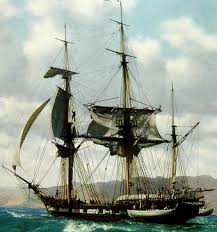
HMS Beagle, Darwin's ship

HMS Beagle, on a voyage of discovery

On December 27, 1831, Charles Darwin and H.M.S. Beagle set sail on an around-the-world voyage of discovery that would change all of science, and especially biology, forever.

December 27 1831
After a few delays, H.M.S. Beagle headed out from Plymouth with a crew of 73 under clear skies and a good wind. Darwin became sea-sick almost immediately.

Darwin never fully overcame his seasickness, but he fought it well enough to become the single greatest collector of specimens in history for the British Museum and British science, a distinction that won him election to science societies even before his return from the trip — and cemented his life in science, instead of in the church. Darwin’s discoveries would have revolutionized biology in any case. In analyzing what he had found, a few years later and with the aid of experts at the British Museum, Darwin realized he had disproved much of William Paley’s hypotheses about life and its diversity, and that another, more basic explanation was possible. This led to his discovery of evolution by natural and sexual selection.

Mini-sheet from the Royal Mail honoring Darwin's discoveries in the Galapagos Islands

Mini-sheet from the Royal Mail in 2009 honoring Darwin's discoveries in the Galapagos Islands

On December 27, 1968, Apollo 8 splashed down after a successful and heartening trip to orbit the Moon. The three crewmen, Commander Frank Borman, James A. Lovell, Jr., and William A. Anders, had orbited the Moon, a very important milestone in the methodological race to put humans on the Moon (which would be accomplished seven months later). 1968 was a terrible year for the U.S., with the North Korean capture of the U.S.S. Pueblo, assassinations of Rev. Martin Luther King, Jr., and Sen. Robert F. Kennedy during the presidential campaign, riots in dozens of American cities, nasty political conventions with riots at the Democratic Convention in Chicago, a contentious and bitter election making sore the nation’s divide over Vietnam policy, and other problems. On Christmas Eve, Borman, Lovell and Anders broadcast from orbit around the Moon, a triumphant and touching moment for the Apollo Program and Americans around the world. Their safe return on December 27 raised hopes for a better year in 1969.

Motherboard.tv has a great write up from Alex Pasternack:

In 1968, NASA engineers were scrambling to meet President Kennedy’s challenge to land a man on the moon by decade’s end. Because delays with the lunar module were threatening to slow the Apollo program, NASA chose to change mission plans and send the crew of Apollo 8 all the way to the moon without a lunar module.

Exactly 43 years ago, the three astronauts of Apollo 8 became the first humans to orbit another celestial object. As they came around the dark side of the Moon for the third time, Frank Borman, the commander, finally turned their capsule around. And then they saw the Earth.

Borman: Oh my God! Look at that picture over there! Here’s the Earth coming up. Wow, is that pretty.
Anders: Hey, don’t take that, it’s not scheduled.
Borman: (laughing) You got a color film, Jim?
Anders: Hand me that roll of color quick, will you…

One of the resulting photos taken by Anders on a Hasselblad camera became one of the world’s most iconic images.

As Bill Anders recalls it:

I just happened to have one with color film in it and a long lens. All I did was to keep snapping… It’s not a very good photo as photos go, but it’s a special one. It was the first statement of our planet Earth and it was particularly impressive because it’s contrasted against this startling horizon… After all the training and studying we’d done as pilots and engineers to get to the moon safely and get back, [and] as human beings to explore moon orbit, what we really discovered was the planet Earth.

Yeah, we missed toasting it on time in 2010. Plan to raise a glass today, December 27, 2011, to Great Beginnings Day for the human race. December 27 is a day we should remember, for these achievements.

Also on December 27:

  • 1927 – “Show Boat” with music by Jerome Kern and libretto by Oscar Hammerstein II, opened at the Ziegfeld Theater in New York City (AP)
  • 1932 – Radio City Music Hall opened for the first time, with a stage that, to me, looks like an old radio (AP)
  • 1945 – The World Bank was formed under the Bretton Woods Agreement of 1944, a key part of world finance structure following World War II
  • 1949 – Indonesia gained independence in a grant from Queen Juliana of the Netherlands; Netherlands had ruled Indonesia for three centuries

Adapted from a post from 2010.


Still U.S. flags on the Moon?

July 7, 2011

One of the most dramatic categories of evidence that the U.S. landed men on the Moon is the detritus and other stuff they left behind.  Now we have satellites orbiting the Moon that can send back images of the landing sites with an amazing amount of detail.

Around the 4th of July somebody usually wonders how those flags left behind, are doing.

CBS News reporter Jim Axelrod asked around; you can see his report at YouTube (CBS disallows embedding of these reports, so you’ll need to click the image a couple of times to go to the YouTube site for CBS):

(720 views of this report when I posted this; come on, news hounds, flag fliers and Moon and history buffs, you can boost that total.)


Scouts Shooting for the Moon: The story of twelve Moon walkers, and Scouting

April 30, 2011

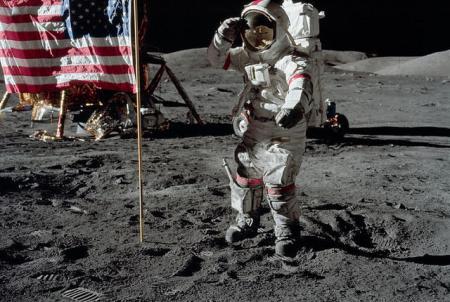
1cernan_jump_salutes_flag_-_gpn-2000-001273_0

Astronaut and 2nd Class Boy Scout Eugene Cernan saluted the U.S. flag on the Moon, on the last Apollo mission, Apollo 17. Photography by Astronaut and Tenderfoot Scout Harrison Schmitt. NASA image.

A short piece I presented this morning to the Tom Harbin Scout Museum Symposium on Scout History, a great morning organized by Bob Reitz, the curator of the Tom Harbin Scout Museum at Camp Wisdom, in Dallas, Texas. Of course the material is copyrighted, but by all means you have permission to use the material at Courts of Honor or in recounting the better history of Boy Scouting.

Scouts Shooting for the Moon:  The story of twelve Moon walkers, and Scouting

This is a recreation with modern numbers of a presentation first used a decade ago. Searching for material for a speech to honor Eagles at our District Dinner, several people suggested in a short period of time, ‘Why not talk about the astronauts who landed on the Moon. I hear they were all Eagle Scouts.’  Was that accurate?  It would have been a good story if so. Research revealed something quite different. The true story can carry just as much inspiration, however. Scouting is shown to be a program that can lead to a lifetime of adventure and accomplishment. Also, Eagles may take some inspiration in knowing they have accomplished something most of the men who walked on the Moon did not.

Speakers constantly need good material for Eagle Scout Courts of Honor and other events honoring Scouts and Scouters. For one event honoring a group of new Eagle Scouts, several people urged that I research the facts behind the story they had heard, that most, or all of the men who walked on the Moon were Eagle Scouts. New Eagles would find comfort in knowing they had soared into the midst of such company, they reasoned.

So it came to pass that, before the advent of Wikipedia and Google, I spent hours on the telephone until a press person at NASA pointed out to me a collection of information on astronauts that NASA had thoughtfully put on-line. At some high cost I printed out the few pages that dealt with the Scouting experience of astronauts, and worked to correlate it with information about which of them had gone to the moon, and which had not.

Anyone can find that book online with ease, today. The NASA Astronaut Fact Book provides information on almost every detail about NASA’s crew of astronauts, past and present. It includes one-and-a-half pages on the Scouting background of people working as astronauts and payload specialists for NASA, and others NASA has launched into manned missions. Cross-indexing that information with lists of Apollo Mission astronauts, I created four short tables showing the Apollo astronauts who went to the Moon, their missions, and the Scout rank they achieved, if any.

Lunar Astronauts and Scouting Experience

Twelve Moon Walkers

Name Mission Dates on the Moon Scout Rank
1 Neil Armstrong Apollo 11 July 21, 1969 Eagle Scout
2 Buzz Aldrin Apollo 11 July 21, 1969 Tenderfoot Scout
3 Pete Conrad Apollo 12 November 19-20, 1969 Cub Scout
4 Alan Bean Apollo 12 November 19-20, 1969 1st Class
5 Alan Shepard Apollo 14 February 5-6, 1971 1st Class
6 Edgar Mitchell Apollo 14 February 5-6, 1971 Life Scout
7 David Scott Apollo 15 July 31-August 2, 1971 Life Scout
8 James Irwin Apollo 15 July 31-August 2, 1971 None
9 John Young Apollo 16 April 21-23, 1972 2nd Class
10 Charles Duke Apollo 16 April 21-23, 1972 Eagle Scout
11 Eugene Cernan Apollo 17 December 11-14, 1972 2nd Class
12 Harrison Schmitt Apollo 17 December 11-14, 1972 Tenderfoot Scout

Apollo 13

Name Mission Dates on the Moon Scout Rank
1 Jim Lovell Apollo 13 Lunar Swingby Eagle Scout
2 Jack Swigert Apollo 13 Lunar Swingby 2nd Class
3 Fred Haise Apollo 13 Lunar Swingby Star

Lunar Missions That Did Not Land

Name Mission Dates on the Moon Scout Rank
1 Frank Borman Apollo 8 Orbited only None
2 Jim Lovell Apollo 8 (&13) Orbited only Eagle Scout
3 William Anders Apollo 8 Orbited only Life Scout
4 Tom Stafford Apollo 10 Orbited only Star Scout
5 John Young Apollo 10 (& 16) Orbited only 2nd Class
6 Eugene Cernan Apollo 10 (& 17) Orbited only 2nd Class

Others Who Did Not Land

Name Mission Dates on the Moon Scout Rank
1 Michael Collins Apollo 11 Capsule pilot None
2 Dick Gordon Apollo 12 Capsule pilot Star Scout
3 Stewart Roosa Apollo 14 Capsule pilot None
4 Al Worden Apollo 15 Capsule pilot 1st Class
5 Ken Mattingly Apollo 16 Capsule pilot Life Scout
6 Ronald Evans Apollo 17 Capsule pilot Life Scout

In all, 24 men flew to the Moon. Twelve set foot on the lunar surface. Of the twelve, eleven were Scouts, two were Eagles. Of the 24, 20 were Scouts, three were Eagles.

At the time I originally researched, about 70% of all astronauts were alumni of Scouting, men and women. Officially, BSA lists 181 NASA astronauts as being alumni, 57.4%

NASA lists the colleges and universities astronauts attended. NASA lists military service, hometowns, and states of birth. But with the possible exception of a generic category of “public schools,” no category of astronauts is larger than the category of Scouting experience. If we were advising a young person on how to get to become an astronaut, we would be remiss if we did not advise him or her to join Scouting.

What can we conclude?

Three things became apparent to me in tracking these figures down. One, I learned once again that the true stories most often carry great value, more value than the stories people make up, or assume.

Two, I learned that Scouting by itself carries great value, without a Scout’s having earned Eagle. We know that not all the Moon walkers earned the Eagle rank. But we also notice that no flight ever went to the Moon without at least two Scouts aboard. Three of the 24 lunar voyagers are Eagles, 12.5%. Two of the dozen who actually set foot on the Moon are Eagles, 16.7%. Eleven of the twelve Moon walkers were Scouts, 91.7%. 21 of 24 lunar voyagers were Scouts, 87.5%.

So, while it was not necessary to be an Eagle, it certainly seemed to help. But simply having Scouting experience seemed to be the biggest help. There may be some magic in a boy’s having taken that oath that carries through his entire life, and spurs him to do daring and great things. That is important. A trend begins to emerge. Scouting by itself, without earning the highest rank, provides great value. When a boy signs up, he signs on for the adventure of a lifetime, and often that leads to a lifetime of adventure. That venturesome spirit carries on well past his Scouting years.

The story of Jim Lovell might carry some great weight with Scouts. Lovell is the only person to have gone to the Moon twice, but never set foot on it. He was the commander of Apollo 13, whose near-disaster was chronicled in the movie of the same name. Among other lessons that might be pulled out of the story:  When your Moon-bound spaceship explodes and loses power on the way to the Moon, it is often good to have an Eagle Scout handy to help get through the experience and return safely.

Is there inspiration here?

When I first presented these figures at a Scout meeting, a parent asked me whether these numbers would discourage boys from working for any rank advancement, since just being a Scout seems to carry such weight. This should not discourage Eagles, nor discourage any Scout from working to get the Eagle rank. We should look at it this way:  Every Scout who earns an Eagle has done what ten of the twelve who walked on the Moon did not do, perhaps could not do. Nine more Moon walkers started on that path to Eagle, but did not finish, or could not finish.

Not every Eagle can go to the Moon, but every Eagle has already won an award that most of those who did go to the Moon wish they had.

Especially in the circles of corporate and government leadership, character, what it is and how to get it, concerns people. What sort of character does it take to go to the Moon? Every Scout has a glimpse of what is required, and every Eagle can say, “I know what it takes to get such character.”

Bibliography

Human Spaceflight, “The Apollo Program,” NASA, July 2, 2009; accessed April 28, 2011; http://spaceflight.nasa.gov/history/apollo/

Astronaut Fact Book, NASA,  NP-2005-01-001JSC, January 2005; accessed April 27, 2011; spaceflight.nasa.gov/spacenews/factsheets/pdfs/astro.pdf

BSA, “Facts About Scouting,” 2009; accessed April 28, 2011; http://www.scouting.org/about/factsheets/scoutingfacts.aspx

“Astronauts With Scouting Experience,” Eagle Scout Information, U.S. Scouting Service Project, April 6, 2011; accessed April 29, 2011; http://www.usscouts.org/eagle/eagleastronauts.asp

About the author:

Ed Darrell teaches U.S. History at Moises E. Molina High School in Dallas. He has taught economics, government, world history and street law in high schools; he also taught at the University of Utah, University of Arizona, and DeVry University. He is a former speech writer for politicians. His degree in Mass Communication came from the University of Utah, and his law degree from George Washington University. This was presented to the Jack Harbin Museum Symposium of Scout History, April 30, 2011.

World Scout badge carried to the Moon by Astronaut Neil Armstrong.

World Scout badge carried to the Moon by Astronaut Neil Armstrong.


Save


Palin can’t tell satellites from doughnuts

February 1, 2011

You can tell by the dates I’m not following this closely — it’s a Sarah Palin thing, after all, and we all hope it will go away.

Spudnut Shop, Richland Washington, Tri-City Herald photo by Kai-Huei Yau

Baking doughnuts before dawn at the Spudnut Shop, Richland Washington, Tri-City Herald photo by Kai-Huei Yau

Palin wasn’t content to just screw up the history of the phrase “Sputnik moment,” as noted earlier.  Oh, no, she had to go deeper in dumb, and talk about Spudnut shops.  If you’re not from Salt Lake City where the Spudnut HQ sign adorned Interstate 15 for many years, you may never have heard of Spudnuts, doughnuts made with potato dough.

If you’re wondering what in the world Spudnuts have to do with Sputnik, you’ve got more sense than Sarah Palin.

After screwing up the history, like a blind squirrel, Palin blundered on to talk about a vestige Spudnut shop in Richland, Washington.  She found something we all applaud, a good doughnut shop.   On one hand fans of the doughnut are happy to know of one of a tiny handful of such shops left.  Plus, it’s great to boost a small shop in a small Washington town.

On the other hand, doughnuts, even Spudnuts, don’t come close to the movement to improve American education inspired by the Soviet launch of Sputnik.  From just getting history horribly in error, Palin came close to ridiculing American business with her idea of meeting the challenges like space exploration, with doughnuts and coffee.  Doughnuts and coffee will not lift student test scores, nor are they the answer to lifting our economy today and keeping the U.S. competitive and on top, in the future.

Others covered the topic better than I.

Yes, that is what we need to get the economy back on track.

A bakery.

Not more expertise in math and science, engineering, technology, and developing enterprises that will allow us to compete with the rest of the world. A bakery, full of Real Americans.

Do you realize how this sounds? This is like if I were to say, “Hey, I think we need to take a course to familiarize ourselves with what actually caused the Soviet Union to collapse!” and you were to respond, “Anything can be solved with Hard Work, donuts, and the American Way!” It’s as if I were to say, “Let’s study geometry!” and you were to respond, “Let’s study Gia Spumanti, the red-blooded American protagonist of ‘A Shore Thing.'” “Those two sound similar, but are in no way comparable,” I would point out. And that’s what this is. It’s the kind of bizarre semi-sequitur that has always been a hallmark of your speaking style.

Stromberg got serious for a moment, and makes the case against Palin’s claims:

But in claiming that the Soviets incurred their consequential debts long before Reagan was president, Palin ends up arguing that the Gipper wasn’t nearly that responsible for the USSR spending itself to death. If a reverence for Reagan’s anti-Soviet spending inspired her narrative in the first place, then this is incoherent. If she’s just making this all up, then she’s really also claiming that the Reagan-brought-down-the-USSR narrative is overstated.

Palin appears to be lazily checking a lot of Fox News boxes. She wants to criticize Obama’s State of the Union address, so she grabs hold of the Sputnik line. She wants to make a point about debt, so she invents a history in which the USSR had a debt crisis decades before this inference could have made much sense. Even better — her argument sounds like an implicit vindication of Reagan, but that really just makes it either self-contradictory or hostile to Reagan’s legacy.

Even worse, it seems that Palin planned her rhetorical disaster, as she goes on to discuss the “Spudnut Shop,” a bakery in Washington State that’s succeeding without government support. Yet more evidence that her judgment in both what she says and who she has vetting it is pathetic. It’s not even cleverly manipulative. It’s just dreck.

Zeno provides the horrifying evidence that Palin’s stupid is leaking out, and may be contagious.  Zeno caught Brian Sussman at the formerly-august KSFO talking to a woman who would fail the Sputnik issue even by Texas standards.  In Texas, in 11th grade U.S. history, students need to know a half-dozen dates, turning points in U.S. history.  1957 is one of those dates, for the launch of Sputnik.  Oy, what does it say when a San Francisco radio station is dumber than Texas’s weak and skewed social studies standards?

More:

Tip of the old scrub brush to Oh, For Goodness Sake.


“WTF?” Palin completely misunderstands what “Sputnik Moment” means

January 28, 2011

Vodpod videos no longer available.

“WTF?” Palin completely misunderstands what “S…, posted with vodpod

Some bloggers have sworn off comments on Sarah Palin. Good on them.

This fruit is too low-hanging.

Palin doesn’t appear to have a clue about what the phrase “Sputnik moment” refers to — and mistakes it with the much later financial difficulties of the Soviet Union.  You’d think, since she was so close to the U.S.S.R. in Alaska, she’d know something about Sputnik.

And what’s with the “WTF” on television?  Has she no composure, no decency?

Here, Sarah; a primer:

Sputnik was the first artificial satellite launched from Earth, in October 1957.  (Palin wasn’t born for another seven years . . . arguments about teaching history, anyone?)

Please note that the launch of the satellite scared the bejeebers out of Americans.  Most people thought — without knowing anything about how heavy a nuclear device might be, nor how hard it might be to target one — that if the Russians could orbit a satellite the size of a beach ball, they could certainly launch missiles with nuclear warheads to rain down on America.  Maybe, some thought, Russians had already orbited such nukes, which could just fall from space without warning.

That was the spooky, red scary part.  Then there was the kick-American-science-in-the-pants part.  A lot of policy makers asked how the Russians could surpass the U.S. in the race for space (wholly apart from the imported German rocket scientists used by both the U.S. and the U.S.S.R.).  Looking around, they found science and technology education in America sadly lacking.  Congress passed a law that called science education necessary for our defense, and appropriated money to help boost science education — the National Defense Education Act.

The Cold War stimulated the first example of comprehensive Federal education legislation, when in 1958 Congress passed the National Defense Education Act (NDEA) in response to the Soviet launch of Sputnik. To help ensure that highly trained individuals would be available to help America compete with the Soviet Union in scientific and technical fields, the NDEA included support for loans to college students, the improvement of science, mathematics, and foreign language instruction in elementary and secondary schools, graduate fellowships, foreign language and area studies, and vocational-technical training.

(See the Wikipedia entry on NDEA, too.)

The National Science Foundation (NSF) history points to the genuine advances in science the Soviets had made, and the need for the U.S. to quickly catch up:

Sputnik once again elevated the word “competition” in the language of government officials and the American public. Sputnik threatened the American national interest even more than the Soviet Union’s breaking of America’s atomic monopoly in 1949; indeed it rocked the very defense of the United States because Russia’s ability to place a satellite into orbit meant that it could build rockets powerful enough to propel hydrogen bomb warheads atop intercontinental ballistic missiles.  Perhaps more importantly, however, Sputnik forced a national self-appraisal that questioned American education, scientific, technical and industrial strength, and even the moral fiber of the nation. What had gone wrong, questioned the pundits as well as the man in the street. They saw the nation’s tradition of being “Number One” facing its toughest competition, particularly in the areas of science and technology and in science education.

With its ties to the nation’s research universities, the Foundation of course became a key player in the unfolding events during this trying time. An indication is shown by the large increase in Foundation monies for programs already in place and for new programs. In fiscal year 1958, the year before Sputnik, the Foundation’s appropriation had leveled at $40 million. In fiscal 1959, it more than tripled at $134 million, and by 1968 the Foundation budget stood at nearly $500 million. Highlights of this phase of the agency’s history cannot be told in a vacuum, however, but must be placed within the broad context of American political happenings.

The Congress reacted to Sputnik with important pieces of legislation and an internal reorganization of its own committees. Taken together, the action announced that America would meet the Soviet competition.  The National Aeronautics and Space Act, more than any other post-Sputnik law, had great impact on increasing federal funding of scientific research and development. Signed by the president in July 1958, the law created the National Aeronautics and Space Administration (NASA) and gave it responsibility for the technological advancement of the space program. NASA became a major contracting agency and boosted tremendously the extra mural research support of the federal government. NASA not only symbolized America’s response to the Soviet challenge, but also dramatized the federal role in support of science and technology.

Among other things, the National Science Foundation looked at science textbooks used in elementary and secondary schools, and found them badly outdated.  NSF and other organizations spurred the development of new, up-to-date books, and tougher academic curricula in all sciences.

So, when President Obama refers to a “Sputnik moment,” he isn’t referring to a foolish expenditure of money for space junk that bankrupts the nation.  He’s referring to that time in 1957 when America woke up to the fact that education is important to defense, and to preparing for the future, and did a lot about improving education.  Between the G.I. Bill’s education benefits and the NDEA, the U.S. became the world’s leader in science and technology for the latter half of the 20th century.

But we’ve coasted on that 1958 law for too long.  Now we are being lapped by others — India, China, France, Japan, and others — and it’s time to spur progress in education again, to spur progress and great leaps in science.

One gets the impression Palin does not think much of science, nor education, nor especially science education.  She could use some lessons in history, too.  Sputnik didn’t bankrupt the Soviet Union.  Ignoring Sputnik might have bankrupted the U.S.

Santayana’s Ghost is shaking his head in sad disbelief.  And he has a question for Sarah Palin:  Santayana’s Ghost wants to know from Ms. Palin, can the U.S. compete with the Russians?

Tip of the old scrub brush to P. Z. Myers and Pharyngula, and another shake to DailyKos.

More, resources:


Antique, if not ancient, technology

December 28, 2010

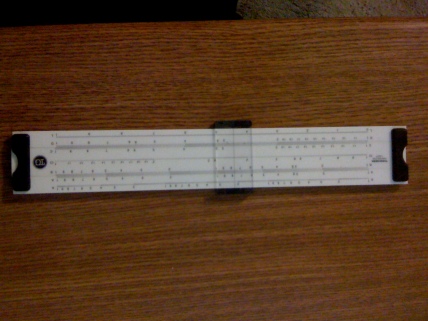
Slide rule, gifted to Art Hunt in December 2010 by his children - photo by Art Hunt

You could slide through the physics final with this device, at one time.

This is the device used to put humans on the Moon.

Have you ever used one?

It’s a slide ruleNice story about Art Hunt’s kids listening to tales from the olden days, and bringing back a little piece of the olden days for him.  He now claims to be ready for a power outage at his lab.

How does anyone understand a logarithmic scale anymore without a slide rule?  Does anyone make good slide rules anymore?


December 27, Good Trip Day: Darwin and Apollo 8

December 28, 2010

December 27 is one of those days — many of us are off work, but it’s after Boxing Day, and it’s not yet on to New Year’s Eve or Day.  We should have celebrated, maybe.

We should celebrate it as a day of portent:  A good embarkation, and a good, safe end to a nation-encouraging trip to almost touch the Moon.

HMS Beagle, Darwin's ship

HMS Beagle, on a voyage of discovery

On December 27, 1831, Charles Darwin and H.M.S. Beagle set sail on an around-the-world voyage of discovery that would change all of science, and especially biology, forever.

December 27 1831
After a few delays, H.M.S. Beagle headed out from Plymouth with a crew of 73 under clear skies and a good wind. Darwin became sea-sick almost immediately.

Darwin never fully overcame his seasickness, but he fought it well enough to become the single greatest collector of specimens in history for the British Museum and British science, a distinction that won him election to science societies even before his return from the trip — and cemented his life in science, instead of in the church.  Darwin’s discoveries would have revolutionized biology in any case.  In analyzing what he had found, a few years later and with the aid of experts at the British Museum, Darwin realized he had disproved much of William Paley’s hypotheses about life and its diversity, and that another, more basic explanation was possible.  This led to his discovery of evolution by natural and sexual selection.

Mini-sheet from the Royal Mail honoring Darwin's discoveries in the Galapagos Islands

Mini-sheet from the Royal Mail in 2009 honoring Darwin's discoveries in the Galapagos Islands

On December 27, 1968, Apollo 8 splashed down after a successful and heartening trip to orbit the Moon.  The three crewmen, Commander Frank Borman, James A. Lovell, Jr., and William A. Anders, had orbited the Moon, a very important milestone in the methodological race to put humans on the Moon (which would be accomplished seven months later).  1968 was a terrible year for the U.S., with the North Korean capture of the U.S.S. Pueblo, assassinations of Rev. Martin Luther King, Jr., and Sen. Robert F. Kennedy during the presidential campaign, riots in dozens of American cities, nasty political conventions with riots at the Democratic Convention in Chicago, a contentious and bitter election making sore the nation’s divide over Vietnam policy, and other problems.  On Christmas Eve, Borman, Lovell and Anders broadcast from orbit around the Moon, a triumphant and touching moment for the Apollo Program and Americans around the world.   Their safe return on December 27 raised hopes for a better year in 1969.

Motherboard.tv has a great write up from Alex Pasternack:

In 1968, NASA engineers were scrambling to meet President Kennedy’s challenge to land a man on the moon by decade’s end. Because delays with the lunar module were threatening to slow the Apollo program, NASA chose to change mission plans and send the crew of Apollo 8 all the way to the moon without a lunar module.

Exactly 42 years ago, the three astronauts of Apollo 8 became the first humans to orbit another celestial object. As they came around the dark side for the third time, Frank Borman, the commander, finally turned their capsule around. And then they saw the Earth.

Borman: Oh my God! Look at that picture over there! Here’s the Earth coming up. Wow, is that pretty.
Anders: Hey, don’t take that, it’s not scheduled.
Borman: (laughing) You got a color film, Jim?
Anders: Hand me that roll of color quick, will you…

One of the resulting photos taken by Anders on a Hasselblad camera became one of the world’s most iconic images.

As Bill Anders recalls it:

I just happened to have one with color film in it and a long lens. All I did was to keep snapping… It’s not a very good photo as photos go, but it’s a special one. It was the first statement of our planet Earth and it was particularly impressive because it’s contrasted against this startling horizon… After all the training and studying we’d done as pilots and engineers to get to the moon safely and get back, [and] as human beings to explore moon orbit, what we really discovered was the planet Earth.

Yeah, we missed toasting it on time in 2010.  Plan to raise a glass on December 27, 2011, to Good Trip Day for the human race.  December 27 is a day we should remember, for these achievements.


July 24: Touchdown Day!

July 24, 2010

From various “Today in History” features, AP, New York Times, and others:

July 24, 1969: Apollo 11 returned to the Earth, and splashed down in the Pacific Ocean, Michael Collins, Buzz Aldrin and Neil Armstrong — Aldrin and Armstrong having landed on the Moon.

July 24, 1847: A larger contingent of Mormons, refugees from a literal religious war in Illinois and Missouri, entered into the Salt Lake Valley under the leadership of Brigham Young, who famously said from his wagon sick-bed, “This is the place; drive on!”

July 24, 1866: Tennessee became the first of the Confederate States, the former “state in rebellion,” to be readmitted fully to the Union, following the end of the American Civil War.

July 24, 2005: Lance Armstrong won his seventh consecutive Tour de France bicycle race.

July 24, 1959: Visiting Moscow, USSR, to support an exhibit of U.S. technology and know-how, Vice President Richard Nixon engaged Soviet Communist Party Secretary and Premier Nikita Khruschev in a volley of points about which nation was doing better, at a display of the “typical” American kitchen, featuring an electric stove, a refrigerator, and a dishwasher.  Khruschev said the Soviet Union produced similar products; Nixon barbed  back that even Communist Party leaders didn’t have such things in their homes, typically, but such appliances were within the reach of every American family.  It was the “Kitchen Debate.”

July 24, 1974: The U.S. Supreme Court ruled unanimously that President Richard Nixon had to turn over previously-secret recordings made of conversations in the White House between Nixon and his aides, to the special prosecutor appointed to investigate the Watergate affair and cover-up.  Nixon would resign the presidency within two weeks, the only president to leave office by resignation.

July 24, 1975: An Apollo spacecraft splashed down after a mission that included the first link-up of American and Soviet spacecraft.  (The Apollo mission was not officially numbered, but is sometimes called “Apollo 18” — after Apollo 17, the last trip to the Moon.)


One more way to know Apollo 11 landed on the Moon

April 4, 2010

Every year at this time . . .

In a discussion of the Cold War, the Space Race, and the Race to the Moon, we get to a photo about Apollo 11’s landing on the Moon.

Like clockwork, a hand goes up:  “Mr. Darrell, wasn’t that landing a hoax?  They didn’t really go to the Moon then, did they?”

There are a lot of ways to know that Apollo 11 landed on the Moon.  Among other things, students could talk to people alive at the time who have the slightest bit of technological savvy:  With lots of other people, I tracked part of the trip with my 6-inch reflecting telescope.  Ham radio operators listened in on the radio broadcasts.  And so on.

But I really like this chunk of evidence:  How about a photograph of the landing site?

Holy cow!  You can see the tracksof Neil Armstrong’s footprints to the lip of Little West crater (see arrow below).

Tranquility Base, from the LROC -- showing evidence of Apollo 11's landing -

Tranquility Base, shot from the Lunar Reconnaissance Orbiter Camera (LROC), showing the traces left by Apollo 11's landing on the Moon. It really happened. Credit: NASA/GSFC/Arizona State University

According to the LROC website:

The astronaut path to the TV camera is visible, and you may even be able to see the camera stand (arrow). You can identify two parts of the Early Apollo Science Experiments Package (EASEP) – the Lunar Ranging Retro Reflector (LRRR) and the Passive Seismic Experiment (PSE). Neil Armstrong’s tracks to Little West crater (33 m diameter) are also discernable (unlabeled arrow). His quick jaunt provided scientists with their first view into a lunar crater.

Check out this video made from the photos, “High Noon at Tranquility Base”:

Fox News?  What’s your story now?

More:

Tip of the old scrub brush to Collect Space forum, and the Carnival of Space #147 at Weird Sciences.  Thanks to ScienceBlips for telling us about Carnival of Space.


Geography quiz: In space, who will accept your teeming masses?

December 3, 2009

Lady Liberty from space, European Space Agency photo

What is this famous landmark?

This could be an interesting geography or history bell ringer.  What are these famous sites pictured above?

Answer below the fold.

Read the rest of this entry »


Sputnik at 52

October 5, 2009

Encore post from 2007:

America woke up on October 4, 1957.

Sputnik, model hanging in Smithsonian Air & Space Museum (Wikimedia photo via Polytechnic U.S. History)

Sputnik model, at the Smithsonian Air & Space Museum (Wikimedia image)


The Union of Soviet Socialist Republics (USSR) launched the world’s first artificial satellite into orbit. After successfully putting the shiny ball into orbit, the Soviets trumpeted the news that Sputnik traced the skies over the entire planet, to the shock of most people in the U.S. (Photo of the model in the Smithsonian’s Air & Space Museum in Washington, D.C.)

New Scientist magazine’s website provides significant details about how awake America became, including very good coverage of the Moon landings that were nearly a direct result of Sputnik’s launch — without Sputnik, the U.S. probably wouldn’t have jump started its own space program so, with the creation of NASA and the drive for manned space flight, and without the space race President John F. Kennedy probably wouldn’t have made his dramatic 1961 proposal to put humans on the Moon inside a decade.

Sputnik really did change the world.

Much of the progress to the 1969 Moon landing could not have occurred without the reform of education and science prompted by the Soviets’ triumph. With apathetic parents and the No Child Left Behind Act vexing U.S. education and educators from both sides, more than nostalgia makes one misty-eyed for the National Defense Education Act (NDEA), a direct product of Sputnik-inspired national ambition. Coupled with the GI Bill for veterans of World War II and Korea, NDEA drove U.S. education to be the envy of the world, best in overall achievement (and also drove creationists to try to block such improvements).

(Today NDEA gets little more than a footnote in real historyWikipedia’s entry is short and frustrating, the U.S. Department of Education gives little more. Educators, you have got to tell your history.)

Texas Essential Knowledge and Skills (TEKS) lists 1957 as among the dozen dates students need to know in U.S. history, for Sputnik. It is the only date Texas officials list for U.S. history that is really an accomplishment by another nation. (The first time I encountered this requirement was in a meeting of social studies teachers gearing up for classes starting the following week. The standards mention the years, but not the events; I asked what the event was in 1957 that we were supposed to teach, noting that if it was the Little Rock school integration attempt, there were probably other more memorable events in civil rights. No one mentioned Sputnik. It was more than two weeks before I got confirmation through our district that Sputnik was the historic event intended. Ouch, ouch, ouch!)

Sputnik was big enough news to drive Elvis Presley off the radio, at least briefly, in southern Idaho. My older brothers headed out after dinner to catch a glimpse of the satellite crossing the sky. In those darker times — literally — rural skies offered a couple of meteoroids before anyone spotted Sputnik. But there it was, slowly painting a path across our skies, over the potato fields, over the Snake River, over America.

Sputnik’s launch changed our lives, mostly for the better.

Resources:

Phil Plait at Bad Astronomy provides a series of links teachers can rely on for good information, especially if you’re composing a lesson plan quickly.

New Scientist’s broad range of coverage of the space race, up to the current drive to go to Mars, is well worth bookmarking.

google_sputnik.gif

Google’s anniversary logo, in use today only, gets you to a good compilation of sources.

Fifty nano-satellites launched in honor of the 50th anniversary of Sputnik.

NASA’s history of the event. You can listen to a .wav recording of the telemetry signal from the satellite there, too.

How will you mark the anniversary?

[More links below the fold.]

More resources:

Also see at Millard Fillmore’s Bathtub:

Help spread the news:

Add to FacebookAdd to NewsvineAdd to DiggAdd to Del.icio.usAdd to StumbleuponAdd to RedditAdd to BlinklistAdd to TwitterAdd to TechnoratiAdd to Furl


Quote of the moment: John F. Kennedy, “We choose to go to the Moon”

July 24, 2009

John F. Kennedy at Rice University, Houston, Texas, Sept 12, 1962 - photo from NASA

John F. Kennedy at Rice University, Houston, Texas, Sept 12, 1962 – photo from NASA

There is no strife, no prejudice, no national conflict in outer space as yet. Its hazards are hostile to us all. Its conquest deserves the best of all mankind, and its opportunity for peaceful cooperation many never come again. But why, some say, the moon? Why choose this as our goal? And they may well ask why climb the highest mountain? Why, 35 years ago, fly the Atlantic? Why does Rice play Texas?

We choose to go to the moon. We choose to go to the moon in this decade and do the other things, not because they are easy, but because they are hard, because that goal will serve to organize and measure the best of our energies and skills, because that challenge is one that we are willing to accept, one we are unwilling to postpone, and one which we intend to win, and the others, too.

President John F. Kennedy, September 12, 1962, at Rice University, Houston, Texas

Why this speech in Houston?  There’s more here than just a speech in a football stadium.  Kennedy was working to save the space initiative, and to make America more secure.

In this quest, Kennedy lays out the reasons we need strong science research programs funded by our federal government, and strong science educational achievement in all of our schools.

From the White House History Association:

Race to the Moon

President John F. Kennedy (1961-1963) awoke on April 12, 1961, to the news that the Soviet Union had won the race to put a man into space. Kennedy immediately met with Vice President Lyndon Johnson in the White House to discuss the embarrassment of the Soviets beating America again. “Can we put a man on the moon before them?” Kennedy asked. A few weeks later, Kennedy challenged the nation to “commit itself to achieving the goal, before this decade is out, of landing a man on the moon and returning him safely to earth.”

Kennedy challenged Congress and the imaginations of all Americans a few weeks later, when on May 25, in a special Joint Session of Congress, he proposed a Moon exploration program.  In a speech outlining defense and foreign policy needs to make the U.S. secure and safe against threats from Soviet communism, or any other nation or faction, Kennedy spoke openly about the space race that had been waged since October 4, 1957, when the Soviet Union became the first nation on Earth to orbit an artificial satellite, Sputnik.

Kennedy told Congress in that part of the speech:

Finally, if we are to win the battle that is now going on around the world between freedom and tyranny, the dramatic achievements in space which occurred in recent weeks should have made clear to us all, as did the Sputnik in 1957, the impact of this adventure on the minds of men everywhere, who are attempting to make a determination of which road they should take. Since early in my term, our efforts in space have been under review. With the advice of the Vice President, who is Chairman of the National Space Council, we have examined where we are strong and where we are not, where we may succeed and where we may not. Now it is time to take longer strides–time for a great new American enterprise–time for this nation to take a clearly leading role in space achievement, which in many ways may hold the key to our future on earth.

I believe we possess all the resources and talents necessary. But the facts of the matter are that we have never made the national decisions or marshalled the national resources required for such leadership. We have never specified long-range goals on an urgent time schedule, or managed our resources and our time so as to insure their fulfillment.

Recognizing the head start obtained by the Soviets with their large rocket engines, which gives them many months of leadtime, and recognizing the likelihood that they will exploit this lead for some time to come in still more impressive successes, we nevertheless are required to make new efforts on our own. For while we cannot guarantee that we shall one day be first, we can guarantee that any failure to make this effort will make us last. We take an additional risk by making it in full view of the world, but as shown by the feat of astronaut Shepard, this very risk enhances our stature when we are successful. But this is not merely a race. Space is open to us now; and our eagerness to share its meaning is not governed by the efforts of others. We go into space because whatever mankind must undertake, free men must fully share.

I therefore ask the Congress, above and beyond the increases I have earlier requested for space activities, to provide the funds which are needed to meet the following national goals:

First, I believe that this nation should commit itself to achieving the goal, before this decade is out, of landing a man on the moon and returning him safely to the earth. No single space project in this period will be more impressive to mankind, or more important for the long-range exploration of space; and none will be so difficult or expensive to accomplish. We propose to accelerate the development of the appropriate lunar space craft. We propose to develop alternate liquid and solid fuel boosters, much larger than any now being developed, until certain which is superior. We propose additional funds for other engine development and for unmanned explorations–explorations which are particularly important for one purpose which this nation will never overlook: the survival of the man who first makes this daring flight. But in a very real sense, it will not be one man going to the moon–if we make this judgment affirmatively, it will be an entire nation. For all of us must work to put him there.

(Here’s a link to an audio excerpt of that speech, from the Kennedy Library.)

The race was on.  The Soviet Union’s massive rocket engines gave them a decided advantage.  Kennedy’s challenge captured the imagination of Americans and America.  Necessary money flowed from Congress, but not in a completely free flow.  Some opposed the nation’s efforts in space exploration because they thought spending on space exploration detracted from the nation’s defense efforts.  Kennedy continued to stress the connection between space exploration and defense.  He was backed by successes — Navy Commander Alan Shepard, Jr., had successfully launched into space and returned safely; and on February 20, 1962, pilot Marine Capt. John Glenn orbited the Earth three times, catching the U.S. up almost to where the Soviet Union was in manned space exploration.

Kennedy understood that constant attention, constant selling of the space program would be necessary.  So in September 1962 he found himself in Houston, the newly-designated home of the manned space program, and he took the opportunity to cast the American goals in the space race as peaceful, good for all mankind, and definitely worth the massive costs.

Notice in how he casts putting a human on the Moon in league with other great achievements of civilization.  Kennedy was truly shooting for the stars.

Notice also how he relates space exploration to practical applications then in existence, such as communication, navigation of ships at sea, and weather forecasting.  This was years before geosynchronus satellites were used for everyday telephone conversations, years before quantum theory was harnessed for Global Positioning Systems (GPS) and digital personal, handheld telephones, and before the newly-invented printed circuits were miniaturized to make computer calculating a possibility in space — the Moon landing was done with slide rules and hand calculations.

Just over 14 months later Kennedy would die in Texas, in Dallas, on November 22, 1963.  On July 20, 1969, Neil Armstrong and Buzz Aldrin landed the Eagle Lunar Module on the Moon, at the Sea of Tranquility.  A few hours later, on July 21, they stepped out on the Moon.  From Kennedy’s speech to Congress, the task had taken 8 years, one month and 26 days.

More resources:

Tip of the old scrub brush for inspiration to “Anything You Ever Wanted to Know” at KERA-FM 90.1 in Dallas, on July 24, 2009.

Buzz Aldrin on the Moon, with Neil Armstrong, the U.S. flag, and the Eagle Lunar Module reflected in his helmet visor, July 21, 1969 - NASA photo via Wikimedia

Buzz Aldrin on the Moon, with Neil Armstrong, the U.S. flag, and the Eagle Lunar Module reflected in his helmet visor, July 21, 1969 – NASA photo via Wikimedia

Please share.

Add to FacebookAdd to NewsvineAdd to DiggAdd to Del.icio.usAdd to StumbleuponAdd to RedditAdd to BlinklistAdd to TwitterAdd to TechnoratiAdd to Furl


Our nation’s first man in space

July 20, 2009

Our first man in space got there by a route most people can’t guess:  Balloon.

Joe Kittinger recounted his adventures to the CBS Morning Show, how he leaped from a balloon at the edge of space for the Air Force, to prove that humans could survive a fall from such distances, in the event of an emergency that required an astronaut to bail out.

Kittinger bailed out of the balloon at over 102,000 feet, nearly three times the height of Mt. Everest into the atmosphere.

But Elton John never wrote a song about “Balloon Man.”


Alas, that’s the way it is: Walter Cronkite dead at 92

July 18, 2009

You can’t explain the influence of Walter Cronkite to a high school kid today.  They don’t have any experience that begins to corroborate what you’d say.

Walter Cronkite in the last decade - Texas Parks and Wildlife photo by Richard Roberts

Walter Cronkite in the last decade - Texas Parks and Wildlife photo by Richard Roberts

Along with Chet Huntley and David Brinkley on NBC, Mr. Cronkite was among the first celebrity anchormen. In 1995, 14 years after he retired from the “CBS Evening News,” a TV Guide poll ranked him No. 1 in seven of eight categories for measuring television journalists. (He professed incomprehension that Maria Shriver beat him out in the eighth category, attractiveness.) He was so widely known that in Sweden anchormen were once called Cronkiters. (from the New York Times)

I’m saddened at the death of Cronkite.  One of the things that saddens me is that he probably could have anchored for at least a decade past when he last signed off.  Nothing against Dan Rather, at least not from me — just that Cronkite was one of a kind.  He won’t be missed by too many people alive today who never had a chance to see him work.

So, go see him work. Media Decoder has a series of YouTube pieces showing what Cronkite could do, what Cronkite did.  It’s history go see.

Other posts on Cronkite at Millard Fillmore’s Bathtub:

More, probably better stuff