Flying U.S. flags in January 2025

January 3, 2025

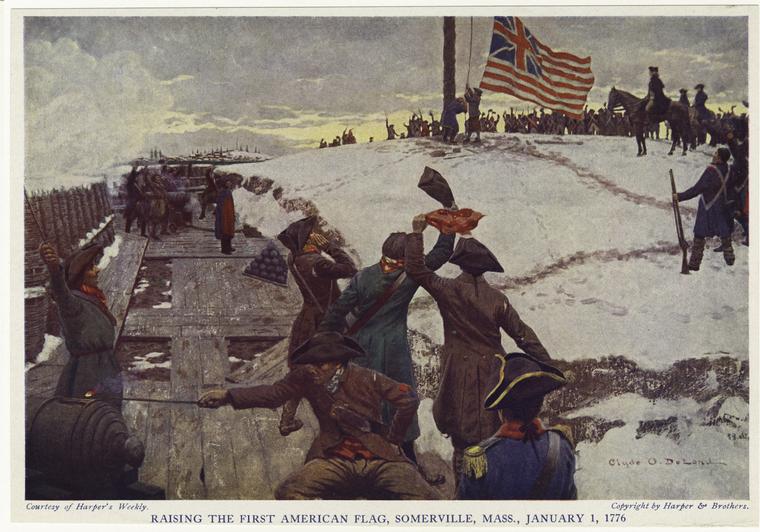
“Raising the first American flag, Somerville, Mass., January 1, 1776.” Harper’s Weekly painting by Clyde Osmer DeLand, 1897. From the digital collections of the New York Public Library; yes, MFB has used this painting before. I like it.

One problem with January’s flag flying dates is that if I snooze a little, you miss a lot. There are four flag-flying dates in the first five days of January: New Year’s Day and statehood days for Georgia, Alaska and Utah. You, Dear Reader, are alert and didn’t let any of those dates pass unmarked if you’re in those states, right?

There are more dates to go in January, including New Mexico’s statehood. We’re not halfway done, yet.

President Joe Biden declared flags should fly at half-staff in honor of the late President Jimmy Carter, for 30 days, until January 28. That covers all the dates in the usual flag-flying calendar. When flying flags at half staff, the flag should be hoisted quickly to full staff, then lowered soberly (slowly) to half staff.

In January 2025, the U.S. Flag Code urges citizens to fly flags on these dates, listed chronologically:

  • New Year’s Day, January 1, a federal holiday
  • January 2, Georgia Statehood Day
  • January 3, Alaska Statehood Day
  • January 4, Utah Statehood Day
  • January 6, New Mexico Statehood Day
  • January 9, Connecticut Statehood Day
  • Martin Luther King’s Birthday, a federal holiday on the third Monday of January; that date is January 19, in 2025; King’s actual birthday is January 15, and you may fly your flag then, too
  • Inauguration Day, January 20, the year after election years; 2025 will see an inauguration
  • January 26, Michigan Statehood Day
  • January 29, Kansas Statehood Day

You may fly your flag any other day you wish, too; flags should not be flown after sundown unless they are specially lighted, or at one of the few places designated by Congress or Presidential Proclamation for 24-hour flag flying.  According to Wikipedia’s listing, those sites include:

  • Fort McHenry, Baltimore, Maryland (Presidential Proclamation No. 2795, July 2, 1948).
  • Flag House Square, Albemarle and Pratt Streets, Baltimore, Maryland (Public Law 83-319, approved March 26, 1954).
  • Marine Corps War Memorial (Iwo Jima Memorial), Arlington, Virginia (Presidential Proclamation No. 3418, June 12, 1961).
  • Lexington Battle Green, Lexington, Massachusetts (Public Law 89-335, approved November 8, 1965).
  • White House, Washington, D.C. (Presidential Proclamation No. 4000, September 4, 1970).
  • Washington Monument, Washington, D.C. (Presidential Proclamation No. 4064, July 6, 1971, effective July 4, 1971).
  • Any port of entry to the United States which is continuously open (Presidential Proclamation No. 413 1, May 5, 1972).
  • Grounds of the National Memorial Arch in Valley Forge State Park, Valley Forge, Pennsylvania (Public Law 94-53, approved July 4, 1975).
Flag House in 1936, 844 East Pratt & Albemarle Streets (Baltimore, Independent City, Maryland) (cropped). Image courtesy of the federal HABS—Historic American Buildings Survey of Maryland.

Flag House in 1936, where Mary Pickersgill sewed the garrison-sized, 15-star flag that flew over Fort McHenry at the Battle of Baltimore in 1814; one of the sites where the U.S. flag may be flown 24 hours. The house is at 844 East Pratt & Albemarle Streets (Baltimore, Independent City, Maryland). Cropped image courtesy of the federal HABS—Historic American Buildings Survey of Maryland.

Save
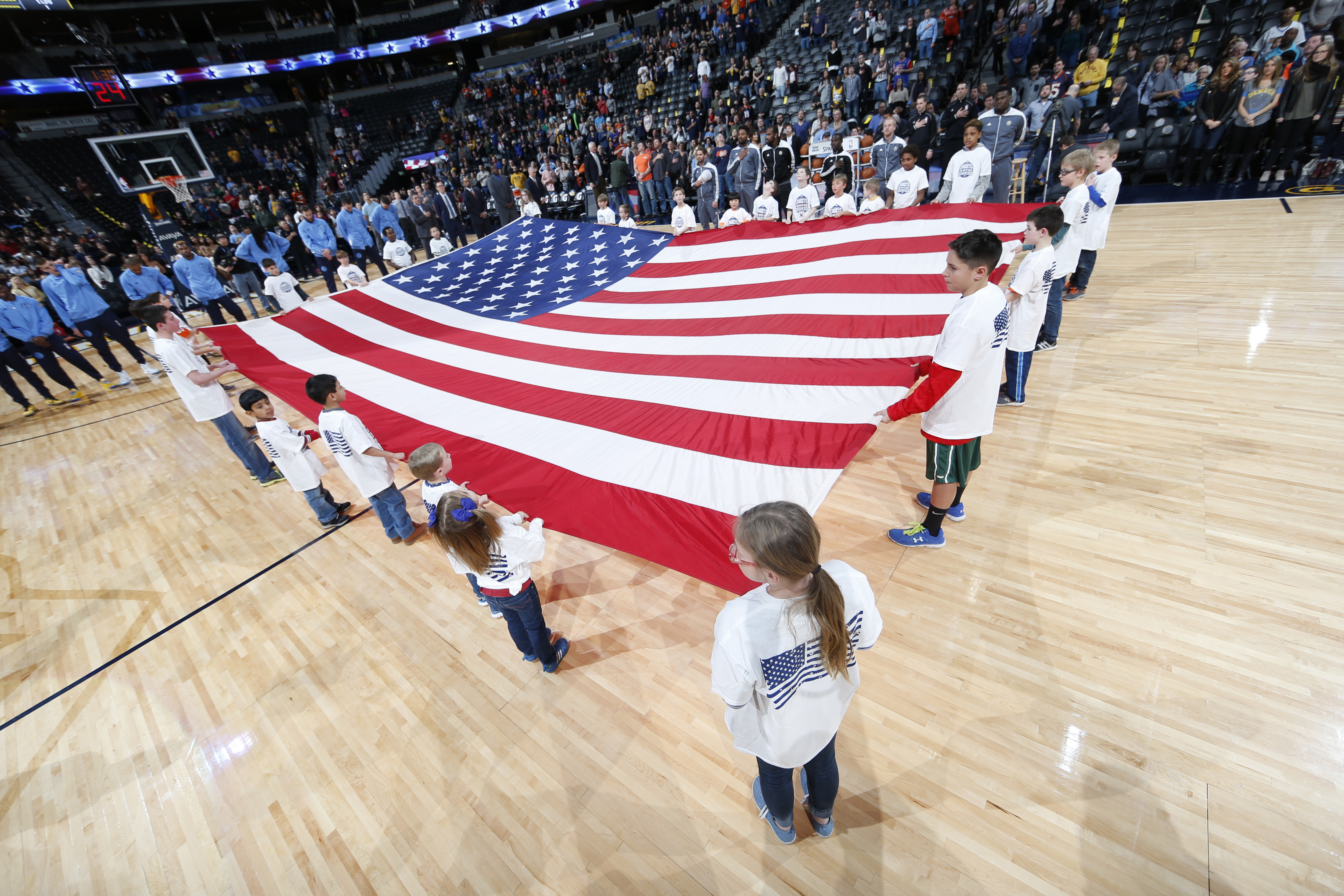
Children unfurl a large flag at a Denver Nuggets/Indiana Pacers NBA basketball game in Denver, January 2016. Colorado Public Radio image.
This is an encore post.
Yes, this is an encore post. Defeating ignorance takes patience and perseverance.

Michigan governor’s office continues practice honoring fallen soldiers

June 23, 2011

Michigan’s Gov. Rick Snyder chose to continue the practice of his predecessor, Gov. Jennifer Granholm, in ordering flags to be flown at half-staff throughout the state to honor a Michigan soldiers killed in Afghanistan and Iraq.

Good on him.

Description: Description: Description: cid:image001.png@01CC318F.8A7F61B0

Flags to be lowered Monday, June 27
for Private First Class Brian J. Backus

LANSING, Mich. – Gov. Rick Snyder ordered U.S. flags throughout the state to be lowered to half-staff in honor of Private First Class Brian J. Backus on Monday, June 27. Flags should be returned to full-staff on Tuesday, June 28.

Backus, 21, of Harbor Beach, died June 18 in Kandahar province, Afghanistan, of wounds suffered when insurgents attacked his unit with small arms fire.

“Pfc. Backus served our country with bravery and courage.  My thoughts and prayers are with his family and friends at this time of great sorrow,” Snyder said.

Backus was assigned to the 2nd Battalion, 87th Infantry Regiment, 3rd Brigade Combat Team, 10th Mountain Division of Fort Drum, New York. His awards include the National Defense Service Medal, the Afghanistan Campaign Medal, the Global War on Terrorism Service Medal, the Army Service Ribbon and the Combat Medical Badge. Backus deployed with his unit in March 2011 to Afghanistan in support of Operation Enduring Freedom.

The funeral service and arrangements are pending.

When flown at half-staff or half-mast, the U.S. flag should be hoisted first to the peak for an instant and then lowered to the half-staff or half-mast position. The flag should again be raised to the peak before it is lowered for the day.

This message was sent on Thursday, June 23, 2011 at 12:28 p.m.


1943 conflict: Flag, First Amendment’s Establishment Clause

June 14, 2010

Historic irony: On Flag Day in 1943, the U.S. Supreme Court issued its decision in the case of West Virginia vs. Barnette.

Billy Gobitis explained why he would not salute the U.S. flag, November 5, 1935 - Library of Congress collection

Image 1 - Billy Gobitas explained why he would not salute the U.S. flag, November 5, 1935 - Library of Congress collection

The case started earlier, in 1935, when a 10-year-old student in West Virginia, sticking to his Jehovah’s Witness principles, refused to salute the U.S. flag in a state-required pledge of allegiance. From the Library of Congress:

“I do not salute the flag because I have promised to do the will of God,” wrote ten-year-old Billy Gobitas (1925-1989) to the Minersville, Pennsylvania, school board in 1935. His refusal, and that of his sister Lillian (age twelve), touched off one of several constitutional legal cases delineating the tension between the state’s authority to require respect for national symbols and an individual’s right to freedom of speech and religion.

The Gobitas children attended a public school which, as did most public schools at that time, required all students to salute and pledge allegiance to the flag of the United States. The Gobitas children were members of the Jehovah’s Witnesses, a church that in 1935 believed that the ceremonial saluting of a national flag was a form of idolatry, a violation of the commandment in Exodus 20:4-6 that “thou shalt not make unto thee any graven image, nor bow down to them. . . .” and forbidden as well by John 5:21 and Matthew 22:21. On 22 October 1935, Billy Gobitas acted on this belief and refused to participate in the daily flag and pledge ceremony. The next day Lillian Gobitas did the same. In this letter Billy Gobitas in his own hand explained his reasons to the school board, but on 6 November 1935, the directors of the Minersville School District voted to expel the two children for insubordination.

The Watch Tower Society of the Jehovah’s Witnesses sued on behalf of the children. The decisions of both the United States district court and court of appeals was in favor of the right of the children to refuse to salute. But in 1940 the United States Supreme Court by an eight-to-one vote reversed these lower court decisions and ruled that the government had the authority to compel respect for the flag as a key symbol of national unity. Minersville v. Gobitis [a printer’s error has enshrined a misspelling of the Gobitas name in legal records] was not, however, the last legal word on the subject. In 1943 the Supreme Court by a six-to-three vote in West Virginia State Board of Education v. Barnette, another case involving the Jehovah’s Witnesses, reconsidered its decision in Gobitis and held that the right of free speech guaranteed in the First Amendment to the Constitution denies the government the authority to compel the saluting of the American flag or the recitation of the pledge of allegiance.

There had been strong public reaction against the Gobitis decision, which had been written by Justice Felix Frankfurter (1882-1965). In the court term immediately following the decision, Frankfurter noted in his scrapbook that Justice William O. Douglas (1898-1980) told him that Justice Hugo LaFayette Black (1886-1971) had changed his mind about the Gobitis case. Frankfurter asked, “Has Hugo been re-reading the Constitution during the summer?” Douglas replied, “No–he has been reading the papers.”1 The Library’s William Gobitas Papers showcase the perspective of a litigant, whereas the abstract legal considerations raised by Gobitis and other cases are represented in the papers of numerous Supreme Court justices held by the Manuscript Division.

1. Quoted in H. N. Hirsch, The Enigma of Felix Frankfurter (New York: Basic Books, 1981), 152.

John E. Haynes and David Wigdor, Manuscript Division

Second page, Billy Gobitiss explanation of why he will not salute the U.S. flag - Library of Congress

Second page, Billy Gobitas's explanation of why he will not salute the U.S. flag: "I do not salute the flag not because I do not love my country but I love my country and I love God more and I must obey His commandments." - Library of Congress

Supreme Court justices do not often get a chance to reconsider their decisions. For example, overturning Plessy vs. Ferguson from 1896 took until 1954 in Brown v. Topeka Board of Education. In the flag salute/pledge of allegiance cases Justice Hugo Black had a change of mind, and when a similar case from West Virginia fell on the Court’s doorstep in 1943, the earlier Gobitis decision was reversed.

Writing for the majority, Justice Robert H. Jackson said:

If there is any fixed star in our constitutional constellation, it is that no official, high or petty, can prescribe what shall be orthodox in politics, nationalism, religion, or other matters of opinion, or force citizens to confess by word or act their faith therein. If there are any circumstances which permit an exception, they do not now occur to us.

Jehovah’s Witnesses, and all other Americans, thereby have the right to refuse to say what they and their faith consider to be a vain oath.

And that, boys and girls, is what the First Amendment means.

Resources:


June 14 – Flag Day

June 14, 2008

Did you fly your flag today?  Even without my reminding you?  Good!

Norman Rockwell painting, Scout saluting the flag

Painting by Norman Rockwell, Scout saluting the flag.

Flag Day celebrates the date of the first resolution passing the Continental Congress designating Stars and Stripes as the flag of the soon-to-be U.S., on June 14, 1777.


Armed Forces Day, May 17 – Fly your flag

May 12, 2008

Flag etiquette reminder: Armed Forces Day is the third Saturday in May, this year on May 17. This is one of the days Congress suggests we should fly our flags. There may be events near your home.

Armed Forces Day 2008 poster

Resources:


15 stars, 15 stripes

January 13, 2008

January 13, 1794, President George Washington signed the law adding two stars and two stripes to the U.S. flag, after Vermont and Kentucky joined the union.

This was the only U.S. flag ever officially to have more than 13 stripes.

Replica of the flag flown during the War of 1812, with 15 stripes and 15 stars.  Very few examples of a 15-stripe flag remain.  The flag that flew over Ft. McHenry, the original

Replica of the flag flown during the War of 1812, with 15 stripes and 15 stars. Very few examples of a 15-stripe flag remain. The flag that flew over Ft. McHenry, the original “Star-spangled Banner,” is one. This replica flies in the peace garden in Oswego, New York.

The “Star-spangled Banner” that flew over Ft. McHenry, near Baltimore, which inspired Francis Scott Key to write the poem which was put to music to form our national anthem, had 15 stripes. President James Monroe signed a law in 1818 that specified 13 stripes, with a new star to be added on July 4 of any year after a new state was added, a practice which has held through our current 50-star, 13-stripe flag.

Tennessee was the 16th state. I have been unable to clarify what happened with the number of stripes between Tennessee’s admission to the union on June 1, 1796, and the law passed in the Monroe administration in 1818. Does anyone know? Got links?

More (added after August 2013):

