I was working and I missed it: Happy Religious Freedom Day! (a little late)

January 18, 2008

January 16 was Religious Freedom Day. I missed it again.

But I celebrate it most days, and you can, too.

They just don’t make many like Thomas Jefferson any more.

Thomas Jefferson, in bas relief, in the chamber of the U.S. House of Representatives.  Architect of the Capitol photo.   C. Paul Jennewein, sculptor

Thomas Jefferson, in bas relief, in the chamber of the U.S. House of Representatives, a gallery of lawgivers who contributed to the heritage of U.S. law and freedom. Architect of the Capitol photo. C. Paul Jennewein, sculptor


Quote of the Day: John Kennedy, June 26, 1963

June 26, 2007

President Kennedy addresses Berlin citizens, 6-26-1962 (photographer unidentified)

From the Smithsonian Magazine site:

June 26, 1963: “Ich bin ein Berliner”

In West Berlin, President John F. Kennedy delivers the famous speech in which he declares, “Ich bin ein Berliner.” Meaning literally “I am a citizen of Berlin,” the statement shows U.S. solidarity with democratic West Berlin, surrounded by communist territory.

View a video of President Kennedy’s speech at American Rhetoric, Top 100 Speeches.

Photo of President Kennedy addressing Berlin’s citizens, photographer unidentified; from American Rhetoric site.


Quote of the Moment: Churchill’s Iron Curtain speech

March 19, 2007

Winston Churchill delivering the "Iron Curtain" speech, Westminster College, Fulton, Missouri, March 5, 1946 - Photo by George Skadding

Winston Churchill delivering the “Iron Curtain” speech, Westminster College, Fulton, Missouri, March 5, 1946 – Photo by George Skadding

“From Stettin in the Baltic to Trieste in the Adriatic, an iron curtain has descended across the Continent. Behind that line lie all the capitals of the ancient states of Central and Eastern Europe. Warsaw, Berlin, Prague, Vienna, Budapest, Belgrade, Bucharest and Sofia, all these famous cities and the populations around them lie in what I must call the Soviet sphere, and all are subject in one form or another, not only to Soviet influence but to a very high and, in many cases, increasing measure of control from Moscow.”

Sir Winston S. Churchill, in a speech at Westminster College, Fulton, Missouri, on March 5, 1946, titled “The Sinews of Peace.”

Some historians mark the beginning of the Cold War from this speech, in which a respected world leader first spelled out the enormous stakes at issue, and also pointed out that Russian, communist totalitarian governments were replacing more democratic governments in nations only recently freed from the spectre of Nazi rule, in World War II.

Oh, why not: Below the fold is the speech in its entirety, from the transcript at the Churchill Centre. Read the rest of this entry »


“Penetration however slight”: More on a good and noble hoax – the U.S.S. Pueblo

March 9, 2007

1968 brought one chunk of bad news after another to Americans. The year seemed to be one long, increasingly bad disaster. In several ways it was the mark of the times between the feel-good, post-war Eisenhower administration and the feel-good-despite-the-Cold-War Reagan administration. 1968 was depressing.

What was so bad? Vietnam manifested itself as a quagmire. Just when Washington politicians predicted an end in sight, Vietcong militia launched a nationwide attack in South Vietnam on the Vietnamese New Year holiday, Tet, at the end of January. Civil rights gains stalled, and civil rights leaders came out in opposition to the Vietnam war. President Johnson fared poorly in the New Hampshire primary election, and eventually dropped out of the race for the presidency (claiming he needed to devote time to making peace in Vietnam). Labor troubles roiled throughout the U.S., including a nasty strike by garbage collectors in Memphis. It didn’t help to settle the strike that the sanitation workers were almost 100% African American, the leadership of Memphis was almost 100% white, and race relations in the city were not so good as they might have been – the strike attracted the efforts of the Southern Christian Leadership Conference, and Martin Luther King, Jr. – who was assassinated there in early April. In response, riots broke out in 150 American cities.

More below the fold, including the key confession to “penetration.” Read the rest of this entry »


After the end, Hoover showed the way for Bush

December 28, 2006

Herbert Hoover, White House Portrait

Herbert Hoover, White House Portrait

Herbert Hoover is one of the great foils for U.S. history courses. The Great Depression is on national standards and state standards. Images from the dramatic poverty that resulted win the rapt attention of even the most calloused, talkative high school juniors. Most video treatments leave students wondering why President Hoover wasn’t tried for crimes against humanity instead of just turned out of office.

In most courses, Hoover is left there, and the study of Franklin Roosevelt‘s event-filled twelve years in office (with four elected terms) takes over the classroom. If Hoover is mentioned again at all in the course, it would likely be for his leading humanitarian work after World War II.

But there is, hiding out in California, the Hoover Institution. Hoover’s impact today? Well, consider some recent fellows of the Hoover Institution: Condaleeza Rice, Milton Friedman, George Shultz, E. D. Hirsch, Jr., Gary Becker, Diane Ravitch, Chester Finn. The Hoover Institution, “at Stanford University,” is the conservatives’ anchor in the intellectual and academic world.

Hoover’s legacy is being remade, constantly, through his post-Presidential establishment of an institution to promote principles of conservatism (and liberalism in its old, almost archaic education sense). The Hoover Institution has carried Hoover’s ideas and principles back into power.

Dallas has been wracked recently with the shenanigans and maneuvers around the work of Southern Methodist University to be named as the host for the George W. Bush Presidential Library. In a humorous headline last week the Dallas Morning News (DMN) said such a library could lead Dallas’s intellectual life in the future (the headline is different in the on-line version — whew!).

Humor aside, there is grist for good thought there. Read the rest of this entry »


No “Grito” on video

November 15, 2006

It’s amazing what is not available on video for use in the classroom.

Texas kids have to study the “Grito de Dolores” in the 7th grade — the “Cry from Dolores” in one translation, or the “Cry of Pain” in another (puns in Spanish! Do kids get it?). Father Miguel Hidalgo y Castillo made the speech on September 16, 1810, upon the news that Spanish authorities had learned of his conspiracy to revolt for independence. The revolution had been planned for December 8, but Hidalgo decided it had to start early.

This date is celebrated in Mexico as Independence Day. Traditionally the President of Mexico issues an update on the Grito, after the original bell that Father Hidalgo used is rung, near midnight.

Hidalgo himself was captured by the Spanish in 1811, and executed.

It’s a great story. It’s a good speech, what little we have of it (Hidalgo used no text, and we work from remembered versions).

Why isn’t there a good 10- to 15-minute video on the thing for classroom use? Get a good actor to do the speech, it could be a hit. Where is the video when we need it?Father Hidalgo issues the Grito

Statue of Father Hidalgo in Dolores, Mexico


Behind “kill all the lawyers”

September 24, 2006

In an otherwise informative post about a controversy over alternative certification for school administrators, at EdWize, I choked on this:

The Department leaders, Klein, Seidman and Alonso, lawyers all (perhaps Shakespeare was correct), are rigid ideologues who have alienated their work force as well as the parents of their constituents

Did you catch that? Especially the link to the Shakespeare line, “The first thing we do, let’s kill all the lawyers?”

This is not exactly history we’re fisking here — it’s drama, I suppose. Still, it falls neatly into the category of debunkings, not too unlike the debunking of the story of Millard Fillmore’s bathtub.

The line from Shakespeare is accurate. It’s from Henry VI, Part II. But it’s not so much a diatribe against lawyers as it is a part of a satirical indictment of those who would overthrow government, and oppress the masses for personal gain.

It is Dick the Butcher who says the line. Jack Cade has just expressed his warped view that he should be king, after having attempted a coup d’etat and taken power, at least temporarily. Cade starts in with his big plans to reform the economy — that is, to let his friends eat cheap or free.

Dick chimes in to suggest that in the new regime, the lawyers ought to be the first to go — they protect rights of people and property rights, and such rights won’t exist in Cade’s imagined reign. Cade agrees. The purpose of killing the lawyers, then, is to perpetuate their rather lawless regime.

At that moment others in Cade’s conspiracy enter, having captured the town Clerk of Chatham. The man is put on trial for his life, accused of being able to read and keep accounts. Worse, he’s been caught instructing young boys to read. Read the rest of this entry »


Berlin Wall’s 45th

August 13, 2006

August 13, 2006, is the 45th “anniversary” of the erection of the Berlin Wall, the totem of the Cold War that came down in 1989, pushing the end of the Cold War. Residents of Berlin awoke on this day in 1961 to find the communist government of East Germany erecting what would become a 96-mile wall around the “western quarters” of the city — not so much to lay siege to the westerners (that had been tried in 1948, frustrated by the Berlin Airlift) as to keep easterners from “defecting” to the West. The Brandenburg Gate was closed on August 14, and all crossing points were closed on August 26.

From 1961 through 1991 1989, teachers could use the Berlin wall as a simple and clear symbol for the differences between the communist Eastern Bloc, the Soviet Union and her satellite states, and the free West, which included most of the land mass of Germany, England, France, Italy, the United States and other free-market nations — the North Atlantic Treaty Organization (NATO) countries. I suspect most high school kids today know very little about the Wall, why it was there, and what its destruction meant, politically.

This era of history is generally neglected in high school. Many courses fail to go past World War II; in many courses the Cold War is in the curriculum sequenced after the ACT, SAT and state graduation examinations, so students and teachers have tuned out.

But the Wall certain had a sense of drama to it that should make for good lessons. When I visited the wall, in early 1988, late at night, there were eight fresh wreaths honoring eight people who had died trying to cross the Wall in the previous few weeks (in some places it was really a series of walls with space in between to make it easier for the East German guards to shoot people trying to escape) — it’s an image I never forget. Within a year after that, East Germans could travel through Hungary to visit the West, and many “forgot” to return. Within 18 months the wall itself was breached.

The Wall was a great backdrop for speeches, too — President John F. Kennedy visited Berlin in June 1963, and expressed his solidarity with the walled-in people of both West and East Berlin, with the memorable phrase, “Ich bin ein Berliner, which produced astounding cheers from the tens of thousands who came to hear him. There are a few German-to-English translators who argue that some of the reaction was due to the fact that “Berliner” is also an idiomatic phrase in Berlin for a bakery confection like a jelly doughnut — so Kennedy’s words were a double entendre that could mean either “I am a citizen of Berlin,” or “I am a jelly doughnut.”  [Be sure to see the comments below, from Vince Treacy (9/28/2010).]  Ronald Reagan went to the same place Kennedy spoke to the Berlin Wall, too, to the Brandenburg Gate, in his famous June 1987 speech which included a plea to the Soviet Union’s Premier Mikhail Gorbachev: “Mr. Gorbachev, tear down this wall!”
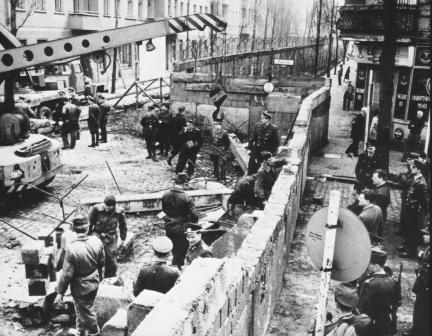
Construction of the Berlin Wall, photol collected by Corey S. Hatch

Construction of the Berlin Wall in August 1961 –photo from University of Utah, by Corey Hatch.

Update March 9, 2007: Berlin Airlift information and lesson plans are available from the Truman Library, here, here and here.

Update November 9, 2009: Notes on the 20th anniversary of the fall of the Wall

Please share this post:

Add to FacebookAdd to NewsvineAdd to DiggAdd to Del.icio.usAdd to StumbleuponAdd to RedditAdd to BlinklistAdd to TwitterAdd to TechnoratiAdd to Furl
