Typewriter of the moment: Mencken and the 1948 conventions

June 10, 2008


Mencken at 1948 Democratic Convention

Mencken at 1948 Democratic Convention

Photo from the collection of the School of Journalism and Mass Communication, at the Park Library, University of North Carolina.

H. L. Mencken at one of the 1948 political conventions (Thomas Dewey was the Republican nominee, Harry S. Truman was the Democratic nominee). Obviously the photo is a copy from the National Press Club Library. The Park Library site describes the photo and Mencken:

H. L. Mencken (1880-1956) was a familiar figure at many national political conventions. This photo, taken at the one in 1948, was his last political convention. He is well known for his attacks on American taste and culture, or the lack of same. His magnum opus, The American Language: An Inquiry into the Development of English in the United States, was first published in 1919 and remains a classic. From 1906 to 1941, he worked chiefly as a reporter, editor, and columnist for the Baltimore Sun. (Photo courtesy of the Baltimore Sun Library.)

Assuming Mencken covered both conventions, this photo was taken at the Democratic convention in Philadelphia in mid-July, 1948. We know it was taken in Philadelphia since both parties held their conventions there that year, the Republicans from June 21 to June 26, and the Democrats from July 12 to July 14.

Republicans nominated New York Gov. Thomas J. Dewey and California Gov. Earl Warren for president and vice president.

After a contentious convention that saw Minneapolis Mayor Hubert H. Humphrey propose a civil rights plank that got South Carolina Gov. Strom Thurmond to walk out of the convention and found his own States’ Rights (Dixiecrat) Party (with himself as the nominee for president), and former Vice President Henry Wallace walk out because the party platform was too conservative (Wallace ran on the Socialist Progressive Party ticket), Democrats nominated President Harry S Truman and Kentucky Sen. Alben W. Barkley for president and vice president. Truman narrowly defeated Georgia Sen. Richard B. Russell for the nomination. Had Thurmond not walked out, Truman may well have lost the nomination of his own party.

And the rest of the story?

  • Truman had a contentious second term, and was defeated in the New Hampshire primary in 1952 by Sen. Estes Kefauver; Truman ended his campaign for a second full term shortly after.
  • Earl Warren was appointed Chief Justice of the Supreme Court by Truman’s successor, President Dwight D. Eisenhower, in late 1953. Warren is remembered for engineering the 9-0 decision in Brown vs. Topeka Board of Education which ruled “separate but equal” school systems to violate the Constitution’s equal protection clause, and for his chairing the commission that investigated the assassination of President John F. Kennedy.
  • Hubert Humphrey moved on to the U.S. Senate, served as Vice President to Lyndon Johnson, and won the Democratic nomination for president in another contentious convention in 1968 in Chicago. Humphrey lost the election to Richard Nixon, and returned to the U.S. Senate two years later.
  • Strom Thurmond won election to the U.S. Senate in 1954, switching parties to Republican in 1964, and serving until his death in 2003.
  • Russell, who had served as Georgia’s senator since 1933, continued to serve to his death on January 21, 1971; he was a key member of the Warren Commission that investigated the assassination of President John F. Kennedy. The Russell Senate Office Building is named in his honor, the oldest of the three Senate office buildings.
  • Barkley was the oldest vice president ever inaugurated, aged 71. He remarried in his first year as vice president (his first wife died in 1947). Barkley’s nephew suggested that he should be called “the veep” because “Mr. Vice President” was too long. The title was seized up on by headline writers. Considered too old to run for the presidency in 1952, Barkley won a U.S. Senate seat from Kentucky in the 1954 elections, serving from 1955 to his death in 1956. Barkley Dam on the Cumberland River is named in his honor, as is the lake behind it, Lake Barkley.
  • Henry Wallace finished a distant fourth in the 1948 election, behind Dewey and Thurmond. His political career was essentially over due to his inability or unwillingness to disavow communist support. He achieved success as a chicken breeder. In a daramatic turnabout, he wrote a book, Where I Was Wrong, disavowing communism and critical of Joseph Stalin, and endorsed Republican candidates in 1956 and 1960. He died of Amyotrophic Lateral Sclerosis (ALS, or Lou Gehrig’s Disease) in 1965.
  • Dewey returned to his law practice. In 1952, Dewey helped engineer the nomination of Eisenhower over his old political nemesis Sen. Robert Taft of Ohio, pushed Richard Nixon as the Vice Presidential nominee, and in 1956 first convinced Ike to run again, and then to keep Nixon on the ticket. Dewey politely refused offers of offices, including refusing a nomination to the U.S. Supreme Court, sticking to his law practice which made him very wealthy. He died suddenly of a heart attack in 1971, at age 68.
  • Mencken suffered a stroke later in 1948 that left him unable to speak, or read, or write for a time. He spent much of the rest of his life working to organize his papers, and died in 1956. His epitaph, on his tombstone and on a plaque in the lobby of the Baltimore Sun, reads: “If, after I depart this vale, you ever remember me and have thought to please my ghost, forgive some sinner, and wink your eye at some homely girl.”

Bathtubs in the White House 15 years before Fillmore

January 8, 2008

Is this the information which confirms Mencken’s writing was really a hoax? Can we confirm there was a bathtub in the White House before Millard Fillmore got there?

America’s premier building historian, William Seale, lists a timeline at the White House Historical Association that shows showers and baths installed in the White House about 15 years before Millard Fillmore could have the chance:

Caption from Smithsonian: An 1830s hand pump shower similar to those once used in the White House bathing room. Smithsonian Institution

Caption from Smithsonian: An 1830s hand pump shower similar to those once used in the White House bathing room. Smithsonian Institution


Running water was introduced into the White House in 1833. Initially its purpose was to supply the house with drinking water and to fill reservoirs for protection against fire. An engineer named Robert Leckie built the system of reservoirs, pumps, and pipes that supplied the White House, and the Treasury, State, War, and Navy buildings with water. Very soon, a “bathing room” was established in the east wing to take advantage of the
fine water supply. The room featured a cold bath, a shower, and a hot bath heated by coal fires under large copper boilers.

Source: William Seale, The President’s House, 199-200. (Photo: Hand pump shower, similar to those installed in the 1830s White House; from the Smithsonian’s collection)

In 1833, Andrew Jackson started his second term.  Regardless when in 1833 that plumbing work was done, Jackson was the president.

Seale also has Franklin Pierce improving the plumbing upstairs, in the family quarters (which may be the source of Scholastic’s claim that Pierce put the first tub in):

The 1850s saw many improvements and expansions to the mansion’s existing conveniences. By this time many Americans who had gaslight wondered how they had ever lived without it. President Zachary Taylor ordered an enlargement of the gas system into the White House’s offices, family quarters, and basement. Millard Fillmore determined that the house should be comfortable in any season and had the heating system improved. The White House of Franklin Pierce came to represent the best domestic technology of its time (1853). The heating plant was modified again with the addition of a hot-water furnace that was more efficient and healthful because the air was warmed directly by coils rather than “cooked” from outside the air chamber. Pierce also made significant improvements to the plumbing and toilet facilities, including the installation of a bathroom on the second floor with the first permanent bathing facilities. The new bathroom was luxurious in having both hot and cold water piped in. Before 1853 bathing on the second floor required portable bathtubs, and kettles of hot water had to be hauled up from the existing east wing bathing room.

Source: William Seale, The President’s House, 283, 291, 315-16; and William Seale, The White House: The History of an American Idea, 90.

And wouldn’t you know it: Seale is a native of Beaumont, Texas. It takes a Texan to get the details to dispel these hoaxes.


A neglected anniversary

January 5, 2008

Gee, here’s one this blog really should be celebrating: December 28 was the 90th anniversary of the Mencken Fillmore Bathtub Hoax column.

According to the Associated Press, this the historic highlight for December 28:

On Dec. 28, 1917, the New York Evening Mail published “A Neglected Anniversary,” a facetious essay by H.L. Mencken supposedly recounting the history of bathtubs in America. (For example, Mencken “claimed” the first American bathtub made its debut in the Cincinnati home of grain dealer Adam Thompson on Dec. 20, 1842, and that the first White House bathtub was installed in 1851 at the order of President Millard Fillmore.)

We know Mencken was only foolin’.


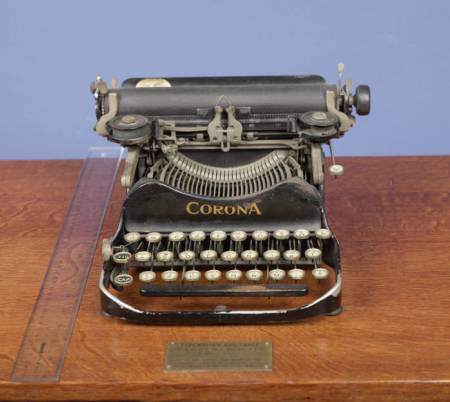
Mencken’s typewriter

January 10, 2007

Mencken's Corona Typewriter, Enoch Pratt Library

Mencken's Corona Typewriter, at the Mencken Room in the Enoch Pratt Library, Baltimore, Maryland

The typewriter that belonged to H. L. Mencken. Photo by the Enoch Pratt Free Library, Baltimore, Maryland. [Update, April 15, 2007: The photo has moved, and is restricted by copyright; you may follow the links to view the original photo of the typewriter, at the site of the Enoch Pratt Free Library. E.D.]

Was this the machine upon which Mencken composed the Millard Fillmore/Bathtub hoax?  Perhaps.  It was used prior to 1930.


Millard Fillmore’s Bathtub?

July 3, 2006

History is a study of what happened and why. Often, high school and college studies of history are ruined by rote memorization of a long list of dates with a couple of words describing an event. That is not history. Often, studies of history are ruined through unreliable sources.

H. L. Mencken, the famous newspaper columnist from Baltimore, wrote a column published December 28, 1917, about the history of the bathtub, specifically that it was rare in the U.S., and how President Millard Fillmore introduced it to the White House, thereby making bathtubs and bathing popular. The column was brilliant, and it was a complete fabrication, a hoax. Within two years, however, Mencken’s column had found its way to reference books, encyclopedias, and bad history books. Here is Mencken’s original column: “A Neglected Anniversary.”  [3/19/2009 – that link is dead; see Mencken’s column here.]  You can read a history of the hoax and its spread at this site, Millard Fillmore’s Bathtub.

It’s a great story, about a do-nothing president, the press, and errors of history. To know the story, dates are unimportant. No one cares what years Fillmore was actually in office, no one cares exactly when Mencken’s column was published. Knowing lists of dates has never stopped a bad historian from reciting the erroneous claim that Millard Fillmore introduced the concept of bathing in a bathtub to the White House.

But now you know better.

This site is dedicated to knowing history, especially U.S. history, better.

Thank you for visiting. Noodle around, see what articles are here, leave some comments if you care to. Especially, if you find errors, leave a note of correction.