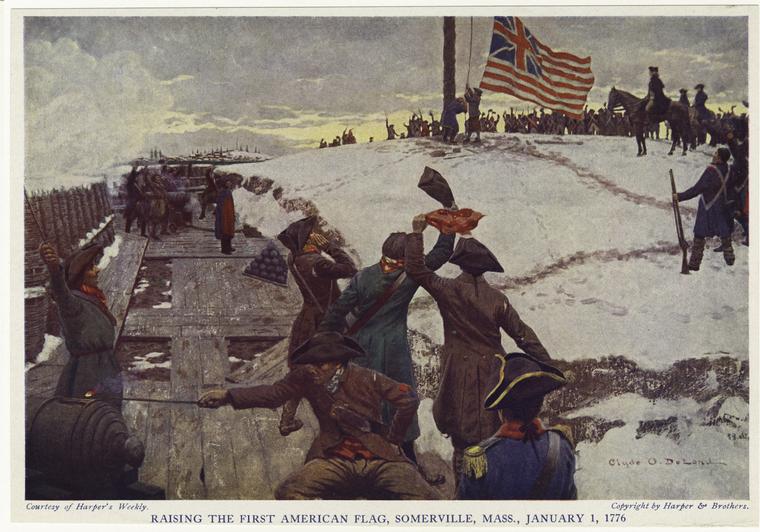
“Raising the first American flag, Somerville, Mass., January 1, 1776.” Harper’s Weekly painting by Clyde Osmer DeLand, 1897. From the digital collections of the New York Public Library
January is loaded with flag flying dates, when we add in statehood days, dates those states are invited to fly their U.S. flags.
In January 2016, the U.S. Flag Code urges citizens to fly flags on these dates, listed chronologically:
New Year’s Day, January 1, a federal holiday
January 2, Georgia Statehood Day
January 3, Alaska Statehood Day
January 4, Utah Statehood Day
January 6, New Mexico Statehood Day
January 9, Connecticut Statehood Day
Martin Luther King’s Birthday, a federal holiday on the third Monday of January; that date is January 18, in 2016; King’s actual birthday is January 15, and you may fly your flag then, too
Inauguration Day, January 20, the year after election years (next one in 2017)
January 26, Michigan Statehood Day
January 29, Kansas Statehood Day
You may fly your flag any other day you wish, too; flags should not be flown after sundown unless they are specially lighted, or at one of the few places designated by Congress or Presidential Proclamation for 24-hour flag flying. According to Wikipedia’s listing, those sites include:
Fort McHenry, Baltimore, Maryland (Presidential Proclamation No. 2795, July 2, 1948).
Flag House Square, Albemarle and Pratt Streets, Baltimore, Maryland (Public Law 83-319, approved March 26, 1954).
Lexington Battle Green, Lexington, Massachusetts (Public Law 89-335, approved November 8, 1965).
White House, Washington, D.C. (Presidential Proclamation No. 4000, September 4, 1970).
Washington Monument, Washington, D.C. (Presidential Proclamation No. 4064, July 6, 1971, effective July 4, 1971).
Any port of entry to the United States which is continuously open (Presidential Proclamation No. 413 1, May 5, 1972).
Grounds of the National Memorial Arch in Valley Forge State Park, Valley Forge, Pennsylvania (Public Law 94-53, approved July 4, 1975).
Flag House in 1936, where Mary Pickersgill sewed the garrison-sized, 15-star flag that flew over Fort McHenry at the Battle of Baltimore in 1814; one of the sites where the U.S. flag may be flown 24 hours. The house is at 844 East Pratt & Albemarle Streets (Baltimore, Independent City, Maryland). Cropped image courtesy of the federal HABS—Historic American Buildings Survey of Maryland.
Spread the word; friends don't allow friends to repeat history.
Fighting malaria is difficult, and complex, and expensive. No magic bullet can slow or stop malaria.
Reasonable people understand the stakes, not only for Africa, where $12 billion is lost every year to malaria illness and death, according to WHO records; but also for all nations who trade with Africa and other malaria endemic nations in the world.
What should we do about malaria?
Before we leap to solutions, let us look to see what the United States is already doing, according to USAID, the agency which has led U.S. malaria-fighting since the 1950s.
Each year, malaria causes about 214 million cases and an estimated 438,000 deaths worldwide
While malaria mortality rates have dropped by 60 percent over the period 2000–2015, malaria remains a major cause of death among children. Although the disease is preventable and curable, it is estimated that a child dies every minute from malaria. In Asia and the Americas, malaria causes fewer severe illnesses and deaths, but antimalarial drug resistance is a serious and growing problem.
The U.S. Agency for International Development (USAID) has been committed to fighting malaria since the 1950s. Malaria prevention and control remains a major U.S. foreign assistance objective and supports the U.S. Government’s vision of ending preventable child and maternal deaths and ending extreme poverty. USAID works closely with national governments to build their capacity to prevent and treat the disease. USAID also invests in the discovery and development of new antimalarial drugs and malaria vaccines. USAID-supported malaria control activities are based on country-level assessments, and a combination of interventions are implemented to achieve the greatest public health impact – most importantly the reduction of maternal and child mortality. These interventions include:
Indoor residual spraying (IRS): IRS is the organized, timely spraying of an insecticide on the inside walls of houses or dwellings. It kills adult mosquitoes before they can transmit malaria parasites to another person.
Insecticide-treated mosquito nets (ITNs): An insecticide-treated mosquito net hung over sleeping areas protects those sleeping under it by repelling mosquitoes and killing those that land on it.
Intermittent preventive treatment for pregnant women (IPTp): Approximately 125 million pregnant women annually are at risk of contracting malaria. IPTp involves the administration of at least two doses of an antimalarial drug to a pregnant woman, which protects her against maternal anemia and reduces the likelihood of low birth weight and perinatal death.
Diagnosis and treatment with lifesaving drugs: Effective case management entails diagnostic testing for malaria to ensure that all patients with malaria are properly identified and receive a quality-assured artemisinin-based combination therapy (ACT).
The President’s Malaria Initiative (PMI) works in 19 focus countries in sub-Saharan Africa and the Greater Mekong Subregion in Asia. PMI is an interagency initiative led by USAID and implemented together with the U.S. Centers for Disease Control and Prevention. In 2015, PMI launched its next 6-year strategy for 2015–2020, which takes into account the progress over the past decade and the new challenges that have arisen. It is also in line with the goals articulated in the Roll Back Malaria (RBM) Partnership’s second generation global malaria action plan, Action and Investment to Defeat Malaria (AIM) 2016–2030: for a Malaria-Free World [PDF, 18.6MB] and The World Health Organization’s (WHO’s) updated Global Technical Strategy: 2016–2030 [PDF, 1.0MB]. The U.S. Government’s goal under the PMI Strategy 2015-2020 [PDF, 8.9MB] is to work with PMI-supported countries and partners to further reduce malaria deaths and substantially decrease malaria morbidity, toward the long-term goal of elimination. USAID also provides support to malaria control efforts in other countries in Africa, including Burkina Faso, Burundi and South Sudan, and one regional program in the Amazon Basin of South America. The latter program focuses primarily on identifying and containing antimalarial drug resistance.
Do you think the U.S. spends too much on foreign aid, even good aid to fight malaria? How much do you think is spent? Put your estimate in comments, please — and by all means, look for sources to see what the actual amount is.
Spread the word; friends don't allow friends to repeat history.
Between Christmas and New Year’s Day, here at Millard Fillmore’s Bathtub we celebrate a variety of historically holy days. December 31, by tradition, is Bright Idea Day, the anniversary of the day Thomas Edison demonstrated for the public a working light bulb, in 1879.
100,000 people gather in Times Square, New York City (surely not the 1 million predicted by NBC!) tonight, and millions more around the world, in festivities for the new year made possible by the work of Thomas Alva Edison.
Here it is, the invention that stole sleep from our grasp, made clubbing possible, and launched 50,000 cartoons about ideas:
The light bulb Thomas Edison demonstrated on December 31, 1879, at Menlo Park, New Jersey – Wikimedia image (GFDL)
The light bulb. It’s an incandescent bulb.
It wasn’t the first bulb. Edison a few months earlier devised a bulb that worked with a platinum filament. Platinum was too expensive for mass production, though — and Edison wanted mass production. So, with the cadre of great assistants at his Menlo Park laboratories, he struggled to find a good, inexpensive filament that would provide adequate life for the bulb. By late December 1879 they had settled on carbon filament.
Edison invited investors and the public to see the bulb demonstrated, on December 31, 1879.
Thomas Edison in 1878, the year before he demonstrated a workable electric light bulb. CREDIT: Thomas Edison, head-and-shoulders portrait, facing left, 1880. Prints and Photographs Division, Library of Congress. Reproduction number LC-USZ62-98067
Edison’s successful bulb indicated changes in science, technology, invention, intellectual property and finance well beyond its use of electricity. For example:
Edison’s Menlo Park, New Jersey, offices and laboratory were financed with earlier successful inventions. It was a hive of inventive activity aimed to make practical inventions from advances in science. Edison was all about selling inventions and rights to manufacture devices. He always had an eye on the profit potential. His improvements on the telegraph would found his laboratory he thought, and he expected to sell the device to Western Union for $5,000 to $7,000. Instead of offering it to them at a price, however, he asked Western Union to bid on it. They bid $10,000, which Edison gratefully accepted, along with the lesson that he might do better letting the marketplace establish the price for his inventions. Other inventive labs followed Edison’s example, such as the famous Bell Labs, but few equalled his success, or had as much fun doing it. (Economics teachers: Need an example of the marketplace in action?)
Edison didn’t invent the light bulb — but his improvements on it made it commercial. “In addressing the question ‘Who invented the incandescent lamp?’ historians Robert Friedel and Paul Israel list 22 inventors of incandescent lamps prior to Joseph Wilson Swan and Thomas Edison. They conclude that Edison’s version was able to outstrip the others because of a combination of three factors: an effective incandescent material, a higher vacuum than others were able to achieve (by use of the Sprengel pump) and a high resistance lamp that made power distribution from a centralized source economically viable.”
Look around yourself this evening, and you can find a score of ways that Edison’s invention and its descendants affect your life. One of the more musing effects is in cartooning, however. Today a glowing lightbulb is universally accepted as a nonverbal symbol for ideas and inventions. (See Mark Parisi’s series of lightbulb cartoons, “Off the Mark.”)
Even with modern, electricity-saving bulbs, the cartoon shorthand hangs on, as in this Mitra Farmand cartoon.
Brilliant cartoon from Mitra Farmand, Fuffernutter (regrettably, we note this site is no longer there; but with some hope, we find a new site here)
Or see this wonderful animation, a video advertisement for United Airlines, by Joanna Quinn for Fallon — almost every frame has the symbolic lightbulb in it.
Electrification of America, and the consequent spread of electric lighting and electrical machines to make domestic and industrial life more productive, and the spread of great public works to enable these and other inventions to spread, were made possible by a people roughly united in advancing progress, what historians now call “the progressive agenda” and the great advances of the Progressive Era.
Could we get such agreement among workers, corporate bosses and many levels of government today? When we celebrate anniversaries, like the demonstration of the light bulb, we celebrate the united polity that made such things possible, too.
Thomas Edison’s electric lamp patent drawing and claim for the incandescent light bulb CREDIT: “New Jersey–The Wizard of Electricity–Thomas A. Edison’s System of Electric Illumination,” 1880. Prints and Photographs Division, Library of Congress. Reproduction Number LC-USZ62-97960.
[Today is actually the day! You may fly your flag if you choose. This is the traditional Millard Fillmore’s Bathtub Hubble Day post.]
Lift a glass of champagne today in tribute to Edwin Hubble and his great discovery. Not sure what to call it — Hubble Day, Looking Up Day, Endless Possibilities Day — whatever, this is the anniversary of Edwin Hubble’s announcement that he had discovered the universe is much, much larger than anyone had imagined, containing far more stars than anyone had dared guess.
It’s a big universe out there.
Ultraviolet image of the Andromeda Galaxy. Wired caption: “Photo: Edwin Hubble’s 1920s observations of Andromeda (whose ultraviolet spectrum is rendered here) expanded our notions of the size and nature of a universe that is itself expanding. Galaxy Evolution Explorer image courtesy NASA.”
So, today is a good day to celebrate the universe in all it’s glory – December 30.
On December 30, 1924, Edwin Hubble announced he’d discovered other galaxies in distant space. Though it may not have been so clear at the time, it meant that, as a galaxy, we are not alone in the universe (whether we are alone as intelligent life is a separate question). It also meant that the universe is much, much bigger than most people had dared to imagine.
Hubble was the guy who showed us the universe is not only bigger than we imagined, it’s probably much bigger and much more fantastic than we can imagine. (See J. B. S. Haldane’s “queerer” quote.) Hubble is the guy who opened our imaginations to the vastness of all creation.
Hubble’s work would have been impossible without the earlier work of one of the great, unsung women of science, Henrietta Leavitt, as Wired explained:
He trained the powerful new 100-inch telescope at Mount Wilson in Southern California on spiral nebulae. These fuzzy patches of light in the sky were generally thought to be clouds of gas or dust within our galaxy, which was presumed to include everything in the universe except the Magellanic Clouds. Some nebulae seemed to contain a few stars, but nothing like the multitudes of the Milky Way.
Hubble not only found a number of stars in Andromeda, he found Cepheid variable stars. These stars vary from bright to dim, and a very smart Harvard computationist named Henrietta Leavitt had discovered in 1912 that you could measure distance with them. Given the brightness of the star and its period — the length of time it takes to go from bright to dim and back again — you could determine how far away it is.
Hubble used Leavitt’s formula to calculate that Andromeda was approximately 860,000 light years away. That’s more than eight times the distance to the farthest stars in the Milky Way. This conclusively proved that the nebulae are separate star systems and that our galaxy is not the universe.
How does one celebrate Hubble Day? Here are some suggestions:
Easier than Christmas cards: Send a thank-you note to your junior high school science teacher, or whoever it was who inspired your interest in science. Mrs. Hedburg, Mrs. Andrews, Elizabeth K. Driggs, Herbert Gilbert, Mr. Willis, and Stephen McNeal, thank you.
Rearrange your Christmas/Hanukkah/Eid/KWANZAA lights in the shape of the Andromeda Galaxy — or in the shape of any of the great photos from the Hubble Telescope (Andromeda Galaxy pictured above; Hubble images here)
Spend two hours in your local library, just looking through the books on astronomy and the universe
Write a letter to your senators and congressman; tell them space exploration takes a minuscule portion of our federal budget, but it makes us dream big; tell them we need to dream big, and so they’d better make sure NASA is funded well. While you’re at it, put in a plug for funding Big Bird and the rest of public broadcasting, too. Science education in this nation more and more becomes the science shows on NPR and PBS, watched by kids who learned to read and think by watching Big Bird.
Anybody got a good recipe for a cocktail called “The Hubble?” “The Andromeda?” Put it in the comments, please. “The Hubble” should have bubbles in it, don’t you think? What was it the good monk said? He was working to make great wine, but goofed somewhere, and charged the wine with another dose of yeast. When he uncorked the very first bottle of what would come to be called champagne, Benedictine Monk Dom Pierre Perignon said “I am drinking stars!” Except, he said it in French. In any case, a Hubble cocktail should have bubbles, some of Perignon’s stars.
In 1924, he announced the discovery of a Cepheid, or variable star, in the Andromeda Nebulae. Since the work of Henrietta Leavitt had made it possible to calculate the distance to Cepheids, he calculated that this Cepheid was much further away than anyone had thought and that therefore the nebulae was not a gaseous cloud inside our galaxy, like so many nebulae, but in fact, a galaxy of stars just like the Milky Way. Only much further away. Until now, people believed that the only thing existing outside the Milky Way were the Magellanic Clouds. The Universe was much bigger than had been previously presumed.
Later Hubble noted that the universe demonstrates a “red-shift phenomenon.” The universe is expanding. This led to the idea of an initial expansion event, and the theory eventually known as Big Bang.
Hubble’s life offered several surprises, and firsts:
Hubble was a tall, elegant, athletic, man who at age 30 had an undergraduate degree in astronomy and mathematics, a legal degree as a Rhodes scholar, followed by a PhD in astronomy. He was an attorney in Kentucky (joined its bar in 1913), and had served in WWI, rising to the rank of major. He was bored with law and decided to go back to his studies in astronomy.
In 1919 he began to work at Mt. Wilson Observatory in California, where he would work for the rest of his life. . . .
Hubble wanted to classify the galaxies according to their content, distance, shape, and brightness patterns, and in his observations he made another momentous discovery: By observing redshifts in the light wavelengths emitted by the galaxies, he saw that galaxies were moving away from each other at a rate constant to the distance between them (Hubble’s Law). The further away they were, the faster they receded. This led to the calculation of the point where the expansion began, and confirmation of the big bang theory. Hubble calculated it to be about 2 billion years ago, but more recent estimates have revised that to 20 billion years ago.
An active anti-fascist, Hubble wanted to joined the armed forces again during World War II, but was convinced he could contribute more as a scientist on the homefront. When the 200-inch telescope was completed on Mt. Palomar, Hubble was given the honor of first use. He died in 1953.
“Equipped with his five senses, man explores the universe around him and calls the adventure Science.”
(Does anyone have a suitable citation for that video? Where did it come from? Who produced it? Is there more somewhere?)
Happy Hubble Day! Look up!
Resources:
Journey to Palomar site (production currently being broadcast on PBS affiliates – wonderful story of George Ellery Hale and the origins of modern astronomy at Palomar; that’s where Hubble worked)
Andromeda as we can see it today. Wikimedia image: The Andromeda Galaxy is a spiral galaxy approximately 2.5 million light-years away in the constellation Andromeda. The image also shows Messier Objects 32 and 110, as well as NGC 206 (a bright star cloud in the Andromeda Galaxy) and the star Nu Andromedae. This image was taken using a hydrogen-alpha filter.
Yes, this is mostly an encore post. Fighting ignorance requires patience.
Spread the word; friends don't allow friends to repeat history.
On December 30, 1924, Edwin Hubble announced he’d discovered other galaxies in distant space. Though it may not have been so clear at the time, it meant that, as a galaxy, we are not alone in the universe (whether we are alone as intelligent life is a separate question). It also meant that the universe is much, much bigger than most people had dared to imagine.
December 30, 2015 is the 91st anniversary of the announcement. When dealing with general science illiteracy, it’s difficult to believe we’ve been so well informed for more than nine decades. In some quarters, news travels more slowly than sound in the vacuum of space.
I find hope in many places. Just three years ago the Perot Museum of Nature and Science opened in downtown Dallas. It’s the old Dallas Museum of Science and Natural History, once cramped into a bursting building in historic Fair Park, now expanded into a beautiful new building downtown, and keeping the Fair Park building, too. Considering the strength of creationism in Texas, it’s great news that private parties would put up $185 million for a museum dedicated to hard science.
Displays in the Perot border on brilliance at almost every stop. Stuffy museum this is not — it’s designed to spark interest in science and engineering in kids, and I judge that it succeeds, though we need to wait 20 years or so to see just exactly what and who it inspires.
We visited the Perot regularly through 2014. On one visit in 2012, as I was admiring a large map of the Moon, a family strolled by, and a little girl I estimated to be 8 or 9 pointed to the Moon and asked her maybe-30-something father where humans landed. I had been working to see whether the very large photo showed any signs of activity — but the father didn’t hesitate, and pointed to the Sea of Tranquility. “There,” he said. The man was not old enough to have been alive at the time; I’d wager most of my contemporaries would hesitate, and maybe have to look it up. Not that guy.
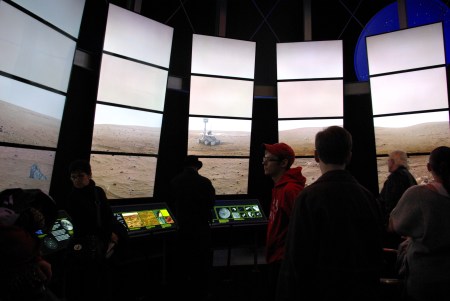
On 32 flat-panel video displays hooked together to make one massive display, visitors to the Perot Museum of Nature and Science view Mars as our new Mars Rover’s friend might see it, in a section of the museum devoted to astronomy, physics, astronomy and planetary exploration. Photo by Ed Darrell; use encouraged with attribution.
Still, kids today need this museum and the knowledge and excitement it imparts. One recent July I accompanied a group of Scouts from Troop 355 to summer camp in Colorado, to Camp Chris Dobbins in the foothills just east of Colorado Springs. Near lights out one night I hiked the half-mile to our campsite admiring the Milky Way and other bright displays of stars that we simply do not get in light-polluted Dallas County. I expected that our older Scouts would have already started on the Astronomy merit badge, but the younger ones may not have been introduced. So I asked how many of them could find the Milky Way. Not a hand went up.
“Dowse the lights, let’s have a five minute star lesson,” I said. we trekked out to a slight opening in the trees, and started looking up. I had just enough time to point out the milky fog of stars we see of our own galaxy, when one of the Scouts asked how to tell the difference between an airplane and a satellite. Sure enough, he’d spotted a satellite quietly passing overhead — and just to put emphasis on the difference, a transcontinental jet passed over flying west towards Los Angeles or San Francisco.
Then, when we were all looking up, a meteoroid streaked from the south across almost the whole length of the visible Milky Way. Teenage kids don’t often go quiet all at once, but after the oohs and aahs we had a few moments of silence. They were hooked already. Less than five minutes in, they’d seen the Milky Way, found the Big Dipper, seen a satellite, a jet, and a shooting star.
Perfection!
Edwin Hubble’s discovery can now be the stuff of elementary school science, that the blobs in the sky astronomers had pondered for a century were really galaxies like our own, which we see only through a faint fuzz we call the Milky Way.
Do kids get that kind of stuff in elementary school? Not enough, I fear.
We named a great telescope after the guy; shouldn’t we do a bit more to celebrate his discovery?
It’s Texas Statehood day, the 170th anniversary of Texas joining the Union — or as some Texans prefer, the anniversary of Texas’s making America great.
According to the U.S. flag code, people should fly their U.S. flags on their state’s statehood day.
Not many Texans are, if any. Can you find someone honoring statehood day?
U.S. and Texas flags at the Texas Capitol – photo: jmtimages
170 years ago today: Rub your pet armadillo’s belly, slaughter the fatted longhorn, crank up the barbecue pit with the mesquite wood, put Willie Nelson and Bob Wills on the mp3 player, put the “Giant” DVD on the television, and raise your glass of Big Red, Dr. Pepper, or Lone Star Beer (or Pearl, or Shiner Bock, Sir Williams English Brown Ale, or Llano Wine).
Texas was admitted to the union of the United States of America on December 29, 1845.
President Polk’s Authorization to affix the Great Seal to Texas Statehood documents – Texas Memorial Museum, University of Texas at Austin
The text of Polk’s message:
I hereby authorize and direct the Secretary of State to affix the Seal of the United States to an authenticated copy of “an act to extend the laws of the United States over the State of Texas and for other purposes” approved Dec. 29, 1845 dated this day, and signed by me and for so doing this shall be his warrant.
Great Seal of the United States of America, affixed to the Texas Statehood Proclamation – image from State Archives Division, Texas State Library
Resources:
“Annexation – Celebrating 150 years of statehood,” at Humanities Interactive, Texas Council for the Humanities Resource Center (this page is difficult to find if you just go to the Humanities Interactive site — bookmark it!)
Daughters of the Republic of Texas site, with this reminder: Texas Statehood Day [February 19, 1846] (Texas wouldn’t take “yes” for an answer then, either.) “The legal entry of Texas into the Union was 29 December 1845, but the decade-old Republic of Texas did not formally transfer the authority to the new State of Texas until 19 February 1846.The Texans had until the end of the year in 1845 to accept the annexation as one of the states of the United States of America. They waited until 29 December 1845 to accept the terms, independent to the end. The formal transfer of authority from the Republic of Texas took place 19 February 1846 at the log capitol in Austin with President Anson Jones presiding. On this day we celebrate the end of the Republic of Texas.”
In education we miss out on most information technological innovation. Textbooks were notoriously dull when books were the chief medium found in schools. Schools took 60 years to make progress in showing film. Television, which started out commercially as a great education tool — what was arguably the best orchestra in the U.S. used to play every Sunday on NBC way back when. Then video, then computers, then the internet and personal data devices penetrated modern life, but not yet schools.
So I am always pleased to hear after Christmas break the questions high school economics and history students came back to class with, especially after “having to watch” that hoary and venerable old movie, “It’s a Wonderful Life.” Frank Capra’s film cuts through the fog on some important history and economics issues.
Not that you find it used much in U.S. schools. What follows is a blog post I did for my U.S. history blog some years back, to answer some of those student questions.
George Bailey (played by actor Jimmy Stewart) works to deal with a run on the Bailey Savings & Loan Association in Bedford Falls, New York — a classic “run on the bank” — in the 1946 movie, “It’s a Wonderful Life,” by Frank Capra. Image from Warner Bros., via Our Values blog.
“What’s a bank run?”
Whenever we get to the Great Depression, somebody asks about bank runs. What is a “run on the bank?” Why would people suddenly rush to get their cash out of the bank? And why can’t the bank just pay it out?
Frank Capra showed and explained it best, probably, in his 1946 film, “It’s a Wonderful Life.” But first, my weak attempt:
Banks don’t keep all the money deposited there in the vault. Banks make money by loaning out to others the money put on deposit. The people who get the loans must pay interest on the loan, and that allows the bank to pay interest on the deposits people put there (precious little today — my first account paid 5.25% on my first $5.00 deposit; today you’re lucky to get 1%, and you have to have a sizable minimum, generally. But I digress . . .).
So, if you and a hundred other people each deposit $100 in the bank, the bank turns around and loans out as much as they can. Of the $10,000 deposited, say, they loan out $9,000 to the guy who lives next door to you, so he can put an addition on his house. He’ll pay it back, with interest.
But, that loan means that there is only $1,000 left in the vault. Generally a 10% “reserve” will cover all the cash transactions a bank makes in a day. That is, if they have 10% of their total assets sitting in the vault, making no new money for them, it is highly unlikely that in a normal day there will be a demand for more than about $1,000 of that $10,000 on deposit. (The actual reserve amounts vary; last time I looked, several months ago, the Federal Reserve Board required member banks to hold about 7% of their total assets in cash on hand.)
You can begin to see why a bank run is a problem. If, in one day, every depositor showed up and demanded their deposit, the bank couldn’t pay them all. This is a death sentence in the banking world, for a bank to be unable to meet obligations, and generally that would mean that the bank would be out of business. But of course, that’s rather unfair to the bank — they have their money (your money, really) loaned out to dozens of other people. When those loans come in, the bank will have the cash to pay.
A run on the bank puts a kink in those careful, conservative calculations of how much cash a bank needs to have on hand to cover all the transactions of a day.
Banks fear a run. That’s what killed banks in 1932 and 1933, in the last year of the Hoover administration. Even a good bank could be doomed by an unjustified run — no bank could repay all of its depositors, in cash, on any one day.
Roosevelt’s bank holiday, just a week after his inauguration, stopped the runs for that week. The Federal Deposit Insurance Corporation (FDIC) insured deposits, so that even were there a run on a bank, a depositor could get his or her money back. Those measures essentially stopped runs on banks for decades.
Frank Capra’s 1946 movie, “It’s a Wonderful Life,” tells the story of a man who manages a small town savings and loan association, which is similar to a bank in that it accepts deposits and loans money, but different from a bank in that it is chartered for the benefit of its depositors, or members, and not for a bank corporation. In fact, the antagonist in the film is the town banker, Potter, who does what he can to bring the savings and loan to ruin.
In one memorable scene, a rumor that the savings and loan is about to fail prompts dozens of the members to make a run — indeed, there is also a run on the bank at the same time. Jimmy Stewart explains to the members why he can’t pay everybody . . . but he also has an infusion of $2,000 cash he plans to cash for his honeymoon. This is what a bank run looks like, with a smart banker (savings and loan manager in this case) who can keep his organization going:
This film clip is undoubtedly copyrighted by the current owners of the film’s intellectual property. I wish they would make it available for classroom use without heavy copyright fees, in the interest of the public.
It’s another case of a fictional film portraying history better than any history book, and economics, too. Licensing the film for classroom use costs more than teachers can pay — plus, in the dog-eat-teachers world of the War on Education, few administrators stand the use of fiction in history and economics classes. That’s before a teacher even gets to the issue of whether there is technical support to show the film.
Save
Spread the word; friends don't allow friends to repeat history.
In 1823, the poem “Account of a Visit from St. Nicholas” was published anonymously in the Troy (N.Y.) Sentinel; the verse, more popularly known as “‘Twas the Night Before Christmas,” was later attributed to Clement C. Moore.
Regardless who wrote the poem first published 192 years ago yesterday, how did the poem influence America’s view of St. Nicholas, or Santa Claus? And how much of the Santa Claus story really was invented in America?
Thomas Nast invented Santa Claus? Clement C. Moore didn’t write the famous poem that starts out, “‘Twas the night before Christmas, and all through the house . . . ?”
The murky waters of history from Millard Fillmore’s Bathtub soak even our most cherished ideas and traditions.
Isn’t that part of the fun of history?
In Janaury 1863, Thomas Nast portrayed Santa Claus as he delivered gifts to Union troops a few days earlier in Washington, D.C., wearing a blue, star-spangled coat.
Yes, Virginia (and California, too)! Thomas Nast created the image of Santa Claus most of us in the U.S. know today. Perhaps even more significant than his campaign against the graft of Boss Tweed, Nast’s popularization of a fat, jolly elf who delivers good things to people for Christmas makes one of the great stories in commercial illustration. Nast’s cartoons, mostly for the popular news publication Harper’s Weekly, created many of the conventions of modern political cartooning and modeled the way in which an illustrator could campaign for good, with his campaign against the graft of Tammany Hall and Tweed. But Nast’s popular vision of Santa Claus can be said to be the foundation for the modern mercantile flurry around Christmas.
Nast’s drawings probably drew some inspiration from the poem, “Account of a Visit from St. Nicholas,” traditionally attributed to Clement C. Moore, a New York City lawyer, published in 1822. The poem is among the earliest to describe the elf dressed in fur, and magically coming down a chimney to leave toys for children; the poem invented the reindeer-pulled sleigh.
Modern analysis suggests the poem was not the work of Moore, and many critics and historians now attribute it to Major Henry Livingston, Jr. (1748-1828) following sleuthing by Vassar College Prof. Don Foster in 2000. Fortunately for us, we do not need to be partisans in such a query to enjoy the poem (a complete copy of which is below the fold).
The Library of Congress still gives Moore the credit. When disputes arise over who wrote about the night before Christmas, is it any wonder more controversial topics produce bigger and louder disputes among historians?
Moore is thought to have composed the tale, now popularly known as “The Night Before Christmas,” on December 24, 1822, while traveling home from Greenwich Village, where he had bought a turkey for his family’s Christmas dinner.
Inspired by the plump, bearded Dutchman who took him by sleigh on his errand through the snow-covered streets of New York City, Moore penned A Visit from St. Nicholas for the amusement of his six children, with whom he shared the poem that evening. His vision of St. Nicholas draws upon Dutch-American and Norwegian traditions of a magical, gift-giving figure who appears at Christmas time, as well as the German legend of a visitor who enters homes through chimneys.
Again from the Library of Congress, we get information that suggests that Moore was a minor celebrity from a well-known family with historical ties that would make a good “connections” exercise in a high school history class, perhaps (”the link from Aaron Burr’s treason to Santa Claus?”): (read more, below the fold)
Clement Moore was born in 1779 into a prominent New York family. His father, Benjamin Moore, president of Columbia University, in his role as Episcopal Bishop of New York participated in the inauguration of George Washington as the nation’s first president. The elder Moore also administered last rites to Alexander Hamilton after he was mortally wounded in a tragic duel with Aaron Burr.
A graduate of Columbia, Clement Moore was a scholar of Hebrew and a professor of Oriental and Greek literature at the General Theological Seminary in Manhattan. [See comment from Pam Bumsted below for more on Moore.] He is said to have been embarrassed by the light-hearted verse, which was made public without his knowledge in December 1823. Moore did not publish it under his name until 1844.
Tonight, American children will be tucked in under their blankets and quilts and read this beloved poem as a last “sugarplum” before slipping into dreamland. Before they drift off, treat them to a message from Santa, recorded by the Thomas Edison Company in 1922.
But Henry Livingston was no less noble or historic. He hailed from the Livingstons of the Hudson Valley (one of whose farms is now occupied by Camp Rising Sun of the Louis August Jonas Foundation, a place where I spent four amazing summers teaching swimming and lifesaving). Livingston’s biography at the University of Toronto site offers another path for a connections exercise (”What connects the Declaration of Independence, the American invasion of Canada, the famous poem about a visit from St. Nick, and George W. Bush?”):
Henry Livingston Jr. was born in Poughkeepsie, New York, on Oct. 13, 1748. The Livingston family was one of the important colonial and revolutionary families of New York. The Poughkeepsie branch, descended from Gilbert, the youngest son of Robert Livingston, 1st Lord of Livingston Manor, was not as well off as the more well-known branches, descended from sons Robert and Philip. Two other descendants of Gilbert Livingston, President George Walker Herbert Bush and his son, President-Elect George W. Bush, though, have done their share to bring attention to this line. Henry’s brother, Rev. John Henry Livingston, entered Yale at the age of 12, and was able to unite the Dutch and American branches of the Dutch Reformed Church. At the time of his death, Rev. Livingston was president of Rutgers University. Henry’s father and brother Gilbert were involved in New York politics, and Henry’s granduncle was New York’s first Lt. Governor. But the law was the natural home for many of Henry’s family. His brother-in-law, Judge Jonas Platt, was an unsuccessful candidate for governor, as was his daughter Elizabeth’s husband, U.S. Supreme Court Justice Smith Thompson. Henry’s grandson, Sidney Breese, was Chief Justice of the Illinois Supreme Court.
Known for his encyclopedic knowledge and his love of literature, Henry Livingston was a farmer, surveyor and Justice of the Peace, a judicial position dealing with financially limited criminal and civil cases. One of the first New Yorkers to enlist in the Revolutionary Army in 1775, Major Henry Livingston accompanied his cousin’s husband, General Montgomery, in his campaign up the Hudson River to invade Canada, leaving behind his new wife, Sarah Welles, and their week-old baby, on his Poughkeepsie property, Locust Grove. Baby Catherine was the subject of the first poem currently known by Major Livingston. Following this campaign, Livingston was involved in the War as a Commissioner of Sequestration, appropriating lands owned by British loyalists and selling them for the revolutionary cause. It was in the period following Sarah’s early death in 1783, that Major Livingston published most of his poems and prose, anonymously or under the pseudonym of R. Ten years after the death of Sarah, Henry married Jane Patterson, the daughter of a Dutchess County politician and sister of his next-door neighbor. Between both wives, Henry fathered twelve children. He published his good-natured, often occasional verse from 1787 in many journals, including Political Barometer, Poughkeepsie Journal, and New-York Magazine. His most famous poem, “Account of a Visit from St. Nicholas,” was until 2000 thought to have been the work of Clement Clarke Moore (1779-1863), who published it with his collected poems in 1844. Livingston died Feb. 29, 1828.
Thomas Nast’s full realization of Santa Claus, “Merry Old Santa Claus,” January 1, 1881. Harper’s Weekly, from the Ohio State University Billy Ireland Cartoon Library and Museum, via Bill Cassellman’s site
Our views of Santa Claus owe a great deal also to the Coca-Cola advertising campaign. Coca-Cola first noted Santa’s use of the drink in a 1922 campaign to suggest Coke was a year-round drink (100 years after the publication of Livingston’s poem). The company’s on-line archives gives details:
In 1930, artist Fred Mizen painted a department store Santa in a crowd drinking a bottle of Coke. The ad featured the world’s largest soda fountain, which was located in the department store of Famous Barr Co. in St. Louis, Mo. Mizen’s painting was used in print ads that Christmas season, appearing in The Saturday Evening Post in December 1930.
1936 Coca-Cola Santa cardboard store display
1942 original oil painting – ‘They Remembered Me’
Archie Lee, the D’Arcy Advertising Agency executive working with The Coca-Cola Company, wanted the next campaign to show a wholesome Santa as both realistic and symbolic. In 1931, The Coca-Cola Company commissioned Michigan-born illustrator Haddon Sundblom to develop advertising images using Santa Claus — showing Santa himself, not a man dressed as Santa, as Mizen’s work had portrayed him.
For inspiration, Sundblom turned to Clement Clark Moore’s 1822 poem “A Visit From St. Nicholas” (commonly called “‘Twas the Night Before Christmas”). Moore’s description of St. Nick led to an image of Santa that was warm, friendly, pleasantly plump and human. For the next 33 years, Sundblom painted portraits of Santa that helped to create the modern image of Santa — an interpretation that today lives on in the minds of people of all ages, all over the world.
Santa Claus is a controversial figure. Debates still rage among parents about the wisdom of allowing the elf into the family’s home, and under what conditions. Theologians worry that the celebration of Christmas is diluted by the imagery. Other faiths worry that the secular, cultural impact of Santa Claus damages their own faiths (few other faiths have such a popular figure, and even atheists generally give gifts and participate in Christmas rituals such as putting up a decorated tree).
For over 100 years, Santa Claus has been a popular part of commercial, cultural and religious life in America. Has any other icon endured so long, or so well?
Coca-Cola’s film, “The Legend of Coca-Cola and Santa Claus”:
Thomas Nast may have done as much as Abraham Lincoln to invent the Republican Party.
Nast’s illustration for Harper’s Weekly for the issue of December 31, 1864, expressed his great desire for an end to the Civil War, and offered a vision of what could happen when arms were put down.
Image by Thomas Nast, in Harper’s Weekly. White House History @WhiteHouseHstry Tweeted: “The Union Christmas Dinner,” an illustration which symbolically depicts the reconciliation of the war-torn nation.
As the Union military advanced across the South in December 1864, making Confederate defeat seem to be only a matter of time, artist Thomas Nast drew a holiday illustration betokening mercy for the vanquished and sectional reconciliation for the nation. Under the Christmas proclamation of “Peace on Earth and Good Will Toward Men,” President Abraham Lincoln is the gracious host who generously welcomes the Confederates—President Jefferson Davis, General Robert E. Lee, and state governors—in from the cold, and gestures for them to return to their rightful seats at the sumptuous feast of the states. Seated at the table are the governors of the Union states, and on the wall behind them appear portraits of leading Union generals.
Framing the main banquet scene are four circular insets that convey the message that if the Confederacy will lay down its arms, surrender unconditionally, and be contrite, then the Union will be merciful and joyously welcome them back into the fold. Viewing them clockwise from the upper-left, the symbolic figure of Victory, backed by the American Eagle, offers the olive branch of peace to a submissive Confederate soldier; the forgiving father from the biblical parable embraces his wayward son, whose sorrow for his past rebellion prompts the father to honor his son with a celebratory dinner; under the tattered American flag, the ordinary soldiers of the Union and Confederacy reunite happily as friends and brothers after the Confederate arms and battle standards have been laid on the ground; and, General Robert E. Lee, the Confederate commander, bows respectfully and offers his sword in unconditional surrender to General Ulysses S. Grant, the commander of the Union troops. In the lower-center is a scene from a holiday table at which a Northern family drinks a toast to the Union servicemen.
While Nast could be partisan, as in his portrayal of Democrats as mules kicking down a barn, or Republicans as noble elephants, and Nast could be subject to bigotry, as in his frequent jabs at Catholics and his portrayal of Irish immigrants as near-gorillas, much of his work in illustration for Harper’s and other publications offered a vision of a much better America which welcomed everyone — as his later portrayal of “Uncle Sam’s Thanksgiving” in 1869 demonstrated.
We could use more Republicans, and newspapermen, like the hopeful Nast, today (leave the bigotry behind).
Spread the word; friends don't allow friends to repeat history.
Do we, you and I in 2015, stand as witnesses to the end of newspapers in America? In recent months we’ve seen body blows to the New Orleans Times-Picayune, the San Diego Union, and The Cleveland Plain Dealer, and far too many others. Who anymore remembers the Washington Star, or the wonderfully-named San Antonio Light, or the Dallas Times-Herald?
It’s been a grand history. Newspapering gave us great leaders like Benjamin Franklin. Newspapering gave us wars, like the Spanish-American War. Newspapering gave us Charlie Brown, Ann Landers, the Yellow Kid, Jim Murray, Red Smith, Thomas Nast (and Santa Claus), the Federalist Papers, Watergate, Herblock, news of Vietnam and Pearl Harbor, Neil Armstrong on the Moon, the Pentagon Papers, and coupons to save money on laundry soap.
It’s been a curious history, too. An 1897 editorial vouching for Santa Claus rates as the most popular editorial of all time, according to the Newseum in Washington, D.C. That’s 118 years ago, and that’s quite some staying power.
The man who saved Christmas, at least for Virginia O’Hanlon, Francis Pharcellus Church, probably about 1860 – Wikipedia image
In autumn, 1897, 8-year-old Virginia O’Hanlon of 115 West 95th Street in New York, wrote to the New York Sun with this simple question:
“Please tell me the truth; is there a Santa Claus?”
In the age of Yellow Journalism, the fiercely competitive Sun‘s editors turned the letter to Francis Pharcellus. He responded to little Virginia on September 21, 1897:
Church’s brother, William Conant Church, owned and published the newspaper. Both had followed their father into the news business. They co-founded The Army-Navy Journal in 1863, and went on to a series of journalistic collaborations. Francis was 58 years old when he answered Virginia’s letter. (He died at age 67, in 1906.)
The New York Sun held down the conservative corner in New York journalism at the time, versus the New York Times and the New York Herald-Tribune. But it also had an interesting history, to a blogger intrigued by hoaxes. In 1835 the paper published a series of six newspaper stories falsely attributed to Sir John Herschel, a well-known astronomer, claiming to describe a civilization on the Moon — the Great Moon Hoax. The discovery was credited to a new, very powerful telescope.
In 1844 the paper published a hoax written by Edgar Allen Poe, the Balloon Hoax. Under a pseudonym, Poe wrote that a gas balloon had crossed the Atlantic in three days.
The Sun also featured outstanding reporting. A 1947 and 1948 series about crime on the docks of New York City won a Pulitzer Prize for writer Malcolm Johnson. That series inspired Elia Kazan’s 1954 movie On the Waterfront starring Marlon Brando, Rod Steiger, Eva Marie Saint, Karl Malden and Lee J. Cobb.
Despite the occasional hoax, people trusted newspapers to get the basic facts right, most of the time.
The New York Sun ceased publication in 1950.
For all of its history, the Sun and the Churches are most remembered for that defense of belief in Santa Claus.
Virginia O’Hanlon, about the age of 8, when she wrote to The New York Sun’s editors to inquire about the veracity of the Santa Claus story.
Virginia O’Hanlon grew up, graduated from Hunter College, got a masters at Columbia, and earned a Ph.D. from Fordham Univeresity. She taught in the New York City Public School system, from which she retired in 1959. She died in 1971.
Birth of tradition
Columbia University was Church’s alma mater, as well as O’Hanlon’s. Her letter and his response get a reading each year at the Yule Log Ceremony at Columbia College, along with the poem “A Visit from St. Nicholas.” Animated, live-acting, and other television productions have been mounted in 1974, 1991, and 2009. Is there a Santa Claus? Did Church write a credible defense?The text of the letter and answer, below the fold.
More:
Yes, this is a Christmas tradition here at Millard Fillmore’s Bathtub. Some years I even edit and add something to the piece.
Beethoven takes an unplanned swim in his rush to the concert hall in Google’s Doodle honoring the composer’s 245th year. Image from Google, via Washington Post
Maybe we should say “happy baptism.” The infant Ludwig von Beethoven was baptized on December 17, 1770; he was born the previous day, perhaps (some historians disagree).
But the point is, Google honors Beethoven with an interactive Google Doodle, one of the best they’ve ever done. The Doodle features the composer finishing scores and heading to the concert hall — with a series of mishaps along the way that scatter his musical scores and leaves them torn up, speared and generally out of order.
Then you, Dear Reader, get a chance to re-arrange the score in order. When you do that, it plays. Finally Beethoven gets to the concert hall.
It’s a great learning device, really. Can Google do this for history? Can we figure out a way to create these for use in our classrooms?
Now that you’ve finished the quizzes, relax for 42 minutes with Beethoven’s Symphony No. 6, The Pastorale, performed by the Bremen symphonie, directed by Paavo Jarvi.
President John F. Kennedy at the ground breaking of the Robert Frost Library at Amherst College, Massachusetts, October 26, 1963
“We must never forget that art is not a form of propaganda; it is a form of truth.”
Remarks at Amherst College upon receiving an Honorary Degree (439),” October 26, 1963, Public Papers of the Presidents: John F. Kennedy, 1963. Via JFK Library
The Anti-Saloon League held many large meetings in their campaign to bring a prohibition on alcohol consumption to the U.S. Meetings continued for a time after the 18th Amendment’s ratification, and the Volstead Act, which took effect January 17, 1920.
At the time of this meeting, in Washington, D.C., on December 8, 1921, Prohibition had been in effect for almost two years. The banner showing the number 18 probably celebrates the passage of the 18th Amendment.
Anti-Saloon League at Washington, D.C., Dec. 8, 1921. J. M. Naiman, photographer. Library of Congress image. Click image for a larger version.
Sadly, as much time as I spent along Pennsylvania Avenue in Washington, I can’t identify the building and location of the photo.
Political dissension crippled the League in the late 1930s, partly caused by the Leagues attacks on drinking by ethnic groups, such as Germans, and hostility towards Catholics; at one point the League seemed allied with the Ku Klux Klan.
Eventually moving from Washington to Westerville, Ohio, where it had a legendarily large publishing house cranking out anti-drinking pamphlets, the League still exists today as the American Council on Alcohol Problems.
Flag flies at half-staff over the USS Utah, in Pearl Harbor (2004 photo – Pearl Harbor, Hawaii (May 31, 2004) – Sailors assigned to ships based at Pearl Harbor bring the flag to half-mast over the USS Utah Memorial on Ford Island in honor of Memorial Day May 31, 2004. U.S. Navy photo)
December 7 is a two-fer flag-flying day.
By public law, December 7 is Pearl Harbor Remembrance Day, and Americans fly the U.S. flag in memory of those who lost their lives at Pearl Harbor on December 7, 1941. U.S. flags should be flown at half-staff.
In 1787 Delaware quickly and promptly elected delegates to the former colony’s convention to ratify the Constitution proposed at the Philadelphia convention just over three months earlier. The ratification of the Constitution won opposition from strong factions in almost every state. Pols anticipated tough fights in New York, Virginia, and other states with large populations. They also expected other states would wait to see what the bigger states did.
Delaware didn’t wait. On December 7 Delaware became the first of the former British colonies to ratify the Constitution. Perhaps by doing so, it guaranteed other states would act more favorably on ratification.
Because Delaware was first, it is traditionally granted first position in certain ceremonies, such as the parades honoring newly-inaugurated presidents. Delaware’s nickname is “The First State.”
In Delaware and the rest of the nation, fly your flags on December 7, 2015.
Every U.S. history teacher is familiar with a great on-line resource assembled by John Woolley and Gerhard Peters at the University of California – Santa Barbara, The American Presidency Project. Or, if by some oversight any teacher is not familiar with it, someone should do them a favor and let them know.
It’s an ambitious project of cataloging and making available in one place all the official papers of the presidents of the United States, speeches, press conferences, executive orders, and miscellaneous material including election speeches. The project started in 1999, and as of today contains more than 111,000 documents.
Masthead photo collage from the American Presidency Project at the University of California – Santa Barbara
In 2008, the project started counting access to the documents, and can now give us seven years of data as to which documents of presidents, from George Washington to Barack Obama, are the most popularly accessed.
Before you read further, ponder this question: Which presidential speeches, documents and miscellanea do you think should be in the top 25 documents people look in a decade? Surely students and scholars, and policy wonks, would be interested in Lincoln’s inspiring words at Gettysburg, perhaps his two inaugural addresses, or the Emancipation Proclamation. FDR’s first inaugural address, “nothing to fear but fear itself,” ought to be among the top. Wilson’s 14 Points, perhaps? Washington’s Farewell? John Kennedy’s inaugural? Lyndon Johnson’s Great Society speech? Eisenhower’s farewell, warning of the “military-industrial complex?”
Now look at the list. What does it tell us that these are the top 25 sought-after documents from the American Presidency Project? What does it tell us that what we might expect to be in the top 25, are not? Tell us in comments what you think.
Here’s the top 25 Most Viewed Documents since 2008 at the American History Project; hotlinks go to the document at AHP:
Or, until that account is unsuspended by the forces supporting Donald Trump: Follow @FillmoreWhite, the account of the Millard Fillmore White House Library
We've been soaking in the Bathtub for several months, long enough that some of the links we've used have gone to the Great Internet in the Sky.
If you find a dead link, please leave a comment to that post, and tell us what link has expired.
Thanks!
Retired teacher of law, economics, history, AP government, psychology and science. Former speechwriter, press guy and legislative aide in U.S. Senate. Former Department of Education. Former airline real estate, telecom towers, Big 6 (that old!) consultant. Lab and field research in air pollution control.
My blog, Millard Fillmore's Bathtub, is a continuing experiment to test how to use blogs to improve and speed up learning processes for students, perhaps by making some of the courses actually interesting. It is a blog for teachers, to see if we can use blogs. It is for people interested in social studies and social studies education, to see if we can learn to get it right. It's a blog for science fans, to promote good science and good science policy. It's a blog for people interested in good government and how to achieve it.
BS in Mass Communication, University of Utah
Graduate study in Rhetoric and Speech Communication, University of Arizona
JD from the National Law Center, George Washington University


 Posted by Ed Darrell







 Millard Fillmore's Bathtub