“Damn the torpedoes” at 150: Battle of Mobile Bay, August 5, 1864

August 5, 2014

Julius O. Davidson's painting (published by Louis Prang) of the Battle of Mobile Bay, August 5, 1864.

Julius O. Davidson’s painting (published by Louis Prang) of the Battle of Mobile Bay, August 5, 1864.

It was 150 years ago today:  Especially with the excellent help of Tom Petty, whose 1979 album “Damn the Torpedoes” propelled him to stardom, the phrase “Damn the torpedoes!” remains one of the most used phrases out of history.

Just try to find someone who can tell you who first said it, and what the circumstances were. It’s a sign that history instruction is not what it should be on some matters.

August 5 marks the 150th anniversary of the Battle of Mobile Bay in 1864, when the Union Navy under the command of Admiral David Farragut took Mobile from Confederate forces.

U.S. Heritage Protection Services — a division of the National Park Service — gives a straight up, unemotional description of the fight, which was a key victory for the Union, shutting down much of the Confederacy’s ability to trade with foreign nations and supply its army:

Photograph from circa 1855-1865 of then-Rear Admiral David Glasgow Farragut, the commander of the Union forces at the Battle of Mobile Bay, and the man to who is attributed the famous line,

Photograph from circa 1855-1865 of then-Rear Admiral David Glasgow Farragut, the commander of the Union forces at the Battle of Mobile Bay, and the man to who is attributed the famous line, “Damn the Torpedoes!”

Other Names: Passing of Forts Morgan and Gaines

Location: Mobile County and Baldwin County

Campaign: Operations in Mobile Bay (1864)

Date(s): August 2-23, 1864

Principal Commanders: Adm. David G. Farragut and Maj. Gen. Gordon Granger [US]; Adm. Franklin Buchanan and Brig. Gen. Richard L. Page [CS]

Forces Engaged: Farragut’s Fleet (14 wooden ships and 4 monitors) and U.S. army forces near Mobile [US]; Buchanan’s Flotilla (3 gunboats and an ironclad), Fort Morgan Garrison, Fort Gaines Garrison, and Fort Powell Garrison [CS]

Estimated Casualties: 1,822 (US 322; CS 1,500)

Description: A combined Union force initiated operations to close Mobile Bay to blockade running. Some Union forces landed on Dauphin Island and laid siege to Fort Gaines. On August 5, Farragut’s Union fleet of eighteen ships entered Mobile Bay and received a devastating fire from Forts Gaines and Morgan and other points.  After passing the forts, Farragut forced the Confederate naval forces, under Adm. Franklin Buchanan, to surrender, which effectively closed Mobile Bay. By August 23, Fort Morgan, the last big holdout, fell, shutting down the port. The city, however, remained uncaptured.

Results(s): Union victory

World War I recruiting poster showing Admiral David Farragut lashed to the mast of his ship, and offering the quote for which Farragut is famous.

World War I recruiting poster showing Admiral David Farragut lashed to the mast of his ship, and offering the quote for which Farragut is famous. Image from the collection of the Library of Congress, via Wikipedia

Nota bene:

  • Was Farragut lashed to the rigging? Wikipedia’s listing:An anecdote of the battle that has some dramatic interest has it that Farragut was lashed to the mast during the passage of Fort Morgan. The image it brings to mind is of absolute resolve: if his ship were to be sunk in the battle, he would go down with her. The truth is more prosaic; while he was indeed lashed to the rigging of the mainmast, it was a precautionary move rather than an act of defiance. It came about after the battle had opened and smoke from the guns had clouded the air. In order to get a better view of the action, Farragut climbed into Hartford‘s rigging, and soon was high enough that a fall would certainly incapacitate him and could have killed him. Seeing this, Captain Drayton sent a seaman aloft with a piece of line to secure the admiral. He demurred, saying, “Never mind, I am all right,” but the sailor obeyed his captain’s orders, tying one end of the line to a forward shroud, then around the admiral and to the after shroud.[50]Later, when CSS Tennessee made her unsupported attack on the Federal fleet, Farragut climbed into the mizzen rigging. Still concerned for his safety, Captain Drayton had Flag-Lieutenant J. Crittenden Watson tie him to the rigging again.[51] Thus, the admiral had been tied to the rigging twice in the course of the battle.
  • Did Farragut actually say, “Damn the torpedoes, full speed ahead?  Mobile Bay had been mined by the Confederates, to hold off exactly the sort of Union attack Farragut mounted. Mines, in that time, were known as “torpedoes,” not the underwater-missiles made famous by World War II movies.  Farragut had an iron-clad ship, Tecumseh, under his command leading the attack; legend holds that other ships slowed to allow Tecumseh to cross them and move ahead.  Farragut asked why the attack was slowing, and upon hearing that they feared torpedoes (mines), he later was reputed to have said “Damn the torpedoes,” and urged moving at all speed.  Did he say, “full speed ahead?”  Accounts differ on that, even in legend.  In one version he shouted to the ship Brooklyn, “Go ahead!”  That’s unlikely in the din of sailing, coupled with the din of battle.  Another account has him shouting (vainly) to the Hartford, “Four bells, Captain Drayton.”  Yet another version, that almost makes sense, has him shouting to the Metacomet, which was lashed to the Hartford’s side, “Go ahead, Jouett, full speed.”  The entire quote must be listed as attributed, and the only part most versions agree on is “Damn the torpedoes.”  A World War I recruiting poster probably inscribed the quote into history (see the poster in this post).  Alas, Tecumseh hit a torpedo early in the battle, and sank, killing most of its crew.
  • Political importance:  Coupled with Gen. William Tecumseh Sherman‘s March Across Georgia, and the Fall of Atlanta, the Battle of Mobile Bay gave credence to the idea that the fortunes of the Civil War had turned in the Union’s favor.  This victory probably contributed greatly to the re-election of President Abraham Lincoln against opponents who urged simply ending the war without victory.
  • Mobile Bay was an important port? Mobile Bay stands as a monument to poor soil conservation practices, today.  Maps of the battle show a much larger bay than exists today; since 1864, silting from the river has filled in the bay, making it much less useful, and much less important to shipping.
H. H. Lloyd & Co's 1861 map of Mobile Bay, Alabama

1861 map of Mobile Bay: “H.H. Lloyd & Co’s Campaign Military Charts Showing The Principal Strategic Places Of Interest. Engraved Expressly To Meet A Public Want During The Present War. Compiled From Official Data By Egbert L. Viele, Military and Civil Engineer; and Charles Haskins. Published Under The Auspices Of The American Geographical And Statistical Society. Entered … 1861 by H.H. Lloyd & Co. H.H. Lloyd & Co’s Military Charts. Sixteen Maps On One Sheet.”

LandSat image of Mobile Bay, from NASA, 2003 (via Wikipedia)

LandSat image of Mobile Bay, from NASA, 2003 (via Wikipedia).  The Northern Bay is almost completely silted in by the Mobile River and others.

Whether Admiral David G. Farragut actually said, “Damn the torpedoes!” the phrase remains an often-used quotation to urge action in the face of uncertainty, hopefully, to victory.  Farragut’s forces won the Battle of Mobile Bay on August 5, 1864, a key maritime battle of the Civil War.  Whatever he said, it must have been inspiring.

What torpedoes are you damning today?

More:

This is an encore post.

This is an annual event. Much of this is an encore post.


Marcus Garvy 90 years ago

August 4, 2014

A photograph of Marcus Garvey from the collection of the Library of Congress.  The photo was taken on August 5, 1924.

Why?  I don’t know.

Marcus Garvey, August 5, 1924.  Photographer, and location, unknown.  Library of Congress collection.

Marcus Garvey, August 5, 1924. Photographer, and location, unknown. Library of Congress collection.

The photo was part of a Library of Congress exhibit honoring the NAACP in 2009, on its 100th anniversary.  The description from the exhibit covers Garvey’s life.

Born in Jamaica, Marcus Garvey (1887–1940) moved to New York in 1917 to organize the American branch of the Universal Negro Improvement Association (UNIA), the largest black mass movement.  His defiant black nationalism, which stressed self-help and entrepreneurship, coupled with his flair for pageantry galvanized thousands of working class urban blacks. Garvey also founded the Negro Factories Corporation and the Black Star Steamship Line. Financial mismanagement of these organizations led to his indictment on mail fraud charges in 1922.  He was convicted and sentenced to Atlanta’s federal penitentiary in 1925.  After his release in 1927, he was deported to Jamaica.


History in art: August 4, 1964, and the Dallas Symphony

August 4, 2014

On August 4, 1964, President Johnson awoke to the news that two U.S. Navy ships cruising in the Tonkin Gulf had been fired upon by North Vietnamese Navy gunboats; then the FBI called and announced that the bodies of three civil rights workers had been found, young men registering African Americans to vote in Mississippi.  Both of these events rumble through history like a Rocky Mountain avalanche to today; either was a make-or-break event for any presidency.  

Lyndon Johnson dealt with them both, the same day

“August 4, 1964,” is an oratorio covering a remarkable and fantastic coincidence in the presidency of Lyndon B. Johnson.  On that day, the bodies of three civil rights workers who had been missing for nearly seven weeks, were found in shallow graves near Philadelphia, Mississippi — they were the victims of violence aimed at stopping blacks from voting.  The incident was a chief spur to the 1965 Voting Rights Act.

And also on that day, the U.S.S. Maddox reported it had been attacked by gunboats of the North Vietnamese Navy, in the Gulf of Tonkin.  The Gulf of Tonkin incident led to the Gulf of Tonkin Resolution, which gave Johnson the authority to expand and escalate the war in Vietnam, which he did.

Cover for the CD of the Dallas Symphony's performance of Steven Stucky's

Cover for the CD of the Dallas Symphony’s Grammy-nominated performance of Steven Stucky’s “August 4, 1964,” Jaap van Zweden conducting.

The Dallas Symphony commissioned the work, from composer Steven Stucky and librettist Gene Scheer, in commemoration of President Johnson’s 100th birth anniversary — he would have been 100 on August 27, 2008.  The works were premiered in Dallas in 2008.

The music is outstanding, especially for a modern piece.  The Dallas Symphony was at its flashiest and most sober best, under the baton of new conductor Jaap van Zweden.  It was a spectacular performance.  According to the New York Times:

Mr. van Zweden, hailed in his debut as music director a week before, scored another triumph here. And the orchestra’s assured and gritty performance was rivaled by that of the large Dallas Symphony Chorus, both corporately and individually, in shifting solo snippets charting the course of the fateful day.

The strong cast, mildly amplified, was robustly led by the Johnson of Robert Orth, last heard as another president in John Adams’s “Nixon in China” in Denver in June. Laquita Mitchell and Kelley O’Conner, wearing period hats, were touching as Mrs. Chaney and Mrs. Goodman. Understandably, the taxing role of a high-strung McNamara took a small toll on the tenor of Vale Rideout in his late aria.

The entire thing deserves more commentary, perhaps soon.  There is stellar history in the choral piece.  And there is this:  Consider that Lyndon Johnson, the best legislator and second most-effective executive we ever had as president, got hit with these two crises the same day.  On the one hand the nation got the Voting Rights Act, the Fair Housing Act, executive orders and government support to end segregation and the evils it created.  On the other hand, we got stuck with the disaster of the Vietnam War.

How would the nation fared had a lesser person been in the White House on that day?

(August 4 is a busy, busy day in history; much to think about.)

More: 

This is an encore post.

Much of this is an encore post.


Rachel Carson: Pen Against Poison (U.S. State Department bio)

August 4, 2014

Especially for international audiences, often distributed by U.S. Embassies in foreign nations, the U.S. State Department offers a wealth of information about the United States, our businesses and heritage, and our history and national heroes.

For several years State has made available a 20 page booklet on Rachel Carson, one of the great drivers of the modern conservation movement after 1960. It was created in 2007, to celebrate the 100th anniversary of Carson’s birth.

Cover of the 20-page pamphlet, Rachel Carson: Pen Against Poison

Cover of the 20-page pamphlet, Rachel Carson: Pen Against Poison

It keeps moving.  Today I’m unable to find it at the site of the U.S. State Department, except through our Embassy to South Korea.  I fear the document may go away, and I frequently refer people to it.

I’m making it available here, as insurance against its going away from State Department sites.

If you haven’t read it, take a look.  If you’re a teacher of literature, or biology or science, or history, consider this as a resource for your students.

Three extended essays make up the substance of the book.  Phyllis McIntosh wrote, “A Quiet Woman Whose Book Spoke Loudly.”  Michael Jay Friedman discussed the effects of Carson’s work and writings, “A Book That Changed a Nation.”  And distinguished entomologist May Berenbaum contributed an essay on the actual controversies about the hard choices involved in dealing with pesticide safety, “A Persistent Controversy, A Still Valid Warning.”  There is a photo essay covering 50 years, and a series of links and other sources, good for students.

If you find those links no longer work, please comment below — and maybe send me an e-mail.


70 years ago today, August 4, 1944: Germans capture Anne Frank and her family

August 4, 2014

When I look at the time line, I feel frustrated and angry.

Commemorative stamp honoring Anne Frank, from Germany, 1979.

Commemorative stamp honoring Anne Frank, from Germany, 1979.

On August 4, 1944, the German Army in the Netherlands raided the warehouse where Anne Frank’s family hid from the Nazis since 1942.  As you know, Anne died in a concentration camp shortly after — only her father survived from her immediate family.

History students will recognize that this was nearly two months after D-Day, the Invasion of Normandy that set off the events leading to liberation of Europe from Nazi rule and the collapse of Hitler’s grand visions of conquest.  How could Nazi minions not know their time was limited, and oppression ultimately futile?

Germany surrendered in May 1945.  In nine months, the Frank family would not need to hide.  Anne died in March 1945, less than eight weeks before the surrender of Germany.

More:

Photos from the liberation of Amsterdam, which occurred on May 6, 1945:

This is an encore post.

This is an encore post.


August 3, 1923: Calvin Coolidge sworn in as president

August 2, 2014

Calvin Coolidge taking the oath of office August 3, 1923, upon learning of the death of President Warren G. Harding. Curtis Publishing Company image (artist?), 1924; from the American Memory Collection at the Library of Congress

Calvin Coolidge taking the oath of office August 3, 1923, upon learning of the death of President Warren G. Harding. Curtis Publishing Company image (artist?), 1924; from the American Memory Collection at the Library of Congress

Vice President Calvin Coolidge took the oath of office for the presidency first from his father, a notary public, in New Hampshire, after having been officially informed of the death of President Warren G. Harding while on a tour, in San Francisco.

Coolidge is the only president to have been sworn in by a member of his immediate family.

More on Calvin Coolidge from the Library of Congress “Today in History” feature:

Calvin Coolidge

After all, the chief business of the American people is business.

President Calvin Coolidge,
address before the American Society of Newspaper Editors,
Washington, D.C., January 17, 1925.
Foundations of the Republic (1926), 187.

Calvin Coolidge
Calvin Coolidge, full-length portrait, seated at desk, facing front, holding pen and paper, wearing black armband in mourning for President Harding,
Washington, D.C.,
August 4, 1923.
Prosperity and Thrift: The Coolidge Era and the Consumer Economy, 1921-1929

Calvin Coolidge took the presidential oath of office on August 3, 1923, after the unexpected death in office of President Warren Harding. The new president inherited an administration plagued and discredited by corruption scandals. In the two remaining years of this term, Coolidge, long recognized for his own frugality and moderation, worked to restore the administration’s image and regain the public’s trust.  He went on to win the presidential election of 1924 in his own right.

Coolidge believed that government should interfere as little as possible with business and industry. His administration supported tax reductions for U.S. businesses as well as high protective tariffs in support of U.S. goods—which were being produced in greater quantities than ever before. Technological and managerial innovations, improvements in the methods of production, and growing distribution networks made consumer items more generally available.  Many Americans purchased cars and radios, vacuum cleaners, and washing machines—taking advantage of increasingly obtainable consumer credit.

Vacuum Cleaners on Display at the J.C. Harding & Co. Store
Vacuum cleaners on display at the J. C. Harding & Co. Store, probably in Washington, D.C.,
[1909-32].
Prosperity and Thrift: The Coolidge Era and the Consumer Economy, 1921-1929

Raleigh Haberdasher Show Window
Raleigh Haberdasher show window
Washington, D.C., circa 1925.
Prosperity and Thrift: The Coolidge Era and the Consumer Economy, 1921-1929

Automobiles in Window of the Washington-Cadillac Co.
Automobiles in window of the Washington-Cadillac Co.,
Washington, D.C., 1927.
Prosperity and Thrift: The Coolidge Era and the Consumer Economy, 1921-1929

Some groups did not participate fully in the emergent consumer economy, notably both African-American and white farmers as well as immigrants. While one-fifth of the American population made their living on the land, rural poverty was widespread. Despite agricultural overproduction and successive attempts in Congress to provide relief, the agricultural economy of the 1920s experienced an ongoing depression. Large surpluses were accompanied by falling prices at a time when American farmers were burdened by heavy debt. Between 1920 and 1932, one in four farms was sold to meet financial obligations and many farmers migrated to urban areas.

Restrictive immigration laws, aided by a resurgence of nativism in America in the 1920s, contributed to an atmosphere hostile to immigrants. The Emergency Quota Act of 1921 discriminated against immigrants from southern and eastern Europe. The National Origins Act of 1924 completely excluded Japanese and other Asian immigrants and further reduced those admitted from southern and eastern Europe.

Visitin' 'Round at Coolidge Corners
Visitin’ ‘Round at Coolidge Corners,
1924.
Prosperity and Thrift: The Coolidge Era and the Consumer Economy, 1921-1929

The economic growth of the 1920s spurred the rise of consumer organizations and campaigns. Some, such as the Truth-in-Advertising Movement, which pursued ethics and self-regulation in advertising, were industry-based. Other campaigns and organizations sought to educate consumers. The Better Homes Movement celebrated home ownership, home maintenance and improvement, and home decoration in towns and cities across the country. The Thrift Movement sought to teach children and citizens how to save and spend wisely. Stuart Chase worked to educate consumers about unfair advertising and pricing practices used by manufacturers of consumer products. Lastly, there were campaigns such as the Playground Movement which began in response to popular anxieties about material excess, misuse of leisure time, and the loss of traditional values.

Learn more about Calvin Coolidge and his era:

More:

From the Library of Congress collections: Calvin Coolidge, full-length portrait, seated at desk, facing front, holding pen and paper, wearing black armband in mourning for President Harding. Coolidge took the oath of office in Plymouth Notch, VT early in the morning of Friday, August 3rd, and arrived in Washington late that night, the day after the death of President Warren Gamaliel Harding (1865-1923). Coolidge was the nation’s thirtieth president.


Annals of DDT: Study implicates DDT in human obesity and diabetes

August 2, 2014

Press report from the University of California at Davis (unedited here):

Exposure of pregnant mice to the pesticide DDT is linked to an increased risk of obesity, diabetes, high cholesterol and related conditions in female offspring later in life, according to a study led by the University of California, Davis.

White mouse looking at camera

Caption from UC-Davis: The study is the first to show that developmental exposure to DDT increases the risk of females later developing a cluster of conditions that include increased body fat, blood glucose and cholesterol.

The study, published online July 30 in the journal PLOS ONE, is the first to show that developmental exposure to DDT increases the risk of females later developing metabolic syndrome — a cluster of conditions that include increased body fat, blood glucose and cholesterol.

DDT was banned in the United States in the 1970s but continues to be used for malaria control in countries including India and South Africa.

Scientists gave mice doses of DDT comparable to exposures of people living in malaria-infested regions where it is regularly sprayed, as well as of pregnant mothers of U.S. adults who are now in their 50s.

“The women and men this study is most applicable to in the United States are currently at the age when they’re more likely to develop metabolic syndrome, because these are diseases of middle- to late adulthood,” said lead author Michele La Merrill, assistant professor of environmental toxicology at UC Davis.

The scientists found that exposure to DDT before birth slowed the metabolism of female mice and lowered their tolerance of cold temperature. This increased their likelihood of developing metabolic syndrome and its host of related conditions.

“As mammals, we have to regulate our body temperature in order to live,” La Merrill said. “We found that DDT reduced female mice’s ability to generate heat. If you’re not generating as much heat as the next guy, instead of burning calories, you’re storing them.”

The study found stark gender differences in the mice’s response to DDT. Females were at higher risk of obesity, Type 2 diabetes and cholesterol, but in males, DDT exposure did not affect obesity or cholesterol levels and caused only a minor increase in glucose levels.

A high fat diet also caused female mice to have more problems with glucose, insulin and cholesterol but was not a risk factor for males. The sex differences require further research, the authors said.

The study was funded by the National Institute of Environmental Health Sciences.

Co-authors include Emma Karey and Michael La Frano of UC Davis; John Newman of UC Davis and the U.S. Department of Agriculture; and Erin Moshier, Claudia Lindtner, and Christoph Buettner of Mount Sinai School of Medicine.

About UC Davis

UC Davis is a global community of individuals united to better humanity and our natural world while seeking solutions to some of our most pressing challenges. Located near the California state capital, UC Davis has more than 34,000 students, and the full-time equivalent of 4,100 faculty and other academics and 17,400 staff. The campus has an annual research budget of over $750 million, a comprehensive health system and about two dozen specialized research centers. The university offers interdisciplinary graduate study and 99 undergraduate majors in four colleges and six professional schools.

Additional information:

In the past five decades, the case that DDT and its daughter metabolites damage human health in subtle but extremely destructive ways constantly mounted. Perhaps Rachel Carson was right to urge much more study of the stuff, in Silent Spring.  Perhaps the National Academy of Sciences was right when it called for a rapid phasing out of DDT use in 1970, after noting it had been one of the greatest lifesaving pesticides ever known.

In 1972 the U.S. Environmental Protection Agency prohibited use of DDT in agriculture.  Use in day-to-day indoor extermination had ended earlier; bedbugs had become almost wholly immune to DDT by 1960.  The U.S. ban was predicated on damage to wildlife, not human health.  The order allowed U.S. DDT manufacturers to continue to make the stuff for export to other nations.  Exports continued from 1972 to 1984, when the Superfund required manufacturers to clean up any pollution they may have caused.


Happy 74th, Bugs Bunny

July 27, 2014

Who was it who observed that Bugs Bunny is the guy we all hope we are, but Daffy Duck is the guy we fear we really are?

Bugs Bunny is 74 today, having debuted this day in 1940.  Read more here, from last year’s commemoration.

Development of Bugs Bunny -- third image from left is THE Bugs. Wikipedia image

Development of Bugs Bunny — third image from left is THE Bugs. Wikipedia image


Happy birthday, Peter Schickele – 79 on July 17, 2014

July 17, 2014

The genius behind P. D. Q  Bach, and the compoaser of the score to Silent Running, is 79 today.  Happy birthday, Peter Schickele!

This is a mostly encore post, of course.

Peter Schickele, a.k.a. P. D. Q. Bach

Peter Schickele, born July 17, 1935

May he live to be a happy, robust, still-composing, still performing 139, at least.

Some people know him as a great disk jockey. Some people know him as the singer of cabaret tunes. Some people know and love him as a composer of music for symphony orchestra, or to accompany Where the Wild Things Are.

Peter Shickele, left, and P. D. Q. Bach, together, in happier times.

Then there are those happy masses who know him for his historical work, recovering the works of Johann Sebastian Bach’s final and most wayward child, P. D. Q. Bach.

Tip of the old bathtub-hardened conductor’s baton to Eric Koenig.

This is mostly an encore post.  It was scheduled to run on time, not sure why it didn’t — problems of being on the road, you know.


Atomic Age enters with a bang, July 16, 1945 – Trinity test, world’s first atomic bomb

July 16, 2014

Another good reason to follow the National Archives on Twitter, Tumblr and other media:  Great updates.

Like this one on the explosive arrival of the Atomic Age:

 Atomic Age Begins

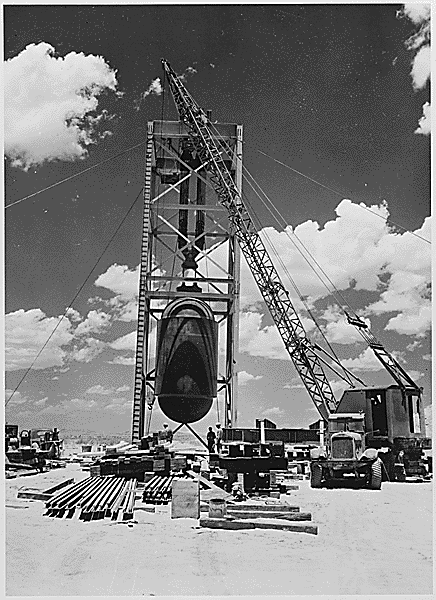
"Trinity" atomic device being positioned at White Sands, New Mexico - National Archives

Trinity atomic device “Jumbo” being positioned at White Sands, New Mexico – National Archives

Atomic Age Begins

On July 16, 1945 the United States tested a nuclear device, code named “Trinity”, for the first time in White Sands Proving Ground, New Mexico.

Left: [“Jumbo” atomic device being positioned for “Trinity” test at Alamogordo, New Mexico.], 1945

Right: [“Trinity” explosion], 07/16/1945

Source: research.archives.gov

English: Rare color photograph of the first nu...

Rare color photograph of the first nuclear test at Trinity site, July 16, 1945. Blurriness is in the original photograph (done when color photography was still fairly new). (Photo credit: Wikipedia)

This is based on an earlier post, and is mostly an encore post.

This is based on an earlier post, and is mostly an encore post.


80/20 Day: July 15, 1848, Vilfredo Pareto joined the human race

July 15, 2014

Happy 80/20 Day!

Italian economist, engineer and political activist Vilfredo Pareto was born on July 15, 1848, in Paris, where his father had fled due to political difficulties.

Pareto should be more famous, for his explanation of the 80/20 rule, and for his contribution to making better things, the Pareto chart.  Many economic texts ignore his work almost completely.  Quality management texts ignore his life, too — generally mentioning the principles they borrow, but offering no explanation.

Vilifred Pareto, Wikipedia image

Vilfredo Pareto, Wikipedia image

His contributions, as accounted at Wikipedia:

A few economic rules are based on his work:

And now you, dear reader, having just skimmed the surface of the pool of information on Vilfredo Pareto, know more about the man than 99.99% of the rest of the people on the planet.  Welcome to the tip-top 0.01%.

Resources:


No, DDT was not ‘erroneously’ banned from the world

July 13, 2014

Fights over genetically-modified organism (GMO) foods take some odd turns.  Some anti-GMO people point to the dangers of DDT in the past as a warning to be super cautious; and some pro-GMO people claim DDT wasn’t all that bad.

If there ever was a shortage of DDT in Africa, 40 tons would probably fill the gap, right?  The UN Food and Agricultural Organization today struggles to clean up surplus DDT left over in Africa from the past 50 years. There was no shortage. Caption from FAO: TN (Tanzania) before: 40 tonnes of 50 year old DDT were found in Menzel Bourguiba Hospital, TN – : M. Davis

If there ever was a shortage of DDT in Africa, 40 tons would probably fill the gap, right? The UN Food and Agricultural Organization today struggles to clean up surplus DDT left over in Africa from the past 50 years. There was no shortage. Caption from FAO: TN (Tanzania) before: 40 tonnes of 50 year old DDT were found in Menzel Bourguiba Hospital, TN – : M. Davis

Before we hold up the history and science and law of DDT as an example, can we at least get the facts right?  That generally is a failing of the pro-DDT people.

Logo for

Logo for “greener ideal.” An astroturf group?

Like Mischa Popoff at Greener Ideal.

He wrote:

In its first major action in 1972, the United States Environmental Protection Agency made history by banning dichloro-diphenyl-trichloroethane (DDT). It led to a worldwide ban, all based on the public outcry elicited by marine biologist Rachel Carson’s 1962 book Silent Spring.

This marks the beginning of the organic movement in America, and remains a badge of honor for organic activists, in spite of the fact that this ban resulted in the deaths of over 41 million people – roughly the same number of people Chairman Mao murdered in his Great Leap Forward – as public-health authorities lost their only effective means of controlling mosquitos that act as a vector for tropical diseases like malaria and dengue fever.

[There’s more, dealing with making the case for GMO foods; feel free to click over and read his opinion.]

I wrote:  There has never been a worldwide ban on DDT. DDT has never been banned in Africa, nor Asia, nor South America.

The U.S. ban on DDT applied only to the U.S. EPA has no jurisdiction outside the U.S. EPA’s order specifically granted DDT manufacturers the right and duty to keep making the stuff in the U.S., for export.

Malaria deaths have fallen most years since the U.S. ban on DDT — there was no malaria in the U.S. of any consequence, then. But malaria deaths have fallen from 4 million annually at peak-DDT-use years of 1958-1963, to fewer than 700,000 annual deaths, today.

Popoff responded.

You are so completely out of touch Ed.

The United States and the World Trade Organization banned DDT, and then threatened to withhold financial aid from any nation that continued to use it. This resulted in an effective world-wide ban on DDT.

It doesn’t matter whether Africa, Asia or South America actually went through the trouble of writing up legislation and passing it into law to ban DDT. After the big boys in Europe and the U.S. of A. banned it, it was banned for all.

And so it came to pass that tens-of-millions of people would die from preventable diseases like malaria and dengue fever.

You should be ashamed of yourself for getting this so wrong, and for misleading people.

Should I have been stung?  His errors of history blunted any sting.  I responded again (but it’s being held; too many links, I suspect):

The US banned DDT for use on crops, out of doors. Indoor Residual Spraying (as for malaria) is legal in the U.S.

The World Trade Organization has no authority to ban any substance, anywhere. Anyone who told you otherwise was pulling your leg.

EPA tried to save the chemical companies who made DDT. The order banning it for use on crops, specifically allowed manufacture in the U.S. to continue, for export. ALL that DDT, several millions of pounds, was exported to Africa and Asia, for use against mosqutoes or any other pest people there wanted to use it against.

There has never been a shortage of DDT in Africa or Asia.

The World Health Organization started using DDT in 1955, and though they had to end their ambitious campaign to eradicate malaria in 1965 (seven years before the U.S. ban) due to DDT abuse by farmers and other businesses, WHO has used DDT constantly since 1955. Mexico used DDT since 1948 — and still does.

When DDT was banned in the U.S., it became cheaper and much more available everywhere else in the world. In fact, one problem now is what to do with all the surplus DDT that was left over. (See the photos, especially — and click through for the full FAO report: http://timpanogos.wordpress.co… ) DDT manufacture in the U.S. continued at least through 1984; today it is made in massive quantities in India; it’s easy to make, and anyone who wants to manufacture it, may.

Though WHO ended the malaria eradication campaign, people kept fighting it. Many fail to understand that DDT was just one leg of the platform used to beat malaria. The idea was to knock down the local mosquito population TEMPORARILY, and then treat and cure all the humans — so when the mosquitoes came roaring back as they always do, there would be no well of malaria disease for the mosquitoes to draw from, to spread it (mosquitoes must get infected with malaria before they can pass it on, and then they have to incubate the parasite for another two weeks). Efforts to treat and cure malaria continued, and from the DDT-peak-use high of 4 million dying each year of malaria, the death toll was reduced to about a million a year by 1999. With the assistance of NGOs like the Gates Foundation, WHO and several nations re-energized the anti-malaria fight in 1999, using Integrated Vector Management, the methods Rachel Carson urged in 1962. Since 1999, malaria deaths have been cut by 45% more, WHO calculates — about 600,000/year. That’s a dramatic difference from 4 million a year. Still too many, but much, much improvement.

And so it came to pass that, mostly without DDT, malaria deaths did NOT INCREASE, but instead DECREASED, year over year, after the U.S. banned DDT use on cotton in Arkansas.

By the way, the head of the U.S. Public Health Service testified to the EPA in 1971 that there was not need to keep DDT around in the U.S. for malaria or any other disease — “no legitimate use” of the stuff for 20 years prior, he said. Norman Borlaug, fresh from his Nobel Prize, testified DDT was important to third-world nations — which was one more factor in EPA’s odd order, against U.S. law, leaving the manufacturing going, for export.

Mischa, there is a lot written on DDT history, at EPA’s site (though much of it was taken down prior to 2008), and at many other sites. You can catch up by starting here, at Millard Fillmore’s Bathtub: http://timpanogos.wordpress.co…

Other good sources include the blog Deltoid, and look for John Quiggin’s book on Zombie Economics.

DDT has never been banned worldwide. The Persistent Organic Pollutants Treaty names it one of the “dirty dozen” chemicals, but there is a special addendum to the treaty that keeps it available to fight malaria, for any nation.

I also recommend WHO’s annual “World Malaria Report.”

And if you’re interested in actually helping fight malaria, go to Nothing But Nets, and buy a bednet for a kid. Nets are about double the effectiveness of DDT or other pesticide spraying to prevent malaria.

Get in touch with what’s really going on in the malaria fight, and join in.

He responded again, with more tartness (this comment has since been cast into “moderation,” so it’s not visible; are they thinking of deleting it, or what?):

Ed, Ed, Ed… you’re wallowing in details my friend. And, again, you should be ashamed of yourself.

It’s one thing to clarify, or provide background. But you’re actually implying that people in the Third World never suffered or died in the MILLIONS after authorities lost the ability to control disease-carrying mosquitoes with DDT. You’re lying, plain and simple.

You’re right to point out that DDT is only one part of how to control malaria, but it is the MOST IMPORTANT part because DDT persists on surfaces inside people’s homes, and thereby prevents children from being bitten by mosquitoes in their sleep.

And on that note, you’re wrong (dead wrong) to suggest that mosquito nets are more effective than DDT. “Nothing But Nets” is nothing but a feel-good attempt by Hollywood elites to assuage their guilt for being part of the world-wide campaign to ban DDT.

What’s simpler? Sending tens-of-millions of mosquito nets to people in the Third World? Or simply spraying the inside of a hut with a few ounces of DDT?

DDT was most-certainly and quite effectively banned by organic activists in spite of the fact that the hero of the organic movement, Rachel Carson, never called for a ban on ANY synthetic pesticides. Here: https://www.fcpp.org/files/1/R…
See for yourself.

To which I responded:

Mischa, I provided corrections. You call me a liar?

Your history is wrong.  You’re wrong on the law, wrong on history, wrong on the chemistry, wrong on the medicine.

Are you lying?  I assumed you had made an error.  I offer you links to sources you can check.

Before you falsely malign those who offer you correction, I urge you to get the facts.

With such a rabid attack on a those who correct your history, can we trust what you claim about GMOs, either?  Unlikely.

It’s one thing to imply that people in the Third World have a tough time with malaria.  Quite another to falsely malign scientists, science, and history to claim, falsely, that environmentalists made malaria worse than it was.

Malcolm Gladwell makes it clear in his history of Fred Soper, the super mosquito fighter who created the malaria eradication campaign, that it was DDT advocates who killed the malaria eradication campaign, by overusing DDT where it wasn’t necessary.  In doing that, they forced the bugs to evolve resistance and immunity to DDT.  By the time the malaria fighters got to Central Africa with DDT as their champion tool to knock down mosquitoes, DDT didn’t work as well as they needed to buy time to cure the humans.  (See Gladwell’s piece here, especially sections 5 and 6, remembering Soper was no great fan of Carson: http://gladwell.com/the-mosquito-killer/ .)

So it was DDT advocates who created the trouble, and environmentalists who warned us it would happen — though Rachel Carson didn’t think it would happen until much later (Soper had hoped he’d have until about 1975).  The DDT advocates were wrong, and reckless.

You’re right, Rachel Carson did NOT call for a ban in DDT. She did warn that abuse of DDT would ruin it for fighting disease.

That came to pass. Seven years after her death, the case to ban DDT in the U.S. was firm (nor was there any malaria there to fight).

The ban in the U.S. covered ONLY the U.S.  DDT was NEVER banned in Africa nor Asia.  DDT has been in constant use outside of North America and western  Europe — but also in constantly diminishing effectiveness.

Your criticism of environmentalists is misplaced and wrong.

You falsely malign the critics who were right.  I must assume that you, too, are wrong, and reckless about GMOs.  What else explains your unfair and inaccurate criticism of me and my post?

What are the odds he’s right about GMOs, but just sadly and badly informed on DDT?

You know, I wonder if this guy is related to Roger Bate and Richard Tren.  Is Greener Ideal part of the greenwash movement?

If you’re looking for opposition to genetically-modified organisms in our food supply, I’m not the guy to see.  I started out in biology, remember, and I’ve seen and come to understand that humans have been altering the genomes of creatures for at least 5,000 years.  Otherwise, we’d not be able to plant wheat, we’d not have maize corn, we’d not have beef or chicken, or pork.  The question is whether the modifications are dangerous.  We’ve had some disastrous genetic modification with simple hybridization.  Obviously, the idea of crossing African bees with European honeybees turned out to be a bad idea — but that was not done in a laboratory, but by simple hybridization.  Hip dysplasia in domesticated canines is one more indication of the evils of “natural” genetic modification.

I’m not the guy to look to for evidence that science always screws things up.  Those who argue on the razor’s edge, that scientists screwed up their warnings about things in the past and therefore should not be trusted now if they happen to warn against science modifying genes in foods we eat, won’t find safe haven with me.  They’d get a sympathetic ear for their presentation of facts, though, if they could avoid patently false claims, like the repetition of the various forms of the Rachel-Carson-was-evil-DDT-is-manna-from-heaven hoaxes.  It’s difficult to argue that all scientists are bad when they warn us of dangers, but those scientists who create the dangers are always right and do things only for our benefit.  The story is much more complex than that, and broad-brush, landscape views often cover over the facts, and obscure wise policy paths.  When they claim the poison DDT is “harmless,” one must wonder what else they have completely wrong, and wonder whether they erred with bad research, or have ulterior motives for making false claims.

Popoff didn’t avoid that trap this time.

More:

Save


July 10, 1850: Millard Fillmore sworn in as president

July 10, 2014

Millard Fillmore was elected vice president largely because he was on the ticket with the very popular Gen. Zachary Taylor, hero of the Mexican War.

About 15 months into his presidency, President Taylor took ill  after presiding over July 4 festivities in blazing heat.  He died on July 9, 1850; Vice President Millard Fillmore took the oath as president the next day, and served out the term.  164 years ago today, Millard Fillmore served his first day as President.

Fillmore became the second person to take the presidency of the U.S. without having been elected.  John Tyler was William Henry Harrison’s vice president when Harrison died of pneumonia a mere 31 days after being sworn in as president.

Millard Fillmore in an 1850 lithograph by Francis DAvignon after a photograph by Matthew Brady (unclear if this was before or after his ascending to the presidency) - Library of Congress image

Millard Fillmore in an 1850 lithograph by Francis D’Avignon after a photograph by Matthew Brady (unclear if this was before or after his ascending to the presidency) – Library of Congress image

Zachary Taylor had encouraged New Mexico and California to draw up state constitutions, which would have disallowed slavery in those states.  To southern leaders who threatened secession, Taylor promised to personally lead the army that would hold the union together by force, and personally hang those who had proposed rebellion.

Fillmore had presided over the Senate during months of furious debate on issues that always seemed to come down to slavery.  Because he didn’t hold to the views of the Whig Party which had elected the Taylor-Fillmore ticket, even more than Taylor had strayed, the cabinet resigned.  Fillmore appointed Daniel Webster as Secretary of State, and proceeded to push for compromise on issues to avoid war.  His machinations helped get California admitted as a free state, but left New Mexico as a territory.  His support of the Fugitive Slave Act alienated even more Whigs, and by 1852 the Whigs refused to nominate Fillmore for a term of his own.  He left office in 1853, succeeded by Franklin Pierce.

Fillmore’s greatest accomplishment as president, perhaps, was his sending a fleet of ships to Japan to force that nation to open up to trade from the U.S.  The political furor over the Fugitive Slave Act, the Missouri Compromise, and other issues around slavery, tend to eclipse the memory of the good that Fillmore did.

Nota bene:  Controversy surrounded the death of Taylor.  Because he had threatened southern secessionists and incurred anger from several other groups, from the time of his death there were rumors he had been poisoned with arsenic.  Officially, the cause of death was gastroenteritis; popular accounts note that he had, in the heat of July, drunk milk and eaten cherries and cucumbers.  Certainly strep, staph or other bacteria in the milk could have created a problem.  In 1991 a team led by George Washington University Law Professor James Starrs exhumed Taylor’s body from his Louisville, Kentucky burial plot, and tested his remains for arsenic at the Oak Ridge National Laboratory.  Analysis presented to the Kentucky medical examiner indicated arsenic levels way too low for a poisoning victim.

[This is an encore post, in parts.]

More:

"An Available Candidate: The One Qualific...

“An Available Candidate: The One Qualification for a Whig President”. Political cartoon about the 1848 presidential election which refers to Zachary Taylor or Winfield Scott, the two leading contenders for the Whig Party nomination in the aftermath of the Mexican-American War. Published by Nathaniel Currier in 1848, digitally restored. (Photo credit: Wikipedia)  Despite the cynicism of many , Zachary Taylor won the Whig Party nomination, and the presidency.  Taylor died just over a year after his inauguration.


July 9, 1850: Death of President Zachary Taylor; cue Millard Fillmore

July 9, 2014

President Zachary Taylor died on July 9, 1850.  The cause is still not fully clear, but poisoning by arsenic has been ruled out.

What would have happened had Taylor lived?

At the blog of the National Constitution Center, we get a few details of his death and life immediately preceding:

President Zachary Taylor’s death on July 9, 1850 shocked a nation that was in a heated debate about issues that eventually led to the Civil War. But his sudden passing also sidestepped two constitutional crises.

zachary-taylorThe details about how and why President Taylor died are still in dispute today. The president attended a ceremony at the site of the Washington Monument on July 4th on a reportedly hot summer day.

He fell ill soon after with a stomach ailment. His doctors gave him relief medication that included opium and later bled the president. Taylor died five days later at the age of 65.

Officially, he died from cholera morbus, and today, the prevalent theory is that Taylor suffered from gastroenteritis, an illness exacerbated by poor sanitary conditions in Washington.

There are other theories, including one where Taylor was poisoned by people who supported the South’s pro-slavery position. (In recent years, Taylor’s body was exhumed and a small, non-lethal amount of arsenic was found in samples taken from his corpse.)

It was Taylor’s unexpected opposition to slavery (he was from the South and was the last president to own slaves) that had caused an immediate crisis in 1850.

Taylor ran as a Whig candidate in 1848 and he wasn’t a professional politician. Taylor was a career military man and a hero in the war with Mexico.

Once he took office in March 1849, it became clear that Taylor, the military man, was more interested in preserving the Union than the art of politics.

Taylor decided to press for statehood for the newly acquitted territories of California and New Mexico, and to let the regions hold their own constitutional conventions. This guaranteed that California and New Mexico would join the Union as anti-slavery states, tipping the balance in the Senate to the North.

[more at the blog site]

In any case, Taylor died on July 9.

And on July 10, 1850, his vice president, Millard Fillmore, was sworn in as president.

No, that doesn’t mean the bathtub tale is true.

More:


Saving the plains bison, at Caprock Canyon State Park, Texas

July 8, 2014

Few days go by that I don’t hear from some Texas yahoo about the futility of conservation, especially attempts to save sustainable populations of animals near or teetering on the brink of extinction.

American bison galloping. Photos by Eadweard Muybridge, first published in 1887 in Animal Locomotion. Wikipedia image

American bison galloping. Photos by early motion-studying photographer Eadweard Muybridge, first published in 1887 in Animal Locomotion. Wikipedia image

Conservation works.  Conservation works in Texas.  How can they ignore stories like this one, about the conservation of the plains bison, at Texas’s Caprock Canyon State Park?

This film from the Texas Parks and Wildlife Department illustrates and discusses the work going on at Caprock Canyon SP to keep a herd of bison there healthy and reproducing:

Published on Feb 1, 2013

Caprock Canyons State Park in the Texas Panhandle holds the last remnants of pure Southern Plains Bison that once numbered in the millions on this land. Watch as this historic herd is restored to its native habitat. For details on visiting the park, see http://www.tpwd.state.tx.us/state-par…

If we had a national mammal, is there much doubt the noble American buffalo would be it?

Defenders of Wildlife range map, showing where to find bison in North America. DoW said: Bison once roamed across much of North America. Today bison are ecologically extinct throughout most of their historic range, except for a few national parks and other small wildlife areas. Yellowstone National Park has the largest population of free-roaming plains bison (about 4,000), and Wood Buffalo National Park has the largest population of free-roaming wood bison (about 10,000).

Defenders of Wildlife range map, showing where to find bison in North America. DoW said: Bison once roamed across much of North America. Today bison are ecologically extinct throughout most of their historic range, except for a few national parks and other small wildlife areas. Yellowstone National Park has the largest population of free-roaming plains bison (about 4,000), and Wood Buffalo National Park has the largest population of free-roaming wood bison (about 10,000).

You can see that conservation is not easy, that serious conservation of animals takes cooperation between governments, federal, state, county and local.  Throw in migratory birds, and you’re talking international efforts.

But it’s worth it, at least to me.  Wholly apart from the direct benefits to humans — the discovery of drugs like digitalis and tamoxifen, for example — we learn so much about how the planet operates, how nature operates.  We get a view into the ideas of God, if not a direct view into the universe’s creative mind.

There are two recognized subspecies in North America: Bison bison bison and B. b. athabascae.  We have populations saved in small plots across the U.S.:  In and around Yellowstone National Park; on Antelope Island in the Great Salt Lake; in Utah’s Henry Mountains in the south central part of the state; at the LBJ Grasslands (National Forest); and at Caprock Canyons State Park.  At one time, millions of the plains subspecies migrated for hundreds, perhaps thousands of miles, harvesting grass and turning the soil to make the North American Great Plains one of the most productive habitats for plants and animals on the face of the Earth.  We screwed that up a bit.  The same area today does not produce equally to 200 years ago in fiber and meat, despite modern farming and ranching.

Maybe we can learn a lot more from these creatures, about how to keep food supplies going for that other common, though self-threatened species, Homo sapiens.

Probably can’t improve on the video, but I hope to get some good photos of these creatures for myself, this summer.  Check the map above. If your summer travels take you close to a population of bison, why not stop in and visit?

More:

World Wildlife Fund image of plains bison, mother and calf

World Wildlife Fund image of plains bison, mother and calf, and caption: Historically bison were the dominant grazer on the Northern Great Plains landscape. This dominance shaped the landscape by affecting the pattern and structure of the grasses and vegetation that grew, and it was this vegetation pattern that allowed animals to flourish.