Prohibition — in 6 hours, by Ken Burns

October 2, 2011

Starts tonight on KERA, our local PBS affiliate.  A key part of history, especially for the political winds of 2011.

Should I require classes to watch it?

Part 1 runs tonight at 7:00 p.m. and the repeats at about 8:30 p.m. (if I’m reading this schedule correctly, and KERA has done this before with programs they expect to be very popular).

Part 2 is scheduled for Monday at 7:00, and Part 3 for Tuesday at 7:00 — with repeats to follow both nights.


Saroyan, gone 30 years

September 28, 2011

Time fills up with anniversaries, if we remember history long enough.

Today is This year marks the 30th anniversary of William Saroyan’s death (on May 18).  A few hits on my post about his typewriter made me aware of the date.

There’s a nice tribute by Tom Vartabedian to the legacy of Saroyan, a man who loved books and who understood the value of knowledge, literature, a library, and what it means to be Armenian, at the Armenian Weekly.

An interesting guy, with interesting stories most often about one of our planet’s more interesting groups of people.  In 1936 Saroyan wrote about the resiliency and vibrancy of Armenians, in Inhale and Exhale.  One quote can be purchased from the William Saroyan Society on a poster:

I should like to see any power of the world destroy this race, this small tribe of unimportant people, whose wars have all been fought and lost, whose structures have crumbled, literature is unread, music is unheard, and prayers are no more answered. Go ahead, destroy Armenia. See if you can do it. Send them into the desert without bread or water. Burn their homes and churches. Then see if they will not laugh, sing and pray again. For when two of them meet anywhere in the world, see if they will not create a New Armenia.

30 years since he passed?  Really?


Strike a blow for freedom and the Constitution: Read a banned book!

September 26, 2011

John Maunu reminded me this week is Banned Books Week.  Details from the American Library Association:

Banned Books Week 2011

September 24−October 1, 2011

Banned Books Week (BBW) is an annual event celebrating the freedom to read and the importance of the First Amendment.  Held during the last week of September, Banned Books Week highlights the benefits of free and open access to information while drawing attention to the harms of censorship by spotlighting actual or attempted bannings of books across the United States.

Intellectual freedom—the freedom to access information and express ideas, even if the information and ideas might be considered unorthodox or unpopular—provides the foundation for Banned Books Week.  BBW stresses the importance of ensuring the availability of unorthodox or unpopular viewpoints for all who wish to read and access them.

The books featured during Banned Books Week have been targets of attempted bannings.  Fortunately, while some books were banned or restricted, in a majority of cases the books were not banned, all thanks to the efforts of librarians, teachers, booksellers, and members of the community to retain the books in the library collections.  Imagine how many more books might be challenged—and possibly banned or restricted—if librarians, teachers, and booksellers across the country did not use Banned Books Week each year to teach the importance of our First Amendment rights and the power of literature, and to draw attention to the danger that exists when restraints are imposed on the availability of information in a free society.

Banned Books Week is sponsored by the American Booksellers Association; American Booksellers Foundation for Free Expression; the American Library Association; American Society of Journalists and Authors; Association of American Publishers; and the National Association of College Stores.  It is endorsed by the Center for the Book in the Library of Congress. In 2011, the Comic Book Legal Defense Fund; National Coalition Against Censorship; National Council of Teachers of English; and PEN American Center also signed on as sponsors.

For more information on getting involved with Banned Books Week: Celebrating the Freedom to Read, please see Calendar of Events, Ideas and Resources, and the new Banned Books Week site. You can also contact the ALA Office for Intellectual Freedom at 1-800-545-2433, ext. 4220, or bbw@ala.org.


Quote of the moment: Mike Mansfield

September 20, 2011

Senate Majority Leader Mike Mansfield, D-Montana

Senate Majority Leader Mike Mansfield, D-Montana; oil on canvas by Aaron Shikler, 1978 - Wikimedia image

Mike Mansfield was born on March 16, 1903.  Best boss I ever had.

Robert A. Nowlan’s Born This Day attributed this quote to Mansfield:

After all, even a politician is human.

Laconic as he was, Mansfield didn’t say anything more meaty than that?

Read about Mansfield at the Bathtub, here.  Mansfield died on October 5, 2001.


Shakespeare: Still viral after all these years

September 19, 2011

A little sketch in her notebook, an off-the-top-of-her-head list of common phrases.  Common today, but originating with William Shakespeare.

Becky's tumblr image:  Things we say that we owe to Shakepspeare

Becky's quick summary of some of the best-known phrases we use everyday, invented by Shakespeare. From Becky, age 20, in London.

Becky’s quick work caught a lot of eyes.  One of NPR’s blogs brought it to my attention.  English teachers, take notice (maybe someone at your school has a large format printer, and can make for you a poster . . .)

Someone could write a book explaining the original Shakespeare meaning of these phrases, the play, the context, and the value in the story. (Perhaps it’s already been done.)  It’s really quite stunning to consider how many phrases trace back to the Bard — surely he did not originate each and every one.  But Shakespeare’s works are rivaled perhaps only by scriptures in producing so many common phrases and aphorisms.

Is this graphic design of a sort that would meet with approval from Edward Tufte and his followers?


Sausage makers? Or U.S. Congress? Do you want to see how they do it?

September 15, 2011

How does a bill become law?

Charts in government and civics texts always amuse me for what they leave out — mostly the political machinations.  Anyone who worked or works in the halls of Congress knows the process is never so clean as Bismarck pretended with his old, misattributed bon mot (actually John Godfrey Saxe, not Bismarck) (and would Bismarck be chagrined at my using a French phrase to describe his words?).

At In Custodia Legis, the blog of the law librarians at the Library of Congress, I stumbled across this post featuring a photograph of a chart hanging in a committee room on the House side.  Wouldn’t it be nice to have a copy of that available to teachers?

Andrew Weber wrote the post.

Sometimes the legislative process is a little more confusing than I’m Just a Bill.  As Margaret mentioned in The Curious History of the 2011 Debt Ceiling Legislation earlier this week, sometimes the legislative process takes interesting turns.  Christine also blogged about the unique situation of vehicle bills.  The poster below details the various status steps legislation can take, including Introductory, Committee, Discharge, Calendar, Floor, Conference, and Presidential Steps.

For tips on THOMAS that can relate to the legislative process, you can subscribe to the RSS feed or via email alert.  There is also a glossary in THOMAS to help.

Is the poster available?  I asked, and got this response from Mr. Weber:

This is what it says at the bottom right of the poster:

Committee on House Administration
Wayne L. Hays, Chairman
Prepared by House Information Systems Staff
Frank B. Ryan, Director

Also, on the bottom left it has a date:

Current as of November 1974

Wayne Hayes, the meanest man in the House according to Bud Shuster?  November 1974?  This was pre-scandal Hayes (Democrat of Ohio), just barely post-Nixon Washington. [

If you can find a link to this chart that makes the wording and details legible, or if you happen to find it and can photograph it so we can read it, will you let us know here?


September 14: President McKinley died, 1901

September 14, 2011

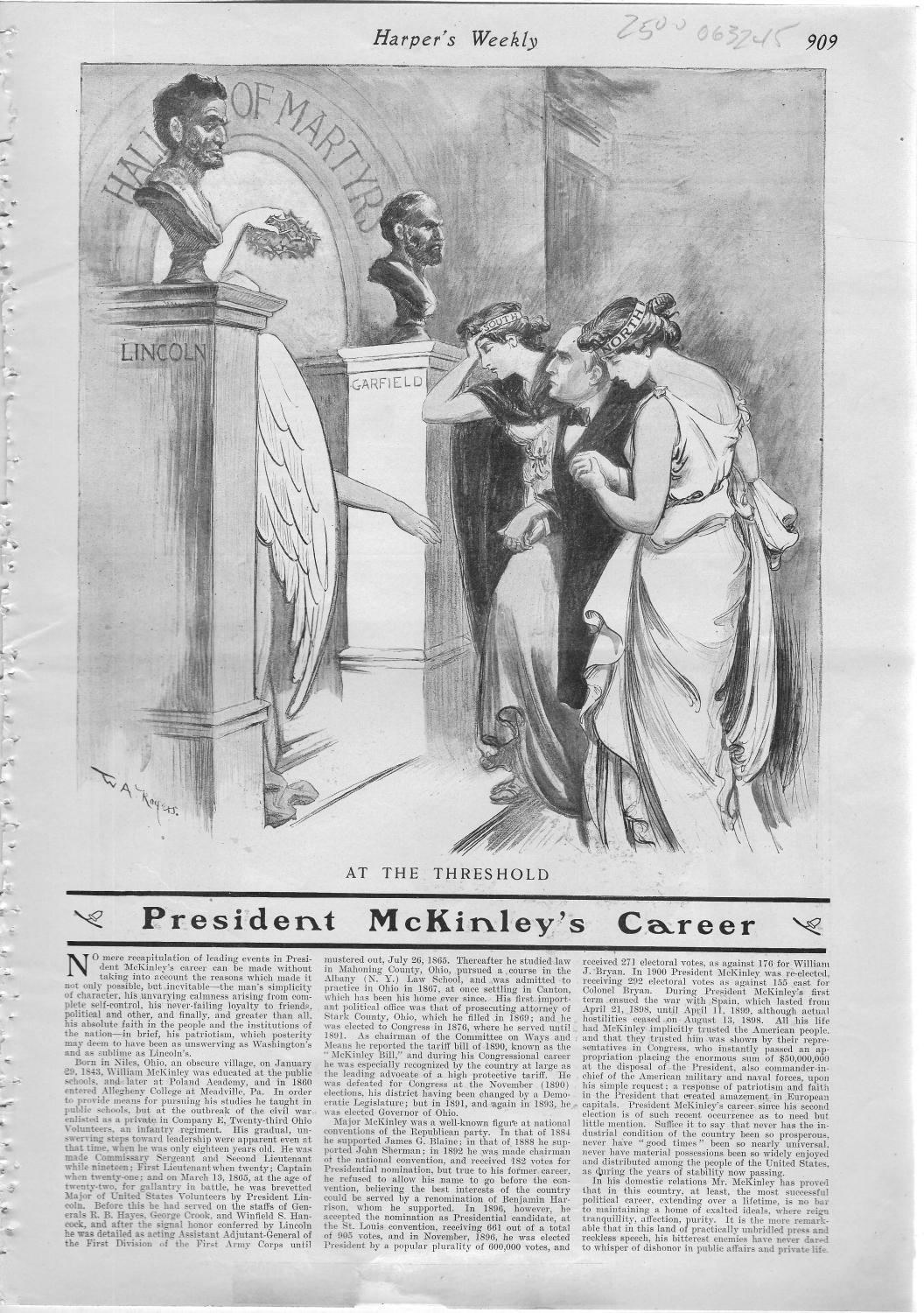
Image from Harper’s Magazine, September 14, 1901 -= McKinley “At the Threshold” of Martyrs’ Hall

Teachers should be mining the “On This Day” feature at the New York Times, which usually features an historic cartoon or illustration from an antique Harper’s Weekly. It is a favorite feature, to me.

Yesterday, it featured the illustration from Harper’s upon the death of President William McKinley, on September 14, 1901.

At the Threshold

Artist: William Allen Rogers

his post-dated cartoon was published as President William McKinley lay dying from an assassin’s bullet. He had been shot on September 6, 1901, by anarchist Leon Czolgosz (pronounced chol-gosh) at the Pan-American Exposition in Buffalo, New York. The president died on September 14. Here, McKinley is led to the Hall of Martyrs by grief-stricken personifications of the North and South. Between pillars topped by busts of the two previously slain presidents, Abraham Lincoln and James Garfield, the angel of death prepares to place a laurel wreath of honor upon McKinley’s head. (Images related to Garfield’s assassination also showed a reconciled North and South.)

There is much more at the Times site.

Robert Lincoln, the son of Abraham Lincoln, was present when McKinley was shot. Accounts I have read but not confirmed say that Robert Lincoln had been invited to attend Ford’s Theatre with his father and mother, the night his father was shot. As a member of President James Garfield’s cabinet, Robert Lincoln had been awaiting Garfield’s arrival at Union Station in Washington, D.C., when Garfield was shot.

And as a visitor in Buffalo, Robert Lincoln had as a matter of respect lined up to shake President William McKinley’s hand.

Astounding if true. Four U.S. presidents have been assassinated. Robert Lincoln was close to the first, the assassination of his father, and present for the next two. Where can we confirm that story?

McKinley’s death catapulted the do-gooder, Theodore Roosevelt, into the presidency, probably to the great chagrin of corrupt Republican politicians who had hoped that by getting him nominated to the vice presidency they could get him out of New York politics.

The rest is history.

(This is an encore post.)

Image is available for purchase at AbeBooks.


Free copy of the U.S. Statistical Abstract

September 13, 2011

Government, economics and U.S. history teachers:

You may get a free copy of the 2011 U.S. Statistical Abstract, on CD.

Available January 2011

On the CD-ROM version are Excel spreadsheet files for each of the individual tables.

In many cases the files contain more detailed information than is found in the book. Also, in some cases the Excel files contain more recent and revised data that were released by the source after publication of the printed version of the Abstract. You will also find the same Adobe Acrobat files for each section which you find on this web site.

Additional information
While supplies last, single copy FREE (one per customer) by calling Customer Services at 1-800-923-8282.


September 11 – fly your flag today, half-staff if you can

September 11, 2011

Americans are urged to fly flags today, at half-staff, in honor of patriots and those who died in the attacks on the U.S. on September 11, 2001.

According to Cornell University’s Legal Information Institute, the law says:

TITLE 36 > Subtitle I > Part A > CHAPTER 1> § 144

§ 144. Patriot Day

How Current is This?

(a) Designation.— September 11 is Patriot Day.

(b) Proclamation.— The President is requested to issue each year a proclamation calling on—
(1) State and local governments and the people of the United States to observe Patriot Day with appropriate programs and activities;

(2) all departments, agencies, and instrumentalities of the United States and interested organizations and individuals to display the flag of the United States at halfstaff on Patriot Day in honor of the individuals who lost their lives as a result of the terrorist attacks against the United States that occurred on September 11, 2001; and

(3) the people of the United States to observe a moment of silence on Patriot Day in honor of the individuals who lost their lives as a result of the terrorist attacks against the United States that occurred on September 11, 2001.

Patriot Day formerly occurred earlier in the year; information on flag flying has not been added to the Flag Code portions of U.S. law, and consequently this news gets missed.

Fly your flag today, at half-staff. Remember when flying a flag at half-staff, it is first raised to full staff, then slowly lowered to the half-staff position. When the flag is retired at the end of the day, it should again be crisply raised to the full-staff position before being lowered.

A flag attached to a pole that does not allow a half-staff position should be posted as usual.

A National Day of Service

Also, September 11 is also designated as a national day of service, under the Edward M. Kennedy Serve America Act, Public Law 111-13 (April 21, 2009). The Corporation for National and Community Service is charged with encouraging appropriate service in honor of the day and in honor of those who died.

National Day of Service and Remembrance

Date(s): September 11, 2010

Location: National

Event URL: http://911day.org/

Description
On April 21, 2009, President Barack Obama signed legislation that for the first time officially established September 11 as a federally recognized National Day of Service and Remembrance.

By pledging to volunteer, perform good deeds, or engage in other forms of charitable service during the week of 9/11, you and your organization will help rekindle the remarkable spirit of unity, service and compassion shared by so many in the immediate aftermath of the attacks. And you’ll help create a fitting, enduring and historic legacy in the name of those lost and injured on 9/11, and in tribute to the 9/11 first responders, rescue and recovery workers, and volunteers, and our brave military personnel who continue to serve to this day.

Check in your own community to find opportunities for service projects.


Channeling Monty Python: “The border between India and Pakistan is closed for the day”

September 7, 2011

BBC map showing location of Wagah and Punjab

BBC map showing location of Wagah and Punjab, divided between Pakistan and India, south of Kashmir

Written accounts cannot possibly do justice to the ceremonies that mark the daily close of business at the border between India and Pakistan.  I had understood it was quite a good show, rivaling the changing of the guard at Buckingham Palace.

But, you don’t expect Monty Python to break out at these affairs, do you? Here’s a video of the ceremony as it was conducted prior to July 2010, I believe, which I found at Wimp.com.  It’s a video clip from BBC Worldwide, narrated by comedian Sanjeev Bhaskar.

Vodpod videos no longer available.

(If that one doesn’t work, try this one — a bit lower quality video):

(Or, here’s a shorter, YouTube version of Baskar’s film.)

Where in the world is this?  It’s in a town and area called Wagah, in Punjab, divided between India and Pakistan since the 1947 independence of those nations (links to Wikipedia left in for your convenience).

Wagah (Punjabi: ਵਾਘਾ, Hindi: वाघा, Urdu: واہگہ) is the only road border crossing between India and Pakistan[1], and lies on the Grand Trunk Road between the cities of Amritsar, India and Lahore, Pakistan. Wagah itself is a village through which the controversial Radcliffe Line was drawn. The village was divided by independence in 1947. Today, the eastern half of the village remains in the Republic of India while the western half is in Pakistan.

While both nations and local residents fully recognize the silliness, it also stands as a symbol of the deep divisions between the two nations.

The Wagah border, often called the “Berlin wall of Asia”,[2] is a ceremonial border on the India–Pakistan Border where each evening there is a retreat ceremony called ‘lowering of the flags’,[3] which has been held since 1959.[4] At that time there is an energetic parade by the Border Security Force (B.S.F) of India and the Pakistan Rangers soldiers. It may appear slightly aggressive and even hostile to foreigners but in fact the paraders are imitating the pride and anger of a Cockerel.[1][5][6] Troops of each country put on a show in their uniforms with their colorful turbans.[7] Border officials from the two countries sometimes walk over to the offices on the other side for day to day affairs. The happenings at this border post have been a barometer of the India-Pakistan relations over the years.[1]

Did someone say “Pythonesque?”

Here’s Michael Palin narrating another view of the ceremony for one of his BBC enterprises, Himalaya with Michael Palin:

Would you be surprised to hear that local people refer to this as “the dance of the roosters?”

Events at this crossing reflect some minor easing of tension between the two nations in the last decade, and in 2010 both nations announced they would tone down the retreat ceremonies. Surely some scholar has analyzed this retreat ceremony and its history, to determine whether it helped ease the tension, or increased the conflict between the two nations.  Could soldiers who participate in such goings-on actually shoot at each other?

Has anyone got a more recent viewing of the ceremony?

How will you explain this to your sophomore world history class?  Is there anything sillier than humans in conflict?

Video via VodPod.

An astonished tip of the old scrub brush to Judith Shields.

More:


Pete Seeger: STILL standing taller than his critics

September 6, 2011

(This is almost completely an encore post — one that should get more circulation.  From four years ago, in 2007.  I have not updated years or ages — sharpen your math skills, and do it as you go.)

Some people can’t let go of the past, and like the greedy chimpanzee who grasps the rice in the jar, and then is trapped when he cannot pull out his fist nor will he give up his prize to save his freedom, they trap themselves out of a good life.

  • Cover to Pete Seeger album

    Cover of 1996 album of songs, "Pete." Seeger, born May 3, 1919, is 88 years old now.

Like this fellow, whose father’s dislike of an old political position of Pete Seeger kept them both from a good concert. He appears to agree with his father, though, thinking that somehow Seeger is responsible for the evils of Stalinism, and complaining that Seeger was tardy in making note of the fact that Stalin was evil. And Instapundit’s Glenn Reynolds agrees, profanely, and inaccurately, as I’ll explain below the fold. But heed this warning: I’m explaining at length.

Get a life, people! Pete Seeger did.

Read the rest of this entry »


Honor American labor: Fly your flag today, Labor Day 2011

September 5, 2011

Probably more important in 2011 than before:  Fly your flag for American labor today.

Free Labor Will Win, poster from 1942, (Library of Congress)

Poster from the Office of War Information, 1942

It’s Labor Day 2011 in the United States, a federal holiday, and one of those days Americans are urged to fly the U.S. flag.

The poster was issued by the Office of War Information in 1942, in full color. A black-and-white version at the Library of Congress provides a few details for the time:

Labor Day poster. Labor Day poster distributed to war plants and labor organizations. The original is twenty-eight and one-half inches by forty inches and is printed in full color. It was designed by the Office of War Information (OWI) from a photograph especially arranged by Anton Bruehl, well-known photographer. Copies may be obtained by writing the Distribution Section, Office of War Information [alas, you can’t get a copy from the Office of War Information in 2011]

Even down here in deepest, darkest-right-to-work Texas, patriots fly their flags to honor Labor today. It’s heartening.


Biography of Millard Fillmore — not up to the bathtub test?

September 4, 2011

A new biography of Millard Fillmore popped out last spring, and the publisher didn’t send me a copy to review!

Not that my review could boost sales much — nor harm them — but don’t publishers use Google to figure out how they might get some publicity for their books?  Most internet searches for “Millard Fillmore” end up here.

No, I’m not really offended.  But I did find it interesting that none of my “Millard Fillmore” keyword  compilers picked up on the book.

Details:  Millard Fillmore, Paul Finkelman, Times Books, $23.

Cover of Millard Fillmore, by Paul Finkelman

Cover of Millard Fillmore, by Paul Finkelman

In a review for the Wall Street Journal, Fergus M. Bordewich wrote:

In this short, fierce book—part of the “American Presidents” series—Mr. Finkelman has delivered an unvarnished but compelling portrait of one of our least remembered but far from insignificant presidents. Against his grain, he gives Fillmore credit for promoting a number of “visionary” ideas that would come to fruition only after he left the presidency in 1853: the transcontinental railroad, the assertion of American power in Hawaii, the building of a Central American canal. “But on the central issues of the age,” Mr. Finkelman writes at the end of “Millard Fillmore,” “his vision was myopic and his legacy is worse.”

Has anyone read the book?  Is it any good?

More: 


U.S. exporting energy? Then conservation is a boost to economy, too

September 4, 2011


Do Americans have great business sense?

Then it is unlikely that we’ll pass up the opportunity to export energy for profit — and consequently, we’ll boost our wind generating capacities, geothermal power generation, and step in to retake the lead in solar cell development and production, won’t we?

Here is a story I’ll bet you missed last spring — I missed it, too; from the Daily Ticker:

Just as the average price for gas is set to hit $4 a gallon this week, the U.S. Energy Information Administration reports February was the third month out of four that the U.S. — the world’s most energy-hungry nation — actually exported more oil that it imported.

Despite the notion that the U.S. is currently hugely reliant on foreign oil, the country sold 34,000 more barrels of petroleum products a day than it imported in November 2010. And, in both December and February, the U.S. sold 54,000 more barrels a day. Net imports have not been negative for nearly two decades.

Part of this has to do with weak U.S. demand in recent years due to the recession. The other part rests on the growing demand in our own backyard for not only crude oil, but refined oil as well.

Mexico, Latin America and even OPEC member Ecuador are some of the U.S.’s top customers for fuel products, namely refined oil. Rising demand in these countries far outpaces their capacity to refine crude oil into petroleum products like gasoline or diesel fuel.

But, as Dan points out in the accompanying clip, this is not the only news item that hints at this country’s ability to export energy to the rest of the world.

Yesterday, Arch Coal announced a $3.4 billion all-cash deal to buy its competitor International Coal Group. The transaction would make the newly formed company the second-largest U.S. supplier of metallurgical coal, which is the coal used to make steel.

And because of growing demand in places like India and China, where coal is used for electricity, the U.S. has started to export more at higher prices than in previous years.

Then there’s natural gas. U.S. reserves of natural gas have also grown considerably in the last decade to record levels. A new report by the Potential Gas Committee suggests that in the last two years, potential U.S. natural gas supplies have increased by 3 percent. Two years ago, however, the group reported that supplies jumped 36 percent.

The U.S. does not currently export liquefied natural gas, but that time may soon be on the horizon.

Watch a video discussion of the news:
Vodpod videos no longer available.
What Energy Problem? U.S. Oil Exports Are on th…, posted with vodpod

Of course the U.S. is not about to join OPEC.  But this news, quietly sneaking up on us as it did, should change the nature of the discussions about our energy future, and the direction, too.

In the first place, energy substitution — wind and geothermal for coal and oil, for example — becomes an issue of generating revenue, rather than just saving imports.  If we can get power from the wind for free and sell coal to others for profit as a result, we get wins for U.S. citizenry and big wins for U.S. industry.

I haven’t seen much discussion of the topic.  Stephen Leahy wrote an opinion piece for Common Dreams suggesting that oil companies have a political stake in keeping this news quiet, in order to get greater advantage for themselves, especially in electoral politics.

The only reason U.S. citizens may be forced to endure a risky, Canadian-owned oil pipeline called Keystone XL is so oil companies with billion-dollar profits can get the dirty oil from Canada’s tar sands down to the Gulf of Mexico to export to Europe, Latin America or Asia, according to a new report by Oil Change International released Wednesday.

“Keystone XL will not lessen U.S. dependence on foreign oil, but rather transport Canadian oil to American refineries for export to overseas markets,” concludes the report, titled “Exporting Energy Security”.

Little of the 700,000 to 800,000 barrels of tar sands oil pumped through the 2,400-kilometre, seven-billion-dollar Keystone XL will end up in U.S. gas tanks because the refineries on the Gulf Coast are all about expanding export markets. One huge refinery operator called Valero has been touting the potential export revenues of tar sands oil to investors, the report found.

In 1941, the U.S. was the largest oil-producing and oil-exporting nation in the world.  When we cut off oil to Japan, Japan determined to attack the U.S. to try to get energy superiority in the Pacific, and our nation was pulled into World War II.

Is it possible we can avoid future energy wars, and change the game with our energy exporting capabilities over the next decade?  What do you think?  Does this change any game, and how does it change things?

Watch those exports.


ACLU and “Uncensored” exhibit

September 4, 2011

Special invitation just for you:

You’re invited: “Uncensored” Celebration at the Harry Ransom Center in Austin

On Friday, September 9, the Harry Ransom Center at the University of Texas announces “Uncensored,” the opening celebration for the fall exhibitions, “Banned, Burned, Seized, and Censored” and “The Greenwich Village Bookshop Door: A Portal to Bohemia, 1920-1925.”

Materials from the archive of ACLU attorney Morris Ernst, who defended James Joyce’s novel Ulysses against obscenity charges, are featured in the exhibition.

Order your tickets from the Harry Ransom Center’s website.

MORE ON THE EVENT (PDF)

From the flyer on the event:

Banned, Burned, Seized, and Censored

How did hundreds of thousands of books, pictures, plays, and magazines come to be banned, burned, seized, and censored in the span of less than 30 years? This exhibition, drawn from the Ransom Center’s holdings, reveals the rarely-seen “machinery” of American censorship from 1918 to 1941. Writers, reformers, agents, attorneys, and publishers battled publicly over obscenity and freedom of expression. Ulysses, All Quiet on the Western Front, Lady Chatterley’s Lover, and The Grapes of Wrath came under fire from would-be censors alongside classics like The Decameron and The Canterbury Tales.   This exhibition tells how the New York Society for the Suppression of Vice, the New England Watch and Ward Society, the Post Office Department, and the Customs Bureau irrevocably altered the American literary landscape.

The exhibit runs through January 22. The Harry Ransom Center is located at the corner of 21st and Guadalupe Streets on the campus of The University of Texas at Austin. For more information, including a map of parking options, visit http://www.hrc.utexas.edu/visit or 512-471-8944.