Designed to promote democracy versus communism, and free enterprise (capitalism) over communism’s totalitarian governments then in vogue in the Eastern Bloc, this film was targeted to young college students who did not have the opportunity to fight for freedom in World War II. “Make Mine Freedom” was produced by Harding College in 1948, preserved by the Prelinger Archives.
Is it a bit heavy handed? Is this an accurate portrait of economic or political freedom? Are the characters in this animated short movie quite stereotyped?
In Blogylvania, the movie has been seized on as a sort of parable for our times. Thosebloggerswhosayitisaparablesee a lot more in the movie than I do. Almost any Lewis Hine photograph of child labor should be a good rebuttal. Some say it seemed far-fetched in 1948 (then why did anyone bother to make it?). It’s much, much more far-fetched now.
It’s a good departure point for discussions about propaganda in the Cold War.
Walter Cronkite at his typewriter, in his office - from The Typewriter blog
Pipe rack to his left, on the shelf above; full set of the Encyclopedia Britannica to his right (probably a 1960s set); A lot of books, some dealing with space exploration, among his favorite topics; models of the X-15 and early versions of the Space Shuttle; award from the Boy Scouts to his right, where he can see it easily.
When was this photo taken? 1970s? Earlier? Maybe someone who follows Dixie Cups could date the cup to Cronkite’s left.
This is probably the same office, redecorated, and stripped down to move – and with a different typewriter (a Smith-Corona electric?):
Caption from the San Francisco Chronicle website: "In this March 6, 1981 file photo, Walter Cronkite talks on the phone at his office, prior to his final newscast as CBS anchorman in New York City. Behind him is a framed Mickey Mouse cartoon and his Emmy award. Famed CBS News anchor Walter Cronkite, known as the 'most trusted man in America' has died, Friday, July 17, 2009. He was 92."
Spread the word; friends don't allow friends to repeat history.
Part 1 runs tonight at 7:00 p.m. and the repeats at about 8:30 p.m. (if I’m reading this schedule correctly, and KERA has done this before with programs they expect to be very popular).
Part 2 is scheduled for Monday at 7:00, and Part 3 for Tuesday at 7:00 — with repeats to follow both nights.
Spread the word; friends don't allow friends to repeat history.
Time fills up with anniversaries, if we remember history long enough.
Today is This year marks the 30th anniversary of William Saroyan’s death (on May 18). A few hits on my post about his typewriter made me aware of the date.
An interesting guy, with interesting stories most often about one of our planet’s more interesting groups of people. In 1936 Saroyan wrote about the resiliency and vibrancy of Armenians, in Inhale and Exhale. One quote can be purchased from the William Saroyan Society on a poster:
I should like to see any power of the world destroy this race, this small tribe of unimportant people, whose wars have all been fought and lost, whose structures have crumbled, literature is unread, music is unheard, and prayers are no more answered. Go ahead, destroy Armenia. See if you can do it. Send them into the desert without bread or water. Burn their homes and churches. Then see if they will not laugh, sing and pray again. For when two of them meet anywhere in the world, see if they will not create a New Armenia.
30 years since he passed? Really?
Spread the word; friends don't allow friends to repeat history.
Banned Books Week (BBW) is an annual event celebrating the freedom to read and the importance of the First Amendment. Held during the last week of September, Banned Books Week highlights the benefits of free and open access to information while drawing attention to the harms of censorship by spotlighting actual or attempted bannings of books across the United States.
Intellectual freedom—the freedom to access information and express ideas, even if the information and ideas might be considered unorthodox or unpopular—provides the foundation for Banned Books Week. BBW stresses the importance of ensuring the availability of unorthodox or unpopular viewpoints for all who wish to read and access them.
The books featured during Banned Books Week have been targets of attempted bannings. Fortunately, while some books were banned or restricted, in a majority of cases the books were not banned, all thanks to the efforts of librarians, teachers, booksellers, and members of the community to retain the books in the library collections. Imagine how many more books might be challenged—and possibly banned or restricted—if librarians, teachers, and booksellers across the country did not use Banned Books Week each year to teach the importance of our First Amendment rights and the power of literature, and to draw attention to the danger that exists when restraints are imposed on the availability of information in a free society.
A little sketch in her notebook, an off-the-top-of-her-head list of common phrases. Common today, but originating with William Shakespeare.
Becky's quick summary of some of the best-known phrases we use everyday, invented by Shakespeare. From Becky, age 20, in London.
Becky’s quick work caught a lot of eyes. One of NPR’s blogs brought it to my attention. English teachers, take notice (maybe someone at your school has a large format printer, and can make for you a poster . . .)
Charts in government and civics texts always amuse me for what they leave out — mostly the political machinations. Anyone who worked or works in the halls of Congress knows the process is never so clean as Bismarck pretended with his old, misattributed bon mot (actually John Godfrey Saxe, not Bismarck) (and would Bismarck be chagrined at my using a French phrase to describe his words?).
Sometimes the legislative process is a little more confusing than I’m Just a Bill. As Margaret mentioned in The Curious History of the 2011 Debt Ceiling Legislation earlier this week, sometimes the legislative process takes interesting turns. Christine also blogged about the unique situation of vehicle bills. The poster below details the various status steps legislation can take, including Introductory, Committee, Discharge, Calendar, Floor, Conference, and Presidential Steps.
For tips on THOMAS that can relate to the legislative process, you can subscribe to the RSS feed or via email alert. There is also a glossary in THOMAS to help.
Is the poster available? I asked, and got this response from Mr. Weber:
This is what it says at the bottom right of the poster:
Committee on House Administration
Wayne L. Hays, Chairman
Prepared by House Information Systems Staff
Frank B. Ryan, Director
If you can find a link to this chart that makes the wording and details legible, or if you happen to find it and can photograph it so we can read it, will you let us know here?
Spread the word; friends don't allow friends to repeat history.
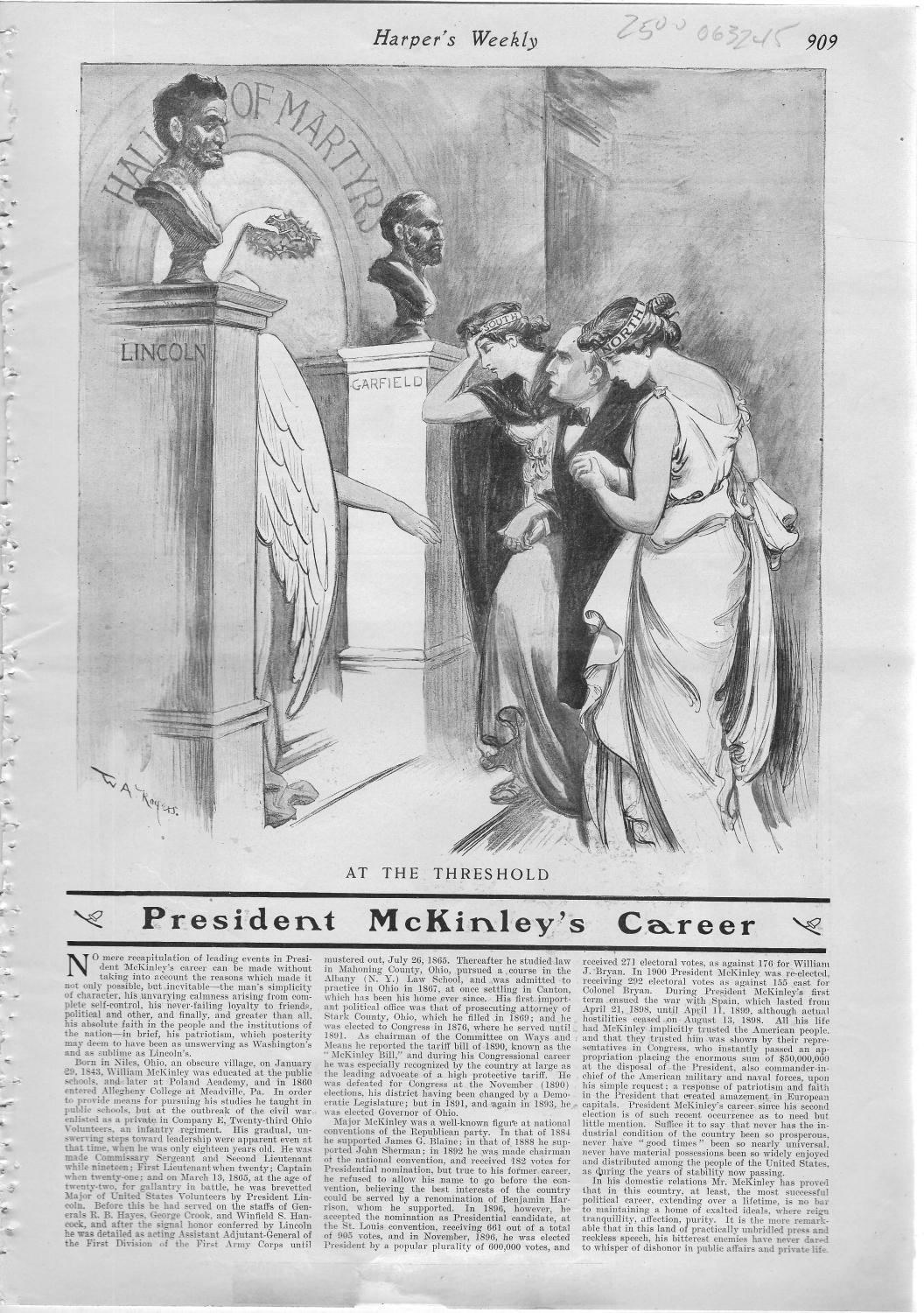
Image from Harper’s Magazine, September 14, 1901 -= McKinley “At the Threshold” of Martyrs’ Hall
Teachers should be mining the “On This Day” feature at the New York Times, which usually features an historic cartoon or illustration from an antique Harper’s Weekly. It is a favorite feature, to me.
his post-dated cartoon was published as President William McKinley lay dying from an assassin’s bullet. He had been shot on September 6, 1901, by anarchist Leon Czolgosz (pronounced chol-gosh) at the Pan-American Exposition in Buffalo, New York. The president died on September 14. Here, McKinley is led to the Hall of Martyrs by grief-stricken personifications of the North and South. Between pillars topped by busts of the two previously slain presidents, Abraham Lincoln and James Garfield, the angel of death prepares to place a laurel wreath of honor upon McKinley’s head. (Images related to Garfield’s assassination also showed a reconciled North and South.)
There is much more at the Times site.
Robert Lincoln, the son of Abraham Lincoln, was present when McKinley was shot. Accounts I have read but not confirmed say that Robert Lincoln had been invited to attend Ford’s Theatre with his father and mother, the night his father was shot. As a member of President James Garfield’s cabinet, Robert Lincoln had been awaiting Garfield’s arrival at Union Station in Washington, D.C., when Garfield was shot.
And as a visitor in Buffalo, Robert Lincoln had as a matter of respect lined up to shake President William McKinley’s hand.
Astounding if true. Four U.S. presidents have been assassinated. Robert Lincoln was close to the first, the assassination of his father, and present for the next two. Where can we confirm that story?
McKinley’s death catapulted the do-gooder, Theodore Roosevelt, into the presidency, probably to the great chagrin of corrupt Republican politicians who had hoped that by getting him nominated to the vice presidency they could get him out of New York politics.
You may get a free copy of the 2011 U.S. Statistical Abstract, on CD.
Available January 2011
On the CD-ROM version are Excel spreadsheet files for each of the individual tables.
In many cases the files contain more detailed information than is found in the book. Also, in some cases the Excel files contain more recent and revised data that were released by the source after publication of the printed version of the Abstract. You will also find the same Adobe Acrobat files for each section which you find on this web site.
Additional information—
While supplies last, single copy FREE (one per customer) by calling Customer Services at 1-800-923-8282.
Spread the word; friends don't allow friends to repeat history.
(b) Proclamation.— The President is requested to issue each year a proclamation calling on— (1) State and local governments and the people of the United States to observe Patriot Day with appropriate programs and activities;
(2) all departments, agencies, and instrumentalities of the United States and interested organizations and individuals to display the flag of the United States at halfstaff on Patriot Day in honor of the individuals who lost their lives as a result of the terrorist attacks against the United States that occurred on September 11, 2001; and
(3) the people of the United States to observe a moment of silence on Patriot Day in honor of the individuals who lost their lives as a result of the terrorist attacks against the United States that occurred on September 11, 2001.
Patriot Day formerly occurred earlier in the year; information on flag flying has not been added to the Flag Code portions of U.S. law, and consequently this news gets missed.
Fly your flag today, at half-staff. Remember when flying a flag at half-staff, it is first raised to full staff, then slowly lowered to the half-staff position. When the flag is retired at the end of the day, it should again be crisply raised to the full-staff position before being lowered.
A flag attached to a pole that does not allow a half-staff position should be posted as usual.
A National Day of Service
Also, September 11 is also designated as a national day of service, under the Edward M. Kennedy Serve America Act, Public Law 111-13 (April 21, 2009). The Corporation for National and Community Service is charged with encouraging appropriate service in honor of the day and in honor of those who died.
Description
On April 21, 2009, President Barack Obama signed legislation that for the first time officially established September 11 as a federally recognized National Day of Service and Remembrance.
By pledging to volunteer, perform good deeds, or engage in other forms of charitable service during the week of 9/11, you and your organization will help rekindle the remarkable spirit of unity, service and compassion shared by so many in the immediate aftermath of the attacks. And you’ll help create a fitting, enduring and historic legacy in the name of those lost and injured on 9/11, and in tribute to the 9/11 first responders, rescue and recovery workers, and volunteers, and our brave military personnel who continue to serve to this day.
Check in your own community to find opportunities for service projects.
Spread the word; friends don't allow friends to repeat history.
BBC map showing location of Wagah and Punjab, divided between Pakistan and India, south of Kashmir
Written accounts cannot possibly do justice to the ceremonies that mark the daily close of business at the border between India and Pakistan. I had understood it was quite a good show, rivaling the changing of the guard at Buckingham Palace.
But, you don’t expect Monty Python to break out at these affairs, do you? Here’s a video of the ceremony as it was conducted prior to July 2010, I believe, which I found at Wimp.com. It’s a video clip from BBC Worldwide, narrated by comedian Sanjeev Bhaskar.
Vodpod videos no longer available.
(If that one doesn’t work, try this one — a bit lower quality video):
(Or, here’s a shorter, YouTube version of Baskar’s film.)
Where in the world is this? It’s in a town and area called Wagah, in Punjab, divided between India and Pakistan since the 1947 independence of those nations (links to Wikipedia left in for your convenience).
Wagah (Punjabi: ਵਾਘਾ, Hindi: वाघा, Urdu: واہگہ) is the only road border crossing between India and Pakistan[1], and lies on the Grand Trunk Road between the cities of Amritsar, India and Lahore, Pakistan. Wagah itself is a village through which the controversial Radcliffe Line was drawn. The village was divided by independence in 1947. Today, the eastern half of the village remains in the Republic of India while the western half is in Pakistan.
While both nations and local residents fully recognize the silliness, it also stands as a symbol of the deep divisions between the two nations.
The Wagah border, often called the “Berlin wall of Asia”,[2] is a ceremonial border on the India–Pakistan Border where each evening there is a retreat ceremony called ‘lowering of the flags’,[3] which has been held since 1959.[4] At that time there is an energetic parade by the Border Security Force (B.S.F) of India and the Pakistan Rangers soldiers. It may appear slightly aggressive and even hostile to foreigners but in fact the paraders are imitating the pride and anger of a Cockerel.[1][5][6] Troops of each country put on a show in their uniforms with their colorful turbans.[7] Border officials from the two countries sometimes walk over to the offices on the other side for day to day affairs. The happenings at this border post have been a barometer of the India-Pakistan relations over the years.[1]
Did someone say “Pythonesque?”
Here’s Michael Palin narrating another view of the ceremony for one of his BBC enterprises, Himalaya with Michael Palin:
Would you be surprised to hear that local people refer to this as “the dance of the roosters?”
Events at this crossing reflect some minor easing of tension between the two nations in the last decade, and in 2010 both nations announced they would tone down the retreat ceremonies. Surely some scholar has analyzed this retreat ceremony and its history, to determine whether it helped ease the tension, or increased the conflict between the two nations. Could soldiers who participate in such goings-on actually shoot at each other?
Has anyone got a more recent viewing of the ceremony?
How will you explain this to your sophomore world history class? Is there anything sillier than humans in conflict?
Video via VodPod.
An astonished tip of the old scrub brush to Judith Shields.
(This is almost completely an encore post — one that should get more circulation. From four years ago, in 2007. I have not updated years or ages — sharpen your math skills, and do it as you go.)
Some people can’t let go of the past, and like the greedy chimpanzee who grasps the rice in the jar, and then is trapped when he cannot pull out his fist nor will he give up his prize to save his freedom, they trap themselves out of a good life.
Cover of 1996 album of songs, "Pete." Seeger, born May 3, 1919, is 88 years old now.
Probably more important in 2011 than before: Fly your flag for American labor today.
Poster from the Office of War Information, 1942
It’s Labor Day 2011 in the United States, a federal holiday, and one of those days Americans are urged to fly the U.S. flag.
The poster was issued by the Office of War Information in 1942, in full color. A black-and-white version at the Library of Congress provides a few details for the time:
Labor Day poster. Labor Day poster distributed to war plants and labor organizations. The original is twenty-eight and one-half inches by forty inches and is printed in full color. It was designed by the Office of War Information (OWI) from a photograph especially arranged by Anton Bruehl, well-known photographer. Copies may be obtained by writing the Distribution Section, Office of War Information [alas, you can’t get a copy from the Office of War Information in 2011]
A new biography of Millard Fillmore popped out last spring, and the publisher didn’t send me a copy to review!
Not that my review could boost sales much — nor harm them — but don’t publishers use Google to figure out how they might get some publicity for their books? Most internet searches for “Millard Fillmore” end up here.
No, I’m not really offended. But I did find it interesting that none of my “Millard Fillmore” keyword compilers picked up on the book.
Details: Millard Fillmore, Paul Finkelman, Times Books, $23.
In this short, fierce book—part of the “American Presidents” series—Mr. Finkelman has delivered an unvarnished but compelling portrait of one of our least remembered but far from insignificant presidents. Against his grain, he gives Fillmore credit for promoting a number of “visionary” ideas that would come to fruition only after he left the presidency in 1853: the transcontinental railroad, the assertion of American power in Hawaii, the building of a Central American canal. “But on the central issues of the age,” Mr. Finkelman writes at the end of “Millard Fillmore,” “his vision was myopic and his legacy is worse.”
Or, until that account is unsuspended by the forces supporting Donald Trump: Follow @FillmoreWhite, the account of the Millard Fillmore White House Library
We've been soaking in the Bathtub for several months, long enough that some of the links we've used have gone to the Great Internet in the Sky.
If you find a dead link, please leave a comment to that post, and tell us what link has expired.
Thanks!
Retired teacher of law, economics, history, AP government, psychology and science. Former speechwriter, press guy and legislative aide in U.S. Senate. Former Department of Education. Former airline real estate, telecom towers, Big 6 (that old!) consultant. Lab and field research in air pollution control.
My blog, Millard Fillmore's Bathtub, is a continuing experiment to test how to use blogs to improve and speed up learning processes for students, perhaps by making some of the courses actually interesting. It is a blog for teachers, to see if we can use blogs. It is for people interested in social studies and social studies education, to see if we can learn to get it right. It's a blog for science fans, to promote good science and good science policy. It's a blog for people interested in good government and how to achieve it.
BS in Mass Communication, University of Utah
Graduate study in Rhetoric and Speech Communication, University of Arizona
JD from the National Law Center, George Washington University


 Posted by Ed Darrell