Quote of the moment, Daniel Boorstin channels Kin Hubbard: Pretension to knowledge more dangerous than ignorance

February 26, 2012

Daniel Boorstin, Librarian of Congress, Information Bulletin January 2003

Daniel Boorstin, Librarian of Congress, Information Bulletin January 2003

In an earlier post I asked about the origins of this quote, and a reader capable of searching well gave us a good enough citation:   Daniel Boorstin, the late historian and former Librarian of Congress, wrote:

I have observed that the world has suffered far less from ignorance than from pretensions to knowledge. It is not skeptics or explorers but fanatics and ideologues who menace decency and progress. No agnostic ever burned anyone at the stake or tortured a pagan, a heretic, or an unbeliever.

Boorstin wrote that in an essay in  a book published in 1990, “The Amateur Spirit,” in the update of 1935’s Living Philosophies (edited by Clifton Fadiman).  You can see a more complete version of the quote here.

Isn’t that eerily similar to Kin Hubbard’s observation?  From Boorstin, the former Librarian of Congress, it carries the heft of more academic language than Hubbard’s version, but it clearly echoes the idea, doesn’t it?

Below the fold, the statement in greater context of the duty of historians.

Tip of the old scrub brush to j a higginbotham.

Read the rest of this entry »


Occupy Your Local Library

November 8, 2011

Rob Rogers at the Pittsburgh Post Gazette firms up the reasons he should get a Pulitzer for cartooning; want books, computers, and the ability to travel through time and space?  Santa has a deal for you:

Rob Rogers cartoon, Library Card - Pittsburgh Post-Gazette

Rob Rogers cartoon, Library Card - Pittsburgh Post-Gazette

Big tip of the old scrub brush to Jean Detjen in Appleton, Wisconsin.


Strike a blow for freedom and the Constitution: Read a banned book!

September 26, 2011

John Maunu reminded me this week is Banned Books Week.  Details from the American Library Association:

Banned Books Week 2011

September 24−October 1, 2011

Banned Books Week (BBW) is an annual event celebrating the freedom to read and the importance of the First Amendment.  Held during the last week of September, Banned Books Week highlights the benefits of free and open access to information while drawing attention to the harms of censorship by spotlighting actual or attempted bannings of books across the United States.

Intellectual freedom—the freedom to access information and express ideas, even if the information and ideas might be considered unorthodox or unpopular—provides the foundation for Banned Books Week.  BBW stresses the importance of ensuring the availability of unorthodox or unpopular viewpoints for all who wish to read and access them.

The books featured during Banned Books Week have been targets of attempted bannings.  Fortunately, while some books were banned or restricted, in a majority of cases the books were not banned, all thanks to the efforts of librarians, teachers, booksellers, and members of the community to retain the books in the library collections.  Imagine how many more books might be challenged—and possibly banned or restricted—if librarians, teachers, and booksellers across the country did not use Banned Books Week each year to teach the importance of our First Amendment rights and the power of literature, and to draw attention to the danger that exists when restraints are imposed on the availability of information in a free society.

Banned Books Week is sponsored by the American Booksellers Association; American Booksellers Foundation for Free Expression; the American Library Association; American Society of Journalists and Authors; Association of American Publishers; and the National Association of College Stores.  It is endorsed by the Center for the Book in the Library of Congress. In 2011, the Comic Book Legal Defense Fund; National Coalition Against Censorship; National Council of Teachers of English; and PEN American Center also signed on as sponsors.

For more information on getting involved with Banned Books Week: Celebrating the Freedom to Read, please see Calendar of Events, Ideas and Resources, and the new Banned Books Week site. You can also contact the ALA Office for Intellectual Freedom at 1-800-545-2433, ext. 4220, or bbw@ala.org.


Memphis Public Library assembling history of 2011 floods

June 28, 2011

Here’s a good idea:  The Memphis Public Library is putting together an archive on the 2011 floods in the area, we learn from the Memphis Daily News:

St. Mary’s Senior Helps Library Build Flood Archive

St. Mary’s Episcopal School student Ellery Ammons is devoting her summer break to helping the Memphis Public Library & Information Center build an archive documenting the Mid-South floods of 2011.

Ammons, an employee of the Shelby Forest General Store owned by her parents, is also a Girl Scout, working toward her Gold Award.

Recognizing the need to document this year’s historic deluge, the high school senior decided to take on the tasks of soliciting, cataloging and archiving community photos to create the 2011 Flood Collection.

She plans to create a digital archive of flood photographs to provide future generations with an accurate record of the floods that ensued when the Mississippi and its tributaries overflowed in Memphis and the surrounding areas this past spring.

Library digital projects manager Sarah Frierson said she’s delighted to have the extra hands in the history department, saying the collection “will be a wonderful complement to the library’s existing Mid-South Flood Collection, which documents the floods of 1927 and 1937.”

The Benjamin L. Hooks Central Library, 3030 Poplar Ave., is seeking photo donations to add to the 2011 Flood Collection. Donations, which will become part of the library’s permanent collection, can be brought to the history department on the main library’s fourth floor or e-mailed to Flood2011.Photography@gmail.com.

– Aisling Maki


Bush I Presidential Library and Museum: Hello, Indiana Jones?

June 14, 2011

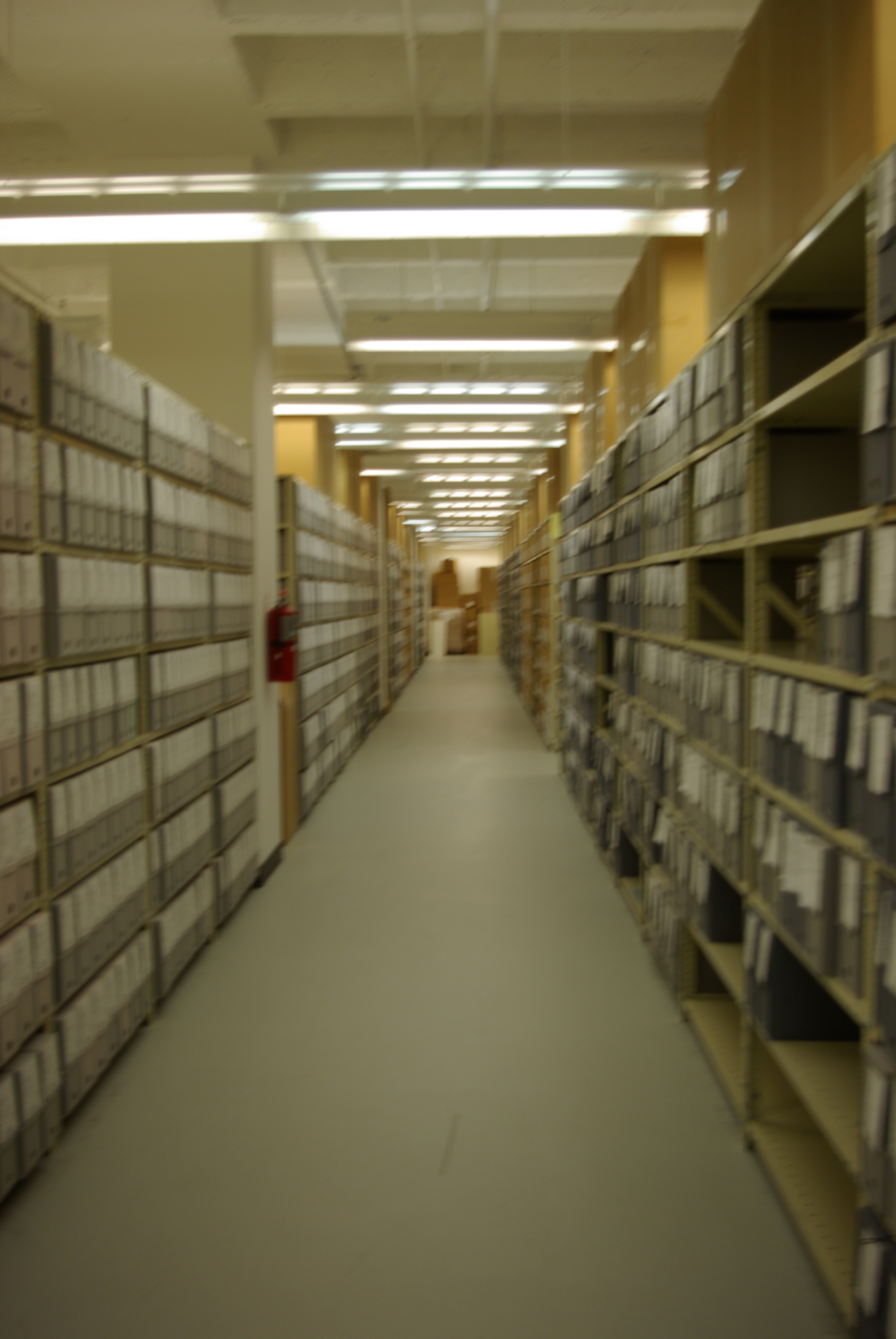
It’s not really that big — but what do you think of when you see this photo of the unindexed files at the George H. W. Bush Library and Museum (at Texas A&M at College Station, Texas)?

Unindexed files at the Bush I Library - 6-13-2011 1677-Photo by Ed Darrell, use permitted with attribution

Hello? Which row has the Arks of the Convenants?

Yeah, we all thought the same.

The big difference:  In College Station, archivists are working through these documents, indexing them for use.

They use Freedom of Information Act requests to set their agenda, which strikes me as bass ackwards, but they’re working on getting it done.


Free bus tours to the FDR Library?

June 6, 2011

Franklin Roosevelt voting in Hyde Park, New York

Franklin Roosevelt voting in Hyde Park, New York, November 2, 1937 - FDR LIbrary image

In the Dallas district, and across much of Texas, field trips are being cut out.  Budget restraints, you know.  Rick Perry’s math is atrocious, and the “surplus” he claimed we had in the budget turned out to be a $27 billion deficit.

So, I got quite excited to read this press release from the Franklin D. Roosevelt Presidential Library and Museum in Hyde Park, New York:

FOR IMMEDIATE RELEASE

For information call:
Clifford Laube at (845) 486-7745

YOUR BUS COULD BE ON US!

New funding available for field trips to historic Hyde Park destinations

HYDE PARK – Field trips are back! The National Park Service and FDR Presidential Library and Museum are pleased to offer new transportation grants for 2011 field trips to five renowned Hyde Park destinations – FDR Presidential Library and Museum, Home of FDR National Historic Site, Eleanor Roosevelt National Historic Site, Top Cottage and Vanderbilt Mansion National Historic Site.

The new grants are managed by Teaching the Hudson Valley (THV), a nonprofit that helps educators and students discover and appreciate the natural, historical and cultural treasures of the Hudson Valley. A list of available programs and grant application form are available in the Grants section of THV’s website.

“These sites are brimming with world-class learning opportunities for local students,” said Sarah Olson, superintendant of the Roosevelt-Vanderbilt National Historic Sites. “We recognize that many school districts have cut back or eliminated field trips due to budget constraints. These grants are designed to put great field trips back in reach.”

Educators are free to create their own curriculum, and the sites have a wide variety of prepared curricula, including:

  • Pretend You are the President, grades 4-6
  • Eleanor Roosevelt: First Lady of the World, grades 4-6
  • FDR’s Boyhood Farm, grades 1-3
  • Searching for Salamanders, grades 7-12
  • Podcasts interpreting the many trails that traverse the 5 sites

“To walk in the footsteps of history, to touch and hear nature – these are the experiences that make learning vivid and memorable,” said Lynn Bassanese, director of the FDR Presidential Library & Museum. “Field trips are becoming an endangered species, but the need for them is still great. Together these sites have provided decades of great experiences for educators and students. These new grants will help us continue the tradition.”

K-12 educators in public and private schools may apply for regular, summer or after-school programs. Trips should be related to core curriculum or programs and take place by December 31, 2011. Teachers in the same school or district may apply together.

ABOUT THV

Launched in 2003, Teaching the Hudson Valley (THV) helps educators and students discover and appreciate the natural, historical, and cultural treasures of the Hudson Valley. THV programs foster collaboration between schools and informal learning sites. Our growing collection of free K-12 lessons uses significant Valley sites to teach all subjects. For details, visit http://www.TeachingtheHudsonValley.org.

THV is a program of the Hudson River Valley National Heritage Area and HRV Greenway Conservancy, Inc.; National Park Service – Roosevelt-Vanderbilt National Historic Sites; Hudson River Estuary Program/NY State Dept. of Environmental Conservation; and Hudson River Valley Institute at Marist College.

#   #   #

Alas, it turns out it’s not intended for Texas classrooms.  Drat.

I’ve taken large groups of 14-16 year-olds through those sites.  An halfway interested teenager can get eyes opened seeing how FDR grew up, in the place he grew up.  The library and museum offer spectacular displays on FDR’s presidency and the times.  It’s exactly the sort of experience a lot of my students have never had, but need.

I’ll have to see what we can do with museums and libraries a little bit closer — the George H. W. Bush Library in College Station, Texas, the Lyndon Johnson Library in Austin, and the  Bill Clinton Library in Little Rock.  Possibilities of touring close-by sites make me quiet about the odd situation at the George W. Bush Library and Center for Right-Wing Propaganda planned for Southern Methodist University.   There’s a great chance that the advantages of having the educational resources will outweigh the ignominy of the propaganda activities (though the Hoover Institute makes one appropriately wary).

Look for some reports back, soon.  While you wait, call the Texas Lege and tell them to appropriate enough money to educate the students in the American Way, will you?  The Lege is still meeting in Austin, in emergency, special session.


Typewriter of the moment: William Saroyan

December 19, 2010

William Saroyan's typewriter, photo from the Bancroft Library, University of Caliornia - Berkeley

William Saroyan's typewriter, displayed at the Saroyan Museum at his home in San Francisco - photo from the Bancroft Library, University of California; Berkeley

William Saroyan’s niece, Jacqueline Kazarian, recently gifted the Bancroft Library with a significant part of the archives of Saroyan’s work.  The press release on the gift included a photo of Saroyan’s Fox typewriter, which is displayed at the Saroyan museum in San Francisco.

Saroyan came from an Armenian American family, born in Fresno, California in 1908.  His writings illuminated the experience of Californians and Armenian Americans, especially during the Great Depression.

In many ways Saroyan’s work symbolizes the uniqueness of the Armenian community in America, especially California.  [You still out there, Ben Davidian?]   Wikipedia strikes the right tone:

Saroyan’s stories celebrated optimism in the midst of the trials and tribulations of the Depression. Several of Saroyan’s works were drawn from his own experiences, although his approach to autobiographical fact contained a fair bit of poetic license.

His advice to a young writer was: “Try to learn to breathe deeply; really to taste food when you eat, and when you sleep really to sleep. Try as much as possible to be wholly alive with all your might, and when you laugh, laugh like hell.” Saroyan endeavored to create a prose style full of zest for life and seemingly impressionistic, that came to be called “Saroyanesque”.

The complete May 19, 2010,  press release from the University of California is below.

a sketch "from a Turkish admirer," a photo of the author in his youth, and a framed sketch of Saroyan

The Bancroft Library's new archival material on William Saroyan includes (left to right) a sketch "from a Turkish admirer," a photo of the author in his youth, and a framed drawing of Saroyan with a passage of his writing on Armenia. (Images courtesy of the Bancroft Library)

The Bancroft Library accepts gift of William Saroyan archives

By Kathleen Maclay, Media Relations | 19 May 2010

William Saroyan

William Saroyan (Photo courtesy of The Bancroft Library)

BERKELEY — The Bancroft Library at the University of California, Berkeley, has received a spectacular gift of hundreds of books, drawings, correspondence and other personal communications to and from one of America’s best-known writers, the Armenian-American author and playwright William Saroyan.

The rich collection includes approximately 48 cartons with 1,200 books and other archival materials assembled by his niece, Jacqueline Kazarian, of San Francisco, who also is the founder of the William Saroyan Literary Foundation International. A celebration of the gift is set for noon on Friday (May 21) at The Faculty Club on campus.

“UC Berkeley is such an incredible place of learning and growing and intellectual exploration,” said Kazarian, who earned degrees in communication and decorative arts at UC Berkeley in the early 1950s. “I know that my uncle wanted his library, manuscripts and galleys to go to Berkeley. Students will be inspired by the collection.”

Apart from this gift, The Bancroft Library already retains significant holdings of Saroyan’s work that it collected over the course of his life and career, and it continues to add to that collection. Most of the latest materials come from Saroyan’s home on San Francisco’s 15th Avenue that is now a Saroyan museum directed by Kazarian. Those materials were supplemented by Kazarian’s extensive personal collection, as well as by items of Saroyan’s that she acquired through a prominent Boston archivist and via a Saroyan friend.

“Jacqueline Kazarian’s new gift is the largest and most substantial augmentation to the Saroyan collections at Bancroft that we have ever received,” said Peter Hanff, Bancroft’s deputy director.

The author’s classic manual typewriter, as displayed at his San Francisco home

The author’s classic Fox manual typewriter, as displayed at his San Francisco home. (Photo courtesy of The Bancroft Library)

Saroyan, born in Fresno, Calif., in 1908, drew extensively on his Armenian-American heritage and childhood experiences for his books, plays and short stories. Much of his writing was considered impressionistic and reflected a hearty optimism often hard to find during the gritty Great Depression. He died in 1981 at the age of 72, with his niece at his side.When Story magazine editors Martha Foley and Whit Burnett printed Saroyan’s “The Daring Young Man on the Flying Trapeze” in 1934, it was an immediate success, triggering Saroyan’s fame and standing as one of his many literary achievements.

“Uncle Bill’s writing revolutionized the short story,” said Kazarian, adding that she has always found his work “almost spiritual and fable-like.”

His five-act play, “The Time of Your Life,” is the only American play to have won both the New York Drama Critics’ Circle Award and the Pulitzer Prize. Saroyan’s work as a screenwriter with Hollywood director Louis B. Mayer on the film “The Human Comedy” won an Academy Award in 1943, and Saroyan later wrote a widely acclaimed book with the same title.

Kazarian’s gift to The Bancroft Library includes multiple first editions of Saroyan’s works, such as “The Daring Young Man on the Flying Trapeze,” “My Name is Aram” (1940), “The Human Comedy” and “Obituaries” (1979), and many materials personally inscribed by the writer. Also among the new items according to Steven Black, the head of acquisitions for Bancroft, are letters, telegrams and notes written by Saroyan to relatives and others close to him, mostly during the 1930s and 1940s.

antiquarian book dealer Peter Howard of Berkeley, shown here poring through Saroyan materials

Antiquarian book dealer Peter Howard of Berkeley, poring through Saroyan materials. (Photo courtesy of The Bancroft Library)

“He personalized a lot of what passed through his hands,” Black said, noting that much of the material features marginalia reflecting Saroyan’s thoughts and interests.

There also is a copy of Henry Miller’s “Aller Retour New York,” an 80-page journal about a 1935 visit by Miller to New York City and his journey aboard a Dutch ship back to Europe. It is inscribed by Miller to Saroyan.

And a Saroyan scrapbook in the collection contains press announcements about the Pulitzer Prize for his book, “The Time of Your Life.” He scoffed at the award, contending that the arts should not be judged by commerce.

The new Bancroft collection also contains a pre-publication proof of “Burnt Norton,” the first poem of T.S. Eliot’s “Four Quartets,” which Black said the publisher may have given to Saroyan “when he crossed the pond” on a trip from his temporary home in France to England.

There also is a wide range of magazines, including issues of Horizon and the Partisan Review, a leading publication of the Anglo-American intelligentsia during the 1930s and ’40s, Black said.

The first major deposit at The Bancroft Library of Saroyan’s papers was recorded in October 1980, and the library agreed to organize the collection and give Saroyan a general description and an index. After Saroyan died in 1981, the Saroyan Foundation paid the library to continue assembling the papers for official archives, which the foundation ultimately decided to place at Stanford University. That happened in 1996.

William Saroyan's niece, Jacqueline Kazarian, surveys materials at his San Francisco home

William Saroyan's niece, Jacqueline Kazarian, surveys materials in his home. (Photo courtesy of The Bancroft Library)

Kazarian’s donation is in honor of Berkeley antiquarian book dealer Peter Howard, who has provided appraisal assistance to Bancroft on Saroyan materials and other collections for decades. While director of The Bancroft Library, the late James D. Hart also developed strong professional and personal ties to Saroyan over the years, according to Kazarian and Black.

“Now, the Saroyan family materials come to a place that Saroyan himself would have been happy to see accepting them,” Black said, noting that Bancroft is proud to have so much of Saroyan’s “intellectual remains” to be able to share with the public.

Scheduled to speak about the acquisition at Friday’s event are Jacqueline Kazarian; David Calonne, vice president of education for the Saroyan Literary Foundation International and a Saroyan scholar; San Francisco novelist Herbert Gold; theater director Val Hendrickson reading Saroyan’s short story, “Common Prayer,” and the credo to “The Time of Your Life”; and Charles Faulhaber, director of The Bancroft Library.

UC Berkeley already is home to an Armenian Studies Program, which is focused on contemporary Armenian history, politics, language and culture. And Bancroft, a rich, special collections library containing historical and literary documents and other materials relating to California, the West, Mexico and Latin America, is known for its strong collections on California writers, including Jack London, Robinson Jeffers, Bret Harte, Frank Norris and others.

More information about The Bancroft Library is online. Bancroft is celebrating its 150th anniversary this year.

More:

William Saroyan commemorative stamps from the U.S., and U.S.S.R.

On commemorative stamps issued in both the U.S. and the U.S.S.R., Saroyan wears the Armenian-style moustache he wore through most of his later life. For a stamp to honor a man in both the U.S. and the Soviet Union was extremely rare -- maybe unique.


Constitution Monday

October 2, 2010

Here’s an idea your class could carry out in its own blog:  Alaskan Librarian covers part of the Constitution each monday — here’s the middle of coverage on the amendments.

There’s a bell ringer or 27 bell ringers in there somewhere.


Read a book for International Literacy Day, September 8

September 8, 2010

I almost never remember on time:  September 8 is International Literacy Day, a day designated by the United Nations to celebrate literacy.  International Literacy Day logo 2010

From the Dag Hammerskjöld Library:

Literacy is a cause for celebration since there are now close to four billion literate people in the world. However, literacy for all – children, youth and adults – is still an unaccomplished goal and an ever moving target. A combination of ambitious goals, insufficient and parallel efforts, inadequate resources and strategies, and continued underestimation of the magnitude and complexity of the task accounts for this unmet goal. Lessons learnt over recent decades show that meeting the goal of universal literacy calls not only for more effective efforts but also for renewed political will and for doing things differently at all levels – locally, nationally and internationally.

In its resolution A/RES/56/116, the General Assembly proclaimed the ten year period beginning 1 January 2003 the United Nations Literacy Decade. In resolution A/RES/57/166, the Assembly welcomed the International Plan of Action for the Decade and decided that Unesco should take a coordinating role in activities undertaken at the international level within the framework of the Decade.

Sources listed by the Dag Hammerskjöld Library:

Links to UN and UN System sites:

Unesco

United Nations

UNICEF

United Nations Development Programme

World Bank Group

Additional resources:

The additional resources links on this page are provided for information purposes only and do not necessarily represent an endorsement by the United Nations.

Asia-Pacific Literacy Database

Center for Literacy Studies

Commonwealth of Learning

Education International

International Reading Association
—   International Literacy Day

Literacy Online

Proliteracy Worldwide

SIL International – Literacy

StoryPlus Foundation

Even more resources:

It’s fascinating to me that activities on International Literacy Day seem to be noted in out-of-the-way U.S. newspapers, and even there not much.  Do Americans care about literacy, really?

I half expect the Texas State Board of Education to pass a resolution condeming literacy, since the UN worries about it.


Books dead? Barnes & Noble for sale

August 4, 2010

News of the death of books panicked some stockholders in Barnes & Noble.  Responding to those concerns, the company put itself up for sale (Wall Street Journal article).

The pen didn’t kill the book.  The typewriter didn’t kill the book.  The pencil didn’t kill the book.  Radio didn’t kill the book.  Movies didn’t kill the book.  Television didn’t kill the book.  Telephone didn’t kill the book.  Personal computers didn’t kill the book (much to the chagrin, perhaps, of the designers of the Apple Lisa — and if you remember that, and it’s coming with all the works of Shakespeare loaded on the harddrive, you’re older than your colleagues think you are).

In “A Dangling Conversation,” recorded in 1966 by Simon and Garfunkel, Paul Simon’s lyrics say, “We speak of things that matter/With words that must be said./’Can analysis be worthwhile?/Is the theatre really dead?'”  Some other questions are similarly and equally unstuck in time, and I think “Is the book dead?” is one of them.

So long as there are books, and readers who demand books, there is a need for a bookstore.  They may move to our libraries, but we’ll still need and want them.

Add to FacebookAdd to NewsvineAdd to DiggAdd to Del.icio.usAdd to StumbleuponAdd to RedditAdd to BlinklistAdd to TwitterAdd to TechnoratiAdd to Furl


Quote of the moment: David Brooks, books vs. internet

July 12, 2010

Wisdom comes in keen insights:

These different cultures foster different types of learning. The great essayist Joseph Epstein once distinguished between being well informed, being hip and being cultivated. The Internet helps you become well informed — knowledgeable about current events, the latest controversies and important trends. The Internet also helps you become hip — to learn about what’s going on, as Epstein writes, “in those lively waters outside the boring mainstream.”

But the literary world is still better at helping you become cultivated, mastering significant things of lasting import. To learn these sorts of things, you have to defer to greater minds than your own. You have to take the time to immerse yourself in a great writer’s world. You have to respect the authority of the teacher.

Right now, the literary world is better at encouraging this kind of identity. The Internet culture may produce better conversationalists, but the literary culture still produces better students.

It’s better at distinguishing the important from the unimportant, and making the important more prestigious.

David Brooks, “The Medium is the Medium,” New York Times, July 9, 2010, page A23


Quote of the moment: Books as lighthouses in the dark sea of time

July 3, 2010

Jeffrey Robbins, a human character in the animated cartoon series,

Jeffrey Robbins, a human character in the animated cartoon series, “The Gargoyles”

The written word is all that stands between memory and oblivion. Without books as our anchors, we are cast adrift, neither teaching nor learning. They are windows on the past, mirrors on the present, and prisms reflecting all possible futures. Books are lighthouses, erected in the dark sea of time.

Jeffrey Robbins, a character in the cartoon series, “The Gargoyles”

Now available on Youtube.  To get the quote above, to go to 21:30 in this video:

Tip of the old scrub brush to James Kessler.


Paranoia strikes the birthers

June 20, 2010

Thursday evening WordPress had a glitch — a stray character in code caused the system to overwrite some material, to mess up a lot of blogs.  It took a couple of hours to fix.

In the birther world, such things only happen “by design.”  Because of a glitch that affected 50,000 blogs (including this one), the birthers feel singled out.

Seriously, at that site where the paranoia runs rampant, My Very Own Point of View, the discussion is on what can be discerned by differences in images from microfiche copies of the newspaper columns announcing births recorded in Honolulu, from the Hawaii Vital Records office, in 1961.  In 5,000 words or so, the author determined that there are differences in the images because some of the microfiche is scratched, and some isn’t.

Ergo, the author says, Obama conspired to mess with every microfiche in the world, and he’s therefore an alien (probably from the planet Tralfamador, or maybe a waiter in the Restaurant at the End of the Universe).

I’ve read the piece three times trying to figure out what the point is, other than the author has never thought much about libraries or microfiche or newspapers ever before.  Am I wrong?

No wonder there’s an aluminum foil shortage, eh?

Tinfoil hat area

Warning: Tinfoil Hat Wearers Too Close for Comfort

I suggested a less ominous meaning behind the scratches on the microfiche, but the blog owner found my comments offensive, and refused to post them.  I asked why, and this was the response I got:

Because you are not civil. There is nothing about race in this material or in my posts. There is not a single “conclusion drawn”. If you have an INTELLIGENT debate to advance on the material then do so. If you do not, go post somewhere where your poison is not moderated.

Of course, I made no mention of race.  I addressed solely the issues of library archival procedures and how they might make for differences in copies from different libraries.  Here is the comment she’s talking about; you decide which of us is crazy, Dear Reader:

http://myveryownpointofview.wordpress.com/2010/05/28/extra-extra-announcing-obamas-birth/#comment-251

Why do you assume that microfilm copies should be the same in all locations?  You’re assuming that there were not different editions of the same paper, which is incorrect; you’re assuming there is one source of microfilm copies, which is unlikely (many libraries used to make their own microfilm from paper copies in their collections — it’s unlikely, I think, that the Library of Congress would have used the same microfilm available at the University of Hawaii — in 1961 precedence was given to paper collections, and the microfilming was done later).

You assume that later flaws in the film are not introduced by dust, by reading machines that shred the film.

You assume much that is simply not so in the newspaper industry and in library archiving.

And in the end, what do you claim?  A couple of periods disappear in photocopies?  A new flyspeck appears?

You need to check the rules of civil procedure, specifically with regard to evidence and contemporary business records.  I’ll wager you can figure out why most of what you worry about here is no issue in proving things up in a courtroom.

I don’t  think I was uncivil.  I think that birthers all fall into that category Euripides described, of those whom the gods destroy, they first make mad.

(And, please, if you can figure out what the complaint is about copies differing in quality at different libraries, please tell us what is going on, in comments.)


Annals of What is it about librarians?: Bananas do not soothe the savage beast, and porn titles

April 17, 2010

No Marian-Madam-Librarian for these people.

The Hot Librarian had an adventure with a dancing banana.  And Foxy Librarian gets the giggles from porn titles.

Just What IS It About Librarians?

Don’t even get me going about Judge a Book By Its Cover.

(Oh, and are you looking for a mnemonic on how to remember Van Buren as the 8th president?)

(Video clip from the movie “The Music Man,” Meredith Willson’s brilliant musical play.)


Idle thinking, among the bookporn

March 28, 2010

Night out for the boys — well, for Kenny and me — while Kathryn had some of the girls over.

Kenny introduced me to a Dallas sushi venue, Asian Mint.  His appearing-to-be deep-fried Texas Roll was a pleasant, crunchy blend of oriental and Texas.  The mango sauce added a sweet smoothness.  My more standard tuna came with a little internal heat — the wasabi perfectly blended (Kenny is the one who doesn’t like horseradish heat, having somehow missed that gene from my grandfather).

Asian Mint is a Dallas hit (“Asian fusion”).  It’s not Salt Lake City’s Takashi, but for 1,000 miles from the Wasatch Front, it’s a good place for Saturday night.  We got there early.  Families were lined up waiting when we left.

We closed off the night at Half-Price Books, at the store on Northwest Highway fans and employees fondly deem “the mother ship.”  (Years ago, across the street to the east, the store was in an old, converted restaurant which had a pirate’s ship inside; the store kept the ship as a kids’ reading area.  Was that the origin of “mother ship?”)

Books?  Today?

I don’t read enough.  20 years ago I found a study that said if you read one book a month, 12 books a year, you’re in the 99th percentile of readers.

The coffee mug with Einstein on it says “Coffee makes me smart.”  Kenny, our family’s most-tech savvy early-adopter — a high commendation in a family where Mom and Dad have been in computers since mainframes were the way to go — agreed that it’s more likely books that make us smart.  We don’t read enough, but we stay in the 99th percentile.

What an easy, easy way to get ahead!  Get a book:  Read it.

Michael D. Green, the real estate impresario for Murray Hill who formerly headed the Louis August Jonas Foundation when I had so much fun there, used to say that he was not educated, but he read the book reviews.  Reading the book reviews would be better than not knowing.  At a Manhattan cocktail party he could hold his ground with just about anyone.  I’ve never found a topic on which he didn’t know something, usually cutting-edge.  His book recommendations are always epiphanies.

Bookstores are full of them, epiphanies.

So are libraries.  Idle Think’s “bookporn” series cheers me up enormously, most of the time.