Listen to a voice of experience

August 14, 2007

Quoting from Second Drafts, verbatim:

My mother, Charlotte, just retired in May after 30+ years teaching high school English. As this will be her first August without having to prep for school, I thought I’d better ask for her top ten teaching suggestions before she forgot them all. Here’s what she emailed me:

  1. Establish a seating chart at the beginning, but allow time for schedule changes. Some of my colleagues would allow students to sit where they wanted, and they all would end up at the back of the room. I always wanted them under my nose!
  2. Greet students cheerfully. You may be the only one to do this in their day.
  3. Have high expectations, but be realistic.
  4. Dress professionally, even though others don’t.
  5. Be alert to students whose eyes are focused on their laps – they’re probably texting!
  6. You gotta have a gimmick – a daily trivia question written on the board works well here. I always used the question cards from the Trivial Pursuit game. The first person to answer as the students come into the room gets a piece of peppermint candy, which enhances higher level thinking skills.
  7. Surprise the kids once in a while by diverting from the syllabus (Thoreau would love you for this).
  8. Be consistent in routine and discipline.
  9. Take care of discipline problems yourself, as much as you can.
  10. Be real and enjoy your students.

School starts tomorrow. Anybody else got any counsel you’d like to share?


Teacher pay, Teacher unions — What teacher would switch places with Richard Cohen?

August 14, 2007

Richard Cohen, whom I regarded a good columnist when we lived in Washington, D.C., had made an odd turn in the past decade or so. Where normally he’d stand up for public institutions and the people who run them, he just sounds cranky lately. In short, he’s turned into a person who likes Bush Republicans. Oh, my, it erupted in his recent column which is just grousing about how much education costs in the District of Columbia, with an ambiguous, implicit claim that maybe there’s too much money going into education there.

(Well, maybe too much for the results gotten compared with a few suburban districts; not enough to boost performance on the tests.)

Jason Rosenhouse at Evolutionblog Fisks the column, Fisks Cohen, and generally supports teachers — it’s worth a read.

It’s worth a read especially if you’re one of those who, like Richard Cohen, think we should suppress the pay for teachers until they improve, ignoring all the lessons you might ever have learned about getting what you pay for, and about the economics of hiring the best, the brightest, or just the heroes necessary to make a change. Here’s part of Rosenhouse’s commentary:

But that is not the main subject of this post. Instead it’s that gratuitous slap at the unions that struck me. Cohen, like a trained seal, has learned that mindlessly bashing teacher’s unions will never get you into trouble. That is why he feels no need to provide any specifics about what, exactly, the unions are doing wrong. Instead, when it comes time to reveal those subtleties of the education problem about which Democrats need to be instructed, Cohen only produces this:

Only one candidate, Barack Obama, suggested that maybe money was not all that was lacking when it comes to educating America’s poor and minority children. Parents had a role to play, too. “It is absolutely critical for us to recognize that there are going to be responsibilities on the part of African American and other groups to take personal responsibility to rise up out of the problems we face,” he said. What? It’s not just a question of funding?

Parents! Of course! How could those money grubbing teacher’s unions and their slavish Democratic puppets have overlooked such a thing? All this focus on making sure schools have the funds to heat their buildings in the winter and patch the roof when it leaks, this crazy idea that a school using twenty year old textbooks needs money if they are to procure new ones or that science labs are not exactly inexpensive, and they simply overlooked that parents have a role to play in their children’s education. One can only hope the Democrat’s pay attention to someone as perceptive as Cohen.

::heavy sigh::

The U.S. is not alone.  Australia has some teacher pay and facility issues, too, according to Matt’s Notepad.  Another interesting read.


Sacrificing accuracy and children for art

August 14, 2007

Cartoon Brew has an upload of an animated ad for the abominable Creation Museum in Kentucky, Ken Ham’s monument to denial of reality and campaign against science. (I wish I knew how to upload a link here . . . if you have suggestions, pass them along.) Here’s Youtube version:

Yes, it’s nice animation. As art, it functions rather as the opposite of Picasso’s Guernica, though, doesn’t it? Instead of revealing a truth, even a horrific truth, it is art aiding a campaign of deception.

What do you think?

Does biology need to recruit the ghosts of Tex Avery and Chuck Jones to keep pace? Or is this just one more demonstration of the scientific and moral vacuity of creationism?

We still can’t get legal copies of that brilliant Civil War animation from the Abraham Lincoln Presidential Library and Museum, but we can get crap on television from Ken Ham. It’s just a matter of time before Ham has a slick DVD promo for his museum, mailed to 40,000 high school biology teachers . . . what’s the hurry, and why are we in this handbasket? Going where?

Update: Soyeon Kim, the animator/designer for the commercial, notes in comments that the creators of the ad did not realize it was a creationism museum, since they’d never heard of anything other than legitimate natural history museums. Think of the moral dilemmas: A paying client, versus accurate information. The poorly-paid biology teachers in Dover, Pennsylvania defied their employers and refused to teach creationism. At what point should one simply refuse to go along, even for pay?


Berlin Wall’s 46th

August 13, 2007

Today is the 46th anniversary of the beginning of the Berlin Wall. The post I wrote last year on this topic continues to be popular, day in and day out, but especially when high school curricula get to the Cold War, the Berlin Airlift, the 1960s, and the collapse of the Soviet empire, best exemplified by the destruction of the Berlin Wall itself and the reunification of Germany.

Go read my post of last year, “Berlin Wall’s 45th.”

The photograph I used to illustrate that post has become one of the more popular photos of the Berlin Wall on the internet. It is from a small, too-little used collection posted by Corey Hatch at the University of Utah.

Here is another photo from his collection. It comes without caption; from the barbed wire and the uniform and helmet, I would say This is cropped version of a photo of an East German soldier,  Conrad Schumann , assigned to shoot people trying to breach the wall to escape to West Germany, who instead decided to leap to freedom himself, probably at Checkpoint Charlie, one of three gates between East and West Berlin. I regret I have no further credit information on the photo on August 15, 1961.  The photo is by West German photographer Peter Leibing, then working for Contiepress, in Hamburg.

East German soldier leaping barbed wire of the Berlin Wall, to freedom.

German authorities announced the Wall was open for travel between the two entities of divided Germany on November 9, 1989. Jubilant Germans on both sides of the wall tore down sections, poked holes in the concrete barriers, and generally vandalized the wall over the next few weeks. Negotiations then led the way for the Reunification of Germany on October 3, 1990.

Read the rest of this entry »


Interactive panoramic images of World War II sites

August 13, 2007

Spectacular images of World War II historical sites are available at two websites every history or geography teacher should have bookmarked, and use frequently.

The first is D-Day spots, which features satellite photo/map hybrids, and dozens of Quicktime interactive panoramas of dozens of sites all along the beaches of Normandy.

D-Day Spots image of Utah Beach

The panoramic images are made up of digital photos, usually very high quality, which would be useful images even were they not part of the interactive, panoramic feature; see the image of the West Pointe du Hoc cliffs at right.

West Utah Beach Many beach shots are there, of course — the panoramic images also include a few other sites around the beaches, and some of those images are spectacular all on their own, such as the interior of a local church, Sainte Mére-Eglise.

Sainte Mere-Eglise Church interior, D-Day Panoramas

The second site is Panoramas of World War II Landmarks 1945-2007.

These landmarks feature many battlefield sites, and they offer interactive, Quicktime panoramas of some sites that are not so well known as they ought to be, such as the graveyard at Al Alamein in Egypt (see photo below). To U.S. audiences, some of these sites may be relatively unknown — it’s a good excuse to explore the sites and get more familiar with the European view of World War II.

Al Alamein War Memorial, Egypt

This site also features photos of the war in the Pacific, with a series of photos from Hiroshima (see below), Nagasaki and Tokyo, but also including Pearl Harbor and Okinawa.

Integrating these sites into directed teaching should be easy, if you have a computer and projector. At the D-Day site, many of the panoramas are downloadable. For the Landmarks site, an active internet connection may be required.


Hiroshima, under the dome


Ardeatine Massacre: Bombers were soldiers, not terrorists

August 13, 2007

Our Italian physicist friend, Dorigo, at A Quantum Diaries Survivor reports that an Italian court ruled against a newspaper that started a campaign to deny the history of the Ardeatine Massacre.

Good news today. The supreme court of Cassazione in Italy has ruled that the press campaign labeling “terrorists” the GAP partisans who organized the bombing of Via Rasella in nazi-occupied Rome in 1944, launched by the national newspaper “Il Giornale”, was a striking example of manipulation of historic truth for political means. The newspaper is owned by Paolo Berlusconi (brother of Silvio, formerly premier of Italy in 1994 and 2001-2006), and was directed by Vittorio Feltri . . . a journalist who never hid his sympathy for the extreme right.

What was the Ardeatine Massacre?

Statue memorial to the victims of the Ardeatine Massacre, Italy Wikipedia:

The massacre of Fosse Ardeatine (Italian: Eccidio delle Fosse Ardeatine) took place in Rome, Italy during World War II. On 23 March 1944, 2 German soldiers, 31 Italian soldiers of Battaglione Bozen and a few Italian civilians passing along the road, were killed when members of the Italian Resistance set off a bomb close to a column of German soldiers who were marching on via Rasella[1]. This terrorist attack was led by the Gruppi di Azione Patriottica, of Rosario Bentivegna, Carla Capponi, Antonello Trombadori (Head of GAP in Roma) and the approval of Sandro Pertini (later President of Italian Republic), in order to provocate the reaction of SS troops.

Adolf Hitler is reported but never confirmed to have ordered that within 24 hours, one-hundred Italians were to be shot for each dead German. Commander Herbert Kappler in Rome concluded that ten Italians for each dead German would be sufficient and quickly compiled a list of 320 civilians who were to be killed. Kappler voluntarily added ten more names to the list when the 33rd German/Italian died after the Partisan attack. The total number of people murdered at the Fosse Ardeatine was 335, most Italians. The largest cohesive group among the murdered were the members of Bandiera Rossa, a Communist military Resistance group.

Why is there controversy 60 years later? Read the rest of this entry »


Cheney calls Iraq “quagmire”

August 12, 2007

Santayana’s ghost* e-mailed to call attention to this interview with Vice President Dick Cheney, in which he tells the errors of invading Iraq and deposing Saddam Hussein.

Unfortunately, the interview was with Dick Cheney in 1994, when he was ex-Secretary of Defense, hanging out with the American Enterprise Institute.

Talk about condemned to repeat the errors of history!

* In this case, in the guise of son, Kenny.


Power of a community with common purpose

August 12, 2007

There is a lesson in here about common purpose, maybe even one about democratic action as opposed to a rigid patriarchy (though I confess, I don’t know that water cape buffalo don’t also have a rigid patriarchy).

In any case, the large, gentle creatures beat out two competing, sharp-toothed predators, to save a calf. Parents uniting can do great things.

Amazing video, really:

Tip of the old scrub brush to Telic Thoughts — the most thoughtful post they’ve had there in some time.


DDT’s disruption of hormone activities

August 12, 2007

Critics of Rachel Carson and sponsors of the anti-science, anti-environmentalist campaign to bring back DDT as a major killer, frequently misinform in very selective ways. For example, they like to mention DDT’s role in causing human cancers, because, they claim Rachel Carson was dead wrong about that link. Therefore, they say, DDT is a nice chemical and bans should be lifted.

In reality, carcinogenicity played a very small role in banning DDT. DDT was banned because it kills indiscriminately, killing beneficial insects along with the bad, killing untargeted species, like songbirds, along with the insect targets; and DDT was banned because once released into the wild, it is very long-lived, and its ultimate destructive effects cannot be known or controlled — though some harms, such as the devestation of America’s birds of prey, are extremely well documented.

Similarly, the anti-science crowd doesn’t like to talk about the third big area where DDT produces harms: Hormone disruption. In fact, Steven Milloy’s “100 things you should know about DDT” at the site that peddles junk science, JunkScience.com, does not even contain the word “hormone.”

They play down the fact that DDT and its by-products disrupt reproductive processes, and sometimes disrupt and deform reproductive organs, of nearly every animal it touches. They don’t want you to know about the hormonal effects of DDT and its breakdown products.

So, they never mention books like the National Academy of Sciences’ compilation of the harms of such chemicals, Hormonally Active Agents in the Environment.

Milloy will misquote the NAS when NAS mentions slightly the benefits of DDT; Milloy will not quote NAS when they cite the dangers of DDT. So this book on hormonally active agents, which mentions DDT specifically in 16 chapters for a total of 309 times, will never be mentioned in a discussion of DDT’s dangers — unless you bring it up.

Go see what the book says in the Executive Summary. If you debate the anti-Rachel Carson crowd, use this book frequently — they will have no answers.

And, Sen. Tom Coburn, are you listening? Since when do your constituents want you to defend a chemical which will ruin their farm animals, and especially the ducks they want to hunt? It’s time to quit trying to tarnish the memory of Rachel Carson, Sen. Coburn, and let that post office in Pennsylvania be named after her.


Original Documents: Long history of DDT trouble, from U.S. Fish and Wildlife Service, 1945 and later

August 12, 2007

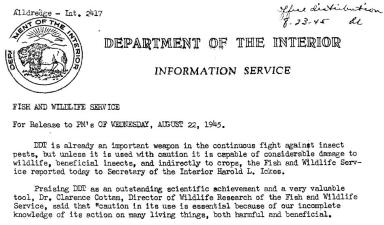
Header of FWS press release, Aug 22 1945

Archives of the U.S. Fish and Wildlife Service (FWS) reveal a long history of trouble with DDT, almost from the first uses of the chemical as an insecticide during World War II. You’ll find extensive links to historic press releases from FWS below the fold.

Critics of the various restrictions on DDT use often claim that DDT is a God-sent chemical that nearly eradicated malaria from the world (absolutely untrue) and which was banned only because of hysteria caused by Rachel Carson’s 1962 book, Silent Spring (untrue at both ends, hysteria and the power of Carson’s book). This is history revisionism at its worst, it is bogus history.

A careful study of the history of the use of DDT shows that scientists were concerned about its dangers from the first uses as a pesticide. The U.S. Fish and Wildlife Service reported dangers in a press release on August 22, 1945, just a week after the surrender of Japan ended World War II (VJ Day was August 15 in Tokyo, August 14 in Washington). In that release FWS noted the beneficial uses of DDT to fight insect and lice infestations that threatened troops and civilians with typhus and other diseases, but cautioned that such use should not become common, that more study was needed: Read the rest of this entry »


Typewriter of the moment: Langston Hughes

August 11, 2007

Langston Hughes at his typewriter

Langston Hughes at his typewriter. Photo from the Kennedy Center.

Manuscript of Langston Hughes' poem,

Manuscsript of “Harlem,” with correction marks. From Kennedy Center website – Harlem Renaissance


Bubba, we’re not in Texas anymore . . .

August 11, 2007

Among other reasons people shouldn’t inject religion into biology is that knowledge of biology can protect one from harm. From Dorigo, at A Quantum Diaries Survivor, in this case, a little mycological knowledge is not only useful to prevent illness, it allows appreciation of beauty:

This morning while following the trail to Malga Nemes, above Passo di Montecroce Comelico, we found a spot of the woods very densely populated with specimens of Amanita Muscaria, a venomous mushroom which has a very esthetic appearance. The intense red color of the cap, covered with white warts, is very distinctive.
Here is a trio which was particularly good looking:

Definitely NOT Texas.

Dorigo is a physicist, and usually very interesting. Don’t take my word for it — go check out his blog.


Henry F. Phillips — when do we celebrate?

August 10, 2007

Herny Phillips' patent for the Phillips screw and screwdriver (Google Patents)

Patent drawings for the Phillips screw and screwdriver, 1936

Only Crook in Town was alerted to the work of Henry F. Phillips by an alert and helpful librarian (well — aren’t they all?). She worries –January 15 is Martin Luther King, Jr., Day, and July 7 is the middle of the summer — what day would be appropriate to celebrate the invention and patenting of the Phillips Screwdriver? (If image above does not display, click the thumbnail picture at the end of the post.)

Ah, history teachers, you noticed that the drawing comes from Google’s files of patent applications. And now you wonder: What other wonderful illustrations can we legally rip off to use in class? Wonderful question — what do you find?

The Phillips screwdriver came along in time for World War II and the mass assembly of aircraft, and aircraft instrument panels. The Phillips screw head helped aircraft assemblers keep from scratching the black metal of the rest of the panel while securing instruments into the forms.

Read the rest of this entry »


Disturbed congressman

August 10, 2007

Idaho’s Rep. Bill Sali is disturbed. But will he seek treatment?

Idaho Rep. Bill Sali - photo from Spokane Spokesman-Review

Better, might he read the Constitution if we give him the link?

Tip of the old scrub brush to Pharyngula, and to Dispatches on the Culture Wars.

Photo probably from the Spokane, Washington, Spokesman-Review


A religious bias against good higher education — in theology!

August 10, 2007

Some religious primary and secondary schools stand on the same, treacherous ground when it comes to curricula which deserve challenging. Castle Hills First Baptist School is not the only educational institution damning children with fool ideas.

Douglas Groothuis teaches at Denver Seminary. In his blog, Constructive Curmudgeon, he lists a set of “imperatives” that he presents annually to his class in “Christian Ethics and Modern Culture.”

Despite his imperative #9:

9. The biblical concept of truth is that a true statement corresponds with or matches objective reality. While human knowing is corrupted by sin, knowledge of the things that matters most—divine and human—is possible, desirable, and pertinent.

Groothuis continues to support and defend intelligent design, a position I find both contrary to his imperative #9, and unethical for anyone, especially Christians, in imperative #17:

17. The Intelligent Design movement is thrusting a wedge between empirical science and philosophical materialism such that the evidence for design in nature may emerge apart from dogmatic and a priori restrictions. Learn about, teach about, and support this movement. See William Dembski, The Design Revolution (IVP, 2004).

Groothuis is a genuine fan of Dembski and Jonathan Wells and all the folderol they can produce. Urging students who claim to be Christian to promote the falsehoods of intelligent design is not a major sin; it’s not so severe as coaching them on racism, genocide, murder, sexism, or disowning the poor. I fear, however, it is the seed of those greater sins. (Here’s a clue: Inter-Varsity Press (IVP) is not known for high standards on science, nor on theology, to some of us; but they are probably more reputable than Regnery publishing.) Intelligent design ideas trend to the fantastic, undesirable, and not relevant.

Shakespeare put the words in Hamlet’s mouth; if only philosophers today would pay them more attention:

There are more things in heaven and earth, Horatio,
Than are dreamt of in your philosophy.

More things like: science, biology, real facts, and honesty and good faith.

What is it about philosophers (Dembski, Groothuis, others at DI)? Are they competing to become to literature and social sciences what engineers are to the sciences, with regard to creationism?