Encore Quote of the Moment: Sherman, on war

May 29, 2007

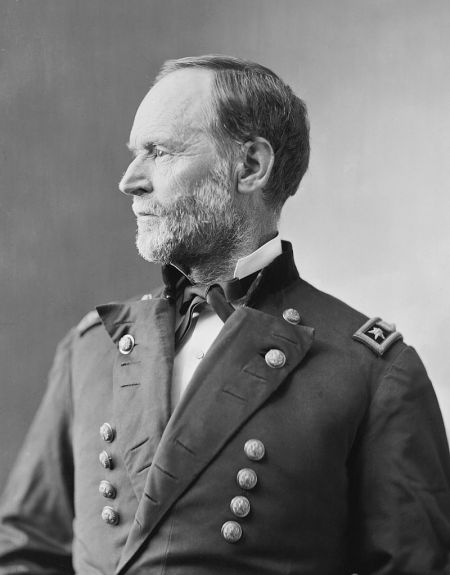
By Mathew Brady - Library of Congress, Prints and Photographs Division, Brady-Handy Collection, reproduction number LC-DIG-cwpbh-04445., Public Domain, https://commons.wikimedia.org/w/index.php?curid=33594

By Mathew Brady – Library of Congress, Prints and Photographs Division, Brady-Handy Collection, reproduction number LC-DIG-cwpbh-04445., Public Domain, https://commons.wikimedia.org/w/index.php?curid=33594

“There is many a boy here today who looks on war as all glory, but, boys, it is all hell.” – Gen. William Tecumseh Sherman,

from an address to the graduating class of the Michigan Military Academy, June 19, 1879, known as his “War is hell” speech (Wikipedia entry on Sherman).
(Query: Does anyone have an electronic link to the full text of Sherman’s address that day? Or, do you know where it might be found, even in hard copy?)

David Parker quoted the prayer out of Mark Twain’s disturbing story, “The War Prayer.Go there for a discussion on what Twain meant, and just how much opposed to war he was.

For a deeper context, and a Jeff Danziger cartoon that will make you stand up and think, see the original post of this quote.


West High best in Utah

May 28, 2007

West High School, Salt Lake City, Utah

Main entrance to West High School, Salt Lake City, Utah. Wikipedia image

I coulda told you that. It’s my mother’s high school. (Class of ’32)

(My old school, Pleasant Grove High, didn’t make the list.)


Call for posts, for 3rd Fiesta de Tejas!

May 28, 2007

The 3rd Fiesta de Tejas! will arrive on June 2, five days from today.

If you blog about Texas, or if you read blogs about Texas, please submit the best posts you wrote or the best posts you read, to share with others.   The best way to submit is through the Blog Carnival entry form:  http://blogcarnival.com/bc/submit_1298.html.

The carnival still needs a logo, and we can use some great art (with permission to publish).  Mostly, we need your contributions.

Texas history, Texas music, Texas culture, Texas geography, Texas food — send it along.

(Please feel free to copy this post and put it on your blog.  The more the merrier.)


Blog Carnival submission form - fiesta de tejas!


Bogus science palace puts blot on Memorial Day remembrances

May 27, 2007

There’s not much to add, beyond the three-quarters of a hundred entries in the one time Ken Ham’s Creation Museum blog carnival, hosted at Pharyngula by P. Z. Myers.

Those we honor on Memorial Day fought, and died, to preserve Ken Ham’s right to believe any fool thing he wants to believe.  That’s part of the ironic beauty of our Constitution and those who fight to defend it.

Having a right to believe any fool thing, and promoting fool ideas with $27 million given by people who expected one to tell the truth, are probably separate, different things.


Memorial Day 2007 – Fly your flag May 28

May 27, 2007

You may fly your flag the entire weekend.  Flag at half-staff at Fort McCoy

Memorial Day, traditionally observed on May 30, now observed the last Monday in May, is a day to honor fallen veterans of wars. Traditionally, family members visit the cemetery where loved ones are interred and leave flowers on the grave.

On Memorial Day itself, flags on poles or masts should be flown at half-staff from sunrise to noon.  At noon, flags should be raised to full-staff position.

When posting a flag at half-staff, the flag should be raised to the full-staff position first, with vigor, then slowly lowered to half-staff; when retiring a flag posted at half-staff, it should be raised to the full staff position first, with vigor, and then be slowly lowered.

Read the rest of this entry »


Historical fiction: Churchill and Fleming, and antibiotics

May 26, 2007

Is this old dead duck still circulating?

The story is that a poor farm kid in England Scotland saves a rich kid from drowning, and the rich family offers to pay for college for the poor kid. The poor kid goes to college, and later makes a great discovery, and that discovery later saves the life of a member of the rich family, who goes on to save the world.

Churchill in Tunisia, 1943, visiting New Zealand’s 2nd Division, with Bernard Freyberg, known as Tiny

Churchill in Tunisia, 1943, visiting New Zealand’s 2nd Division, with Bernard Freyberg, known as Tiny

In various forms I’ve seen this story, that a member of the Churchill family, or Winston Churchill himself, was saved by a member of the Fleming family, or Sir Alexander Fleming himself (the discoverer of penicillin). Then, years later Churchill has a deadly infection, but his life is saved by Fleming’s discovery.

It’s a great story, actually, but it is fabrication from start to finish, laced with famous names, our natural ignorance of some parts of history, and our desire for such coincidences to be true. It’s such a great story that the wrong, hoax version still circulates even after it is so easy to learn that the story is wrong.

The Churchill Centre, in England, has a denial that should be embarrassing to Americans and Christians — they point out it was distributed in the 1950s by churches here.

The story apparently originated in Worship Programs for Juniors, by Alice A. Bays and Elizabeth Jones Oakberg, published ca. 1950 by an American religious house, in a chapter entitled “The Power of Kindness.”

Here are several ways to tell the story is false: Read the rest of this entry »


Listen to your teachers . . . you politicians

May 26, 2007

Long-time friend John Florez erupts at the Deseret News in Salt Lake City from time to time.  Back on April 2, when the Utah legislature was still wrestling with vouchers, a budget surplus and a vastly underfunded education system, Florez had some gentle advice to policymakers everywhere:  “Policy makers must heed teachers’ views.”

      Politicians ought to listen to what the teachers think is needed to improve education. For starters, they want smaller class sizes and an environment that gives them the opportunity to do the most important thing: challenge and motivate students to learn. One wrote that after 30 years of teaching he has “…discouraged … nieces and nephews from taking up the career. What a shame when there is so much possible with all these young minds.” Another wrote that her school had a student teacher quit halfway through, frustrated because the students wouldn’t work; phoning parents resulted in getting an earful, and the principal made little effort to back her up.
The following year, the school had an opening so they phoned her “…to see if she wouldn’t try again at our school.” The reply: “Thank you, if I ever came back it would be there, but never. I have a job now with great opportunities to grow and a great working environment.”

But, John — would better working conditions really help pass the standardized tests?

Some principals and administrators of which I am aware haven’t found the sign yet, but would put it up if they had it:

The daily floggings of staff will continue until morale improves!

They wouldn’t mean it as the joke it was originally intended; or even if they did, the staff would know differently.


Girls and technology: Girl Scouts on the ‘net

May 26, 2007

Here, try this brain teaser.

Girl Scouts of America can be found on the web; some of the stuff at this “Go Tech” site could be useful in the classroom. The design appears to encourage girls to pursue the use of technology, and to open them up to possibilities for careers where women are badly needed, but too seldom go. That becomes clear with this .pdf, 14-page guide for parents, It’s Her Future: Encourage a Girl in Math, Science and Technology.

I wish more organizations would put up sites for kids to use to learn. I’d love to see some interactive sites with great depth on several topics: Geography map skills, navigation, European explorers in the 15th through 20th centuries, market fluctuations for commodities and securities (for economics), Native Americans from 1500 through the 21st century, westward expansion of European colonists in America, time lines of history, great battles, etc., etc. etc.

We are missing the boat when it comes to using computers as tools for learning. Like unicorns and centaurs standing on the dock as Noah sailed away, education as a whole institution and educators individually are missing the boat (with a few notable exceptions — pitifully few).

Where is the Boy Scout site with games and material for the boys?


Quote of the Moment: Physicist Bob Park, on the Creationism Museum

May 25, 2007

The museum is a monument to the failure of education.

o Bob Park, “What’s New,” May 25, 2007

[See full quote below the fold]

Read the rest of this entry »


Who was the first woman in the U.S. Senate?

May 25, 2007

If you answered “Margaret Chase Smith, the Senator from Maine,” you’d be close, but not close enough. Can you tell when she served, even?

David Parker is back from his vacation; in merely noting that he’s back, he pointed to this article about the first woman to serve in the U.S. Senate. Having spent so much time prowling those halls, and having lived with so many people who are so steeped in Senate history, the information caught me a little off guard. Rebecca Latimer Felton, the first woman to serve in the U.S. Senate

Who is it, if it’s not Smith? Read the rest of this entry »


Utah voucher fight: Ball of confusion

May 25, 2007

It’s not clear who will win in the bloody vouchers war going on in Utah — it’s only clear that, once again, public education, students and teachers, lose.

Utah’s legislature, a bastion of Republican conservatism in the last decade or so, passed a voucher bill in its just-ended regular session. Conservative legislature, conservative governor — a law authorizing vouchers is what should be expected these days, no? What the advocates of vouchers failed to take into account has made this quite a drama.

Utah’s voters don’t like vouchers much, but love their public schools a lot.

So, the Utah state board of education opposed the measure. A hint of graft in existing alternatives to public schools angered many citizens. Opponents pointed to, among other things, the possibility that vouchers would vacuum funding from public schools — Utah is already dead last in per-pupil spending in the U.S.

It’s turned into a real donneybrook. [Bloody details below the fold.] Read the rest of this entry »


Creationist math, creationist accuracy

May 24, 2007

From today’s Christian Science Monitor, a story about Ken Ham’s Creation Museum in Petersburg, Kentucky:

The $27 million museum set on 50 acres opens on Memorial Day, and [Answers in Genesis] AiG hopes for 250,000 visitors a year. Mr. Ham, a former science teacher in Australia, is direct about the museum’s purpose: to restore the Bible to its “rightful authority” in society.

And, later in the article:

No one has a handle on the scope of creationism’s influence, says [Ronald] Numbers, author of “The Creationists.” “Intelligent design” (which disputes aspects of evolution but accepts that the universe is billions of years old) has been more in the news recently. But AiG, simply one group in the creationism fold, is clearly doing well. The museum has 8,500 charter members, [Mark] Looy says [AIG’s p.r. guy], and is all paid for – by donations averaging $100.

Now, I admit to having had difficulty with calculus in college. But even using a calculator to make sure my in-the-head numbers were right, 8,500 members multiplied by an average contribution of $100 equals $850,000. That’s considerably less than the $27 million advertised at the top of the article.

There’s a gap of more than $26 million in those figures. Where did the extra $26 million come from?

Is that where the money missing from Iraq went? Is Judge Crater in one of the displays? Is their claim of a 6,000-year-old Earth also off by a factor of at least 27?

Just askin’.


Cartoon of note: Berryman on TR and fair play

May 24, 2007

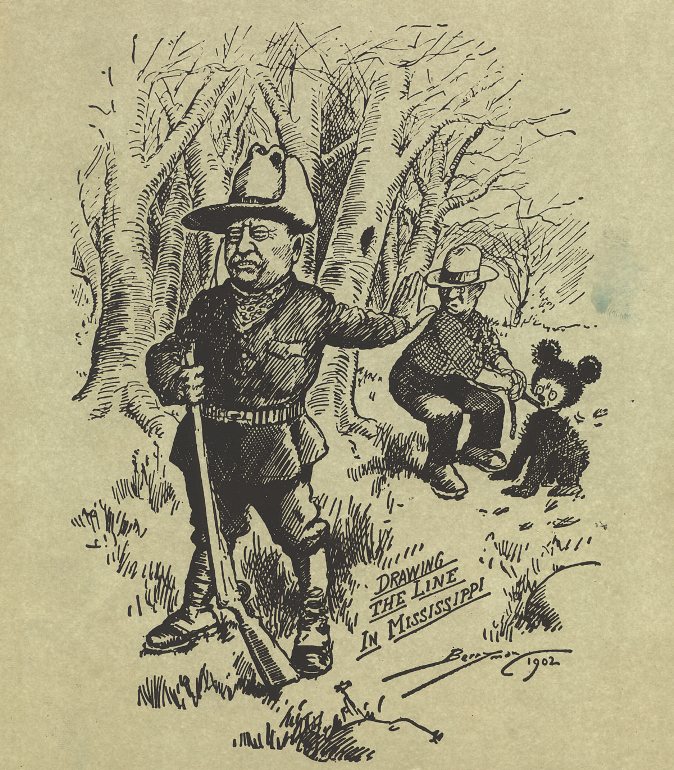
Clifford Berryman cartoon, "Drawing the Line in Mississippi, 1902"

Clifford Berryman cartoon, “Drawing the Line in Mississippi, 1902”

Berryman’s Bear: “Drawing the line in Mississippi.”

In 1902 Teddy Roosevelt hunted bear near Smedes, Mississippi. He didn’t get a bear, as he had hoped. Trip guides tracked a bear with dogs, clubbed it, and tied it up. The bear was offered to TR to shoot.

Teddy refused to shoot it, of course. It was tied up. It was not sporting, not fair, not a match — not the vigorous hunting Roosevelt wanted.

Clifford K. Berryman, a cartoonist for the Washington Post newspaper (he moved to the Washington Star in 1907), captured the moment in a drawing published November 16, 1902. This 1902 cartoon is among the most famous political cartoons ever done.

The good sportsmanship Roosevelt demonstrated echoed long and hard among Americans. His reputation for fair dealing and good sportsmanship increased his popularity immensely.

Candy store owners in New York City, Morris and Rose Michtom, made a stuffed bear, a “Teddy bear,” to commemorate the event. We still call them Teddy bears, today.

Berryman continued to use the bear cub in cartoons for the rest of his career.

Teddy Roosevelt cartoon sources:


Happy birthday, Carl!

May 23, 2007

Carl Linne, b. May 23, 1707

Today is the 300th birthday of Linnaeus, aka Carl Linnaeus, Carolus Linnaeus, Carl von Linné, Carl Linné, etc. etc. Oh, heck, just call him Carl. Happy birthday, Carl!

At Panda’s Thumb.


Fire on the Cutty Sark, to Mary Tyler Moore

May 23, 2007

Everything is connected.

Unaware that the Cutty Sark still existed, the news of the fire on the most famous of the clipper ships caught me by surprise.

Fire on the Cutty Sark

Our U.S. history texts these days mention the clippers, but little more. This wonderful chunk of history, showing great invention in the capture of wind power, and great romance of the sea, falls by the wayside.

Were a teacher so inclined, she might introduce some of that romance and admiration of invention with a bit more than two minutes spent on clipper ships.

For starters, what does “cutty sark” mean? Antiquarian’s Attic provides links to the news of the fire and enough background to make any teacher sound like an aficianado in just a few minutes. “Cutty sark” means a short shift, a very short skirt or dress — it’s from a poem, “Tam O’Shanter” by Robert Burns.

Her cutty sark, o’ Paisley harn,
That while a lassie she had worn,
In longitude tho’ sorely scanty,
It was her best, and she was vauntie.

Hey, who knew there was a poem that gave the name to the hat favored by U.S. Sen. Sam Hayakawa, and the hat which played such a prominent role in the opening sequence of The Mary Tyler Moore Show?

Tam O'Shanter in opening sequence of Mary Tyler Moore showConnections can get a bit out of hand, no?

I digress. Back to Cutty Sark.

Progress in transportation, particularly in speed, makes a solid unit of study in 8th and 11th grade history in Texas, fitting neatly in the advances in technology and how such advances push history along. Particularly with the defense of the America‘s Cup this year putting a spotlight on speed sailing and sailing history, there should be a lot of supplemental material to provide good lesson plan hooks to make a day’s diversion into clipper ships well worth the time.

Perhaps your class would like to contribute to the restoration of the Cutty Sark? Remember it was pennies from U.S. school kids that saved Old Ironsides, after Oliver Wendell Holmes, Sr., wrote a poem in tribute to her. See also the Ballad of Mad Jack.

Did you hear how Mad Jack saved “Old Ironsides” too,
From the scrapheap of flagships too old to renew,
At sixty-five years he inspected each shroud,
And promised the Navy he’d make her stand proud.
He collected the finest ship-riggers around,
From Boston, New Bedford, and Old Portsmouth Town,
He rigged her and jigged her and made her stand tall,
Then he sailed her around the world once and for all.

  • Ballad of Mad Jack by Steve Romanoff, performed by Schooner Fare, 1981