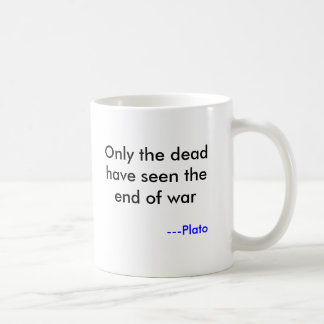
“Only the dead have seen the end of war.” Who said that?

February 25, 2011

When I wrote about George Santayana’s observation that, “Only the dead have seen the end of war,” I didn’t realize it was a quote with controversy over the attribution.

English: Spanish-American philosopher and writ...

He said it: Spanish-American philosopher and writer George Santayana, early in his career (Photo: Wikipedia)

Ridley Scott‘s outstanding 2001 movie, “Blackhawk Down,” opened with the quote, but attributing it to Plato, according to Plato expert Bernard Suzanne in Paris.  One philosopher is as good as another, you might say, so it’s understandable that a good line from a modern philosopher like Santayana might be attributed to one of the most famous philosophers of all time (“they all look alike,” I hear someone saying).  Or, the cynics might say, perhaps Santayana lifted it from Plato — after all, who but another philosopher would actually read the stuff?  Who would know?

Suzanne’s sleuthing is impressive if only because it shows the murkiness of the issue.  According to Suzanne:

  • The quote is popular among American soldiers (ask one — report back in comments).
  • Michael Takiff found it attributed to Plato by a U.S. soldier in Vietnam, writing home, in a book published in 2003.
  • No one has found it in any of Plato’s dialogues — at least, no one Suzanne can find.
  • Gen. Douglas MacArthur used the quote in a farewell address to cadets at the U.S. Military Academy at West Point, in 1962, attributing it to Plato.  That would be a likely source of its popularity among U.S. soldiers.
  • The Imperial War Museum, in London, has the quote engraved on its walls, attributed to Plato.  The museum opened in 1936.  Santayana’s version was published in 1922.
  • Reminder: Santayana said it here: Soliloquies in England and Later Soliloquies, number 25 (1922)

Who put it on the wall of the Imperial War Museum, and why did they misattribute it, just a dozen years after Santayana wrote it?

More:

Quote from George Santayana misattributed to Plato

Quote from George Santayana misattributed to Plato, on a coffee mug from Zazzle

Save


What trains? An insult to fascists . . .

February 25, 2011

XKCD cartoon on difficulty of dealing with fascists in jurisdictions where Godwin's Law applies

XKCD cartoon on difficulty of dealing with fascists in jurisdictions where Godwin's Law applies

Earlier today I stumbled on this claim that Godwin’s Law has been suspended:

3. Godwin’s Law

Made obsolete by the Neocons.
Thanks to the Neocons, Godwin’s law is now obsolete.

And then Jim made me smile with this one, in comments down below that really need to be lifted up a bit to higher visibility:

The Anarcho-Libertarianism advocated by the Tea Party and much of the modern GOP is far, far more dangerous. You see, say what you will about the Fascists…but they make the trains run on time. Under the Anarcho-Libertarians, there either ARE no trains…or they operate when and where the privatized rail companies please…and without such pesky intrusions or encumbrances like safety checks. Who needs safe tracks anyway? Let the buyer beware, right? Sure…the market will solve everything. If one trainload of passengers (or toxic waste) derails…not to worry! The free market fairies will sprinkle their magic free market dust all over the wreckage and next time…it won’t happen. Probably. Maybe. Well…what do you expect? We can’t have gub’mint involved, can we?

And of course, the screaming irony here behind trains and fascism and anarcho-conservatism and Scott Walker is that he queered the deal on high speed rail to begin with. Who needs thousands of new jobs in this humming economy?

Yeah, I know. I am all over the place on this one. But I really do agree with you. Equating Governor Walker with a stupid and evil form of governance like fascism is just plain wrong.

And an insult to fascists.

Of course, Leo Strauss’s reductio ad hitlerum does not mean that, anyone’s noting that an idea’s having been shared by Hitler does not make it bad, also does not make the idea good.

Yeah, I tracked the cartoon down — it is, indeed, from XKCD.


A fungus to fight malaria?

February 24, 2011

From a report in The Scientist Daily today:

Researchers have engineered transgenic fungi that drill into mosquitoes and kill the malaria parasite inside — the first tool of its kind — a February 25, 2011 study in Science reported.

Used in conjunction with traditional insecticide methods against mosquitoes, experts say this bioinsecticide has the potential to greatly improve malaria eradication efforts.

Mosquito infected with pathogenic fungus Metarhizium
Image: Courtesy of Raymond St. Leger

“This is a great example of trying to be innovative and use novel ways to look at this problem,” said Matt Thomas, a disease ecologist at Penn State who was not involved in the research. “It’s a move outside the existing insecticide paradigm, which has dominated parasite and vector control for 40-50 years.”

Read more: Fungus fights malaria? – The Scientist – Magazine of the Life Sciences http://www.the-scientist.com/news/display/58028/#ixzz1EuapNz8Z
Difficulties in developing this solution for use in the field promise no quick results.  Testing remains to be done on the process — and then there is the issue of how to infect the proper species of mosquito in the field.  Additionally, since this process involves genetic modification, there will be a raft of government approvals to contend with before deploying it, if it ever is deployed.

Unfortunately, putting the new technique into action may not be an easy task. “There are already difficult challenges in taking forward biopesticide technology,” said Thomas. “Now we’re adding in the additional regulatory and ethical issues around genetically modified organisms. It’s not a hurdle we should just dismiss as unimportant.”

Researchers at several different places pursue very different routes to help ease malaria — not one of them involving an increase in DDT use.
More:
  • Original article in Science:
    W. Fang et al., “Development of Transgenic Fungi That Kill Human Malaria Parasites in Mosquitoes,” Science 311: 1074-77 


Interesting parent/teacher conference coming in Wisconsin

February 24, 2011

What do you want to bet Wisconsin Gov. David “Ahab” Walker will skip the conference with his son’s teacher next time?

(From the Wisconsin Democratic Party)

The woman, Leah Gustafson,  is very brave.  This is the sort of thing that invites local retaliation by administrators, without even consulting with the governor’s office.  Let’s hope her district’s administrators have a clear understanding of the law, and will back her right to state her views.

Heck, let’s hope they agree with her views.  If they don’t, they should get out of the business.

Tip of the old scrub brush to Michael A. Ryder.


Little Hoovers should ask: Are we in a Second Great Depression?

February 23, 2011

Stalking America and haunting the shadows of every capitol building in America today are people who would profess, if asked, that they fashion themselves in the mold of Herbert Hoover.  Little Hoovers, we might call them.  Unlike Hoover, and unlike the friendly “Little Hoover” phrase we might apply to them, the welfare of America is not their concern.  We might worry about that.

President Harry Truman in 1947 appointed former President Herbert Hoover to head a commission on how to reform the federal government.  I do not know of a high school history text that even mentions this effort today.

Herbert Hoover on the cover of Time Magazine, 1925

Herbert Hoover on the cover of Time Magazine, 1925

Hoover’s commission made 273 recommendations that were taken to heart, then taken to Congress.  Many were enacted into law.

Several states followed the example, as in Utah and famously in California. These groups were often called “Little Hoover” commissions.  In no case that I have found did any of these commissions ever recommend stripping union collective bargaining agreements out of any situation.

But again, this history is mostly lost.  Hoover is remembered today for his failure to stop the Great Depression, for his seeming unwillingness to do what was necessary in great enough effort to relieve the nation’s serious hurts.  That’s too bad, really.

Herbert Hoover was not opposed to government action to fix the depression on most counts.  In his correspondence with Franklin Roosevelt, especially after Roosevelt replaced him in the presidency, Hoover often complained that Roosevelt’s actions were in the right vein, but too much.

We should remember this.

Are we in a Great Depression?  Economically, technically, our nation is in “recovery.”

Realistically, our nation is teetering on the brink of great financial disaster.  Sadly, most people ignore the lessons of history, and consequently, actions of many governmental units today seem driven to push the nation over the brink.  Home prices have not recovered.  Millions are out of work — millions of highly-trained workers cannot find jobs with pay adequate to support a family.

We appear not to have learned these lessons that should not have been forgotten:

  • Stimulus from the government creates demand, which fuels manufacturing recovery, and more jobs.  Tax cuts, such as Hoover’s 1932 tax cut for the wealthy, drive us deeper into recession.
  • Labor unions form vital components of a healthy manufacturing segment; they stand up for worker health and safety, for fair pay and work conditions that spur productivity.  When we ignore or fight unions, we damage economic productivity.  When we work with unions, we make progress.
  • Cracking the whip may get a temporary reaction from workers that looks good.  In the long run, if not immediately, such actions damage productivity and creativity.
  • Unions do not make the big financial decisions that cripple industry.  Unions don’t decide the products to be produced.  Unions cannot gamble a company’s future on ill-advised acquisitions or switches in corporate focus, usually.  Union demands for restrooms improve the sanitation and health of our food supplies.  Union demands for limited work hours lead to productive workers, better safety, and better products.
  • In almost every case where foreign corporations compete successfully with U.S. companies on high-tech and high-skill jobs, and take away U.S. jobs, the government of that foreign nation provides health care for all citizens, so that health care costs are not a cost of business.  In the case of most industrial nations, foreign pension laws are much stiffer than U.S. laws, stiffer in protecting generous benefits for pensioners.
  • All workers benefit when unions gain, traditionally.  It wasn’t Andrew Carnegie who invented the two-week vacation.
  • Workers can do more for consumers when they are treated well and listened to by company management.

I’m depressed at the nasty actions in so many places, in so many ways, designed to thwart progress to good ends, and instead drive our nation into mediocrity.  I find it difficult to post when there is so much disaster looming in so many places.

When political movements from the right go after one group with hammer and tongs, we might do well to remember the old, wise words.  With a full-on awareness of Godwin’s Law, we might do well to remember the words attributed to Martin Niemöller,  and the moral of that story:

“Then they came for the trade unionists,
and I didn’t speak out because I wasn’t a trade unionist.”

What has Scott Walker done for anyone who makes less than $500,000 a year, anyway?  So you should ask:  What has Scott Walker ever done for you, or your family?  If the bargaining rights of any union are removed, anywhere in the U.S., who will speak up for your vacation, pension, health care benefits, and job safety?  OSHA?  Are you sure?

Update: It’s not paranoia when they are coming after you with more ill-will than you can imagine — see this Mother Jones update. It appears some people didn’t learn anything from the Tucson shootings.


More:

Cover of Gordon Lloyd's Two Faces of Liberalism:  How the Hoover-Roosevelt Debates Shape the 21st Century

A book you should buy: Gordon Lloyd's Two Faces of Liberalism: How the Hoover-Roosevelt Debates Shape the 21st Century


Sorehead conservatives can’t hear the people yell “WHOA!”

February 22, 2011

In the Nixon era there was the great bumper-sticker response to William Safire’s line spoken by Spiro Agnew about how the “silent majority” supported Nixon, and not anti-Vietnam war protesters:

The majority isn’t silent; the government is deaf.

Same thing applies to hard-head conservatives and tea-partiers who assume they have God on their sides and so do not need to pay attention to anyone else.

Latest incarnation:  Anchor Rising, who send to spam even milquetoast comments that don’t cheer their heresies and blasphemies against the nation.

Is this really so offensive?  I said:

People who wish to label things “socialist” do it because they think the word pejorative, not because they understand it, and certainly not because what they label is socialist. By von Mises and von Hayek’s definitions, the U.S. government isn’t socialist at all — no production quotas, no significant control of wages or prices. We do have some regulation of industry, but no nationalization — not even defense quotas any more. Since Eisenhower, we have pushed farther and farther from socialism, and our economy has tanked a couple of times as a result.

We could use some more socialism, a decent safety net for the poor, ill, old, and uneducated. It’s the sort of safety net George Washington would have approved of — and it’s not really socialism.

The questions we should be asking are, “Is this the right thing to do?” “Is this the best way to do it?” “How can we pay for this?”

Labeling things socialist, and then quibbling about the misdefinition, only drives us deeper into the mire.

I got this response:

Thank you for commenting.

Your comment has been junked as inappropriate or spam; if you believe you’ve received this message in error, please contact the administrator. adm

Oh, skroom.  A reaction that swift suggests no gray matter involved in the decision process.  It’s worse than “press 2 for Spanish.”

How many conservatives actually can dance on the head of a pin?  Isn’t that pinhead cannibalism or something?

That anchor ain’t rising, and it’s dragging Rhode Island down with it.


Abraham Lincoln, ‘is a dog’s tail a leg?’ and Computational Complexity

February 22, 2011

It’s geek humor for Presidents Day.  I think it’s geek humor.  Computational Complexity analyzed the story attributed to Abraham Lincoln, about the moral of asking how many legs a dog has, if you call a tail “a leg.”

Amazing five-legged dog, Esther Derby.com

Amazing five-legged dog, image by Esther Derby.com

The author acknowledged it, but we now know it was a calf’s tail, not a dog’s tail.


Typewriter of the moment: Helen Keller (again)

February 21, 2011

Helen Keller at her typewriter, 1946 - Perkins School for the Blind

Helen Keller at her typewriter, circa 1946 – Perkins School for the Blind

Helen Keller at her typewriter, circa 1946

Helen Keller at her typewriter, circa 1946. Perkins School for the Blind caption: In 1902, Helen Keller became the first person who was deafblind to write a book. Her autobiography, The Story of My Life, was the first of 14 books she wrote in her lifetime.

Earlier at Millard Fillmore’s Bathtub:  “Typewriter of the Moment:  Helen Keller”


Phillis Wheatley: Poem for Presidents Day

February 21, 2011

From the Poem-a-Day folks at the American Academy of Poets:

His Excellency General Washington
by Phillis Wheatley

George Washington

George Washington, as he appears on the one dollar bill.


Celestial choir! enthron’d in realms of light,
Columbia’s scenes of glorious toils I write.
While freedom’s cause her anxious breast alarms,
She flashes dreadful in refulgent arms.
See mother earth her offspring’s fate bemoan,
And nations gaze at scenes before unknown!
See the bright beams of heaven’s revolving light
Involved in sorrows and the veil of night!

The Goddess comes, she moves divinely fair,
Olive and laurel binds Her golden hair:
Wherever shines this native of the skies,
Unnumber’d charms and recent graces rise.

Muse! Bow propitious while my pen relates
How pour her armies through a thousand gates,
As when Eolus heaven’s fair face deforms,
Enwrapp’d in tempest and a night of storms;
Astonish’d ocean feels the wild uproar,
The refluent surges beat the sounding shore;
Or think as leaves in Autumn’s golden reign,
Such, and so many, moves the warrior’s train.
In bright array they seek the work of war,
Where high unfurl’d the ensign waves in air.
Shall I to Washington their praise recite?
Enough thou know’st them in the fields of fight.
Thee, first in peace and honors—we demand
The grace and glory of thy martial band.
Fam’d for thy valour, for thy virtues more,
Hear every tongue thy guardian aid implore!

One century scarce perform’d its destined round,
When Gallic powers Columbia’s fury found;
And so may you, whoever dares disgrace
The land of freedom’s heaven-defended race!
Fix’d are the eyes of nations on the scales,
For in their hopes Columbia’s arm prevails.
Anon Britannia droops the pensive head,
While round increase the rising hills of dead.
Ah! Cruel blindness to Columbia’s state!
Lament thy thirst of boundless power too late.

Proceed, great chief, with virtue on thy side,
Thy ev’ry action let the Goddess guide.
A crown, a mansion, and a throne that shine,
With gold unfading, WASHINGTON! Be thine.

American Poet Phyllis Wheatley, detail from the Boston Women's Memorial on Commonwealth Ave.

American Poet Phillis Wheatley, detail from the Boston Women’s Memorial on Commonwealth Ave.

Who was the inspiring woman, Phillis Wheatley? Read her biography at the Academy of American Poets site.

Phillis Wheatley was the first black poet in America to publish a book. She was born around 1753 in West Africa and brought to New England in 1761, where John Wheatley of Boston purchased her as a gift for his wife. Although they brought her into the household as a slave, the Wheatleys took a great interest in Phillis’s education. Many biographers have pointed to her precocity; Wheatley learned to read and write English by the age of nine, and she became familiar with Latin, Greek, the Bible, and selected classics at an early age. She began writing poetry at thirteen, modeling her work on the English poets of the time, particularly John Milton, Thomas Gray, and Alexander Pope. Her poem “On the Death of the Rev. Mr. George Whitefield” was published as a broadside in cities such as Boston, New York, and Philadelphia and garnered Wheatley national acclaim. This poem was also printed in London. Over the next few years, she would print a number of broadsides elegizing prominent English and colonial leaders.

More, at the AAP site.


Did Kennedy say it? Why is it on the minds of thinking people from Tehran to Madison?

February 21, 2011

Banner of Kennedy quote, Pueblo, Colorado, by Wavy1

Banner photographed by Wavy1 in Pueblo, Colorado, featuring quote from President John F. Kennedy

Stuck away from my library, I can’t confirm that John Kennedy actually said it, only that he is reputed to have said it:

Those who make peaceful revolution impossible will make violent revolution inevitable.

[March 13, 1962, White House reception for Latin American diplomatic corps,
on the first anniversary of the Alliance for Progress]

The ruling families of Libya and Wisconsin pledge to fight to hold on to power, splitting their nations if necessary rather than concede to democratic forces.

Was Kennedy right?

(What did he really say, where and when?)

Photo of banner from Pueblo, Colorado, by Wavy1.


Fly your flag for President’s Day, 2011

February 21, 2011

Fly your flag today.

White House at night

White House with U.S. flag at night; photo by Keith Stanley, kestan.com

Residents of the United States celebrate Presidents Day today, a holiday that grew out of celebrations of the birthdays of both George Washington (February 22, 1732) and Abraham Lincoln (February 12, 1809), both of whom were born in February (under the “new” Gregorian calendar).

President’s Day is one of a score of dates Congress recognized in the Flag Code as appropriate for patriotic display of the U.S. flag.

Note: Keith Stanley sells his photos, including this one of the White House at night. You can view this one, and many more, and purchase copies, at Mr. Stanley’s website.


Typewriter of the moment: Gypsy Rose Lee

February 20, 2011

Gypsy Rose Lee at her typewriter, 	  New York World-Telegram and the Sun staff photographer: Palumbo, Fred, photographer.

Gypsy Rose Lee at her typewriter, New York World-Telegram and the Sun staff photographer: Palumbo, Fred, photographer. Photo via Wikimedia from Library of Congress

More:


Quote of the moment: Robert C. Lieberman, “Why the Rich Are Getting Richer: American Politics and the Second Gilded Age”

February 20, 2011

The U.S. economy appears to be coming apart at the seams.  Unemployment remains at nearly ten percent, the highest level in almost 30 years; foreclosures have forced millions of Americans out of their homes; and real incomes have fallen faster and further than at any time since the Great Depression.  Many of those laid off fear that the jobs they have lost — the secure, often unionized, industrial jobs that provided wealth, security and opportunity — will never return.  They are probably right.

Cover of Winner-Take-All Politics, by Jacob Hacker and Paul Pierson

Cover of Winner-Take-All Politics, by Jacob Hacker and Paul Pierson

And yet a curious thing has happened in the midst of all this misery.  The wealthiest Americans, among them presumably the very titans of global finance whose misadventures brought about the financial meltdown, got richer.  And not just a little bit richer; a lot richer.  In 2009, the average income of the top five percent of earners went up, while on average everyone else’s income went down.  This was not an anomaly but rather a continuation of a 40-year trend of ballooning incomes at the very top and stagnant incomes in the middle and at the bottom.  The share of total income going to the top one percent has increased from roughly eight percent in the 1960s to more than 20 percent today.

This what the political scientists Jacob Hacker and Paul Pierson call the “winner-take-all economy.”  It is not a picture of a healthy society.  Such a level of economic inequality, not seen in the United States since the eve of the Great Depression, bespeaks a political economy in which the financial rewards are increasingly concentrated among a tiny elite and whose risks are borne by an increasingly exposed and unprotected middle class.  Income inequality in the United States is higher than in any other advanced democracy and by conventional measures comparable to that in countries such as Ghana, Nicaragua, and Turkmenistan.

Robert C. Lieberman, reviewing the book Winner-Take-All Politics:  How Washington Made the Rich Richer — and Turned Its Back on the Middle Class, by Jacob S. Hacker and Paul Pierson, Simon and Schuster, 2010, 368 pages.  $27.00.; review appears in Foreign Affairs, January/February 2011, pp. 154-158.

More:


How to start a hoax about Donald Trump: “Do we really know who Donald Trump is, or where he came from?”

February 19, 2011

Donald Trump demonstrated his ability to spread hoax information at the CPAC Conference recently — a group who love to hear hoaxes and spread them, as much as fourth-grade boys love to hear and spread jokes about flatulence.

But can he take it?  [Note the hoax insinuations below are underlined.]  Could Donald Trump withstand the kind of attack* he made on President Obama?

I mean, he claims President Obama may not have attended Columbia because Trump hasn’t personally interviewed anyone who knew him there — despite years of stories in alumni magazines, major media interviews with the people who knew Obama there, etc., etc.

Donald Trump and unidentified woman

Gratuitous picture that makes trump look funny or evil, with gratuitously misleading caption: “Donald Trump wants people to stop asking why no one, in America, can remember his high school and college days.”  Alternative caption:  “Donald Trump, two of his closest friends and an unnamed woman discuss politics and government policy.”

Does Trump have room to talk?  His Wikipedia bio claims he attended Fordham University for a brief period (got kicked out, maybe?), but didn’t graduate.  It claims he got an undergraduate degree from the Wharton School in Pennsylvania.

A search found no one from Wharton who remembers Donald Trump as a student there.  Jon Huntsman, the founder of Huntsman Container and Huntsman Chemical, the guy who invented the “clamshell box” for McDonalds, is one of the most famous and wealthy Wharton grads (and also the father of Jon Huntsman, Jr., the recently resigned Obama Ambassador to China).  He never saw Trump on campus at Wharton.  James DePriest, the outstanding conductor now with the Oregon Symphony (and fun to watch, trust me) — he never ran into Trump on campus when he attended Wharton.  There’s no record of Trump having had a roommate there. Alan Rachins, the famous actor who graduated from Wharton — not only never took a class with Trump, but said he never heard of Trump attending classes at the time.

Who is Donald Trump?  Where did he come from?  How come no one remembers him?

But the fog gets inkier.

Trump was not only a football standout in high school, he was a social standout, winning awards for his community involvement (although, no one at the high school in his hometown remembers his attending classes there).

But during the time he claims to have attended Fordham, no one remembers him.  No social standout.  No football hero.  Was he ever really at Fordham?

And what about his odd religious beliefs?  There are jokes about his worship of money — but what sort of religion would lead a man to claim that the 2008 economic collapse was “an Act of God?”  Yes, he really believes that.  His “god” appears to have a grudge against the United States and its economy.  Even in his greatest economic ventures, he pays homage to Muslim Hindu religious landmarksWhat is his secret agenda on religion?

Where did Donald Trump come from?  Why does no one in his hometown high school remember him?  Why did he drop out of sight at the time he claims to have attended Fordham University?  Did he buy his way into a listing as an alumnus of Wharton, after so many Wharton grads don’t remember seeing him there?   Who can trust a guy who worships (if he does worship at all) a “god” who strikes down the U.S. economy?

Who is Donald Trump?  Why did no one at CPAC check his questionable credentials before giving Trump a national platform?  Why is CPAC mum about this entire affair?  Why did Fox News conspire to obscure the message and candidacy of Ron Paul, with their new darling, Donald Trump?

Worse for Trump, most of the things in this screed are factually accurate.  Those who live by the inaccurate spin can die by it, too.

Scarier:  Which conservative sites will have the guts to question** Trump’s secret credentials?

Read more here, at Oh, For Goodness Sake (and here at “Donald Trump Pants On Fire”), and here, at PolitiFact.

_____________________________

*   That is, “completely hoaxed up.”

**  Oh, yeah — that should have read, “gullibility to fall for.”  When will the blog owner correct that glaring error?***

*** Not until Trump apologizes to President Obama.

Save

Save

Save

Save


Pressure on Texas Board of Education to fix damage to social studies standards

February 18, 2011

Probably not enough pressure to get the board to act, but the Dallas Morning News turned a cannon on the Texas State Board of Education this morning, asking that they fix the damage done to social studies last year.

The paper’s editorial board keyed off of the Fordham Institute’s grading of state standards — Texas failed, with at D.

Here’s the editorial in its entirety — there’s more at the Dallas Morning News website and I encourage you to go read it there:

Editorial: Report offers new reason to rewrite standards

Just in case you think it’s only us warning about Texas’ new social studies standards, check out the awful grade that the respected Thomas B. Fordham Institute gave those benchmarks in a report released Wednesday.

A big, fat “D” is what Texas got for the history, economics, geography and cultural standards the State Board of Education approved last year for Texas’ elementary and secondary school students.

Some of that awful mark was for the way the standards are organized. Fordham researchers likened their confusing structure to a jigsaw puzzle. But much of the national organization’s critique was about how politicized the State Board of Education has made those standards.

We were particularly struck by Fordham’s conclusion that the hard-right faction on the board, which dominated the writing of the standards, made the same mistake left-wing academics have made in approaching such subjects as history and economics. The Fordham study puts it this way:

“While such social studies doctrine is usually associated with the relativist and diversity-obsessed educational left, the hard right-dominated Texas Board of Education made no effort to replace traditional social studies dogma with substantive historical content. Instead, it seems to have grafted on its own conservative talking points.”

Oh, it gets worse. Back to the report: “The strange fusion of conventional left-wing education theory and right-wing politics undermines content from the start.”

For the record, Fordham is not a left-wing outpost of American thought. Its leader is Chester Finn, a former Reagan administration official and one of education’s most recognized voices. At the least, his organization’s critique is not a predictable one.

The institute echoes the complaint this newspaper has had since the 15-member Texas board rewrote the state’s social studies standards. Its hard-right faction at the time insisted on inserting its slant on those important subjects, such as suggesting Joe McCarthy wasn’t so bad, that international treaties are a problem and that the separation of church and state is misguided.

The warped view is why the revised board must go back and rewrite the standards this spring. And that should be possible.

Voters were so frustrated with the board’s work last year that they elected more moderate Republican members. Moderates now have enough of the upper hand to fix these standards before schools start planning for next year and before publishers start drafting new history and social studies textbooks.

Some on the new board may believe that rewriting the social studies standards will be too difficult. But surely Texas students deserve better than a “D” when it comes to what the state wants them to learn in some of the most critical subjects.


Texas fails among its peers

How big states fared on the Fordham Foundation report on social studies standards nationwide:

California: A-

New York: A-

Florida: C

Texas: D

National average: D