2012 Anniversary of Pearl Harbor, still “infamous”

December 7, 2012

Encore and traditional post, mostly, from December 7, 2006 with updates.

1941 AP file photo, small boat rescues victims from U.S.S. West Virginia

Caption from Naval History and Heritage Command: Photo #: 80-G-19930
Pearl Harbor Attack, 7 December 1941
Sailors in a motor launch rescue a survivor from the water alongside the sunken USS West Virginia (BB-48) during or shortly after the Japanese air raid on Pearl Harbor.
USS Tennessee (BB-43) is inboard of the sunken battleship.
Note extensive distortion of West Virginia’s lower midships superstructure, caused by torpedoes that exploded below that location.
Also note 5″/25 gun, still partially covered with canvas, boat crane swung outboard and empty boat cradles near the smokestacks, and base of radar antenna atop West Virginia’s foremast.
Official U.S. Navy Photograph, National Archives Collection.

Today is the 71st anniversary of Japan’s attack on the U.S.’s Pacific Fleet at Pearl Harbor, Hawaii.

Many Americans fly their U.S. flags today.  The date is not one specified in law for flag-flying.  President Obama issued a proclamation asking citizens to fly flags at half-staff today.

Our local newspaper, The Dallas Morning News, ran a front-page story on survivors of the attack in 2006, who have met every five years in reunion at Pearl Harbor. [December 7, 2006] was their last official reunion. The 18-year-olds who suffered the attack, many on their first trips away from home, are in their 80s now. Age makes future reunions impractical.

In 2010, it is estimated that fewer than 4,000 veterans of Pearl Harbor still live to remember, though, of course those surviving do.

From the article:

“We’re like the dodo bird. We’re almost extinct,” said Middlesworth, now an 83-year-old retiree from Upland, Calif., but then – on Dec. 7, 1941 – an 18-year-old Marine on the USS San Francisco.

Nearly 500 survivors from across the nation were expected to make the trip to Hawaii, bringing with them 1,300 family members, numerous wheelchairs and too many haunting memories.

Memories of a shocking, two-hour aerial raid that destroyed or heavily damaged 21 ships and 320 aircraft, that killed 2,390 people and wounded 1,178 others, that plunged the United States into World War II and set in motion the events that led to atomic bombings of Hiroshima and Nagasaki.

“I suspect not many people have thought about this, but we’re witnessing history,” said Daniel Martinez, chief historian at the USS Arizona Memorial. “We are seeing the passing of a generation.”

Another article notes the work of retired history professor Ron Marcello from the University of North Texas, in Denton, in creating oral histories from more than 350 of the survivors. This is the sort of project that high school history students could do well, and from which they would learn, and from which the nation would benefit. If you have World War II veterans in your town, encourage the high school history classes to go interview the people. This opportunity will not be available forever.

There is much to be learned, Dr. Marcello said:

Dr. Marcello said that in doing the World War II history project, he learned several common themes among soldiers.

“When they get into battle, they don’t do it because of patriotism, love of country or any of that. It’s about survival, doing your job and not letting down your comrades,” he said. “I heard that over and over.”

Another theme among soldiers is the progression of their fear.

“When they first got into combat, their first thought is ‘It’s not going to happen to me.’ The next thought is ‘It might happen to me,’ and the last thought is ‘I’m living on borrowed time. I hope this is over soon,’ ” Dr. Marcello said.

Dr. Marcello said the collection started in the early 1960s. He took charge of it in 1968. Since Dr. Marcello has retired, Todd Moye has taken over as the director.

Other sources:

While this is not one of the usual dates listed by Congress, you may fly your U.S. flag today.

End of 2006 post —

Other resources (2007):

USS Missouri Memorial – Main Battery - from the Panoramas of World War II site

USS Missouri Memorial – Main Battery – from the Panoramas of World War II site

More, 2012:


Millard Fillmore: Victim of yet another hoax

December 6, 2012

The Washington Post’s usually great blog on politics, The Fix, features a list of the best presidential biographies.  This comes just in time for the holidays, of course.  It could be a guide to getting the book for that wonk you know, the one who says Franklin Pierce is underrated, or the woman you know who is fixated on what might have been had Warren G. Harding not died in San Francisco.

The list links to good versions of obscure and arcane history, as well as some major stuff — any good biography of Thomas Jefferson, George Washington, Abraham Lincoln, or Teddy Roosevelt, has to have some major chops going for it, in those crowded niches of good biographies of important people.

English: 1938 u.s. postage stamp of Millard Fi...

1938 U.S. postage stamp of Millard Fillmore, a 13-cent stamp for our 13th president – Wikipedia image

Then there is poor old, hapless Millard Fillmore.

We can excuse Natalie Jennings and Sean Sullivan, perhaps.  After all, there are not many books on Millard Fillmore.  Pickings are slim.

Ever since America’s favorite curmudgeon, H. L. Mencken, created a World War I hoax on the gullibility of the public, with a completely invented history that claimed the only thing of note ever done by Millard Fillmore was putting a bathtub in the White House, against the advice of the American Medical Association, poor Fillmore has been the butt of jokes, but more often the cruel butt of unintended slights when people cite the fictions of his life rather than his accomplishments.  We approach the anniversary of the Mencken “Fillmore’s Bathtub” Hoax, on December 28.

I said the pickings on Fillmore books were slim.  The list at The Fix  includes a parody history of some five years back by George Pendle, The Remarkable Millard Fillmore: The Unbelievable Life of a Forgotten President.

At Amazon, we learn of Pendle’s book:

Millard Fillmore has been mocked, maligned, or, most cruelly of all, ignored by generations of historians–but no more! This unbelievable new biography finally rescues the unlucky thirteenth U.S. president from the dustbin of history and shows why a man known as a blundering, arrogant, shallow, miserable failure was really our greatest leader.

In the first fully researched portrait of Fillmore ever written, the reader can finally come face-to-face with a misunderstood genius. By meticulously extrapolating outrageous conclusions from the most banal and inconclusive of facts, The Remarkable Millard Fillmore reveals the adventures of an unjustly forgotten president. He fought at the Battle of the Alamo! He shepherded slaves to freedom on the Underground Railroad! He discovered gold in California! He wrestled with the emperor of Japan! It is a list of achievements that puts those of Washington and Lincoln completely in the shade.

Refusing to be held back by established history or recorded fact, here George Pendle paints an extraordinary portrait of an ordinary man and restores the sparkle to an unfairly tarnished reputation.

Of course it’s parody!  There’s no indication Fillmore, never a member of the military, fought at the Alamo.  Fillmore never made it to California, nor was he the Mormon who discovered gold at Sutter’s Mill.  In one of his greatest acts, Fillmore dispatched Commodore Perry to Japan to coerce that nation to open its doors to American sailing ships, and trade with the rest of the world.  Fillmore himself did not journey to Japan, and never met the Japanese emperor, let alone wrestled the man. (After his presidency, Fillmore visited Europe; Queen Victoria is attributed with having said he was one of the handsomest men she’d ever met; he refused an honorary degree because, he said, he couldn’t read the Latin it was written in — you can’t make up the real stuff.)

Despite its clearly being a parody, however, there it is on the list of The Fix, as the best biography of Millard Fillmore.

Fillmore parody history listed as best Fillmore biography

Screen clip showing parody Fillmore biography on The Fix’s list of best presidential biographies

H. L. Mencken lifts a beer to toast end of Prohibition

H. L. Mencken at approximately 12:30 a.m., April 7, 1933, at the Rennert Hotel, corner of Saratoga and Liberty Streets, 17 years later, not neglecting a sudsy anniversary – Baltimore Sun photo

The Ghost of H. L. Mencken notes that this item appeared on December 5, 2012, the anniversary of the end of Prohibition — and knocks back a brew.  Every other president gets a serious biography mentioned; for Millard Fillmore, The Fix lists a hoax book as his “best presidential biography.”

More:

A note on fairness to Mr. Pendle:  Pendle has argued here before that his book does contain real history, and it’s there despite the embellishments which he says at least get the book sold.  Earlier, in comments he said:

Dear Sir,

I am the author of the recently published ‘The Remarkable Millard Fillmore’, which I have just discovered has been mentioned by your website on a couple of occasions. Judging by your website’s wonderful name, and your obvious interest in making people more aware of American history, I was slightly troubled to see that you thought I treated Millard Fillmore unfairly in my book.

I don’t know if you have had a chance to read ‘TRMF’ yet, but I can assure you that while it is a faux-biography, and does indeed poke fun at Millard Fillmore’s perceived image (or lack of it), its larger target is that of presidential biographies that are unthinkingly reverential of the office of the president. The cynical revision of history, in which one man is placed at the center of the world’s events is a historical fallacy, as you are probably well aware. Yet it is one which – unlike my book – many historians perpetrate with a straight face.

In ‘TRMF’ I attempted to mock this school of biography by extrapolating the most ridiculous situations from the most basic and inconclusive of historical facts. For instance, I have Millard Fillmore stowing away to Japan, and Sumo-wrestling with the Mikado’s champion, because in real life Fillmore opened up Japan to western trade (albeit from a safe distance in Washington D.C.).

Lest you think I am playing too fast and loose with the truth (some readers have complained that they did not realize my book was a spoof, despite the picture of Millard Fillmore riding a unicorn on its cover!) my book also includes a large appendix of strange but true historical notes to show that many of the ridiculous situations I place Fillmore in were actually based on fact. By reading them I hope one can discover that even the most staid of human lives can be touched by the fantastic.

In short I come not to bury Fillmore, but to praise him, and all those forgottens who have not been granted a role as a ‘Great Man of History’ by the Academy. I very much hope that although ‘The Remarkable Millard Fillmore’ is primarily a spoof and designed to make people giggle, readers will, possibly without being aware of it, come away from the book with a better knowledge of American History than when they started it.

Yours sincerely,
George Pendle

So we are left with a little mystery.  Did the WaPo reporters know that Pendle’s book is a parody, and are they saying it works wonderfully as a tool of history telling?  Or, did they not know?

_____________

Update:  Comes word this morning that The Fix changed its listing for Fillmore, to the Rayback book (Thanks, Lea).  The column says only that it’s been “updated,” but doesn’t explain where or why.   Mr. Pendle might argue his book should be there:  How many books are there on Fillmore after all?


Before the fight: Ford and Reagan, October 31, 1974

December 5, 2012

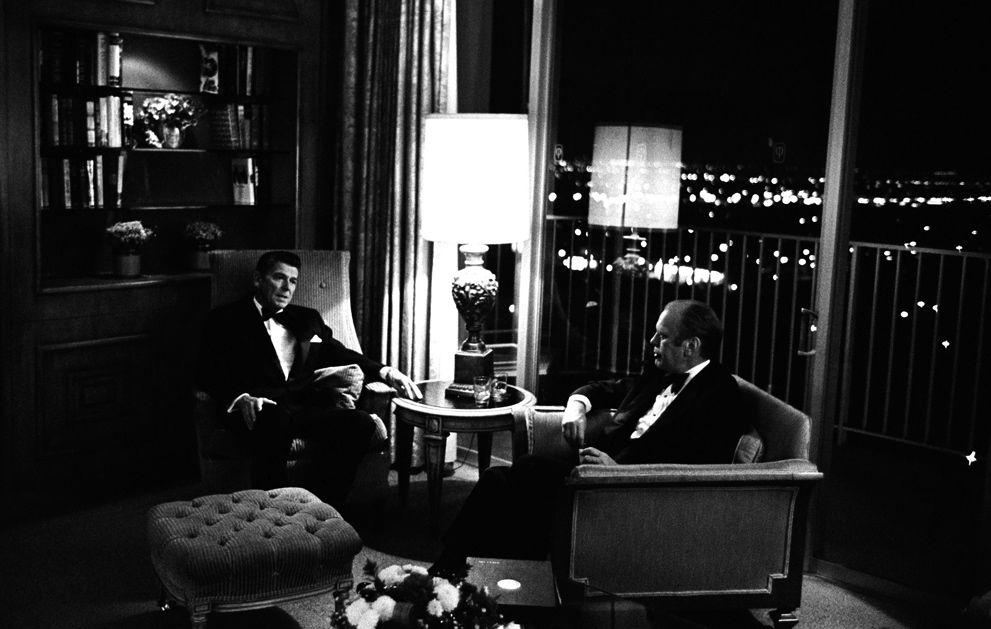
Historian Michael Beschloss Tweeted out a wonderful photo:

President Gerald Ford, former-Gov. Ronald Reagan, October 31, 1974, Century Plaza

October 31, 1974: President Gerald Ford, right, met with former-California Gov. Ronald Reagan, at the Century Plaza Hotel, Los Angeles. Photo courtesy Micheal Beschloss.

Who took the photo?  What was the event?  Beschloss asks on Twitter, why two drinks on Ford’s side of the table, and none on Reagan’s?

Looks like it’s a photo by David Hume Kennerly, the White House photographer in the Ford administration.  The photograph was taken with film, probably in black and white to save money and because it was the best way to get images for print media at the time.  Few newspapers ran color photos as a regular feature.  Electronic still photography at the time occurred in laboratories as tests.  As a pragmatic matter, media to store such photographs electronically were impractical — a large mainframe computer might have 256 kilobytes of memory for such storage, or enough for photo of poor resolution.

Kennerly’s site said this meeting came around a black-tie Republican fund-raiser in Los Angeles, at the then-swanky Century Plaza Hotel.

Vanity Fair’s David Friend called it “L.A. Noir” in a 2007 article on a book of photos by Kennerly:

Today, the image conveys a touch of Rat Pack swagger, an architectural elegance, and a hint of the California glamour that Reagan would eventually import to Washington. At the time, however, Kennerly, who had won a Pulitzer for his work in Vietnam, considered the picture too dark and brooding; he almost overlooked the frame on his contact sheet. But that darkness captured something of the spirit of the time: less than three months before, Watergate had forced Richard Nixon from office; inflation, unemployment, and gas prices were on the rise; and the U.S. was facing defeat in Vietnam.

The picture also caught the sometimes frosty relationship between the two leaders. Both Reagan and Ford, after all, would nix the 1980 “dream ticket” idea, floated by some Republican mandarins, to draft Ford as Reagan’s vice president. And Ford, during his unsuccessful 1976 campaign against Jimmy Carter, resented Reagan’s political infighting. “Truthfully,” Ford confessed to Kennerly years later, “I was upset when he challenged me [for the ’76 Republican nomination]. I thought it was unwise for a Republican to challenge a sitting Republican president. We had a pretty bitter contest. It was a head-to-head, knock-down, drag-out affair.”

“I study this picture now,” says Kennerly, “and it looks like a scene from The Godfather”—which had won the best-picture Oscar the year before.

Were I to guess, with a bit of education, I’d say both glasses belonged to Ford, one a cocktail, one water.  Reagan tended to avoid alcohol.

A great photograph, a tribute to the artistry and craftsmanship of Kennerly, especially with film; it also poses as a time capsule, freezing convention in GOP big-money fundraising, dress for men of influence and means, architecture, and so much more.

David Kennerly

Pulitzer Prize-winning war photographer, and White House photographer, David Hume Kennerly; TEDxBend image


Not before the deluge, not after it, but during the storm.  Nixon was three-months gone from the White House.  Vietnam’s peace agreement was a year-old, but it was seven months to the final invasion of South Vietnam by the communist North that would force the U.S. retreat, and “reunify” Vietnam under communist rule.  The Cold War still raged.  Iran was considered a U.S. puppet.  Mao Zedong still ruled in China.  Elvis Presley still ruled in Memphis.  AIDS was unknown.  Computers were accounting machines taking floors of entire buildings.  Portable telephones were expensive devices that hogged power and generally required at least an automobile to be attached to power the thing.

Barack Obama was 13.

It was a different time.

More:


Typewriter of the moment: Mark Twain’s Hammond

December 5, 2012

Still hoping to find a photo of Samuel Clemens at work on a typewriter.

But until then, this one will have to do:

Mark Twain's Hammond typewriter, Jerry J. Davis photo

A Hammond typewriter that once belonged to Samuel Clemens, or Mark Twain. Photographed by Jerry J. Davis, in an unstated location, probably Hannibal, Missouri

A Hammond typewriter, from oobject.com; perhaps not the typewriter that WAS pictured above; but Twain used this one, and the link to the photo above has died but good.

A Hammond typewriter, from oobject.com; perhaps not the typewriter that WAS pictured above; but Twain used this one, and the link to the photo above has died but good.

Other photos of Twain’s typewriter must exist; and since we know of at least two such machines, there must be some photos of each of them, no?  I wish museums and historians would consider the value of images of some of these objects, and make high quality photos of some of these famous machines.

Twain’s fascination with technology shines clearly in his work.  From his earliest writings we get lyrical and accurate descriptions of the mechanical workings of Mississippi riverboats, for one example.  A Connecticut Yankee in King Arthur’s Court paints a long paean to technology of the late 19th century, transplanted in the tale several centuries earlier.

Some accounts claim The Adventures of Huckleberry Finn to be the first manuscript completed by typewriter — this one, perhaps? TwainQuotes.com features what may be a description of this history:

…I will now claim — until dispossessed — that I was the first person in the world to apply the typewriter to literature…The early machine was full of caprices, full of defects — devilish ones. It had as many immoralities as the machine of today has virtues. After a year or two I found that it was degrading my character, so I thought I would give it to Howells…He took it home to Boston, and my morals began to improve, but his have never recovered.

– “The First Writing Machines”

As a publisher and investor, Twain pushed the development of automated typesetting machines to quickly publish the memoirs of former President Ulysses S Grant.  Though the books were set quickly, and the best-selling memoirs provided an income for Grant’s widow, the technology was still balky and cost Twain his own fortune.

Mark Twain's Hammond typewriter - TwainQuotes.com

Twain’s Hammond at the Mark Twain Museum in Hannibal, Missouri. Image from TwainQuotes.com. Is this the same machine pictured above? There are similarities, but differences more than just the angle.

We shouldn’t be surprised with his acerbic comments on the machines; Twain’s caustic humor targeted everything in modern life.  TwainQuotes.com notes a fraction of a letter to his longtime friend:  Twain’s Hammond at the Mark Twain Museum in Hannibal, Missouri. Image from TwainQuotes.com

The machine is at Bliss’s, grimly pursuing its appointed mission, slowly & implacably rotting away at another man’s chances for salvation.

I have sent Bliss word not to donate it to a charity (though it is a pity to fool away a chance to do a charity an ill turn), but to let me know when he has got his dose, because I’ve got another candidate for damnation. You just wait a couple of weeks & if you don’t see the TypeWriter coming tilting along toward Cambridge with the raging hell of an unsatisfied appetite in its eye, I lose my guess.

– Letter to William Dean Howells, 25 June 1875

Were things really so bad?

I regret to note that in our visit to Hannibal last June I did not encounter any typewriters.  Clearly, I’ll have to go back.

Tip of the old scrub brush to OObjects.

More:


Rachel Carson biography, On a Farther Shore, one of best books of 2012

December 4, 2012

Kirkus Reviews listed as one of 2012’s top 25 books William Souder’s biography of Rachel Carson, On a Farther Shore.

William Souder, author of On a Farther Shore. MPR  image

William Souder, author of On a Farther Shore. Minnesota Public Radio image

Rachel Carson often gets credit for starting the modern environmental movement.  In highly cynical political times, Carson is under cruel smear attack from people who wish the environmental movement did not exist, and who appear to think that we could poison Africa to prosperity if only we’d use enough DDT, contrary to all scientific work and medical opinion.

Souder’s book, issued on the 50th anniversary of the publication of Carson’s best-known book, Silent Spring, lays out the facts.

Nice to see that book lovers like Souder’s work, too.  Carson’s work was painstakingly accurate as science, but also a wonderful read.  Silent Spring has a larger following among lovers of literature than science, a tribute to her writing ability.  Souder’s book plows both veins, science and writing.

Cover of On a Farther Shore, by William Souder

Cover of On a Farther Shore, by William Souder

In circles serious about science, the environment, human health, and literature, Souder’s book is the book of the 50th anniversary of Silent Spring.  There is irony there.  Pesticide manufacturers mounted a campaign against Silent Spring and Rachel Carson calculated to have cost $500,000 in 1962, when that book was published.  Souder’s book fights propaganda from Astro-turf™ organizations like Africa Fighting Malaria, a pro-DDT group that collects money from chemical manufacturers and anti-environmental political sources for a propaganda campaign that costs well over $500,000/year.  Despite all the paid-shill shouting against Rachel Carson and her work, it is the voice of On a Farther Shore that stands out.

More:


Flash mob in the BYU library

December 2, 2012

When flash mobs go Mormon, and invade sacred spaces like libraries, in Provo, Utah . . . well, that’s pushing the boundaries a bit, and telling the aging of the ritual, too.

How many times have you sung in the atrium of a library and thought it would be a great place for a choir?

Notes from the BYU Singers at YouTube (I added links, except for the first YouTube link):

http://youtu.be/LkE_vk86fq0?t=1h7m10s is the link to hear the BYU Singers perform it in concert!

The BYU Singers appear out of the crowd to sing O Sapientia in the BYU Library. For a brief minute, the library stood still! The audience was captivated, and asked for more. We told them that it sounds better live and invited them to our concert!

And, in comments:

Thank you so much for listening to the BYU Singers! Some viewers asked for a recording of us singing “O Sapientia” by Bob Chilcott without the background noise of the library. We’ve put a link into this video’s description, as well as in an annotation during the first 10 seconds of the video. The link goes directly to us singing “O Sapientia” during a broadcast of our concert on Saturday, November 17, 2012 in the DeJong Concert Hall at BYU. Thank you again for listening!

When I attended college at Utah’s senior (and superior) educational institution (back when Dinosaur Jim Jensen was hunting them live in Central Utah), J. Willard Marriott gave $1 million to the University of Utah to finish the library, and a couple of years later gave $1 million to BYU to finish the basketball center.  We noted that Marriott was a good judge of where the priorities lay at each institution.  Since then, BYU built a new library which is, I hear, quite glorious as a study location.  Except, of course, it’s located on the campus of BYU.  If you’re studying late nights there, let’s just say you’d better have had a good night’s sleep the previous week, because caffeine is going to be hard to come by.

I think the Franklin Stewart Harris Fine Arts Center, home of the DeJong Concert Hall, is the only college building in this nation named after a relative of mine.  In the center of an academic institution that often troubled me deeply, it was the site of many a pleasant day in extension classes (here’s to you, Max Golightly), student performances, and debate headquarters.  I’ve taken solace in the building’s being dedicated to arts and performance, which transcends all the other problems I have with the school.

Those kids sing pretty well, don’t you think?

Did you also notice?  No one shushed them.  I mean, it sounded pretty noisy for a library — but it’s still a library!

Tip of the old scrub brush to Evelyn Earl Jeffries.

More:


Twain aboard ship – 1896 photo, 1897 etching

December 1, 2012

One of my favorite images of Mark Twain I found several years ago.  It’s a photograph of Twain, with a genuine smile of some contentment, seated in a deck chair on a ship, feet on the rail, gazing out to sea.

Correspondent J. A. Higginbotham tracked down the origin of the photograph through the Gutenberg Project, and found a nice etching from the photograph at twainquotes.com, with sleuthing by Barbara Schmidt, the curator of that site.

Here’s the photo, from the Gutenberg Project’s version of the 1898 American Publishing Company edition of Following the Equator:

Mark Twain, aboard ship, 1896; photo by Walter G. Chase of Boston

Mark Twain, aboard ship in 1896. Photo by Walter G. Chase, of Boston. This photo provided the frontispiece for the 1898 American Publishing Company edition of Following the Equator.

Who was Walter Chase?  So far as I have found, he was a Boston-based photographer.

Samuel L. Clemens, the man behind Mark Twain, undertook a world-wide speaking tour, to restore his fortune after bankruptcy, and to take his mind off the death of his daughter Susy, in August 1896.  At the same time, there was demand for newspaper columns and books on travel.  The resulting book, Following the Equator in the U.S., ended the series of travelogues Twain wrote.  Columns and the book covered his and his family’s adventures in 1896 and 1897; this photo must have originated in late 1896, in the early part of the tour.  We know from Chapter 1 that the land part of the trip, by train, “westward out of New York,” took 40 days.  Twain wrote that it took seven days to get to Hawaii.  We might be safe in saying the photograph shows him gazing at the Pacific.

Without knowing more, we might be tantalized by the prospect that Chase accompanied Twain on much of this tour, and took other photographs.  Twain wrote about games played among the travelers aboard ship, with notes indicating a key player was someone named “Chase.”  We have a photo of Twain posing for a sculptor in Vienna, from this trip. Somewhere, there may be a trunk of photographs . . .

According to Barbara Schmidt’s sleuthing, William Henry Warren Bicknell created the etching from the photograph, for the 1899 uniform edition of Following the Equator.  Bicknell was one of several illustrators used, including Boy Scout founder Daniel Beard.

Mark Twain in the Pacific, etching by W. H. W. Bicknell, from 1896 photograph by Walter G. Chase,

W. H. W. Bicknell’s etching from the 1896 Walter G. Chase photograph of Mark Twain, aboard a ship in the Pacific Ocean.

Schmidt uses a colored version of the etching on her website’s own frontispiece.  No doubt she describes it in more detail, but I have not found that description.

A color version of an etching of Mark Twain, based on Chase's 1896 photograph.  Image via twainquotes.com, Barbara Schmidt's site.

A color version of an etching of Mark Twain, based on Chase’s 1896 photograph. Image via twainquotes.com, Barbara Schmidt’s site.

A fitting way to end a day of commemorating Mark Twain’s birthday, to discover the origins of one of my favorite images of the man.

New question:  With the exception of the color image, each version includes Twain’s autograph, “Be good & you will be lonesome,” with his signature.  Was this an autograph done solely for the book, or was it an autograph to the publisher, editor, or photographer?

Tip of the old scrub brush to correspondent J. A. Higginbotham.

More:

Mark Twain

Mark Twain (Photo credit: Wikipedia) – Another, earlier image of Twain, origins to sleuth down!


Texas secessionists ecstatic . . . over what, they don’t know

November 30, 2012

Not sure how I got on the mailing list, but I’ll take it.

Texas bugs out on the U.S., by Paul Windle

Graphic for the New York Times, by Paul Windle

To those who commented here that the Texas secessionists are joking, and the petition means nothing at all, please note the e-mail I got today from Roxanna M.  Roxanna is the thoughtful person behind the petition AGAINST the Texas secession petition.  Heed what she says:

Hey friends!

I want to thank each of you again!  I’ve received so many emails, and I am going to be getting back to everyone, but I work two jobs so it will take me a bit.  But thank you all for your interest and your support.  It’s amazing.  There are a couple people, though, that have sent emails calling me some not-so-nice names.  I will not be responding to you, aside from this.  Thanks for being engaged and interested enough to respond, though.

I have had quite a few requests about how many signatures we have so far.  As of today this petition has 13,011 signatures. [Emphasis added here] I think we’re off to a pretty good start!  This is my first petition, so I am open to any suggestions or ideas any of you have.

I checked the “We the People” petition the day I sent out the other email, and yes, at that time the number was 117,889.  I checked it twice.  The number at that time was accurate.  It may be more now.  Unfortunately, my roommate also sends me random text messages when they get more signatures on the petition.  He was very excited when they hit 100,000.

Here’s where you can find the petition to secede:
https://petitions.whitehouse.gov/petition/peacefully-grant-state-texas-withdraw-united-states-america-and-create-its-own-new-government/BmdWCP8B

It’s actually at 118,203 as of today.

I honestly have no idea how they plan on Texas to go it alone.  There’s a lot of boasting about the our economy and how it’s the best, but I haven’t seen or heard a concrete plan as of yet.  I have heard hints that if Texas isn’t granted a peaceful secession then this could end up another Civil War.  I certainly hope not, and tend to ignore those comments, but things like that are being said.

I do not have a Facebook page for the petition.  I have posted links on Facebook, like on Formidable Republican Opposition’s page.  If anyone wants to start one, feel free!  Just let me know and I’ll send out an email with the link.  I’ve gone to a couple forums for Texas Democrats/Independents and posted links as well.  But, like I said, I’m new at this, and I work two jobs, so if any of you have ideas I’m happy to hear them.

I know that I made some grammar mistakes in the petition, and I apologize.  Unfortunately, once someone signed it (besides me), it wouldn’t let me revise it.  So yeah.  We’ll make do, hopefully.

For those of you who would like to read a bit on the secession petition:

Star-Telegram article
http://www.star-telegram.com/2012/11/20/4429851/a-peaceful-texas-secession-would.html

Examiner article with links of sites supporting Texas secession:
http://www.examiner.com/article/texas-secession-petition-response-white-house-deadline-nears-1

Any other questions, comments, concerns, just let me know.  You all are absolutely fantastic!  Thanks so much! [Note this is the petition AGAINST secession.]
http://signon.org/sign/texans-against-secession?mailing_id=7220&source=s.icn.em.cr&r_by=6253019

Many of those who signed and advocate Texas secession appear to lack an idea of scale, as well as any idea about how government works in a constitutional federal republic.

118,000 signatures from Texas?  Wholly apart from the not-really-joking suggestion that at least 50,000 of those come from Oklahoma, that’s less than the population of rural-to-suburban, southern Dallas County.  Duncanville, Desoto, Cedar Hill, and Lancaster, and all the unincorporated nodules at sea in the area, can’t get Dallas County to pay much attention to them, let alone Texas, let alone the U.S. Congress to consider letting such a tiny group secede.  Compare the 118,000 with more than 3 million Texans who voted for Obama, consider the most of the more-than 3 million who voted for Romney and consider themselves proud citizens of the U.S. who would never consider secession, and at least ten million other Texans who think secession is a stupid idea, and you get a clue as to how inconsequential 118,000 people can be.

Please consider the facts; as John Mashey suggests, and as Roxanna warns, let the secessionists make their case, and tally the costs and benefits.  It’s not a pleasant tally:

  • Gov. Rick Perry opposes the idea, dismisses it as silly and says to move on — he’s otherwise a rather randyesque maverick who loves to slam the federal government if it’ll get him a few votes or a case of beer, or a favor from a businessman.  Truth be told, Perry still thinks he can be president of the U.S., which would be impossible were Texas to secede, and even unlikely were secessionists to get any traction from the state government.
  • On straight up accounting, federal income taxes versus direct aid from the federal government to Texas, Texas is modestly a payer rather than a taker of federal largesse.  However, that accounting does not include the several Air Force Bases, Navy installations, major Army and Marine facilities, Houston’s NASA Control Center, and other federal establishments in the state.  Texas pays almost nothing for border protection, for example, while it costs billions just along the Texas-Mexico border; Texas cannot protect its own borders without the U.S.  Texas is an economic shell waiting to collapse, without the U.S.  That does not account for the several dozens of Fortune 500 companies headquartered in Texas, who would have to move out, to stay domestic corporations.  This includes Exxon-Mobil, AT&T, Frito Lay, and dozens of others.
  • If anyone in the Texas Lege thinks it’s a good idea, they’ve got the good sense to keep quiet about it.  Texas needs federal money to balance its budget, and the Texas Constitution requires a balanced budget.  As a nation, Texas would have to borrow big time, probably spend into deficits (as responsible nations do from time to time) — that is not a popular idea among Texas conservatives, who would be the most likely supporters of secession.
  • With no one in the state government supporting the idea, 117,000 signatures on a petition is about the number of Texans Rick Perry snubs his nose at on a daily basis.  The Great State of Texas is not a signatory to any secession idea.  Congress won’t agree anyway, but especially Congress won’t act contrary to the State of Texas’s wishes.
  • While the First Amendment specifically protects American citizens’ right to petition for redress of grievances, there is no process set by which that is done on such issues, really.  Notice this petition is really just a letter of suggestion to the President, and not any requirement for any action.  Obama likes to listen to citizens (no comment on previous people holding his position, of course); this “We the People” process is a public outreach effort by the Obama administration.  Their promise is, if there is a serious issue, they’ll work to answer questions.  The informal process is, on any issue, serious or not, they’ll answer if there are more than 25,000 people who ask (“sign the petition”).  By gathering 117,000 signatures, those people have earned the right, under Obama’s magnanimity, for a letter.  That letter will probably say, “Sorry you’re disappointed, but we will continue to be the united states, in the United States of America.”
  • Were it a petition to Congress, there is still no requirement for any action. The Constitution forbade Congress from even discussing action against slavery for 20 years after the document became effective, Article II Section 9.  During that time, thousands of Americans petitioned Congress to end slavery.  Congress noted the receipt of those petitions somewhere, and did nothing.  After 1808, Congress received thousands of other petitions, and while taking note of them, rarely did anything about them.  We have a right to petition the government for redress of grievances, and that prevents us from being thrown into jail for pointing out the government is screwing up.  But that right ends with the petition.  There is no right of any response, nor are such petitions considered demands that government actually act.  Secessionists seem almost giddy that if they get a bunch of signatures, secession is a reality.  That’s some potent moonshine, but it’s no more than moonshine talking.

John Mashey suggested in another thread that secessionists should start running the numbers now.  They might learn from people who wanted the Iron Curtain to fall, for more than 40 years.  They seriously thought about how to fix things, and in much of Eastern Europe, once the oppressive communist regimes fell, serious people stepped up to make serious reforms in government, and some good stuff resulted — see the Czech Republic, Germany’s reunification, the economic boom and increased liberty in Poland, and the great increase in business in Estonia, for examples.  In sharp contrast, the Muslim Brotherhood complained about Egypt’s government for 50 years.  But when that government fell (not much thanks to the Muslim Brotherhood), it turned out they had not thought about how to actually run a nation; after more than a shaky year and a questionable election, the government is still wracked by demonstrations by nominal allies of the government, asking reforms of actions the former Muslim Brotherhood member President Morsi has already taken.

For good government to work, first, government must work.  Texas secessionists have not even thought through a secession process, let alone how to make things work afterward.

But Roxanna notes secessionists have given little thought to any serious next step, even of just getting a letter from President Obama.  Roxanna hasn’t seen any analysis, nor has anyone else.

Take Mashey’s suggestion, secessionists, and start running the numbers.  It will help you avoid disappointment soon, in the near-future, and perhaps for the rest of your life.

Yesterday Kathryn and I toured the National Memorial in Oklahoma City.  It is a grim, curt and hard reminder that political discontent can drive malcontents to horrific action.  Secessionists need to rein in their rabid nationalism before it destroys their patriotism.  Timothy McVeigh had a plan to try to cut things asunder, but nothing else other than ill-intent.

More: 


Cliffhanger avoidance, from Robert Reich

November 30, 2012

Economist/policy wonk/good guy Robert Reich sends along notes on the discussions in Washington (at his Facebook site, and at his personal site) (links added here for your benefit and ease of use):

Robert Reich

Rhodes Scholar, former Secretary of Labor and UC Berkeley Prof. Robert Reich

Apparently the bidding began this afternoon. According to the Wall Street Journal (which got the information from GOP leaders), Tim Geithner met with Republican leaders and made the following offer:

— $1.6 trillion in additional tax revenues over the next decade, from limiting tax deductions on the wealthy and raising tax rates on incomes over $250,000 (although those rates don’t have to rise as high as the top marginal rates under Bill Clinton)

— $50 billion in added economic stimulus next year

— A one-year postponement of pending spending cuts in defense and domestic programs

— $400 billion in savings over the decade from Medicare and other entitlement programs (the same number contained in the President’s 2013 budget proposal, submitted before the election).

— Authority to raise the debt limit without congressional approval.

The $50 billion in added stimulus is surely welcome. We need more spending in the short term in order to keep the recovery going, particularly in light of economic contractions in Europe and Japan, and slowdowns in China and India.

But by signaling its willingness not to raise top rates as high as they were under Clinton and to cut some $400 billion from projected increases in Medicare and other entitlement spending, the White House has ceded important ground.

Republicans obviously want much, much more.

The administration has taken a “step backward, moving away from consensus and significantly closer to the cliff, delaying again the real, balanced solution that this crisis requires,” said Senate Minority Leader Mitch McConnell (R., Ky.) in a written statement. “No substantive progress has been made” added House Speaker John Boehner (R., Ohio).

No surprise. The GOP doesn’t want to show any flexibility. Boehner and McConnell will hang tough until the end. Boehner will blame his right flank for not giving him any leeway — just as he’s done before.

It’s also clear Republicans will seek whatever bargaining leverage they can get from threatening to block an increase in the debt limit – which will have to rise early next year if the nation’s full faith and credit is to remain intact.

Meanwhile, the White House has started the bidding with substantial concessions on tax increases and spending cuts.

Haven’t we been here before? It’s as if the election never occurred – as if the Republicans hadn’t lost six or seven seats in the House and three in the Senate, as if Obama hadn’t won reelection by a greater number of votes than George W. Bush in 2004.

And as if the fiscal cliff that automatically terminates the Bush tax cuts weren’t just weeks away.

But if it’s really going to be a repeat of the last round, we might still be in luck. Remember, the last round resulted in no agreement. And no agreement now may be better than a bad agreement that doesn’t raise taxes on the wealthy nearly enough while cutting far too much from safety nets most Americans depend on.

If Republicans won’t budge and we head over the fiscal cliff, the Clinton tax rates become effective January 1 – thereby empowering the White House and Democrats in the next congress to get a far better deal.

Watch that space.

It’s especially interesting to me how House Minority Leader Nancy Pelosi (D-California) and Senate Majority Leader Harry Reid (D-Nevada) will work to get a solution, if the GOP continues its blockade to almost all action.

More:


Birthday of Twain and Churchill: Happy Whiskey and Cigar Day 2012!

November 30, 2012

Mark Twain, afloat

Mark Twain aboard a ship, somewhere. Place and photographer unknown (at least to MFB). Young Samuel Clemens apprenticed to be a Mississippi river boat pilot, and held a fascination for water-going vessels his entire life. His pilot years are documented, and analyzed, in Life on the Mississippi.

November 30 is the birthday of Mark Twain (1835), and Winston Churchill (1874).

In 2012, we have the benefit of having had a couple of years to digest Twain’s Autobiography, and we have the benefit of new scholarship and a major new book on Churchill, William Manchester’s and Paul Reid’s The Last Lion.

Twain had a comment on the Texas Education Agency and State Board of Education:

In the first place God made idiots. This was for practice. Then He made School Boards.

Following the Equator; Pudd’nhead Wilson‘s New Calendar

The Nobel literature committees were slow; Twain did not win a Nobel in Literature; he died in 1910. Churchill did win, in 1953.

Both men were aficionados of good whiskey and good cigars. Both men suffered from depression in old age.

Both men made a living writing, early in their careers as newspaper correspondents. One waged wars of a kind the other campaigned against. Both were sustained by their hope for the human race, against overwhelming evidence that such hope was sadly misplaced.

churchill-time-cover-man-of-the-year-1941.jpg

Winston S. Churchill, Time Magazine’s Man of the Year for 1941, copyright 1941 by Time Magazine. Churchill’s career was built much on his work as First Lord of the Admiralty, a position he took in 1911.  While he was the goat of the Battle of the Dardanelles (and had to resign as a result), his earlier work to switch Britain’s Navy to oil power from coal, and to use airplanes in combat, kept the British Navy as an important and modern military organization through World War II.

Both endured fantastic failures that would have killed other people, and both rebounded.

Each possessed a great facility with words, and wit, and frequently said or wrote things that people like to remember and repeat again.

Both of them rank near the top of the list of people to whom almost any quote will be attributed if the quote is witty and the speaker can’t remember, or doesn’t know, who actually said it.

Both men are worth study. And wouldn’t you really love to have had them over to dinner?

Twain, on prisons versus education:

Every time you stop a school, you will have to build a jail. What you gain at one end you lose at the other. It’s like feeding a dog on his own tail. It won’t fatten the dog.” – Speech, November 23, 1900

Churchill on the evil men and nations do:

“No One Would Do Such Things”

“So now the Admiralty wireless whispers through the ether to the tall masts of ships, and captains pace their decks absorbed in thought. It is nothing. It is less than nothing. It is too foolish, too fantastic to be thought of in the twentieth century. Or is it fire and murder leaping out of the darkness at our throats, torpedoes ripping the bellies of half-awakened ships, a sunrise on a vanished naval supremacy, and an island well-guarded hitherto, at last defenceless? No, it is nothing. No one would do such things. Civilization has climbed above such perils. The interdependence of nations in trade and traffic, the sense of public law, the Hague Convention, Liberal principles, the Labour Party, high finance, Christian charity, common sense have rendered such nightmares impossible. Are you quite sure? It would be a pity to be wrong. Such a mistake could only be made once—once for all.”

—1923, recalling the possibility of war between France and Germany after the Agadir Crisis of 1911, in The World Crisis,vol. 1, 1911-1914, pp. 48-49. (Obviously, and sadly, Churchill was wrong — twice wrong.)

Image of Twain aboard ship – origin unknown. Image of Winston S. Churchill, Time Magazine’s Man of the Year for 1941, copyright 1941 by Time Magazine.

More on Mark Twain

More on Winston Churchill

Orson Welles, with Dick Cavett, on Churchill, his wit, humor and grace (tip of the old scrub brush to the Churchill Centre):

Yeah, mostly this is an encore post from past years.

More, contemporary reports from 2012:


Ready for November 30? Humidor set? Liquor stocked?

November 29, 2012

November 30 is the birthday of Mark Twain (or Samuel Clemens), and of Winston Spencer Churchill.

A good study of American history could be achieved merely in studying the chronicle of the lives of these two men, even though Churchill was British.  A good study of American history, or world history, cannot be had without familiarity with both of them, and why they are important.

Prime Minister Winston Churchill gives the &qu...

Prime Minister Winston Churchill gives the “Victory” sign to crowds in London on Victory in Europe Day. Wikipedia image

Both were writers, of travelogues and geographical romps, of history, though Twain is chiefly known as a fiction writer.  Both were great humorists, often funny, often sharply witty with bon-mots that shone a highlight on some human foible or forgotten-but-shouldn’t-be point of history.

Both of them loved good whiskey, and a good cigar.

(I should have more to say about each of these men, especially having visited with Churchill in Wisconsin, Fulton, Missouri, and Washington, D.C., and with Twain in his hometown of Hannibal, Missouri, and Washington, D.C., in the past few months.  But I also will attend a funeral for a friend, and I will get a good night’s sleep; get a shot of whiskey, a good cigar if your cardiologist lets you have one on occasion, and toast them whether I write any more or not.)

So, how will you celebrate the anniversary of the births of Mark Twain and Winston Churchill, on November 30?

I wonder how they celebrate in Hannibal, and in Fulton?

Twain in Old Crow ad

Mark Twain was featured in an ad for Old Crow Whiskey, unknown year. Twain wrote, “Total abstinence is so excellent a thing that it cannot be carried to too great an extent. In my passion for it I even carry it so far as to totally abstain from total abstinence itself.” (Autograph inscription in album to Mrs. Rutherford B. Hayes, reported in The Washington Post, June 11, 1881)

More:


Two Alcotts, and the Concord transcendentalists – November 29

November 29, 2012

April is the cruelest month, and November the most disagreeable.

Students of literature might recognize something in that sentence.

English: Headshot of Louisa May Alcott (Novemb...

Louisa May Alcott (November 29, 1832 – March 6, 1888), American novelist, at age 20 – image from Wikipedia

Interesting coincidence:  Louisa May Alcott was born on November 29, 1832; her father, Amos Bronson Alcott, was born on November 29, 33 years earlier.

Do high school literature students find them interesting, even? Or do the students learn about transcendentalism only because they know “it’s on the test?”

American Memory at the Library of Congress holds history for each day of the year.  The entry for November 29 notes and chronicles the dual births of the Alcotts, and discusses the transcendentalist movement — with a lot of good links for teachers or students.

My hope is that more teachers of history will use more literature in their courses.  While Texas standards on history say little about transcendentalism, the reality is that it is difficult to understand America and its development from 1800 to the Civil War, without understanding transcendentalism.  Would America have gone to war over slavery and states rights, but for this movement in literature and social theory?

What can students learn about life in America from reading the Alcotts’ books?

Cribbed entirely from the American Memory LOC site, this is a self-contained literature and history unit by itself [links in the text all from the good people at the Library of Congress]:

English: Photograph of American educator and p...

American educator and philosopher Amos Bronson Alcott (1799-1888), father of the literary Alcott girls. From the NYPL Digital Gallery via Wikipedia

Daughter of the Transcendentalists

“November is the most disagreeable month in the whole year,” said Margaret, standing at the window one dull afternoon, looking out at the frostbitten garden.

“That’s the reason I was born in it,” observed Jo pensively, quite unconscious of the blot on her nose.

“If something very pleasant should happen now, we should think it a delightful month,” said Beth, who took a hopeful view of everything, even November.

“I dare say, but nothing pleasant ever does happen in this family,” said Meg, who was out of sorts….

“My patience, how blue we are!” cried Jo…. “Oh, don’t I wish I could manage things for you as I do for my heroines!…I’d have some rich relation leave you a fortune unexpectedly….”

“Jo and I are going to make fortunes for you all. Just wait ten years, and see if we don’t,” said Amy, who sat in a corner making mud pies, as Hannah called her little clay models of birds, fruit, and faces.   Louisa May Alcott, Little Women, Chapter 15

Louisa May Alcott, the second daughter of Amos Bronson Alcott, teacher and transcendentalist philosopher, and Abigail May, social worker and reformer, was born in the “disagreeable month” of November, just like her literary creation Jo March, the rambunctious heroine of Little Women.

On November 29, 1832, Amos Bronson Alcott wrote his mother of his joy in “the birth of a second daughter on my own birth-day.” Convinced of the importance of early childhood, Bronson Alcott continued to keep a regular journal of each of his four daughters’ growth and activities. Shortly before her second birthday, Louisa’s father wrote of her:

Louisa…manifests uncommon activity and force of mind at present…by force of will and practical talent, [she] realizes all that she conceives.…Bronson Alcott, November 5, 1834.
The Journals of Bronson Alcott, (Boston: Little, Brown and Company, 1938), page 47.

During Louisa’s early years, her father’s innovative Temple School in Boston failed, as did the family’s experiment with communal living with a group of transcendentalist mystics at Fruitlands, an early eighteenth-century farmhouse.

A happier time began after the family settled at Hillside House, later Nathaniel Hawthorne’s residence, which he renamed the Wayside, in Concord, Massachusetts. There, the Alcotts found a sympathetic community and like-minded friends. Louisa and her sisters were always welcome to participate in the conversations of the poets, philosophers, and reformers that made up their parents’ circle.

Bridge surrounded by trees
The Old Bridge, Concord, Massachusetts, 1900.
Touring Turn-of-the-Century America: Photographs from the Detroit Publishing Company, 1880-1920

The Alcott girls enjoyed the natural beauty of Concord, boating on the river, ice skating on Walden Pond, and running free in the surrounding fields and woods. Henry David Thoreau was one of Louisa’s instructors when she was a young girl. In one of his fanciful lessons, he taught her that a cobweb was a “handkerchief dropped by a fairy.” As a teenager, Louisa enjoyed borrowing books from Ralph Waldo Emerson‘s collection and delighted in conversing with the “sage of Concord.”

For the most part, the Alcotts taught their daughters at home. Daily journal-keeping formed a significant part of the home curriculum. Louisa and her sisters each wrote a weekly journal in which they recorded family events and published their literary and artistic endeavors. The girls and their neighbors formed a dramatic society, and the Hillside barn became the local theater where they performed the Louisa’s melodramatic plays.

Although their home and community life was rich, the family remained financially impoverished. Of necessity, all family members pitched in to support the family, with the daughters working as teachers, companions, and domestics. Besides their paid labors, they contributed their time and talents to the abolition movement, the women’s suffrage movement, and to the relief of those poorer than themselves.

Louisa resolved early on to earn money to relieve the hardship of her mother’s life. Gradually, she began earning a reliable income from stories and sketches published in and from dime-novel thrillers, including published under the pseudonym “A. M. Barnard.” Her first book of stories, , was published in 1855.

View of a hospital ward
Patients in Ward K of Armory Square Hospital,
Washington, D.C.,
August, 1865.
Selected Civil War Photographs, 1861-1865

During the Civil War, Louisa served as a nurse at a Union Army hospital in Washington, D.C. There, she kept careful journals which she published later as Hospital Sketches. A severe bout of typhoid fever brought her home to Concord an invalid. It is thought that she was treated with mercury for her fever, as were many others who became ill during this period. Mercury poisoning was apparently the cause of the slow debilitation that led to her death twenty years later.

In 1868, at the suggestion of her publisher, Louisa wrote a “story for girls” that was to bring her lasting fame, Little Women; or Meg, Jo, Beth, and Amy, based on the experiences of her own family. Little Women was an immediate success. It was followed the next year by a second volume with the same title, subtitled, “Part Second,” and in subsequent years, by two sequels, Little Men and Jo’s Boys.

During the 1870s, Alcott and her mother were deeply involved in the women’s suffrage movement, canvassing door-to-door encouraging women to register to vote. In 1879, Louisa registered as the first woman to vote in the Concord school committee election.

Suffragette in a group of men
Help Us to Win the Vote, 1914.
By Popular Demand: “Votes for Women” Suffrage Pictures, 1850-1920

Louisa’s later years were financially secure and her family was able to live comfortably and pursue their many intellectual and artistic interests at their second home in Concord, Orchard House. Her last years, however, were shadowed by the deaths of two of her sisters and her brother-in-law. As the sole support of her parents, sisters, and her nephews and niece, she became overburdened with work and ill health. Louisa May Alcott died, two days after her father, on March 6, 1888, at the age of fifty-six.

House nestled in an orchard
The Orchard House, Concord, Home of the Alcotts,
Concord, Massachusetts, 1900.
Touring Turn-of-the-Century America: Photographs from the Detroit Publishing Company, 1880-1920

Father of the “Little Women”

Woman…is helping herself to secure her place in a better spirit and manner than any we [men] can suggest or devise,…it becomes us to take, rather than proffer Consels [sic], readily waiting to learn her wishes and aims, as she has so long and so patiently deferred to us.Letter from A. Bronson Alcott to Elizabeth Cady Stanton
Concord, Massachusetts, May 4, 1869.
The Letters of A. Bronson Alcott (Ames, Iowa: Iowa State University Press, 1969), p. 471.

On November 29, 1799, Amos Bronson Alcott, educator, philosopher of American Transcendentalism, and father of the original “Little Women”—Anna, Louisa, Elizabeth, and May Alcott—was born in Wolcott, Connecticut. The son of a poor flax farmer, Alcott was almost completely self-educated. As a young man, Alcott worked as a peddler, handyman, and gardener, pursuing a self-selected course of readings in English and German literature and philosophy.

In 1830, Alcott journeyed to Boston to attend a series of lectures on abolition. There he met Samuel Joseph May, Unitarian minister, and his sister Abigail “Abba” May, a teacher and social worker. On May 23, 1830, Alcott and Abba May were married. During the next several years, the Alcotts were forced to move several times, as Bronson’s experimental schools were abandoned as financially unsuccessful.

During this period, the couple’s four daughters were born and Alcott continued to develop his lifelong habit of journal-writing, chronicling the daily events in the development of his children. At the basis of his educational theory was his belief that “early education is the enduring power” in the formation of the imagination and moral life of the human being.

Exterior of Tremont Temple
Tremont Temple,
Boston, Massachusetts,
c 1900.
Touring Turn-of-the-Century America: Photographs from the Detroit Publishing Company, 1880-1920

On September 22, 1834, Alcott opened his famous Temple School, located in the Masonic Temple on Tremont Street in Boston, where he put into effect many of his innovative educational theories. His assistant, Elizabeth Palmer Peabody, who went on to found the first kindergarten in the United States, published the plan of the school the next year in her book Record of a School.

Alcott believed that learning should be a pleasant experience for children, and that the classroom environment should be beautiful. He built the classroom furniture himself and allowed the children to decorate the room with pictures and plants and to arrange their desks in a manner pleasing to themselves.

Alcott emphasized the cultivation of the virtues of self-discipline, self-expression, and charity. A form of democratic classroom government was instituted. His curriculum included physical education, dance, art, music, nature study, and daily journal-writing. He acquired a juvenile library and also encouraged the children to read classic adult works such as Bunyan’s Pilgrim’s Progress, Spenser’s Faerie Queene, Milton’s Paradise Lost, and the poems of Wordsworth and Coleridge.

The school was, at first, very successful, and attracted a number of well-connected students. However, Alcott’s inability to compromise on his ideals eventually led to its failure as well. In 1835, the last remaining pupils were withdrawn from the school due to Alcott’s insistence on permitting the attendance of a black child.

Exterior of a house
Wayside, the Home of Hawthorne, Concord, Massachusetts, [formerly Hillside, home of the Alcotts], c1901.
Touring Turn-of-the-Century America: Photographs from the Detroit Publishing Company, 1880-1920

With the financial assistance of Ralph Waldo Emerson, the Alcotts moved to Hillside House in Concord, Massachusetts. Emerson also paid for Alcott’s trip to England to visit a school founded upon his theories. Alcott returned with a new friend, Charles Lane, a mystic transcendentalist, with whom he embarked on a new experiment, that of communal living at the farm they purchased, Fruitlands, an early eighteenth-century farmhouse.

The experiment in communal living was Alcott’s least successful adventure and proved a great hardship to his wife and children. The experience was later satirized by his daughter Louisa in her story, “Transcendental Wild Oats.” After the farm’s complete failure, the Alcotts returned to Concord, where the family renewed congenial friendships and developed a happy family life, in spite of their constant struggle with poverty.

I have had some faithful readings, during these January days—all of Carlyle including his translations—all of Goethe that came within my reach…. I have found refreshment, too, in Conversing with some little Children who pass the day in my study.… there is begotten in me the liveliest sense of my…duty of Teaching again.A. Bronson Alcott, Letter to Charles Lane, January 1846,
The Letters of A. Bronson Alcott, (Ames, Iowa: Iowa State University Press, 1969), 124.

A path into a grove of trees
Path to School of Philosophy,
Concord, Massachusetts,
c[between 1910-20].
Touring Turn-of-the-Century America: Photographs from the Detroit Publishing Company, 1880-1920

Always notable for his humility, modesty, and his serene and happy spirit, Alcott continued to develop his educational ideas, teaching his children at home, and giving occasional “conversations.” These talks were directed parlor seminars in which he led a Socratic form of dialogue, in return for a small stipend. Eventually, Alcott’s seminars gained a popular following. They were especially well-attended on his tours in the West.

Exterior of the School of Philosophy
School of Philosophy,
Concord, Massachusetts,
c[between 1910-20].
Touring Turn-of-the-Century America: Photographs from the Detroit Publishing Company, 1880-1920

In his later years, Alcott’s daughter Louisa’s financial success as a writer enabled the family to purchase not only necessities, but a few luxuries as well. The family moved to Orchard House where Alcott established the Concord Summer School of Philosophy in a converted barn on the property. Alcott’s School of Philosophy was a gathering center for the Transcendentalists and flourished until shortly after his death in 1888.

Discover more about Alcott and the Concord Transcendentalists in American Memory:

More:


Climate insanity

November 28, 2012

Watching New Yorkers get caught not-yet-prepared to stop the shutdown of the subways and electrical grid due to the Sandy storm surge at high tide, and noting that the ridicule heaped by denialists on those who tried to warn us about such storms, I asked at Climate Sanity about updates on their rosy “What? Us worry?” view of climate change.

Photo of water in 86th Street Station in Brooklyn, NY, after Sandy

Photo of water in 86th Street Station in Brooklyn, NY, after Sandy – photo found at Naked Capitalism. Denialists could note that subway crime was significantly reduced at the time of this photo.

Surprisingly, we got an answer.  ‘What?  Worry?  Us?  What surge?  You shoulda seen the Hurricane of 1938!  Why, back in the Jurassic there were even BIGGER surges . . .’

It’s a classic example of how rabid advocacy for a disproven position can predict that the rabid advocate will not change her/his mind, at least publicly.

More:

Cartoon by Joel Pett, USAToday, what if climate change is a big hoax

Cartoon by Joel Pett, USA Today


Parkland Hospital weathered the crises – November 27, 1963

November 27, 2012

Dallas County Judge Clay Jenkins* wrote a piece for the Dallas Morning News, published November 25, 2012, describing the qualities he hopes the search committee will find in a new leader for Dallas County’s massive medical care institution, Parkland Hospital“Parkland needs an inspiring servant leader.”

Parkland Hospital, Dallas - Dallas Business Journal image

Parkland Hospital, Dallas – Dallas Business Journal image

For more than a decade the hospital has been hammered by a massive load of charity cases, including tens of thousands of people forced to used the emergency room for primary care because they cannot get into the health care system in other ways.  Such crowds, such budget pressures, such pressures on staff, force mistakes.  Parkland has not been immune.

Parkland emergency room wait times for non-critical care are legendary.  I’ve had students miss most of a week waiting for care there.  At the same time, I’ve had students return to class in what I considered record time after being patched up from problematic baby deliveries, auto accidents, and gunshot wounds.

Problems in billing and record keeping for Medicaid and Medicare forced the resignation of a long-time hospital director.  Much of the past two years have been crisis mode for the hospital, laboring frantically not to lose its federal funding (Dallas County underfunds the hospital as a matter of tax-restraint policy).

Friends tell me morale is not great.

I stumbled into this letter at a great site for historical items, Letter of Note.  In times of crisis, those appointed or anointed to lead may do several things to rally workers to do their best, to carry an institution through the tough times.

I wager this letter, in 1963, did more to build Parkland Hospital as a quality institution than all the audits, investigations, and exhortations to abide by federal policy and stop losing money, in the past decade.  What do you think?

November 27, 1963, was less than a week after the assassination of President John F. Kennedy, who died in a Parkland operating room, the wounding of Texas Gov. John Connally, who was operated on in another operating room, and the shooting of presumed assassin Lee H. Oswald, who also got care at Parkland at his death.

We were not found wanting, thank you letter to employees of Parkland Hospital, Dallas, Nov. 27, 1963

We were not found wanting, thank you letter to employees of Parkland Hospital, Dallas, Nov. 27, 1963; (Source: Dallas Observer; Image via Wired.) (Click for larger image)

Transcript, from the Dallas Observer, via Wired, via Letters of Note:

Transcript [links added here]

DALLAS COUNTY HOSPITAL DISTRICT
Office Memorandum
November 27, 1963

To: All Employees

At 12:38 p.m., Friday, November 22, 1963, President John F. Kennedy and Texas’ Governor John Connally were brought to the Emergency Room of Parkland Memorial Hospital after being struck down by the bullets of an assassin.

At 1:07 p.m., Sunday, November 24, 1963, Lee. H. Oswald, accused assassin of the late president, died in an operating room of Parkland Memorial Hospital after being shot by a bystander in the basement of Dallas’ City Hall. In the intervening 48 hours and 31 minutes Parkland Memorial Hospital had:

1. Become the temporary seat of the government of the United States.

2. Become the temporary seat of the government of the State of Texas.

3. Become the site of the death of the 35th President.

4. Become the site of the ascendency of the 36th President.

5. Become site of the death of President Kennedy’s accused assassin.

6. Twice become the center of the attention of the world.

7. Continued to function at close to normal pace as a large charity hospital.

What is it that enables an institution to take in stride such a series of history jolting events? Spirit? Dedication? Preparedness? Certainly, all of these are important, but the underlying factor is people. People whose education and training is sound. People whose judgement is calm and perceptive. People whose actions are deliberate and definitive. Our pride is not that we were swept up by the whirlwind of tragic history, but that when we were, we were not found wanting.

(Signed)

C. J. Price
Administrator

The people of Parkland Hospital in 2012 will bring it through the current, slower series of jolting events, I predict.

When that happens, will the administrator think to thank them?

More:

_____________

* In Texas, the lead commissioner in the county commissions is called “judge.”  To distinguish between this executive branch judge and court judges, judges of courts are usually identified by the court in which they preside.  Clay Jenkins is the leader of the Dallas County Commission.


Department of Interior finally settled the Native American trust case

November 27, 2012

Here’s a headline that shouldn’t be buried in lame duck Congress folderol nor holiday news doldrums:  The U.S. Department of Interior (DOI) and plaintiffs in the Cobell case reached a settlement that the court has approved. This is the end of litigation — parties hope — on the long-running saga of government mismanagement of trust accounts held by the Bureau of Indian Affairs (BIA) for the benefit of Native Americans, over the last century.

Billions of dollars went missing to bad accounting.

Elouise Cobell met with President Barack Obama in the Oval Office, 2010

Elouise Cobell met with President Barack Obama in the Oval Office, in December 2010, after the passage and signing of the Claims Resolution Act of 2010.

Wikipedia has a concise, but thorough enough description of the case and its predecessors:

Cobell v. Salazar (previously Cobell v. Kemp- thorne and Cobell v. Norton and Cobell v. Babbitt) is a class-action lawsuit brought by Native American representatives against two departments of the United States government. The plaintiffs claim that the U.S. government has incorrectly accounted for the income from Indian trust assets, which belong to individual Native Americans (as beneficial owners) but are managed by the Department of the Interior (as the legal owner and fiduciary trustee). The case was filed in the United States District Court for the District of Columbia. The original complaint asserted no claims for mismanagement of the trust assets, since such claims could only properly be asserted in the United States Court of Federal Claims.

Arguments, appeals and deeper investigation strung the case out; lead plaintiff Elouise Cobell, a member of the Blackfoot Tribe, did not live to see the end of the case (she died in 2011).

It’s difficult to judge whether justice has been served in this case, and that judgment may not be ripe for many years.  Ending the litigation should create some hope for better conditions on Indian Reservations, and for Native Americans across the nation.  Especially the education benefits of the law required to settle the case, could provide a foundation for future prosperity of the affected tribes and people.

DOI announced the settlement in a press release November 26 (links in the body of the release added here):

Salazar Announces Final Steps on Cobell Litigation and Implementation of Settlement


Settlement includes land consolidation program to help promote tribal self-determination and strengthen economic development

11/26/2012

WASHINGTON, D.C. – Secretary of the Interior Ken Salazar today lauded the final approval of the Cobell settlement and outlined steps that Interior will take to help implement the historic $3.4 billion settlement. The settlement resolves a long-running class action lawsuit regarding the U.S. government’s trust management and historical accounting of individual American Indian trust accounts. It became final on November 24, 2012, following action by the Supreme Court and expiration of the appeal period.

“With the settlement now final, we can put years of discord behind us and start a new chapter in our nation-to-nation relationship,” said Salazar. “Today marks another historic step forward in President Obama’s agenda of reconciliation and empowerment for Indian Country and begins a new era of trust administration.”

The settlement includes a $1.5 billion fund to be distributed to class members for accounting and potential trust fund and asset mismanagement claims. The settlement also includes a $1.9 billion fund for a land consolidation program that allows for the voluntary sale of individual land interests that have “fractionated,” or split among owners, over successive generations. Fractionated land can have many owners – sometimes hundreds or more – diminishing the land’s value and making it difficult for individuals to use the land for agriculture, business development, or housing from which tribes can benefit. Up to $60 million of the $1.9 billion fund may be set aside to provide scholarships for American Indians and Alaska Natives to attend college or vocational school.

“This marks the historic conclusion of a contentious and long running period of litigation,” said Hilary Tompkins, Solicitor for the Department of the Interior. “Through the hard work and good will of plaintiffs, Interior and Treasury officials and Department of Justice counsel, we are turning a new page and look forward to collaboratively working with Indian country to manage these important funds and assets.”

Payments to Claimants
The Claims Administrator will now begin overseeing disbursement of the $1.5 billion to nearly 500,000 class members. The court previously approved GCG, Inc., as the Claims Administrator. The Department of the Treasury will transfer the $1.5 billion to an account at JP Morgan Chase, a bank approved by the court. Per the terms of the settlement agreement, Interior’s Office of the Special Trustee (OST) has assisted GCG with its database by supplying contact information of individual class members from its records.

“We will continue to work with GCG to ensure it has the information it needs to make expeditious and accurate payments,” Deputy Secretary of the Interior David J. Hayes said. “At the same time, we’re focused on making meaningful improvements to our trust administration so that we’re more transparent, responsive and accountable in managing these substantial funds and assets.”

Trust Land Consolidation Program
The Department of the Interior will use $1.9 billion from the Trust Land Consolidation Fund to acquire interests in trust and restricted lands that have “fractionated” over successive generations since the 1880s.

Individual owners will be paid fair market value for such interests with the understanding that the acquired interests will remain in trust and be consolidated for beneficial use by tribal communities. Interested sellers may convey their fractional interests on a voluntary basis. Currently, there are over 2.9 million fractional interests owned by approximately 260,000 individuals.

While the settlement was pending, Interior held a series of consultation meetings with tribes in 2011 to ensure that this landmark program incorporates tribal priorities and promotes tribal participation in reducing land fractionation in a timely and efficient way. These discussions informed a draft land consolidation plan released in February of 2012. Interior is incorporating public comments and expects to release an updated plan by the end of the year for additional consultation.

“The land consolidation program is our chance to begin to solve a fractionation problem that has plagued Indian country for decades,” said Interior Assistant Secretary of Indian Affairs Kevin K. Washburn. “We are anxious to get started. We know that Interior’s continued outreach through consultations with Indian Country is a crucial component to accomplishing truly open government-to-government communication”

Congress approved the Cobell settlement on November 30, 2010 as part of the Claims Resolution Act of 2010. President Obama signed the legislation on December 8, 2010. The district court approved the Cobell settlement on August 4, 2011 and it has been upheld through the appeals process.

For additional information about the individual class-action payments, please contact GCG, Inc. at 1-800-961-6109 or via email at Info@IndianTrust.com

For additional information on the Trust Land Consolidation Program, please visit http://www.doi.gov/cobell/index.cfm

More:

  • Page in memory of Elouise Cobell, the lead plaintiff in the case — who died in 2011; President Obama described Ms. Cobell, and the litigation, in remembering her:  ¶”As treasurer of the Blackfeet Nation, Elouise spoke out when she saw that the federal government had failed to account for billions of dollars that it owed to hundreds of thousands of her fellow Native Americans. In 1996, she filed suit, and for 15 years, tirelessly led a legal battle, with seven trials, 10 appeals, and dozens of published decisions. She fought her battle not just in the courts, but in the halls of Congress before finally securing justice for more than 300,000 American Indians and Alaska Natives in the form of a $3.4 billion settlement.  ¶”The agreement reached in Cobell v. Salazar marked the largest government class-action settlement in our nation’s history. The scholarship fund this settlement established will give more Native Americans access to higher education. Tribes will have more control over their own lands. Elouise’s tireless efforts strengthened the government-to-government relationship with Indian country, and a generation of Native Americans and all Americans has seen the promise of justice realized.  ¶”Last December, I had the privilege to meet with Elouise in the Oval Office prior to signing into law a bill to make things right. The Claims Resolution Act of 2010 is a direct result of the settlement that bears her name. It is proof of an enduring American idea – that change is always possible.”