Mike Mansfield’s been gone 14 years

October 5, 2015

Senate Majority Leader Mike Mansfield, D-Montana

Senate Majority Leader Mike Mansfield, D-Montana; oil on canvas by Aaron Shikler, 1978 – Wikimedia image

Mike Mansfield was born on March 16, 1903.  Best boss I ever had.

Mansfield died 14 years ago on this day, October 5. Rarely a day goes by I don’t read the newspaper and think we could sure use a few more people like him today.  He’s been gone 14 years, and I miss him. I hope I’m not alone in that.

Robert A. Nowlan’s Born This Day attributed this quote to Mansfield:

After all, even a politician is human.

Laconic as he was, Mansfield didn’t say anything more meaty than that?

Read about Mansfield at the Bathtub, here.  Mansfield died on October 5, 2001.  He is interred at  Arlington National Cemetery in a soldier’s grave, reflecting his unique view of the world from an ordinary grunt soldier. Mansfield served as a Seaman in the U.S. Navy, enlisting at the age of 14; he served then as a Private in the U.S. Army; then he served as a private in the U.S. Marine Corps. His history proved a delightful prelude when, as Majority Leader of the U.S. Senate,  he met with the Joint Chiefs of Staff at the Pentagon on issues of soldiers’ welfare.

At our current sad time, when the political agenda of activist republic destroyers includes bitterly working hard to wipe out the history of great men like Mansfield, it’s important we remember him.

English: Senate desk X, used by Democratic lea...

This is a photo of one of the rarest views of history one can see, visible only to those few people who get onto the floor of the U.S. Senate, and only if someone opens a desk for them.  One of the more interesting, odd, and sentimental traditions developed in the U.S. Senate is the signing of the desks.  Sometime in the 19th century senators began signing the inside of the desks they were assigned to on the Senate floor.  Sometimes a desk gets associated with a particular state and a senator from that class; sometimes a desk get associated with family (Sens. John, Ted and Robert Kennedy, for example).  Here is Senate desk X, used by Democratic leaders (Joseph T. Robinson, Alben W. Barkley, Scott W. Lucas, Ernest McFarland, Lyndon B. Johnson, Mike Mansfield, Robert Byrd, George J. Mitchell, Tom Daschle and Harry Reid) (Photo credit: Wikipedia)

More:

Mike Mansfield on the cover of Time Magazine, March 20, 1964. This cover story reminds us that the Democrats were a fractious majority in the 1960s, which lends an even greater patina to Mansfield's reputation as a wrangler of Senators and the Senate Majority, at one of the most productive times in Congress's history, a sharp comparison to 2015.

Mike Mansfield on the cover of Time Magazine, March 20, 1964. This cover story reminds us that the Democrats were a fractious majority in the 1960s, which lends an even greater patina to Mansfield’s reputation as a wrangler of Senators and the Senate Majority, at one of the most productive times in Congress’s history, a sharp comparison to 2015.


Yes, this is mostly an encore post. Fighting ignorance requires patience.

Yes, this is mostly an encore post. Fighting ignorance requires patience.


October 5, 1964: Heart of Atlanta Motel asked Supreme Court for right to discriminate

October 5, 2015

PG posted this photo in one of his collections at Chamblee54:
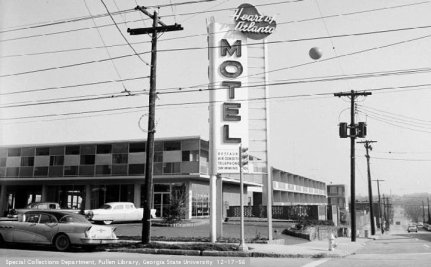
Heart of Atlanta Motel, 1956 - Special Collections and Archives,Georgia State University Library

Heart of Atlanta Motel, 1956 – Special Collections and Archives,Georgia State University Library

I wondered whether this is the motel in the case testing the 1964 Civil Rights Act — and sure enough, it is.  The case was decided, finally, by the U.S. Supreme Court in 1964, Heart of Atlanta Motel, Inc., v. United States, 379 U.S. 241 (1964) .

This important case represented an immediate challenge to the Civil Rights Act of 1964, the landmark piece of civil rights legislation which represented the first comprehensive act by Congress on civil rights and race relations since the Civil Rights Act of 1875. For much of the 100 years preceding 1964, race relations in the United States had been dominated by segregation, a system of racial separation which, while in name providing for “separate but equal” treatment of both white and black Americans, in truth perpetuated inferior accommodation, services, and treatment for black Americans.

During the mid-20th century, partly as a result of cases such as Powell v. Alabama, 287 U.S. 45 (1932); Smith v. Allwright, 321 U.S. 649 (1944); Shelley v. Kraemer, 334 U.S. 1 (1948); Sweatt v. Painter, 339 U.S. 629 (1950); McLaurin v. Oklahoma State Regents, 339 U.S. 637 (1950); NAACP v. Alabama, 357 U.S. 449 (1958); Boynton v. Virginia, 364 U.S. 454 (1960) and probably the most famous, Brown v. Board of Education of Topeka, 347 U.S. 483 (1954), the tide against segregation began to turn. However, segregation remained in full effect into the 1960s in parts of the southern United States, where the Heart of Atlanta Motel was located, despite these decisions.

The Atlanta Time Machine, a great collection of photos in the history of Atlanta and Georgia, has more photos, and this description of the site:

The Heart of Atlanta motel, located at 255 Courtland Street NE, was owned by Atlanta attorney Moreton Rolleston Jr.  Rolleston, a committed segregationist, refused to rent rooms at his hotel to black customers.  Upon passage of the Civil Rights Act of 1964, Rolleston immediately filed suit in federal court to assert that the law was the result of an overly broad interpretation of the U.S. Constitution’s commerce clause.  Rolleston represented himself in the case, HEART OF ATLANTA MOTEL, INC. v. UNITED STATES ET AL., which  went all the way to the United States Supreme Court.  Rolleston lost when the Supreme Court ruled that Congress was well within its powers to regulate interstate commerce in such a manner.  The Hilton Hotel now stands on the former site of the Heart of Atlanta Motel.

Texts in law school rarely have illustrations.  I know the motel mostly as a citation on pages of text, great grey oceans of somnambulent text.  This case is important in civil rights, though it is mentioned almost never in history texts.  What are these cases really about?  These photos offer us insight.

The Heart of Atlanta Motel aspired to greatness in the late 1950s and 1960s — evidenced by this publicity flyer photo from the Atlanta Time Machine; notice the flag flying for the motel’s Seahorse Lounge (Atlanta is landlocked):

Heart of Atlanta Motel publicity photo - Atlanta Time Machine

Heart of Atlanta Motel publicity photo – Atlanta Time Machine; not just a podunk “motor lodge,” but a “resort motel.”  Click for larger image.

For the 1960s, this place offered great amenities, including two swimming pools and in-room breakfast service.

Flyer for the Heart of Atlanta Motel, circa 1960 - Atlanta Time Machine image

Flyer for the Heart of Atlanta Motel, circa 1960 – Atlanta Time Machine image

This photo is amusing — I can just imagine the difficulties of launching a motor boat of this size in one of the swimming pools, obviously for a publicity stunt.  The photo is dated February 27, 1960, in the Pullen Library Collection.

Boat in the pool at the Heart of Atlanta Motel, 1960 - Atlanta Time Machine image

Boat in the pool at the Heart of Atlanta Motel, 1960 – Atlanta Time Machine image

To compare how times have changed, you may want to look at this aerial photo of the area, including the Heart of Atlanta Hotel, and compare it with modern photos which show the Hilton Hotel that replaced the property.

Rolleston appears to have had a big ego.  As noted above, he represented himself in this case, and he argued it in the Supreme Court.  Here’s a picture from about that time, from the University of Missouri-Kansas City Law School “Famous Trials” site:

Moreton Rolleston, Jr., owner of the Heart of Atlanta Motel and the attorney who argued the case at the Supreme Court - UMKC Law School image

Moreton Rolleston, Jr., owner of the Heart of Atlanta Motel and the attorney who argued the case at the Supreme Court – UMKC Law School image; photo: Wayne Wilson/Leviton-Atlanta

You may decide for yourself whether this fits the old legal aphorism that a lawyer who represents himself in a case has a fool for a client.  The Oyez site at the University of Chicago provides access to the audio of the oral arguments.  Did Rolleston argue ably?  Rolleston argued against Archibald Cox, who went on to fame in the Watergate scandals.  This appears to have been Rolleston’s only appearance before the Supreme Court; it was Cox’s ninth appearance (he argued 20 cases before the Court in his career, several well known and notable ones).

Heart of Atlanta vs. United States was argued on October 5, 1964The opinion was issued on December 14, 1964, a 9-0 decision against Rolleston and segregation authored by Justice Tom C. Clark (one of Dallas’s earliest Eagle Scouts).

This was a fight Mr. Rolleston picked.  He was not cited nor indicted for violation of the Civil Rights Act, but instead asked for an injunction to prevent the law’s enforcement; according to the published decision,

Appellant, the owner of a large motel in Atlanta, Georgia, which restricts its clientele to white persons, three-fourths of whom are transient interstate travelers, sued for declaratory relief and to enjoin enforcement of the Civil Rights Act of 1964, contending that the prohibition of racial discrimination in places of public accommodation affecting commerce exceeded Congress’ powers under the Commerce Clause and violated other parts of the Constitution. A three-judge District Court upheld the constitutionality of Title II, §§ 201(a), (b)(1) and (c)(1), the provisions attacked, and, on appellees’ counterclaim, permanently enjoined appellant from refusing to accommodate Negro guests for racial reasons.

Oyez summarizes the case question:

Facts of the Case 

Title II of the Civil Rights Act of 1964 forbade racial discrimination by places of public accommodation if their operations affected commerce. The Heart of Atlanta Motel in Atlanta, Georgia, refused to accept Black Americans and was charged with violating Title II.

Question 

Did Congress, in passing Title II of the 1964 Civil Rights Act, exceed its Commerce Clause powers by depriving motels, such as the Heart of Atlanta, of the right to choose their own customers?

The decision turned on the commerce clause, and the reach of Congressional power to regulate interstate commerce.

Decision: 9 votes for U.S., 0 vote(s) against
Legal provision: Civil Rights Act of 1964, Title II

The Court held that the Commerce Clause allowed Congress to regulate local incidents of commerce, and that the Civil Right Act of 1964 passed constitutional muster. The Court noted that the applicability of Title II was “carefully limited to enterprises having a direct and substantial relation to the interstate flow of goods and people. . .” The Court thus concluded that places of public accommodation had no “right” to select guests as they saw fit, free from governmental regulation.

Good decision. As my law professors described it, Americans enjoy the right to travel, a penumbral right of the Constitution. Inherent in that right is the right to rest in a hotel or motel at the end of the day, especially along a federally-funded highway, part of the U.S. Highway system or National Defense Interstate Highway System.

Heart of Atlanta Motel is gone.  The site is occupied by the Hilton Atlanta, today.

Interstate travel, and sleeping in hotels, continues.

Yes, this is mostly an encore post. Fighting ignorance requires patience.

Yes, this is mostly an encore post. Fighting ignorance requires patience.


Angry Texas mom backs down social studies text publisher, frustrates Texas School Board’s bias

October 3, 2015

Cover of the Texas edition of McGraw-Hill's World Geography (image from Birdville ISD site)

Cover of the Texas edition of McGraw-Hill’s World Geography (image from Birdville ISD site)

Oh, the power of one angry mother!

It’s not like we weren’t warned, by people like the Texas Freedom Network. The last round of “book approvals” by the Texas State Board of Education introduced some stunning inaccuracies into books used in Texas history, geography and economics classrooms. GOP appointees and board members worked hard to make sure even correct history standards could be skewed in actual texts.

One Houston-area mother saw her son’s text for world geography, videoed the thing and put it up on Facebook. Surprisingly, the publisher, McGraw-Hill, backed down, and promised fixes.

Here’s the video, from Rusty Styles:

The good news? This one angry mom got McGraw-Hill to take the ethical path, and promise to fix the caption. On Facebook again, McGraw-Hill said:

This week, we became aware of a concern regarding a caption reference to slavery on a map in one of our world geography programs. This program addresses slavery in the world in several lessons and meets the learning objectives of the course. However, we conducted a close review of the content and agree that our language in that caption did not adequately convey that Africans were both forced into migration and to labor against their will as slaves.

We believe we can do better. To communicate these facts more clearly, we will update this caption to describe the arrival of African slaves in the U.S. as a forced migration and emphasize that their work was done as slave labor. These changes will be reflected in the digital version of the program immediately and will be included in the program’s next print run.

McGraw-Hill Education is committed to developing the highest quality educational materials and upholding the academic integrity of our products. We value the insight the public brings to discussions of our content.

World geography was usually taught in the 9th grade in Texas; recent changes in requirements pushed world geography to a lesser status; many Texas kids get to pick between world geography and world history (both used to be required).

Students are old enough to need to know the truth on these issues. That is not to say that history books should stretch or chop the truth at any time, but it is to note that students in early high school are developing an ethical outlook on their lives. Adults, including book publishers, need to lead exemplary lives.

What other errors didn’t get the public scrutiny they deserved a few years ago?

Any other angry moms out there?


More:

And:


Happy birthday, Jimmy Carter (he’s 91)

October 1, 2015

Photo and caption from the Atlanta Journal-Constitution: It’s been a busy few days for former President Jimmy Carter, who turns 91 today. This past Saturday, he was out and about at the annual Plains Festival, including watching the parade with his wife, Rosalynn , from the balcony of the Plains Inn. Ben Gray / bgray@ajc.com

Photo and caption from the Atlanta Journal-Constitution: It’s been a busy few days for former President Jimmy Carter, who turns 91 today. This past Saturday, he was out and about at the annual Plains Festival, including watching the parade with his wife, Rosalynn , from the balcony of the Plains Inn. Ben Gray / bgray@ajc.com


Jimmy Carter was born 91 years ago today in Plains, Georgia.

The Nobel Peace Prize winner still lives there, today. Maybe there are exceptions to Thomas Wolfe’s rule? Especially for those who stay at home.

A short note in the Atlanta Journal-Constitution website suggests celebration activities, if you’re in Atlanta:

Jimmy Carter turns a youthful 91 today. While the former Georgia governor and president of the United States celebrates with family and friends, the Jimmy Carter Presidential Library and Museum in Atlanta has a way for everyone to join the fun. Admission is reduced to 91 cents all day Thursday (those 16 and under are always admitted free of charge), and there’ll be a special drawing for a signed copy of Carter’s book, “Keeping Faith.” In addition, if you bring a birthday card along with you, the library says they’ll make sure President Carter sees it.

The Jimmy Carter Presidential Library and Museum is located at 441 Freedom Parkway, and is open from 9 a.m. to 4:45 p.m Mondays-Saturdays, and from noon to 4:45 p.m. on Sundays. For more information call (404) 865-7100 or go to www.jimmycarterlibrary.gov.


October’s dates to fly U.S. colors

October 1, 2015

Knights of Columbus of New Haven, Connecticut, present the U.S. flag at the start of New Haven's Columbus Day Parade, 2006. 28 flags demonstrated the history of the U.S. flag. KofC photo

Knights of Columbus of New Haven, Connecticut, present the U.S. flag at the start of New Haven’s Columbus Day Parade, 2006. 28 flags demonstrated the history of the U.S. flag. KofC photo

October is not a big month for dates to fly the U.S. flag.  Only one state joined the union in October, and only two other dates have merited Congress’s designation for flag-flying.

Here are October’s three flag-flying days, in chronological order:

  • Columbus Day, October 12 —  tradition puts Columbus Day on October 12, but in law it is designated as the second Monday in October (to make a three-day weekend for workers who get a holiday); in 2015, October 12 is the second Monday of the month.
  • Navy Day, October 27
  • Nevada Statehood Day, October 31; Nevada joined the union during the Civil War, in 1864, the 36th state.

Federal law also designates October 9 as Leif Erickson Day, a concession to Scandanavian-descended Americans who argue Erickson beat Columbus to the Americas by a few hundred years. Congress’s recognition does not include an urging to fly the flag, though the President may issue such a proclamation.

More:
