October 9, 2018 – St. Denis’s Day, patron saint for those who have lost their head

October 9, 2018

Dear Reader: My apologies. As Cecil might say, we’ve been fighting ignorance since 1974, and it’s taking longer than we thought.  My hopes to retire this post have not been realized.  Heck, it doesn’t even need much editing from past years. Saints save us, please!

We might pause to reflect, too:  Recent years have seen the media rise of actual beheadings. This practice, which now strikes many of us as barbaric, occurs in reality as well as memory and literature; unlike St. Denis, those beheaded do not usually carry on to do anything at all; like St. Denis, they are martyred. Vote well in your local elections, and national elections. Your vote should be directed at preventing anyone’s losing their head, even just figuratively.

October 9 is the Feast Day of St. Denis.

Who? He’s the patron saint of Paris (and France, by some accounts), and possessed people. Take a look at this statue, from the “left door” of the Cathedral of Notre Dame in Paris (Cathédrale Notre-Dame de Paris: portail de gauche). He was martyred by beheading, in about 250 C.E.

A later painting of the martyring of St. Denis. Though I can find a couple copies of this painting, neither lists who was the painter, nor where the painting is.

A later painting of the martyring of St. Denis. Though I can find a couple copies of this painting, neither lists who was the painter, nor where the painting is.

Our trusty friend Wikipedia explains:

According to the Golden Legend, after his head was chopped off, Denis picked it up and walked two miles, preaching a sermon the entire way.[6] The site where he stopped preaching and actually died was made into a small shrine that developed into the Saint Denis Basilica, which became the burial place for the kings of France. Another account has his corpse being thrown in the Seine, but recovered and buried later that night by his converts.[2]

Clearly, he is the guy to pray to about Donald Trump, Ben Carson, Rush Limbaugh, Todd Akin, Paul Ryan, intelligent design, and the Texas State Board of Education, no? In 2013, we added Ted Cruz, Mike Lee, Louis Gohmert, the entire Tea Party, and the entire GOP crew of the House of Representatives. You catch my drift. In 2018 we could add a raft of people: Marsha Blackburn, Ryan Zinke, Sid Miller, Denny Marchant, Jeff Sessions, Sarah Sanders, Mitch McConnell, Lindsey Graham. We’ve left 253 Republicans off for lack of space.

Perhaps you can use this factoid to some advantage, enlightenment, and perhaps humor.  In Catholic lore, St. Denis is one of the “14 Holy Helpers,” and his aid is sought to help people with headaches, or who have been possessed.

Crazy GOP members who I suspect of having been possessed give me and America a headache. St. Denis seems to be our man. Or saint.

Who else do you know of in this modern, vexatious time, who keeps talking after losing his/her head?

As Rod Stewart sang, just “let your imagination run wild.” Maybe St. Denis is listening.

More:

Statue to St. Denis, in Cluny

Another portrayal, in sculpture, of St. Denis. Notice how this one’s face doesn’t really look like the one above? Ouvre du Musée de Cluny, Wikipedia photo by Guillaume Blanchard (Aoineko), June 2001, FinePix 1400Z.

Yes, this is mostly an encore post. I had hoped to have to retire this post someday.  I still hope.  Perhaps this will be the last year we’ll have so many wackaloons running loose. Pray to St. Denis.


October 8, 2018: Fly your flags for Columbus Day, or Indigenous Americans Day

October 8, 2018

It’s another controversy over flying flags, but the flag itself isn’t involved.

U.S. Flag Code specifies that we fly the flag for Columbus Day, but on the rather-new legal day, the second Monday in October. For about a hundred years before that, tradition and law put it on October 12.

So my flag is flying. Many others fly, too. I hope you remembered to post yours.

Parade in Westerly, Rhode Island/Pawcatuck, Connecticut, for Columbus Day 2018.

Parade in Westerly, Rhode Island/Pawcatuck, Connecticut, for Columbus Day 2018. “Several youngsters enjoy the tractors entered in the 71st annual Westerly-Pawcatuck Columbus Day Parade on Sunday. Jackie Turner, Special to The Sun.” Westerly Sun photo.

Columbus Day history tells us the celebration is intended, in part, to offset ugly bias against Italian immigrants in America. Good for that.

But we remember and acknowledge a lot more about history than a century ago. Today, in many quarters Columbus is viewed as a villainous conqueror, an explorer who brought slavery and misery to indigenous Americans.

And there are protests against Columbus in some places. In other places, officials celebrate Indigenous Americans Day, instead of Columbus Day. South Dakota, Columbus, Ohio, and Berkeley and Los Angeles California celebrate indigenous Americans.

There is no doubt that Columbus’s explorations set off several centuries of intense culture clash, resource exploitation and genocide. Probably no one could have foreseen the results. It is also true that in the Americas today modern cultures contribute and lead the world in many fields.

Maybe we should rename it “Celebrate History (and be very sure you know what the history is!) Day.”

Fly your flag, welcome the opportunity to discuss history.

Do you agree?

More:

  • Navy Day is October 27, the next date listed in the Flag Code to fly the flag.

Annals of Global Warming: IPCC Special Report of Global Warming of 1.5°C

October 8, 2018

Are we doomed? This report is not optimistic — instead it quite starkly spells out the challenge that faces humans, as a total planetary population, if we are to have our species survive for another 100 years.

Cover of IPCC-CH report, Special Report of Global Warming of 1.5°C

Cover of IPCC-CH report, Special Report of Global Warming of 1.5°C

The language of the report is quite dry, as we expect from scientists. But the report, from the International Panel on Climate Change (IPCC), is really quite urgent. If the planet — meaning you and me — does not make dramatic progress in controlling carbon air pollution now, any child born now will face dramatic problems from climate warming.

From the executive summary of the report:

A. Understanding Global Warming of 1.5°C

A1. Human activities are estimated to have caused approximately 1.0°C of global warming above pre-industrial levels, with a likely
range of 0.8° C to 1.2°C. Global warming is likely to reach 1.5°C between 2030 and 2052 if it continues to increase at the current rate. (high confidence) {1.2, Figure SPM.1}

A1.1.
Reflecting the long-term warming trend since pre-industrial times, observed global meansurface temperature (GMST) for the decade 2006–2015 was 0.87°C (likely between 0.75°C and 0.99°C) higher than the average over the 1850–1900 period (very high confidence). Estimated anthropogenic global warming matches the level of observed warming to within ±20% (likely range). Estimated anthropogenic global warming is currently increasing at 0.2°C (likely between 0.1°C and 0.3°C) per decade due to past and ongoing emissions (high confidence). {1.2.1, Table 1.1, 1.2.4}

A1.2.
Warming greater than the global annual average is being experienced in many land regions and seasons, including two to three times higher in the Arctic. Warming is generally higher over land than over the ocean. (high confidence) {1.2.1, 1.2.2, Figure 1.1, Figure 1.3, 3.3.1, 3.3.2}

A1.3.
Trends in intensity and frequency of some climate and weather extremes have been detected over time spans during which about 0.5° C of global warming occurred (medium confidence). This assessment is based on several lines of evidence, including attribution studies for changes in extremes since 1950. {3.3.1, 3.3.2, 3.3.3}

Who will respond to the call to arms? Who will read this report?

I’m providing links to the report here, and the complete press release. Read it here (or at the UN site linked) to get the facts, and to see just how much distortion gets introduced by anti-Earth, anti-science propagandists.

Here is the unedited press release from IPCC on this report:

2018/24/PR
8 October 2018
Summary for Policymakers of IPCC Special Report on Global Warming of 1.5°C approved by governments

Incheon, Republic of Korea, October 8– Limiting global warming to 1.5°C would require rapid, far-reaching and unprecedented changes in all aspects of society, the IPCC said in a new assessment. With clear benefits to people and natural ecosystems, limiting global warming to 1.5°C compared to 2°C could go hand in hand with ensuring a more sustainable and equitable society, the Intergovernmental Panel on Climate Change (IPCC) said on Monday.

The Special Report on Global Warming of 1.5°C was approved by the IPCC on Saturday in Incheon, Republic of Korea. It will be a key scientific input into the Katowice Climate Change Conference in Poland in December, when governments review the Paris Agreement to tackle climate change.

“With more than 6,000 scientific references cited and the dedicated contribution of thousands of expert and government reviewers worldwide, this important report testifies to the breadth and policy relevance of the IPCC,” said Hoesung Lee, Chair of the IPCC.

Ninety-one authors and review editors from 40 countries prepared the IPCC report in response to an invitation from the United Nations Framework Convention on Climate Change (UNFCCC) when it adopted the Paris Agreement in 2015.

The report’s full name is Global Warming of 1.5°C, an IPCC special report on the impacts of global warming of 1.5°C above pre-industrial levels and related global greenhouse gas emission pathways, in the context of strengthening the global response to the threat of climate change, sustainable development, and efforts to eradicate poverty.

“One of the key messages that comes out very strongly from this report is that we are already seeing the consequences of 1°C of global warming through more extreme weather, rising sea levels and diminishing Arctic sea ice, among other changes,” said Panmao Zhai, Co-Chair of IPCC Working Group I.

The report highlights a number of climate change impacts that could be avoided by limiting global warming to 1.5°C compared to 2°C, or more. For instance, by 2100, global sea level rise would be 10 cm lower with global warming of 1.5°C compared with 2°C. The likelihood of an Arctic Ocean free of sea ice in summer would be once per century with global warming of 1.5°C, compared with at least once per decade with 2°C. Coral reefs would decline by 70-90 percent with global warming of 1.5°C, whereas virtually all (> 99 percent) would be lost with 2°C.

“Every extra bit of warming matters, especially since warming of 1.5°C or higher increases the risk associated with long-lasting or irreversible changes, such as the loss of some ecosystems,” said Hans-Otto Pörtner, Co-Chair of IPCC Working Group II.

Limiting global warming would also give people and ecosystems more room to adapt and remain below relevant risk thresholds, added Pörtner. The report also examines pathways available to limit warming to 1.5°C, what it would take to achieve them and what the consequences could be. “The good news is that some of the kinds of actions that would be needed to limit global warming to 1.5°C are already underway around the world, but they would need to accelerate,” said Valerie Masson-Delmotte, Co-Chair of Working Group I.

The report finds that limiting global warming to 1.5°C would require “rapid and far-reaching” transitions in land, energy, industry, buildings, transport, and cities. Global net human-caused emissions of carbon dioxide (CO2) would need to fall by about 45 percent from 2010 levels by 2030, reaching ‘net zero’ around 2050. This means that any remaining emissions would need to be balanced by removing CO2 from the air.

“Limiting warming to 1.5°C is possible within the laws of chemistry and physics but doing so would require unprecedented changes,” said Jim Skea, Co-Chair of IPCC Working Group III.

Allowing the global temperature to temporarily exceed or ‘overshoot’ 1.5°C would mean a greater reliance on techniques that remove CO2 from the air to return global temperature to below 1.5°C by 2100. The effectiveness of such techniques are unproven at large scale and some may carry significant risks for sustainable development, the report notes.

“Limiting global warming to 1.5°C compared with 2°C would reduce challenging impacts on ecosystems, human health and well-being, making it easier to achieve the United Nations Sustainable Development Goals,” said Priyardarshi Shukla, Co-Chair of IPCC Working Group III.

The decisions we make today are critical in ensuring a safe and sustainable world for everyone, both now and in the future, said Debra Roberts, Co-Chair of IPCC Working Group II.

“This report gives policymakers and practitioners the information they need to make decisions that tackle climate change while considering local context and people’s needs. The next few years are probably the most important in our history,” she said.

The IPCC is the leading world body for assessing the science related to climate change, its impacts and potential future risks, and possible response options.

The report was prepared under the scientific leadership of all three IPCC working groups. Working Group I assesses the physical science basis of climate change; Working Group II addresses impacts, adaptation and vulnerability; and Working Group III deals with the mitigation of climate change.

The Paris Agreement adopted by 195 nations at the 21st Conference of the Parties to the UNFCCC in December 2015 included the aim of strengthening the global response to the threat of climate change by “holding the increase in the global average temperature to well below 2°C above pre-industrial levels and pursuing efforts to limit the temperature increase to 1.5°C above pre-industrial levels.”

As part of the decision to adopt the Paris Agreement, the IPCC was invited to produce, in 2018, a Special Report on global warming of 1.5°C above pre-industrial levels and related global greenhouse gas emission pathways. The IPCC accepted the invitation, adding that the Special Report would look at these issues in the context of strengthening the global response to the threat of climate change, sustainable development, and efforts to eradicate poverty.

Global Warming of 1.5°C is the first in a series of Special Reports to be produced in the IPCC’s Sixth Assessment Cycle. Next year the IPCC will release the Special Report on the Ocean and Cryosphere in a Changing Climate, and Climate Change and Land, which looks at how climate change affects land use.

The Summary for Policymakers (SPM) presents the key findings of the Special Report, based on the assessment of the available scientific, technical and socio-economic literature relevant to global warming of 1.5°C.

The Summary for Policymakers of the Special Report on Global Warming of 1.5°C (SR15) is available at https://www.ipcc.ch/report/sr15 or www.ipcc.ch.

Key statistics of the Special Report on Global Warming of 1.5°C

91 authors from 44 citizenships and 40 countries of residence
– 14 Coordinating Lead Authors (CLAs)
– 60 Lead authors (LAs)
– 17 Review Editors (REs)

133 Contributing authors (CAs)
Over 6,000 cited references
A total of 42,001 expert and government review comments
(First Order Draft 12,895; Second Order Draft 25,476; Final Government Draft: 3,630)

For more information, contact:
IPCC Press Office, Email: ipcc-media@wmo.int
Werani Zabula +41 79 108 3157 or Nina Peeva +41 79 516 7068

Notes for editors The Special Report on Global Warming of 1.5 °C, known as SR15, is being prepared in response to an invitation from the 21st Conference of the Parties (COP21) to the United Nations Framework Convention on Climate Change in December 2015, when they reached the Paris Agreement, and will inform the Talanoa Dialogue at the 24th Conference of the Parties (COP24). The Talanoa Dialogue will take stock of the collective efforts of Parties in relation to progress towards the long-term goal of the Paris Agreement, and to inform the preparation of nationally determined contributions. Details of the report, including the approved outline, can be found on the report page. The report was prepared under the joint scientific leadership of all three IPCC Working Groups, with support from the Working Group I Technical Support Unit.

What is the IPCC?
The Intergovernmental Panel on Climate Change (IPCC) is the UN body for assessing the science related to climate change. It was established by the United Nations Environment Programme (UN Environment) and the World Meteorological Organization (WMO) in 1988 to provide policymakers with regular scientific assessments concerning climate change, its implications and potential future risks, as well as to put forward adaptation and mitigation strategies. It has 195 member states.

IPCC assessments provide governments, at all levels, with scientific information that they can use to develop climate policies. IPCC assessments are a key input into the international negotiations to tackle climate change. IPCC reports are drafted and reviewed in several stages, thus guaranteeing objectivity and transparency.

The IPCC assesses the thousands of scientific papers published each year to tell policymakers what we know and don’t know about the risks related to climate change. The IPCC identifies where there is agreement in the scientific community, where there are differences of opinion, and where further research is needed. It does not conduct its own research.

To produce its reports, the IPCC mobilizes hundreds of scientists. These scientists and officials are drawn from diverse backgrounds. Only a dozen permanent staff work in the IPCC’s Secretariat.

The IPCC has three working groups: Working Group I, dealing with the physical science basis of climate change; Working Group II, dealing with impacts, adaptation and vulnerability; and Working Group III, dealing with the mitigation of climate change. It also has a Task Force on National Greenhouse Gas Inventories that develops methodologies for measuring emissions and removals.

IPCC Assessment Reports consist of contributions from each of the three working groups and a Synthesis Report. Special Reports undertake an assessment of cross-disciplinary issues that span more than one working group and are shorter and more focused than the main assessments.

Sixth Assessment Cycle
At its 41st Session in February 2015, the IPCC decided to produce a Sixth Assessment Report (AR6). At its 42nd Session in October 2015 it elected a new Bureau that would oversee the work on this report and Special Reports to be produced in the assessment cycle. At its 43rd Session in April 2016, it decided to produce three Special Reports, a Methodology Report and AR6.

The Methodology Report to refine the 2006 IPCC Guidelines for National Greenhouse Gas Inventories will be delivered in 2019. Besides Global Warming of 1.5°C, the IPCC will finalize two further special reports in 2019: the Special Report on the Ocean and Cryosphere in a Chanhttps://twitter.com/IPCC_CH/status/1049127236564082689ging Climate and Climate Change and Land: an IPCC special report on climate change, desertification, land degradation, sustainable land management, food security, and greenhouse gas fluxes in terrestrial ecosystems. The AR6 Synthesis Report will be finalized in the first half of 2022, following the three working group contributions to AR6 in 2021.

For more information, including links to the IPCC reports, go to: www.ipcc.ch

Discuss away, comments are open.

More:

  • See the Tweet from IPCC, below


Second thoughts in Eatonville, Washington

October 6, 2018

We passed this garage on the way to Mt. Ranier National Park, on a day in August when smoke from global-warming aggravated fires in British Columbia almost obscured one of America’s biggest, mist obvious mountains. That’s part of the yellow tint to the light.

A lot of voters have second thoughts.

And this voter’s sign for candidate “Trump” has become a sign for candidate “TRump.”

Will you vote to fix things, this November?

Tip of the old scrub brush to Mr. Darrell’s Government and Politics, a sister blog


Lasting effects of powerful testimony often reach beyond the immediate result? Time’s cover

October 5, 2018

Time Magazine cover, October 14, 2018, featuring an image of Dr. Christine Blase Ford composed of words from her testimony to the U.S. Senate Judiciary Committee. Cover by Jon Mavroudis.

Time Magazine cover, October 14, 2018, featuring an image of Dr. Christine Blase Ford composed of words from her testimony to the U.S. Senate Judiciary Committee. Cover by Jon Mavroudis.

Cover art used to be absolutely necessary to sell magazines at the newsstand.

But who buys anything at a newsstand today?

The surge in great cover art over the past decade pleases me partly because it’s almost pointless, in the old sense. Great covers rarely increase circulation of print publications any more.

So why the surge?

A memorable cover still builds the reputation of a publication, and art is useful online, too.

Time Magazine is a skinny version of its old self, these days, no longer the foundation of the powerful Time/Life/Fortune/Money empire built by Henry Luce. Heck, are those four magazines even owned by the same company any more, even apart from Life having ceased publication decades ago?

The covers continue, and occasionally them come in an animated form. They still set expectations for news, and provide a visual shorthand for material on the inside, material the publishers hope we’ll read.

What is Time trying to tell us this week, with Dr. Christine Blasey Ford on the cover? (Look at this animated version; wish I could figure out how to embed it short of the Tweet.)


https://twitter.com/ZenPopArt/status/1047859739676139521

Perhaps more important, how will this cover, this moment in time captured there, affect politics in the future, say on November 6, or in 2020? Has the testimony of Dr. Christine Blasey Ford pushed America in any different direction on any issue?

Check out the article at Time, “How Christine Blasey Ford’s Testimony Changed America,” by Haley Sweetland Edwards.

More:

Please help fight ignorance, and share this post on your Twitter, Facebook, Reddit or other social media accounts. Thank you.


Important history not covered in the Texas standards: Electric bass, 1935 to 1969

October 4, 2018

Scott Devine and a blue Fender Bass. Scott's the guy behind the YouTube monster, Scott's Bass Lessons.

Scott Devine and a blue Fender Bass. Scott’s the guy behind the YouTube monster, Scott’s Bass Lessons.

It’s from Scott’s Bass Lessons — but history you need. Let Scott and the video speak for itself.

The Bass, 1935-1969: The Players You need to know.

Am I biased toward bass? Well, yeah — biased toward most stuff in the bass clef, really.

Larry Graham? Heck, in comments here, tell who your favorite bass player was, before 1970. And in hopes of actually stimulating a conversation, throw in any double-bass, stand-up bass players you want to add.

More:

Patent for the first electric bass built by the Fender company, March 24, 1953. Clarence L. Fender (Leo Fender) claimed a patent on the "ornamental design" of the "guitar." I see no mention that it's a bass. Interesting.

Patent for the first electric bass built by the Fender company, March 24, 1953. Clarence L. Fender (Leo Fender) claimed a patent on the “ornamental design” of the “guitar.” I see no mention that it’s a bass. This is the same drawing Scott shows in the video.  Interesting. Via Google Patent.


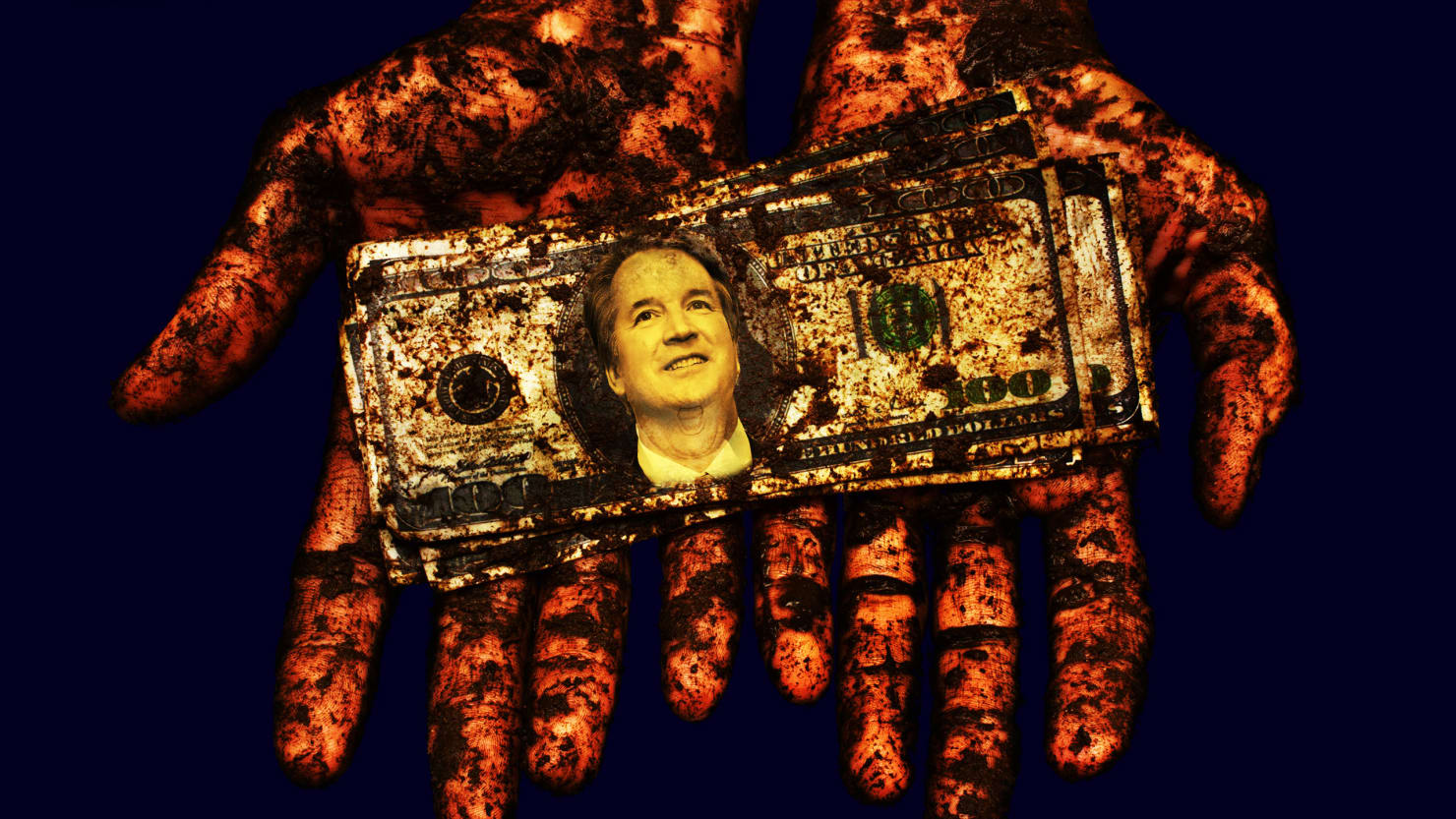
Dark money pushing Kavanaugh nomination, and savaging people who testify against him

October 3, 2018

Photo Illustration by Lyne Lucien/The Daily Beast

Photo Illustration by Lyne Lucien/The Daily Beast

Series of Tweets from Mike Farb, discussing the dark money campaign to put Brett Kavanaugh on the Supreme Court.

One more ugly piece of an ugly puzzle.

Farb is one of the geniuses behind UnhackTheVote.com, a project dedicated to ballot security and increasing protections for democracy in our elections.

https://twitter.com/mikefarb1/status/1017472640624349185

https://twitter.com/mikefarb1/status/1017472643186950144

https://twitter.com/mikefarb1/status/1017472660677255168

https://twitter.com/mikefarb1/status/1017472668893933571

Maguire’s Tweet:

https://twitter.com/mikefarb1/status/1017472674723979264

https://twitter.com/mikefarb1/status/1017472682806468608

https://twitter.com/mikefarb1/status/1017472687608823809

https://twitter.com/mikefarb1/status/1017472692755320832

https://twitter.com/mikefarb1/status/1017472698786766848

https://twitter.com/mikefarb1/status/1017472703094280192

https://twitter.com/mikefarb1/status/1017472713546399744

https://twitter.com/mikefarb1/status/1017472717723963398

More:


Quote of the moment: JFK, ‘Go with the United States; they represent the future’

October 2, 2018

President John Kennedy, a photo taken several months after his speech in Hamtramck, MIchigan. Photographer not identified.

President John Kennedy, a photo taken several months after his speech in Hamtramck, MIchigan. Photographer not identified.

The function of the President of the United States,
the President of the United States,
is to build a strong society here,
to maintain full employment,
to educate our children,
to provide security for our aged citizens,
to provide justice for our people,
to build an image of a society on the move,
so that people around the world who wonder what the future holds for them,
who wonder which road they should take, they decide,
“We want to go with the United States; they represent the future.”

As long as the United States lives, so freedom lives.
As long as we build our strength,
as long as we are on the move,
as long as we are a progressive society,
then the future belongs to us
and not to Mr. Khrushchev.

John F. Kennedy: “Remarks of Senator John F. Kennedy, Keyworth Stadium, Hamtramck, MI,” October 26, 1960. Online by Gerhard Peters and John T. Woolley, The American Presidency Project. http://www.presidency.ucsb.edu/ws/?pid=74225.


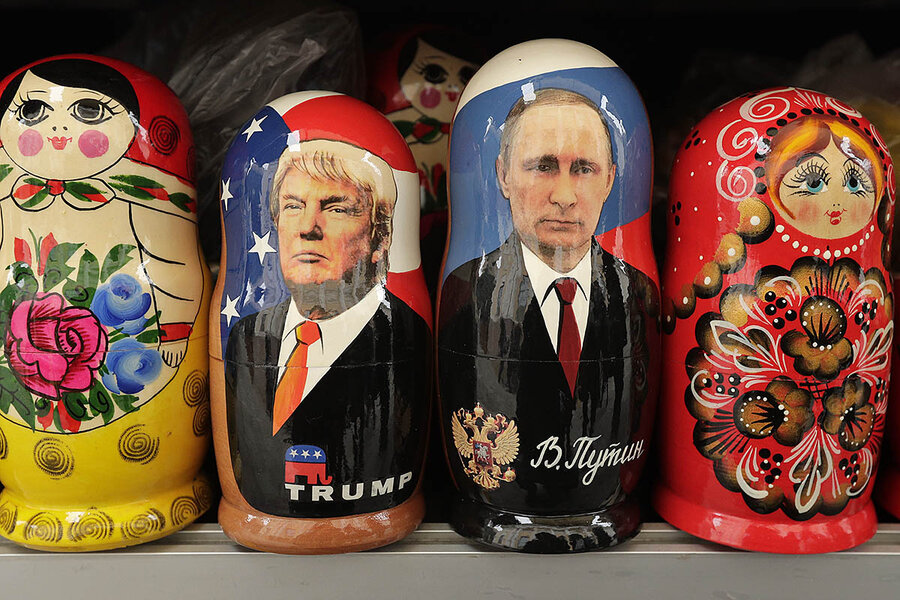
Trump/Russia: Collusion, shmallusion; whatever it is, it stinks, and it’s bad for America

October 2, 2018

The Trump doll doesn't fit into the Putin doll, and vice versa; but that doesn't mean Trump's destructive anti-U.S./pro-Russia policies are good, nor that Russia didn't illegally interfere in U.S. elections, nor that illegally activities on both sides didn't tip the election, even if not formally coordinated. Christian Science Monitor image, From Dmitri Lovetsky/AP, dolls in a St. Petersburg, Russia, souvenir shop.

The Trump doll doesn’t fit into the Putin doll, and vice versa; but that doesn’t mean Trump’s destructive anti-U.S./pro-Russia policies are good, nor that Russia didn’t illegally interfere in U.S. elections, nor that illegally activities on both sides didn’t tip the election, even if not formally coordinated. Christian Science Monitor image, From Dmitri Lovetsky/AP, dolls in a St. Petersburg, Russia, souvenir shop.

This is a couple of weeks old, which means investigators and reporters have even more damning evidence that the Trump campaign and Donald Trump himself worked with the Russian government and Russian agents to foul up our 2016 presidential election, succeeding beyond the wildest hopes of Vladimir Putin.

But in the end, two years down the road from 2016 our best hopes for putting America back on the right track lie in the ballots Americans will cast in 2018. We have the power to make things better.

How are you going to vote in November 2018? Will you vote Democratic, to save the U.S? Or will you vote Republican?

Am I putting the stakes too severely? Have you read this investigative piece from Scott Shane and Mark Mazzetti in the New York Times, which newspaper itself played an ugly role of journalistic failure in 2016?


https://platform.twitter.com/widgets.js

More:


Gold Star Mothers Day 2018 – Fly your flags, Sunday, September 30

September 30, 2018

Gold Star Families Memorial in Bronte, Texas, with flag framed in the cutout of a soldier. Photo from KSAN TV

Gold Star Families Memorial in Bronte, Texas, with flag framed in the cutout of a soldier. Photo from KSAN TV and the Concho Valley homepage.

In wars in the 20th century, mothers with children serving in the military put a red-trimmed, white flag with a blue star in the middle, in their windows to show their child was off at war. Blue Star Mothers.

If that child died, the blue star was replaced with a gold star. Blue Star Mothers became Gold Star Mothers.

On the last Sunday of September we fly our U.S. flags in honor of those mothers of fallen soldiers, and the soldiers’ families, for Gold Star Mothers Day. In 2018, that is September 30.

So, everyone should fly a U.S. flag on Sunday, if you can.

More:

Also see at Millard Fillmore’s Bathtub:


Still necessary: Banned Books Week 2018

September 29, 2018

Weren’t we supposed to be more free by now?

And yet, we still need Banned Books Week (#BannedBooksWeek) to push against censorship and suppression of books.

I’m running behind. Banned Books Week 2018 started on September 24. I don’t really have much brilliant to say about it, except we’re still fighting to keep history in Texas history standards, to keep history in Texas school history texts, and the latest outrage is the “deletion” of Helen Keller and Hillary Clinton from the list of historic figures kids ought to rub intellectual elbows with in their studies.

So let me offer a quick and dirty, but often compelling compendium of some of the best Tweets about banned books this week, and the celebration of freedom.

Ray Bradbury had it right:

Ray Bradbury had it right: “You don’t have to burn books to destroy a culture. Just get people to stop reading them.”

What’s the best banned book you’ve read lately?

What books have people tried to ban in your town or state this year?

What good, controversial books have you read that you recommend we read, before it gets banned?

Some old banned books offer great wisdom for our present crises. Like Tom Sawyer:

The Mental Floss list of 35 most-banned books over the last five years is instructive. It tells us something about what issues “authorities” want to keep quiet, and what people read enough to annoy other people enough to complain to libraries. The article lists these:

Since most requests to remove books from schools or libraries go unreported, these lists are not definitive; instead, they offer a “snapshot” of book challenges, according to the [American Library Association’s Office for Intellectual Freedom (OIF)]. In recognition of Banned Books Week, which runs from September 23 through September 29, we’ve compiled a list of the most banned and challenged books of the past five years (2013 to 2017), including the years they were challenged and the reasons why.

1. Thirteen Reasons Why by Jay Asher
Year(s): 2017
Reason: Discussion of suicide

2. The Absolutely True Diary of a Part-Time Indian by Sherman Alexie
Year(s): 2013, 2014, 2017
Reason: Anti-family, cultural insensitivity, drugs/alcohol/smoking, gambling, offensive language, sex education, sexually explicit, violence, and “depictions of bullying”

3. Drama by Raina Telgemeier
Year(s): 2014, 2016, 2017
Reason: LGBT characters

4. The Kite Runner by Khaled Hosseini
Year(s): 2014, 2017
Reason: Sexual violence, unsuited to age group; was thought to “promote Islam”

5. George by Alex Gino
Year(s): 2016, 2017
Reason: Transgender child character

6. Sex is a Funny Word by Cory Silverberg and Fiona Smyth
Year(s): 2017
Reason: Addresses sex education; was thought to lead children to “want to have sex or ask questions about sex”

7. To Kill a Mockingbird by Harper Lee
Year(s): 2017
Reason: Violence and use of the N-word

8. The Hate U Give by Angie Thomas
Year(s): 2017
Reason: Drug use, profanity, offensive language

9. And Tango Makes Three by Peter Parnell, Justin Richardson, and Henry Cole
Year(s): 2014, 2017
Reason:Anti-family, homosexuality, political and religious viewpoints

10. I Am Jazz by Jessica Herthel, Jazz Jennings, and Shelagh McNicholas
Year(s): 2015, 2016, 2017
Reason: Addresses gender identity, homosexuality, sex education, religious viewpoint, unsuited to age group

11. This One Summer by Mariko Tamaki and Jillian Tamaki
Year(s): 2016
Reason: LGBT characters, drug use, profanity, sexually explicit content

12. Two Boys Kissing by David Levithan
Year(s): 2015, 2016
Reason: LGBT and sexually explicit content

13. Looking for Alaska by John Green
Year(s): 2013, 2015, 2016
Reason: Sexually explicit scene, unsuited to age group; was thought to lead students to “sexual experimentation”

14. Big Hard Sex Criminals by Matt Fraction and Chip Zdarsky
Year(s): 2016
Reason: Sexually explicit content

15. Make Something Up: Stories You Can’t Unread by Chuck Palahniuk
Year(s): 2016
Reason: Profanity and sexually explicit content; was called “disgusting and all around offensive”

16. Little Bill (series) by Bill Cosby and Varnette P. Honeywood
Year(s): 2016
Reason: Criminal sexual allegations against Bill Cosby

17. Eleanor & Park by Rainbow Rowell
Year(s): 2016
Reason: Offensive language

18. Fifty Shades of Grey by E. L. James
Year(s): 2013, 2015
Reason: Sexually explicit content, unsuited to age group; was also called “poorly written”

19. Beyond Magenta: Transgender Teens Speak Out by Susan Kuklin
Year(s): 2015
Reason: Offensive language, homosexuality, sex education, political and religious viewpoints, anti-family, unsuited to age group

20. The Curious Incident of the Dog in the Night-Time by Mark Haddon
Year(s): 2015
Reason: Profanity, religious viewpoint (atheism), unsuited to age group

21. The Holy Bible
Year(s): 2015
Reason: Religious viewpoint

22. Fun Home by Alison Bechdel
Year(s): 2015
Reason: Violence and graphic images

23. Habibi by Craig Thompson
Year(s): 2015
Reason: Nudity, sexually explicit content, unsuited to age group

24. Nasreen’s Secret School: A True Story from Afghanistan by Jeanette Winter
Year(s): 2015
Reason: Religious viewpoint, violence, unsuited to age group

25. Persepolis: The Story of a Childhood by Marjane Satrapi
Year(s): 2014
Reason: Gambling, offensive language, political viewpoint, graphic depictions; was called “politically, racially, and socially offensive”

26. The Bluest Eye by Toni Morrison
Year(s): 2013, 2014
Reason: Sexually explicit, unsuited to age group; was said to “contain controversial issues”

27. It’s Perfectly Normal by Robie Harris and Michael Emberley
Year(s): 2014
Reason: Nudity, sex education, sexually explicit

28. Saga by Brian Vaughan and Fiona Staples
Year(s): 2014
Reason: Anti-family, nudity, offensive language, sexually explicit, unsuited to age group

29. The Perks of Being a Wallflower by Stephen Chbosky
Year(s): 2013, 2014
Reason: Drugs/alcohol/smoking, homosexuality, offensive language, sexually explicit

30. A Stolen Life by Jaycee Dugard
Year(s): 2014
Reason: Drugs/alcohol/smoking, offensive language, sexually explicit, unsuited to age group

31. Captain Underpants (series) by Dav Pilkey
Year(s): 2013
Reason: Offensive language, violence, unsuited to age group

32. The Hunger Games by Suzanne Collins
Year(s): 2013
Reason: Religious viewpoint, unsuited to age group

33. A Bad Boy Can Be Good for A Girl by Tanya Lee Stone
Year(s): 2013
Reason: Drugs/alcohol/smoking, nudity, offensive language, sexually explicit content

34. Bless Me, Ultima by Rudolfo Anaya
Year(s): 2013
Reason: Drugs/alcohol/smoking, homosexuality, sexually explicit content, unsuited to age group

35. Bone (series) by Jeff Smith
Year(s): 2013
Reason: Political viewpoint, racism, violence

A good list of reading. Irony that The Holy Bible and The Curious Incident of the Dog in the Night both appear on the list; one might imagine advocates of one book complaining about the other.

https://twitter.com/StephenARhodes/status/1044218309544161280

https://twitter.com/AlanaEFarrell/status/1044153651177148416

A literature or history teacher can find a whole school year’s worth of graphics from Tweets during Banned Books Week.

This post may be updated. Please comment, and come back to discuss.


September 26, 1850: Millard Fillmore nominated Brigham Young as governor of the Utah Territory

September 26, 2018

Interesting exercise, probably for an undergraduate college history student:  What became of these men during their service in the Utah Territory, and afterward?  What effect did they have on Utah’s history, and Utah on them?

On September 26, 1850, Millard Fillmore sent the Senate, for confirmation, his nominations of officers to run the Utah Territory, three years after Brigham Young had led the first band of Latter-day Saints into the Salt Lake Valley to settle; Fillmore nominated Brigham Young as Governor of the Territory:

Letter from President Millard Fillmore to the U.S. Senate, nominating people (all men) to govern the Utah Territory, September 26, 1850 - U.S. National Archives image

Letter from President Millard Fillmore to the U.S. Senate, nominating people (all men) to govern the Utah Territory, September 26, 1850 – U.S. National Archives image

Page 2:

Page 2 of President Fillmore's letter to the U.S. Senate, nominating officers to govern the Utah Territory , in 1850. National Archives image

Page 2 of President Fillmore’s letter to the U.S. Senate, nominating officers to govern the Utah Territory , in 1850. National Archives image

National Archives notes:  Executive Nominations for the First Session of the 31st Congress, 12/03/1849 – 09/30/1850

Production Dates: 09/26/1850

Notes in red ink indicate that confirmation dates for each of these nominees — all but one done two days later.  Fillmore’s nominee to be U.S. marshall in the territory wasn’t confirmed until the following February.

Amazing to think of the speed with which these confirmations occurred, compared to today’s U.S. Senate — and remembering that Congress was not particularly friendly to Fillmore.

An animated GIF of the as it evolved from 1850...

An animated GIF of the Utah Territory as it evolved from 1850 to 1896, when statehood was granted. (Territory boundaries not exact, especially in the west, where early proposals took in parts of California) Wikipedia image

Nominations were:

  • Brigham Young, of Utah, to be governor of the Utah territory
  • Broughton Davis Harris, of Vermont, to be Secretary of the territory
  • Joseph Buffington, of Pennsylvania, to be Chief Justice of the Supreme Court of the Utah Territory
  • Perry E. Brocchus, of Alabama, to be Associate Justice of the Supreme Court of the Utah Territory
  • Zerubabbel Snow, of Ohio, to be Associate Justice of the Supreme Court of the Utah Territory
  • Seth Blain, of Utah, to be U.S. Attorney
  • Joseph L. Haywood, of Utah, to be U.S. Marshall.

What other odd little delights are hidden away in the on-line holdings of the National Archives?  What sort of DBQ exercise can history teachers make out of this stuff?

More:

Brigham Young in 1851; photo from LDS archives

Brigham Young in 1851; photo from LDS archives

This is an encore post.

Yes, this is an encore post. Defeating ignorance takes patience and perseverance.


Europe, mapped by famous art works

September 26, 2018

This is stunning, politically hot, and frustrating in that I cannot immediately identify the artworks (I think one is a sculpture photograph), let alone the artists.

But still cool.

Who made it? Where is the legend to identify the art?

From Simon Kuestenmacher (on Twitter: @simongerman600):

From Simon Kuestenmacher (on Twitter: @simongerman600): “Map of Europe with each country represented by one of it’s most recognizable pieces of art. How many can you name? Source: https://buff.ly/2eKIYUV”

Mr. Kuestenmacher found the map on Reddit. Ripred42, who posted it on Reddit, didn’t offer any other details as to who made the map or what the art works are; several comments identify several of the works. I have not yet found a better legend.

This map might make a good exercise for AP Geography or AP Human Geography, or AP History, or IB History. There are some possibilities for good discussion. At Reddit there is a complaint that the Mona Lisa shouldn’t represent Italy, since it was sold to a foreign king and is displayed in a foreign museum. The Gustav Klimt painting shown for Austria was determined to have been stolen from its rightful owners, who took the painting and put it on display in New York City instead (the subject of the movie starring Helen Mirren, “The Woman in Gold.”)

Is Turner really the best representative for England? Can any work be determined for Cypress or Ireland? The discussion on Twitter is better than Reddit, and most informative.

Can you identify the works? I’ll list those I can figure out in comments. Please help identify others if you can.

Tip of the old scrub brush to Simon Kuestenmacher on Twitter.


September 25, 1789: Bill of Rights sent to American people, Congress asked approval

September 25, 2018

From the Atlanta Coin Show: A commemorative gold-clad silver half-dollar provides an image of Madison writing the Bill of Rights with his quill pen with a view of Montpelier in the background.

From the Atlanta Coin Show: A commemorative gold-clad silver half-dollar provides an image of Madison writing the Bill of Rights with his quill pen with a view of Montpelier in the background. “LIBERTY,” “JAMES MADISON,” “FATHER OF THE BILL OF RIGHTS” and “IN GOD WE TRUST” along with “1993” are shown on the half dollar’s obverse.

September 25, 1789, Congress approved and enrolled the proposals, and sent twelve proposed amendments to the Constitution to the states for ratification.  Ten of the twelve amendments were approved, rather quickly, and by 1791 they were attached to the Constitution, known as the Bill of Rights.

The two proposals that failed to earn the required approval of three-fourths of the 13 states fell into a special limbo for Constitutional amendments that became clear only in the late 1970s when Congress discussed how long to wait for states to approve the Equal Rights Amendment (this is a much-simplified explanation, I know).  Congress put deadlines on the ratification process in the late 20th century, but the first twelve proposals had no deadlines.  In the 1980s, Congress passed a law that said any amendments floating around, unapproved, would be considered dead after a date certain.  Senate Judiciary Committee investigation found six such amendments, yet unratified.

Before that deadline passed, more states took a look at one of James Madison’s 1789 proposals, liked it, and passed it.

That amendment became the 27th Amendment to the Constitution, on May 7, 1992, 203 years after it was proposed:

No law, varying the compensation for the services of the Senators and Representatives, shall take effect, until an election of Representatives shall have intervened.

This means James Madison, the Father of the Constitution, also proposed the first ten Amendments to the Constitution, ratified by 1791; and he also proposed the 27th Amendment, the last at the moment.

Patience is a virtue in legislative action, sometimes.

A portion of the Bill of Rights is seen at the Vancouver [Washington] Community Library in 2016. (Amanda Cowan/The Columbian)

A portion of the Bill of Rights is seen at the Vancouver [Washington] Community Library in 2016. (Amanda Cowan/The Columbian)

This is an encore post.

Yes, this is an encore post. Defeating ignorance takes patience and perseverance.


On This Day: Washington’s Farewell “Address,” September 19, 1796

September 19, 2018

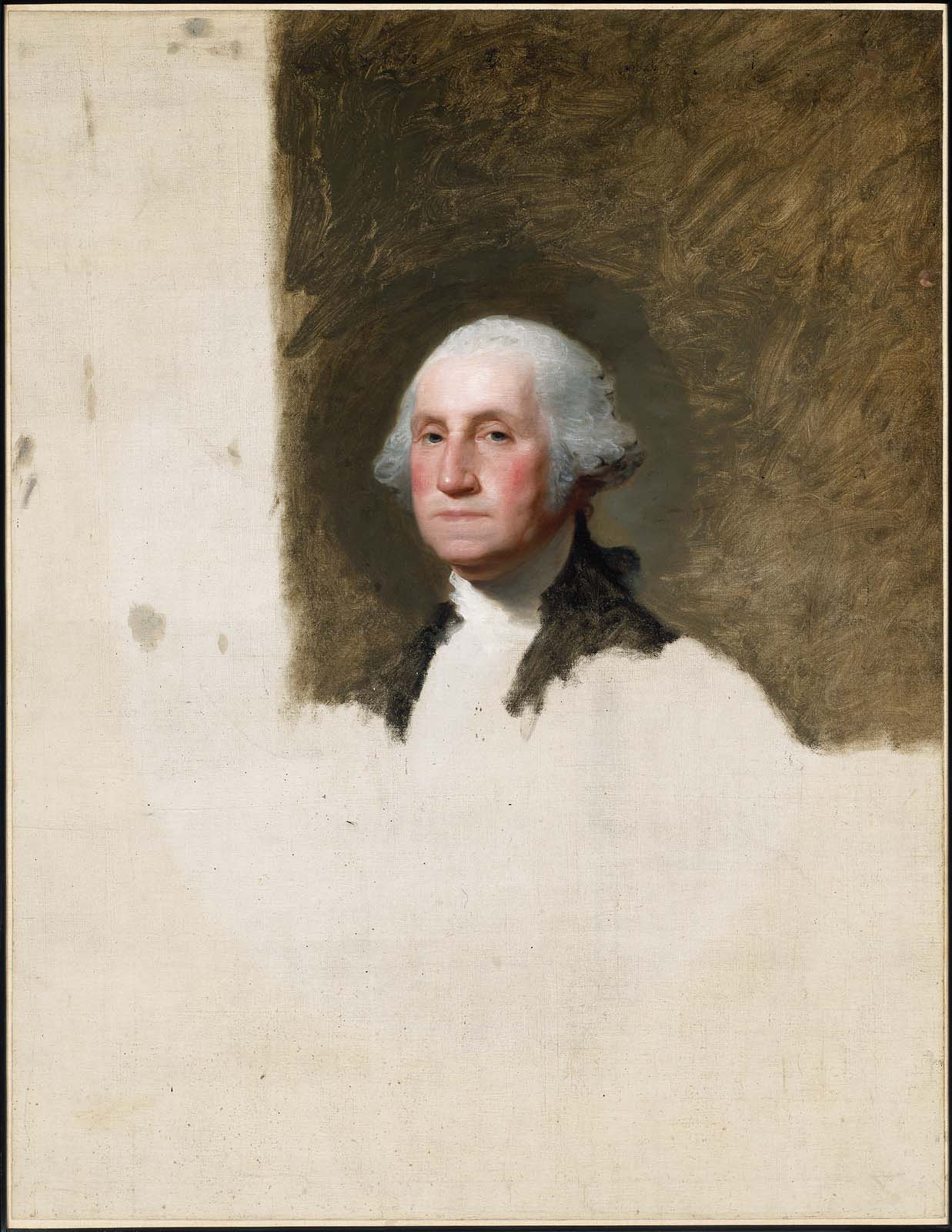
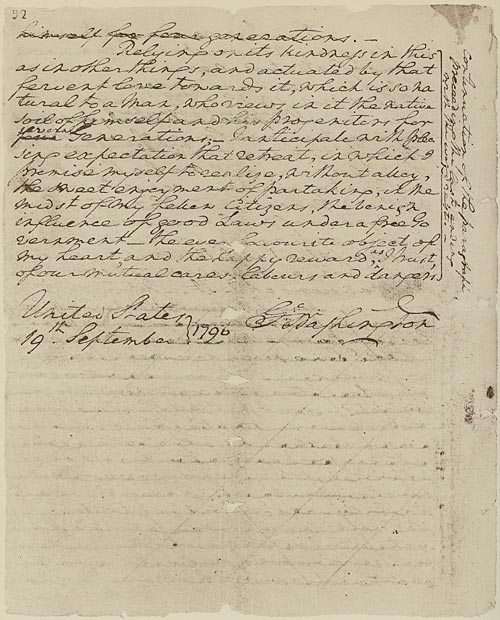
Unfinished portrait of George Washington, by Gilbert Stuart, Museum of Fine Arts of Boston.   Washington left an unfinished experiment in democratic government. Have we listened to his advice on how to keep it?

Unfinished portrait of George Washington, by Gilbert Stuart, Museum of Fine Arts of Boston. Washington left an unfinished experiment in democratic government. Have we listened to his advice on how to keep it?

Image from Declaration Resources’ Twitter feed:

Washington's Farewell Address was printed #onthisday 220 yrs ago. @HamiltonMusical fans will know the last few lines. Declaration Resources image, @declarationres

Washington’s Farewell Address was printed #onthisday 220 yrs ago. @HamiltonMusical fans will know the last few lines. Declaration Resources image, @declarationres

George Washington wanted to make a formal explanation for his departure from government. For his entire life Washington followed examples set by the great Roman general, statesman and politician, Cincinnatus. Twice Cincinnatus answered the call of the Senate of the Roman Republic, taking on the powers of Dictator to quell rebellion and attack from without; both times, after completing his assigned task, Cincinnatus broke tradition to resign and return to his farm.

Tradition? Under the law, a Dictator’s office ran for six months. If by some fluke or stroke of luck the task for which the Dictator was appointed was completed early, Roman Dictators filled out their term, appointing friends and relatives to government positions in order to enrich them and himself.

Cincinnatus would have none of that. His task done, he resigned and returned government to its rightful position under Roman law. Friends and relatives won no undeserved positions, and Cincinnatus took no graft to enrich himself. This example inspired Romans, who strove afterward to live up to that standard. Then Julius Caesar came along, and abolished the Republic with a permanent dictatorship that evolved into the title and role of emperor.

Washington clung to the more noble intent. After leading the rag-tag Continental Army to victory over the British Army, the greatest army on the planet, after putting down a coup d’etat in the making among his officers, Washington was expected to declare himself king of the colonies, and he would have been a popular king. Instead, in 1783 he resigned his commission, and retired to his farms at Mount Vernon Virginia.

Elected the first President, unanimously among presidential electors, Washington wanted to quite after one term, setting the Cincinnatian example again. James Madison, the top ghost writer of the founding era, wrote a farewell address for Washington in 1792.

But Washington was persuaded to take a second four-year term, to finish setting up the government created by the Constitution, and to provide some political stability in his non-partisan way. Washington and Madison fell out of company in 1794; Washington asked Alexander Hamilton to touch up and revise Madison’s proposed farewell address. Lacking broadcast ability, lacking any excuse to deliver the address to Congress, and probably preferring not to have to orally deliver the speech, Washington submitted it to a local Philadelphia newspaper, instead.

U.S. National Archives and Records Administration (NARA) includes Washington’s Farewell Address as one of the 100 most important documents in American history, at OurDocuments.com. NARA describes the address:

In his farewell Presidential address, George Washington advised American citizens to view themselves as a cohesive unit and avoid political parties and issued a special warning to be wary of attachments and entanglements with other nations.

In early 1796, President George Washington decided not to seek reelection for a third term and began drafting this farewell address to the American people. The address went through numerous drafts, in large part due to suggestions made by Alexander Hamilton.

In the 32-page handwritten address, Washington urged Americans to avoid excessive political party spirit and geographical distinctions. In foreign affairs, he warned against long-term alliances with other nations.

The address was printed in Philadelphia’s American Daily Advertiser on September 19, 1796. Washington’s final manuscript is at The New York Public Library.

For more information, see the University of Virginia’s The Papers of George Washington collection.

I think every president should review this “address” at least twice, once when entering the office, and once when leaving, as inspiration, perhaps, for new words of wisdom to guide the nation.

Washington's Farewell Address published in the Philadelphia Advertiser, September 19, 1796. Image from ConstitutionFacts.com

Washington’s Farewell Address published in the Philadelphia Advertiser, September 19, 1796. Image from ConstitutionFacts.com

Here is the full text of the address, from Yale’s Avalon Project, via NARA’s OurDocuments.com.

Transcript of President George Washington’s Farewell Address (1796)

Friends and Fellow Citizens:

The period for a new election of a citizen to administer the executive government of the United States being not far distant, and the time actually arrived when your thoughts must be employed in designating the person who is to be clothed with that important trust, it appears to me proper, especially as it may conduce to a more distinct expression of the public voice, that I should now apprise you of the resolution I have formed, to decline being considered among the number of those out of whom a choice is to be made.

I beg you, at the same time, to do me the justice to be assured that this resolution has not been taken without a strict regard to all the considerations appertaining to the relation which binds a dutiful citizen to his country; and that in withdrawing the tender of service, which silence in my situation might imply, I am influenced by no diminution of zeal for your future interest, no deficiency of grateful respect for your past kindness, but am supported by a full conviction that the step is compatible with both.

The acceptance of, and continuance hitherto in, the office to which your suffrages have twice called me have been a uniform sacrifice of inclination to the opinion of duty and to a deference for what appeared to be your desire. I constantly hoped that it would have been much earlier in my power, consistently with motives which I was not at liberty to disregard, to return to that retirement from which I had been reluctantly drawn. The strength of my inclination to do this, previous to the last election, had even led to the preparation of an address to declare it to you; but mature reflection on the then perplexed and critical posture of our affairs with foreign nations, and the unanimous advice of persons entitled to my confidence, impelled me to abandon the idea.

I rejoice that the state of your concerns, external as well as internal, no longer renders the pursuit of inclination incompatible with the sentiment of duty or propriety, and am persuaded, whatever partiality may be retained for my services, that, in the present circumstances of our country, you will not disapprove my determination to retire.

The impressions with which I first undertook the arduous trust were explained on the proper occasion. In the discharge of this trust, I will only say that I have, with good intentions, contributed towards the organization and administration of the government the best exertions of which a very fallible judgment was capable. Not unconscious in the outset of the inferiority of my qualifications, experience in my own eyes, perhaps still more in the eyes of others, has strengthened the motives to diffidence of myself; and every day the increasing weight of years admonishes me more and more that the shade of retirement is as necessary to me as it will be welcome. Satisfied that if any circumstances have given peculiar value to my services, they were temporary, I have the consolation to believe that, while choice and prudence invite me to quit the political scene, patriotism does not forbid it.

In looking forward to the moment which is intended to terminate the career of my public life, my feelings do not permit me to suspend the deep acknowledgment of that debt of gratitude which I owe to my beloved country for the many honors it has conferred upon me; still more for the steadfast confidence with which it has supported me; and for the opportunities I have thence enjoyed of manifesting my inviolable attachment, by services faithful and persevering, though in usefulness unequal to my zeal. If benefits have resulted to our country from these services, let it always be remembered to your praise, and as an instructive example in our annals, that under circumstances in which the passions, agitated in every direction, were liable to mislead, amidst appearances sometimes dubious, vicissitudes of fortune often discouraging, in situations in which not unfrequently want of success has countenanced the spirit of criticism, the constancy of your support was the essential prop of the efforts, and a guarantee of the plans by which they were effected. Profoundly penetrated with this idea, I shall carry it with me to my grave, as a strong incitement to unceasing vows that heaven may continue to you the choicest tokens of its beneficence; that your union and brotherly affection may be perpetual; that the free Constitution, which is the work of your hands, may be sacredly maintained; that its administration in every department may be stamped with wisdom and virtue; that, in fine, the happiness of the people of these States, under the auspices of liberty, may be made complete by so careful a preservation and so prudent a use of this blessing as will acquire to them the glory of recommending it to the applause, the affection, and adoption of every nation which is yet a stranger to it.

Here, perhaps, I ought to stop. But a solicitude for your welfare, which cannot end but with my life, and the apprehension of danger, natural to that solicitude, urge me, on an occasion like the present, to offer to your solemn contemplation, and to recommend to your frequent review, some sentiments which are the result of much reflection, of no inconsiderable observation, and which appear to me all-important to the permanency of your felicity as a people. These will be offered to you with the more freedom, as you can only see in them the disinterested warnings of a parting friend, who can possibly have no personal motive to bias his counsel. Nor can I forget, as an encouragement to it, your indulgent reception of my sentiments on a former and not dissimilar occasion.

Interwoven as is the love of liberty with every ligament of your hearts, no recommendation of mine is necessary to fortify or confirm the attachment.

The unity of government which constitutes you one people is also now dear to you. It is justly so, for it is a main pillar in the edifice of your real independence, the support of your tranquility at home, your peace abroad; of your safety; of your prosperity; of that very liberty which you so highly prize. But as it is easy to foresee that, from different causes and from different quarters, much pains will be taken, many artifices employed to weaken in your minds the conviction of this truth; as this is the point in your political fortress against which the batteries of internal and external enemies will be most constantly and actively (though often covertly and insidiously) directed, it is of infinite moment that you should properly estimate the immense value of your national union to your collective and individual happiness; that you should cherish a cordial, habitual, and immovable attachment to it; accustoming yourselves to think and speak of it as of the palladium of your political safety and prosperity; watching for its preservation with jealous anxiety; discountenancing whatever may suggest even a suspicion that it can in any event be abandoned; and indignantly frowning upon the first dawning of every attempt to alienate any portion of our country from the rest, or to enfeeble the sacred ties which now link together the various parts.

For this you have every inducement of sympathy and interest. Citizens, by birth or choice, of a common country, that country has a right to concentrate your affections. The name of American, which belongs to you in your national capacity, must always exalt the just pride of patriotism more than any appellation derived from local discriminations. With slight shades of difference, you have the same religion, manners, habits, and political principles. You have in a common cause fought and triumphed together; the independence and liberty you possess are the work of joint counsels, and joint efforts of common dangers, sufferings, and successes.

But these considerations, however powerfully they address themselves to your sensibility, are greatly outweighed by those which apply more immediately to your interest. Here every portion of our country finds the most commanding motives for carefully guarding and preserving the union of the whole.

The North, in an unrestrained intercourse with the South, protected by the equal laws of a common government, finds in the productions of the latter great additional resources of maritime and commercial enterprise and precious materials of manufacturing industry. The South, in the same intercourse, benefiting by the agency of the North, sees its agriculture grow and its commerce expand. Turning partly into its own channels the seamen of the North, it finds its particular navigation invigorated; and, while it contributes, in different ways, to nourish and increase the general mass of the national navigation, it looks forward to the protection of a maritime strength, to which itself is unequally adapted. The East, in a like intercourse with the West, already finds, and in the progressive improvement of interior communications by land and water, will more and more find a valuable vent for the commodities which it brings from abroad, or manufactures at home. The West derives from the East supplies requisite to its growth and comfort, and, what is perhaps of still greater consequence, it must of necessity owe the secure enjoyment of indispensable outlets for its own productions to the weight, influence, and the future maritime strength of the Atlantic side of the Union, directed by an indissoluble community of interest as one nation. Any other tenure by which the West can hold this essential advantage, whether derived from its own separate strength, or from an apostate and unnatural connection with any foreign power, must be intrinsically precarious.

While, then, every part of our country thus feels an immediate and particular interest in union, all the parts combined cannot fail to find in the united mass of means and efforts greater strength, greater resource, proportionably greater security from external danger, a less frequent interruption of their peace by foreign nations; and, what is of inestimable value, they must derive from union an exemption from those broils and wars between themselves, which so frequently afflict neighboring countries not tied together by the same governments, which their own rival ships alone would be sufficient to produce, but which opposite foreign alliances, attachments, and intrigues would stimulate and embitter. Hence, likewise, they will avoid the necessity of those overgrown military establishments which, under any form of government, are inauspicious to liberty, and which are to be regarded as particularly hostile to republican liberty. In this sense it is that your union ought to be considered as a main prop of your liberty, and that the love of the one ought to endear to you the preservation of the other.

These considerations speak a persuasive language to every reflecting and virtuous mind, and exhibit the continuance of the Union as a primary object of patriotic desire. Is there a doubt whether a common government can embrace so large a sphere? Let experience solve it. To listen to mere speculation in such a case were criminal. We are authorized to hope that a proper organization of the whole with the auxiliary agency of governments for the respective subdivisions, will afford a happy issue to the experiment. It is well worth a fair and full experiment. With such powerful and obvious motives to union, affecting all parts of our country, while experience shall not have demonstrated its impracticability, there will always be reason to distrust the patriotism of those who in any quarter may endeavor to weaken its bands.

In contemplating the causes which may disturb our Union, it occurs as matter of serious concern that any ground should have been furnished for characterizing parties by geographical discriminations, Northern and Southern, Atlantic and Western; whence designing men may endeavor to excite a belief that there is a real difference of local interests and views. One of the expedients of party to acquire influence within particular districts is to misrepresent the opinions and aims of other districts. You cannot shield yourselves too much against the jealousies and heartburnings which spring from these misrepresentations; they tend to render alien to each other those who ought to be bound together by fraternal affection. The inhabitants of our Western country have lately had a useful lesson on this head; they have seen, in the negotiation by the Executive, and in the unanimous ratification by the Senate, of the treaty with Spain, and in the universal satisfaction at that event, throughout the United States, a decisive proof how unfounded were the suspicions propagated among them of a policy in the General Government and in the Atlantic States unfriendly to their interests in regard to the Mississippi; they have been witnesses to the formation of two treaties, that with Great Britain, and that with Spain, which secure to them everything they could desire, in respect to our foreign relations, towards confirming their prosperity. Will it not be their wisdom to rely for the preservation of these advantages on the Union by which they were procured ? Will they not henceforth be deaf to those advisers, if such there are, who would sever them from their brethren and connect them with aliens?

To the efficacy and permanency of your Union, a government for the whole is indispensable. No alliance, however strict, between the parts can be an adequate substitute; they must inevitably experience the infractions and interruptions which all alliances in all times have experienced. Sensible of this momentous truth, you have improved upon your first essay, by the adoption of a constitution of government better calculated than your former for an intimate union, and for the efficacious management of your common concerns. This government, the offspring of our own choice, uninfluenced and unawed, adopted upon full investigation and mature deliberation, completely free in its principles, in the distribution of its powers, uniting security with energy, and containing within itself a provision for its own amendment, has a just claim to your confidence and your support. Respect for its authority, compliance with its laws, acquiescence in its measures, are duties enjoined by the fundamental maxims of true liberty. The basis of our political systems is the right of the people to make and to alter their constitutions of government. But the Constitution which at any time exists, till changed by an explicit and authentic act of the whole people, is sacredly obligatory upon all. The very idea of the power and the right of the people to establish government presupposes the duty of every individual to obey the established government.

All obstructions to the execution of the laws, all combinations and associations, under whatever plausible character, with the real design to direct, control, counteract, or awe the regular deliberation and action of the constituted authorities, are destructive of this fundamental principle, and of fatal tendency. They serve to organize faction, to give it an artificial and extraordinary force; to put, in the place of the delegated will of the nation the will of a party, often a small but artful and enterprising minority of the community; and, according to the alternate triumphs of different parties, to make the public administration the mirror of the ill-concerted and incongruous projects of faction, rather than the organ of consistent and wholesome plans digested by common counsels and modified by mutual interests.

However combinations or associations of the above description may now and then answer popular ends, they are likely, in the course of time and things, to become potent engines, by which cunning, ambitious, and unprincipled men will be enabled to subvert the power of the people and to usurp for themselves the reins of government, destroying afterwards the very engines which have lifted them to unjust dominion.

Towards the preservation of your government, and the permanency of your present happy state, it is requisite, not only that you steadily discountenance irregular oppositions to its acknowledged authority, but also that you resist with care the spirit of innovation upon its principles, however specious the pretexts. One method of assault may be to effect, in the forms of the Constitution, alterations which will impair the energy of the system, and thus to undermine what cannot be directly overthrown. In all the changes to which you may be invited, remember that time and habit are at least as necessary to fix the true character of governments as of other human institutions; that experience is the surest standard by which to test the real tendency of the existing constitution of a country; that facility in changes, upon the credit of mere hypothesis and opinion, exposes to perpetual change, from the endless variety of hypothesis and opinion; and remember, especially, that for the efficient management of your common interests, in a country so extensive as ours, a government of as much vigor as is consistent with the perfect security of liberty is indispensable. Liberty itself will find in such a government, with powers properly distributed and adjusted, its surest guardian. It is, indeed, little else than a name, where the government is too feeble to withstand the enterprises of faction, to confine each member of the society within the limits prescribed by the laws, and to maintain all in the secure and tranquil enjoyment of the rights of person and property.

I have already intimated to you the danger of parties in the State, with particular reference to the founding of them on geographical discriminations. Let me now take a more comprehensive view, and warn you in the most solemn manner against the baneful effects of the spirit of party generally.

This spirit, unfortunately, is inseparable from our nature, having its root in the strongest passions of the human mind. It exists under different shapes in all governments, more or less stifled, controlled, or repressed; but, in those of the popular form, it is seen in its greatest rankness, and is truly their worst enemy.

The alternate domination of one faction over another, sharpened by the spirit of revenge, natural to party dissension, which in different ages and countries has perpetrated the most horrid enormities, is itself a frightful despotism. But this leads at length to a more formal and permanent despotism. The disorders and miseries which result gradually incline the minds of men to seek security and repose in the absolute power of an individual; and sooner or later the chief of some prevailing faction, more able or more fortunate than his competitors, turns this disposition to the purposes of his own elevation, on the ruins of public liberty.

Without looking forward to an extremity of this kind (which nevertheless ought not to be entirely out of sight), the common and continual mischiefs of the spirit of party are sufficient to make it the interest and duty of a wise people to discourage and restrain it.

It serves always to distract the public councils and enfeeble the public administration. It agitates the community with ill-founded jealousies and false alarms, kindles the animosity of one part against another, foments occasionally riot and insurrection. It opens the door to foreign influence and corruption, which finds a facilitated access to the government itself through the channels of party passions. Thus the policy and the will of one country are subjected to the policy and will of another.

There is an opinion that parties in free countries are useful checks upon the administration of the government and serve to keep alive the spirit of liberty. This within certain limits is probably true; and in governments of a monarchical cast, patriotism may look with indulgence, if not with favor, upon the spirit of party. But in those of the popular character, in governments purely elective, it is a spirit not to be encouraged. From their natural tendency, it is certain there will always be enough of that spirit for every salutary purpose. And there being constant danger of excess, the effort ought to be by force of public opinion, to mitigate and assuage it. A fire not to be quenched, it demands a uniform vigilance to prevent its bursting into a flame, lest, instead of warming, it should consume.

It is important, likewise, that the habits of thinking in a free country should inspire caution in those entrusted with its administration, to confine themselves within their respective constitutional spheres, avoiding in the exercise of the powers of one department to encroach upon another. The spirit of encroachment tends to consolidate the powers of all the departments in one, and thus to create, whatever the form of government, a real despotism. A just estimate of that love of power, and proneness to abuse it, which predominates in the human heart, is sufficient to satisfy us of the truth of this position. The necessity of reciprocal checks in the exercise of political power, by dividing and distributing it into different depositaries, and constituting each the guardian of the public weal against invasions by the others, has been evinced by experiments ancient and modern; some of them in our country and under our own eyes. To preserve them must be as necessary as to institute them. If, in the opinion of the people, the distribution or modification of the constitutional powers be in any particular wrong, let it be corrected by an amendment in the way which the Constitution designates. But let there be no change by usurpation; for though this, in one instance, may be the instrument of good, it is the customary weapon by which free governments are destroyed. The precedent must always greatly overbalance in permanent evil any partial or transient benefit, which the use can at any time yield.

Of all the dispositions and habits which lead to political prosperity, religion and morality are indispensable supports. In vain would that man claim the tribute of patriotism, who should labor to subvert these great pillars of human happiness, these firmest props of the duties of men and citizens. The mere politician, equally with the pious man, ought to respect and to cherish them. A volume could not trace all their connections with private and public felicity. Let it simply be asked: Where is the security for property, for reputation, for life, if the sense of religious obligation desert the oaths which are the instruments of investigation in courts of justice ? And let us with caution indulge the supposition that morality can be maintained without religion. Whatever may be conceded to the influence of refined education on minds of peculiar structure, reason and experience both forbid us to expect that national morality can prevail in exclusion of religious principle.

It is substantially true that virtue or morality is a necessary spring of popular government. The rule, indeed, extends with more or less force to every species of free government. Who that is a sincere friend to it can look with indifference upon attempts to shake the foundation of the fabric?

Promote then, as an object of primary importance, institutions for the general diffusion of knowledge. In proportion as the structure of a government gives force to public opinion, it is essential that public opinion should be enlightened.

As a very important source of strength and security, cherish public credit. One method of preserving it is to use it as sparingly as possible, avoiding occasions of expense by cultivating peace, but remembering also that timely disbursements to prepare for danger frequently prevent much greater disbursements to repel it, avoiding likewise the accumulation of debt, not only by shunning occasions of expense, but by vigorous exertion in time of peace to discharge the debts which unavoidable wars may have occasioned, not ungenerously throwing upon posterity the burden which we ourselves ought to bear. The execution of these maxims belongs to your representatives, but it is necessary that public opinion should co-operate. To facilitate to them the performance of their duty, it is essential that you should practically bear in mind that towards the payment of debts there must be revenue; that to have revenue there must be taxes; that no taxes can be devised which are not more or less inconvenient and unpleasant; that the intrinsic embarrassment, inseparable from the selection of the proper objects (which is always a choice of difficulties), ought to be a decisive motive for a candid construction of the conduct of the government in making it, and for a spirit of acquiescence in the measures for obtaining revenue, which the public exigencies may at any time dictate.

Observe good faith and justice towards all nations; cultivate peace and harmony with all. Religion and morality enjoin this conduct; and can it be, that good policy does not equally enjoin it? It will be worthy of a free, enlightened, and at no distant period, a great nation, to give to mankind the magnanimous and too novel example of a people always guided by an exalted justice and benevolence. Who can doubt that, in the course of time and things, the fruits of such a plan would richly repay any temporary advantages which might be lost by a steady adherence to it ? Can it be that Providence has not connected the permanent felicity of a nation with its virtue ? The experiment, at least, is recommended by every sentiment which ennobles human nature. Alas! is it rendered impossible by its vices?

In the execution of such a plan, nothing is more essential than that permanent, inveterate antipathies against particular nations, and passionate attachments for others, should be excluded; and that, in place of them, just and amicable feelings towards all should be cultivated. The nation which indulges towards another a habitual hatred or a habitual fondness is in some degree a slave. It is a slave to its animosity or to its affection, either of which is sufficient to lead it astray from its duty and its interest. Antipathy in one nation against another disposes each more readily to offer insult and injury, to lay hold of slight causes of umbrage, and to be haughty and intractable, when accidental or trifling occasions of dispute occur. Hence, frequent collisions, obstinate, envenomed, and bloody contests. The nation, prompted by ill-will and resentment, sometimes impels to war the government, contrary to the best calculations of policy. The government sometimes participates in the national propensity, and adopts through passion what reason would reject; at other times it makes the animosity of the nation subservient to projects of hostility instigated by pride, ambition, and other sinister and pernicious motives. The peace often, sometimes perhaps the liberty, of nations, has been the victim.

So likewise, a passionate attachment of one nation for another produces a variety of evils. Sympathy for the favorite nation, facilitating the illusion of an imaginary common interest in cases where no real common interest exists, and infusing into one the enmities of the other, betrays the former into a participation in the quarrels and wars of the latter without adequate inducement or justification. It leads also to concessions to the favorite nation of privileges denied to others which is apt doubly to injure the nation making the concessions; by unnecessarily parting with what ought to have been retained, and by exciting jealousy, ill-will, and a disposition to retaliate, in the parties from whom equal privileges are withheld. And it gives to ambitious, corrupted, or deluded citizens (who devote themselves to the favorite nation), facility to betray or sacrifice the interests of their own country, without odium, sometimes even with popularity; gilding, with the appearances of a virtuous sense of obligation, a commendable deference for public opinion, or a laudable zeal for public good, the base or foolish compliances of ambition, corruption, or infatuation.

As avenues to foreign influence in innumerable ways, such attachments are particularly alarming to the truly enlightened and independent patriot. How many opportunities do they afford to tamper with domestic factions, to practice the arts of seduction, to mislead public opinion, to influence or awe the public councils? Such an attachment of a small or weak towards a great and powerful nation dooms the former to be the satellite of the latter.

Against the insidious wiles of foreign influence (I conjure you to believe me, fellow-citizens) the jealousy of a free people ought to be constantly awake, since history and experience prove that foreign influence is one of the most baneful foes of republican government. But that jealousy to be useful must be impartial; else it becomes the instrument of the very influence to be avoided, instead of a defense against it. Excessive partiality for one foreign nation and excessive dislike of another cause those whom they actuate to see danger only on one side, and serve to veil and even second the arts of influence on the other. Real patriots who may resist the intrigues of the favorite are liable to become suspected and odious, while its tools and dupes usurp the applause and confidence of the people, to surrender their interests.

The great rule of conduct for us in regard to foreign nations is in extending our commercial relations, to have with them as little political connection as possible. So far as we have already formed engagements, let them be fulfilled with perfect good faith. Here let us stop. Europe has a set of primary interests which to us have none; or a very remote relation. Hence she must be engaged in frequent controversies, the causes of which are essentially foreign to our concerns. Hence, therefore, it must be unwise in us to implicate ourselves by artificial ties in the ordinary vicissitudes of her politics, or the ordinary combinations and collisions of her friendships or enmities.

Our detached and distant situation invites and enables us to pursue a different course. If we remain one people under an efficient government. the period is not far off when we may defy material injury from external annoyance; when we may take such an attitude as will cause the neutrality we may at any time resolve upon to be scrupulously respected; when belligerent nations, under the impossibility of making acquisitions upon us, will not lightly hazard the giving us provocation; when we may choose peace or war, as our interest, guided by justice, shall counsel.

Why forego the advantages of so peculiar a situation? Why quit our own to stand upon foreign ground? Why, by interweaving our destiny with that of any part of Europe, entangle our peace and prosperity in the toils of European ambition, rivalship, interest, humor or caprice?

It is our true policy to steer clear of permanent alliances with any portion of the foreign world; so far, I mean, as we are now at liberty to do it; for let me not be understood as capable of patronizing infidelity to existing engagements. I hold the maxim no less applicable to public than to private affairs, that honesty is always the best policy. I repeat it, therefore, let those engagements be observed in their genuine sense. But, in my opinion, it is unnecessary and would be unwise to extend them.

Taking care always to keep ourselves by suitable establishments on a respectable defensive posture, we may safely trust to temporary alliances for extraordinary emergencies.

Harmony, liberal intercourse with all nations, are recommended by policy, humanity, and interest. But even our commercial policy should hold an equal and impartial hand; neither seeking nor granting exclusive favors or preferences; consulting the natural course of things; diffusing and diversifying by gentle means the streams of commerce, but forcing nothing; establishing (with powers so disposed, in order to give trade a stable course, to define the rights of our merchants, and to enable the government to support them) conventional rules of intercourse, the best that present circumstances and mutual opinion will permit, but temporary, and liable to be from time to time abandoned or varied, as experience and circumstances shall dictate; constantly keeping in view that it is folly in one nation to look for disinterested favors from another; that it must pay with a portion of its independence for whatever it may accept under that character; that, by such acceptance, it may place itself in the condition of having given equivalents for nominal favors, and yet of being reproached with ingratitude for not giving more. There can be no greater error than to expect or calculate upon real favors from nation to nation. It is an illusion, which experience must cure, which a just pride ought to discard.

In offering to you, my countrymen, these counsels of an old and affectionate friend, I dare not hope they will make the strong and lasting impression I could wish; that they will control the usual current of the passions, or prevent our nation from running the course which has hitherto marked the destiny of nations. But, if I may even flatter myself that they may be productive of some partial benefit, some occasional good; that they may now and then recur to moderate the fury of party spirit, to warn against the mischiefs of foreign intrigue, to guard against the impostures of pretended patriotism; this hope will be a full recompense for the solicitude for your welfare, by which they have been dictated.

How far in the discharge of my official duties I have been guided by the principles which have been delineated, the public records and other evidences of my conduct must witness to you and to the world. To myself, the assurance of my own conscience is, that I have at least believed myself to be guided by them.

In relation to the still subsisting war in Europe, my proclamation of the twenty-second of April, I793, is the index of my plan. Sanctioned by your approving voice, and by that of your representatives in both houses of Congress, the spirit of that measure has continually governed me, uninfluenced by any attempts to deter or divert me from it.

After deliberate examination, with the aid of the best lights I could obtain, I was well satisfied that our country, under all the circumstances of the case, had a right to take, and was bound in duty and interest to take, a neutral position. Having taken it, I determined, as far as should depend upon me, to maintain it, with moderation, perseverance, and firmness.

The considerations which respect the right to hold this conduct, it is not necessary on this occasion to detail. I will only observe that, according to my understanding of the matter, that right, so far from being denied by any of the belligerent powers, has been virtually admitted by all.

The duty of holding a neutral conduct may be inferred, without anything more, from the obligation which justice and humanity impose on every nation, in cases in which it is free to act, to maintain inviolate the relations of peace and amity towards other nations.

The inducements of interest for observing that conduct will best be referred to your own reflections and experience. With me a predominant motive has been to endeavor to gain time to our country to settle and mature its yet recent institutions, and to progress without interruption to that degree of strength and consistency which is necessary to give it, humanly speaking, the command of its own fortunes.

Though, in reviewing the incidents of my administration, I am unconscious of intentional error, I am nevertheless too sensible of my defects not to think it probable that I may have committed many errors. Whatever they may be, I fervently beseech the Almighty to avert or mitigate the evils to which they may tend. I shall also carry with me the hope that my country will never cease to view them with indulgence; and that, after forty five years of my life dedicated to its service with an upright zeal, the faults of incompetent abilities will be consigned to oblivion, as myself must soon be to the mansions of rest.

Relying on its kindness in this as in other things, and actuated by that fervent love towards it, which is so natural to a man who views in it the native soil of himself and his progenitors for several generations, I anticipate with pleasing expectation that retreat in which I promise myself to realize, without alloy, the sweet enjoyment of partaking, in the midst of my fellow-citizens, the benign influence of good laws under a free government, the ever-favorite object of my heart, and the happy reward, as I trust, of our mutual cares, labors, and dangers.

United States
19th September, 1796

Geo. Washington

Transcription courtesy of the Avalon Project at Yale Law School.

More:


Save