The Seldom Scene 1979 – Rider (Bluegrass)

June 22, 2023

I discovered the Seldom Scene within the first year I moved to Washington permanently. To me, Washington was the Bluegrass Capital of the World in those days.

At the venerable Birchmere in Alexandria, Virginia, the best bluegrass bands and performers of the day came through every week, and on Thursday nights the Seldom Scene could be seen as they seldom were.

Somebody caught this video, not at the Birchmere, but a song they often played.

Members of the 1979 Seldom Scene: John Duffey (Mandolin), Ben Eldridge (Banjo), Mike Auldridge (Dobro), Phil Rosenthal (Guitar), & Tom Gray (Bass). I do not know the venue.

Perhaps I could blame the band for discouraging me from taking up playing again. On every instrument, they were so superior to most, playing at a level very few could ever hope to reach.

Still loved them.

From the Bluegrass Library.

Bluegrass legends Seldom Scene, c. 1979. John Duffy, Tom Gray, Phil Rosenthal, Ben Edredge and Mike Auldridge. Probably a publicity photo, via Rocky 52.

Bluegrass legends Seldom Scene, c. 1979. Left to right, John Duffey on mandolin, Tom Gray on bass, Phil Rosenthal on guitar, Ben Eldredge on banjo and Mike Auldridge on Dobro. Probably a publicity photo, via Rocky 52.


See also:


Remember to fly your flag on Father’s Day 2023!

June 18, 2023

In the video, the U.S. flag flying at Circle 10 Council’s Camp Wisdom, in Dallas County, Texas.

Perhaps when you were a child, you watched your father as he posted Old Glory near your front door, on holidays and other special occasions. Your father set an example that you follow today.

Remember to honor your father by posting the flag today, Fathers Day. Fathers Day is one of those dates set in the U.S. Flag Code for citizens to fly the U.S. flag.

“Litchfield, Minnesota veterans Roger Tipka, Don Nordlie and Stan Mortenson, pictured from left, raise the U.S. flag prior to the start of the third annual Tournament of Duty in 2015. The three men all served in the Battle of Iwo Jima during World War II.” Litchfield Independent Observer photograph.


Flag Day 2023! (Fly your flag all week) – A teacher started it

June 12, 2023

Of course you know to fly your flag on June 14 for Flag Day — but did you know that the week containing Flag Day is Flag Week, and we are encouraged to fly the flag every day?

Clifford Berryman's 1901 Flag Day cartoon, found at the National Archives:

Clifford Berryman’s 1901 Flag Day cartoon, found at the National Archives: “In this June 14, 1904, cartoon, Uncle Sam gives a lesson to schoolchildren on the meaning of Flag Day. Holding the American flag in one hand, Uncle Sam explains that the flag has great importance, unlike the Vice Presidency, which he ridicules in a kindly manner. (National Archives Identifier 6010464)”

The 105th Congress in 1998 passed a law designating the week in which Flag Day falls as Flag Week, encouraging Americans to fly the flag the entire week. In 2023 that runs from Sunday, June 11, through Saturday, June 17.

Our National Archives has a blogged history of Flag Day pointing out it was a teacher who started Flag Day celebrations.

On June 14, 1885, Bernard J. Cigrand placed a 10-inch, 38-star flag in a bottle on his desk at the Stony Hill School in Ozaukee County, Wisconsin. The 19-year-old teacher then asked his students to write essays on the flag and its significance to them. This small observance marked the beginning of a long and devoted campaign by Cigrand to bring about national recognition for Flag Day.

And so we do, today, still.

This is an encore post.

Yes, this is an encore post. Defeating ignorance takes patience and perseverance.


Past time to act against pollution that causes global warming

June 7, 2023

I am reminded of a Senate hearing during the Dust Bowl — is it an apocryphal story? An enormous windstorm picked up thousands of tons of dust from Texas, Oklahoma, New Mexico, Colorado, and sent it cross country.

A Department of Agriculture official trying to get the government to act heard of the storm, and tracked it. He asked a Senatte committee meeting on the Dust Bowl to take an early lunch break in a hearing.

When the committee hearing resumed after lunch, a senator asked the official if the Dust Bowl was really that big a deal — what would the effects be?

The Ag official got up from the table, went to the windows and opened them, so the dust could swirl into the hearing room. He said the dust had been topsoil used for farming a couple of days earlier. The dust had blown into Washington just after noon.

Congress acted. U.S. defeated the Dust Bowl and restored millions of acres of farmland.

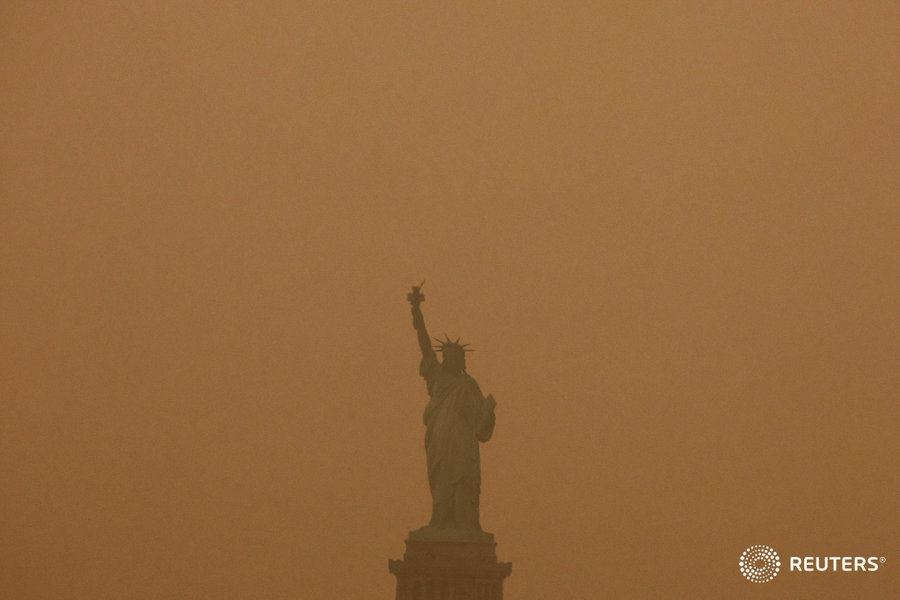
In New York and other eastern cities this week, smoke from wildfires in Canada settled in after a nearly 3,000-mile journey.

Who will act this time?

Statue of Liberty stands obscured and choked by smoke from wildfires in Western Canada. Reuters photo by Amr Alfiky | عمرو الفقي@alfiky_amr.

Global heating dries out western forests, and some effects cause trees to die, making them great tinder for fires. It’s clear to anyone who looks, to anyone who loves science, to anyone who loves Liberty.

Tip of the old scrub brush to @corinne_perkins on Twitter.


Encore: Greatest leadership example in history? Eisenhower’s astonishing D-Day plan B, “Blame . . . is mine alone”

June 6, 2023

It is a model of leadership, an example more leaders should follow — though too few do. It’s one more example of the high caliber leadership Dwight Eisenhower demonstrated throughout his life. In its imperfections, handwritten, it should take your breath away.  Eisenhower was a leader down to the bone.

So again, today, on the 79th anniversary of the D-Day invasion, we remember.

Eisenhower's unused statement on the failure of D-Day

Eisenhower’s contingency statement, in case D-Day failed – image from the National Archives

This quote actually isn’t a quote. It was never said by the man who wrote it down to say it. It carries a powerful lesson because of what it is.

In preparing for the D-Day invasion, Supreme Allied Commander Dwight Eisenhower carefully contemplated what would happen if the invasion failed.  What if the Germans repulsed the Allies, and no foothold was established to re-take the main body of Europe from the Germans?

Ike’s answer is a model of leadership:  He would take the blame.  Regardless what happened, Ike took full responsibility for the failure, giving credit to the soldiers who would have sacrificed in vain, perhaps their lives.

The Bathtub recently posted Gen. Dwight Eisenhower’s “order of the day” to the troops about to conduct the Allied invasion of Normandy — D-Day — to establish the toehold in Europe the Allies needed to march to Berlin, and to end World War II in Europe. As a charge to the troops, it was okay — Eisenhower-style words, not Churchill-style, but effective enough. One measure of its effectiveness was the success of the invasion, which established the toe-hold from which the assaults on the Third Reich were made.

eisenhower-with-paratrooper-eve-of-d-day.jpg

Photo shows Eisenhower meeting with troops of the 101st Airborne Division, 502nd Parachute Infantry Regiment, on the eve of the invasion. It was these men whose courage he lauded.

When Eisenhower wrote his words of encouragement to the troops, and especially after he visited with some of the troops, he worried about the success of the operation. It was a great gamble. Many of the things the Allies needed to go right — like weather — had gone wrong. Victory was not assured. Defeat strode the beaches of Normandy waiting to drive the Allies back into the water, to die.

Eisenhower wrote a second statement, a shorter one. This one was directed to the world. It assumed the assault had failed. In a few short sentences, Eisenhower commended the courage and commitment of the troops who, he wrote, had done all they could. The invasion was a chance, a good chance based on the best intelligence the Allies had, Eisenhower wrote. But it had failed.

The failure, Eisenhower wrote, was not the fault of the troops, but was entirely Eisenhower’s.

He didn’t blame the weather, though he could have. He didn’t blame fatigue of the troops, though they were tired, some simply from drilling, many from war. He didn’t blame the superior field position of the Germans, though the Germans clearly had the upper hand. He didn’t blame the almost-bizarre attempts to use technology that look almost clownish in retrospect — the gliders that carried troops behind the lines, sometimes too far, sometimes killing the pilots when the gliders’ cargo shifted on landing;  the flotation devices that were supposed to float tanks to the beaches to provide cover for the troops (but which failed, drowning the tank crews and leaving the foot soldiers on their own); the bombing of the forts and pillboxes on the beaches, which failed because the bombers could not see their targets through the clouds.

There may have been a plan B, but in the event of failure, Eisenhower was prepared to establish who was accountable, whose head should roll if anyone’s should.

Eisenhower took full responsibility.

Our landings in the Cherbourg-Havre area have failed to gain a satisfactory foothold and I have withdrawn the troops. My decision to attack at this time and place was based upon the best information available. The troop, the air [force] and the navy did all that bravery and devotion to duty could do. If any blame or fault attaches to the attempt, it is mine alone.

Who in the U.S. command would write such a thing today?  Who else in history would have written such a thing?  Is there any indication that Julius Caesar, Alexander the Great, Attila the Hun, Genghis Khan, or any other commander of a great army in  a world-turning invasion, considered how to save and perhaps salve the reputation of his troops, though they had failed?

Leadership is more than just positive thinking.

  • The message may also be viewed here. Yes, it’s incorrectly dated July 5 — should have been June 5.  In history, little is perfect.  We can excuse his slip of the pen, considering what else he had on his mind.


More:

General Eisenhower speaks with members of the ...

Another  angle of the meeting with the troops:  General Eisenhower speaks with members of the 101st Airborne Division on the evening of 5 June 1944.  Wikipedia image

This is an encore post.

Yes, this is an encore post. Defeating ignorance takes patience and perseverance.


June 2023: When do we fly the Old Glory?

June 1, 2023

“Flag Day, Pittsburgh, Pennsylvania.” 1942 photo by John Vachon (1914-1975) for the U.S. Farm Security Administration/Office of War Information. Image from the National Archives and Records Administration (NARA)

June holds only two days designated for flying the U.S. flag out of the specific days mentioned in the U.S. Flag Code, and six statehood days, when residents of those states should fly their flags.  Plus, there is National Flag Week. And now there is Juneteenth.

Two Flag Code-designated days:

  • Flag Day, June 14
  • Fathers Day, third Sunday in June (June 18 in 2023)

Several states celebrate statehood. New Hampshire, Virginia, Arkansas, Kentucky, Tennessee and West Virginia celebrate statehood; Kentucky and Tennessee share the same date.

  • Kentucky, June 1 (1792, 15th state)
  • Tennessee, June 1 (1796, 16th state)
  • Arkansas, June 15 (1836, 25th state)
  • West Virginia, June 20 (1863, 35th state)
  • New Hampshire, June 21 (1788, 9th state), and
  • Virginia, June 25 (1788, 10th state)

Additionally, Congress passed a resolution designating the week in which June 14th falls as National Flag Week, and urging that citizens fly the flag each day of that week.  In 2023 that will be the week of June 11, which falls on Sunday, through June 17.

The resolution naming Juneteenth National Independence Day a holiday was signed into law last year by President Joe Biden. Juneteenth is June 19 — day after Fathers Day in 2023.

Flag-flying days for June, listed chronologically:

  1. Kentucky and Tennessee statehood, June 1
  2. Flag Day, June 14; National Flag week, June 11 to 17
  3. Arkansas statehood, June 15 (duplicating a day in National Flag Week)
  4. Fathers Day, June 18
  5. Juneteenth National Independence Day, June 19
  6. West Virginia statehood, June 20
  7. New Hampshire statehood, June 21
  8. Virginia statehood, June 25

As you know, any resident may fly the flag any day of the year, under the etiquette provided in the Flag Code.

Tip of the old scrub brush to Mike’s Blog Rounds at Crooks and Liars — thanks for the plug!

National Archives caption: This illustration entitled, “Flag Day - 1900”, by cartoonist Clifford Berryman, which appeared in the Washington Post on June 14, 1900, depicts the growth of American influence in the world as the European powers watch in the background as new century is ushered in.

National Archives caption: This illustration entitled, “Flag Day – 1900”, by cartoonist Clifford Berryman, which appeared in the Washington Post on June 14, 1900, depicts the growth of American influence in the world as the European powers watch in the background as new century is ushered in.

Flag Day, 1918, at Fort Sam Houston, Texas. Photo by Miles F. Weaver (1879-1932), from the collection of the National Archives (NARA)

Flag Day, 1918, at Fort Sam Houston, Texas. Photo by Miles F. Weaver (1879-1932), from the collection of the National Archives (NARA).

Save