90 years ago today, the fighting 369th won the war

September 25, 2008

You won’t find it phrased that way in any of the textbooks, but it would improve the telling of history of World War I if we did tell it that way.  This retelling promises to be a good one.

It might improve race relations in the U.S., too.

The story of the Harlem Hellfighters, the 369th Infantry Regiment, and their bravery and fighting acumen in World War I, make for a gripping day of war stories, if you’re looking for stories of heroism.

Edge of the American West is one of those blogs that will make you smarter as you read it, rather than angrier.  If someone is wrong somewhere on the internet, Edge of the American West will help you keep it in perspective.


Stanton Sharp history teaching symposium at SMU, February 9

January 8, 2008

Tired of odd speakers trying to tell you about how boys learn differently from girls because of the size of the Crockus in their brain?

How about serious material to beef up your teaching: Vietnam, the Russian Revolution, Mexicans in U.S. history, Native Americans in the 20th century, use of the internet in history classes — three sessions, each with three classes to choose from.

Poster for session on Russian Revolution, Stanton Sharp Symposium at SMU, 2008

The history department at Southern Methodist University in Dallas offers solid education in serious history issues for teachers in colleges and secondary schools. The Stanton Sharp Teaching Symposium on Saturday, February 9 offers great material in nine different areas. Several of these topics seem to be pulled from the Texas Education Agency’s list of subjects that students need to do better on, for the Texas Assessment of Knowledge and Skills (TAKS).

Invitation below the fold. The $15 fee includes lunch; you may earn up to 7 hours of Continuing Education Units (CEU) credits.

(I plan to be there, and if you’re really interested in the Crockus and its scholars, I happen to have a photo of the elusive Crosley Shelvador on my cell phone — he appeared to have used one of those spray-on tanning solutions, but is otherwise real, as the photos show.)

Read the rest of this entry »


Human Liberty Bell: Tribute to photos of Mole & Thomas

December 12, 2007

Surely you’ve seen some of these photos; if you’re a photographer, you’ve marveled over the ability of the photographer to get all those people to their proper positions, and you’ve wondered at the sheer creative genius required to set the photos up.

Like this one, a depiction of the Liberty Bell — composed of 25,000 officers and men at Fort Dix, New Jersey. The photo was taken in 1918.

Mole & Thomas photo, Human Liberty Bell The Carl Hammer Gallery in Chicago featured an exhibit of these monumental photos in April and May, 2007:

The outbreak of World War I and its inherent violence engendered a new commitment by the world’s photographers to document every aspect of the fighting, ending an era of In A Patriotic Mole, A Living Photograph, Louis Kaplan, of Southern Illinois University, writes, “The so-called living photographs and living insignia of Arthur Mole [and John Thomas] are photo-literal attempts to recover the old image of national identity at the very moment when the United States entered the Great War in 1917.

Mole’s [and Thomas’s] photos assert, bolster, and recover the image of American national identity via photographic imaging. Moreover, these military formations serve as rallying points to support U.S. involvement in the war and to ward off any isolationist tendencies. In life during wartime, [their] patriotic images function as “nationalist propaganda” and instantiate photo cultural formations of citizenship for both the participants and the consumers of these group photographs.”

The monumentality of this project somewhat overshadows the philanthropic magnanimity of the artists themselves.Instead of prospering from the sale of the images produced, the artists donated the entire income derived to the families of the returning soldiers and to this country’s efforts to re-build their lives as a part of the re-entry process.

Eventually, other photographers, appeared on the scene, a bit later in time than the activity conducted by Mole and Thomas, but all were very clearly inspired by the creativity and monumentality of the duo’s production of the “Living” photograph.

One of the most notable of those artists was Eugene Omar Goldbeck. He specialized in the large scale group portrait and photographed important people (Albert Einstein), events, and scenes (Babe Ruth’s New York Yankees in his home town, San Antonio) both locally and around the world (Mt. McKinley). Among his military photographs, the Living Insignia projects are of particular significance as to how he is remembered.

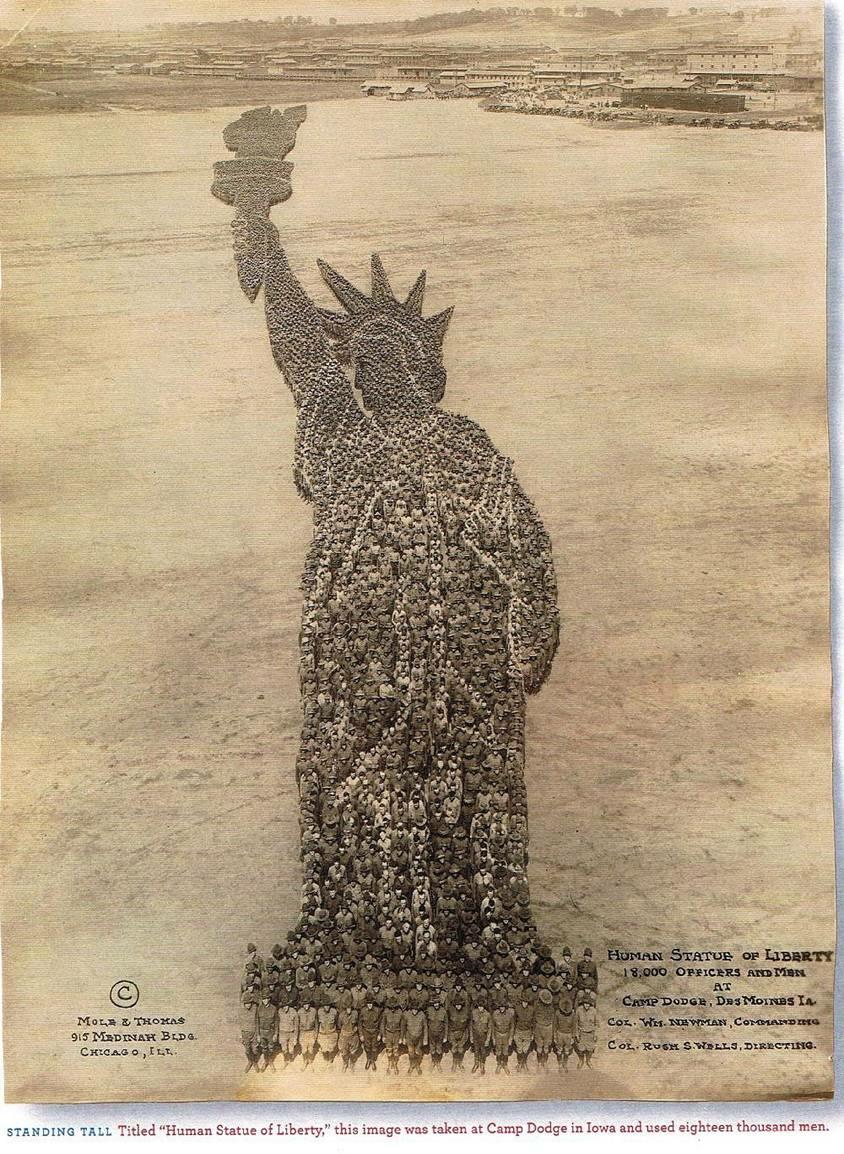
Using a camera as an artist’s tool, using a literal army as a palette, using a parade ground as a sort of canvas, these photographers made some very interesting pictures. The Human Statue of Liberty, with 18,000 men at Camp Dodge, Iowa?


statue-of-liberty-human-camp-dodge-from-snopes.jpg

Most of these pictures were taken prior to 1930. Veterans who posed as part of these photos would be between 80 and 100 years old now. Are there veterans in your town who posed for one of these photos?


Good photographic copies of some of these pictures are available from galleries. They are discussion starters, that’s for sure.

Some questions for discussion:

  1. Considering the years of the photos, do you think many of these men saw duty overseas in World War I.
  2. Look at the camps, and do an internet search for influenza outbreaks in that era. Were any of these camps focal points for influenza?
  3. Considering the toll influenza took on these men, about how many out of each photo would have survived the influenza, on average?
  4. Considering the time, assume these men were between the ages of 18 and 25. What was their fate after the Stock Market Crash of 1929? Where were they during World War II?
  5. Do a search: Do these camps still exist? Can you find their locations on a map, whether they exist or not?
  6. Why do the critics say these photos might have been used to build national unity, and to cement national identity and will in time of war?
  7. What is it about making these photos that would build patriotism? Are these photos patriotic now?

These quirky photos are true snapshots in time. They can be used for warm-ups/bell ringers, or to construct lesson plans around.

Tip of the old scrub brush to Gil Brassard, a native, patriotic and corporate historian hiding in Baton Rouge, Louisiana.


Military history carnival

August 18, 2007

American Presidents, which is a great blog for history and economics teachers and students anyway, hosts the Military History Carnival.

Got a lot of carnival catch up to do. This one should help you focus on polishing lesson plans and getting ideas for student projets.

Tenth century soap opera? It’s a true story. Great background — is this the sort of story that might interest women more?

Waterberg – the first genocide of the 20th century. “Trail of bones.” Largely forgotten — or unknown — history of war in Africa in 1904. I’ll wager you didn’t know about it. It’s not in your world history book.

What do you know about African troops fighting in Europe in World War I? This post, “Forgotten soldiers of the Great War,” is guaranteed to make World War I more relevant to your African-related students.

Are you really prepared to explain the significance of the Battle of Shiloh?

◊ The school’s network went down and took your PowerPoint presentation on the Spanish Armada. What to do? Here’s some help — the PowerPoint slides you’re missing, perhaps.

◊ History is Elementary is represented by a great post about camouflage in war, particularly World War I. This is a wonderful foundation for a lesson plan that deals with non-electronic technology — and as a sidelight, this is the sort of topic where the hunters among your students will be able to provide five or six examples of modern versions, with detailed explanations about the best places to use them. (You should read the post even if it’s out of your area; it’s a fascinating mashup of art, modern art, botany, zoology, psychology and war.)

There is a magnanimous link to the Bathtub’s post on panoramic photos of World War II sites.

And a lot more. Go see.


BBC animation: The Western Front, World War I

July 30, 2007

Western Front of World War I, from BBC animation

Here’s another map animation from the BBC that helps people visualize the stalemate nature of the Western Front of World War I.

If this animation is available in any form for purchase from the BBC for classroom use, I haven’t found it. I do wish the BBC would do a DVD or CD compilation of these animations and make it available at very low cost to teachers (high costs mean schools buy only one copy, which teachers can’t get a chance to see, and consequently won’t integrate into their lesson plans; paradoxically, a low-priced disk would probably earn BBC more money, and certainly would contribute to much more classroom learning).

This would be a good link for individual study at home on the internet. A great lecture could be built around it, if one has internet access live in the classroom and a way to project it.