Small town fireworks

July 6, 2010

No, literally.  Well, okay, 36,000 people isn’t a tiny hamlet.  Still, Duncanville, Texas, is a small town in many ways.

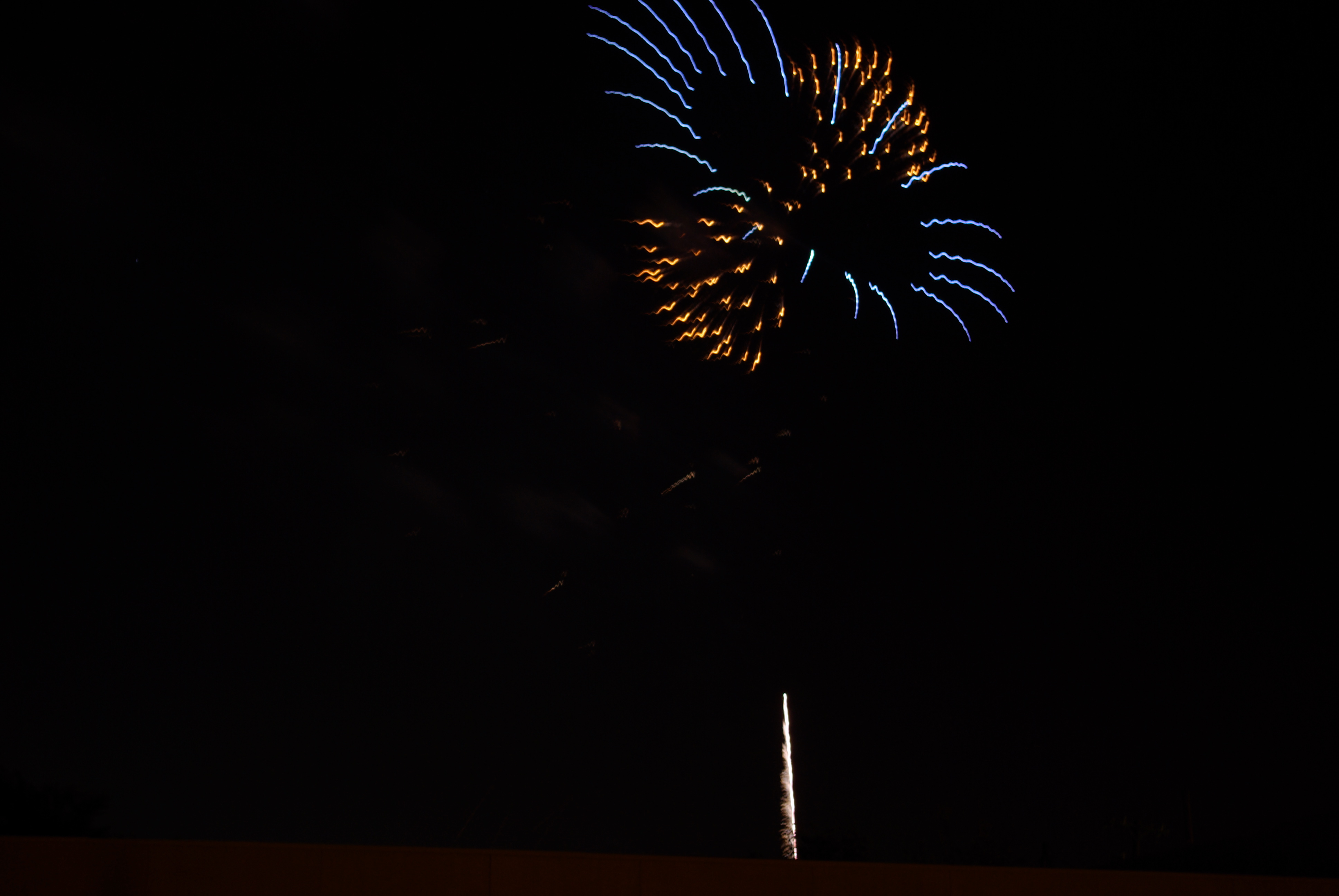
Nice fireworks show, nothing super spectacular.  But enough for me to experiment with the digital SLR on capturing images.  Lessons learned:  Yes, the tripod is a must; a “cable release” is essential, too; to get good color, smaller aperture settings work best; exposures over a second work best.

Duncanville, Texas, Fireworks, July 4, 2010 - Big blue blossom

Duncanville fireworks - black hole at the center of a galaxy

Duncanville fireworks - a colored crown

Duncanville fireworks - a blue aster

Duncanville fireworks - four blossoms

Duncanville fireworks - were they trying to portray Cthulu?

Duncanville fireworks - multicolor burst

These are a few of the many shots I took — more successful than in past years (why didn’t I think of the tripod before?).  Generally these are the most successful fireworks shots I’ve taken since that old Kodak Hawkeye FlashFun  — was it that long ago?  —  at the Idaho Centennial.

I wonder where those pictures are now?

The idea is to get this down to where I can set up the camera and take shots while smiling at Kathryn, whose birthday is July 4, and who thinks fireworks are for watching, forget about the hassle of photography.  She’s probably right.


Fireworks in Washington, D.C.

July 6, 2009

President Barack Obama and First Lady Michelle Obama watch the fireworks over the National Mall from the White House on July 4, 2009. (Official White House photo by Pete Souza)

President Barack Obama and First Lady Michelle Obama watch the fireworks over the National Mall from the White House on July 4, 2009. (Official White House photo by Pete Souza) (White House caption)

July 4 in Washington was always a lot of fun, and I always found myself without the right film or the right lens, or knowledge about how to make the exposure work.  Several times I tried to get good shots of the fireworks from the Capitol lawn — no success.  Once we walked the Mall and sat under the fireworks going off, near the Lincoln Memorial (Kathryn won’t let me forget that one).  Bad angle for photos, and for viewing.  Once I tried from the Virginia side of the Potomac.  Not a single good shot.

One of the great joys of electronic photography is getting more of these kinds of shots.

Still, this photograph shows great skill on Souza’s part — lens selection, exposure, and composition come together just right.

Some restrictions apply to use of this photograph.  See notes here.


Scouts show the colors, Duncanville, Texas

July 4, 2009

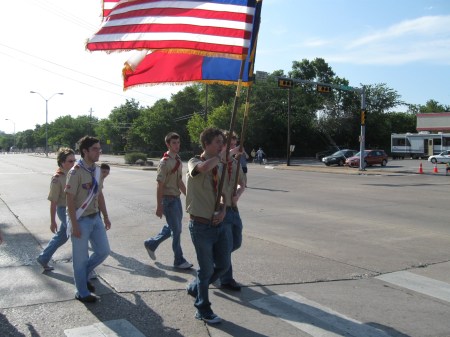
Scouts from Troop 355 and Pack 494 carry the colors in the Duncanville, Texas, 4th of July parade

Scouts from Troop 355 and Pack 494 carry the colors in the Duncanville, Texas, 4th of July parade


Proper flag display, on the way to Monticello

July 4, 2009

U.S. flag displayed over Virginia Route 53, the road to Monticello, Jeffersons home in Virginia, 2008 - Photo by Emory

U.S. flag displayed over Virginia Route 53, the road to Monticello, Jefferson's home in Virginia, 2008 - Photo by Emory

Properly displayed, by the way.  The field is in the “northwest” position.


Fly your flag today, July 4, 2009

July 4, 2009

Soldiers raise the U.S. flag at a base in Afghanistan, 2003

Soldiers raise the U.S. flag at a base in Afghanistan, 2003

It’s the 233rd anniversary of the announcement of the Declaration of Independence.  The resolution calling for independence of the 13 colonies passed the Continental Congress on July 2, 1776.  The Declaration would be Thomas Jefferson’s crowning achievement, outshining even his presidency and the Louisiana Purchase.   John Adams wrote to his wife, Abigail, that July 2 would forever be marked by patriotic displays.

But the Declaration, which gave teeth to the resolution, was adopted on July 4.  Adams didn’t miss a beat.  Who quibbles about a couple of days when the celebrating is so good?

Adams and Jefferson were two of the five-member committee the Congress had tasked to write a declaration.  Adams and Ben Franklin quickly determined to leave it up to Jefferson, who had a grand flair with words, and who had just written a couple of stirring documents for Virginia.  Roger Sherman and Robert Livingston, the other two members, went along.

Adams and Jefferson became friends only later, when they both served the nation at war as ambassadors to France, and then for Adams, to England.  A widower, Jefferson was taken in by Abigail Adams who worried about him.  After the war, Jefferson was in England when Adams was to meet King George III in a grand ceremony in which the king would accept the credentials of all the ambassadors of foreign nations to England.  As the king strode down the line, each ambassador or delegation would bow, the king would acknowledge them, the papers would be passed, and the king would move on.  Adams and Jefferson bowed.  King George moved on, ignoring them completely.

In such a case of such a snub, the snubbed foreigners usually made a quick exit.  Adams and Jefferson did not.  They stood at attention as if the king had treated them like all the rest, reversing the snub.

Back in America in peacetime, Adams and Jefferson fell out.  Jefferson favored a more limited federal government; Adams favored a more powerful one.  By the end of Washington’s second term, party politics had been well developed.  Adams defeated Jefferson in the election of 1796.  As was the law then, Jefferson was vice president; but Adams kept Jefferson out of all government affairs.  Perhaps because he didn’t have Jefferson to help, Adams’s presidency did not go well.  In the rematch election in 1800, one of  the bitterest fights ever, Jefferson’s party defeated Adams.  The gleeful Democratic-Republican electors all voted one ballot for Jefferson, the presidential candidate, and one ballot for Aaron Burr, the party’s vice presidential candidate.

Alas, that produced a tie vote in the electoral college.  Adams’s party, the Federalists, still held the House of Representatives before the new Congress came in.  A tie vote goes to the House for decision.  They could not bring themselves to vote for Jefferson, and the deadlock continued for 37 ballots.  Finally Jefferson’s arch enemy Alexander Hamilton intervened, explaining that Burr was clearly the greater scoundrel, and the House elected Jefferson.  Adams slunk out of town, avoiding the inauguration.

It wasn’t until after 1809 when Benjamin Rush hoodwinked Jefferson into writing to Adams, and Adams to Jefferson, that the two became friendly again.  For the next 17 years Jefferson and Adams carried on perhaps the greatest series of correspondence in history between two great minds.  Letters went out almost daily.  They discussed the weather, their families, old times, farming — but especially the republic they had been most instrumental in creating, and how it might be preserved, and prosper.  Eventually the letters became harder to read, both because their eyesight was failing, and because their penmanship deteriorated, too.

The ideas, however, flowed like a river.

Both men took ill early in 1826.  This was a landmark year, 50 years since the Declaration of Independence.  In Massachusetts, a grand display of fireworks was to cap off a day of feasting and celebration.  Adams hoped he might attend.  In Virginia, a week before, it became clear Jefferson was too ill to venture even as close as Charlottesville for the celebration.  Jefferson slept through most of July 3, but awoke about 9:00 p.m., and asked, “This is the fourth?”  It was not.  These are the last significant, recorded words of Jefferson.  He awoke at about 4:00 a.m. on the Fourth of July, 1826, but could not make a rally.  He died at 12:50 in the afternoon.

Adams, too, was too ill to attend the celebrations.  In the late afternoon or early evening of the Fourth, he awoke, and heard the celebration in the town.  Almost as if he had worked just to live to see that particular day, he checked the date.  Realizing he was near the end, happy that he’d seen 50 years after the Declaration, and unaware of the events earlier that day in Virginia, Adams said, “Thomas Jefferson still survives.”

Fly your flag today. Remember John Adams and Thomas Jefferson.  Remember their great work in creating the nation that protects our freedoms today.  Remember their great friendship.  Write a letter to a good friend you’ve not written to lately.

It’s the Fourth of July.  Their spirit survives in us, as we celebrate, and as we remember why we celebrate.


Power Line documents flag desecretion in Minnesota

July 28, 2007

What’s wrong with this picture?

Uncle Sam on stilts, carrying a flag improperly; citizens do not salute

They didn’t mean to, but there it is: Flag displays not in accordance with the U.S. Flag Code at every turn — flag desecration! Or, as Power Line titles it, “A Minnesota 4th of July.” You can see the slide show here. I point out some Flag Code violations in a slide-by-slide list, after the fold.

No, I’m not calling for the Sheriff of Buncombe County, North Carolina, to dispatch his deputies to arrest everyone in Apple Valley, Minnesota, who participated in the 2004 4th of July Parade — not even if they are Ron Paul supporters (in 2004, who knew?). Heck, we’d need to do the same for Duncanville, Texas (I was there; I probably still have some photographs somewhere), and probably for Provo, Utah (“the nation’s biggest Freedom Day celebration”) and Prescott, Arizona, and 15,000 other towns in America where citizens turn out on the celebration for our Declaration of Independence and have a parade. Of course, most of those towns are not fettered with North Carolina’s outdated and uconstitutional flag desecration law, either.

Fact is, most people are not too familiar with the U.S. Flag Code, and in their attempts to have a good time and celebrate the good stuff in and of this nation, they sometimes do not hew to the Flag Code’s call.

Which means simply that we need to do a better job of educating citizens on how to respect their flag and display it respectfully; and it also means we shouldn’t get all worked up whenever someone screams “FLAG DESECRATION!” to alarm us and make us rally around George Bush (who, as we saw in the last post, needs some Flag Code education for himself).

To his credit, Scott Johnson at Power Line is not a huge backer of flag desecration amendments to the Constitution. Nor are the other two contributors at PowerLine, except for their frequent complaint that the First Amendment “protects flag burning and nude dancing” but not whatever it is they want to rant about at that moment.

But if these über patriots think all this Flag Code bustin’ is good patriotism, where does a deputy in Asheville, North Carolina, get off telling people they can’t use the flag in their protest? Isn’t that THE core value the flag stands for, that citizens can protest?

Or, is it really true that the Bush defenders have politicized the nation so badly that only some political statements are protected by the First Amendment? We, our people, fought King George III to win the right to speak our minds. We shouldn’t yield to anyone that right won with the blood of patriots.

Read the rest of this entry »


The story is the thing; tell the story in history

July 15, 2007

Son James and I spent July 4 in Taos, New Mexico, where we were working with Habitat for Humanity building homes (a project of the youth group at the church we attend, First Christian Church (Disciples of Christ) of Duncanville, Texas). We took that day off, saw Transformers, looked at the sights in Taos, and drove to Eagle Nest Lake to see fireworks.

Lincoln reading to son, Tad; LOC photo

At some point through the week I was discussing with others the stories that make history memorable, in my view, and we discovered that few others on the trip knew the story of the deaths of both John Adams and Thomas Jefferson on July 4, 1826, the 50th anniversary of the signing of the Declaration of Independence. It’s a story that is generally glossed over in U.S. history texts, but one that I make room for in U.S. history courses. My experience is that once kids get the story, that these two great men from such radically different backgrounds became great friends, then in presidential politics, great enemies, and then were reconciled, and then died on the exactly the same day which commemorated the event that both made them famous and that they made famous, kids don’t forget the story.

The story of their friendship is powerful and can be accompanied by readings from their letters in their later life (DBQ opportunity, teachers!). Generally, the story gets told in response to a question from a student. If I do it well, there will be sniffles from the class when we get to the part about Jefferson’s near-coma, awakening to ask whether it is the 4th of July, and then dying, and Adams’ death a few hours later, saying in error that “Jefferson still survives” (which is good that some students choke up, because it always gets me).

The story offers several mnemonic opportunities: 1826, the 50th year after the Declaration (1776); the presidencies of Adams and Jefferson, following one another; the fact that Adams and Jefferson were on the committee to write the Declaration, and that Adams nominated Jefferson as the better writer; the order of the terms of the presidency; the bitter politics at the end of Washington’s presidency (kids get interested in conflict, and the founding seems more vital to them when the controversies rear up); the reverence for law; Adams’ and Jefferson’s service as foreign ambassadors; and so on.

Once I’d told the story, others got the point. The story illustrates Mark Twain’s point about how much more difficult it is to write fiction. Fiction must stick with possibilities, Twain noted, while reality isn’t so constrained. If you wrote a screenplay with two heroes like Adams and Jefferson, and then had them die on the same day within a few hours of each other, hundreds of miles apart, you’d be criticized for being unrealistic. But it happened in history. It’s a true story, better than any lipsticked version Parson Weems could ever invent.

Study of history should never be a drudging trudge to memorize dates. The stories are what count, they are the things people remember. The stories tell people why history is important, and what mistakes to avoid, to satisfy Santayana’s ghost.

Such stories, especially about the founding of America, make history come alive and, often, grab students by the throat and make it memorable for them.  History is Elementary carries a nice story with the same message, though using Washington’s surprise attack on the Hessians from Trenton.  Teachers in need of such stories might do well to pick up a copy of David McCullough’s 1776, or Joseph Ellis’s Founding Brothers.

What other stories are there?  Well, the story about the scar on James Madison’s nose, and how it led to the cementing of the American Revolution (James Monroe, by the way, also died on July 4 — but in 1831).  The story of Lincoln’s trip to New Orleans; the story of Teddy Roosevelt’s capture of Mike Finnegan and two other outlaws, in the Dakotas; the story of Calvin Coolidge’s son’s death; the story of Robert Lincoln’s brushes with presidential assassinations; the story of the Civil War beginning in one man’s back-40 acres, and ending in his parlor; the story as Stephen Ambrose tells it of three men pinned down on a beach in Normandy on D-Day, and deciding the best course of action was to move forward to win the war; American history is rife with bizarre coincidences and seemingly minor events that go on to have great consequences.

I love to hear the story, especially told well.  Well told stories help students learn and retain history, and, I’ll wager, they boost the scores on standardized tests.


Flag etiquette for the 4th of July

July 4, 2007

Every kid should learn this stuff by third grade, but it’s clear from what we see that they don’t.

Flag flying in front of U.S. Capitol (East side) LOC photo

So here’s a quick review of dos and don’ts for display and behavior toward the U.S. flag on this most flag-worthy of days, the 4th of July. With a few comments.

1. Fly your flag, from sunup to sundown. If you’re lucky enough to have a flagpole, run the flag up quickly. Retire it slowly at sunset. Then go see fireworks.

2. Display flags appropriately, if not flown from a staff. If suspended from a building or a wall, remember the blue field of stars should always be on the right — the “northwest corner” as you look at it. Do not display a flag flat.

3. Salute the flag as it opens the 4th of July parade. In a better world, there would be just one U.S. flag at the opening of the parade, and the entire crowd would rise as it passes them in a great patriotic, emotional wave — civilians with their hands over their hearts, hats off; people in uniform saluting appropriately with hats on. It’s likely that your local parade will not be so crisp. Other entries in the parade will have flags, and many will be displayed inappropriately. A true patriot might rise and salute each one — but that would look silly, perhaps even sillier than those sunshine patriots who display the flag inappropriately. Send them a nice letter this year, correcting their behavior. But don’t be obnoxious about it.

4. Do not display the flag from a car antenna, attached to a window of a car, or attached in the back of a truck. That’s against the Flag Code, which says a flag can only be displayed attached to the right front fender of a car, usually with a special attachment. This means that a lot of the National Guard entries in local parades will be wrongly done, according to the flag code. They defend the flag, and we should not make pests of ourselves about it. Write them a letter commending their patriotism. Enclose the Flag Code, and ask them to stick to it next time. Innocent children are watching.

5. Do not dishonor the flag by abusing it or throwing it on the ground. It’s become popular for a local merchant to buy a lot of little plastic flags and pass them out to parade goers. If there is an advertisement on the flag, that is another violation of the Flag Code. The flag should not be used for such commercial purposes. I have, several times, found piles of these flags on the ground, dumped by tired people who were passing them out, or dumped by parade goers who didn’t want to carry the things home. It doesn’t matter if it’s printed on cheap plastic, and made in China — it is our nation’s flag anyway. Honor it. If it is worn, dispose of it soberly, solemnly, and properly.

That’s probably enough for today. When the Flag Desecration Amendment passes — if it ever does — those parade float makers, National Guard soldiers, and merchants, can all be jailed, perhaps. Or punished in other ways.

Until that time, our best hope is to review the rules, obey them, and set examples for others.

Have a wonderful 4th of July! Fly the flag. Read the Declaration of Independence out loud. Love your family, hug them, and feed them well. That’s part of the Pursuit of Happiness that this day honors. It is your right, your unalienable right. Use it wisely, often and well.


Asimov’s tribute to the national anthem

September 23, 2006

The song’s popularity increased enormously during the Civil War. Because the song extolled the national flag—a symbol of loyalty to the Union—Northerners enthusiastically embraced it as a patriotic anthem.

In times of crisis and turmoil, Americans often turn to patriotic symbols for inspiration. Caption from the National Museum of American History (Smithosonian): Elmira Cornet Band, Civil War The song’s popularity increased enormously during the Civil War. Because the song extolled the national flag—a symbol of loyalty to the Union—Northerners enthusiastically embraced it as a patriotic anthem.

The scientist, science and science fiction writer Isaac Asimov at one time held the title for the most published human being ever. There were few topics he didn’t have a learned opinion on, and there were many areas of ignorance where a well-trained scientist with a drive to get at the facts could shed a lot of light. His path lighting was not always appreciated. He wrote a guide to the Bible that has earned disdain from many a Christian conservative, thought I suspect that their disdain is really a disguise for the fear that a secular Jew could know the text so well and challenge so many unwarranted, but common, assumptions.

To the surprise of some, Asimov was quite a patriot. His short piece on the four stanzas of the “Star-spangled Banner” demonstrate his patriotism and his love of history, while offering a bit of humor to make it all stick in your mind. I post a complete copy below the fold.

I have not yet found the original publication source for Asimov’s piece; if you know it, or find it, please let me know. I suspect there is copyright attribution to be made, too. I borrowed the text from an on-line source called The Purewater Gazette. Read the rest of this entry »


God we trust, to Girard we owe

August 12, 2006

Steel engraving of Stephen Girard, with his signature, by Alonzo Chappel,

Steel engraving of Stephen Girard, the man who personally saved the United States, with his signature, by Alonzo Chappel,”National Portrait Gallery of Eminent Americans from original full length portraits by Alonzo Chappel” Vol I, New York: Johnson, Fry & Co. 1862 “The Cooper Collections” via Wikipedia

Irony strikes the White House.

I mean, you can’t really make stuff like this up.

To be sure, the humor is quite Santayanaesque — if you don’t know the history, you won’t see the irony.

President Bush issued a proclamation noting the 50th anniversary of one of our national mottoes, “In God We Trust.” No big deal, these presidential proclamations. Note the occasion, say it’s worth commemorating, urge citizens to commemorate it “appropriately.”

Somebody in the White House communications commissariat decided to dress it up a little, add some history — you know, pad the proclamation to please the partisan pundits. What better thing to mention than, say, the “Star-Spangled Banner,” our national anthem, which has a line in it, “in God is our trust?” Read the rest of this entry »


Fisking a Flag-Fold Flogging

July 19, 2006

Update, March 24, 2007: Be sure to see the updated flag ceremony, which you can find through this post on the news of the its release.

Yes, the flag amendment is dead, again. Yes, the Fourth of July is past. False history continues to plague the U.S. flag, however. When my wife forwarded to me the post below, it was the fourth time I had gotten it, recently. Bad history travels fast and far. Let’s see if we can steer people in a better direction with real facts.

A flag folding at a funeral for a military person carries great weight, without any script at all.  Wikimedia image from DOD release:  Members of the U.S. Navy Ceremonial Guard fold the American flag over the casket bearing the remains of sailors killed in the Vietnam War during a graveside interment ceremony at Arlington National Cemetery on May 2, 2013. Lt. Dennis Peterson, from Huntington Park, Calif.; Ensign Donald Frye, from Los Angeles; and Petty Officers 2nd Class William Jackson, from Stockdale, Texas, and Donald McGrane, from Waverly, Iowa, were killed when their SH-3A Sea King helicopter was shot down on July 19, 1967, over Ha Nam Province, North Vietnam. All four crewmembers were assigned to Helicopter Squadron 2.

A flag folding at a funeral for a military person carries great weight, without any script at all. Wikimedia image from DOD release: Members of the U.S. Navy Ceremonial Guard fold the American flag over the casket bearing the remains of sailors killed in the Vietnam War during a graveside interment ceremony at Arlington National Cemetery on May 2, 2013. Lt. Dennis Peterson, from Huntington Park, Calif.; Ensign Donald Frye, from Los Angeles; and Petty Officers 2nd Class William Jackson, from Stockdale, Texas, and Donald McGrane, from Waverly, Iowa, were killed when their SH-3A Sea King helicopter was shot down on July 19, 1967, over Ha Nam Province, North Vietnam. All four crewmembers were assigned to Helicopter Squadron 2.

Here is the post as it came to me each time — I’ve stripped it of the sappy photos that are occasionally added; note that this is mostly whole cloth invention:

Did You Know This About Our Flag

Meaning of Flag Draped Coffin.

All Americans should be given this lesson. Those who think that America is an arrogant nation should really reconsider that thought. Our founding fathers used God’s word and teachings to establish our Great Nation and I think it’s high time Americans get re-educated about this Nation’s history. Pass it along and be proud of the country we live in and even more proud of those who serve to protect our “GOD GIVEN” rights and freedoms.

To understand what the flag draped coffin really means……

Read the rest of this entry »


4th of July

July 4, 2006

Independence Day is one of the best holidays of the year, especially for those of us who love fireworks. In the first few years of our marriage we lived in and very near Washington, D.C., where there is one of the grandest fireworks displays annually, against one of the most arresting set of backdrops possible. When we lived on Capitol Hill it was a short walk to the Capitol, to watch the display at the Washington Monument, with the Lincoln Memorial and Lee’s Mansion at Arlington National Cemetery in the background. Once we hiked to the Lincoln Memorial to get the opposite view.

There are other grand displays. Baltimore annually has a grand fireworks program on Baltimore Harbor, near Fort McHenry whose shelling was the inspiration to Francis Scott Key to write what is now our national anthem. In the Norfolk area there is a fine show at the Yorktown National Battlefield site. New York City has great stuff, as do Boston, Philadelphia, and Chicago.

But the best part of the holiday is the annual retelling of the story of freedom, of the Declaration of Independence, and of its chief author Thomas Jefferson, and the friendships that included Benjamin Franklin, James Madison, George Washington, Alexander Hamilton, and especially John Adams. The story of the friendship, falling out, reconciliation and great love between Adams and Jefferson is one of the finest stories in American history. After having reconciled a few years after their great falling out during the bitter election of 1800, they continued to correspond to their deaths. The series of letters is a great explication of democracy, how to form a republic, and the duties and privileges of citizens in a free nation. To add to the poignancy, both Adams and Jefferson died on July 4, 1826, 50 years to the day that the Declaration of Independence was published. Ed Brayton of Dispatches from the Culture Wars has a fine post on the day, the Declaration, and the friendship between Adams and Jefferson, here.