Historic images: Quanah Parker, Last Chief of the Comanches

June 19, 2008

Quanah Parker, photo by Lanney

Quanah Parker, a Kwahadi Comanche chief; full-length, standing in front of tent.
Photographed by Lanney. Public Domain photo.
National Archives, “Pictures of Indians in the United States”

Photographs of Native Americans reside among the publicly and internet available materials of the National Archives. Images can be ordered in sets of slides, or as individual prints, though many are available in quality high enough for PowerPoint works and use on classroom materials. Many of the photos are 19th century.

Quanah Parker stands as one of the larger Native Americans in Texas history. This photo puts a face to a reputation in Texas history textbooks. Texas teachers may want to be certain to get a copy of the photo. His life story includes so many episodes that seem to come out of a Native American version of Idylls of the King that a fiction writer could not include them all, were they not real.

  • Quanah’s mother was part of the famous Parker family that helped settle West Texas in the 1830s. Cynthia Ann Parker was captured in 1836 when Comanches attacked Fort Parker, near present-day Groesbeck, Texas, in Limestone County. (See Fort Parker State Park.) Given a new name, Nadua (found one), she assimilated completely with the Nocona band of Comanches, and eventually married the Comanche warrior Noconie (also known as Peta Nocona). Quanah was their first child, born in 1852.
  • Nadua was captured by a Texas party led by Lawrence Sullivan “Sul” Ross in 1860, in the Battle of Pease River. Noconie, Quanah, and most of the Nocona men were off hunting at the time, and the fact of Nadua’s capture was not realized for some time. Nadua asked to return to the Comanches and her husband, but she was not allowed to do so. When her youngest daughter, who had been captured with her, died of an infection, Nadua stopped eating, and died a few weeks later.
  • Sul Ross was a character in his own right. At the time he participated in the raid that recaptured Cynthia Parker, he was a student at Baylor University (“What do I do on summer breaks? I fight Indians.”) At the outbreak of the Civil War, Ross enlisted in the Confederate Army as a private. Over 135 battles and skirmishes he rose to the rank of Brigadier General, the ninth youngest in the Confederate Army. A successful rancher and businessman back in Texas after the war, he won election as governor in 1887, served two very successful terms (he resolved the Jaybird-Woodpecker War in Fort Bend County, and had to call a special session of the legislature to deal with a budget surplus), refused to run for a third term, and was named president of Texas Agricultural and Mechanical College (Texas A&M) within a few days of stepping down as governor. Ross’s leadership of the college is legendary — students put pennies near a statue of Ross in a traditional plea to pass final exams, among many other traditions. After his death, Texas created Sul Ross State University, in Alpine, Texas, in his honor.
  • Quanah Parker’s father, Noconie, died a short time after his mother’s capture. He left the Nocona band, joined the Destanyuka band under Chief Wild Horse, but eventually founded his own band with warriors from other groups, the Quahadi (“antelope eaters”) (also known as Kwahadi). The Quahadi band grew to be one of the largest and most notorious, always with Quanah leading them. The Quahadis refused to sign the 1867 Medicine Lodge Treaties, and so avoided immediate internment to a reservation. However, dwindling food supplies and increasing opposition forced Quanah to retire to a reservation in 1875, in what is now southwestern Oklahoma. This was the last Comanche band to come to the reservation.
  • Quanah was appointed Chief of all the Comanches.
  • Through investments, Quanah became rich — probably the richest Native American of his time.
  • Quanah hunted with President Theodore Roosevelt.
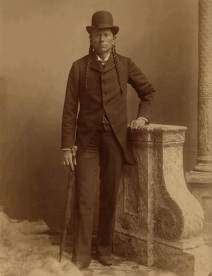
    Quanah Parker in later life, as a successful businessman. Wikipedia image, public domain

    Quanah Parker in later life, as a successful businessman. Wikipedia image, public domain

  • Rejecting monogamy and Christianity, Quanah founded the Native American Church movement, which regards the use of peyote as a sacrament. Quanah had been given peyote by a Ute medicine man while recovering from wounds he’d suffered in battle with U.S. troops. Among his famous teachings: The White Man goes into his church and talks about Jesus. The Indian goes into his Tipi and talks with Jesus.
  • Photo at right: Quanah Parker in his later life, in his business attire. Photo thought to be in public domain.
  • Bill Neeley wrote of Quanah Parker: “Not only did Quanah pass within the span of a single lifetime from a Stone Age warrior to a statesman in the age of the Industrial Revolution, but he never lost a battle to the white man and he also accepted the challenge and responsibility of leading the whole Comanche tribe on the difficult road toward their new existence.”
  • Quanah Parker died on February 23, 1911. He is buried at Fort Sill Cemetery, Oklahoma, next to his mother and sister.

Quanah Parker’s epitaph reads:

Resting Here Until Day Breaks
And Shadows Fall and Darkness Disappears is
Quanah Parker Last Chief of the Comanches
Born 1852
Died Feb. 23, 1911

Other Resources:

Spread Quanah’s story:

Add to FacebookAdd to NewsvineAdd to DiggAdd to Del.icio.usAdd to StumbleuponAdd to RedditAdd to BlinklistAdd to TwitterAdd to TechnoratiAdd to Furl


Taxis to the past, and the future

May 30, 2008

Bill Howdle lives, for a while longer anyway, in Manitoba. He’s got heart disease and a brain tumor, which explain the name of his blog, Dying man’s daily journal.

He used to drive a taxi. One woman was grateful he did.

That story is well worth the time to read it. Click on the link. After all, each of us is dying. We might learn something.


Good though: Folksinger, Storyteller, Railroad Tramp Utah Phillips Dead at 73

May 27, 2008

Utah Phillips died Friday. He was 73. He died at his home in Nevada City, California.

Wonderful tribute at Fifteen Iguana.

Utah Phillips publicity shot

Utah Phillips (publicity photo via Bluegrass Today)

Phillips’s website lists planned tributes, memorials and the funeral in Nevada City, California. KVMR Radio’s site has an obit and links to other tributes.

Read the rest of this entry »


‘Twas the 18th of April in ’75 . . . (Paul Revere’s Ride)

April 19, 2008

Paul Revere — tonight’s the anniversary of his famous ride.

John Copley's painting of Paul Revere

Paul Revere, 1768, by John Singleton Copley (1738-1815)

John Copley painted all the bigwigs of revolutionary Boston, including this portrait of the famous horse-mounted alarm before he turned older and grayer.

And as April 18 is the anniversary of Revere’s ride, April 19 is the anniversary of the “shot heard ’round the world.”

Both events are celebrated in poetry; April is National Poetry Month. This could be a happy marriage for history and English classrooms.

National Poetry Month 2008 poster


Evolution teacher expelled from creationist movie

March 20, 2008

First the producers lied when they interviewed him for the film, claiming to be doing a different movie, a documentary. Then they refused to let him see anything that might reveal what of his own words they were using in the movie.

And now, the producers of Ben Stein’s great turkey of a movie, “Expelled!,” have booted the evolution teacher out of a viewing of the movie of which he is a star they promoted.

[Spew alert! Put the coffee/coke/beer down, and swallow before clicking on the link and reading the story linked to below.]

But having expelled the evolution teacher P. Z. Myers from the movie “Expelled!” and ironically making the point that the pretense of the movie only a pretense, the producer missed Dr. Myers much more famous guest.

Go, see, and laugh.

Wesley's bumpersticker

Buy the bumper sticker!


Ann and Molly

March 15, 2008

I miss Ann Richards.

Ann Richards with her motorcycle
Photo of Ann Richards with her motorcycle, from the Texas State Library & Archives Commission, Prints and Photographs Collection

Here’s an excerpt from Molly Ivins’ column of September 18, 2006, the week after Ann died.

She knew how to deal with teenage egos: Instead of pointing out to a kid who was pouring charcoal lighter on a live fire that he was idiot, Ann said, “Honey, if you keep doing that, the fire is going to climb right back up to that can in your hand and explode and give you horrible injuries, and it will just ruin my entire weekend.”

She knew what it was like to have four young children and to be so tired you cried while folding the laundry. She knew and valued Wise Women like Virginia Whitten and Helen Hadley.

At a long-ago political do at Scholz Garten in Austin, everybody who was anybody was there meetin’ and greetin’ at a furious pace. A group of us got the tired feet and went to lean our butts against a table at the back wall of the bar. Perched like birds in a row were Bob Bullock, then state comptroller, moi, Charles Miles, the head of Bullock’s personnel department, and Ms. Ann Richards. Bullock, 20 years in Texas politics, knew every sorry, no good sumbitch in the entire state. Some old racist judge from East Texas came up to him, “Bob, my boy, how are you?”

Bullock said, “Judge, I’d like you to meet my friends: This is Molly Ivins with the Texas Observer.

The judge peered up at me and said, “How yew, little lady?”

Bullock, “And this is Charles Miles, the head of my personnel department.” Miles, who is black, stuck out his hand, and the judge got an expression on his face as though he had just stepped into a fresh cowpie. He reached out and touched Charlie’s palm with one finger, while turning eagerly to the pretty, blonde, blue-eyed Ann Richards. “And who is this lovely lady?”

Ann beamed and replied, “I am Mrs. Miles.”

One of the most moving memories I have of Ann is her sitting in a circle with a group of prisoners. Ann and Bullock had started a rehab program in prisons, the single most effective thing that can be done to cut recidivism (George W. Bush later destroyed the program). The governor of Texas looked at the cons and said, “My name is Ann, and I am an alcoholic.”

She devoted untold hours to helping other alcoholics, and anyone who ever heard her speak at an AA convention knows how close laughter and tears can be.

One to make history, one to record it.

I miss Molly Ivins.

Save

Save


Saving Texas’s only natural lake

August 3, 2007

Aptly named, Salvinia molesta threatens to choke Caddo Lake to death. As Caddo Lake is the only natural lake in Texas, and a site of outstanding beauty and great natural treasure, the friends of Caddo Lake are fighting back.

Spraying Salvinia molesta on Caddo Lake - NY Times photo by Michael Stravato

The New York Times features a lengthy story on the lake and the fight to save it in this week’s Science section (July 31, 2007 – Science is part of the Times every Tuesday).

Every Texas social studies teacher should know Caddo Lake and its stories as well as anything else. It’s the stuff memorable classes are made of.

1. It’s the only “natural” lake in Texas, though it is formed by a dam. The “only honest lake in Texas,” in the local lingo. The original lake was formed by a monumental log jam on the Red River, probably trees blown down by a massive hurricane several hundred years ago.

2. Caddo Lake is named after the Caddo Tribe, the tribe whose word for friend, “tejas,” gave the state its name. (See my earlier post on Caddoland.)

3. Caddo Lake straddles what was once “no man’s land,” or the Neutral Territory, a buffer zone between English/French, then American, and Spanish, then Mexican settlements. It was a haven for criminals, scalawags, filibusterers and revolutionaries. The area plays a large role in the decades of fighting to steal Texas from the Spain, and later from Mexico. Texas history is much better understood when one knows the lake.

4. Caddo Lake once was the means to make Jefferson, Texas, a port city. Until Col. Shreveport dynamited the logjam that made the lake in 1873, Jefferson was a bustling center of commerce. Today Jefferson boasts some wonderfully preserved historic remnants of that era, many converted to bed and breakfast inns, a great weekend getaway. Fishing is good, photography is great.

5. Ladybird Johnson was born nearby, and her family still lives in the area.

6. The Hughes Tool Company had its beginnings on Caddo Lake, where Howard Hughes, Sr., tested his drill bit, “the rock eater,” designed to cut through mud and rock to where the oil was; this is the home of the fortune that Howard Hughes, Jr., inherited, to build to one of the greatest fortunes in the world. That the younger Hughes was a rake, a mechanical genius, an air pioneer, daring movie producer, and weird as hell only makes the story better. Hughes named his movie production company after the lake, Caddo Productions.

6. Contrary to most of Texas’s political leanings, local people around Caddo Lake have rallied to efforts to protect the lake and conserve its rare beauty. The area is designated for protection as a Ramsar Treaty critical wetlands site — a designation that most conservative Texans ridicule and fear (at one point the Texas Republican Party platform opposed conservation easements to protect the lake bizarre). Latter-day Caddoans welcome the designation, and when we toured the area they sang the praises of Don Henley, the rock and roll musician who is aiding their efforts to save the lake. It’s an odd combination for any political work — uniquely Texas. (Here’s your chance to play the Eagles for your classes, teachers!)

7. When it comes to Texas botany, zoology, and biology in general, Caddo Lake provides the local angle for water quality, water shortages (one proposal is to steal water from the lake for Texas cities far away), wildlife management, and of course, the invasion of exotic species.

8. Everything about this area screams Texas quirkiness. Uncertain, Texas? An often-told story (accurate?) is that when the town applied for a post office, there was a dispute about what to call the town. The fellow who filled out the application wrote “uncertain” in the blank for the town’s name — and that’s how the U.S. Postal Service approved it. Another story holds that the name “Uncertain Landing” caught on because the landing was treacherous mooring for boats. You got a better story about your town’s name? I doubt it.

Save the article from the Times, teachers! You’ll be glad you have it later this year.

Add to FacebookAdd to NewsvineAdd to DiggAdd to Del.icio.usAdd to StumbleuponAdd to RedditAdd to BlinklistAdd to TwitterAdd to TechnoratiAdd to Furl
