
Nick Anderson of the Houston Chronicle on Texas SBOE social studies standards, in 2009
Nick Anderson of the Houston Chronicle on Texas SBOE social studies standards, in 2009
 2 Comments |
  Accuracy, Cartoons, Economics, Education, Education quality, History, Political cartoons, Politics, Separation of church and state, Social Studies, State school boards, TEKS, Texas | Tagged: Accuracy, Cartoons, Education, education standards, History, Houston Chronicle, Nick Anderson, Political cartoons, Politics, Social Studies, state board of education, Texas |
  Permalink
 Posted by Ed Darrell
Tony Whitson from Curricublog made the killing observation:
BookTV [C-SPAN] this weekend has Steve Forbes talking about his new book,
With these new Social Studies TEKS, TX students won’t know what such a
book is about.
Small bit of humor from a truly sad situation. One of the leaders of the Texas State Soviet of Education defended the evisceration and defenestration of social studies standards saying they didn’t need to listen to liberal college professors.
In economics, the professor was a conservative, well-respected economics professor from Texas A&M University, one of the most conservative state universities in the nation (with a Corps of Cadets numbering in the thousands and tradition deeper than Palo Duro Canyon and broader than the Gulf of Mexico). Calling these people “liberal” is tantamount to complaining about the communism espoused by Ronald Reagan and Dwight Eisenhower — that is, it demonstrates a divorce from reality and rationality.
In the grand scheme of things it’s not a huge problem, but it’s more than a trifle. It’s difficult, if not impossible, to fully comprehend market economics in the U.S. without understanding what capitalism is, and how it works. Teachers will be left to find their own materials to explain “free enterprise” and, if the students ever make it into a real economics course in college, they will discover “free enterprise” is a quaint, political term that is not discussed in serious economics circles. Texas students will, once again, be pushed to the hindmost by Don McLeroy’s odd views of America and what he doesn’t want Americans to know.
For example, look at the Council for Economic Education — while “capitalism” is not the only word they use for market-based economies, you’ll have a tougher time finding any definition of “free enterprise.” Or, more telling, look at the Advanced Placement courses, or the International Baccalaureate courses. AP and IB courses are the most academically rigorous courses offered in American high schools. The Texas TEKS step away from such rigor, however (while the Texas Education Agency rides Texas schools to add rigor — go figure). IB courses talk a lot about enterprise, but they don’t censor “capitalism,” nor do they pretend it’s not an important concept.
At the very conservative and very good Library of Economics and Liberty (which every social studies teacher should have bookmarked and should use extensively), a search for “free enterprise” produces 77 entries (today). “Capitalism” produces almost ten times as much, with more than 750 listings.
Which phrase do you think is more useful in studying American economics, history and politics?
Teachers will deal with it. It’s one more hurdle to overcome on the path to trying to educate Texas students. It’s one more roadblock to their learning what they need to keep the freedom in America.

Capitalism - Warren Buffett - BusinessWeek image

Free Enterprise - Bernie Madoff
The real difference? Literature on capitalism frequently address the issue of moral investments, and the need for some regulation to bolster the Invisible Hand in producing discipline to steer markets from immoral and harmful investments. The essential history politics economic question of the 20th and 21st centuries is, can economic freedom exist without political freedom, and which one is more crucial to the other? We know from every period of chaos in history when governments did not function well, but bandits did, that free enterprise can exist without either political freedom or economic freedom. I think of it like this:
Capitalism |
Free Enterprise |
| Adam Smith | Blackbeard the Pirate |
| Warren Buffett | Bernie Madoff |
| Investing | Spending |
| Building institutions | Taking profits |
| Retail | Robbery |
| Wholesale | Extortion |
| Save for a rainy day | debt-equity swap |
| Antitrust enforcement to keep markets fair | Don’t get caught, hope for acquittal |
| Milton Friedman | P. T. Barnum |
| Ludwig von Mises | Charles Ponzi |
| Friedrich von Hayek | Richard Cheney, “deficits don’t matter” |
| Paul Krugman | Kato Kaelin |
| Stockholders | Victims and suckers |
Leave a Comment » | Accuracy, Business, Business Ethics, Capitalism, Economics, Education, Education reform, Freedom - Economic, History, Rampant stupidity, Social Studies, State school boards, TEKS, Texas | Tagged: Capitalism, Economics, Free Enterprise, Rampant stupidity, Social Studies, Texas, Texas State Board of Education | Permalink
Posted by Ed Darrell
Peter Sinclair takes some claims from climate denialists too seriously. I hope.
On the other hand, he thoroughly shreds some of the more hoary claims of the denialists. Plus he includes clips of everybody’s favorite movie, Monty Python and the Holy Grail. Give it a watch, “Flogging the Scientists”:
Gee. Here in Texas we could use a Peter Sinclair film on history, economics and other social studies. Quick!
Tip of the old scrub brush to Tim Lambert at Deltoid.
4 Comments | Accuracy, Climate change, climate_change, Global warming, Hoaxes, Science | Tagged: Climate change, Climate Denail Hoaxes, denialism, Flogging the Scientists, Global warming, IPCC, Peter Sinclair, Research, Science, Sea Level Rise | Permalink
Posted by Ed Darrell
Tuesday, March 16 was the 259th anniversary of the birth of James Madison, the Father of the Constitution, the sponsor of the Bill of Rights, the life-long campaigner for good government based on knowledge of the errors of history, especially in the area of religious freedom.
Under social studies standards proposed by the Texas State Board of Education, Texas students will never study Madison’s views, or Madison’s Constitution, without intervention by their parents or good teachers who run some risk to teach the glories of American history to students.
Newspaper stories across the nation concentrated on Madison’s birthday expressed revulsion and rejection of the crabbed and cramped views of the Texas SBOE, and the cup of revulsion runneth over.
For example, the attempted evisceration and hobbling of science standards occurred last year, but the editorial cartoon in USA Today reached back to remind us just what is going on in Austin.

By Scott Stantis, Chicago Tribune, for USA TODAY, March 16, 2010
More comment to come.
Tip of the old scrub brush to Christina Castillo Comer.
2 Comments | Accuracy, America's founding, American Revolution, Economics, Education, Education quality, Evolution, History, Science, Social Studies, State school boards, Texas | Tagged: Economics, Education, education standards, Evolution, History, Science, Social Studies, Texas State Board of Education | Permalink
Posted by Ed Darrell
Here in Texas we haven’t gotten over the loss of Charlie Wilson. Wilson’s exploits fairly told themselves — you didn’t even need Molly Ivins to write it up for you to make it clear just how funny it was. And patriotic.
Sarah Palin visited Florida recently, and to hear this account, she’s doing her best to make Alan Grayson, the genuinely-sometimes-rogue Democratic Member of Congress, a legend.
Whose side is she on, again?
Of course, according to this account in Buzz, the blog of the St. Petersburg Times and Miami Herald, the chief author of Grayson’s legend status is Grayson himself. Do you think Grayson actually wrote this? Can this account possibly be accurate?
March 14, 2010Ever outlandish, Alan Grayson tops himself with Sarah Palin rant
Actual campaign e-mail from U.S. Rep. Alan Grayson, D-Orlando.
Subject: Palin Attacks Grayson; Grayson Applies Calamine Lotion to the Resulting Reddish Skin
On Friday night, Sarah Palin came to Orlando, and attacked Rep. Alan Grayson. This is what she said:
“I got to meet quite a few candidates who are lining up in a contested primary who want to take out Alan Grayson. And I think Alan Grayson — what can you say about Alan Grayson? Piper is with me tonight, so I won’t say anything about Alan Grayson that can’t be said around children. [Good one, Sarah!] But thank you, Florida, for allowing candidates in a contested primary to duke it out over ideas and principles and values, all with the same goal, and that is unseating those who have such a disconnect from the people of America. That’s what the goal is here in this race against Alan Grayson. Please fight hard, and do this for the rest of the country. Fight hard, and send a conservative to Washington, DC.”
Palin, the former half-term Governor, current-nothing and future-even-less, charmed the all-Republican audience with her folksy folksiness and her homespun homespunnery. Atypically, Palin was wearing clothes that she had paid for herself. At the end of the event, she shared her recipe for mooseface pie.In response to Palin’s attack on Rep Grayson, Grayson actually complimented Palin. Grayson praised Palin for having a hand large enough to fit Grayson’s entire name on it. He thanked Palin for alleviating the growing shortage of platitudes in Central Florida.
Grayson added that Palin deserved credit for getting through the entire hour-long program without quitting. Grayson also said that Palin really had mastered Palin’s imitation of Tina Fey imitating Palin. Grayson observed that Palin is the most-intelligent leader that the Republican Party has produced since George W. Bush.
When asked to comment about what effect Palin’s criticism might have, Grayson pointed out, “As the Knave’s horse says in Alice in Wonderland, ‘dogs will believe anything.'” Earlier, as the Orlando Sentinel reported, Grayson said, “I’m sure Palin knows all about politics in Central Florida, since from her porch she can see Winter Park,” which is part of Grayson’s district.
Grayson said that the Alaskan chillbilly was welcome to return to Central Florida anytime, as long as she brings lots of money with her, and spends it. “I look forward to an honest debate with Governor Palin on the issues, in the unlikely event that she ever learns anything about them,” Grayson added, alluding to Politifact’s “liar, liar, pants on fire” evaluation of much of what Palin has said.
Scientists are studying Sarah Palin’s travel between Alaska and Florida carefully. They hope to learn more about the flight patterns of that elusive migratory species, the wild Alaskan dingbat.
Posted by Alex Leary at 07:27:56 PM on March 14, 2010
Dick Tuck’s ghost rubs his hands with glee (and Tuck isn’t even dead yet). Thousands of Americans outside of Florida wish they could vote for him, or someone very much like him.
Tip of the old scrub brush to Sarah Ann Maxwell.
7 Comments | Accuracy, Humor, Politics | Tagged: Alan Grayson, Charlie Wilson, Dick Tuck, Humor, Politics, Sarah Palin | Permalink
Posted by Ed Darrell
If they are honorable people, they wish they could take it back.
John Hinderaker at Powerline, November 23, 2009:
At the end of 2008, the scientists at East Anglia predicted that 2009 would be one of the warmest years on record:
On December 30, climate scientists from the UK Met Office and the University of East Anglia projected 2009 will be one of the top five warmest years on record. Average global temperatures for 2009 are predicted to be 0.4∞C above the 1961-1990 average of 14 ∫ C. A multiyear forecast using a Met Office climate model indicates a rapid return of global temperature to the long-term warming trend, with an increasing probability of record temperatures after 2009.
We know now that the alarmists’ prediction for 2009 didn’t come true. What’s interesting is that in January of this year, another climate alarmist named Mike MacCracken wrote to Phil Jones and another East Anglia climatologist, saying that their predicted warming may not occur . . .
Hinderaker quoting Anthony Watts’ chest thumping at Watts Up With That. In November, with cool weather in the local forecasts, they thought that 2009 would turn out to be a cold year, climate wise, and so they were demanding that climate scientists retract predictions and claims based on the data at hand. Watts was averaging his thermometer readings before they thermometers had been read.
Oops.
Here’s what actually happened:
NASA, Goddard Institute for Space Studies, Saturday, Jan. 21, 2010
2009 was tied for the second warmest year in the modern record, a new NASA analysis of global surface temperature shows. The analysis, conducted by the Goddard Institute for Space Studies (GISS) in New York City, also shows that in the Southern Hemisphere, 2009 was the warmest year since modern records began in 1880.

From NASA: "This map shows the 10-year average (2000-2009) temperature anomaly relative to the 1951-1980 mean. The largest temperature increases are in the Arctic and the Antarctic Peninsula. (Image credit: NASA/GISS)"
I’ve been hunting for retractions from Powerline and WUWT, but haven’t found them yet. Has anyone else seen the retractions from these guys, for accuracy’s sake, for the record? Hinderaker blogged the issue as recently as February 2, but mistook the continued warmness as a ‘lack of additional warming.’ Really. Hinderaker’s consistency in error is profound, with six or more posts on the issue since November 23, and not one noting his glaring error, each one assuming his error does not exist. It is a consistency striven for only by hobgoblins of no mind.
Hinderaker said in that November post:
Climate science is in its infancy, and every proposition is controversial. What climate scientists like those at East Anglia don’t know dwarfs what they do know. They can produce a model for every occasion, but are the models any good? If so, which one? One thing we know for sure is that they don’t generate reliable predictions. In every scientific field other than global warming, a scientific hypothesis that generates false predictions is considered disproved. When it comes to global warming, however, there is no such thing as falsification. Which is the ultimate evidence that the alarmist scientists are engaged in a political enterprise, not a scientific one.
Really? Political commentary on climate science is in its infancy, and every proposition is controversial, even those that should not be. What ill-informed and sometimes ignorant, belligerent pundits like those at Powerline and Watts Up don’t know dwarfs what they do know. They can’t produce a model for any occasion, but they will ask as if they had anything to add other than heckling, “are the models any good? If so, which one?” One thing we know for sure is that they don’t generate accuracy in reporting or trustworthy claims. In every scientific field other than global warming, a scientific hypothesis that generates false predictions is considered disproved. When it comes to global warming’s critics and outright denialists, however, there is no such thing as falsification. There is, so far, no such thing as an honorable confession of error, either. In political commentary, anyone who makes a prediction in late November that is exactly wrong when the numbers are tallied two months later, should have the grace to make a concession speech. These ravings, and failure to strive for accuracy when error is apparent, provide ultimate evidence that the contrarians and denialists are not scientists, and are engaged in a political enterprise, not a scientific one. Hinderaker and Watts give their readers voodoo science at its most voodoo. They could not fail to know what they post is hoax, even if they were sucked in at first.
Even if they read this and understand it’s true and accurate, I’ll wager you won’t see any errata notices from either Watts or Hinderaker.
More, I’ll wager no one would take such a wager, not even their defenders.
Do all climate contrarians all take their marching orders from the faxes and e-mails from the GOP National Committee?
Not one of the contrarian’s work could survive half the scrutiny Phil Jones or Michael Mann has had since their server was broken into.
P.S.: These guys at Powerline have a very twisted streak, you know?
“Steve [Hayward] is also the author of the annual Index of Leading Environmental Indicators. The fourteenth edition of the Index was published in April by the Pacific Research Institute to coincide with Earth Day and Lenin’s birthday; it is accessible in PDF here.”
Why is the Pacific Research Institute timing a report to coincide with Lenin’s birthday? Why would Hinderaker even joke about it? No scientist is checking that date. No Democrat is. It’s like these guys study the old communists and fascists, not as a learning exercise to find mistakes to avoid as Santayana urged, but to steal the methods of the Stalinists and fascists. More snark than sense, more snark than science, at Powerline and the Pacific Research Institute.
Ask others to join the campaign for accurate science:


43 Comments | Accuracy, Climate change, climate_change, Global warming, Hoaxes, Political Smear, Politics, Voodoo history, Voodoo science | Tagged: Accuracy, Climate change, Global warming, Hoaxes, Political Smears, Politics, Powerline, Research, Research Errors, Voodoo history, Voodoo science, What's Up With That | Permalink
Posted by Ed Darrell
With Henry Louis Mencken as his father.
No, that’s not really what they claim (I think; sometimes it’s difficult to tell). But what happened, and how it spread virally through websites of birthers and Obama haters, should provide a moral to someone’s story.
To demonstrate how easy it is to create hoax claims about Obama and birth certificates, somebody created a false MySpace page, and a story of an office supply store employee who helped the Obama campaign generate a false birth certificate.
Birthers jumped on the story as proof that the Obama birth certificate is false. Seriously. You can’t make this stuff up. Story at the aptly-named and fully entertaining Oh, For Goodness Sake! which seems dedicated to debunking all the birthers’ craziness (a mother lode of hoaxes and gullibility to be sure).
Santayana’s Ghost wags his finger, and Mencken’s Ghost has gone out in search of stronger beer. You tell ’em it’s voodoo history, you tell ’em it’s a hoax, they still suck it up. Dr. Kate, New Mexico Paralegal, Texas Darlin’, Free Republic, Orly Taitz, Tea Baggers, we know what you are and we don’t want to haggle about the price. We ain’t buyin’.
3 Comments | Accuracy, Birth Certificate, Historic documents, History, Hoaxes, President Obama, Presidential Eligibility, Presidents, Voodoo history | Tagged: Barack Obama, Birth Certificate, Birthers, History, Hoaxes, President Obama, Presidential Eligibility, Voodoo history | Permalink
Posted by Ed Darrell
Joanne Nova is, I gather, a former television personality in Australia now blogging away against science and the study of climate change at JoNova. Here’s how far off the track she is: She’s been sucked in by Monckton, as some great scientist and hero — he whose biggest achievements are to call scientists “bedwetters” and attack the reputations of famous dead women (what is it about Monckton and dead women?).
Her latest post is a hoot. She’s claiming that the case for global warming is coming apart. She illustrates it with this PhotoShop™ masterpiece (note the “JoNova” in the lower lefthand corner, and note it well):

JoNova defaces photo of Glen Canyon Dam. Original photo copyright by Wild Nature Images.
Glen Canyon Dam poses problems for serious advocates of environnmental protection for many reasons, not the least being the death of Glen Canyon. This dam represents one of the greatest losses of the environmental movement. That’s not why Nova chose the photos, I’m sure — I’d be surprised if she could find Glen Canyon on a map, and I’m all but certain she’s clueless about the controversy about the dam (don’t even wonder whether she’s ever read Ed Abbey).
Regardless where one stands on the issues around Glen Canyon Dam, one cannot look at this photo without seeing the white stripe from the water behind the dam, running about 50 feet up the canyon walls.
Check out the original, copyrighted photo here, at WildNatureImages.com (and maybe buy a copy — it’s a great photo of the dam, Lake Powell and the area; no bluer sky anywhere). I presume that, even with the huge “JoNova” on it, Nova will allow free duplication of her original work; but why didn’t she credit the guy who took the photo (Ron Niebrugge) and the people who put it on the internet for her (WildNatureImages.com)? Update: Nova is giving credit, now.
The original, without comment, is at once more beautiful, more awe-striking, and more accurate a portrayal of the effects of climate than Nova’s doctored version:

Glen Canyon Dam, photo by Ron Niebrugge, at WildNatureImages.com. Displayed here with express written permission.
See, climate change is thought to be one of the culprits for that white line. Glen Canyon Dam is in straits right now, as is the Colorado River Compact that created the legal justification for constructing the dam, because precipitation in the mountains where the Colorado River is born has fallen dramatically in the past couple of decades — and Lake Powell has shrunk to a vestige of its former self, of its planned extent, of the extent hoped for in cooler times.

Lake Powell's drop, circa 2008, photo by Marco Ammannati via National Parks Traveler. Caption from National Parks Traveler: "At Glen Canyon National Recreation Area, years of drought, possibly an indicator of climate change, have revealed Lake Powell's bathtub walls. Spring runoff, however, could soon make those bathtub walls vanish."
JoNova uses a photograph showing the harms of climate change, to claim that climate change does not occur.
Is this the stupidest anti-climate change statement ever made?
Offer your candidates for dumber or stupider claims below. It’s time we started counting and cataloging.
More:
25 Comments | Accuracy, Climate change, climate_change, Cost of Green, Geography - Physical, Global warming, Green Politics, Politics, Science, Voodoo science | Tagged: Climate change, Cost of Green, denialism, Glen Canyon Dam, Green Politics, JoNova, Lake Powell, Politics, Science, Voodoo science | Permalink
Posted by Ed Darrell
It really is that bad. Climate science denialists now attack any information simply for not being what they want it to be. Lysenko’s Ghost smiles broadly.
Anthony Watts is just the most prominent of the bloggers making hoax charges of error and worse in the fourth report from the Intergovernmental Panel on Climate Change (IPCC), because of a footnote that cites a rock climbing magazine.
Here’s the trouble for Watts: There is no indication that the citation is in error in any way. Watts’s move is more fitting of King George III’s campaign against Ben Franklin’s lightning rods, the prosecution of John Peter Zenger, the pre-World War II campaign against Einstein’s work because he was born a Jew, or the hoary old Red Channels campaign against Texas history told by John Henry Faulk. It’s as bad as the Texas State Board of Education’s attack on Brown Bear, Brown Bear, What Do You See? Watts’ and others’ complaint is simply that Climbing magazine’s story on the worldwide retreat of glaciers suitable for climbing is not published in a juried science journal.
In other words, they indict the science, not because it’s wrong — they have no evidence to counter it — but because it’s too American Patriot correct Jewish left Texan mistakenly thought to be political well-known, too accessible, (small “d”) democratically-reported.
And of course, any comment that points that out at Watts’s blog goes into long-term “moderation,” keeping it from the light of day in the best tradition of the Crown’s defense of Gov. Cosby’s misadministration of New York (see “John Peter Zenger”). Watts said in a quote that should have been attributed to the Daily Telegraph:
The IPCC’s remit is to provide an authoritative assessment of scientific evidence on climate change.
In its most recent report, it stated that observed reductions in mountain ice in the Andes, Alps and Africa was being caused by global warming, citing two papers as the source of the information.
However, it can be revealed that one of the sources quoted was a feature article published in a popular magazine for climbers which was based on anecdotal evidence from mountaineers about the changes they were witnessing on the mountainsides around them.
The other was a dissertation written by a geography student, studying for the equivalent of a master’s degree, at the University of Berne in Switzerland that quoted interviews with mountain guides in the Alps.
The revelations, uncovered by The Sunday Telegraph, have raised fresh questions about the quality of the information contained in the report, which was published in 2007.
It comes after officials for the panel were forced earlier this month to retract inaccurate claims in the IPCC’s report about the melting of Himalayan glaciers.
By those standards, Watts’s own readers should eschew his blog — it’s not peer reviewed science by any stretch, and Watts isn’t an established authority in climate science (he’s not even working for an advanced degree). Consistency isn’t a virtue or concern among climate change denialists. Watt’s entire modus operandi is much more anecdotal than the story in Climbing, which was written by a physicist/climber who studies climate change in the world’s mountains.
And did you notice? They’re whining about research done by a scientist in pursuit of a degree, complaining about the second citation. That’s the exaclty kind of research that they claim the magazine article is not. Their complaint is, it appears, that a scientist in pursuit of education is not the right “kind” of person to do climate research. It’s the chilling sort of bigotry that we spent so much time in the 20th century fighting against. In the 21st century, though, it appears one can still get away with demonizing knowledge, education and research, part of the campaign to indict “elitism,” the same sort of elitism aspired to by America’s founders. Too much of the criticism against scientists involved in documenting global warming is the cheap bigotry the critics claim to find in science, falsely claimed in my view.
Topsy-turvy.
And the glaciers? Yeah, the evidence tends to show they are in trouble. Those Himalayan glaciers? The IPCC report was accurate in everything except the speed at which the glaciers decline — they should be with us for another three centuries, not just 50 years, if we can reduce warming back to 1990s levels (oddly, denialists rarely deal with the facts of accelerating warming, preferring to point to a local snowstorm as a rebuttal of all knowledge about climate).
Oh, and the research? The author of the story in Climbing magazine is Mark Bowen. Dr. Bowen’s Ph.D. is in physics from MIT. He’s a climber, and he researches climate change on the world’s highest mountains. His 2005 book, Thin Ice, focused tightly on what we can learn about climate from the world’s highest mountains. Bowen is the expert Anthony Watts would like to be.
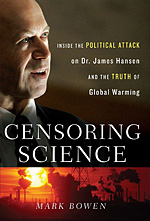
Cover of Mark Bowen’s book defending climate science, “Censoring Science.”
Bowen’s newest book: Censoring Science: Inside the political attack on James Hansen and the truth of global warming. Watts doesn’t want anyone to read that book. It is easy to imagine Watt’s s attack is, he hopes, pre-emptive, against Bowen’s book.
I’ll wager Watts hasn’t read the article in Climbing, and didn’t know who Bowen was when he launched his attack, though. The denials of bias coming out of the denialists’ camp will be interesting to watch.
Let the denialists roll out the rope far enough, they’ll inevitably hang themselves.
More:
Do something for freedom: Spread the news
35 Comments | Accuracy, Climate change, climate_change, Ethics, Geography - Physical, Glaciers, Global warming, History, Journalism, Physics, Political Smear, Politics, Science | Tagged: Accuracy, Climate change, denialism, geography, Glaciers, Global warming, Hoaxes, Physics, Science | Permalink
Posted by Ed Darrell
Otherwise occupied, I nearly forgot: 92 years ago yesterday, on December 28, 1917, this column by H. L. Mencken was published in The New York Evening Mail:
A Neglected Anniversary
H. L. Mencken at approximately 12:30 a.m., April 7, 1933, at the Rennert Hotel, corner of Saratoga and Liberty Streets, 17 years later, not neglecting a sudsy anniversary - Baltimore Sun photo
On December 20 there flitted past us, absolutely without public notice, one of the most important profane anniversaries in American history, to wit, the seventy-fifth anniversary of the introduction of the bathtub into These States. Not a plumber fired a salute or hung out a flag. Not a governor proclaimed a day of prayer. Not a newspaper called attention to the day.
True enough, it was not entirely forgotten. Eight or nine months ago one of the younger surgeons connected with the Public Health Service in Washington happened upon the facts while looking into the early history of public hygiene, and at his suggestion a committee was formed to celebrate the anniversary with a banquet. But before the plan was perfected Washington went dry (This was war-time Prohibition, preliminary to the main catastrophe. — HLM), and so the banquet had to be abandoned. As it was, the day passed wholly unmarked, even in the capital of the nation.
Bathtubs are so common today that it is almost impossible to imagine a world without them. They are familiar to nearly everyone in all incorporated towns; in most of the large cities it is unlawful to build a dwelling house without putting them in; even on the farm they have begun to come into use. And yet the first American bathtub was installed and dedicated so recently as December 20, 1842, and, for all I know to the contrary, it may still be in existence and in use.
Curiously enough, the scene of its setting up was Cincinnati, then a squalid frontier town, and even today surely no leader in culture. But Cincinnati, in those days as in these, contained many enterprising merchants, and one of them was a man named Adam Thompson, a dealer in cotton and grain. Thompson shipped his grain by steamboat down the Ohio and Mississippi to New Orleans, and from there sent it to England in sailing vessels. This trade frequently took him to England, and in that country, during the ’30s, he acquired the habit of bathing.
The bathtub was then still a novelty in England. It had been introduced in 1828 by Lord John Russell and its use was yet confined to a small class of enthusiasts. Moreover, the English bathtub, then as now, was a puny and inconvenient contrivance — little more, in fact, than a glorified dishpan — and filling and emptying it required the attendance of a servant. Taking a bath, indeed, was a rather heavy ceremony, and Lord John in 1835 was said to be the only man in England who had yet come to doing it every day.
Thompson, who was of inventive fancy — he later devised the machine that is still used for bagging hams and bacon — conceived the notion that the English bathtub would be much improved if it were made large enough to admit the whole body of an adult man, and if its supply of water, instead of being hauled to the scene by a maid, were admitted by pipes from a central reservoir and run off by the same means. Accordingly, early in 1842 he set about building the first modern bathroom in his Cincinnati home — a large house with Doric pillars, standing near what is now the corner of Monastery and Orleans streets.
There was then, of course, no city water supply, at least in that part of the city, but Thompson had a large well in his garden, and he installed a pump to lift its water to the house. This pump, which was operated by six Negroes, much like an old-time fire engine, was connected by a pipe with a cypress tank in the garret of the house, and here the water was stored until needed. From the tank two other pipes ran to the bathroom. One, carrying cold water, was a direct line. The other, designed to provide warm water, ran down the great chimney of the kitchen, and was coiled inside it like a giant spring.
The tub itself was of new design, and became the grandfather of all the bathtubs of today. Thompson had it made by James Cullness, the leading Cincinnati cabinetmaker of those days, and its material was Nicaragua mahogany. It was nearly seven feet long and fully four feet wide. To make it water-tight, the interior was lined with sheet lead, carefully soldered at the joints. The whole contraption weighed about 1,750 pounds, and the floor of the room in which it was placed had to be reinforced to support it. The exterior was elaborately polished.
In this luxurious tub Thompson took two baths on December 20, 1842 — a cold one at 8 a.m. and a warm one some time during the afternoon. The warm water, heated by the kitchen fire, reached a temperature of 105 degrees. On Christmas day, having a party of gentlemen to dinner, he exhibited the new marvel to them and gave an exhibition of its use, and four of them, including a French visitor, Col. Duchanel, risked plunges into it. The next day all Cincinnati — then a town of about 100,000 people — had heard of it, and the local newspapers described it at length and opened their columns to violent discussions of it.
The thing, in fact, became a public matter, and before long there was bitter and double- headed opposition to the new invention, which had been promptly imitated by several other wealthy Cincinnatians. On the one hand it was denounced as an epicurean and obnoxious toy from England, designed to corrupt the democratic simplicity of the Republic, and on the other hand it was attacked by the medical faculty as dangerous to health and a certain inviter of “phthisic, rheumatic fevers, inflammation of the lungs and the whole category of zymotic diseases.” (I quote from the Western Medical Repository of April 23, 1843.)
The noise of the controversy soon reached other cities, and in more than one place medical opposition reached such strength that it was reflected in legislation. Late in 1843, for example, the Philadelphia Common Council considered an ordinance prohibiting bathing between November 1 and March 15, and it failed of passage by but two votes. During the same year the legislature of Virginia laid a tax of $30 a year on all bathtubs that might be set up, and in Hartford, Providence, Charleston and Wilmington (Del.) special and very heavy water rates were levied upon those who had them. Boston, very early in 1845, made bathing unlawful except upon medical advice, but the ordinance was never enforced and in 1862 it was repealed.
This legislation, I suspect, had some class feeling in it, for the Thompson bathtub was plainly too expensive to be owned by any save the wealthy; indeed, the common price for installing one in New York in 1845 was $500. Thus the low caste politicians of the time made capital by fulminating against it, and there is even some suspicion of political bias in many of the early medical denunciations. But the invention of the common pine bathtub, lined with zinc, in 1847, cut off this line of attack, and thereafter the bathtub made steady progress.
The zinc tub was devised by John F. Simpson, a Brooklyn plumber, and his efforts to protect it by a patent occupied the courts until 1855. But the decisions were steadily against him, and after 1848 all the plumbers of New York were equipped for putting in bathtubs. According to a writer in the Christian Register for July 17, 1857, the first one in New York was opened for traffic on September 12, 1847, and by the beginning of 1850 there were already nearly 1,000 in use in the big town.
After this medical opposition began to collapse, and among other eminent physicians Dr. Oliver Wendell Holmes declared for the bathtub, and vigorously opposed the lingering movement against it in Boston. The American Medical Association held its annual meeting in Boston in 1849, and a poll of the members in attendance showed that nearly 55 per cent of them now regarded bathing as harmless, and that more than 20 per cent advocated it as beneficial. At its meeting in 1850 a resolution was formally passed giving the imprimatur of the faculty to the bathtub. The homeopaths followed with a like resolution in 1853.
But it was the example of President Millard Fillmore that, even more than the grudging medical approval, gave the bathtub recognition and respectability in the United States. While he was still Vice-President, in March, 1850, he visited Cincinnati on a stumping tour, and inspected the original Thompson tub. Thompson himself was now dead, but his bathroom was preserved by the gentlemen who had bought his house from the estate. Fillmore was entertained in this house and, according to Chamberlain, his biographer, took a bath in the tub. Experiencing no ill effects, he became an ardent advocate of the new invention, and on succeeding to the Presidency at Taylor’s death, July 9, 1850, he instructed his secretary of war, Gen. Charles M. Conrad, to invite tenders for the construction of a bathtub in the White House.
This action, for a moment, revived the old controversy, and its opponents made much of the fact that there was no bathtub at Mount Vernon, or at Monticello, and that all the Presidents and other magnificoes of the past had got along without any such monarchical luxuries. The elder Bennett, in the New York Herald, charged that Fillmore really aspired to buy and install in the White House a porphyry and alabaster bath that had been used by Louis Philippe at Versailles. But Conrad, disregarding all this clamor, duly called for bids, and the contract was presently awarded to Harper & Gillespie, a firm of Philadelphia engineers, who proposed to furnish a tub of thin cast iron, capable of floating the largest man.
This was installed early in 1851, and remained in service in the White House until the first Cleveland administration, when the present enameled tub was substituted. The example of the President soon broke down all that remained of the old opposition, and by 1860, according to the newspaper advertisements of the time, every hotel in New York had a bathtub, and some had two and even three. In 1862 bathing was introduced into the Army by Gen. McClellan, and in 1870 the first prison bathtub was set up at Moyamensing Prison, in Philadelphia.
So much for the history of the bathtub in America. One is astonished, on looking into it, to find that so little of it has been recorded. The literature, in fact, is almost nil. But perhaps this brief sketch will encourage other inquirers and so lay the foundation for an adequate celebration of the centennial in 1942.
(Text courtesy of Poor Mojo’s Almanac(k))
The entire history was a hoax composed by Mencken.
Even conservative wackoes appreciate the column.
Content with his private joke, Mencken remained silent about the hoax until a follow-up article, “Melancholy Reflections,” appeared in the Chicago Tribune on May 23, 1926, some eight years later. This was Mencken’s confession. It was also an appeal for reason to the American public.
His hoax was a joke gone bad. “A Neglected Anniversary” had been printed and reprinted hundreds of times in the intervening years. Mencken had been receiving letters of corroboration from some readers and requests for more details from others. His history of the bathtub had been cited repeatedly by other writers and was starting to find its way into reference works. As Mencken noted in “Melancholy Reflections,” his “facts” “began to be used by chiropractors and other such quacks as evidence of the stupidity of medical men. They began to be cited by medical men as proof of the progress of public hygiene.” And, because Fillmore’s presidency had been so uneventful, on the date of his birthday calendars often included the only interesting tidbit of information they could find: Fillmore had introduced the bathtub into the White House. (Even the later scholarly disclosure that Andrew Jackson had a bathtub installed there in 1834—years before Mencken claimed it was even invented—did not diminish America’s conviction that Fillmore was responsible.)
(No, dear reader, probably not correct; surely John Adams brought a bathtub with him when he moved into the White House, then called the President’s Mansion. Plumbing, hot water, and finally hot water to a bathtub in the president’s residence, were installed between 1830 and 1853, as best I can determine.)
Mencken wrote an introduction to the piece in a later book, A Mencken Chrestomathy (Alfred A. Knopf, 1949):
The success of this idle hoax, done in time of war, when more serious writing was impossible, vastly astonished me. It was taken gravely by a great many other newspapers, and presently made its way into medical literature and into standard reference books. It had, of course, no truth in it whatsoever, and I more than once confessed publicly that it was only a jocosity . . . Scarcely a month goes by that I do not find the substance of it reprinted, not as foolishness but as fact, and not only in newspapers but in official documents and other works of the highest pretensions.
There’s a moral to the story: Strive for accuracy!
So, Dear Reader, check for accuracy, and question authority.
Resources:
Warn others of the hoax!
2 Comments | 1914-1918, A Good Story, Accuracy, Fillmore's bathtub, H. L. Mencken, History, Hoaxes, How do we know what we know, Journalism, Millard Fillmore, Newspapers, White House, World War I | Tagged: 1914-1918, A Good Story, Accuracy, H. L. Mencken, History, Hoaxes, Journalism, Millard Fillmore, Newspapers, White House, World War I | Permalink
Posted by Ed Darrell
Associate Press put a team of five reporters on the e-mails purloined from the Hadley climate science group in England. AP sought advice on interpreting the messages from other scientists involved in ethical science issues.
To the best of my knowledge, this is the only group that has gone through the entire mass to see what is really shown — more than a million words, the AP story estimated.
Veteran climate issue reporter Seth Borenstein wrote up the story: Scientists in the heat of research and interpretation, on deadline with government policy makers, often attacked unfairly — one received death threats for his work on climate change. Under those conditions, one might understand that the scientists were defensive and rude, in private, about their critics. One of the critics harassed scientists with repeated FOI requests, then didn’t use the data. In one case, a critic published a paper based on bad data — what the critics accused the scientists of doing.
But in the end, there was no pattern of data fixing. Independent reviews today confirm that independently-generated studies confirm the warming the scientists wrote about.
Of course, that doesn’t stop the hecklers of the scientists from complaining, either about the science or the way it’s reported. Rather than deal with the material AP reported, for example, warming blogger Anthony Watts attacked the reporter who wrote the story, complaining that he is “too close” to the story, since he seems to have been covering the story long enough that his e-mail appears in the purloined e-mails.
‘You can’t report the news because you know too much,’ is Watts’s complaint.
In the e-mail cited, Seth Borenstein wrote to some of the world’s best scientists in the field and asked their opinions about a paper making some contrary claims.
To Watts, seeking information from the experts is beyond the pale. He calls it an ethical infraction.
Watts is unbound by such ethical rules, however, and so can make up stuff like this with abandon. Watts’ charge is hooey, foul play, and stupid. In the headline to his post, Watts wrote, “AP’s Seth Borenstein is just too damn cozy with the people he covers – time for AP to do something about it.”
That’s right, AP — it’s time Borenstein got a promotion for doing the legwork, honestly, that critics of the science have refused to do. Borenstein’s reporting is important. The story goes beyond mere repeating of press releases, beyond the mere “he-said/he-said” norm. Borenstein, in unemotional, clear and cool terms, indicted the critics of warming, by factually reporting the events. Give that man and his team a Pulitzer Prize.
Why shouldn’t reporters go to the experts? Why shouldn’t they ask the opinions of all sides in a science debate?
Think about it for a moment: Watts’s complaint is that Borenstein sought fairness in reporting on Watts’s side’s claim. Because Borenstein refused to show the bias Watts wants, Watts went after Borenstein.
Could there be a more clear and dramatic illustration of why the scientists’ ire is raised by such silly criticism?
Watts quotes at length from the Associated Press Statement of News Values and Principles, slyly implying by doing so that Borenstein violated the rules somewhere. Not so.
Watts worries about “getting too cozy with sources.” Read his blog. Watts prefers to be the source — but he also reports on the debate.
Watts would do well to read that AP ethical statement again, and take it to heart.
His charges are groundless, scurrilous in the light of the AP team’s going to great lengths to be fair to all sides. Watts and other critics bank on people being shocked that scientists get angry. Watts and his colleagues have campaigned across the web, on television and in print, to have these scientists tarred and feathered, and their science dismissed — though there is not handful of feathers to weigh against the mountains of evidence the scientists accumulated and published over the past 50 years.
Do not take my word for it. Read the AP story. Read Watts’s rant. Read the e-mails, if you wish (you can find them from my opinionated take on the flap). Check with the scientists you know and trust on their views of the science done and reported.
I won a couple of minor investigative journalism awards in college. I have been a member of the Society of Professional Journalists off and on since 1974 (not much since I quit doing that stuff full time). I have worked with some of the best investigative journalists and Congressional investigators in my duties with the Senate. I’ve been a member of the FOIA committees in Utah and Maryland. I’ve lobbied in three states for freedom of information. I know a little bit about investigative reporting and fairness. And yes, IAAL.
Borenstein’s piece is solid and good. In light of the firestorm Watts hopes to bring down on it, Borenstein’s article is a shining example of high ethics in journalism. It deserves your reading.
If the critics had data denying warming, or denying human causation of warming, why are they hiding it so well? If they have the data to prove the scientists are in error, why not publish it, instead of sniping at a wire service reporter who merely tells the story?
Critics don’t have the data to contest the hard work of the scientists. They don’t have the data to make a case against either warming or human causation. And now we all know.
Post Script: Um, and , you know, it’s not like Borenstein hasn’t done some stuff over the years to make it look like he’s been on Watts’s side: Stoat, Mooney’s Intersection, Island of Doubt. Watts’ fit may put a gloss on Borenstein’s work that wasn’t there to begin with.
Help others investigate the facts:
14 Comments | Accuracy, air pollution, Climate change, climate_change, Cost of Green, Environmental protection, Ethics, Global warming, Green Politics, History, Political Smear, Politics, Science | Tagged: Accuracy, Anthony Watts, Associated Press, Climate change, Ethics, Global warming, Journalism, Purloined e-mails, Science, Seth Borenstein | Permalink
Posted by Ed Darrell
I warned you about it earlier. Crank science sites across the internet feature news of another cheap hit on Rachel Carson and science in movie form.
“Not Evil, Just Wrong” is slated for release on October 18. This is the film that tried to intrude on the Rachel Carson film earlier this year, but managed to to get booked only at an elementary school in Seattle, Washington — Rachel Carson Elementary, a green school where the kids showed more sense than the film makers by voting to name the school after the famous scientist-author.
The film is both evil and wrong.
Errors just in the trailer:
When the human health, human welfare, and environmental effects which could be expressed in dollar terms were added up for the entire 20-year period, the total benefits of Clean Air Act programs were estimated to range from about $6 trillion to about $50 trillion, with a mean estimate of about $22 trillion. These estimated benefits represent the estimated value Americans place on avoiding the dire air quality conditions and dramatic increases in illness and premature death which would have prevailed without the 1970 and 1977 Clean Air Act and its associated state and local programs. By comparison, the actual costs of achieving the pollution reductions observed over the 20 year period were $523 billion, a small fraction of the estimated monetary benefits.
That’s a whopper about every 15 seconds in the trailer — the film itself may make heads spin if it comes close to that pace of error.
Where have we seen this before? Producers of the film claim as “contributors” some of the people they try to lampoon — people like Ed Begley, Jr., and NASA’s James E. Hansen, people who don’t agree in any way with the hysterical claims of the film, and people who, I wager, would be surprised to be listed as “contributors.”
It’s easy to suppose these producers used the same ambush-the-scientist technique used earlier by the producers of the anti-science, anti-Darwin film “Expelled!“
Here, see the hysteria, error and alarmism for yourself:
Ann McElhinney is one of the film’s producers. Her past work includes other films against protecting environment and films for mining companies. She appears to be affiliated with junk science purveyors at the Competitive Enterprise Institute, an astro-turf organization in Washington, D.C., for whom she flacked earlier this year (video from Desmogblog):
Remember, too, that this film is already known to have gross inaccuracies about Rachel Carson and DDT, stuff that high school kids could get right easily.
Anyone have details on McElhinney and her colleague, Phelim McAlee?
More:
Related posts, at Millard Fillmore’s Bathtub:
133 Comments | Accuracy, Climate change, climate_change, Cost of Green, Environmental protection, Freedom of Information, Global warming, Green Politics, History, Junk science, Natural resources, Political Smear, Politics, Rachel Carson, Science, Uncomposted Organic Fertilizer, Voodoo history, Voodoo science, War on Science | Tagged: Accuracy, Climate change, climate_change, Cost of Green, Environmental protection, Freedom of Information, Global warming, Green Politics, History, Junk science, Natural resources, Political Smear, Politics, Rachel Carson, Science, Uncomposted Organic Fertilizer, Voodoo history, Voodoo science, War on Science | Permalink
Posted by Ed Darrell
It is hard to miss the irony in people eagerly poring through illegally-obtained private email, looking for ethical breaches by the writers! I’m sure we can all imagine the outrage if one of the emails revealed that a scientist had hacked into one of the sceptics’ computers and was reading all their correspondence. So a bit of perspective is called for here.
James Is A Scientist (IANAS), and he has much good stuff to say (read some of the other posts about the hacked e-mails while you’re there) — but you gotta wonder about a blog that follows such a post with this:

Prawns not in their native habitat. Probably Tastimus deliciousus
1 Comment | Accuracy, Climate change, climate_change, Ethics, Food history, Global warming, How do we know what we know, Research, Science | Tagged: Accuracy, Climate change, CRU, Ethics, food, Global warming, Hadley, How do we know what we know, Prawns, Research, Science | Permalink
Posted by Ed Darrell
The hard core uneducables who make of the hard knot at the center of the anti-science and anti-environmental movement just refuses to jettison their adored myths about science, regardless how many times those myths are shown to be false.
It’s a religious exercise with them, and their faith in error and bad applications of science won’t be shaken.
Have you ever read Tom Wolfe’s Radical Chic & Mau-mauing the Flak Catchers? Claiming Ruckelshaus an enemy of Africans and Rachel Carson a mass murderer is the new Radical Chic, and constant writing about it the new Mau-mauing.
Natalie Sirkin writes screeds for newspapers in Connecticut, I understand from an odd blog that collects these misdeeds, Don Pesci’s Connecticut Commentary: Red Notes from a Blue State.
(Pesci has a particular fetish for DDT myths, and Sirkin’s been there, too. He’s hard-core — no amount of information can sway him.)
Sirkin’s latest screed is “Myths for Fun and Profit,” and includes as one of the myths DDT’s ban in the U.S. Her complaint is badly worded, but from the brief and grossly wrong explanation, we can see she thinks that DDT shouldn’t have been banned, and that map and calendar challenged, she thinks the ban on using DDT on cotton in the U.S. in 1972 somehow led to a rise in malaria in Africa in the 1980s. (Mosquitoes don’t travel that far, generally, either across the ocean from the U.S. to Africa, nor in time, from 1972 to 1980, nor the other way around.)
Sirkin wrote:
8….DDT, the most wonderful chemical ever. “It is estimated that in little more than two decades, DDT has prevented 500 million deaths that would otherwise have been inevitable,” concluded the National Academy of Sciences in 1971, the year before EPA head William Ruckelshaus banned it. Thanks to Ruckelshaus, Rachel Carson, environmentalist extremists, and the WHO, millions of Africans including children are dying or disabled today.
Why, these irrational policy errors?
So I responded:
Banning DDT from agricultural use was an extremely rational act, as vouched for by the summary judgment against the DDT manufacturers in both of the cases brought against EPA for the ban, and as vouched for by the removal of the bald eagle and brown pelican from the Endangered Species List.
Sirkin wrote: “DDT, the most wonderful chemical ever. ‘It is estimated that in little more than two decades, DDT has prevented 500 million deaths that would otherwise have been inevitable,’ concluded the National Academy of Sciences in 1971, the year before EPA head William Ruckelshaus banned it.”
EPA relabeled DDT in 1972, not 1971, effectively banning the use of DDT on cotton. Under that rule, DDT could be available to fight malaria in the U.S., and DDT was manufactured in the U.S. for export to anyone who wished to use it. There has never been a ban on using DDT to fight malaria.
But DDT ceased to work well against malaria-carrying mosquitoes in the 1960s. Africans are not stupid. Had DDT been a panacea, I’m sure they would have used it.
But while I worry about your implicit denigration of Africans and Asians in suggesting they are somehow incapable of deciding for themselves to use an effective weapon against disease, I am more concerned at your erroneous characterization of DDT’s value. The National Academy of Sciences made an editing error, so part of your error is understandable. DDT was never credited with saving 500 million lives. During the entire time DDT has been available to fight malaria, from 1946 to today, the death rate worldwide from malaria has never exceeded 4 million a year, and since the 1960s the death rate has been about a million year. At 4 million deaths per year, to save 500 million lives, DDT would have had to have been used for 125 years prior to now. Insecticidal properties of the stuff were discovered only in 1939, 70 years ago.
At about a million deaths per year, to save 500 million lives, DDT would have had to have been used for 500 years.
Clearly there was an error in math, or confusion in citations. About 500 million people are afflicted with malaria annually, noted earlier in that NAS book, which is where I think the 500 million figure came from.
But let’s leave that aside for a moment. That 1970 publication by the National Academy of Sciences was an evaluation of chemicals in the environment. That sentence crediting DDT with saving so many lives, erroneous as it was, was in a call to ban DDT as quickly as possible, and to increase research to find alternatives to DDT in order to get DDT use completely stopped.
NAS recognized the value of DDT, but said it was too dangerous to keep using.
Don’t cite NAS’s credit to DDT without noting they said we must stop using it, because its dangers outweigh the benefits.
You can find a more thorough discussion of the NAS report at this blog. [You should go see, Dear Reader — neither Sirkin nor Pesci will likely ever bother.]
Sirkin wrote:
“Thanks to Ruckelshaus, Rachel Carson, environmentalist extremists, and the WHO, millions of Africans including children are dying or disabled today.”With the great assistance of the Bill and Melinda Gates Foundation, and continued efforts of the World Health Organization, several African nations have cut malaria rates by 50% to 85% with the use of bednets and “integrated vector management” (IVM), usually known as integrated pest management (IPM) in the U.S.
Anyone who reads Carson’s astoundingly accurate book knows that she did not call for a ban on DDT, but instead called for the use of an integrated program of pest management. Had we listened to Rachel Carson in 1962, we could have saved several million children from death, in Africa, from malaria alone. It is scurrilous, calumnous, and inaccurate to the point of sin to blame Rachel Carson for deaths caused by failure to listen to her and heed her words.
Ruckelshaus acted with full knowledge of the National Academy of Science’s calling for an end to DDT use due to its harms, known and then unknown. It is foolish to blame people for acting with hard evidence and careful, rational thought. It’s particularly ungraceful to then accuse them of acting irrationally.
I doubt that either Pesci or Sirkin will ever change their tune. They’d have to concede that science works, that scientists are not all evil, and that sometimes environmentalists, and even liberals, get things right. More importantly, they’d have to concede they erred — and that would be like Baum’s Wicked Witch of the West taking a shower.
4 Comments | Accuracy, Africa, Cost of Green, DDT, Green Politics, History, History of Science, Rachel Carson, Reason | Tagged: Accuracy, Africa, Cost of Green, DDT, Green Politics, History, History of Science, Politics, Rachel Carson, Reason | Permalink
Posted by Ed Darrell
Satire, hoax, fact — how can we tell the difference?
Maybe more importantly, how can we tell early on that the “Climategate” kerfuffle, involving purloined, but otherwise dull e-mails from climate scientists, is nothing to worry about?
Look at history! Remember Newtongate? Read it here, at Carbon Fixated.
If you own any shares in companies that produce reflecting telescopes, use differential and integral calculus, or rely on the laws of motion, I should start dumping them NOW. The conspiracy behind the calculus myth has been suddenly, brutally and quite deliciously exposed after volumes of Newton’s private correspondence were compiled and published.
When you read some of these letters, you realise just why Newton and his collaborators might have preferred to keep them confidential. This scandal could well be the biggest in Renaissance science. These alleged letters – supposedly exchanged by some of the most prominent scientists behind really hard math lessons – suggest:
Conspiracy, collusion in covering up the truth, manipulation of data, private admissions of flaws in their public claims and much more.
But perhaps the most damaging revelations are those concerning the way these math nerd scientists may variously have manipulated or suppressed evidence to support their cause.
What kind of conspiracy keeps calculus being taught to innocent children today? Exactly the same conspiracy that causes scientists to sound the alarms about climate change.
Leave a Comment » | Accuracy, Climate change, climate_change, Cost of Green, Ethics, Global warming, Green Politics, Hoaxes, Politics, Propaganda, Science | Tagged: Accuracy, Climate change, Climate Research Unit, Climategate, Ethics, Global warming, Hadley, Newtongate, Science | Permalink
Posted by Ed Darrell
You are currently browsing the archives for the Accuracy category.


Ed Darrell on Texas's Colorado River


Come on in, the water's fine. Come often: Cleanliness is next to godliness.


 Millard Fillmore's Bathtub