On the night before Christmas: Untangling the history of a visit from St. Nick

December 24, 2007

Thomas Nast invented Santa Claus? Clement C. Moore didn’t write the famous poem that starts out, “‘Twas the night before Christmas, and all through the house . . . ?”

The murky waters of history from Millard Fillmore’s Bathtub soak even our most cherished ideas and traditions.

But isn’t that part of the fun of history?

  • Below: Thomas Nast’s first published drawing featuring Santa Claus; for Harper’s Weekly, “A Journal of Civilization,” January 3, 1863 Nast portrayed the elf distributing packages to Union troops: “Santa Claus in camp.” Nast (1840-1904) was 23 when he drew this image.

Santa Claus delivers to Union soldiers, "Santa Claus in Camp" - Thomas Nast, Harper's Weekly, Jan 3, 1863 Yes, Virginia (and California, too)! Thomas Nast created the image of Santa Claus most of us in the U.S. know today. Perhaps even more significant than his campaign against the graft of Boss Tweed, Nast’s popularization of a fat, jolly elf who delivers good things to people for Christmas makes one of the great stories in commercial illustration. Nast’s cartoons, mostly for the popular news publication Harper’s Weekly, created many of the conventions of modern political cartooning and modeled the way in which an illustrator could campaign for good, with his campaign against the graft of Tammany Hall and Tweed. But Nast’s popular vision of Santa Claus can be said to be the foundation for the modern mercantile flurry around Christmas.

Nast is probably ensconced in a cartoonists’ hall of fame. Perhaps he should be in a business or sales hall of fame, too.  [See also Bill Casselman’s page, “The Man Who Designed Santa Claus.]

Nast’s drawings probably drew some inspiration from the poem, “Account of a Visit from St. Nicholas,” traditionally attributed to Clement C. Moore, a New York City lawyer, published in 1822. The poem is among the earliest to describe the elf dressed in fur, and magically coming down a chimney to leave toys for children; the poem invented the reindeer-pulled sleigh.

Modern analysis suggests the poem was not the work of Moore, and many critics and historians now attribute it to Major Henry Livingston, Jr. (1748-1828) following sleuthing by Vassar College Prof. Don Foster in 2000. Fortunately for us, we do not need to be partisans in such a query to enjoy the poem (a complete copy of which is below the fold).

The Library of Congress still gives Moore the credit. When disputes arise over who wrote about the night before Christmas, is it any wonder more controversial topics produce bigger and louder disputes among historians?

Moore was not known for being a poet. The popular story is that he wrote it on the spur of the moment:

Moore is thought to have composed the tale, now popularly known as “The Night Before Christmas,” on December 24, 1822, while traveling home from Greenwich Village, where he had bought a turkey for his family’s Christmas dinner.

Inspired by the plump, bearded Dutchman who took him by sleigh on his errand through the snow-covered streets of New York City, Moore penned A Visit from St. Nicholas for the amusement of his six children, with whom he shared the poem that evening. His vision of St. Nicholas draws upon Dutch-American and Norwegian traditions of a magical, gift-giving figure who appears at Christmas time, as well as the German legend of a visitor who enters homes through chimneys.

Again from the Library of Congress, we get information that suggests that Moore was a minor celebrity from a well-known family with historical ties that would make a good “connections” exercise in a high school history class, perhaps (“the link from Aaron Burr’s treason to Santa Claus?”): (read more, below the fold)

Read the rest of this entry »


Allowable political satire, or attack on the President?

December 20, 2007

So, is this allowable parody, political satire, in the nature of a political cartoon?
Mug shotsOr, is this an untoward attack on the President?

Will children be confused if they find these photos in a display of political art at the New York Public Library?

Is it not acceptable satire?

Tip of the old scrub brush to Gallery of the Absurd.


Human Liberty Bell: Tribute to photos of Mole & Thomas

December 12, 2007

Surely you’ve seen some of these photos; if you’re a photographer, you’ve marveled over the ability of the photographer to get all those people to their proper positions, and you’ve wondered at the sheer creative genius required to set the photos up.

Like this one, a depiction of the Liberty Bell — composed of 25,000 officers and men at Fort Dix, New Jersey. The photo was taken in 1918.

Mole & Thomas photo, Human Liberty Bell The Carl Hammer Gallery in Chicago featured an exhibit of these monumental photos in April and May, 2007:
The outbreak of World War I and its inherent violence engendered a new commitment by the world’s photographers to document every aspect of the fighting, ending an era of In A Patriotic Mole, A Living Photograph, Louis Kaplan, of Southern Illinois University, writes, “The so-called living photographs and living insignia of Arthur Mole [and John Thomas] are photo-literal attempts to recover the old image of national identity at the very moment when the United States entered the Great War in 1917.

Mole’s [and Thomas’s] photos assert, bolster, and recover the image of American national identity via photographic imaging. Moreover, these military formations serve as rallying points to support U.S. involvement in the war and to ward off any isolationist tendencies. In life during wartime, [their] patriotic images function as “nationalist propaganda” and instantiate photo cultural formations of citizenship for both the participants and the consumers of these group photographs.”

The monumentality of this project somewhat overshadows the philanthropic magnanimity of the artists themselves.Instead of prospering from the sale of the images produced, the artists donated the entire income derived to the families of the returning soldiers and to this country’s efforts to re-build their lives as a part of the re-entry process.

Eventually, other photographers, appeared on the scene, a bit later in time than the activity conducted by Mole and Thomas, but all were very clearly inspired by the creativity and monumentality of the duo’s production of the “Living” photograph.

One of the most notable of those artists was Eugene Omar Goldbeck. He specialized in the large scale group portrait and photographed important people (Albert Einstein), events, and scenes (Babe Ruth’s New York Yankees in his home town, San Antonio) both locally and around the world (Mt. McKinley). Among his military photographs, the Living Insignia projects are of particular significance as to how he is remembered.

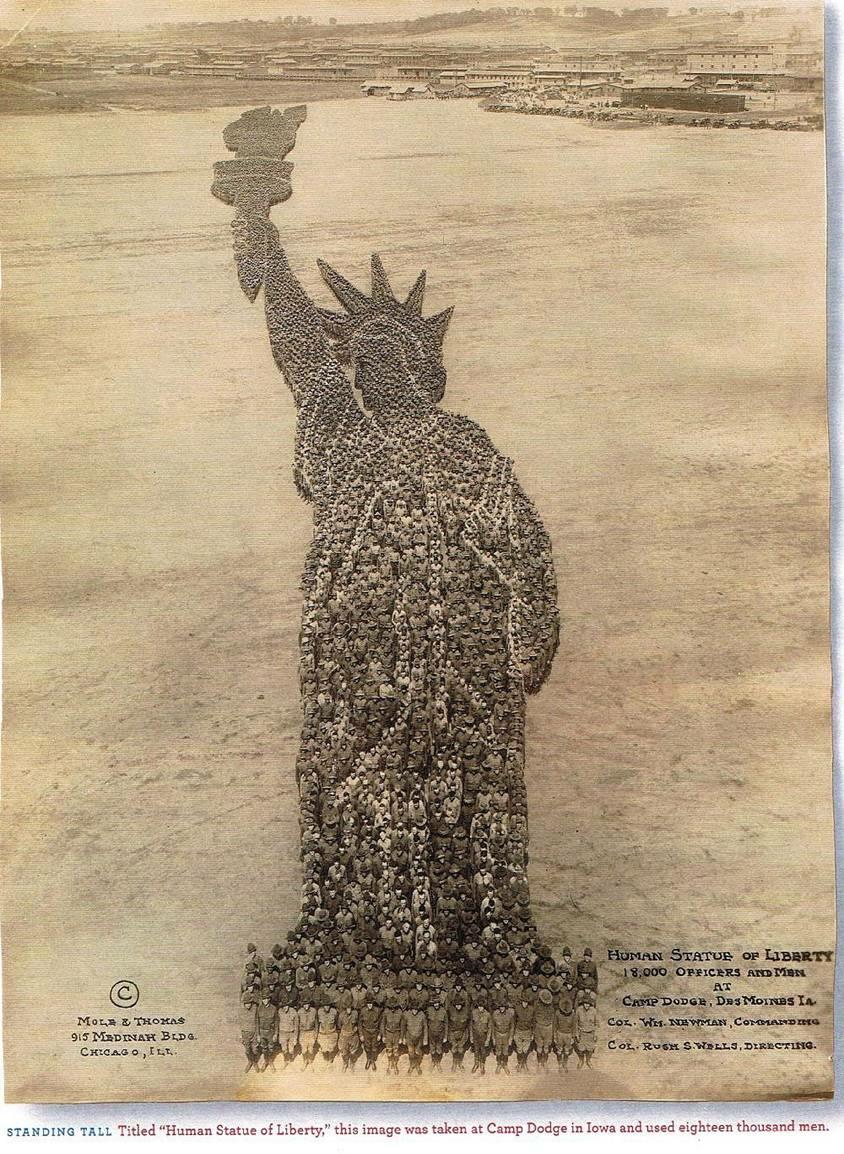
Using a camera as an artist’s tool, using a literal army as a palette, using a parade ground as a sort of canvas, these photographers made some very interesting pictures. The Human Statue of Liberty, with 18,000 men at Camp Dodge, Iowa?


statue-of-liberty-human-camp-dodge-from-snopes.jpg

Most of these pictures were taken prior to 1930. Veterans who posed as part of these photos would be between 80 and 100 years old now. Are there veterans in your town who posed for one of these photos?


Good photographic copies of some of these pictures are available from galleries. They are discussion starters, that’s for sure.

Some questions for discussion:

  1. Considering the years of the photos, do you think many of these men saw duty overseas in World War I.
  2. Look at the camps, and do an internet search for influenza outbreaks in that era. Were any of these camps focal points for influenza?
  3. Considering the toll influenza took on these men, about how many out of each photo would have survived the influenza, on average?
  4. Considering the time, assume these men were between the ages of 18 and 25. What was their fate after the Stock Market Crash of 1929? Where were they during World War II?
  5. Do a search: Do these camps still exist? Can you find their locations on a map, whether they exist or not?
  6. Why do the critics say these photos might have been used to build national unity, and to cement national identity and will in time of war?
  7. What is it about making these photos that would build patriotism? Are these photos patriotic now?

These quirky photos are true snapshots in time. They can be used for warm-ups/bell ringers, or to construct lesson plans around.

Tip of the old scrub brush to Gil Brassard, a native, patriotic and corporate historian hiding in Baton Rouge, Louisiana.


Tuba Christmas, St. Louis!

December 10, 2007

I love a good tuba tune — I love all the low brass.  Tuba Christmas is one of the great joys of this season.  It may be better than the sing-along “Messiah!”

Tuba Christmas at Rockefeller Center, NYC - Voice of America photograph

Photo at left:  Tuba Christmas at Rockefeller Center, New York City, 2006; Voice of America photograph

The St. Louis Post-Dispatch has a good slide show on Tuba Christmas in St. Louis this year.

Not to brag, but there are 21 Tuba Christmas events set for Texas this year, equal to the total of California and New York together.  (That link shows events in all states.)


U.S. dollar edge incusions

November 5, 2007

A few weeks ago I looked all over to find an image of the engraving of the edge of the new U.S. “presidential dollar” coins.

Now, of course, I don’t need it — so I found a marvelous illustration at the U.S. Mint site (yes, I checked there earlier).

FYI, and use:

U.S. Presidential Dollar, showing edge incusions


Prehistory and art: Lesson plan material

October 7, 2007

Teachers looking for good interactive graphics on human migration in prehistoric times should take a look at the website of Australia’s Bradshaw Foundation. The map requires an Adobe Flash player, and I cannot embed it here — but go take a look, here. “The Journey of Man” seems tailor made for classroom use, if you have a live internet connection and a projector.

Ancient art is the chief focus of the foundation.

Ancient paintings, the Bradshaw paintings, at the Bradshaw Foundation Examples of some of the most famous cave and rock paintings populate the site, along with many lesser known creations — the eponymous paintings, the Bradshaw group, generally disappear from U.S. versions of world history texts. The Bradshaw Foundation website explains:

The Bradshaw Paintings are incredibly sophisticated, as you will see from the 32 pictures in the Paintings Section, yet they are not recent creations but originate from an unknown past period which some suggest could have been 50,000 years ago. This art form was first recorded by Joseph Bradshaw in 1891, when he was lost on an Kimberley expedition in the north west of Australia. Dr. Andreas Lommel stated on his expedition to the Kimberleys in 1955 that the rock art he referred to as the Bradshaw Paintings may well predate the present Australian Aborigines.

This ancient art carries a story that should intrigue even junior high school students, and it offers examples of archaeological techniques that are critical to determining the ages of undated art in the wild:

According to legend, they were made by birds. It was said that these birds pecked the rocks until their beaks bled, and then created these fine paintings by using a tail feather and their own blood. This art is of such antiquity that no pigment remains on the rock surface, it is impossible to use carbon dating technology. The composition of the original paints cant be determined, and whatever pigments were used have been locked into the rock itself as shades of Mulberry red, and have become impervious to the elements.

Fortuitously, in 1996 Grahame Walsh discovered a Bradshaw Painting partly covered by a fossilised Mud Wasp nest, which scientists have removed and analysed using a new technique of dating, determining it to be 17,000 + years old.

Texas history and geography teachers should note the Bradshaw Foundation’s work on prehistorica art in the Pecos River Valley: “Pecos Experience: Art and archeaology in the lower Pecos.” There is much more here than is found in most Texas history texts — material useful for student projects or good lesson plans.

Painting from Panther Cave, lower Pecos, Texas - Bradshaw Foundation


Rainbows of August, Taos, New Mexico

September 13, 2007

Rainbow over Taos valley, New Mexico, 8-31-2007; photo by Composite photo by Melody Romancito

“At twilight Friday (Aug. 31) a complete rainbow arched over Taos Valley.  Composite photo by Melody Romancito”

From the Taos News Online.

There is just something about Taos that brings out the beauty of things, and the artistic nature of people in order to capture the beauty.


Phrases I wish I’d written

August 17, 2007

Some people have a flair for writing. P. Z. Myers is one of those, though his flair may be wasted a bit because he’s a practicing, teaching biologist (there probably is something to the oft-observed fact that so many great writers are scientists in their first professions, including people like Arthur Conan Doyle, Oliver Sacks, and Hans Zinsser).

Myers wrote this today, and I just wanted to memorialize it, so you, too, can admire the craft and skill that went into it:

If you want to take a look at one of the sources of creationist thought, the workshop where the red-hot anvil of pseudoscience and the inflexible hammer of theology are used to forge the balloon animals of creationism, The Journal of Creation (formerly the Creation ex nihilo Technical Journal) is now online . . .

“The workshop where the red-hot anvil of pseudoscience and the inflexible hammer of theology are used to forge the balloon animals of creationism.”

In just a few words, he captures the essence of the thing so perfectly!

File it under “Quotes that Should Be Famous.”


Typewriter of the moment: Langston Hughes

August 11, 2007

Langston Hughes at his typewriter

Langston Hughes at his typewriter. Photo from the Kennedy Center.

Manuscript of Langston Hughes' poem,

Manuscsript of “Harlem,” with correction marks. From Kennedy Center website – Harlem Renaissance


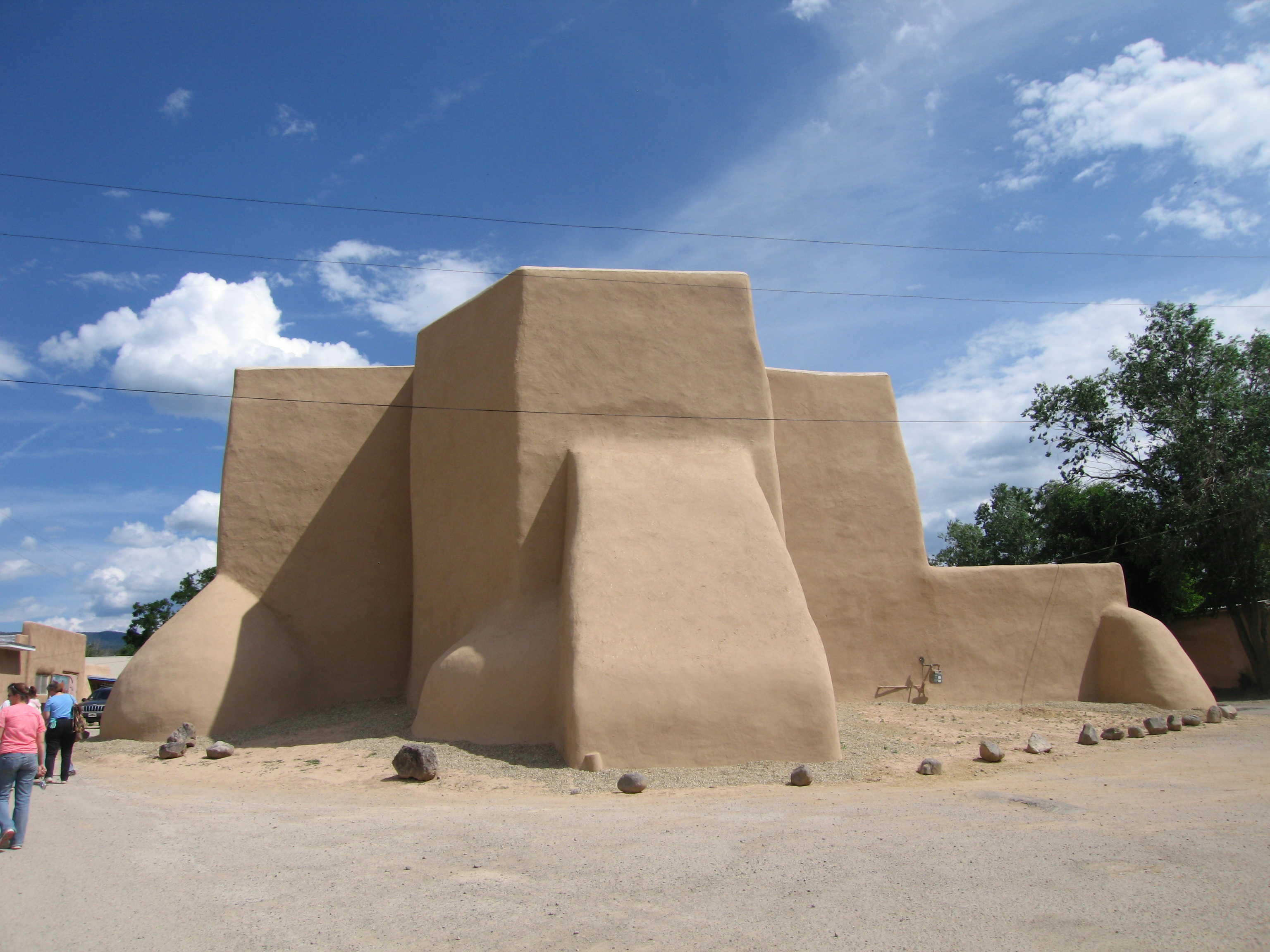
Image of the moment: San Francisco de Asis without Adams or O’Keefe

July 6, 2007

Neither Ansel Adams nor Georgia O’Keefe noted the power lines, or the gas meter.

They must be recent additions.

The essential beauty of the church remains.

1549-san-francisco-de-asis-church-in-taos-july-5-2007.jpg

The original adobe construction of the church was completed in 1772 — four years prior to the Declaration of Independence. It is built in the shape of a cross, but structural weaknesses required the addition of buttresses, shown in the photograph — also of adobe.

A bad photograph of the church is almost impossible.

The interior is cool on a hot afternoon. Adobe construction offers significant advantages, even in the 21st century. The church hosts an active congregation, without air conditioning.

Photo: Copyright 2007, Ed Darrell; you may reproduce for educational or non-profit use, so long as attribution is attached. Attribution must be attached.

Welcome, visitors!  Please leave a comment, at least tell why you visited, and where you’re from.  Thank you.