I discovered the Seldom Scene within the first year I moved to Washington permanently. To me, Washington was the Bluegrass Capital of the World in those days.
At the venerable Birchmere in Alexandria, Virginia, the best bluegrass bands and performers of the day came through every week, and on Thursday nights the Seldom Scene could be seen as they seldom were.
Somebody caught this video, not at the Birchmere, but a song they often played.
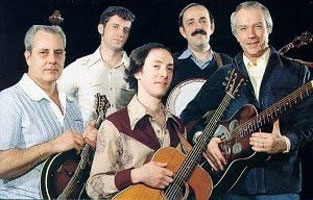
Members of the 1979 Seldom Scene: John Duffey (Mandolin), Ben Eldridge (Banjo), Mike Auldridge (Dobro), Phil Rosenthal (Guitar), & Tom Gray (Bass). I do not know the venue.
Perhaps I could blame the band for discouraging me from taking up playing again. On every instrument, they were so superior to most, playing at a level very few could ever hope to reach.
Still loved them.
From the Bluegrass Library.
Bluegrass legends Seldom Scene, c. 1979. Left to right, John Duffey on mandolin, Tom Gray on bass, Phil Rosenthal on guitar, Ben Eldredge on banjo and Mike Auldridge on Dobro. Probably a publicity photo, via Rocky 52.
Record label of the 1926 recording of “White House Blues,” by Charlie Poole with the North Carolina Ramblers
We noted the birthday of William McKinley on Monday, January 29.
Long-time reader Ellie commented with the lyrics to a song called “White House Blues,” starting out with a lament about McKinley’s being shot. The song was new to me, so I asked about it. Ellie gave us a good encyclopedia entry.
Ellie’s first comment:
The pistol fires, McKinley falls
Doc says, “McKinley, I can’t find that ball”
In Buffalo, in Buffalo
Zolgotz, Zolgotz you done him wrong
You shot poor McKinley while he was walking along
In Buffalo, Buffalo
Well, Doc had a horse and he threw down the rein
He said to that horse, “You better outrun this train”
From Buffalo to Washington
Yeah, Doc come a-running and he tore off his specs
He said, “Mr. McKinley, done cashed in your checks
You’re bound to die, you’re bound to die”
McKinley he hollered, McKinley he squalled
The doc say, “McKinley, I can’t find that ball”
In Buffalo to Washington
Look here, little rascal, just look what you’ve done
You shot my husband with that Ivor Johnstone gun
He’ll be gone a long, long time.
Well hush up, little children, don’t you fret
You’ll draw a pension off your poor papa’s death
He’s gonna be gone a long, long time.
Roosevelt in the White House, he’s doing his best
McKinley’s in the graveyard, he’s taking his rest
He’s gonna be gone a long, long time
Roosevelt in the White House he’s drinking out of a silver cup
McKinley’s in the graveyard, he never will wake up
He’ll be gone a long, long time.
White House Blues – one of many versions
After I asked, Ellie elaborated:
I believe this is the oldest recorded version of the song:
But, there are many others. I first came across it back in the late ’60s – early 70’s, but I can’t remember where. I thought it was in Sandburg’s American Song Bag, but I just checked, and it isn’t. There have been many recordings, including Doc Watson, Bill Monroe, Flatt & Scruggs, all with slight differences in the words. The first one I learned had a reference to Ida’s children having another Papa on another railroad line, but that was a later addition stolen from other songs. Ida and William appeared to have loved each other. Note the misspelling of Czolgosz. That was from the version I learned, and not my mistake. :-)
Here’s a slightly more contemporary version, but quite different.
This is the latest version I’ve found (hope I haven’t overloaded with links)
Nice “talking” to you.
Dear reader: Do you have a different version you recommend? Tell us in comments.
Now everybody’s celebrating. Time for a quick reprise of this post from June.
Published on Jun 19, 2014
Grammy Award winning bluegrass band the Steep Canyon Rangers, well known for their work with Steve Martin, perform a special version of “The Star-Spangled Banner” for the Smithsonian’s National Museum of American History in honor of the song’s 200th anniversary.
The museum will “Raise It Up!” and celebrate the 200th anniversary by uniting the original manuscript with the flag at the Museum from June 14-July 6, 2014 and holding a special event at the museum on Flag Day (Saturday, June 14, 2014). Join the party: http://anthemforamerica.smithsonian.com/
Special thanks to the team at Wool and Tusk for their hard work and creativity: Scott Mele, Roger Pistole, Derek West, Joe Pisapia, David Bartin, Michael Freeman, Alexis Kaback, Daniel Walker, Jeff Rosen, Harvey Moltz, and Greg and Erin Whiteley.
Grammy Award winning bluegrass band the Steep Canyon Rangers, well known for their work with Steve Martin, perform a special version of “The Star-Spangled Banner” for the Smithsonian’s National Museum of American History in honor of the song’s 200th anniversary.
The museum will “Raise It Up!” and celebrate the 200th anniversary by uniting the original manuscript with the flag at the Museum from June 14-July 6, 2014 and holding a special event at the museum on Flag Day (Saturday, June 14, 2014). Join the party: http://anthemforamerica.smithsonian.com/
Special thanks to the team at Wool and Tusk for their hard work and creativity: Scott Mele, Roger Pistole, Derek West, Joe Pisapia, David Bartin, Michael Freeman, Alexis Kaback, Daniel Walker, Jeff Rosen, Harvey Moltz, and Greg and Erin Whiteley.
There can be only three or four legitimate banjo jokes possible, right? There’s the one about the banjo player’s Porsche, there’s the one about perfect pitch . . .
Not only is John Starling back, he’s got his old colleagues from the original Seldom Scene with him, Mike Auldridge and Tom Gray (Ben Eldridge continues to hold down the fort with the new casts of players in the Scene).
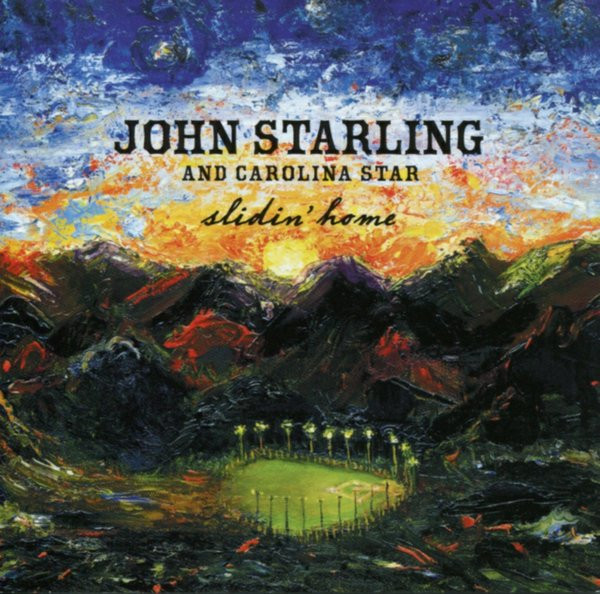
“Sliding Home,” 2007 album from John Starling and Carolina Star, featuring a lot of Starling’s friends as guests (and great musicians), including from Seldom Scene.
The seeds for this reunion were planted in 2005 at a benefit concert for Eddie Adcock in Washington D.C. “I knew they (Auldridge and Gray) were going to be there, and I called Ben, and he came, and Larry Stephenson was there,” Starling recalls. “We just went up there, Larry sang tenor and the other four of us were original members of Seldom Scene, just went up and did a show. We worked it up backstage, and next thing you know, we had so much fun, we decided to do another couple of shows.”
With encouragement from Massenburg and an attentive audience base, Starling, Auldridge and Gray decided to go into the studio and record a few songs to see how things went. “We liked it and decided to come back to Washington and put together a group that would go out and play it and decided to take a couple of Beltway bandits, Jimmy Gaudreau and Richie Simpkins, who also live in the Washington area and went back and finished the album with that group,” he says.
Or, until that account is unsuspended by the forces supporting Donald Trump: Follow @FillmoreWhite, the account of the Millard Fillmore White House Library
We've been soaking in the Bathtub for several months, long enough that some of the links we've used have gone to the Great Internet in the Sky.
If you find a dead link, please leave a comment to that post, and tell us what link has expired.
Thanks!
Retired teacher of law, economics, history, AP government, psychology and science. Former speechwriter, press guy and legislative aide in U.S. Senate. Former Department of Education. Former airline real estate, telecom towers, Big 6 (that old!) consultant. Lab and field research in air pollution control.
My blog, Millard Fillmore's Bathtub, is a continuing experiment to test how to use blogs to improve and speed up learning processes for students, perhaps by making some of the courses actually interesting. It is a blog for teachers, to see if we can use blogs. It is for people interested in social studies and social studies education, to see if we can learn to get it right. It's a blog for science fans, to promote good science and good science policy. It's a blog for people interested in good government and how to achieve it.
BS in Mass Communication, University of Utah
Graduate study in Rhetoric and Speech Communication, University of Arizona
JD from the National Law Center, George Washington University


 Posted by Ed Darrell






 Millard Fillmore's Bathtub