Diogenes, call your office: Honest man returns $2 million

November 25, 2007

Over 100 million boys in the U.S. have repeated the Scout Law, “Trustworthy, Loyal, Helpful, Friendly, Courteous, Kind, Obedient, Cheerful, Thrifty, Brave, Clean, Reverent.”

Jerry Mika of Draper, Utah, lives it.

Jerry Mika, of Draper Utah, with $2 million check sent to him in error - Jeremy Harmon photo, SL Tribune

Mika returned a check for $2,245,342 that the State of Utah had sent him in error (see the Associated Press story in the Provo Daily Herald — photo, above, by Jeremy Harmon, Salt Lake Tribune).

Mika returned the check — a mistake that occurred when an employee entered a serial number, not an amount — to state finance offices Wednesday.

“Clearly we have an honest, honest citizen. I wish I could do something more than say thanks,” commerce department director Francine Giani said.

Can’t Utah grant him a kingdom — half of Millard County or something? A little duchy in Fillmore, Utah?

Mika, who runs the nonprofit Providence Foundation to help Nepalese sherpas, said he’s had great fun showing off the state’s mistake.

“Everybody looked at it, started giggling and asked why I wasn’t already in Switzerland,” he said.

He admits to being tempted to deposit the money and draw a bit interest before the state asked for its return.

“That money would have gone a long way,” he said.

When a company comptroller complained to me once that the $4 million in refunds to our company would mess up his quarterly bookkeeping because he expected the money in the next quarter, I volunteered to park the money in an account for him. He quickly came to his senses. At low, passbook interest rates, the $4 million would have paid $141/hour, 24 hours a day — more than $3,300 a day. A few weeks of that and you’re talkin’ big money.

Because the check was state-issued, cashing it would probably have been easy, despite the large amount, Giani said.

“It was a valid check,” said Rick Beckstead, the state accounting operation manager whose signature is stamped on the check.

How honest are you, Dear Reader? How much of a temptation would it have been to cash that check? (I’ll wager this man is a former Boy Scout; how much does that account for his actions?)

Perhaps you could reward Mr. Mika’s honesty with a contribution to the foundation he operates, The Providence Foundation.

Teachers: Can you see how to make this into a bell-ringer, warm-up exercise?

Read the rest of this entry »


Science history slips away: Ralph Alpher and Big Bang

September 20, 2007

Looking for something else in an old newspaper, I came across a small obituary for Ralph Alpher. Alpher died August 12, 2007, in Austin, Texas, at the home of his son, Dr. Victor S. Alpher.

Ralph Alpher, physicist who co-hypothesized the Big Bang

Ralph Alpher, physicist who co-hypothesized the Big Bang

Ralph Alpher gave us the Big Bang. We let him slip away, almost unnoticed. Odds are you don’t recall ever hearing of Alpher. Here’s your mnemonic: The alphabet paper.

In 1948, as a graduate student under George Gamow at the George Washington University, Alpher and Robert Herman of Johns Hopkins laid the groundwork for what would become Big Bang theory, calculating how matter could arise in the Universe. Gamow, exhibiting the sense of humor for which physicists are famous, listed the authors of the paper as Alpher, Bethe, Gamow and Herman — a play on the Greek alphabet’s first three letters (alpha, beta, gamma), and a joke invoking the name of the great physicist Hans Bethe. Bethe liked the joke, consulted on the paper, and the theory of Big Bang was published.

Ralph Alpher, in Florida, 2006; Alpher home page

The name “Big Bang” was applied a few years later; Sir Frederick Hoyle and his colleagues favored a “steady state” universe, and at the time both hypotheses could accurately predict most of what was observed, and neither could be disproven. Hoyle, hoping to poke ridicule at the competing hypothesis, belittled it as “a big bang.” The name stuck. The name misleads the unwary; the theory posits a rapid expansion at the beginning of the universe and time, but not an explosion, per se.

Alpher wrote the mathematical model; the model predicted Big Bang, and specifically, it predicted the cosmic background radiation that would have been left over; it was this background radiation, the “echo” of Big Bang, that Arno Penzias and Robert Wilson stumbled across in 1965. Robert H. Dicke had invested several years in trying to discover this signature, and had to explain to Penzias and Wilson what they had found. Penzias and Wilson won the Nobel Prize for their discovery; Dicke, Alpher, Herman and Gamow, did not get Nobel Prizes. This is generally regarded as one of the great miscarriages of justice in Nobel Prize awards, not that Penzias and Wilson did not deserve an award, but that the chief theorists and the man who unveiled the discovery were overlooked.

This is another story of rejection leading to great discovery; it is also a rather sad story of a momentous achievement, mostly overlooked through the years.

Alpher was the son of Jewish émigrés from the Russian pogroms. His high school achievements merited a scholarship to the Massachusetts Institute of Technology, in 1937. MIT had a rule at the time that scholarship recipients could not work outside the school. Alpher assisted his father in building houses in the Washington, D.C. area; the family had little money, and Alpher would be unable to pay room and board without working. Discussions with MIT broke down — the offer of a scholarship was withdrawn, according to most accounts when MIT discovered he was a Jew. As so many great people of the post World War II era, he enrolled at the George Washington University.

At GWU, Alpher found Gamow as a mentor, and much of the rest is history.

The New York Times:

The paper reported Dr. Alpher’s calculations on how, as the initial universe cooled, the remaining particles combined to form all the chemical elements in the world. This elemental radiation and matter he dubbed ylem, for the Greek term defining the chaos out of which the world was born.

The research also offered an explanation for the varying abundances of the known elements. It yielded the estimate that there should be 10 atoms of hydrogen for every one atom of helium in the universe, as astronomers have observed.

Months later, Dr. Alpher collaborated with Robert Herman of the Applied Physics Laboratory at Johns Hopkins University on a paper predicting that the explosive moment of creation would have released radiation that should still be echoing through space as radio waves. Astronomers, perhaps thinking it impossible to detect any residual radiation or still doubting the Big Bang theory, did not bother to search.

The Alpher-Bethe-Gamow paper, or αβγ paper, as explained by the American Institute of Physics:

When Alpher and Gamow prepared a paper on the subject, Gamow mischievously added the name of the noted nuclear physicist Hans Bethe to the list of authors so it would be called the “Alpher-Bethe-Gamow paper,” mimicking the “alpha-beta-gamma” of the first letters of the Greek alphabet. Unknown to Gamow, Bethe was a reviewer for the journal to which Gamow submitted the article. Bethe took it in good humor, later explaining, “I felt at the time that it was rather a nice joke, and that the paper had a chance of being correct, so that I did not mind my name being added to it.” Gamow also urged Herman to change his name to Delter to match delta, the next letter in the Greek alphabet. Despite Herman’s refusal, in a paper in a major scientific journal Gamow referred to “the neutron-capture theory…developed by Alpher, Bethe, Gamow and Delter.” Not least among his notable characteristics was his sense of humor.

Alpher continued in this work for a time, but joined General Electric’s labs in the 1950s. When he retired from GE, in 1986 he joined the faculty at Union College in Schenectady, New York, and taught there until 2004.

Alpher was largely overlooked for awards even while his theory was big news in astronomy and physics for the last 40 years of the 20th century. I regret that I was wholly unaware he was in Austin; how many other great contributors to science and history live among us, unrecognized, uncelebrated, and their stories unrecorded?

Alpher, Herman and Gamow - and the famous Cointreau bottle

Photo caption from AIP: A 1949 composite picture with Robert Herman on the left, Ralph Alpher on the right, and George Gamow in the center, as the genie coming out of the bottle of “Ylem,” the initial cosmic mixture of protons, neutrons, and electrons from which the elements supposedly were formed. [The Cointreau bottle from which the three drank a toast upon the acceptance of the paper, is now in the collection of the Smithsonian Institution.]

Alpher was an Eagle Scout. I wonder whether anyone has a history of his time in Scouting?

While the Nobel Prize eluded Alpher, he collected a host of other prestigious awards and honors. Earlier this year, President Bush announced that Alpher had been awarded the National Medal of Science, which is administered by the National Science Foundation and is the highest honor for science.

. . . [T]he citation reads in part:

“For his unprecedented work in the areas of nucleosynthesis, for the prediction that universe expansion leaves behind background radiation, and for providing the model for the Big Bang theory.”

Note from George Gamow, on confirmation of Big Bang Gamow’s humor again on display — an undated note from Gamow upon the confirmation of the Big Bang, with a punny reference to Steady State backer Sir Frederick Hoyle. Image from the American Institute for Physics.

Online sources for Ralph Alpher:

More:

Help others hear the echo:

Add to FacebookAdd to NewsvineAdd to DiggAdd to Del.icio.usAdd to StumbleuponAdd to RedditAdd to BlinklistAdd to TwitterAdd to TechnoratiAdd to Furl


Build-a-Prairie: Online game for geography, history, biology

September 9, 2007

Build-a-prairie logo from University of Minnesota

The University of Minnesota distance learning site has a game students can play to create the ecosystems for a successful prairie.

The prairie is one of North America’s great ecosystems and a vital habitat for many plants and animals. Over 98% of the prairie has been lost in the past 150 years—but some people are trying to bring it back, hectare by hectare. Restoring a prairie is a great challenge, requiring knowledge of biology, ecology, climatology, and even economics.

Are you up for the challenge? If you choose the right plants and animals, you can watch the prairie come to life before your eyes! Let’s begin!

North America’s prairie is divided into the tallgrass ecosystem and shortgrass ecosystem (plus an area in between—the “mixed grass” prairie). Which one do you want to restore?

This game fits neatly into geography curricula for a number of states, and also covers parts of the 7th grade social studies standards for Texas — if your state is covered by the tallgrass or shortgrass prairies as shown on the accompanying map, it’s likely your state standards include students’ learning about prairie ecosystems.

North American tallgrass and shortgrass prairies, U of Minnesota The game is fail-safe; it does not allow incorrect selections. It’s not a sim, really, but a basic introduction to what makes a successful prairie. Students should be able to master the game in 15 minutes.

Though developed way up north in Minnesota, the game and species are close to Texas prairies, too. The emphasis on soil points to some of the key errors made by farmers (encouraged by developers and the U.S. Department of Agriculture) which led to the Dust Bowl; this is a good enrichment exercise for Dust Bowl lesson plans.  These games cover many of the requirements for Boy Scout merit badges, too:  Environmental Science, Wildlife Management, and Soil and Water Conservation, and others.

This game comes out of the Bell Museum at the University of Minnesota; be sure to check out the Watershed game, too.

Watershed Game logo, Bell Museum, University of Minnesota

Update, October 2011:  No, I can’t find the game now, either.  It appears the Bell Museum took the site down, and trusting (and hoping) they wouldn’t do that, I didn’t pirate any of the images, nor especially the game.

Here’s hoping someone will put the thing back on line, somewhere.  If you find it, will you let me know?  I’d like to renew the links.  Several school systems went through this site to get to the game for classroom activities.  It was a good thing.

Update October 30, 2011:  Try the game here.


Baltimore Scout collects, makes history

September 7, 2007

How about having your students work with the Library of Congress on a history project?

The Veterans History Project encourages people to contribute oral histories of veterans, a project that I think has some wonderful possibilities. Below the fold, read about Tim Mantegna, a Baltimore teen who collected histories as part of his Eagle project. This fall he enters the University of Maryland – Baltimore County to study political science, as an Eagle Scout.  (Also see this story:  “Iraq Veterans Record Their Stories”)

Read the rest of this entry »


Little Rock, 50 years later

September 4, 2007

Elizabeth Eckford leaves Little Rock's Central High after being denied enrollment

50 years ago today.

Elizabeth Eckford, one of the Little Rock Nine, leaves Little Rock’s Central High School after having been denied the chance to enroll. Arkansas Gov. Orval Faubus called the Arkansas National Guard to duty to prevent nine African American students from enrolling.  (Photo by Will Counts – see his series here.)

Elizabeth Eckford graduated*, went on to a career with the Army as a journalist, and is the only one of the nine students (all of whom graduated and did well) to live in Little Rock today. Central High school is a National Historical Monument — and still a high school.

What I want to know is this: The woman in back of Ms. Eckford, face thoroughly engaged in delivering a piece of her mind, I suppose: Who is she, and where is she, today? Does anyone know?


North American wildlife photos: Send yours in!

August 21, 2007

Elron Steele submitted one of his — I’ll wager several readers here have photos that should be included in the encyclopedic site of photos of North American Wildlife. The project is collecting mammal photos right now (birds, reptiles and invertebrates yet to come?)

Richardson's Ground Squirrel, photo by Elron Steele, all rights reserved

I note the project has only one not-very-clear photo of a tassel-eared squirrel, and I know there are at least two species of these things ranging through Arizona, New Mexico and Colorado, and I know there are no fewer than four Boy Scout Camps in those areas — so does some Scout or Scouter have a good shot of one of the tassel-eared guys to include?

So, if you have a good photo, send it along to North American Wildlife, or drop it in an e-mail to the curator of the site.

In my recent excursion into New Mexico, we were south of Raton when I spotted a fine specimen of a pronghorn antelope alongside the road. Within a few minutes we had spotted way over a dozen, and returning along the route a week later we must have seen at least 50 of them, in groups as large as a dozen. While I got no decent photos zipping along at 60 mph, surely someone from one of the mountain states has a very good picture that could be contributed.

And teachers: This is a great source of images for student projects and presentations for biology, environmental science, history and geography.


Yahoo! slides on Scouting’s 100th anniversary

August 20, 2007

Reuters photo of Scouts taking oath Aug 1, 2007, at Brownsea Island World Jamboree

Yahoo! News assembled half a hundred news photos from around the world relating to Scouting’s 100th anniversary — many from the World Jamboree at Brownsea Island, outside of London, and others showing Scouts around the world renewing their oaths on August 1.


Cub Scout asks creation of Navajo religious award

August 19, 2007

If he’s successful — and he should be, I think — 9 year-old Kinlichiinii John will make history. He asks the Boy Scouts of America to recognize the Navajo religion Azeé Bee Nahagha, his own faith, so that he can earn a religious award as a Cub Scout.

He already has the backing of the President of the Navajo Nation, Joe Shirley, Jr.

Kinlichiinii John and his family, visiting Window Rock, Arizona -- seeking a Navajo religious award

[Associated Press via Santa Fe New Mexican] Cub Scout Kinlichiinii John of Clermont, Fla., front middle, poses with his family while holding a Cub Scout manual in his hands during his visit to Window Rock, Ariz. on Aug. 1, 2007. John recently visited Navajo Nation President Joe Shirley in Window Rock, where Shirley offered his support to John, who hopes to earn and establish a Boy Scouts of America Religious Emblem that recognizes his faith in traditional Navajo spiritual way of life, or Azee Bee Nahagha _ also called the Native American Church. Although emblems exist for 35 other religious affiliations, no emblem exists for American Indian religions. (AP photo/Navajo Nation, George Hardeen)

It is neither an easy task, nor a sure thing. While the National Council of the Boy Scouts of America recognizes religious awards, it leaves the rules governing such awards to the religious groups themselves. BSA rules on whether the faith measures up to Boy Scout standards, and authorizes Scouts to wear the religious medal when they earn it, or to wear an emblem over their left pocket to signify they have earned their faith’s religious award.

Read the rest of this entry »


A Scout is . . . Friendly, Courteous, Kind . . . Reverent: 100 years of Scouting

August 4, 2007

Scouts at the World Jamboree renew their oaths, Wednesday, August 1, 2007

  • Scouts from many nations renew their oaths, August 1, at Brownsea Island, off the south coast of England — the 30th World Jamboree of Scouting, marking the founding of Scouting 100 years ago. Photo by Ron Neal, AFP/Getty Images.

The rowdies who like to claim all shows of manners are just ‘wussy PC boojum’ got their knickers all atwist because Scouts at the 30th World Jamboree eat vegetarian.

Why not? It’s a World Jamboree. If the menu that best fits Scouts from 80 nations is vegetarian, why not? In the U.S., the fourth, fifth and sixth points of the Scout Law are “Friendly, Courteous, Kind.” If the menu offends a quarter of the Scouts, can they live up to those three points of the law? What about the twelfth point, which says a Scout is Reverent, especially to the religious views of others?

Here’s the post that set me off, at Innocent Bystanders.  (And here’s the same sort of bluster at a very Scout-unfriendly site — warning, site contains cheesecake NSFW.)

Here’s the news story from ThisIsLondon.com that probably inspired that post: “Scouts banned from eating burgers and bangers — because of religious belief.”

Here’s the AP story in the Bryan-College Station Eagle, in Texas, that notes the fire ban at the Jamboree:

LONDON – Scouts around the world celebrated the 100th anniversary of their movement Wednesday, but those at its birthplace couldn’t show off one of their fundamental skills – firebuilding.

While observances took place from the Kingdom of Bhutan to Ecuador, the symbolic focus was on Brownsea Island, off the coast of southern England. That’s the site where Robert Baden-Powell organized a camp for 20 boys that developed into the worldwide Scouting movement.

Baden-Powell, a lieutenant-general in the British army, organized that camp to teach boys outdoor skills and physical fitness. He detailed the experiences in a book called Scouting For Boys, and the movement gained footing when boys organized themselves into groups, persuaded adults to become their leaders and used Baden-Powell’s ideas as the basis for camps, treks and other activities.

Older girls were allowed to join during the 1970s. Membership was extended to all girls, ages 6 to 25, in 1991.

“When [Baden-Powell] first ran the camp, he brought together different social classes from public schools and less fortunate backgrounds,” said scout Jon Grimes, 19. “It was about crossing the social divide and making friends. Our camp this year will be about making friends between people from different cultures.”

But unlike Baden-Powell’s boys, today’s Scouts are banned from lighting campfires on Brownsea Island. The National Trust acquired the island in 1962 and forbids fires in order to protect the wildlife.

The campfire ban did not dampen the spirit of the 300 Scouts on Brownsea Island who celebrated the centennial canoeing, hiking, making pottery, learning archery and participating in workshops.

Our troop, Troop 355, didn’t send anyone to the World Jamboree, but five boys have already attained their Eagle rank this year — we had an Eagle Court of Honor this afternoon. Scouts devised several interesting ways to celebrate the 100th anniversary of Scouting, regardless of where they are:

Some centennial celebrations began as early as Saturday, when Prince William opened the 21st World Scout Jamboree, in eastern England, with 40,000 youngsters from more than 160 countries.

Scouts from around the world are taking part in events. About 1,000 Scouts are cooking a huge campfire breakfast in Namibia, and groups from all over Malawi will be camping at the top of Mulanje mountain, one of the highest peaks in Africa.

Scouting in the U.S. marks its centennial in 2010.

Other coverage:


88-year-old man finally gets Eagle Scout rank

July 29, 2007

Joining the elite, top 5% of all Boy Scouts, Walter Hart was awarded his Eagle rank in a ceremony Saturday in Fort Myers, Florida. Walter is 88.

There was a 70+ year delay in Walter’s ceremony — he passed the requirements for the rank, but then went off to fight in World War II before the award was made.

The Associated Press story ran in the New York Times:

”I’ve been looking forward to this for a long time,” said Hart, who lives in a retirement center in nearby Lehigh Acres.

Scout officials say he may be the oldest person to ever earn the honor.

Hart joined the Cub Scouts in 1928 in Malden, Mass., and earned 23 merit badges during his years as a Boy Scout, scouting officials said. Of the 120 merit badges available, 21 must be earned to qualify for Eagle Scout rank.

It all got set aside when he joined the Navy during World War II and served two years aboard the USS Alfred A. Cunningham.

Last year, he rediscovered some of his old Boy Scout memorabilia, including documents that showed he completed the requirements for his Eagle Scout rank. He contacted the Scouts about receiving his award.

”I think this was something that was always on his mind, but every time he went to go do it, something else came up,” daughter Elizabeth Gatturna said. ”I know how hard he’s tried to get to this point.”

Congratulations, Walter.

Walter Hart, 88, rec'd Eagle Badge 7-28-2007

  • Walter Hart, 88, is shown wearing a 2007 Boy Scout uniform with the merit badge sash he used as a youth, prior to World War II. Apart from the not-quite fit, we can tell the sash is his old one because many of the merit badges are in their pre-World War II designs, and the sash shows rank badges for Star Scout and Life Scout; current uniform rules do not allow rank badges on the sash. Under Scout rules, Walter may wear this sash for his Scouting career. Associated Press photo.

Spread the news, please:

Add to FacebookAdd to NewsvineAdd to DiggAdd to Del.icio.usAdd to StumbleuponAdd to RedditAdd to BlinklistAdd to TwitterAdd to TechnoratiAdd to Furl


Power Line documents flag desecretion in Minnesota

July 28, 2007

What’s wrong with this picture?

Uncle Sam on stilts, carrying a flag improperly; citizens do not salute

They didn’t mean to, but there it is: Flag displays not in accordance with the U.S. Flag Code at every turn — flag desecration! Or, as Power Line titles it, “A Minnesota 4th of July.” You can see the slide show here. I point out some Flag Code violations in a slide-by-slide list, after the fold.

No, I’m not calling for the Sheriff of Buncombe County, North Carolina, to dispatch his deputies to arrest everyone in Apple Valley, Minnesota, who participated in the 2004 4th of July Parade — not even if they are Ron Paul supporters (in 2004, who knew?). Heck, we’d need to do the same for Duncanville, Texas (I was there; I probably still have some photographs somewhere), and probably for Provo, Utah (“the nation’s biggest Freedom Day celebration”) and Prescott, Arizona, and 15,000 other towns in America where citizens turn out on the celebration for our Declaration of Independence and have a parade. Of course, most of those towns are not fettered with North Carolina’s outdated and uconstitutional flag desecration law, either.

Fact is, most people are not too familiar with the U.S. Flag Code, and in their attempts to have a good time and celebrate the good stuff in and of this nation, they sometimes do not hew to the Flag Code’s call.

Which means simply that we need to do a better job of educating citizens on how to respect their flag and display it respectfully; and it also means we shouldn’t get all worked up whenever someone screams “FLAG DESECRATION!” to alarm us and make us rally around George Bush (who, as we saw in the last post, needs some Flag Code education for himself).

To his credit, Scott Johnson at Power Line is not a huge backer of flag desecration amendments to the Constitution. Nor are the other two contributors at PowerLine, except for their frequent complaint that the First Amendment “protects flag burning and nude dancing” but not whatever it is they want to rant about at that moment.

But if these über patriots think all this Flag Code bustin’ is good patriotism, where does a deputy in Asheville, North Carolina, get off telling people they can’t use the flag in their protest? Isn’t that THE core value the flag stands for, that citizens can protest?

Or, is it really true that the Bush defenders have politicized the nation so badly that only some political statements are protected by the First Amendment? We, our people, fought King George III to win the right to speak our minds. We shouldn’t yield to anyone that right won with the blood of patriots.

Read the rest of this entry »


World War II in Texas: Japanese internment

July 23, 2007

Girl Scouts at Japanese Doll Day celebration, in Crystal City, Texas, internment center, 1943-45

“Girl Scout drama presentation for Hinamatsuri (Doll’s Festival), on Japanese Girl’s Day, at the Crystal City, Texas, internment facility operated by the Justice Department, 1943-45.

Each of us has pockets of ignorance; some of the pockets are larger than others.

How did I miss that there were Japanese-American internees in Texas? If I stumbled across that fact before, it really didn’t register. Reviewing the website for the University of Texas – San Antonio’s Institute of Texas Cultures, I came across the Spring 2007 Newsletter, which is dedicated to the Crystal City internment facility.

Crystal City is unknown to many other Texans, too, I wager. Study of a list of the War Department “Relocation” camps shows nothing in Texas. Surprise! The U.S. Justice Department also operated camps of interned Americans of Japanese descent. The War Department rounded up Japanese Americans in west coast states and their neighbors; the Bureau of Immigration and Naturalization Services, the old INS which was rolled into the Department of Homeland Security after the 2001 attacks on New York and Washington, arrested and detained Japanese-Americans from the rest of the United States. INS operated at least four such camps in Texas. Read the rest of this entry »


Flag day? Heck! Fly it all week!

June 11, 2007

President Bush proclaimed the week of June 10 through 17 National Flag Week, in anticipation of Flag Day, June 14.

Scouts from Mason City IA Globe-Gazette - Troop 14, probably

Fly your U.S. flag all week!

Of course, you may fly your state and local flags, too.

June 14 commemorates the day the first resolution was passed designating the stars and stripes as the national flag of the united colonies, June 14, 1777. This is another event occurring even prior to the creation of the United States by the Constitution.

Full text of the proclamation, and photo credit and explanation, below the fold. Read the rest of this entry »


Girls and technology: Girl Scouts on the ‘net

May 26, 2007

Here, try this brain teaser.

Girl Scouts of America can be found on the web; some of the stuff at this “Go Tech” site could be useful in the classroom. The design appears to encourage girls to pursue the use of technology, and to open them up to possibilities for careers where women are badly needed, but too seldom go. That becomes clear with this .pdf, 14-page guide for parents, It’s Her Future: Encourage a Girl in Math, Science and Technology.

I wish more organizations would put up sites for kids to use to learn. I’d love to see some interactive sites with great depth on several topics: Geography map skills, navigation, European explorers in the 15th through 20th centuries, market fluctuations for commodities and securities (for economics), Native Americans from 1500 through the 21st century, westward expansion of European colonists in America, time lines of history, great battles, etc., etc. etc.

We are missing the boat when it comes to using computers as tools for learning. Like unicorns and centaurs standing on the dock as Noah sailed away, education as a whole institution and educators individually are missing the boat (with a few notable exceptions — pitifully few).

Where is the Boy Scout site with games and material for the boys?


Congress’s flag etiquette book: Our Flag

January 14, 2007

A good guide to flag etiquette from the U.S. Congress is on-line now. Our Flag is a traditional publication Congress passes out in efforts to help education in history and patriotism (H.Doc 108-97).

Interest in proper etiquette for flag display increased recently — not enough by my calculation, but any increase is welcomed. Where is good information available?

This Congressionally-sponsored guide is basic and accurate. As a classroom resource or a piece of a Scout troop library, it’s a useful reference guide. It can be downloaded (it’s a .pdf), and printed out in color (56 pages).

The book includes many illustrations showing proper flag display.  It also covers the history of the U.S. flag in good enough detail to get through most high school reports, and it features illustrations of flags of each of the states.

Congress in the past provided many publications on such topics for general public consumption and use in classrooms, but has cut back on free distribution of printed information since the early 1980s.  One might be able to get a printed copy with a request to one’s local Member of the House of Representatives, or U.S. Senator.

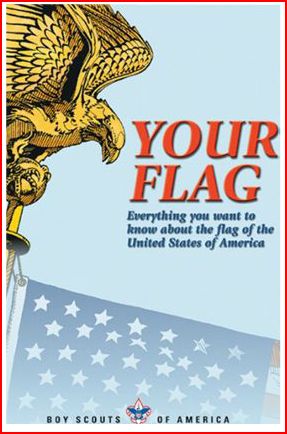
Boy Scouts of America version of the flag etiquette guide, Your Flag

Boy Scouts of America version of the flag etiquette guide, Your Flag

Another book I’ve found very useful is an official Boys Scouts of America publication of the almost the same name, Your Flag.  It’s a graphic-novel type of publication — cartoons for every point to be made.  It features deeper information on proper flag display.  The book can be purchased at any local Boy Scout Council supply shop, or any other shop that stocks Scout literature.  It can also be ordered from BSA’s national catalog, or online at Scoutstuff.org, for $7.9910.99plus shipping.  Every Scout troop should have one of these, and it is also very useful for classroom libraries, for history and civics.

In either publication, one learns that there are not many ways to display a flag properly from a vehicle — improper displays include decals on windows, bumper stickers, flying them from the radio antenna, or attaching them to a window pole to be battered in freeway-speed winds.

One might hope these books get much broader circulation.